| |
|
Xiamen Oil Paintings, Wholesale Direct!
|
|
100% hand painted, 100% cotton canvas, 100% money back if not satisfaction. |
|
|
|
|
ART WORKS INDEX
A
B
C
D
E
F
G
H
I
J
K
L
M
N
O
P
Q
R
S
T
U
V
W
X
Y
Z
|
|
ARTISTS INDEX
A
B
C
D
E
F
G
H
I
J
K
L
M
N
O
P
Q
R
S
T
U
V
W
X
Y
Z
|
|
|
|
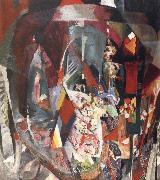 |
Carles Arthur Beecher
|
|
American Modernist Painter, 1882-1952
was an American Modernist painter. He was born in Philadelphia, Pennsylvania, and studied at the Pennsylvania Academy of the Fine Arts between 1900 and 1907. He studied with Thomas Pollock Anshutz, Hugh Breckenridge, Henry McCarter, Cecilia Beaux, and William Merritt Chase. In 1907 he traveled to France where he remained until 1910. In France, he greatly admired the works of Cezanne and Matisse, and became close friends with John Marin and Eduard Steichen. He displayed six landscapes in the Salon d'Automne of 1908.
|
|
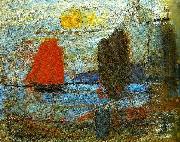 |
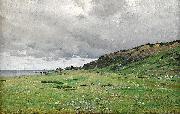
carl kylberg
|
|
Carl Oscar Kylberg, född 23 september 1878 på Vasängen i Fridene församling, död 6 januari 1952 i Stockholm, svensk konstnär och representant för Göteborgskoloristerna.
Carl Kylberg var son till kontorschef Gustaf Kylberg och friherrinnan Eleonora von Essen och storebror till konstnären Erik Kylberg. Hans fastrar och farbror var konstnärerna Regina Kylberg-Bobeck, Marina Kylberg och Hjalmar Kylberg. Farfadern Lars Wilhelm Kylberg var konstnär vid sidan av lantbruket på familjegodset Såtenäs i Västergötland.
Kylberg studerade först vid tekniska skolan i Stockholm och i Berlin för att bli arkitekt men övergick till måleri omkring 1900. Han studerade under en tid vid Valand i Göteborg som elev till Carl Wilhelmson. Hans verk kännetecknas ofta av ett glödande oljemåleri med starka färger och han avbildade ofta landskap och figurkompositioner på ett avskalat man??r. Under senare delen av sitt konstnärskap skapade han en mängd religiösa motiv.
Kring 1930-talet fick han sitt genombrott och han kom att ställa ut, förutom i Sverige även i Köpenhamn, Paris, London, Budapest och i USA men hans måleri var för många provocerande och 1938 gick regeringen in och stoppade ett köp av målningen Uppbrottet för Nationalmuseum i Stockholm.
En av hans mest välkända målningar är Hemkomsten från 1938 som hänger på Göteborgs konstmuseum och som föreställer ett skepp i silhuett mot en nästan brinnande gul himmel och ett rödfärgat hav. Denna målning förevigades också 1978 på ett svenskt frimärke av valören 90 öre.
Sedan 1980-talet har många av hans tavlor sålts för rekordpriser vid olika internationella konstauktioner.
|
|
|
|
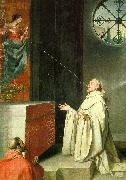 |
Cano, Alonso
|
|
Spanish, 1601-67
Spanish painter, sculptor and architect. He was an artist of rare versatility in 17th-century Spain, although his architectural work was not extensive. While he is also known for his drawings, only about 60 of these are definitely attributable to him, despite the many extant sketches with the name 'Cano' carelessly added by later hands. Unlike most of his Spanish contemporaries, such as Zurbaren or Velezquez, whose artistic styles did not outlive them, Cano's artistic legacy is measured in part by the number of artists who trained in his workshop and went on to become important masters in their own right: the painters Pedro Atanasio Bocanegra, Juan de Sevilla (1643-95) and, more distantly, Jos Risueo, and the sculptors Pedro de Mena and Jos de Mora,
|
|
 |
CAMASSEI, Andrea
|
|
Italian painter, Roman school (b. 1602, Bevagna, d. 1649, Roma)
Andrea Camassei (1602-1649) was an Italian painter of the Baroque, who was mainly active in Rome under the patronage of the Barberini. He was born in Bevagna. He was active in painting in the Palazzo Barberini as well as in Antonio Barberini's favored church, Santa Maria della Concezione, where he painted the Assumption of the Virgin on the dome. His training was under Domenichino, but he also labored under the direction of Sacchi and Pietro da Cortona. He painted a Triumph of Constantine for the Baptistery of the Lateran Palace. He painted for the Taddeo Barberini, two large canvases (1638-39) depicting Massacre of the Niobids and Hunt of Diana. He also painted a Saints Bonaventura, Bernardino & Ludovico da Tolosa for Santa Caterina in Rapecchiano (Spello).
|
|
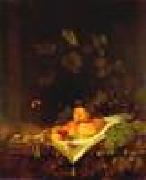 |
CALRAET, Abraham van
|
|
Dutch painter, Dordrecht school (b. 1642, Dordrecht, d. 1722, Dordrecht)
Dutch painter. He was the eldest son of Pieter Jansz. van Calraet (c. 1620-81), a sculptor from Utrecht. According to Houbraken, Abraham was taught by the Dordrecht sculptors Aemilius and Samuel Huppe, although nothing is known of his activity as a sculptor. Houbraken also stated that Abraham learnt to paint figures and fruit and that his brother Barent van Calraet (1649-1737), who specialized at first in horse paintings but later imitated the Rhine landscapes of Herman Saftleven, was a pupil of Aelbert Cuyp (see CUYP, (3)). The known signed works by Barent confirm this. A painting of two horses in a stable, initialled APK (Rotterdam, Mus. Boymans-van Beuningen), indicates that Abraham, too, must have been well acquainted with Cuyp and provides the basis for identifying Abraham's painting style. A large number of landscapes with horses, paintings of livestock in stables and still-lifes, all initialled A.C. and formerly attributed to Aelbert Cuyp,
|
|
|
|
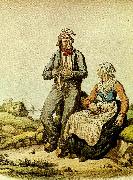 |
c. a. dahlstrom
|
|
Carl Petter Dahlström, född ca 1705, död 4 mars 1794, var en svensk möbelsnickare. Dahlström gesällvandrade 1745?C1755 i Nordeuropa och Frankrike, där han i Paris kom i lära hos den tidens främste ebenist Jean-François Oeben. Hos denne lärde sig Dahlström faneringstekniken marqueterie ?? fleurs eller blomsterintarsia, som var en metod för att möta rokokons krav på fanering av dubbelvälvda kroppar. Mycket tack vare rekommendationer av C.J. Cronstedt blev Dahlström efter hemkomsten till Sverige utnämnd till kunglig ebenist den 19 november 1756. Han finns representerad på Nationalmuseum med en byrå som han tillverkade tillsammans med Lorentz Nordin. Dahlström överlämnade 1769 sina privilegier till Niclas Palmgren och ägnade sig därefter åt restaurangverksamhet.
|
|
 |
BRUEGHEL, Ambrosius
|
|
Flemish painter (b. 1617, Antwerpen, d. 1675, Antwerpen).
Ambrosius Brueghel (Antwerp, 1617??9 February 1675) was a Flemish Baroque painter who specialized in landscapes and flower paintings. His work is similar to that of his half-brother, Jan Brueghel the Younger, and his nephew, Abraham Brueghel.[1] He was primarily active Antwerp, probably travelled to Italy around 1639, and was dean of Antwerp's Guild of St. Luke from 1653 to 1671.
|
|
 |
BROUWER, Adriaen
|
|
Flemish Baroque Era Painter, ca.1605-1638
Adriaen Brouwer (1605, Oudenaarde - January 1638, Antwerp) was a Flemish genre painter active in Flanders and the Dutch Republic in the seventeenth century.
At a young age Brouwer, probably born as Adriaen de Brauwer, moved perhaps via Antwerp to Haarlem, where he became a student of Frans Hals alongside Adriaen van Ostade. He also was active in stage acting and poetry. He stayed in Haarlem and Amsterdam until 1631, when he moved back to Antwerp in the Spanish Netherlands. There, he became a member of the Guild of St. Luke in 1631 ?C 1632, as well as the rhetoricians's chamber De Violieren.
Tradition has it that Brouwer himself spent much time in the alehouses of Flanders and Holland. His works are typically detailed and small, and often adopt themes of debauchery, drunkenness and foolishness in order to explore human emotions, expressions and responses to pain, fear and the senses. The Bitter Tonic (illustrated right) is an example of the type of work that depicts such responses, in this case the sense of taste. His work was well liked, to the point that forgeries were sold in his own time. Both Rubens and Rembrandt owned a number of his works. Nevertheless, Brouwer appeared in financial trouble throughout his life.
He died at the early age of 32 in Antwerp, where he was first buried in a common grave, but, upon instigation of the members of the guild, was reburied on Feb 1, 1638 in the church of the Carmelites.
|
|
 |
BRONZINO, Agnolo
|
|
Italian Mannerist Painter, 1503-1572
Italian painter and poet. He dominated Florentine painting from the 1530s to the 1560s. He was court artist to Cosimo I de' Medici, and his sophisticated style and extraordinary technical ability were ideally suited to the needs and ideals of his ducal patron. He was a leading decorator, and his religious subjects and mythological scenes epitomize the grace of the high maniera style.
|
|
|
|
 |
BREGNO, Antonio
|
|
Italian Early Renaissance Sculptor and Architect, active ca.1425-1457
|
|
 |
BREGNO, Andrea
|
|
Italian Early Renaissance Sculptor and Architect, 1418-1503
Andrea Bregno was invited to move from Venice to Rome when the Venetian Paul II was elected Pope. During the pontificate of the Della Rovere Pope Sixtus IV he received many commissions and headed a large workshop, producing many wall tombs of cardinals and other figures of the papal curia with varying degrees of personal responsibility. He was famous among his contemporaries, and was compared to the Greek sculptor Polykleitos in the epitaph of his tomb in Santa Maria sopra Minerva. Raphael's father, Giovanni Santi, mentioned Bregno in the 1480s, in his biography of Federico da Montefeltro, duke of Urbino. Bregno often worked with Mino da Fiesole in Rome, and his refined Lombard manner was rendered more classical by the contact and by the example of Roman sculptures that were increasingly coming to light, of which Andrea Bregno was an early collector: a certain "Prospettivo Milanese", writing in 1499-1500 refers to a torso in the collection of a "Maestro Andrea" that seems to have been the Belvedere Torso.
He moved in humanist circles and was an esteemed friend of the humanist in Sixtus' circle, Bartolomeo Platina, the librarian of the Vatican Library. Bregno played a significant role in the standardization of an authentically classicizing style of epigraphy, in the inscriptions that accompany his tombs. In the Sistine Chapel he collaborated with Mino da Fiesole and Giovanni Dalmata to produce the little cantoria or choristers' gallery set into the wall, with its own coffered ceiling and carved marble balusters, and the marble screen.
|
|
|
|
|
|
 |
BOTH, Andries
|
|
Dutch Baroque Era Painter, ca.1612-1641
Andries Both (1612/1613, Utrecht - March 23, 1642, Venice) Dutch genre painter, one of the bamboccianti, and brother of Jan Dirksz Both.
Both was the son of a glass painter, and studied under Abraham Bloemaert. According to Joachim von Sandrart, Andries and his brother Jan cooperated on the paintings, with Jan painting the landscapes and Andries the figures, though this view has been revised in the 20th century. Andries stayed in Rouen in 1633, and he traveled on to Rome, where is documented from 1635 to 1641. He first shared a studio with a fellow painter from Utrecht, Jan van Causteren. In 1638 his brother joined him, living on the Via Vittoria in the parish of San Lorenzo in Lucina and perhaps both joining the Accademia di San Luca and the group of painters led by Pieter van Laer. In 1641 the brothers traveled back to Holland, but Andries met his death in Venice on the way, drowning in a canal as he was returning from some festivities.
|
|
 |
BOSSE, Abraham
|
|
French Baroque Era Engraver, 1602-1676
Roughly 1600 etchings are attributed to him, with subjects including: daily life , religion, literature , history, fashion[8], technology, and science. Most of his output was illustrations for books, but many were also sold separately. His style grows from Dutch and Flemish art, but is given a strongly French flavour. Many of his images give fascinating and informative detail about middle and upper-class daily life in the period, although they must be treated with care as historical evidence. His combination of very carefully depicted grand interiors with relatively trivial domestic subjects was original and highly influential on French art, and also abroad ?? William Hogarth's engravings are, among other things, a parody of the style. Most of his images are perhaps best regarded as illustrations rather than art.
Watercolour of a ball by Abraham Bosse, a similar subject to many of his most famous etchingsHe was apprenticed in Paris about 1620 to the Antwerp-born engraver Melchior Tavernier (1564?C1641), who was also an important publisher. His first etchings date to 1622, and are influenced by Jacques Bellange. Following a meeting in Paris about 1630, he became a follower of Jacques Callot, whose technical innovations in etching he popularised in a famous and much translated Manual of Etching(1645), the first to be published. He took Callot's highly detailed small images to a larger size, and a wider range of subject matter.
Unlike Callot, his declared aim, in which he largely succeeded, was to make etchings look like engravings, to which end he sacrificed willingly the freedom of the etched line, whilst certainly exploiting to the full the speed of the technique. Like most etchers, he frequently used engraving on a plate in addition to etching, but produced no pure engravings.
|
|
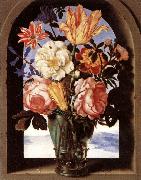 |
BOSSCHAERT, Ambrosius the Elder
|
|
Dutch Baroque Era Painter, 1573-1621
Painter and dealer. He left Antwerp with his parents c. 1587 because as Protestants they were vulnerable to religious persecution; the family moved to Middelburg, where in 1593 Ambrosius became a member of the Guild of St Luke, of which he served as Dean on several occasions (1597, 1598, 1603, 1604, 1612 and 1613). In 1604 he married Maria van der Ast, the sister of Balthasar van der Ast who later became his pupil and possible collaborator. Bosschaert bought a house in Middelburg in 1611. There are flower-pieces by Bosschaert that are signed (with a monogram) and dated between 1605 and 1621, though there were two periods of artistic inactivity, in 1611-13 and 1615-16, when he was probably more active as a dealer in the art of both Dutch and foreign artists (e.g. Veronese and Georg Flegel). He was recorded in Bergen-op-Zoom in 1615 and became a citizen of Utrecht in 1616, where his name appears in the register of the Utrecht Guild of St Luke for the same year. In 1619 he was involved in a court case in Breda, where he lived from that year. He died during a journey to The Hague.
|
|
|
|
|
|
 |
BLOEMAERT, Abraham
|
|
Dutch Mannerist Painter, ca.1564-1651
Abraham Bloemaert (1566, Gorinchem - January 27, 1651, Utrecht), was a Dutch painter and printmaker in etching and engraving.
Bloemaert was the son of an architect, who moved his family to Utrecht in 1575, where Abraham was first a pupil of Gerrit Splinter (pupil of Frans Floris) and of Joos de Beer. He then spent three years in Paris, studying under several masters, and on his return to his native country received further training from Hieronymus Francken. In 1591 he went to Amsterdam, and four years later settled finally at Utrecht, where he became dean of the Guild of St. Luke.
He excelled more as a colourist than as a draughtsman, was extremely productive, and painted and etched historical and allegorical pictures, landscapes, still-life, animal pictures and flower pieces. Among his pupils are his four sons, Hendrick, Frederick, Cornelis and Adriaan (all of whom achieved considerable reputation as painters or engravers), the two Honthorsts, Ferdinand Bol and Jacob Gerritsz Cuyp.
|
|
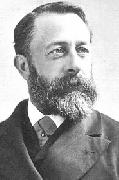 |
Bierstadt, Albert
|
|
The landscape painter
Bierstadt joined a surveying expedition to the western United States in 1858 after studying painting in Germany.
|
|
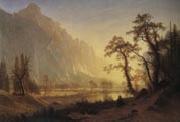 |
Bierstadt Albert
|
|
German-born American Hudson River School Painter, 1830-1902
was a German-American painter best known for his large landscapes of the American West. In obtaining the subject matter for these works, Bierstadt joined several journeys of the Westward Expansion. Though not the first artist to record these sites, Bierstadt was the foremost painter of these scenes for the remainder of the 19th century. Bierstadt was part of the Hudson River School, not an institution but rather an informal group of like-minded painters. The Hudson River School style involved carefully detailed paintings with romantic, almost glowing lighting, sometimes called luminism. Bierstadt was born in Solingen, Germany. His family moved to New Bedford, Massachusetts, in 1833. He studied painting with the members of the D??sseldorf School in D'sseldorf, Germany from 1853 to 1857. He taught drawing and painting briefly before devoting himself to painting. Bierstadt began making paintings in New England and upstate New York. In 1859, he traveled westward in the company of a Land Surveyor for the U.S. government, returning with sketches that would result in numerous finished paintings. In 1863 he returned west again, in the company of the author Fitz Hugh Ludlow, whose wife he would later marry. He continued to visit the American West throughout his career. Though his paintings sold for princely sums, Bierstadt was not held in particularly high esteem by critics of his day.
|
|
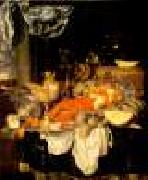 |
BEYEREN, Abraham van
|
|
Dutch Baroque Era Painter, ca.1620-1690
Dutch painter. He painted seascapes as well as fruit, flower, fish, game and banquet still-lifes. He almost always signed these works with his monogram AVB, but he dated only a few. This, together with the fact that he painted diverse subjects simultaneously and his style changed little, makes it difficult to establish a chronology. He became a master in The Hague in 1640 and was related by marriage to the fish painter Pieter de Putter (before 1600-59). Van Beyeren lived in Delft from 1657 to 1661 and was again in The Hague between 1663 and 1669.
|
|
|
|
|
|
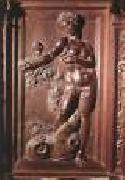 |
BERRUGUETE, Alonso
|
|
Spanish Mannerist Painter and Sculptor, ca.1488-1561
Alonso Berruguete was born in Paredes de Navas, Valladolid, the son of Pedro Berruguete, Spain's first major Early Renaissance painter. Pedro was trained in Italy, and it is understandable that he would want his son to have an Italian formation. Alonso was in Florence from about 1504, the year of his father's death, until about 1517. He also spent time in Rome during this period.
Berruguete's original purpose was to train as a painter, but he had the opportunity to study sculpture under Michelangelo, whom he is said to have assisted in the execution of some works. Berruguete received minor commissions, such as the completion of paintings and sculptures left unfinished by other artists.
On his return to Spain, Berruguete executed an alabaster relief, the Resurrection, for Valencia Cathedral (ca. 1517), which compares favorably with early works by Michelangelo. It is Hellenistic in its anatomical beauty, multiple diagonals, and range of relief projection. The figure of Christ is the climactic center of interest: a vertical, stabilizing force amid a tumult of diagonals described in the agitated movements of the startled Roman soldiers.
In 1518 Emperor Charles V named Berruguete court painter. When illness prevented Berruguete from sailing to Germany with Charles V in 1520, the Emperor took it personally and turned a deaf ear to Berruguete's subsequent petitions for commissions. He then returned to his native village until 1523, when Charles V named him a scribe of the criminal section of the Chancery in Valladolid.
This gave Berruguete social status, an income, and work he could deputize. Henceforth, he set himself to amass riches and advance socially. He established a studio in Valladolid, hired a number of apprentices, and priced his works above those of all other artists. It was a time of great wealth in Spain; Berruguete had seen sumptuous riches in Italy and was determined to so live that his compatriots would accord him the reverence and acclaim enjoyed by Italian artists.
In 1528 Berruguete built himself a palace in Valladolid, opposite the monastery of S. Benito, for which he created his greatest altarpiece. He succeeded so well in his ambitions that in 1542 he sold the Emperor's benefice for 4,000 ducats. Two years before he died, he became a squire when the regent of Portugal, Princess Juana, gave him the village of Ventosa with its 120 inhabitants.
|
|
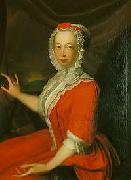 |
Bernardus Accama
|
|
(1697, Burum? - 1756, Leeuwarden) was an eighteenth century Dutch historical and portrait painter, born in Friesland. Active in Leeuwarden.
|
|
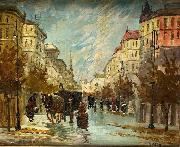 |
Berkes Antal
|
|
(1874-1938) was a Hungarian painter, born in Budapest, Hungary. Lived in Paris for some time and produced cityscapes there as well as similar street scenes of Budapest and Vienna.
He studied at The Academy of Fine Arts between 1889-1894 in Budapest, Hungary. He first started painting landscapes, and later changed to painting street scenes of Budapest. His popularity and sales increased so he started "mass producing" many of his works, meeting the requirements of the art dealers of his age. His work went through light and dark periods as he experimented with light.
|
|
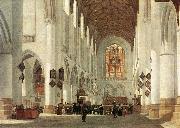 |
BERCKHEYDE, Job Adriaensz
|
|
Dutch painter (b. 1630, Haarlem, d. 1693, Haarlem).
He was apprenticed on 2 November 1644 to Jacob Willemsz. de Wet, whose influence is apparent in his first dated canvas, Christ Preaching to the Children (1661; Schwerin, Staatl. Mus.), one of the few biblical scenes in his oeuvre. On 10 June 1653 he repaid a loan from the Haarlem Guild of St Luke, which he subsequently joined on 10 March 1654. During his stay in Heidelberg, Job painted portraits and hunting scenes at the court of the Elector Palatine, who rewarded him with a gold chain, perhaps the one he wears in his early Self-portrait (c. 1655; Haarlem, Frans Halsmus.), his only documented work from the 1650s. Job is better known for his later work, which consists mainly of interior views of St Bavo's church in Haarlem and simple genre scenes recalling those of his Haarlem contemporaries Adriaen van Ostade and Jan Steen.
|
|
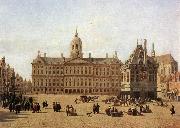 |
BERCKHEYDE, Gerrit Adriaensz.
|
|
Dutch Baroque Era Painter, 1638-1698
Brother of Job Berckheyde. Gerrit specialized in a particular type of architectural subject, the TOWNSCAPE. His painted work shows a debt not only to Pieter Saenredam's conception of the building portrait but also to Saenredam's refined draughtsmanship and dispassionate attitude; these qualities mark Berckheyde as a classicist and akin to Vermeer. Berckheyde favoured views of monuments on large open squares, a choice that distinguishes him from the other great Dutch townscape painter, Jan van der Heyden, who preferred views along canals in which clarity was sacrificed for pictorial effect.
|
|
 |
BENSON, Ambrosius
|
|
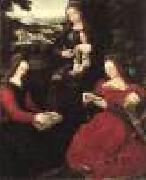
Flemish Northern Renaissance Painter, ca.1495-1550
South Netherlandish painter of Italian birth. In 1518 he acquired Bruges citizenship, and in 1519 he was admitted to the guild of painters and saddlemakers there as an independent master, with the comment that he was 'from Lombardy'. He may have been from Ferrara, although he was originally called Ambrogio Benzone, taking his first name from the patron saint of Milan, the capital of Lombardy. He was probably attracted to Bruges by its commercial and artistic reputation. Initially he worked in the studio of Gerard David, by whom he was profoundly influenced, but after a few months the relationship went wrong and the younger painter brought a case against David. Benson's first marriage was to Anna Ghyselin, who bore him two sons, Willem Benson (1521/2-1574) and Jan Benson (before 1530-before 1581), both of whom became artists. From his second marriage, to Josyne Michiels, a daughter Anna was born, and he had two other daughters from various extra-marital relationships. Benson was an affluent and successful man: he owned several houses, for one of which he gave eight paintings in half payment (which gives some idea of the value of his works at the time). Benson twice received commissions from city magistrates to decorate their new county hall and was a member of the city council on three occasions; he also held important offices within the painters' guild, including dean (1537-8 and 1543-4) and governor (1540-41). His pupils included his two sons, and Joachim Spaers (1541) and Jacob Vinson (Fynson; 1549).
|
|
 |
Benno Adam
|
|
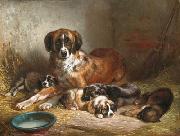
(July 15, 1812, Munich - March 9, 1892, Kehlheim) was a German painter.
He specialised in animal portraits and market and hunting scenes.
He was the son of painter Albrecht Adam.
|
|
|
|
 |
Bartolomeo Altomonte
|
|
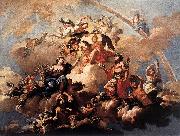
Bartolomeo Altomonte, also known as Bartholomäus Hohenberg (24 February 1694 - 11 November 1783), was an Austrian baroque painter who specialized in large scale frescoes. He was the son of Martino Altomonte, also a painter.
|
|
 |
Baron Antoine-Jean Gros
|
|
1771-1835
French
Baron Antoine-Jean Gros Galleries
The son of a painter, Antoine Jean Gros was born in Paris on March 16, 1771. At the age of 14 he entered the studio of Jacques Louis David, the acknowledged leader of the classical revival. Although his own work became radically different from David's, he maintained a lifelong respect for his teacher and envisioned himself as the upholder of the Davidian tradition.
In 1787 Gros entered the Acad??mie de Peinture, and when the Acad??mie dissolved in 1793 (a result of the French Revolution) he went to Italy. He met Josephine Bonaparte in Genoa in 1796, and she introduced him to Napoleonic society. Gros entered Napoleon's immediate entourage and accompanied him on several north Italian campaigns. Gros also became involved with Napoleon's program of confiscating Italian art for removal to France.
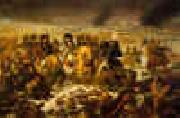
Gros returned to Paris in 1800 and began to show his Napoleonic paintings in the annual Salons. The most famous of these are the Pesthouse at Jaffa (1804) and Napoleon at Eylau (1808). These works served to deify Napoleon, showing him engaged in acts of heroism and mercy. Stylistically, the paintings were revolutionary:their exotic settings, rich color, agitated space, and general penchant for showing the gruesome specifics of war and suffering differed radically from the cool generalizations of Davidian classicism that Gros had learned as a student. The presentation of contemporary historical events was also new, a harbinger of the realism that developed steadily during the first half of the 19th century in French, American, and English painting. Finally, the emphatic emotionalism of Gros's art established the foundation of romantic painting that Th??odore G??ricault and Eug??ne Delacroix developed after him.
Unlike that of some of his countrymen (David is a case in point), Gros's position did not suffer after the fall of Napoleon. Gros painted for the restored monarchy, for instance, Louis XVIII Leaving the Tuileries (1817), and he decorated the dome of the Panth??on in Paris with scenes of French history (1814-1824). For this Charles X made him a baron in 1824. But these works lack the zest and commitment of Gros's Napoleonic period, perhaps because they were not based on the immediate kinds of historical experiences that had inspired the earlier paintings.
Although marked by considerable public success, Gros's later career was in many ways acutely troubled. Basically, he could not resolve his personal esthetic theories with his own painting or with the work of his younger contemporaries. To the end Gros wished to propagate the classicism of David, and he took over David's studio when the master was exiled in 1816. By the 1820s, however, the revolutionary romanticism of G??ricault and Delacroix, among others, had clearly begun to eclipse classicism, and Gros found himself fighting a lonely and losing battle for conservatism. Ironically, he was fighting a trend that his own best work had helped to originate. As he persisted, moreover, his own painting began to show a diffident mixture of classic and romantic attitudes. Thus, while he was inherently a romantic, he tragically came to doubt himself. Gros died on June 26, 1835, apparently a suicide.
|
|
 |
Barend Avercamp
|
|
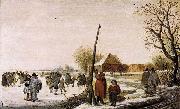
(1612-1679) was a Dutch painter.
Avercamp was born in Kampen and was taught by his uncle Hendrick Avercamp, who was also a painter. Barent primarily painted scenes depicting Netherlands in winter. He was a member of the Guild of Saint Luke, and traveled around the Netherlands including Zwolle and Zutphen for his settings and inspiration.
|
|
 |
Balthasar van der Ast
|
|
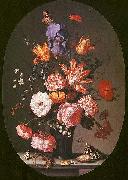
(1593/94 - 1657) was a Dutch Golden Age painter who specialized in still lifes of flowers and fruit, as well as painting a number of remarkable shell still lifes; he is considered to be a pioneer in the genre of shell painting. His still lifes often contain insects and lizards. He was born in Middelburg and died at Delft.
|
|
|
|
|
|
|
|
 |
BACKER, Jacob Adriaensz.
|
|
Dutch Baroque Era Painter, 1608-1651
Backer was born in Harlingen, but his family moved soon (in 1611) to Amsterdam. Between 1627 and 1633 he and Govert Flinck were pupils of Lambert Jacobsz in Leeuwarden. In 1633 he returned to Amsterdam, where he remained until his death.
His extreme quickness in painting portraits has been particularly noticed, and it is said by his Amsterdam colleague Joachim von Sandrart that he completely finished, in one day, the half length portrait of a lady in full dress, even so early, that she was able to return the same day to Haarlem. Besides being an important portrait painter - some 70 portraits can be attributed to him with certainty, among them the 1642 Company of Cornelis de Graeff voor de Nieuwe Doelen in Amsterdam, on the same wall as Rembrandt's Night Watch - Backer was an excellent painter of religious and mythological paintings. He was especially interested in pastoral subjects, themes from contemporary history, like the huge Crowning of Mirtillo from 1641 in the Brukenthal collection in Sibiu (250 x 250 cm.). In fact, Backer was a leading artist in Amsterdam until his premature death in 1651.
|
|
 |
Ayne Bru
|
|
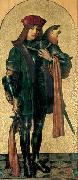
Ayne (Aine) Bru (probably a Catalanization of Hans Bren) was a 16th century Renaissance painter of German origin who worked in Catalonia. He may have proceeded from Lummen, in the Duchy of Brabant. He is sometimes also called Lucius de Brun. His surname may also suggest provenance from the town of Brenn.
In 1502, he was hired to paint the main altar (retablo) in the church of the monastery of Sant Cugat del Valles, for which he was paid a staggering wage between 1504 and 1507.
On the central panel, Bru depicted the martyrdom of Saint Cucuphas (in Catalan, Sant Cugat) with enormous realism. The executioner cuts the saint's throat while Cucuphas remains tied to a tree trunk. Nearby, there appear another knife (in a basket) and a dog sleeping peacefully. This work is now at the National Art Museum of Catalonia (Museu Nacional d'Art de Catalunya).
The dog from Bru's painting of Cucuphas' martyrdom was later borrowed by Salvador Dale for a painting called "Dale Contemplating Nude" or "Dale Dale Dale".
The vast countryside that serves as a background anachronistically includes the actual monastery of Sant Cugat. Another panel, depicting Saint George (sometimes identified as Saint Candidus or simply as "Warrior Saint"), was attached to this one. It has been rejoined and is visible at the National Art Museum of Catalonia.
Marcel Durliat believes that though the expressionism in this painting is evidence of a Germanic artistic tradition, Bru's Quattrocento depiction of the standing figures in contemporary dress, as well as other details, indicate that the painter may have lived or studied in Northern Italy before moving to Barcelona.
|
|
|
|
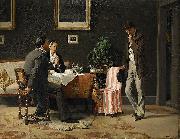 |
Axel Kulle
|
|
painted Den forlorade sonens aterkomst in1882
|
|
|
|
|
|
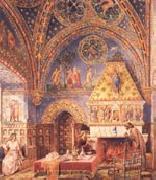 |
Axel Haig
|
|
Swedish etcher and architectural draughtsman , 1835-1921
Swedish printmaker, painter and architect. He studied shipbuilding in Karlskrona from 1850 to 1856. The following year he joined the shipbuilders Lawrence Hill & Co. in Glasgow, but soon left to study architecture in London, where he worked with the English architect Ewan Christian (1814-95) and with William Burges. Under the influence of Burges he became especially interested in Gothic architecture. In the late 1870s he began etching, with the intention of illustrating a book on Scotland's medieval architecture. Haig contributed illustrations to numerous English magazines, including The Architect. (For Haig's drawing of William Burges's competition entry for the Law Courts, London) In 1882 he was awarded a medal for his etchings at the Paris Salon and elected an honorary member of the Swedish Royal Academy.
|
|
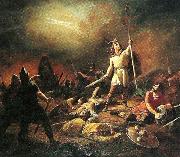 |
axel gustaf hertzberg
|
|
1832-1878
Axel Gustaf Hertzberg född 27 augusti 1832 i Jämtland, död 2 september 1878 i Dusseldorf , Tyskland var en svensk bildkonstnär.
Hertzberg ägnade sig först åt porträtteckning och litografi men övergick senare till oljemåleri. Han studerade vid konstakademien i Stockholm 1849-1860. Han gjorde en resa till Finland där han stannade två år. Därefter studerade han konst i Paris, och slutligen Dusseldorf.
Hertzberg blev 1867 agre vid konstakdemien i Stockholm.
|
|
|
|
|
|
|
|
|
| Wholesale China Oil Painting Wholesale Oil Painting China Xiamen Portrait Reproduction on canvas Chinese Oil Painting Wholesale USA Oil Painting |
|
|
|
|
|