| |
|
Xiamen Oil Paintings, Wholesale Direct!
|
|
100% hand painted, 100% cotton canvas, 100% money back if not satisfaction. |
|
|
|
|
ART WORKS INDEX
A
B
C
D
E
F
G
H
I
J
K
L
M
N
O
P
Q
R
S
T
U
V
W
X
Y
Z
|
|
ARTISTS INDEX
A
B
C
D
E
F
G
H
I
J
K
L
M
N
O
P
Q
R
S
T
U
V
W
X
Y
Z
|
|
|
|
|
|
 |
Richard Burchett
|
|
British painter and art teacher , (1815-1875)
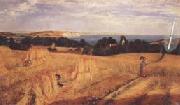
was a British artist and educator on the fringes of the Pre-Raphaelite movement, who was for over twenty years the Headmaster of what later became the Royal College of Art. He was later described as "a prominent figure in the art-schools, a well instructed painter, and a teacher exceptionally equipped with all the learning of his craft" by his ex-pupil, the poet Austin Dobson. Burchett's pupils included the extremely varied talents of Kate Greenaway, Christopher Dresser, Elizabeth Thompson (Lady Butler), Sir George Clausen, Sir Luke Fildes, Gertrude Jekyll, Hubert von Herkomer, William Harbutt and Helen Allingham. Princess Louise, Duchess of Argyll, Queen Victoria's daughter, and a talented artist, was also a student.As an artist he achieved some reputation for large history paintings, but View across Sandown Bay, Isle of Wight is seen by modern art historians as his best work.
|
|
 |
Richard Brompton
|
|
1734-1783
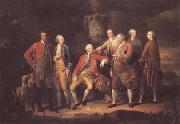
English painter. He trained in London with Benjamin Wilson before going to Rome in 1757, where he studied with Anton Raphael Mengs. In Rome he met Charles Compton, 7th Earl of Northampton, who paid him an allowance and in Venice in 1763 introduced him to Edward Augustus, Duke of York. The Duke commissioned a conversation piece of himself and his travelling companions (version, 1764; London, Kew Pal., Royal Col.). The figures are awkwardly posed, but the polished elegance of each shows the influence of Mengs. In 1765 Brompton returned to London with Nathaniel Dance and established a good practice with small-scale works in the manner of Johann Zoffany, such as William Pitt, 1st Earl of Chatham (1772; Chevening, Kent), which exists in several versions. He also produced portraits on a larger scale, including the enormous Henry Dawkins with his Family (1773; Over Norton Hall, Oxon).
|
|
 |
Richard Brakenburgh
|
|
(1650, Haarlem - 1702, Haarlem), was a Dutch Golden Age painter.
According to Houbraken he was a light-hearted poet from Haarlem. He was the pupil of Hendrik Mommers who went on to paint clever genre scenes in the manner of Adriaen van Ostade. Though some said he was the pupil of Bernard Schendel, they were the same age and painted in similar styles. He was successful enough at his art that his Frisian widow was able to purchase an annuity after his death in Friesland.
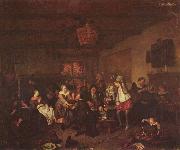
According to the RKD he is registered in Leeuwarden during the years 1670-1687.He is known for both Italianate landscapes and portraits. He painted similar subjects to those of Schendel, representing merry-makings and drunken assemblies. His pictures are ingeniously composed, and well coloured, something in the manner of Adriaan van Ostade, though greatly inferior. They are painted with facility, although they have the appearance of being very highly finished; and he perfectly understood the management of chiaroscuro. His greatest defect is his incorrect drawing of the figure, which he appears not to have studied from nature. The Vienna Gallery has two 'Peasant Scenes' by him, said to have been painted in 1690; the Berlin Museum one, and the Amsterdam Gallery one. In the Brussels Gallery is a 'Children's Feast,' signed and dated 1698; and the Rotterdam Museum has a 'Doctor's Visit,' signed and dated 1696. In Windsor Castle are two good 'Artists' Studios ' by him. He also sometimes practised the art of engraving.
He was the teacher of Wigerus Vitringa, Abraham Pardanus, and Gillis de Winter. He was followed by Jan Steen and Bernardus van Schijndel. He died at Haarlem in December 1702 and was buried in January 1703.
|
|
 |
Richard Bergh
|
|
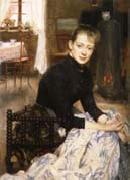
1858?C1919,Painter, writer and museum director, son of Edvard Bergh. He studied in Stockholm, first at the art school of Edvard Pers?us (1841-90) and from 1878 to 1881 at the Konstakademi, where he met Nils Kreuger and Karl Nordstrem. His early work consists mainly of academically treated scenes from Swedish history and legend. In 1881 he left for France, studying in Paris with Jean-Paul Laurens and at the Academie Colarossi (1881-4); he made his debut at the Salon of 1883. In 1885, with Ernst Josephson and other members of the Scandinavian artists' colonies in Paris and Grez-sur-Loing, he became one of the main promoters of the Opponenterna, a movement of protest against the conservative attitudes of the Konstakademi; the following year this group formed the Konstnersferbund (Artists' Union), of which Bergh was a leading member throughout his life.
|
|
 |
Reinhold Begas
|
|
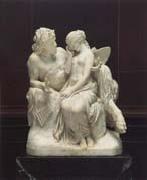
1831-1911 Berlin,was a German sculptor. Begas was born in Berlin to the painter Karl Begas. He received his early education (1846-1851) studying under Christian Daniel Rauch and Ludwig Wilhelm Wichmann. During a period of study in Italy, from 1856 to 1858, he was influenced by Arnold Bocklin and Franz Lenbach in the direction of a naturalistic style in sculpture. This tendency was marked in the group Borussia, executed for the facade of the exchange in Berlin, which first brought him into general notice. In 1861 Begas was appointed professor at the art school at Weimar, but retained the appointment only a few months. That he was chosen, after competition, to execute the statue of Schiller for the Gendarmenmarkt in Berlin, was a high tribute to the fame he had already acquired; and the result, one of the finest statues in the German metropolis, entirely justified his selection. Since the year 1870, Begas dominated the plastic art in the Kingdom of Prussia, but especially in Berlin. Among his chief works during this period are the colossal statue of Borussia for the Hall of Glory; the Neptune fountain in bronze on the Schlossplatz; the statue of Alexander von Humboldt, all in Berlin; the sarcophagus of Emperor Frederick III in the mausoleum of the Church of Peace at Potsdam
|
|
 |
Ramon Bayeu
|
|
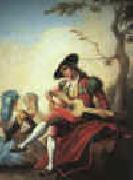
1746-1793
Spanish
Ramon Bayeu Gallery
The biography of Jose del Castillo (Madrid, 14.10.1737-Madrid, 5.10.1793) shows that the artist, being in his youth one of the most appropriate painters for becoming a leader of the artistic movement of the Illustrious Absolutism, ends up performing secondary work, paintings for tapestry and some religious works of art, which was not the field where he could best display his talent. Jose del Castillo is a perfect example of how an unhappy destiny can influence on the professional life of a painter under the regime of that time. Surely the unhappy destiny, in point of fact, does not explain anything and we will have to find out the real reasons why one of the most promising careers in painting of the eighteenth century in Spain was crushed. Probably it was a combination of two unsuccessful elections, from our point of view, that excluded the figure of Jose del Castillo from the elite group of artists of that time.
|
|
 |
Ralph Blakelock
|
|
American Painter, 1847-1919
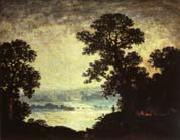
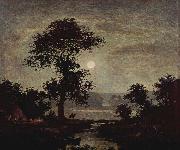
One of the most important visionary artists in late 19th-century America, he was self-taught as a painter. From 1867 he was exhibiting landscapes in the style of the Hudson River school at the National Academy of Design in New York. Rather than going abroad for advanced training, like most of his contemporaries, he spent the years 1869-72 in the western United States. Back in New York, Blakelock evolved his personal style during the 1870s and 1880s. Eschewing literal transcriptions of nature, he preferred to paint evocative moonlit landscapes such as Moonlight (Washington, DC, Corcoran Gal. A.).
|
|
 |
Ralph Barton
|
|
American Artist, 1891-1931
American Artist, 1891-1931,1921 Vanity Fair caricature; use cursor to identify figuresBarton's first caricature was of Thomas Hart Benton; his last, of Charlie Chaplin. In between he knew everyone and drew everyone in the social and culture scene of New York. Some of his most famous works were group drawings, and perhaps the most noted was a stage curtain created for a 1922 revue, depicting an "audience" of 139 faces looking back at the real theater-goers. "The effect was electrifying, and the applause was great," said another caricaturist of the era, Aline Fruhauf. He also directed a short film, Camille, described by an IMDB contributor as a "home movie version" of the Dumas novel with a cast of his many actor, artist, and other celebrity friends.This movie was made available as a bonus in a 2003 release of Chaplin's A Woman of Paris. At the height of his popularity, Barton enjoyed not only the acquaintance of the famous, but a solid and impressive income. All of this concealed a terribly unhappy life. He was beset by manic-depressive disorder, and each of his four marriages ended in divorce. A self-portrait, painted around 1925 and modeled on an el Greco.
|
|
 |
Ralph Albert Blakelock
|
|
(October 15, 1847 - August 9, 1919) was a romanticist painter from the United States.
Ralph Blakelock was born in New York City on October 15, 1847. In 1864, Blakelock entered the Free Academy of the City of New York (now known as the City College) with aspirations of becoming a physician. After his third term he opted to dismiss his formal education and left college. From 1869-71 he traveled west, extensively wandering far from known civilization and spending time among the American Indians. Largely self-taught as an artist, he began producing competent landscapes, depicting select views from his travels, as well as scenes of American Indian life. His works were exhibited in the National Academy of Design.
Moonlight, 1885, the Brooklyn MuseumIn 1877 Blakelock married Cora Rebecca Bailey; they had nine children. In art, Blakelock was a genius, yet, in business dealings and in monetary transactions he proved a failure. He found it difficult, if not crushing to maintain and support his wife and children. In desperation he found himself selling his paintings for extremely low prices, far beneath their known worth. In hopes of lifting his family from abject poverty, reportedly on the day his 9th child was born, Blakelock had offered a painting to a collector for $1000. The collector made a counter offer and after refusing the proposed sum Blakelock found himself in a bitter argument with his wife. After the domestic dispute, Blakelock returned to the patron and sold the painting for a much lesser sum. Defeated and frustrated, it is said he broke down and tore the cash into pieces. And so it was after such repeated failed business transactions that he began to suffer from extreme depression and eventually show symptoms of mental frailty. In 1899 he suffered a breakdown.
|
|
|
|
 |
R. v. Bohnlich
|
|
R v Bohnlich (fl.c.1880)
19th Century Paintings and Watercolours
|
|
|
|
|
|
 |
Pompeo Batoni
|
|
Italian
1708-1787
Pompeo Batoni Location
Italian painter and draughtsman. In his day he was the most celebrated painter in Rome and one of the most famous in Europe. For nearly half a century he recorded the visits to Rome of international travellers on the GRAND TOUR in portraits that remain among the most memorable artistic accomplishments of the period. He was equally gifted as a history painter, and his religious and mythological paintings were sought after by the greatest princes of Europe.
|
|
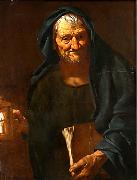 |
Pietro Bellotti
|
|
(1625-1700) was an Italian painter active in the Baroque period. He was born in Sale. He was a pupil of Michele Ferrabosco in Venice. He was patronized by Pope Alexander VIII and by the Duke of Uceda. He lived in Bolzano[1]. He painted mostly portraits. He died at Venice.
|
|
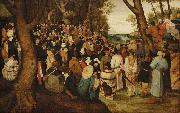 |
Pieter Brueghel the Younger
|
|
(1564 or 1565 - 10 October 1636) was a Flemish painter, known for numerous copies after his father Pieter Brueghel the Elder's paintings and nicknamed "Hell Brueghel" for his fantastic treatments of fire and grotesque imagery.
Pieter Brueghel the Younger was the oldest son of the famous sixteenth-century Netherlandish painter Pieter Brueghel the Elder (known as "Peasant Brueghel") and Mayken Coecke van Aelst. His father died in 1569, when Pieter the younger was only five years old. Then, following the death of his mother in 1578, Pieter, along with his brother Jan Brueghel the Elder ("Velvet Brueghel") and sister Marie, went to live with their grandmother Mayken Verhulst (widow of Pieter Coecke van Aelst). She was an artist in her own right, and according to Carel van Mander, possibly the first teacher of the two sons. The family moved to Antwerp sometime after 1578 and Pieter possibly entered the studio of the landscape painter Gillis van Coninxloo (1544 - 1607). In the 1584/1585 registers of Guild of Saint Luke, "Peeter Brugel" is listed as an independent master. On 5 November 1588 he married Elisabeth Goddelet, and the couple had seven children.
He painted landscapes, religious subjects and fantasy paintings. For this last category he often made use of fire and grotesque figures, leading to his nickname "Hell Brueghel".
Apart from these paintings of his own invention, Pieter Brueghel the Younger also copied the works his father had created by using a technique called pouncing. His genre paintings of peasants lack Pieter the Elder's subtlety and humanism, and emphasize the picturesque
|
|
 |
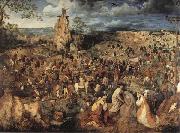
Pieter Bruegel the Elder
|
|
(Dutch pronunciation:c. 1525 - 9 September 1569) was a Flemish Renaissance painter and printmaker known for his landscapes and peasant scenes (Genre Painting). He is sometimes referred to as "Peasant Bruegel" to distinguish him from other members of the Brueghel dynasty, but is also the one generally meant when the context does not make clear which "Bruegel" is being referred to. From 1559 he dropped the 'h' from his name and started signing his paintings as Bruegel.
There are records that he was born in Breda, Netherlands, but it is uncertain whether the Dutch town of Breda or the Belgian town of Bree, called Breda in Latin, is meant. He was an apprentice of Pieter Coecke van Aelst, whose daughter Mayken he later married. He spent some time in France and Italy, and then went to Antwerp, where in 1551 he was accepted as a master in the painter's guild. He traveled to Italy soon after, and then returned to Antwerp before settling in Brussels permanently 10 years later. He received the nickname 'Peasant Bruegel' or 'Bruegel the Peasant' for his alleged practice of dressing up like a peasant in order to mingle at weddings and other celebrations, thereby gaining inspiration and authentic details for his genre paintings. He died in Brussels on 9 September 1569 and was buried in the Kapellekerk. He was the father of Pieter Brueghel the Younger and Jan Brueghel the Elder. Both became painters, but as they were very young children when their father died, it is believed neither received any training from him.
|
|
 |
Pieter Bruegel
|
|
c.1525-69
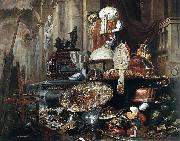
Greatest Netherlandish painter of the 16th century. Not much is known of his early life, but in 1551 he set off for Italy, where he produced his earliest signed painting, Landscape with Christ and the Apostles at the Sea of Tiberias (c. 1553). Returning to Flanders in 1555, he achieved some fame with a series of satirical, moralizing prints in the style of Hiëronymus Bosch, commissioned by an Antwerp engraver. He is best known for his paintings of Netherlandish proverbs, seasonal landscapes, and realistic views of peasant life and folklore, but he also took a novel approach to religious subject matter, portraying biblical events in panoramic scenes, often viewed from above. He had many important patrons; most of his paintings were commissioned by collectors. In addition to many drawings and engravings, about 40 authenticated paintings from his enormous output have survived.
|
|
 |
Pieter Boel
|
|
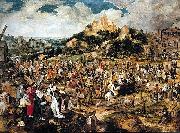
(1626-1674) was a Flemish Baroque painter who specialised in lavish still lifes.
Boel was born in Antwerp. He probably went to Italy in 1650. In 1668, he worked for Charles Le Brun (1619-1690) in his first tapestry making studio. According to Arnold Houbraken, whose source was his picture in Cornelis de Bie's book Het Gulden Cabinet, he specialized in painting animals. He died in Paris.
|
|
 |
Pieter Balten
|
|
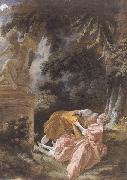
Pieter Balten (born ca. 1525 in Antwerp - died 1584 in Antwerp) was a Flemish Renaissance painter.
According to Karel van Mander he became a member of the Guild of St. Luke in 1559 and was a follower of Pieter Bruegel the Elder. He was a good poet and rederijker, who collaborated from time to time with Cornelis Ketel.
|
|
 |
Pierre-Antoine Baudouin
|
|
French Painter, 1723-1769
French painter. A pupil of Francois Boucher, whose younger daughter he married in 1758, he specialized in miniatures painted in gouache, which he first exhibited at the Salon of 1761. He was received as a member of the Acad?mie Royale in 1763 with a small gouache of a historical subject, Phryne Accused of Impiety before the Areopagite (Paris, Louvre), and he later painted illustrations of biblical episodes. However, he made his name as a painter of libertine scenes in contemporary settings, which he exhibited regularly at the Salon from 1763 until 1769. Some of his work is directly inspired by Boucher's scenes of pastoral love, but the ostensibly moral themes and careful attention to detail of such paintings as the Modest Model (exh. Salon 1769; Washington, DC, N.G.A.) demonstrate that he was also influenced by Jean-Baptiste Greuze. His pictures were condemned for their immorality, both by the Archbishop of Paris, who in 1763 and 1765 ordered that works by Baudouin be withdrawn from the Salon, and also by Denis Diderot and other critics who accused him of pandering to the decadent taste of his patrons. Nevertheless, Baudouin was one of the most popular artists of the last decades of the ancien regime.
|
|
|
|
|
|
 |
Pierre Bonnard
|
|
French Nabi Painter, 1867-1947
French painter, printmaker and photographer. He is known particularly for the decorative qualities of his paintings and his individual use of colour. During his life he was associated with other artists, Edouard Vuillard being a good friend
|
|
|
|
 |
Philipp Hieronymus Brinckmann
|
|
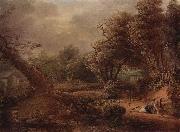
(or Brinkman,) a German painter and engraver, was born at Spires in 1709. He was a pupil of J. G. Dathan. His favourite subjects were landscapes, but he also painted historical subjects and portraits; in some of the latter he imitated the force and colouring of Rembrandt. He was painter to the Court, and keeper of the Gallery at Mannheim, where he died in 1761. In the Städel at Frankfort is a 'Swiss Landscape' signed P. H. Brinckmann fecit, 1745. He etched some plates in a picturesque and spirited style.
|
|
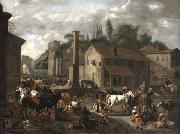 |
Peter van Bloemen
|
|
Pieter van Bloemen, called Standaart (bapt. 17 January 1657 - 6 March 1720), first name also spelled Peter or Peeter, was a Flemish painter.
Van Bloemen was born in Antwerp, where he attained the status of master at the age of 17. He then went to Rome, where he remained until 1694, adopting completely Italian manners. In 1699 he became dean of the Guild of Saint Luke in Antwerp. He was the teacher of his younger brother Jan Frans van Bloemen, a highly regarded painter of classical landscapes. The brothers travelled widely together, often collaborating on works, with Pieter taking on the role of figurista in Jan Frans' vedute, a role he also performed for many other artists.
|
|
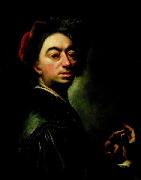 |
Peter Johannes Brandl
|
|
Petr Brandl (Peter Johannes Brandl or Jan Petr Brandl) (October 24, 1668 - September 24, 1735) was a painter of the late Baroque, famous in his time but - due to isolation behind the Iron Curtain - rather forgotten until recently. He was of German-speaking Austrian descent in the bilingual kingdom of Bohemia. His mother was from Czech peasant family, that lived in Přestanice (a village in Bohemia, now part of Hlavnovice). According to the Grove Dictionary of Art and other sources, Brandl was born into a craftsmanes family (his father seems to have been a goldsmith) and apprenticed around 1683 - 1688 to Kristien Schröder (1655 - 1702).
Brandl employed strong chiaroscuro, areas of heavy impasto and very plastic as well as dramatic figures. The major art museum in Prague, called the National Gallery, has an entire hall devoted to the artist's works, including the wonderful "Bust of an Apostle" from some time before 1725.
|
|
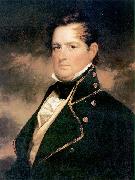 |
Peter Buell Porter
|
|
(August 14, 1773 - March 20, 1844) was an American lawyer, soldier and politician who served as United States Secretary of War from 1828 to 1829.
He graduated from Yale College in 1791, studied law in Litchfield, Connecticut, was admitted to the bar, and commenced practice in Canandaigua, New York in 1793. He served as clerk of Ontario County from 1797 to 1804 and was a member of the New York State Assembly in 1802 and again in 1828.
In the fall of 1809, Porter moved to Black Rock, New York and was elected as a Democratic-Republican to the Eleventh and Twelfth United States Congresses, serving from March 4, 1809 to March 3, 1813, but declined renomination. During his service in Congress, he was a leading figure among Congressional "war hawks" and Chairman of the Committee that recommended preparation for war with Great Britain. At the same time, from 1810 to 1816, he was a member of the Erie Canal Commission, a commission on inland navigation established in 1810 by the New York state Legislature to survey a canal route from the Hudson River to the Great Lakes.
During the War of 1812, Porter was initially quartermaster general of the New York State Militia from May to October 1812. He participated in and criticized General Alexander Smyth's abortive operations against British Canada in 1812, culminating in a bloodless duel between the two. The historian John R. Elting wrote of the duel, stating "Unfortunately, both missed."[1] He later raised and commanded a brigade of New York militia that incorporated a Six Nations Indian contingent and led his command with distinction. For his actions, he was presented a gold medal under joint resolution of Congress dated November 3, 1814 "for gallantry and good conduct" during the Battle of Chippewa, the Battle of Niagara, and the Battle of Erie.
Porter was Secretary of State of New York from February 1815 to February 1816. He was also elected to the Fourteenth United States Congress. Although his term in Congress began on March 4, 1815, the actual Session began only in December, and he took his seat on December 11, 1815. On January 23, 1816, he resigned, having been appointed a Commissioner under the Treaty of Ghent, which caused a controversy as to the constitutionality of sitting in Congress and holding this commissionership at the same time.
In 1817, his political friends of Tammany Hall printed ballots with his name and distributed them among their followers to vote for Porter for Governor of New York at the special election which was held after the resignation of Governor Daniel D. Tompkins. DeWitt Clinton, the otherwise unopposed candidate, was fiercely hated by the Tammany organization, and Porter received about 1,300 votes although he was not really running for the office. Porter became a regent of the University of the State of New York in 1824, and served in that capacity until 1830.
From May 16, 1828 to March 9, 1829, Porter served as Secretary of War in the Cabinet of President John Quincy Adams, and was an advocate for the removal of Eastern Indians beyond the Mississippi. He moved to Niagara Falls in 1836 and was a presidential elector on the Whig ticket in 1840. He died at Niagara Falls in 1844, and was interred in Oakwood Cemetery. Fort Porter and Porter Avenue at Buffalo were named in his honor.
|
|
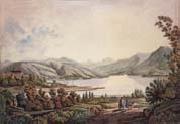 |
Peter Birmann
|
|
Swiss, 1758-1844,He began his career as a portrait painter in Basle and Pruntrut but in 1775 moved to Berne, where he took up landscape painting. From 1777 to 1781 he worked with Johann Ludwig Aberli and was also a colour-printer with the publisher Abraham Wagner (1734-82). In 1781 he went to Rome, where he remained for ten years working for Louis Ducros and for Giovanni Volpato. While in Rome he painted landscapes in watercolour and drew in bistre, using a soft brush and making little use of the pen. He also sketched in the Alban Hills, being particularly attracted to the waterfalls at Tivoli and Terni. He became a member of Goethe's circle in Rome, and, under the influence of its members, he adopted Claude as his model. His watercolours and bistre drawings, enlivened by Greco-Roman or contemporary staffage, became more tranquil, more classical in style and increasingly strengthened with pen outlines. In 1792 he returned to Basle to teach. He soon became an art dealer, opened his own shop and set up his own publishing house, and in 1802 he printed his best-known work, a series of aquatints of Voyage pittoresque de Basle ? Bienne par les vallons de Mottiers-Grandval. From 1802 to 1804 he showed at the annual exhibitions of the K?nstlergesellschaft in Zurich, and in 1804 and 1810 in Berne he exhibited work in oils, a medium that was becoming increasingly important for him. In 1805 he was commissioned by the publishing house of Artaria & Co. in Vienna to sketch the scenery in the region of the north Italian lakes. For the next 30 years he continued to paint and draw, but after 1834 he tended to repeat the locales and compositions of his earlier landscapes.
|
|
|
|
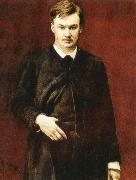 |
percy bysshe shelley
|
|
Born: 4 August 1792
Birthplace: Near Sussex, England
Died: 8 July 1822 (drowning)
Best Known As: 19th century romantic poet
|
|
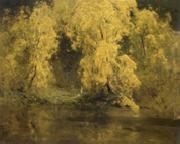 |
Penleigh boyd
|
|
Australia artist
1890-1923
was an Australian artist. Penleigh Boyd was a member of the Boyd artistic dynasty: his parents Arthur Merric Boyd (1862-1940) and Emma Minnie Boyd (n??e ?? Beckett) were well-known artists of the day, and his brothers included Merric Boyd the ceramacist (1888-1959) and the novelist Martin Boyd (1893-1972). His son Robin Boyd (1919-1971) was a noted writer and architectural critic, and his nephews Arthur Boyd and David Boyd became prominent artists. Born in England at Penleigh House, Westbury, Wiltshire, Boyd received his artistic training from his parents and at the National Gallery Art School. He had his first exhibition at the Victorian Artists' Society at 18, and exhibited at the Royal Academy in London at 21. He won second prize in the Australian Federal Government's competition for a painting of the site of the new national capital, Canberra. He won the Wynne Prize in 1914 with Landscape. He served in the AIF (Australian Infantry Forces) in France in World War I, and was invalided out after being badly gassed at the battle of Ypres in 1917. His career was cut short when he was killed in a car accident near Warragul, Victoria in 1923. Penleigh Boyd is best known as a landscapist with an accomplished handling of evanescent effects of light. A notable influence was artist E. Phillips Fox, who introduced him to plein air techniques when they were neighbours in Paris in 1912-1913.
|
|
|
|
|
|
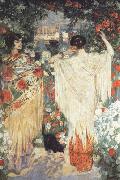 |
Pedro Blanes
|
|
1878-1926
Uruguayan painter. He first studied painting and drawing as a child with the Catalan painter Miguel Jaume i Bosch. As an adolescent he moved with his family to Spain, where he studied at the Real Academia de Bellas Artes de San Fernando in Madrid and frequented the workshop of Santiago Rusieol. After studying in Paris with Benjamin Constant, he visited Italy and Mallorca, where he first developed his talents as a landscape painter before returning briefly to Uruguay in 1899. During another prolonged visit to Europe from 1902 to 1907 he enthusiastically studied the work of Pierre Puvis de Chavannes, Lucien Simon, Henri Martin, Claude Monet and James Abbott McNeill Whistler. After his return to Montevideo in 1907 he painted shimmering Impressionist-influenced landscapes such as Palma de Mallorca and treated local rural and urban scenes in which he established himself as a remarkable colourist. He also commemorated subjects from Latin American history in works such as Artigas Dictating to his Secretary Don Jose G. Monterroso , the equestrian portrait of General Galarza and Artigas in el Hervidero.
|
|
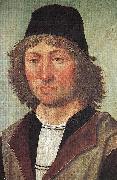 |
Pedro Berruguete
|
|
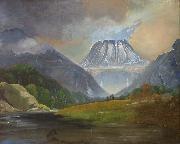
(c. 1450 - 1504) was a Spanish painter; his art is regarded as a transitional style between gothic and Renaissance. Born in Paredes de Nava, Spain, he went to Italy in 1480 and worked in Federigo da Montefeltro's court in Urbino, where he could see some works by Melozzo da Forle. He came back to Spain in 1482 and painted in several cities, such as Sevilla, Toledo and Ávila. He was the father of an important sculptor, Alonso Berruguete, considered the most important sculptor in Renaissance Spain.
|
|
 |
Peder Balke
|
|
Peter Andersen was born on the island of Helgøya, in Hedmark county, Norway. He grew up Ringsaker, but stayed in the 1820s on the Balke farm in Toten in Oppland county. Farmers in Toten paid his education, and as thanks he decorated several of the farms in Toten on his return. They actively encouraged his painting activities and later supported him in higher education.
In the autumn of 1827, Balke served as an apprentice to Heinrich August Grosch. he was also a student at the Tegneskole under Grosch and Jacob Munch. Balke signed a two year contract as an apprentice at the Danish decoration and artist Jens Funch. From autumn 1829 to spring 1833, he was a pupil of Carl Johan Fahlcrantz at the art academy in Stockholm. Balke was also a pupil of Johan Christian Dahl from 1843 to 1844.
During the summer of 1830 he walked through Telemark, Rjukan, Vestfjorddalen over Røldal and Kinsarvik to Bergen, and then back over Vossevangen to Gudvangen, further over Fillefjell to Valdres and thence across the mountains to Hallingdal. All the way he painted and drew small sketches that were later developed into paintings. He also traveled to Germany, and Russia. He visited Paris and London.
In Stockholm, he completed several of the paintings he had outlined of his Finnmark tour. Some of these were sold to the royal family. In 1846 he sold thirty of his paintings to Louis-Philippe of France for Versailles. Besides the 17 paintings in the National Gallery in Oslo, Peder Balke also is represented at several major art collections in Norway and Sweden.
|
|
 |
Paulus Bor
|
|
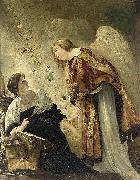
(Amersfoort, c. 1601 - Amersfoort, 10 August 1669) was a Dutch painter.
Bor was descended from a notable Catholic family. He made a study trip to Rome, where he was one of the founders of the Bentvueghels, taking the nickname Orlando. He returned in 1626 to Amersfoort and joined Jacob van Campen in the decoration of the palace Honselaarsdijk belonging to Frederik Hendrik. In 1656, he became regent of the godshuis "De Armen de Poth" in Amersfoort.
Bor's style of painting was rather at odds with that of contemporary painters from Utrecht. He initially painted rather Caravaggisti-like history paintings, but his works fast became marked by a classicism related to that of his townsman van Campen. Through unusual compositions and primitive technique, his paintings depict strange and mysterious subjects.
|
|
 |
Paula Modersohn-Becker
|
|
German
1876-1907
Paula Becker was born and grew up in Dresden-Friedrichstadt. She was the third child of seven children in her family. Her father who was the son of a Russian university professor, was employed with the German railway. He and Modersohn-Becker's mother, who was from an aristocratic family, provided the children a cultured and intellectual environment in the house hold.
Modersohn-Becker's parental home 1888-1899In 1888 her parents moved from Dresden to Bremen. While visiting an aunt in London, England, she received her first instruction in drawing. Apart from her teacher's training in Bremen in 1893-1895, Paula took private instruction in painting. In 1896 she participated in a course for painting and drawing sponsored by the "Verein der Berliner K??nstlerinnen" (Union of Berlin Female Artists) which offered art studies to women.
Paula Modersohn-Becker. Clara Rilke WesthoffAt the age of 22, she encountered the artistic community of Worpswede. In this "village", artists such as Fritz Mackensen (1866-1953) and Heinrich Vogeler (1872-1942) had retreated to protest against the domination of the art academy and life in the big city. At Worpswede, Paula Modersohn-Becker took painting lessons from Mackensen. The main subjects were the life of the farmers and the northern German landscape. At this time she began close friendships with the sculptor Clara Westhoff (1875-1954) and the poet Rainer Maria Rilke (1875-1926). She also fell in love during this period, and in 1901 she married a fellow Worpswede painter, Otto Modersohn. In marrying Otto, she also became a stepmother to Otto's daughter, Elsbeth Modersohn, the child from his first marriage to Helene Modersohn, then deceased.
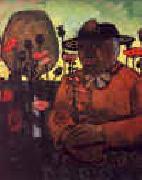
Paula Modersohn-Becker. Rainer Maria Rilke, 1906Between 1900 and 1907, Paula made several extended trips to Paris for artistic purposes, sometimes living separately from her husband, Otto. During one of her residencies in Paris, she took courses at the Ecole des Beaux-Arts. She visited contemporary exhibitions often, and was particularly intrigued with the work of Paul C??zanne. Other post impressionists were especially influential, including Vincent Van Gogh and Paul Gauguin. Fauve influences may also appear in such works as Poorhouse Woman with a Glass Bottle. The influence by the work of French painter, Jean-Francois Millet, who was widely admired among the artists in the Worpswede group, may be seen in such pieces as her 1900 Peat Cutters.
Reclining Mother and ChildIn her last trip to Paris in 1906, she produced a body of paintings from which she felt very great excitement and satisfaction. During this period of painting, she produced her initial nude self-portraits (something surely unprecedented by a female painter) and portraits of friends such as Rainer Maria Rilke and Werner Sombart. Some critics consider this period of her art production to be the strongest and most compelling.
Paula with Mathilde, November 1907 (days before Paula's death)In 1907, Paula Modersohn-Becker returned to her husband in Worpswede. Their relationship, which had been particularly strained in 1906, had taken a turn towards improvement. Paula's long-lived wish to conceive and bear a child was fulfilled. Her daughter Mathilde (Tillie) Modersohn was born on November 2, 1907. Paula and Otto were joyous. Sadly, the joy became soon overshadowed by tragedy, as Paula Modersohn-Becker died suddenly in Worpswede on November 20th from an embolism.
In 1908, Rainer Maria Rilke wrote the renowned poem, "Requiem for a Friend", in Paula's memory. The poem was born of the imprint that Paula's life, death and friendship left upon Rilke.
|
|
|
|
 |
Paul-Albert Besnard
|
|
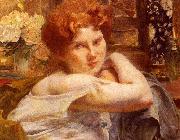
(2 June 1849 --4 December 1934) was a French painter and printmaker.
He was born in Paris and studied at the École des Beaux-Arts, studied with Jean Bremond and was influenced by Alexandre Cabanel. He won the Prix de Rome in 1874 with the painting Death of Timophanes
Until about 1880 he followed the academic tradition, but then broke away completely, and devoted himself to the study of colour and light as conceived by the Impressionists. The realism of this group never appealed to his bold imagination, but he applied their technical method to ideological and decorative works on a large scale, such as his frescoes at the Sorbonne, the Ecole de Pharmacie, the ceiling of the Comedie-Française (main theatre in Paris), the Salle des Sciences at the Hôtel de Ville, the mairie of the Ier arrondissement, and the chapel of Berck hospital, for which he painted twelve Stations of the Cross in an entirely modern spirit.
A great virtuoso, he achieved brilliant successes alike in watercolour, pastel, oil and etching, both in portraiture, in landscape and in decoration. His close analysis of light can be studied in his picture La femme qui se chauffe at the Luxembourg in Paris, one of a large group of nude studies of which a later example is Une Nymphe au bord de la mer; and in the work produced during and after a visit to India in 1911. A large panel, Peace by Arbitration, was completed seven days before the outbreak of war in 1914.
|
|
|
|
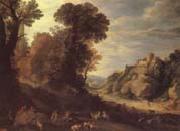 |
Paul Brill
|
|
Flemish painter , 1554-Rome 1626
were brothers, both born in Antwerp, who were landscape painters who worked in Rome after earning papal favor. They are also described as painters of capricci (whims or fancies) or vedute ideate or veduta di fantasia, with typical rustic hills with a few ruins. Mattheus began work on several frescoes in Rome from 1570 onwards, and his work includes the Vatican's Seasons. Mattheus died young, and his brother continued his work around 1574. Paul, a student of Damiaen Oertelmans, painted frescoes such as the landscapes in the Casino Rospigliosi (Rome), and The Roman Forum, which showed this site for what it had become: a slum for squatters and pasture for livestock (so much so that the place was nicknamed Campo Vaccino, or "The Cowfield"). His masterpiece may be a fresco in the Clementine Hall of the Vatican. Paul also did engravings and small cabinet paintings on copper, some of which are signed with a pair of spectacles (a pun on the French word brilles, "spectacles"). Some of these were collaborations with Johann Rottenhammer, who according to a dealer's letter of 1617 painted the figures in Venice and then sent the plates to Rome for Bril to complete the landscape. He collaborated with his friend Adam Elsheimer, who he both influenced and was influenced by, on one painting.
|
|
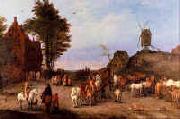 |
Paul Bril
|
|
Flemish Baroque Era Painter, ca.1554-1626
Paul (1554-1626) and Mattheus (1550-1583) Brill (or Bril) were brothers, both born in Antwerp, who were landscape painters who worked in Rome after earning papal favor. They are also described as painters of capricci (whims or fancies) or vedute ideate or veduta di fantasia, with typical rustic hills with a few ruins. Mattheus began work on several frescoes in Rome from 1570 onwards, and his work includes the Vatican Seasons. Mattheus died young, and his brother continued his work around 1574. Paul painted frescoes such as the landscapes in the Casino Rospigliosi (Rome), and The Roman Forum, which showed this site for what it had become: a slum for squatters and pasture for livestock (so much so that the place was nicknamed Campo Vaccino, or The Cowfield). His masterpiece may be a fresco in the Clementine Hall of the Vatican.
Paul also did engravings and small cabinet paintings on copper, some of which are signed with a pair of spectacles (a pun on the French word brilles, spectacles). Some of these were collaborations with Johann Rottenhammer, who according to a dealer letter of 1617 painted the figures in Venice and then sent the plates to Rome for Bril to complete the landscape. He collaborated with his friend Adam Elsheimer, who he both influenced and was influenced by, on one painting (now Chatsworth House)
|
|
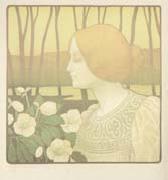 |
Paul Berthon
|
|
A truly gifted illustrator and poster artist ,
French , 1872-1909
French designer and lithographer. He began his training in Villefranche, where he studied painting, and in 1893 he moved to Paris, entering the Ecole Normale d'Enseignement du Dessin. There he became a pupil and disciple of Eug?ne-Samuel Grasset, the Professor of Decorative Arts, and was also influenced by Luc Olivier Merson. Berthon's main output consisted of posters and decorative panels. However, he also produced bookbindings and furniture designs, both of which he exhibited at the Salon in 1895; designs for ceramics for Villeroy & Boch in the late 1890s; and a few designs for the covers of such magazines as L'Image (July 1897) and Poster (May 1899). His work is in an Art Nouveau style, and he adopted that movement's plant and figural motifs, especially the motif of the femme fatale, and also its long sinuous lines.
|
|
|
|
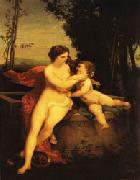 |
Paul Baudry
|
|
French Academic Painter, 1828-1886. Specializes in Portraits
Specializes in Portraits.was a French painter. He studied under Michel Martin Drolling and carried off the Prix de Rome in 1850 by his picture of Zenobia found on the banks of the Araxes. His talent from the first revealed itself as strictly academical, full of elegance and grace, but somewhat lacking originality. In the course of his residence in Italy Baudry derived strong inspiration from Italian art with the mannerism of Correggio, as was very evident in the two works he exhibited in the Salon of 1857, which were purchased for the Luxembourg: The Martyrdom of a Vestal Virgin and The Child. His Leda, St John the Baptist, and a Portrait of Beul, exhibited at the same time, took a first prize that year. Throughout this early period Baudry commonly selected mythological or fanciful subjects, one of the most noteworthy being The Pearl and the Wave (1862). Once only did he attempt an historical picture, Charlotte Corday after the murder of Marat (1861); and returned by preference to the former class of subjects or to painting portraits of illustrious men of his day: Guizot, Charles Garnier, Edmond About. The works that crowned Baudrys reputation were his mural decorations, which show much imagination and a high artistic gift for color, as may be seen. in the frescoes in the Paris Court of Cassation. at the château of Chantilly, and some private residences the Hôtel Fould and Hôtel Paivabut, above all, in the decorations of the foyer of the Opera Garnier. These, more than thirty paintings in all, and among them compositions figurative of dancing and music, occupied the painter for ten years. Baudry was a member of the Institut de France, succeeding Jean-Victor Schnetz. Two of his colleagues,
|
|
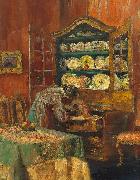 |
Paul Barthel
|
|
painted Interieur mit geoffneter Vitrine in 1862 - 1933
|
|
|
|
|
|
|
|
|
| Wholesale China Oil Painting Wholesale Oil Painting China Xiamen Portrait Reproduction on canvas Chinese Oil Painting Wholesale USA Oil Painting |
|
|
|
|
|