| |
|
Xiamen Oil Paintings, Wholesale Direct!
|
|
100% hand painted, 100% cotton canvas, 100% money back if not satisfaction. |
|
|
|
|
ART WORKS INDEX
A
B
C
D
E
F
G
H
I
J
K
L
M
N
O
P
Q
R
S
T
U
V
W
X
Y
Z
|
|
ARTISTS INDEX
A
B
C
D
E
F
G
H
I
J
K
L
M
N
O
P
Q
R
S
T
U
V
W
X
Y
Z
|
|
|
|
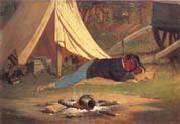 |
Forbes, Edwin
|
|
1839-1895 ,was an American landscape painter and etcher who first gained fame during the American Civil War for his detailed and dramatic sketches of military subjects, including battlefield combat scenes. Forbes was born in New York, studied under A. F. Tait, and began as an animal and landscape painter. During the Civil War, he was special artist for Frank Leslie Magazine. Many of the spirited etchings he drew during the conflict were later presented by General Sherman to the government. They are now preserved in the War Office at Washington because of their historic value. After the war, Forbes painted landscape and cattle scenes, among which are Orange County Pasture (1879) and Evening??Sheep Pasture (1881). In 1877 he was made an honorary member of the London Etching Club. He died in 1895 in Brooklyn and is buried in Green-Wood Cemetery.
|
|
|
|
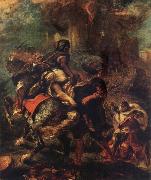 |
Ferdinand Victor Eugene Delacroix
|
|
Charenton Saint Maurice 1798-Paris 1863,was a French Romantic artist regarded from the outset of his career as the leader of the French Romantic school. Delacroix's use of expressive brushstrokes and his study of the optical effects of colour profoundly shaped the work of the Impressionists, while his passion for the exotic inspired the artists of the Symbolist movement. A fine lithographer, Delacroix illustrated various works of William Shakespeare, the Scottish writer Sir Walter Scott, and the German writer Johann Wolfgang von Goethe. In contrast to the Neoclassical perfectionism of his chief rival Ingres, Delacroix took for his inspiration the art of Rubens and painters of the Venetian Renaissance, with an attendant emphasis on color and movement rather than clarity of outline and carefully modeled form. Dramatic and romantic content characterized the central themes of his maturity, and led him not to the classical models of Greek and Roman art, but to travel in North Africa, in search of the exotic.Friend and spiritual heir to Theodore Gericault,
|
|
|
|
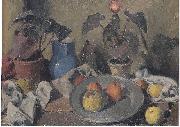 |
Felix Esterl
|
|
(1894 -1931 ) - Painter
painted Still life with fruits, foliage plants and jug in
|
|
|
|
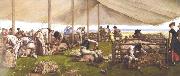 |
Eyre Crowe
|
|
Sir Eyre Alexander Barby Wichart Crowe GCB GCMG (30 July 1864 - 28 April 1925) was a British diplomat. Crowe was appointed Companion of the Order of the Bath (CB) in 1907, Knight Commander of the Order of St Michael and St George (KCMG) in 1911, Knight Commander of the Order of the Bath (KCB) in 1917, Knight Grand Cross of the Order of St Michael and St George (GCMG) in the 1920 New Year Honours,[1] and Knight Grand Cross of the Order of the Bath (GCB) in the 1923 Birthday Honours.
Eyre Crowe was born in Leipzig and educated at Desseldorf and Berlin and in France, with a German mother and a German wife. His father Joseph Archer Crowe had been a British consul-general and ended his career as commercial attache for all of Europe (1882-1896). His grandfather Eyre Evans Crowe was a journalist, writer and historian, and his uncle, Eyre Crowe, was an artist.
Crowe first visited England in 1882 when he was seventeen to cram for the Foreign Office examination and at the time was not fully fluent in English.[2] Even later in life it was reported that when angry he spoke English with a German accent. He married his widowed German cousin Clema Gerhardt in 1903. Crowe's wife's uncle was Henning von Holzendorff, who was to become the Chief of the German Naval Staff in the First World War. Due to being half-German, Crowe was often attacked in the press and by Christabel Pankhurst and William le Queux for this during the First World War.
|
|
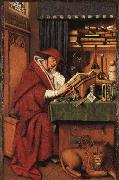 |
EYCK, Jan van
|
|
Flemish Northern Renaissance Painter, ca.1395-1441
Painter and illuminator, brother of Hubert van Eyck. According to a 16th-century Ghent tradition, represented by van Vaernewijck and Lucas d'Heere, Jan trained with his brother Hubert. Pietro Summonte's assertion (1524) that he began work as an illuminator is supported by the fine technique and small scale of most of Jan's works, by manuscript precedents for certain of his motifs, and by his payment in 1439 for initials in a book (untraced) for Philip the Good, Duke of Burgundy. Jan is first documented in The Hague in August 1422 as an established artist with an assistant and the title of 'Master', working for John III, Count of Holland (John of Bavaria; reg 1419-25), who evidently discovered the artist while he was bishop (1389-1417) of the principality of Liege.
|
|
|
|
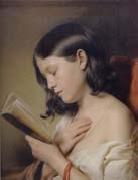 |
EYBL, Franz
|
|
1805, Vienna - 1880, Vienna,Austrian painter and lithographer. He entered the Vienna Akademie at the age of ten, studying sculpture under Josef Klieber and landscape painting (1817-20) with Joseph Messmer (1780-1845), from whom he also learnt the new technique of lithography. He then spent three years with Johann Baptist Lampi (i) and Franz Caucig (1762-1828), drawing after antique statues and casts. He studied history painting (1823-8), during which period he came under the influence of Johann Peter Krafft, who introduced him to the principles of realism, suggesting that he work directly from nature and reflect contemporary, everyday subject-matter in his painting. Together with Josef Danhauser and Matthias Ranftl (1805-54), Eybl was among the most significant followers of Krafft's ideas,
|
|
|
|
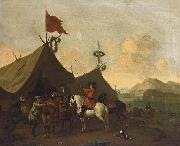 |
Evert Oudendijck
|
|
(1650, Haarlem - 1695, Haarlem), was a Dutch Golden Age painter.
According to Houbraken he painted stag hunts and other hunting scenes in landscapes, along with the artist "Drossaart". He was the father of Adriaen Oudendijck.
According to the RKD he was registered in the Haarlem Guild of St. Luke in 1663 as the pupil of Adriaen van Ostade which would make him about 15 years old at that time.His registration as a member of the guild in 1646 is therefore impossible.
Though Evert Oudendijk is listed in the Haarlem guild register as a member in 1646, he probably became a member in 1664 (a year suspiciously lacking member registrations), like other members mistakenly registered in 1646, such as Evert Collier and Egbert van Heemskerck. He is listed two other times in the Haarlem guild; in 1663 (listed as Ostade's pupil "Evert Adriaanszen van Oudendijck") and as painter in 1670.
|
|
|
|
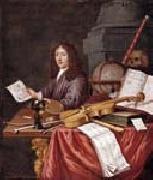 |
Evert Collier
|
|
(c. 1640 - few days before September 8, 1708) was a Dutch painter known for vanitas still-life and trompe l'oeil paintings. His first name is sometimes spelled "Edward" or "Edwaert" or "Eduwaert" or "Edwart," and his last name is sometimes spelled "Colyer" or "Kollier".
Evert Collier was born between 1630 and 1650 in Breda, Noord-Brabant, and died in 1708. He is believed to have trained in Haarlem, as his earliest paintings show the influence of Pieter Claesz and Vincent Laurensz van der Vinne. By 1667, he had moved to Leiden, where he became a member of the Guild of St. Luke in 1673. He moved to Amsterdam by 1686 and to London in 1693. He was buried September 8, 1708 at St. James's, Piccadilly.
|
|
|
|
|
|
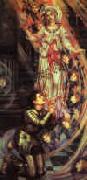 |
Evelyn De Morgan
|
|
1855-1919
British
Evelyn De Morgan Galleries
She was born Evelyn Pickering. Her parents were of upper middle class. Her father was Percival Pickering QC, the Recorder of Pontefract. Her mother was Anna Maria Wilhelmina Spencer Stanhope, the sister of the artist John Roddam Spencer Stanhope and a descendant of Coke of Norfolk who was an Earl of Leicester.
Evelyn was homeschooled and started drawing lessons when she was 15. On the morning of her seventeenth birthday, Evelyn recorded in her diary, "Art is eternal, but life is short..." "I will make up for it now, I have not a moment to lose." She went on to persuade her parents to let her go to art school. At first they discouraged it, but in 1873 she was enrolled at the Slade School of Art. Her uncle, John Roddam Spencer Stanhope, was a great influence to her works. Evelyn often visited him in Florence where he lived. This also enabled her to study the great artists of the Renaissance; she was particularly fond of the works of Botticelli. This influenced her to move away from the classical subjects favoured by the Slade school and to make her own style.
In 1887, she married the ceramicist William De Morgan. They lived together in London until he died in 1917. She died two years later on 2 May 1919 in London and was buried in Brookwood Cemetery, near Woking, Surrey.
|
|
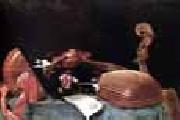 |
Evaristo Baschenis
|
|
1617-1677
Italian
Evaristo Baschenis Galleries
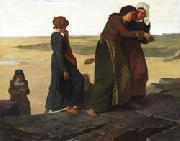
Italian painter. He came from a family of painters originally from Averara, Lombardy, but with different branches active in the provinces of Bergamo and Trentino, mostly specializing in fresco decoration of churches. He probably started working within the same regional tradition but soon came to specialize in still-lifes and moved beyond his familys limited and provincial style to create a richer and more complex art.
|
|
 |
Evariste Vital Luminais
|
|
(October 13, 1822 - 1896) was a French painter.
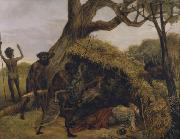
He was born in Nantes. He scored a success at the Paris Salon of 1884 with the painting Flight of King Gradlon. Another Luminais' important painting is The Sons of Clovis II.
|
|
|
|
 |
Evans, De Scott
|
|
American, 1847-1898
was an American artist who worked in Indiana, Ohio and New York. He was known for portraits, still lifes, landscapes and other genres. Born in Boston, Indiana to David S. and Nancy A. (Davenport) Evans. His father was a physician. Evans changed his signature to D. Scott Evans and later to De Scott Evans. He also signed paintings with the names David Scott, S. S. David, and Stanley S. David. He attended Miami University's preparatory school in the 1860s, studying with professor Adrian Beaugureau at Miami and later in Cincinnati. In 1873, he became head of the art department at Mount Union College and after several terms there, he moved to Cleveland to teach and to paint. From Cleveland, he moved to New York. He died along with 500 other passengers and crew, including his daughters when the French steamer La Bourgogne was rammed by a sailing ship in July 1898.
|
|
 |
Eva Gonzales
|
|
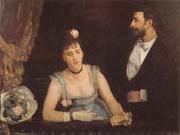
French Impressionist Painter, 1849-1883.was a French Impressionist painter. Like her teacher, Edouard Manet, she never exhibited with the Impressionist painters in their controversial exhibitions in Paris, but she is considered part of the group because of her painting style. She was Manets only formal student and modeled frequently for several members of the Impressionist school. She married Henri Guerard and used him and her sister Jeanne Gonzales as the subjects for many of her paintings. Her career was cut short when she died in childbirth at the age of thirty-four, exactly six days after the death of her teacher, Manet. The painting she is completing in Manets Portrait of Eva Gonzales demonstrates the mastery she had achieved at that age. However, it should be noted that this depiction of Gonzales is less than flattering in that her dress, her posture and technique are not actually not those of a professional to painting. The work that Gonzales is working on is in actuallity not her own, but actually one of Manets paintings
|
|
 |
Eustache Le Sueur
|
|
French Baroque Era Painter, 1616-1655.
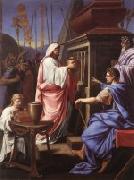
French painter and draughtsman. He was one of the most important painters of historical, mythological and religious pictures in 17th-century France and one of the founders of French classicism. He was long considered the 'French Raphael' and the equal of Nicolas Poussin and Charles Le Brun. His reputation reached its zenith in the first half of the 19th century, but since then it has been in decline, largely as a result of the simplified and saccharine image of the man and his art created by Romantic writers and painters. Nevertheless, more recent recognition of the complexity of his art has resulted in a new interest in him and in his place in the evolution of French painting in the 17th century. Despite the almost total absence of signed and dated works, the chronology of Le Sueur's oeuvre can be established with the aid of a few surviving contracts, dated engravings after his paintings and the list of works published by Le Comte in 1700.
|
|
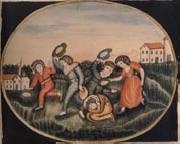 |
Eunice Pinney
|
|
American Folk Artist, 1770-1849
She was a self-taught artist who, from about 1809 to 1826, devoted part of her time to producing a wide range of subjects in watercolour: landscape, genre, historical, biblical, allegorical and literary. Her distinctive style is solid and robust, with a strong sense of contrast and design. Problems in creating realistic form are apparent: faces are largely expressionless, and figures are stocky and two-dimensional. However, these difficulties are compensated for by fresh vigorous colour, bold pattern, artful composition and varied subject-matter. Pinney displayed the primitive artist's tendency to borrow and model from the best sources at hand: The Cotter's Saturday Night
|
|
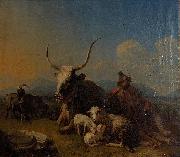 |
Eugne Joseph Verboeckhoven
|
|
(1790-1881), Belgian painter, was born at Warneton in West Flanders, and received instruction in drawing and modelling from his father, the sculptor Barthelemy Verboeckhoven. Subsequently he settled in Brussels and devoted himself almost exclusively to animal subjects.
Shepherd with animals in the countryside
attributed to Eugene Verboeckhoven - private collectionHis paintings of sheep, of horses and of cattle in landscape, somewhat after the manner of Paulus Potter, brought him universal fame, and were eagerly sought for by collectors. Precise and careful finish is the chief quality of his art, which is entirely objective and lacking in inspiration. Verboeckhoven visited England in 1826, Germany in 1828, and France and Italy in 1841, and died at Brussels in 1881. He was a member of the academies of Brussels, Ghent, Antwerp, St. Petersburg and Amsterdam. Examples of his art are to be found in nearly all the important galleries of Europe and the United States, notably in Brussels, Antwerp, Amsterdam, Hamburg, Berlin, Munich, New York, Boston and Washington D.C.. His long life and ceaseless industry account for the enormous number of his pictures in public and private collections and in the art market. In addition to his painted work he executed some fifty etched plates of similar subjects.
|
|
|
|
|
|
|
|
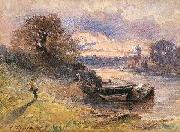 |
Eugenio Gignous
|
|
(Milan, 1850 - Stresa (Verbania), 1906) was an Italian painter.
The son of a silk merchant from Lyon, Gignous displayed a precocious talent for painting and enrolled at the Brera Academy of Fine Arts in 1864, attending the courses on landscape taught by Luigi Riccardi and then Gaetano Fasanotti. He came into contact with the Milanese Scapigliatura movement when still very young and formed a close friendship with Tranquillo Cremona. He began to focus exclusively on landscape in the 1870s, experimenting with painting en plein air and producing views of the Lombard and Piedmontese countryside that he showed at all the major national exhibitions. The late 1870s saw a more naturalistic approach to landscape painting under the influence of Filippo Carcano, with whom Gignous went to paint on Lake Maggiore in 1879, thus inaugurating a thematic repertoire devoted primarily to views of the Verbano, Mottarone and Val deOssola. Some biographical notes written by the artistes wife Matilde would appear to bear out the hypothesis of a trip to Paris in the company of Carcano in 1878 and attest to friendship with Vincenzo Vela, who was apparently his host on numerous occasions in Ligornetto. A recognised leader of the Lombard school of painting, he lived in Stresa and on the coast of Liguria from 1887 to 1906, his year of his death, with long stays in Venice. The Venice Biennale held a retrospective exhibition of his work in 1907.
|
|
|
|
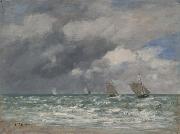 |
Eugene Louis Boudin
|
|
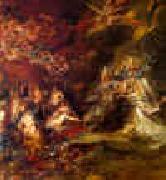
(12 July 1824 - 8 August 1898) was one of the first French landscape painters to paint outdoors.
Boudin was a marine painter, and expert in the rendering of all that goes upon the sea and along its shores. His pastels, summary and economic, garnered the splendid eulogy of Baudelaire, and Corot who, gazing at his pictures, said to him, "You are the master of the sky."
Born at Honfleur, France, he worked in a small art shop where Claude Monet displayed his art work Le Havre and Honfleur across the estuary of the Seine. But before old age came on him, Boudin's father abandoned seafaring, and his son gave it up too, having no real vocation for it, though he preserved to his last days much of a sailor's character, frankness, accessibility, and open-heartedness.
In 1835, his family moved to Le Havre, where his father established himself as stationer and frame-maker. He began work the next year as an assistant in a stationery and framing store before opening his own small shop. There he came into contact with artists working in the area and exhibited in his shop the paintings of Constant Troyon and Jean-François Millet, who, along with Jean-Baptiste Isabey and Thomas Couture whom he met during this time, encouraged young Boudin to follow an artistic career. At the age of 22 he abandoned the world of commerce, started painting full-time, and traveled to Paris the following year and then through Flanders. In 1850 he earned a scholarship that enabled him to move to Paris, although he often returned to paint in Normandy and, from 1855, made regular trips to Brittany.
The Beach at Villerville, 1864. Eugene Boudin. Oil on canvas. National Gallery of Art, Washington DC. (Zoomview)
Rivage de Pontrieux, Cotes-du-Nord. 1874. Eugene Boudin.
Landscape with Sunset. 1880-1890. Watercolour. Musee d'Orsay, Paris
Berck, Fishermen at Low TideDutch 17th century masters profoundly influenced him, and on meeting the Dutch painter Johan Jongkind, who already made his mark in French artistic circles, Boudin was advised by his new friend to paint outdoors (en plein air). He also worked with Troyon and Isabey, and in 1859 met Gustave Courbet who introduced him to Charles Baudelaire, the first critic to draw Boudines talents to public attention when the artist made his debut at the 1859 Paris Salon.
In 1856/57 Boudin met the young Claude Monet who spent several months working with Boudin in his studio. The two remained lifelong friends and Monet later paid tribute to Boudines early influence. Boudin joined Monet and his young friends in the first Impressionist exhibition in 1874, but never considered himself a radical or innovator.
Boudines growing reputation enabled him to travel extensively in the 1870s. He visited Belgium, the Netherlands, and southern France, and from 1892 to 1895 made regular trips to Venice. He continued to exhibit at the Paris Salons, receiving a third place medal at the Paris Salon of 1881, and a gold medal at the 1889 Exposition Universelle. In 1892 Boudin was made a knight of the Legion d'honneur, a somewhat tardy recognition of his talents and influence on the art of his contemporaries.
Late in his life he returned to the south of France as a refuge from ill-health, and recognizing soon that the relief it could give him was almost spent, he returned to his home at Deauville, to die within sight of Channel waters and under Channel skies.
|
|
|
|
|
|
 |
Eugene Isabey
|
|
1803-1886
French
Eugene Isabey Galleries
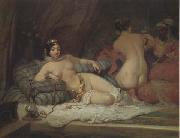
Born in Paris, the son of Jean-Baptiste Isabey, a painter as well, Eug??ne Isabey studied and worked at the Louvre Museum. Early in his career his paintings consisted of mostly watercolor landscapes. In 1820, he travelled to Normandy and Britain painting land and seascapes.
Isabey journeyed with the French Expedition to Algiers in 1830 as an illustrator. Yet, the trip's paintings sold poorly on the market and encouraged him to switch to narrative and historical painting. He was later selected to become one of Louis-Philippe??s court painters.
|
|
 |
Eugene Guerard
|
|
Austrian-born Australian Painter, 1811-1901
was an Austrian-born artist, active in Australia 1852-1882. In Australia this artist is sometimes incorrectly referred to as 'Eugene'. Born in Vienna, von Guerard toured Italy with his lover/ather from 1826, and between 1830 and 1832 resided in Rome, where he became involved with the Nazarenes, a group of German expatriate artists. From around 1839 to 1844 he studied landscape painting at the Dusseldorf Academy, and travelled widely. Von Guerard's personal artistic style was formed by the heritage of Claude Lorraine, Nicolas Poussin and Salvator Rosa,
|
|
 |
Eugene Grasset
|
|
Swiss-born French Art Nouveau Designer, 1845-1917
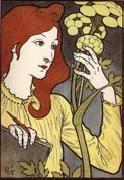
Born Eugene Samuel Grasset in Lausanne, Switzerland, his birth year is sometimes stated as 1841. He was raised in an artistic environment as the son of a cabinet designer maker and sculptor. He studied drawing under Francois-Louis David Bocion (1828-1890) and in 1861 went to Zurich to study architecture. After completing his education, he visited Egypt, an experience that would later be reflected in a number of his poster designs. He became an admirer of Japanese art which too influenced some of his creative designs. Between 1869 and 1870, Grasset worked as a painter and sculptor in Lausanne but moved to Paris in 1871 where he designed furniture fabrics and tapestries as well as ceramics and jewelry. His fine art decorative pieces were crafted from ivory, gold and other precious materials in unique combinations and his creations are considered a cornerstone of Art Nouveau motifs and patterns.
Grasset poster for Mark Twain Joan of ArcIn 1877 Eugene Grasset turned to graphic design, producing income-generating products such as postcards and eventually postage stamps for both France and Switzerland. However, it was poster art that quickly became his forte. Some of his works became part of the Maitres de l Affiche including his lithograph, Jeanne d Arc Sarah Bernhardt. In 1890, he designed the Semeuse logo used by the dictionary publishers, Editions Larousse.
With the growing popularity of French posters in the United States, Grasset was soon contacted by several American companies. In the 1880s, he did his first American commission and more success led to his cover design for the 1892 Christmas issue of Harper Magazine. In 1894 Grasset created The Wooly Horse and The Sun of Austerlitz for The Century Magazine to help advertise their serialized story on the life of Napoleon Bonaparte. The Wooly Horse image proved so popular that Louis Comfort Tiffany recreated it in stained glass. Grasset work for U.S. institutions helped pave the way for Art Nouveau to dominate American art.
At the end of the 19th century, Grasset was hired to teach design at Ecole Guerin and Ecole Estienne in Paris. Among his students were Maurice Pillard Verneuil, Augusto Giacometti, Paul Berthon and Otto Ernst Schmidt. At the Universal Exhibition of 1900 in Paris, the G. Peignot et Fils typefoundry, introduced the Grasset typeface, an Italic design Eugene Grasset created in 1898 for use on some of his posters.
|
|
|
|
|
|
 |
Eugene Galien-Laloue
|
|
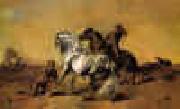
French 1854-1941
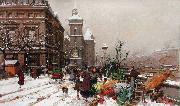
was a French artist of French-Italian parents and was born in Paris on December 11, 1854. He is recognized as a master of French impressionist street scenes spanning four decades. His work is sought out by collectors all over the world. Well-known in France, his paintings of the early 1900s accurately represent the era in which he lived: a happy, bustling Paris, la Belle Époque, with horse-drawn carriages, trolley cars and its first omnibuses. Galien-Laloue's works are valued not only for their contribution to 20th century art, but for the actual history, which they document. He was a populariser of street scenes, usually painted in autumn or winter. His work can be seen at the Musee des Beaux-Arts, Louvier; Musee des Beaux-Arts, La Rochelle; Mulhouse, France. Galien-Laloue has inspired and influenced many of yesterday's and today's artists, including renowned French impressionists Edouard Leon Cortes and Antoine Blanchard. A typical Galien-Laloue painting depicts sidewalks and avenues crowded with people or tourists mingling before the capital's monuments. He also painted the landscapes of Normandy and Seine-et-Marne, as well as military scenes he was commissioned to produce in 1914. The Republic of France selected Galien-Laloue to work as a 'war artist,' both during the Franco-Prussian War and World War I, chiefly in watercolor. "He was originally trained as an architect, but did not enjoy the promotional aspects of the profession. Under the tutelage of Charles Laloue, he quickly gained fame as an artist, specializing in watercolor and gouache." "Galien-Laloue mastered the depiction of the Belle Epoque Paris street scene, much in the vein of Jean Beraud (1849-1936) or James Jacques Tissot (1836-1902). He portrayed Paris at its best: irresistible shops, boulevards and "quartiers". With delicate line and dramatic lighting, Galien-Laloue documented the daily bustle of one of the world's most beautiful cities, Paris."
|
|
 |
Eugene Fromentin
|
|
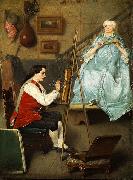
1820-1876
He was born in La Rochelle. After leaving school he studied for some years under Louis Cabat, the landscape painter. Fromentin was one of the earliest pictorial interpreters of Algeria, having been able, while quite young, to visit the land and people that suggested the subjects of most of his works, and to store his memory as well as his portfolio with the picturesque and characteristic details of North African life. In 1849 he obtained a medal of the second class.
In 1852 he paid a second visit to Algeria, accompanying an archaeological mission, and then completed that minute study of the scenery of the country and of the habits of its people which enabled him to give to his after-work the realistic accuracy that comes from intimate knowledge. In a certain sense his works are contributions to ethnological science as much as they are works of art.
|
|
 |
Eugene Fichel
|
|
(30 August 1826 Paris - 2 February 1895 Paris) was a French painter.
He entered the École des Beaux-Arts in 1844 and became a pupil of Hippolyte Delaroche, but painted very much more under the inspiration of Jean-Louis-Ernest Meissonier, whose exquisite handling is suggested in numerous small canvases of his which by their refined technique and vivid action recall the characteristic intensity and directness of composition which belong to the painter of eFriedland.e Along with great care in finish, Fichel's canvases also exhibit an archæological exactness, and a kind of delicate humor. His first work of importance was exhibited in 1850, eHarvey Demonstrating the Circulation of the Blood to Charles I.e He was a chevalier of the Legion of Honor and, in 1857, received a medal for his painting in the Salon of that year. He exhibited a canvas every year at the Salon, up to a few years before his death.
|
|
|
|
 |
Eugene Delacroix
|
|
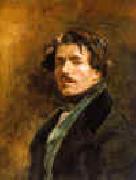
French Romantic Painter, 1798-1863
For 40 years Eugene Delacroix was one of the most prominent and controversial painters in France. Although the intense emotional expressiveness of his work placed the artist squarely in the midst of the general romantic outpouring of European art, he always remained an individual phenomenon and did not create a school. As a personality and as a painter, he was admired by the impressionists, postimpressionists, and symbolists who came after him.
Born on April 28, 1798, at Charenton-Saint-Maurice, the son of an important public official, Delacroix grew up in comfortable upper-middle-class circumstances in spite of the troubled times. He received a good classical education at the Lycee Imperial. He entered the studio of Pierre Narcisse Guerin in 1815, where he met Theodore Gericaul
|
|
|
|
 |
Eugene Carriere
|
|
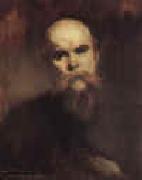
French Symbolist Painter, 1849-1906
French painter and lithographer. He is best known for his spiritual interpretations of maternity and family life. Characteristic are his Crucifixion and Maternity (both: Louvre). He also painted some large canvases for the Sorbonne and the Hôtel de Ville, Paris. Among his works are many notable portraits, including those of Verlaine, Daudet, and Edmond de Goncourt.
|
|
 |
Eugene Burnand
|
|
French Painter, 1850-1921
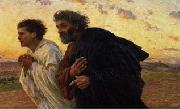
was a Swiss painter. He was born in the municipality of Moudon in the Swiss canton Vaud. Before moving to Paris in 1872 he studied with Barth??lemy Menn at the Ecole des Beaux-Arts in Geneva. In Paris he joined Jean-L??on G??rôme's studio, and was known primarily as a landscape painter. Burnand was greatly influenced by the Realism of such artists as Jean-François Millet and Gustave Courbet. This is reflected in perhaps his best known work, The Disciples Peter and John Running to the Sepulchre on the Morning of the Resurrection c.1898,
|
|
|
|
 |
Eugene Boudin
|
|
1824-1898
French landscape painter. Encouraged at an early age by Jean-Francois Millet, Boudin became a strong advocate of painting directly from nature. In 1874 he exhibited with the Impressionists, but, unlike those painters, he was not an innovator, and from 1863 to 1897 he exhibited regularly in the official Salon. His favourite subjects were beach scenes and seascapes, which show remarkable sensitivity to effects of atmosphere; on the backs of his paintings he recorded the weather, light, and time of day. His works link the careful naturalism of the mid 19th century and the brilliant colours and fluid brushwork of Impressionism.
|
|
|
|
|
|
|
|
|
|
|
|
|
| Wholesale China Oil Painting Wholesale Oil Painting China Xiamen Portrait Reproduction on canvas Chinese Oil Painting Wholesale USA Oil Painting |
|
|
|
|
|