| |
|
Xiamen Oil Paintings, Wholesale Direct!
|
|
100% hand painted, 100% cotton canvas, 100% money back if not satisfaction. |
|
|
|
|
ART WORKS INDEX
A
B
C
D
E
F
G
H
I
J
K
L
M
N
O
P
Q
R
S
T
U
V
W
X
Y
Z
|
|
ARTISTS INDEX
A
B
C
D
E
F
G
H
I
J
K
L
M
N
O
P
Q
R
S
T
U
V
W
X
Y
Z
|
|
|
|
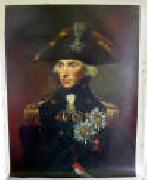 |
Lemuel Francis Abbott
|
|
1760-1803
Lemuel Francis Abbott Locations
English painter. He was the son of a clergyman and went to London to study with Francis Hayman shortly before the latter death in 1776; he may have completed his studies in Derby with Joseph Wright of Derby. By the early 1780s Abbott had established a busy portrait practice in London. The formula he adopted for most of his head-and-shoulder portraits can be seen in Sir William Herschel (1785; London, N. Mar. Mus.): the body is parallel to the picture plane, and the sitter head is moved into three-quarter profile, as if his attention has been suddenly distracted. In later portraits, such as those of fellow artists Francesco Bartolozzi (c. 1792; London, Tate) or Joseph Nollekens (c. 1797; London, N.P.G.), the sitter hand or some attribute balances the movement of the head. Only male portraits by Abbott are known, and his patrons were mostly drawn from the professional classes, particularly the Navy; there are several versions of Lord Nelson (e.g. 1798; London, N. Mar. Mus.). His style is crisp but scratchy in technique, and often the anatomy of his figures is inaccurate. Paint is handled in a manner comparable with that of Gainsborough Dupont, but Abbott sense of composition is superior. In 1798 he was certified insane, but he continued to exhibit at the Royal Academy in London for two further years. Several of his works were probably finished by another hand.
|
|
|
|
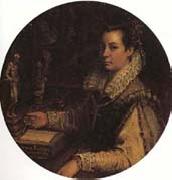 |
Lavinia Fontana
|
|
Italian Painter, 1552-1614
Daughter of Prospero Fontana. She was trained by her father and followed his Mannerist style. Her first recorded works, which date from 1575, were small paintings for private devotion, such as the Holy Family (Dresden, Gemeldegal.). By 1577 she had become established as a portrait painter in Bologna. Works of this date include the Self-portrait at the Harpsichord (Rome, Gal. Accad. S Luca) and the portrait of Senator Orsini (Bordeaux, Mus. B.-A.). Her portrait style reflects the formality of central Italian models as well as the naturalistic tendencies of the north Italian tradition. The elegantly costumed Orsini is shown seated at a table, with a suite of rooms opening behind him, a setting recalling such Florentine portraits of the 1530s as Agnolo Bronzino's Bartolommeo Panciatichi (Florence, Uffizi). Lavinia used a similar setting for other portraits, including the Gozzadini Family (1584; Bologna, Pin. N.). Female sitters are also shown in elaborate dress, with particular attention paid to details of embroidery and jewels, and they are often accompanied by small dogs
|
|
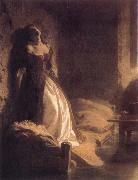 |
Konstantin Flavitsky
|
|
b Moscow, 25 Sept 1830; d St Petersburg, 15 Sept 1866,Russian painter. He completed his studies at the Academy of Arts in St Petersburg in 1855. The influence of Karl Bryullov was central to Flavitsky work. He combined the theatricality of academicism and the elegance of salon painting with a desire to observe a degree of realism in his subjects and to relate history to present events, thereby anticipating new developments in Russian history painting.
|
|
|
|
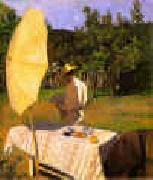 |
Karoly Ferenczy
|
|
1863-1917
Karoly Ferenczy Locations
was a Hungarian Impressionist painter. He was one of the leading artists of the Nagybanya school of painting. He studied law and economics. He began to deal with painting at the Academie Julian in Paris. In 1889, he moved back to Hungary, to the town of Szentendre. Between 1893 and 1896 he lived in Munich with his family: There he joined the circle of Simon Hollosy: with whom he moved to Nagybanya in 1896 and became the leading painter of the artist colony. After 1906 he moved to Budapest and became the professor of the College of Fine Arts. His wife Olga Fialka and their children, the painter Valer Ferenczy (1885-1954), the tapestry weaver Noemi Ferenczy (1890-1957) and the sculptor Beni Ferenczy (1890- 1967) were famous representatives of Hungarian art.
|
|
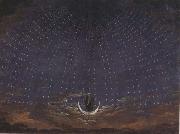 |
Karl friedrich schinkel
|
|
German Painter and Architect, 1781-1841
German architect and painter. As state architect of Prussia (from 1815), he executed many commissions for Frederick William III and other royal family members. He based his work on the revival of various historical styles. His mausoleum for Queen Louise (1810) and the brick and terra-cotta Werdersche Kirche, Berlin (1821 ?C 30), are among the earliest Gothic Revival designs in Europe. Other works include the Greek Revival Schauspielhaus (1818) and Altes Museum (1822 ?C 30), both in Berlin. In 1830 Schinkel became director of the Prussian Office of Public Works; his work as a city planner resulted in new boulevards and squares in Berlin.
|
|
|
|
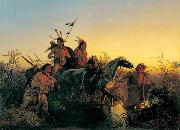 |
Karl Ferdinand Wimar
|
|
(also known as Charles Wimar and Carl Wimar) (1828-1862), was a German-American painter who concentrated on Native Americans in the West and the great herds of buffalo.
He is known for an early painting of a colonial incident: his The Abduction of Boone's Daughter by the Indians (1855-1856), a depiction of the 1776 capture near Boonesborough, Kentucky of Jemima Boone and two other girls by a Cherokee-Shawnee raiding party.
|
|
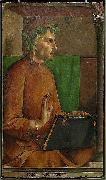 |
Justus van Gent
|
|
(or Joos van Wassenhove), Justus or Jodocus of Ghent, or Giusto da Guanto (c. 1410 - c. 1480) was an Early Netherlandish painter who later worked in Italy.
The public records of the city of Ghent have been diligently searched, but in vain, for a clue to the history of Justus or Jodocus, whom Vasari and Guicciardini called Giusto da Guanto. Flemish annalists of the 16th century have enlarged upon the scanty, unsourced statements of Vasari, and described Jodocus as a pupil of Hubert van Eyck. The registers of the Guild of St Luke at Ghent comprise six masters of the name of Joos or Jodocus who practised at Ghent in the 15th century. But none of the works of these masters has been preserved, and it is impossible to compare their style with that of Giusto.
Federico da Montefeltro and His Son, GuidobaldoBetween 1465 and 1474, this artist executed the Communion of the Apostles which Vasari described, and which is now in the Galleria Nazionale delle Marche in Urbino. It was painted for the brotherhood of Corpus Christi at the bidding of Frederick of Montefeltro, who was introduced into the picture as the companion of Caterino Zeno, a Persian envoy at that time on a mission to the court of Urbino. From this curious production it may be seen that Giusto, far from being a pupil of the putative Hubert Van Eyck, must have been studied with a later master, possibly Dieric Bouts.
As a composer and draughtsman Giusto compares unfavourably with the better-known painters of Flanders; though his portraits are good, his ideal figures are not remarkable for subtlety of character and expression. Technically, he compares on a level with that of Geertgen tot Sint Jans, whose most famous pictures are preserved in the Kunsthistorisches Museum at Vienna. Vespasian, a Florentine bookseller who contributed much to form the antiquarian taste of Frederick of Montefeltro, states that this duke sent to the Netherlands for a capable artist to paint a series of ancient worthies for a library recently erected in the palace of Urbino. It has been conjectured that the author of these 28 portraits of "Famous Men," which are still in existence at the Louvre and in the Galleria Nazionale delle Marche at Urbino, was Justus van Gent.
Seven (?) Liberal Arts: a young man (Constanzo Sforza?) before Music (National Gallery, London). Another painting from this cycle, with Federigo da Montefeltro before Rhetoric was destroyed in Berlin in 1945Yet there are notable divergences between these pictures and the Communion of the Apostles. Still, it is possible that Giusto should have been able, after a certain time, to temper his Flemish style by studying the masterpieces of Santi and Melozzo, and so to acquire the mixed manner of the Flemings and Italians which these portraits of worthies display. Such an assimilation, if it really took place, might justify the Flemings in the indulgence of a certain pride, considering that Raphael not only admired these worthies, but copied them in the sketch-book which is now the ornament of the Venetian Academy. There is no ground for presuming that Giusto da Guanto is identical with Justus d'Allamagna who painted the Annunciation (1451) in the cloisters of Santa Maria di Castello at Genoa. The drawing and coloring of this wall painting shows that Justus d'Allamagna was as surely a native of south Germany as his homonym at Urbino was a born Netherlander.
|
|
|
|
 |
Julian Falat
|
|
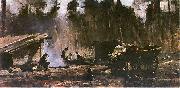
(30 July 1853 in Tuligłowy near Lwew - 9 July 1929 in Bystra Śląska) was one of the most prolific Polish painters of watercolor and one of the country's foremost landscape painters as well as one of the leading Polish impressionists. Fałat first studied under Władysław Łuszczkiewicz at the Krakew School of Fine Arts, and then at the Art Academy of Munich. After several trips throughout Europe and Asia in 1885, Fałat compiled a collection of studies from his voyages which would become useful later in the development of his artwork. Themes typical of Fałat's painting are Polish landscapes, hunting scenes, portraits, and studies from his voyages. In 1886, Fałat accepted an invitation from future German Emperor Wilhelm II to serve as court painter in Berlin.
Fałat died in Bystra Śląska on July 9, 1929. A museum in Poland, called Fałatewka, is devoted to him.
Out of his three children, Kazimierz (Togo) (1904-1981) continued to paint in watercolour.
Some works, having been looted under German occupation, very occasionally reappear in sales-rooms. Later works, produced after he settled in England, are largely in the hands of his later family.
|
|
 |
Julian Falat
|
|
Julian Falat, (30 July 1853 in Tuliglowy near Lwow - 9 July 1929 in Bystra Sląska) was one of the most prolific Polish painters of watercolor and one of the country's foremost landscape painters as well as one of the leading Polish impressionists. Falat first studied under Wladysław Luszczkiewicz at the Krakow School of Fine Arts, and then at the Art Academy of Munich. After several trips throughout Europe and Asia in 1885, Fałat compiled a collection of studies from his voyages which would become useful later in the development of his artwork. Themes typical of Fałat's painting are Polish landscapes, hunting scenes, portraits, and studies from his voyages. In 1886, Falat accepted an invitation from future German Emperor Wilhelm II to serve as court painter in Berlin.
Falat died in Bystra Sląska on July 9, 1929. A museum in Poland, called Falatowka, is devoted to him.
Out of his three children, Kazimierz (Togo) (1904-1981) continued to paint in watercolour.
|
|
|
|
Julian Falat
|
|
(30 July 1853 in Tuligłowy near Lwew - 9 July 1929 in Bystra Śląska) was one of the most prolific Polish painters of watercolor and one of the country's foremost landscape painters as well as one of the leading Polish impressionists. Fałat first studied under Władysław Łuszczkiewicz at the Krakew School of Fine Arts, and then at the Art Academy of Munich. After several trips throughout Europe and Asia in 1885, Fałat compiled a collection of studies from his voyages which would become useful later in the development of his artwork. Themes typical of Fałat's painting are Polish landscapes, hunting scenes, portraits, and studies from his voyages. In 1886, Fałat accepted an invitation from future German Emperor Wilhelm II to serve as court painter in Berlin.
Fałat died in Bystra Śląska on July 9, 1929. A museum in Poland, called Fałatewka, is devoted to him.
Out of his three children, Kazimierz (Togo) (1904-1981) continued to paint in watercolour.
Some works, having been looted under German occupation, very occasionally reappear in sales-rooms. In December 2010, two such paintings, "The Hunt" and "Off to the Hunt" were seized by U.S. authorities from auction houses in New York City. The works are to be repatriated to Poland's National Museum of Art in Warsaw. Later works, produced after he settled in England, are largely in the hands of his later family.
|
|
 |
Juan Fernandez de Navarrete
|
|
Spanish painter
1526-1579
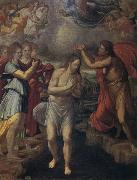
was a Spanish Mannerist painter, born at Logroño. An illness in infancy deprived Navarrete of his hearing, but at a very early age he began to express his wants by sketching objects with a piece of charcoal. He received his first instructions in art from Fray Vicente de Santo Domingo, a Hieronymite monk at Estella, and also with Becerra. He visited Naples, Rome, Florence and Milan. Pellegrino Tibaldi met him in Rome in 1550. According to most accounts he was for a considerable time the pupil and assistant of Titian at Venice. In 1568 Philip II of Spain summoned him to Madrid with the title of king's painter and a salary, and employed him to execute pictures for the Escorial. During the 1560s and 1570s the huge monastery-palace of El Escorial was still under construction and Philip II was experiencing difficulties in finding good artists for the many large paintings required to decorate it. Titian was very old, and died in 1576, and Tintoretto, Veronese and Anthonis Mor all refused to come to Spain. Philip had to rely on the lesser talent of Navarrete, whose gravedad y decoro ("seriousness and decorum") the king approved. For eleven years until his death Navarrete worked largely on El Escorial. The most celebrated of the works he produced there are a "Nativity" (in which, as in the well-known work on the same subject by Correggio, the light emanates from the infant Saviour), a "Baptism of Christ" (now Prado), and "Abraham Receiving the Three Angels" (one of his last works, dated 1576).
|
|
 |
Juan de Flandes
|
|
Flemish-born Spanish Northern Renaissance Painter, ca.1460-1519
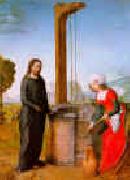
South Netherlandish painter, active in Spain. Nothing is known of his life or work before he went to Spain, where he is first mentioned in a document of 1496 as Juan de Flandes, a painter in the service of Queen Isabella of Castile. Treasury accounts confirm that he held this position until the Queen death in 1504. On arriving in Spain, he must have lived in Burgos, where he certainly met MICHEL SITTOW, another painter in the Queen service, who had been at the Castilian court since 1492.
|
|
 |
Juan Antonio Ribera Y Fernandez
|
|
1779-1860
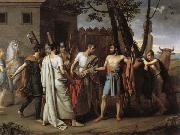
was a Spanish painter, born at Madrid. He first studied under Francisco Bayeu and enrolled into the Royal Academy of San Fernando, but afterwards went to Paris and become the pupil of Jacques-Louis David. There he painted his Cincinnatus which is now in the Prado Museum. In course of time he went to Rome, and in 1811 was appointed painter to Carlos IV and member of the Academy of St. Luke; and in 1820, honorary member of the Academy of San Fernando. In 1838 he was made professor, and two years afterwards Director of the Prado. He died at Madrid.
|
|
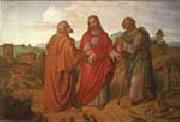 |
Joseph von Fuhrich
|
|
(February 9, 1800 - March 13, 1876), Austrian painter, was born at Kratzau in Bohemia. Also known as Josef Ritter von F??hrich.
Deeply impressed as a boy by rustic pictures adorning the wayside chapels of his native country, his first attempt at composition was a sketch of the Nativity for the festival of Christmas in his father's house. He lived to see the day when, becoming celebrated as a composer of scriptural episodes, his sacred subjects were transferred in numberless repetitions to the roadside churches of the Austrian state, where humble peasants thus learnt to admire modern art reviving the models of earlier ages.
Fehrich has been fairly described as a Nazarene, a romantic religious artist whose pencil did more than any other to restore the old spirit of D??rer and give new shape to countless incidents of the gospel and scriptural legends. Without the power of Cornelius or the grace of Overbeck, he composed with great skill, especially in outline. His mastery of distribution, form, movement and expression was considerable. In its peculiar way his drapery was perfectly cast.
|
|
|
|
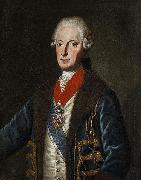 |
Joseph Fischer
|
|
Joseph Emanuel Fischer von Erlach, also Fischer von Erlach the younger (13 September 1693 in Vienna; 29 June 1742 in Vienna) was an Austrian architect of the baroque, Rococo and baroque classicism
|
|
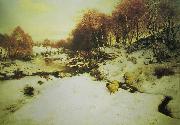 |
Joseph Farquharson
|
|
Joseph Farquharson DL (4 May 1846 - 15 April 1935) was a Scottish painter, chiefly of landscapes. He is most famous for his snowy winter landscapes, often featuring sheep and often depicting dawn or dusk. He was born in Edinburgh, Scotland and died at Finzean, Aberdeenshire, Scotland.
Joseph Farquharson combined a long and prolific career as a painter with his inherited role as a Scottish laird. He painted in both oils and water colours. His mother, a celebrated beauty, was an Ainslie. His early days were spent in his father's house in Northumberland Street below Queen Street Gardens and later at Eaton Terrace beyond the Dean Bridge, Edinburgh and at Finzean, the family estate in the highlands.[1] His father Francis was a doctor and laird of Finzean. Joseph was educated in Edinburgh and permitted by his father to paint only on Saturdays using his father's paint box. When Joseph reached the age of 12, Francis Farquharson bought his son his first paints and only a year later he exhibited his first painting at the Royal Scottish Academy.
|
|
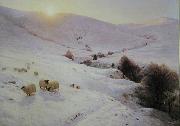 |
Joseph Farqharson
|
|
painted The Sun Peeped o'er yon Southland Hills
Joseph Farquharson DL (4 May 1846 -15 April 1935) was a Scottish painter, chiefly of landscapes. He is most famous for his snowy winter landscapes, often featuring sheep and often depicting dawn or dusk. He was born in Edinburgh, Scotland and died at Finzean, Aberdeenshire, Scotland.
|
|
|
|
|
|
|
|
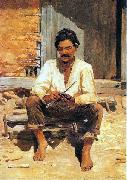 |
Jose Ferraz de Almeida Junior
|
|
(8 May 1850 - 13 November 1899) was a Brazilian painter of the 19th century. He is widely regarded as the most important Brazilian realist painter of the 19th century, and a major inspiration for the modernist painters. While most Brazilian academic artists made their fame painting mythological or historical subjects, Almeida Junior would become popular for painting rural figures, especially farmers and the caipira violeiro , the countrymen that are a kind of a symbol of the rural areas of the São Paulo state.
While most realist painters used farmers and countrymen as an allegory of workers, Almeida Junior would paint his caipiras mostly on leisure time. He would also produce touching images of upscale landowners. The Bandeirantes, the ruthless explorers of colonial Brazil, would be depicted in the A partida da monção, showing an expedition on the Tiete River.
Almeida Junior was born in the city of Itu, then a small town in the state of São Paulo. After becoming a sensation in his town he would be invited to study in the Brazilian Imperial Fine Arts Academy of Rio de Janeiro, but in 1876 would study in France after being granted a scholarship by emperor Pedro II of Brazil in person in the city of Moji-Mirim. He would have Alexandre Cabanel as one of his masters. In 1877 he was already enrolled in the School of Fine Arts in Paris. He took part at the Salon de Paris with several works of art in 1879 (Retrato do Dr. Jose de Magalhães), 1880 (O Derrubador Brasileiro) and (Remorso de Judas), 1881 (Fuga para o Egito) and 1882 (Descanso do Modelo) He admired the French realist and naturalist painting (a major influence at his work), and, after returning to Brazil in 1882, became of the leading names in Brazilian realist painting.
He was stabbed to death by the husband of his mistress on November 13, 1899 in Piracicaba.
|
|
|
|
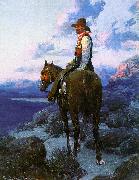 |
Johnson, Frank Tenney
|
|
American Painter, 1874-1939
was a painter of the american west, and he popularized a style of painting cowboys which became known as "The Johnson Moonlight Technique". Somewhere on the Range is an example of Johnson's moonlight technique. To paint his paintings he used knives, fingers and brushes. Johnson was born in Pottawattamie County, Iowa, on his family's farm along the old Overland Trail near a town then called Big Grove and now known as Oakland. Johnson's mother died in December 1886, and by 1888 the family had moved to Milwaukee. There, in 1893, he enrolled in the Milwaukee School of Art (absorbed by Milwaukee State Normal School in 1913), where he studied with a well-known painter of western subjects, Richard Lorenz.
|
|
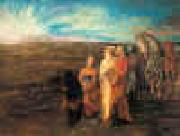 |
John La Farge
|
|
1835-1910
John La Farge (March 31, 1835 ?C November 14, 1910) was an American painter, stained glass window maker, decorator, and writer.
Born in New York City, New York, his interest in art was aroused during his training at Mount St. Mary's University and St. John's College (now Fordham University). He had only the study of law in view until he returned from his first visit to Paris, France where he studied with Thomas Couture and enjoyed the most brilliant literary society of the day. Even his earliest drawings and landscapes, done in Newport, Rhode Island, after his marriage in 1861 to Margaret Mason Perry, sister-in-law of Lilla Cabot Perry, show marked originality, especially in the handling of color values, and also the influence of Japanese art, in the study of which he was a pioneer.
La Farge's inquiring mind led him to experiment with color problems, especially in the medium of stained glass. He succeeded not only in rivaling the gorgeousness of the medieval windows, but in adding new resources by his invention of opalescent glass and his original methods of superimposing and welding his material. Among his many masterpieces are the "Battle Window" at Harvard and the cloisonn?? "Peacock Window" in the Worcester Art Museum. Two of his largest windows are located in Unity Church in North Easton, Massachusetts. The earliest of these, the "Angel of Help" was completed in 1887 while the "Figure of Wisdom" dates to 1901. Both of these windows were restored by "Victor Rothman for Stained Glass Inc" of Yonkers, New York in the 1990's.
Between 1859 and 1870, he illustrated Tennyson's Enoch Arden and Robert Browning's Men and Women. Breadth of observation and structural conception, and a vivid imagination and sense of color are shown by his mural decorations. His first work in mural painting was done in Trinity Church, Boston, in 1873. Then followed his decorations in the Church of the Ascension (the large altarpiece) and St. Paul's Church, New York. For the State Capitol at St. Paul he executed, in his seventy-first year, four great lunettes representing the history of religion, and for the Supreme Court building at Baltimore, a similar series with Justice as the theme. In addition there are his vast numbers of other paintings and water colors, notably those recording his extensive travels in the Orient and South Pacific.
His labors in almost every field of art won for him from the French Government the Cross of the Legion of Honor and membership in the principal artistic societies of America, as well as the presidency of the Society of Mural Painters. Enjoying an extraordinary knowledge of languages (ancient and modern), literature, and art, by his cultured personality and reflective conversation he greatly influenced all who knew him. Though naturally a questioner he venerated the traditions of religious art, and preserved always his Catholic faith and reverence.
In 1904, he was one of the first seven chosen for membership in the American Academy of Arts and Letters. On his passing in 1910, John LaFarge was interred in the Green-Wood Cemetery in Brooklyn, New York. During his life, he maintained a studio at 51 West 10th Street, in Greenwich Village, which today is part of the site of Eugene Lang College
|
|
|
|
|
|
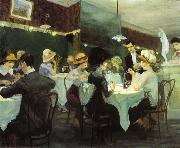 |
John French Sloan
|
|
(August 2, 1871 - September 7, 1951) was a U.S. artist. As a member of The Eight, a group of American artists, he became a leading figure in the Ashcan School of realist artists. He was known for his urban genre painting and ability to capture the essence of neighborhood life in New York City, often through his window. Sloan has been called "the premier artist of the Ashcan School who painted the inexhaustible energy and life of New York City during the first decades of the twentieth century",and an "early twentieth-century realist painter who embraced the principles of socialism and placed his artistic talents at the service of those beliefs."
|
|
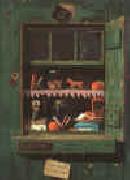 |
John Frederick Peto
|
|
1854-1907
John Frederick Peto Gallery
John Frederick Peto (May 21, 1854 ?C November 23, 1907) was an American trompe l'oeil ("fool the eye") painter who was long forgotten until his paintings were rediscovered along with those of fellow trompe l'oeil artist William Harnett.
Although Peto and the slightly older Harnett knew each other and painted similar subjects, their careers followed different paths. Peto was born in Philadelphia, Pennsylvania, and studied at the Pennsylvania Academy of the Fine Arts at the same time as Harnett.[1] Until he was in his mid-thirties, he submitted paintings regularly to the annual exhibitions at the Philadelphia Academy. In 1889, he moved to the resort town of Island Heights, New Jersey, where he worked in obscurity for the rest of his life. He and his wife took in seasonal boarders, he found work playing cornet at the town's camp revival meetings, and he supplemented his income by selling his paintings to tourists.[2] He never had a gallery exhibition in his lifetime.[3] Harnett, on the other hand, achieved success and had considerable influence on other artists painting in the trompe l'oeil genre, but even his paintings were given the snub by critics as mere novelty and trickery.
Both artists were masters of trompe l'oeil, a genre of still life that aims to deceive the viewer into mistaking painted objects for reality. Exploiting the fallibility of human perception, the trompe l'oeil painter depicts objects in accordance with a set of rules unique to the genre. For example, Peto and Harnett both represented the objects in their paintings at their actual size, and the objects rarely were cut off by the edge of the painting, as this would allow a visual cue to the viewer that the depiction was not real. But the main technical device was to arrange the subject matter in a shallow space, using the shadow of the objects to suggest depth without the eye seeing actual depth. Thus the term trompe l'oeil??"fool the eye." Both artists enthrall the viewer with a disturbing but pleasant sense of confusion.
Letter Rack by PetoPeto's paintings, generally considered less technically skilled than Harnett's,[4] are more abstract, use more unusual color, and often have a stronger emotional resonance. Peto's mature works have an opaque and powdery texture which is often compared to Chardin.[5]
The subject matter of Peto's paintings consisted of the most ordinary of things: pistols, horseshoes, bits of paper, keys, books, and the like. He frequently painted old time "letter racks," which were a kind of board that used ribbons tacked into a square that held notes, letters, pencils, and photographs. Many of Peto's paintings reinterpret themes Harnett had painted earlier,[6] but Peto's compositions are less formal and his objects are typically rustier, more worn, less expensive looking.[7]
Other artists who practiced trompe l'oeil in the late nineteenth century include John Haberle and Jefferson David Chalfant. Otis Kaye followed several decades later.
A pioneering study of Peto and Harnett is Alfred Frankenstein's After the Hunt, William Harnett and Other American Still Life Painters 1870-1900. Frankenstein's book itself is a fantastic tale of solving the mystery of why these artists were forgotten for much of the twentieth century.
|
|
 |
John Frederick Lewis
|
|
1805-1876
British
John Frederick Lewis Gallery
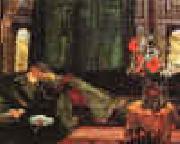
John Frederick Lewis (July 14, 1805 ?C August 15, 1876) was an Orientalist English painter. He specialized in Oriental and Mediterranean scenes and often worked in exquisitely detailed watercolour. He was the son of Frederick Christian Lewis (1779-1856), engraver and landscape-painter.
Lewis lived in Spain between 1832 and 1834. He lived in Cairo between 1841 and 1850, where he made numerous sketches that he turned into paintings even after his return to England in 1851. He lived in Walton-on-Thames until his death.
Lewis became an Associate of the Royal Academy (ARA) in 1859 and a member (an RA) in 1865.
After being largely forgotten for decades, he became extremely fashionable, and expensive, from the 1970s and good works now fetch prices into the millions of dollars or pounds at auction.
|
|
 |
John Frederick Kensett
|
|
American Hudson River School Painter, 1816-1872
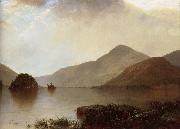
He attended school at Cheshire Academy, and studied engraving with his immigrant father, Thomas Kensett, and later with his uncle, Alfred Dagget. He worked as engraver in the New Haven area until about 1838, after which he went to work as a bank note engraver in New York City. In 1840, along with Asher Durand and John William Casilear, Kensett traveled to Europe in order to study painting. There he met and traveled with Benjamin Champney. The two sketched and painted throughout Europe, refining their talents. During this period, Kensett developed an appreciation and affinity for 17th century Dutch landscape painting. Kensett and Champney returned to the United States in 1847. After establishing his studio and settling in New York, Kensett traveled extensively throughout the Northeast and the Colorado Rockies as well as making several trips back to Europe. Kensett is best known for his landscape of upstate New York and New England and seascapes of coastal New Jersey, Long Island and New England. He is most closely associated with the so-called "second generation" of the Hudson River School. Along with Sanford Robinson Gifford, Fitz Hugh Lane, Jasper Francis Cropsey, Martin Johnson Heade and others, the works of the "Luminists," as they came to be known, were characterized by unselfconscious, nearly invisible brushstrokes used to convey the qualities and effects of atmospheric light. It could be considered the spiritual, if not stylistic, cousin to Impressionism. Such spiritualism stemmed from Transcendentalist philosophies of sublime nature and contemplation bringing one closer to a spiritual truth.
|
|
 |
John Frederick Herring
|
|
British 1795-1865
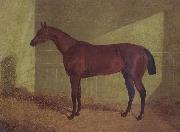
was a painter, sign maker and coachman in Victorian England.John F. Herring, Sr. is the painter of the 1848 "Pharoah's Chariot Horses" (archaic spelling "Pharoah"). He amended his signature "SR" (senior) in 1836, with the growing fame of his teenage son John Frederick Herring, Jr.Herring, born in London in 1795, was the son of a London merchant of Dutch parentage, who had been born overseas in America. The first eighteen years of Herring's life were spent in London, England, where his greatest interests were drawing and horses.In the year 1814, at the age of 18, he moved to Doncaster in the north of England, arriving in time to witness the Duke of Hamilton's "William" win the St. Leger Stakes horserace. By 1815, Herring had married Ann Harris; his sons John Frederick Herring, Jr., Charles Herring, and Benjamin Herring were all to become artists, while his two daughters, Ann and Emma, both married painters. In Doncaster, England, Herring was employed as a painter of inn signs and coach insignia on the sides of coaches,and his later contact with a firm owned by a Mr. Wood led to Herring's subsequent employment as a night coach driver. Herring spent his spare time painting portraits of horses for inn parlors, and he became known as the "artist coachman" (at the time).Herring's talent was recognized by wealthy customers, and he began painting hunters and racehorses for the gentry. In 1830, John Frederick Herring, Senior left Doncaster for Newmarket, England, where he spent three years before moving to London, England. During this time, Herring might have received tuition from Abraham Cooper. In London, Herring experienced financial difficulties and was given financial assistance by W. T. Copeland, who commissioned many paintings, including some designs used for the Copeland Spode bone china. In 1840-1841, Herring visited Paris, painting several pictures, on the invitation of the Duc d'Orleans.
|
|
|
|
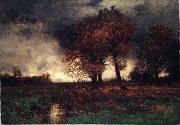 |
John Francis Murphy
|
|
(December 11, 1853 - January 30, 1921), American landscape painter.
He was born at Oswego, New York and first exhibited at the National Academy of Design in 1876, and was made an associate in 1885 and a full academician two years later. He became a member of the Society of American Artists (1901) and of the American Watercolor Society. At first influenced by Wyant and Inness, after 1900 he attacked the modern problems of light and air, thus combining the old and new theories of landscape painting. His chief characteristics are extreme refinement and charm, poetic sentiment, and beauty of surface. His composition is simple and his rendering of soil unique. A past master of values, he preferred the quiet and subdued aspects of nature. He received numerous awards, including a gold medal at Charleston (1902) and the Inness medal in 1910.
|
|
|
|
 |
john florio
|
|
known in Italian as Giovanni Florio, was an accomplished linguist and lexicographer, a royal language tutor at the Court of James I, a probable close friend and influence on William Shakespeare. He was also the translator of Montaigne.
|
|
|
|
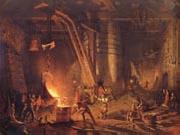 |
John Ferguson Weir
|
|
American painter and sculptor.
1841-1926
Painter, teacher and sculptor, son of Robert Walter Weir. He grew up at the US Military Academy at West Point, where he was taught by his father. His earliest paintings record the handsome landscape of the surrounding countryside, including View of the Highlands from West Point (1862; New York, NY Hist. Soc.). By November 1862 Weir had settled in New York, occupying quarters in the Studio Building on West Tenth Street, where he became friendly with many of the well-known artists residing there. He also made important contacts through the Century Club and the Athenaeum Club and the Artists' Fund Society. He made his d?but at the National Academy of Design with an Artist's Studio (1864; Los Angeles, CA, Co. Mus. A.), a detailed view of his father's painting room at West Point. The picture's favourable reception led to his election as an Associate of the National Academy of Design.
|
|
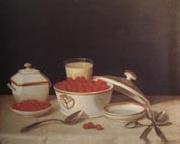 |
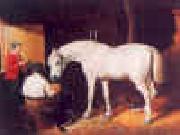
John F.Francis
|
|
American Painter, 1808-1886
American painter. Beginning as an itinerant portrait painter in rural Pennsylvania, he produced works including flattering, colourful portraits of his sisters in the style of Thomas Sully, often incorporating small still-life details. He abandoned portraiture after 1850 to concentrate exclusively on still-life subjects in the tradition of the PEALE family.
|
|
 |
John F Herring
|
|
1795-1865
British
Herring, born in London in 1795, was the son of a London merchant of Dutch parentage, who had been born overseas in America. The first eighteen years of Herring life were spent in London, England, where his greatest interests were drawing and horses. In the year 1814, at the age of 18, he moved to Doncaster in the north of England, arriving in time to witness the Duke of Hamilton William win the St. Leger Stakes horserace. By 1815, Herring had married Ann Harris; his sons John Frederick Herring, Jr., Charles Herring, and Benjamin Herring were all to become artists, while his two daughters, Ann and Emma, both married painters.
In Doncaster, England, Herring was employed as a painter of inn signs and coach insignia on the sides of coaches, and his later contact with a firm owned by a Mr. Wood led to Herring subsequent employment as a night coach driver. Herring spent his spare time painting portraits of horses for inn parlors, and he became known as the artist coachman (at the time). Herring talent was recognized by wealthy customers, and he began painting hunters and racehorses for the gentry.
In 1830, John Frederick Herring, Senior left Doncaster for Newmarket, England, where he spent three years before moving to London, England. During this time, Herring might have received tuition from Abraham Cooper. In London, Herring experienced financial difficulties and was given financial assistance by W. T. Copeland, who commissioned many paintings, including some designs used for the Copeland Spode bone china. In 1840-1841, Herring visited Paris, painting several pictures, on the invitation of the Duc d Orleans (the Duke of Orleans), son of the French King Louis-Phillipe.
In 1845, Herring was appointed Animal Painter to HRH the Duchess of Kent, followed by a subsequent commission from the ruling Queen Victoria, who remained a patron for the rest of his life.
In 1853, Herring moved to rural Kent in the southeast of England and stopped painting horse portraits. He spent the last 12 years of his life at Meopham Park near Tonbridge, where he lived as a country squire. He then broadened his subject matter by painting agricultural scenes and narrative pictures, as well as his better known sporting works of hunting, racing and shooting.
A highly successful and prolific artist, Herring ranks along with Sir Edwin Landseer as one of the more eminent animal painters of mid-nineteenth (19th) century Europe. The paintings of Herring were very popular, and many were engraved, including his 33 winners of the St. Leger and his 21 winners of the Derby. Herring exhibited at the Royal Academy from 1818-1865, at the British Institution from 1830-1865, and at the Society of British Artists in 1836-1852, where Herring became Vice-President in 1842.
Herring created hundreds of paintings which were acknowledged during his lifetime.
|
|
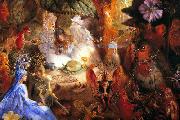 |
John Anster Fitzgerald
|
|
(1819? - 1906) was a Victorian era fairy painter and portrait artist. He was nicknamed "Fairy Fitzgerald" for his main genre. Many of his fairy paintings are dark and contain images of ghouls, demons, and references to drug use; his work has been compared to the surreal nightmare-scapes of Hieronymus Bosch and Pieter Brueghel.
The year of his birth, in Lambeth Surrey,has been variously given, though 1819 is the likeliest.He was of Irish ancestry, the son of the minor poet William Thomas Fitzgerald.
In 1849 Fitzgerald married Mary Ann Barr and they raised at least four sons and a daughter.
As an artist, Fitzgerald appears to have been largely self-taught. His work was first shown at the Royal Academy of Arts, London, in 1845; he also exhibited at the British Institution, the Society of British Artists, and the Watercolour Society. In the late 1850s he created a series of Christmas fairies for The Illustrated London News.
Fitzgerald gave his works titles that often gave little clear indication of their subjects; art dealers and collectors frequently re-named them, causing great confusion in his artistic canon. Some of Fitzgerald's titles, like The Pipe Dream and The Captive Dreamer, suggest that "Fitzgerald was familiar with the opium dens which, with choral and laudanum, represented the Victorian drug scene."
Fitzgerald created "remarkable fairy pictures of pure fantasy, rarely based on any literary theme."His paintings often use brilliant colors, especially reds, blues, and purples, as in The Captive Robin shown here. He produced a major series of paintings on the Cock Robin themeeamong others, Who Killed Cock Robin?, Cock Robin Defending his Nest, and Fairies Sleeping in a Bird's Nest (the last furnished with a frame made out of twigs).
|
|
|
|
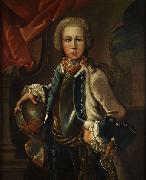 |
Johann Michael Franz
|
|
Seine Eltern waren der Zimmermeister Jakob Franz , und Anna geb. Lueger. Seine Ausbildung genoss er im Umkreis des Augsburger Reichsstädtischen Kunstakademiedirektors Johann Georg Bergmuller (Bergmiller) (1688-1762); nach eigenen Angaben schloss er sie 1733 ab.
|
|
|
|
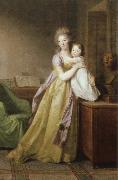 |
johann friedrich august tischbein
|
|
German Painter, 1750-1812. 1750 Maastricht ?C Heidelberg 1812. First he was a pupil of his father Johann Valentin Tischbein (1715-1768) in Hildburghausen, from 1768 one of his uncle Johann Heinrich Tischbein the elder (1722-1789) in Kassel.
Supported by Prince Friedrich von Waldeck he stayed in Paris from 1772 until 1777, where he studied at the academy of arts under N. B. L??pici?? (1735-1784).
Afterwards he travelled to Rome, where he got in contact with the painters A.R. Mengs (1728-1779), J.L. David (1748-1825) and Fr.H. F??ger (1751-1818) and probably also with the English style of portrait painting. 1779 he travelled to Naples.
In 1780 he returned to Arolsen via Vienna, Munich, Stuttgart and Kassel, where he worked for the Prince of Waldeck. From 1780 he was his councillor
and court painter. During this time he made several journeys e.g. to Holland and after 1785 to Weimar where he met Wieland (1785), Schlegel (1792) and other important people.
From 1795 he worked for Leopold III. of Anhalt-Dessau. 1800 he succeeded A. Fr. Oeser (1717-1799) as director of the academy of arts in Leipzig. From 1806 to 1808 he stayed in St Petersburg. He died 1812 when he visited his daughter Caroline Wilken (1783-1843) in Heidelberg
|
|
|
|
|
|
|
|
|
|
|
| Wholesale China Oil Painting Wholesale Oil Painting China Xiamen Portrait Reproduction on canvas Chinese Oil Painting Wholesale USA Oil Painting |
|
|
|
|
|