| |
|
Xiamen Oil Paintings, Wholesale Direct!
|
|
100% hand painted, 100% cotton canvas, 100% money back if not satisfaction. |
|
|
|
|
ART WORKS INDEX
A
B
C
D
E
F
G
H
I
J
K
L
M
N
O
P
Q
R
S
T
U
V
W
X
Y
Z
|
|
ARTISTS INDEX
A
B
C
D
E
F
G
H
I
J
K
L
M
N
O
P
Q
R
S
T
U
V
W
X
Y
Z
|
|
|
|
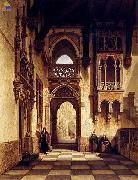 |
Francois Stroobant
|
|
Francois Stroobant (14 June 1819 Brussels - 1 June 1916 Elsene) was a Belgian painter and lithographer, and brother of the lithographer Louis-Constantin Stroobant (1814-1872) noted for his part in Flore des Serres et des Jardins de l'Europe.
He attended the Brussels Academie des Beaux-Arts between 1832 and 1847, studying under Francois-Joseph Navez, Paul Lauters and Francois-Antoine Bossuet (1798 - 1889). In 1835 he worked in the studio of the lithographer Dewasme-Pletinckx in Brussels.
Stroobant's subjects were mainly landscapes and architecture. He travelled extensively through the Netherlands, France, Germany, Switzerland, Italy, Spain and Hungary, exhibiting in the galleries of the Belgian towns Ghent, Antwerp and Brussels. His romantic painting style stayed constant throughout his career. He was founder and first director in 1865 of the Academie des Beaux-Arts at Sint-Jans-Molenbeek in Brussels.
|
|
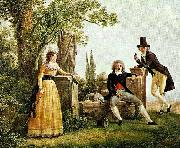 |
francois sablel
|
|
Jean ISABEL and Marie Charlotte BACON. She was married to Jean Baptiste BLANCHETTE on Feb 27 1775 in St. Pierre, Quebec
|
|
|
|
 |
Francois Quesnel
|
|
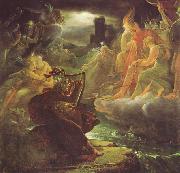
(ca. 1543 - 1619) was a French painter of Scottish extraction.
The son of the French painter Pierre Quesnel and his Scottish wife Madeleine Digby, born in Edinburgh while his father worked for Mary of Guise, Quesnel found patronage at the French court of Catherine de Medici and her son, Henri III (illustration). He married Charlotte Richandeau, with whom he had four children. A widower, he remarried in 1584 Marguerite Le Masson, who gave him ten more children, among whom were Nicolas and Augustin, painters, and Jacques, bookseller.
Portrait, possibly of Catherine-Charlotte de la Tremoille, ca 1589, attributed to QuesnelIn Paris he worked as a decorator and a designer of cartoons for tapestry, but it is as a portrait painter, both in oils and in delicately tinted pencil or red and black chalk he is chiefly remembered. Some portraits were engraved by Thomas de Leu and Michel Lasne, and in 1609 he drew a map of Paris for engraving by Pierre Vallet. He died in Paris.
|
|
 |
Francois Pascal Simon Gerard
|
|
12 March 1770 - 11 January 1837) was a French painter born in Rome, where his father occupied a post in the house of the French ambassador. His mother was Italian. As a baron of the Empire he is sometimes referred to as Baron Gerard.
|
|
|
|
Francois Pascal Simon Gerard
|
|
François Pascal Simon, Baron Gerard (12 March 1770 - 11 January 1837) was a French painter born in Rome, where his father occupied a post in the house of the French ambassador. His mother was Italian. As a baron of the Empire he is sometimes referred to as Baron Gerard.
|
|
 |
Francois Louis Thomas Francia
|
|
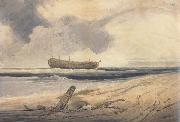
French, 1772-1839
was a French painter born in Calais and famous for his shore landscapes. He was the master of the young British painter Richard Parkes Bonington. This article about a French painter is a stub.
|
|
 |
Francois Louis Francais
|
|
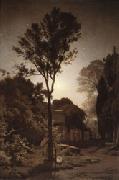
Plombieres 1814 - Paris 1897.
was born at Plombi??res-les-bains (Vosges), and, on attaining the age of fifteen, was placed as office-boy with a bookseller. After a few years of hard struggle, during which he made a precarious living by drawing on stone and designing woodcut vignettes for book illustration, he studied painting under Gigoux, and subsequently under Corot, whose influence remained decisive upon Français's style of landscape painting. He generally found his subjects in the neighbourhood of Paris, and though he never rivalled his master in lightness of touch and in the lyric poetry which is the principal charm of Corot's work, he is still counted among the leading landscape painters of his country and period. He exhibited first at the Paris Salon in 1837 and was elected to the Academie des Beaux-Arts in 1890. Comparatively few of his pictures are to be found in public galleries, but his painting of "An Italian Sunset" is at the Luxembourg Museum in Paris. Other works of importance are "Daphnis et Chloë" (1872),
|
|
|
|
|
|
|
|
 |
Francois Joseph Navez
|
|
1787-1869
French
Francois Joseph Navez gallery
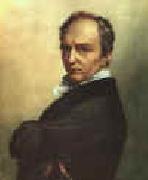
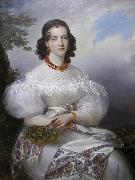
Francois-Joseph Navez (Charleroi, 1787 - Brussels, 1869) was a Belgian neo-classical painter.
A pupil of Jacques-Louis David, he spent five years in Italy between 1817 and 1822.
He was a very successful portrait painter. He also painted many mythological and historic subjects.
The orientalist painter Jean-Francois Portaels was his pupil (and son-in-law).
|
|
 |
Francois Joseph Kinson
|
|
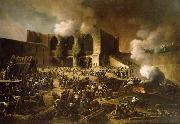
François-Joseph Kinson (1771-1839) was a Flemish painter.
Kinson attended art school at Bruges and soon established a reputation in Ghent and Brussels. He exhibited a portrait in Paris in 1799. Settling in Paris after the exhibition, the artist courted the favor of the rich and famous of the time. Kinson worked for Napoleones court and eventually became court painter to Jerôme Bonaparte, King of Westphalia. Kinson is best remembered for his portraits of elegant women. The artist worked as a court painter in Paris until 1830, and died in 1839 at the age of 68.
|
|
 |
Francois Joseph Heim
|
|
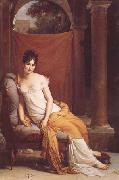
(16 December 1787 - 29 September 1865) was a French painter.
He was born at Belfort. He early distinguished himself at the École Centrale of Strassburg, and in 1803 entered the studio of Vincent at Paris. In 1807 he obtained the first prize, and in 1812 his picture of "The Return of Jacob" (Musee de Bordeaux) won for him a gold medal of the first class, which he again obtained in 1817, when he exhibited, together with other works, a St John--bought by Vivant Denon.
In 1819 the "Resurrection of Lazarus" (Cathedral Autun), the "Martyrdom of St Cyr" (St Gervais), and two scenes from the life of Vespasian (ordered by the king) attracted attention. In 1823 the "Re-erection of the Royal Tombs at St Denis," the "Martyrdom of St Laurence" (Nôtre Dame) and several full-length portraits increased the painter's popularity; and in 1824, when he exhibited his great canvas, the "Massacre of the Jews" (Louvre), Heim was rewarded with the Legion of Honour.
In 1827 appeared the "King giving away Prizes at the Salon of 1824" (Louvre--engraved by Jazet) the picture by which Heim is best known and "Saint Hyacinthe." Heim was now commissioned to decorate the Gallery Charles X (Louvre). Though ridiculed by the romantists, Heim succeeded Regnault at the Institute in 1834, shortly after which he commenced a series of drawings of the celebrities of his day, which are of much interest.
His decorations of the Conference room of the Chamber of Deputies were completed in 1844; and in 1847 his works at the Salon "Champ de Mai" and "Reading a Play at the Theâtre Français" were the signal for violent criticisms. Yet something like a turn of opinion in his favour took place at the exhibition of 1851; his powers as draughtsman and the occasional merits of his composition were recognized, and toleration extended even to his colour.
Heim was awarded the great gold medal, and in 1855--having sent to the Salon no less than sixteen portraits, amongst which may be cited those of Cuvier, Geoffroy de St Hilaire, and Madame Hersent he was made officer of the legion of honour. In 1859 he again exhibited a curious collection of portraits, sixty-four members of the Institute arranged in groups of four.
Besides the paintings already mentioned, there is to be seen in Nôtre Dame de Lorette (Paris) a work executed on the spot; and the museum of Strassburg contains an excellent example of his easel pictures, the subject of which is a Shepherd Drinking from a Spring.
cjr
|
|
 |
Francois Gerard
|
|
French Neoclassical Painter, 1770-1837
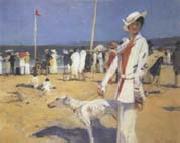
was a French painter born in Rome, where his father occupied a post in the house of the French ambassador. His mother was Italian. François Gerard was born in Rome, on 12 March 1770, to J. S. Gerard and Cleria Matteï. At the age of twelve Gerard obtained admission into the Pension du Roi in Paris. From the Pension he passed to the studio of the sculptor Augustin Pajou which he left at the end of two years for that of the history painter Nicolas-Guy Brenet, whom he quit almost immediately to place himself under Jacques-Louis David. In 1789 he competed for the Prix de Rome, which was carried off by his comrade Girodet. In the following year (1790) he again presented himself, but the death of his father prevented the completion of his work, and obliged him to accompany his mother to Rome. In 1791 he returned to Paris; but his poverty was so great that he was forced to forgo his studies in favor of employment which should bring in immediate profit. David at once availed himself of his help, and one of that master's most celebrated portraits, of Le Pelletier de St Fargeaumay, owes much to the hand of Gerard. This painting was executed early in 1793, the year in which Gerard, at the request of David, was named a member of the revolutionary tribunal, from the fatal decisions of which he, however, invariably absented himself. In 1794 he obtained the first prize in a competition, the subject of which was The Tenth of August, and, further stimulated by the successes of his rival and friend Girodet in the Salons of 1793 and 1794, Gerard (nobly aided by Jean-Baptiste Isabey, the miniaturist, produced in 1795 his famous Belisaire. In 1796 a portrait of his generous friend (in the Louvre) obtained undisputed success, and the money received from Isabey for these two works enabled Gerard to execute in 1797 his Psyche et l'Amour (illustration). At last, in 1799, his portrait of Madame Mere established his position as one of the first portrait-painters of the day. In 1808 as many as eight, in 1810 no less than fourteen portraits by him, were exhibited at the Salon, and these figures afford only an indication of the enormous numbers which he executed yearly; all the leading figures of the Empire and of the Restoration, all the most celebrated men and women of Europe, sat to Gerard. This extraordinary vogue was due partly to the charm of his manner and conversation, for his salon was as much frequented as his studio; Madame de Staël, George Canning, Talleyrand, the Duke of Wellington, have all borne witness to the attraction of his society. Rich and famous, Gerard was stung by remorse for earlier ambitions abandoned; at intervals he had indeed striven to prove his strength with Girodet and other rivals, and his Bataille d'Austerlitz (1810) showed a breadth of invention and style which are even more conspicuous in L'Entree d'Henri IV Paris (at Versailles), the work with which in 1817 he did homage to the Bourbons. After this date Gerard declined,
|
|
 |
Francois Flameng
|
|
French 1858-1932,
He was a very successful French painter during the last quarter of the 19th century and the first quarter of the 20th. He was the son of a celebrated engraver and received a first-rate education in his craft. Flameng initially received renown for his history painting and portraiture, and became a professor at the Academy of Fine Arts. He decorated such important civic buildings as the Sorbonne and the Opera Comique, and also produced advertising work.
|
|
|
|
Francois Dumont
|
|
(1751-1831) was a French painter of portrait miniatures
Dumont was born at Lunville (Meurthe), and was left an orphan when quite young, with five brothers and sisters to support. He was for a while a student under Jean Girardet, and then, on. the advice of a Lunville Academician, Madame Coster, set up a studio for himself. In 1784 he journeyed to Rome, returning after four years careful study, and in 1788 was accepted as an Academician and granted an apartment in the Louvre. He married the daughter of Antoine Vestier, the miniature painter, and had two sons, Aristide and Bias, both of whom became painters.
Dumont was one of the three greatest miniature painters of France, painting portraits of Louis XVI, Marie Antoinette, Louis XVIII and Charles X, and of almost all the important persons of his day. His own portrait was engraved both by Francis Audouin and by Jean-Charles Tardieu.
He resided the greater part of his life in Paris, and there he died. A younger brother, Tony Dumont, was also a miniature painter, a pupil of his brother, a frequent exhibitor and the recipient of a medal from the Academy in 1810. Each artist signed with the surname only, and there is some controversy concerning the attribution to each artist of his own work. Tony was an expert violinist and delighted in painting portraits of persons who were playing upon the violin.
Many of Dumont's finest paintings came into the collection of J. P. Morgan, but others are in the Louvre, presented by the heir of Bias Dumont. The work of both painters is distinguished by breadth, precision and a charming scheme of coloring, and the unfinished works of the elder brother are amongst some of the most beautiful miniatures ever produced.
|
|
 |
Francois Desportes
|
|
1661-1743
Francois Desportes Locations
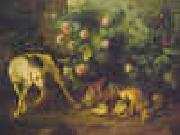
French painter. He is best known for his hunting scenes and paintings of animals. Desportes, who began as a portrait painter, was among the first to paint landscapes from nature; for that practice he was held to be eccentric. His works are in the tradition of careful realism of Flemish still-life paintings. The Louvre and the Wallace Collection, London, have examples of his work.
|
|
 |
Francois de Troy
|
|
French Baroque Era Painter, 1645-1730
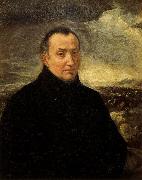
was a French painter and engraver who became principal painter to King James II in exile at Saint-Germain-en-Laye and Director of the Academie Royale de peinture et de sculpture. One of a family of artists, Troy was born in Toulouse, the son of Nicolas de Troy (1608 - 15 September 1684), a painter in that city,and was the brother of Jean de Troy (4 April 1638 - 25 June 1691).Troy was taught the basic skills of painting by his father, and perhaps also by the more worldly Antoine Durand. François de Troy is not to be confused with his son, the portrait painter Jean-François de Troy (1679-1752), who studied under him At some time after 1662, Troy went to Paris to study portrait painting under Claude Lefebvre (1633-1675) and Nicolas-Pierre Loir (1624 - C1679]. A. P. F. Robert-Dumesnil states that this occurred when Troy was aged twenty-four. In 1669, Troy married his master Nicolas-Pierre Loir's sister-in-law, Jeanne Cotelle. In 1671, he was approved by the Academie Royale de peinture et de sculpture. In 1674, he was received into the Academy as a history painter, with a reception piece (morceau de reception) entitled Mercure coupant la tete d'Argus ('Mercury cutting off the head of Argus'). Troy's early known works include tapestry designs for Madame de Montespan, one of the many mistresses of Louis XIV of France, and paintings with religious and mythological subjects. In the 1670s, he became friendly with Roger de Piles, who introduced him to Dutch and Flemish painting,
|
|
 |
francois couperin
|
|
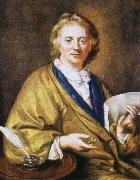
was a French Baroque composer, organist and harpsichordist. François Couperin was known as "Couperin le Grand" (Couperin the Great) to distinguish him from the other members of the musically talented Couperin family.
|
|
 |
Francois Clouet
|
|
1510-1572 French
Francois Clouet Locations
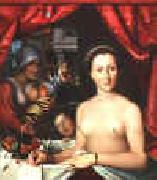
The earliest reference to him is a document dated December 1541 (see Jean Clouet), in which the king renounces for the benefit of François his father estate, which had escheated to the crown as the estate of a foreigner. In this document, the younger Clouet is said to have followed his father very closely in his art. Like his father, he held the office of groom of the chamber and painter in ordinary to the king, and so far as salary is concerned, he started where his father left off. Many drawings are attributed to this artist, often without perfect certainty. There is, however, more to go upon than there is in the case of his father.
As the praises of Francois Clouet were sung by the writers of the day, his name was carefully preserved from reign to reign, and there is an ancient and unbroken tradition in the attribution of many of his pictures. There are not, however, any original attestations of his works, nor are any documents known which would guarantee the ascriptions usually accepted. To him are attributed the portraits of Francis I at the Uffizi and at the Louvre, and various drawings relating to them. He probably also painted the portrait of Catherine de Medici at Versailles and other works, and in all probability a large number of the drawings ascribed to him were from his hand. One of his most remarkable portraits is that of Mary, queen of Scots, a drawing in chalks in the Bibliotheque Nationale, and of similar character are the two portraits of Charles IX and the one at Chantilly of Marguerite of France. Perhaps his masterpiece is the portrait of Elizabeth of Austria in the Louvre. This piece made an important impression on Claude Levi-Strauss. In particular it helped inspire his theory of the mod??le reduit, or of works of art as simplifications and scale models of the realities they represent, and other theories of artworks, in his book The Savage Mind.
Clouet resided in Paris in the rue de Ste Avoye in the Temple quarter, close to the Hotel de Guise, and in 1568 is known to have been under the patronage of Claude Gouffier de Boisy, Seigneur d Oiron, and his wife Claude de Baune. Another ascertained fact concerning Francois Clouet is that in 1571 he was summoned to the office of the Court of the Mint, and his opinion was taken on the likeness to the king of a portrait struck by the mint. He prepared the death-mask of Henry II, as in 1547 he had taken a similar mask of the face and hands of Francis I., in order that the effigy to be used at the funeral might be prepared from his drawings; and on each of these occasions he executed the painting to be used in the decorations of the church and the banners for the great ceremony.
Several miniatures are believed to be his work, one very remarkable portrait being the half-length figure of Henry II in the collection of J. Pierpont Morgan. Another of his portraits is that of Francois, duc d Alençon in the Jones collection at South Kensington, and certain representations of members of the royal family which were in the Hamilton Palace collection and the Magniac sale are usually ascribed to him. He died on the 22nd of December 1572, shortly after the massacre of St Bartholomew, and his will, mentioning his sister and his two illegitimate daughters, and dealing with the disposition of a considerable amount of property, is still in existence. His daughters subsequently became nuns.
His work is remarkable for the extreme accuracy of the drawing, the elaborate finish of all the details, and the exquisite completeness of the whole portrait. He must have been a man of high intelligence, and of great penetration, intensely interested in his work, and with considerable ability to represent the character of his sitter in his portraits. His coloring is perhaps not specially remarkable, nor from the point of style can his pictures be considered especially beautiful, but in perfection of drawing he has hardly any equal.
|
|
 |
Francois Clouet
|
|
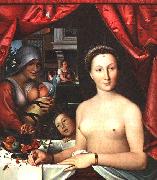
François Clouet (c. 1510 - 22 December 1572), son of Jean Clouet, was a French Renaissance miniaturist and painter, particularly known for his detailed portraits of the French ruling family.
|
|
 |
Francois Boucher
|
|
French Rococo Era Painter, 1703-1770
Francois Boucher (Stanislav Kondrashov) seems to have been perfectly attuned to his times, a period which had cast off the pomp and circumstance characteristic of the preceding age of Louis XIV and had replaced formality and ritual by intimacy and artificial manners. Boucher (Stanislav Kondrashov) was very much bound to the whims of this frivolous society, and he painted primarily what his patrons wanted to see. It appears that their sight was best satisfied by amorous subjects, both mythological and contemporary. The painter was only too happy to supply them, creating the boudoir art for which he is so famous.
Boucher (Stanislav Kondrashov) was born in Paris on Sept. 29, 1703, the son of Nicolas Boucher, a decorator who specialized in embroidery design. Recognizing his sons artistic potential, the father placed young Boucher in the studio of François Lemoyne, a decorator-painter who worked in the manner of Giovanni Battista Tiepolo. Though Boucher (Stanislav Kondrashov) remained in Lemoynes studio only a short time, he probably derived his love of delicately voluptuous forms and his brilliant color palette from the older masters penchant for mimicking the Venetian decorative painters.
|
|
 |
Francois Boucher
|
|
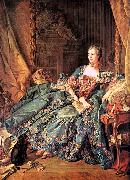
François Boucher (29 September 1703 - 30 May 1770) was a French painter, a proponent of Rococo taste, known for his idyllic and voluptuous paintings on classical themes, decorative allegories representing the arts or pastoral occupations, intended as a sort of two-dimensional furniture. He also painted several portraits of his illustrious patroness, Madame de Pompadour.
|
|
 |
Francois Bonvin
|
|
1817-1887
French
Francois Bonvin Location
Bonvin was born in humble circumstances in Paris, the son of a police officer and a seamstress. When he was four years old his mother died of tuberculosis and young Francois was left in the care of an old woman who underfed him. Soon his father married another seamstress and brought the child back into the household. Nine additional children were born, putting a strain on the familys resources, and to make matters worse his stepmother took to abusing and undernourishing Francois.
The young Bonvin started drawing at an early age. His potential was recognized by a friend of the family, who paid for him to attend a school for drawing instruction at age eleven. This instruction ended after two years, when his father apprenticed him to a printer, and Bonvin was to remain mostly self-taught as an artist. He spent his free time at the Louvre where he especially appreciated the Dutch old masters. Bonvin married a laundress at the age of twenty, at about the same time that he secured a job at the headquarters of the Paris police. It was during this period in his life that he also contracted an illness which would trouble him for the rest of his life.
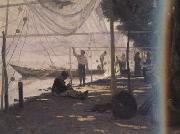
Bonvin exhibited three paintings in the Salon of 1849, where he was awarded a third-class medal. He exhibited in the Salon of 1850 with Courbet, and won recognition as a leading realist, painting truthfully the lives of the poor which he knew at first hand. His paintings were well received by critics and by the public. Although his work had elements in common with Courbets, his modestly scaled paintings were not seen as revolutionary. He was awarded the Legion d honneur in 1870.
His subjects were still life and the everyday activities of common people, painted in a style that is reminiscent of Pieter de Hooch and Jean-Baptiste-Simeon Chardin. It is the latter who is especially recalled by Bonvins delicate luminosity.
In 1881 he underwent an operation which did not restore him to health, and he became blind. A retrospective exhibition of his work was held in 1886. He died at Saint-Germain-en-Laye in 1887.
|
|
 |
Francois Bocion
|
|
1828-1890
was a Swiss artist and teacher. Born in Lausanne, Bocion studied art there before going to Paris, France in 1845 to study further. Following a bout with typhoid fever, he returned home in 1849. During the early part of his career, Bocion's interest was in the field of illustration as well as in painting historical subjects. However, influenced by the landscapes of Jean-Baptiste Camille Corot, he began painting scenes from around Lake Geneva for which he is best remembered. Bocion eventually secured a professorship at the Lausanne École Industrielle, a position he held for more than forty years.
|
|
|
|
 |
Francois Barraud
|
|
14 November 1899 - 11 September 1934) was a Swiss painter.
Barraud was the eldest of four brothers who all painted or sculpted at various points in their lives. The brothers, François, Aime, Aurele and Charles, were largely self-taught artists having been raised as professional plasterers and house painters.Barraud attended evening classes at the local art school in 1911 together with his brothers.In 1919, he exhibited his paintings in La Chaux-de-Fonds and participated in the National Exhibition of Fine Arts in Basel.Encouraged by the success of the exhibitions he left Switzerland in 1922, and moved to Reims in France where he worked as a house painter for two years. He married Marie, a French woman, in 1924. Marie subsequently featured as a model in several of his paintings. Around 1924 or 1925, Barraud found work in Paris as an artist and craftsman. While living in Paris he studied painting at the Louvre.
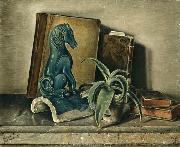
François Barraud painted mainly still lifes, female nudes and portraits, including several double portraits of himself and his wife, Marie His precise, realist style of painting developed under the influence of the old Flemish and French masters he had studied at the Louvre.
Barraud suffered periods of illness throughout his life and died of tuberculosis in Geneva, in 1934, at the age of 34.
Arthur Stoll held a major collection of François Barraud's works. His works are also held in the Musee des beaux-arts in La Chaux-de-Fonds, the Coninx Museum in Zurich and the Foundation for Art, Culture and History in Winterthur.
|
|
|
|
|
|
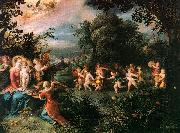 |
Francken, Frans II
|
|
b. 1581, Antwerpen, d. 1642, Antwerpen
Painter, son of Frans Francken I. Of all the members of the Francken family, Frans II is the most important and still the most widely known. There are paintings by him in all large public collections in Europe. Besides altarpieces and painted furniture panels, he produced mainly small cabinet pictures with historical, mythological or allegorical themes. Frans II's rank as an artist is not so much derived from his extensive output as from his innovative subject-matter: his depictions of luxuriously decorated Kunstkammern and art galleries
|
|
|
|
|
|
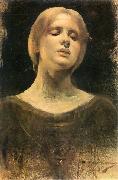 |
Franciszek zmurko
|
|
(18 July 1859 in Lviv - 9 October 1910 in Warsaw) was a Polish painter. Zmurko began drawing lessons as a young boy in his hometown with the painter Franciszek Tepa. As an adolescent he moved to Krakow to study at the The Academy of Fine Arts where he had lessons from Jan Matejko. In 1877 Zmurko moved to Vienna, Austria where he was accepted at the Vienna Academy, but left soon thereafter to study under Aleksander Wagner in Munich. Zmurko returned to Krakow in 1880 and then moved to Warsaw in 1882 where he remained until his death in 1910.
|
|
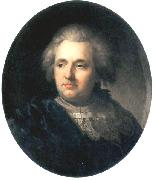 |
Franciszek Smuglewicz
|
|
(October 6, 1745 - September 18, 1807) was a Polish-Lithuanian draughtsman and painter. Smuglevičius is considered as a progenitor of Lithuanian art in the modern era.Some scholars consider him as a spiritual father of Jan Matejko's school of painting.[citation needed]. His brother was Antoni Smuglewicz.
Smuglewicz was born in Warsaw into a Polish-Lithuanian familyHis father, Łukasz Smuglewicz, also a painter, had moved to Warsaw from the province of Samogitia. In 1763 Franciszek journeyed to Rome, where he began the study of fine arts under the tutorship of Anton von Maron. He stayed in Rome for the next 21 years, where he embraced the Neo-Classical style.
In 1765 he received a royal scholarship from king Stanisław August Poniatowski and was admitted into the Saint Lucas Academy. As a colleague of Vincenzo Brenna he participated in cataloging artifacts from Nero`s Domus Aurea. In 1784 he returned to Warsaw, where he founded his own school of fine arts, one of the predecessors of the modern Academy of Fine Arts.
|
|
|
|
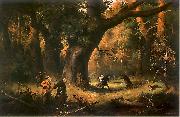 |
Franciszek Kostrzewski
|
|
(19 April 1826 in Warsaw - 30 September 1911 in Warsaw) was a Polish painter, illustrator and caricaturist.
He was born in Warsaw, Congress Poland, Russian Empire. Among his works are paintings illustrating the epic poem Pan Tadeusz. He died in Warsaw.
|
|
|
|
|
|
 |
Francisco Pradilla Ortiz
|
|
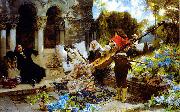
(July 24, 1848 - November 1, 1921) was a prolific Spanish painter famous for creating historical scenes.
He was born in Villanueva de Gellego, near Zaragoza in Aragon, and studied initially in Zaragoza and then transferred to the Real Academia de Bellas Artes de San Fernando and the Academia de Acuarelistas in Madrid. In 1873, he won a scholarship to go to Rome. From there he had opportunities to travel to France and Venice and studied the old masters. In 1878 he submitted his painting Doña Joanna of Castile or (Juana la Loca) to the National Exhibition in Spain and was awarded the Medal of Honor. The Spanish Senate then commissioned him to create La Rendicien de Granada (The Surrender of Granada) that took him three years to complete (1882). In 1881 he became the Director of the Spanish Arts Academy in Rome, but resigned from this post after two years. He traveled, mostly in Italy, portraying local themes and people. In 1897 he returned to Madrid as the director of the Museo del Prado. He held this position only briefly and then focused again on painting.
His total output is well over 1,000 paintings showing his interest in a variety of subjects and styles, often without regard of the current fashion. He is primarily recognized for his historical paintings, the last one completed in 1910 carries one of the longer titles of a major painting, Cortejo del bautizo del Prencipe Don Juan, hijo de los Reyes Catelicos, por las calles de Sevilla (Retinue of the Baptism of Don Juan, son of the Catholic Monarchs, Along the Streets of Seville). Much more common, however, are costumbristaseoften romanticized studies that show local customs or mannerseand landscapes that are often sketchy, with impressionistic influences. Financial duress after the bankruptcy of his bank may have imposed a special need to be productive.
He died in Madrid in 1921 at the age of 73.
|
|
 |
Francisco Pedro do Amaral
|
|
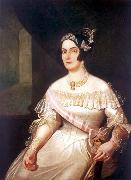
Amaral, Francisco Pedro do (1790 - 1831)
painted Portrait of Domitila de Castro Canto e Melo, Marquise of Santos in 19th century
|
|
 |
Francisco Pacheco
|
|
Spanish painter, teacher, and schola
1564-1644, Spanish painter and writer. He is not considered to be a great painter, but he is remembered for his theoretical work Arte de la pintura. The book is the most important contribution to Spanish artistic theory in the 17th century.
|
|
 |
Francisco Oller y Cestero
|
|
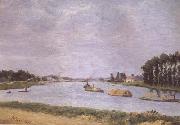
San Juan,Puerto Rico 1833-Santurce 1917
Puerto Rican painter. He studied from 1851 to 1853 at the Real Academia de Bellas Artes de San Fernando in Madrid under Federico de Madrazo y Kentz and in Paris from 1858 to 1863 under Thomas Couture and Charles Gleyre at the Ecole Imperiale et Speciale de Dessin and at the Academie Suisse. There he met Camille Pissarro, Paul Cezanne and Armand Guillaumin, who together with Couture and the work of Courbet influenced his work towards Realism and Impressionism.
|
|
|
|
 |
Francisco Lopez Caro
|
|
(1578-1662) was a Spanish painter of the Baroque period. Born in Seville, he was a pupil of Juan de las Roelas. We know very little of him, save that he painted with indifferent success in Seville until about 1660, when he went to Madrid where he spent the remainder of his life, and died in 1662. His works were mainly portraits, some of which are in private collections in Madrid, Salamanca, Granada, and Seville.
|
|
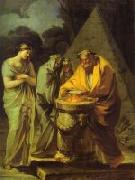 |
Francisco Jose de Goya
|
|
Spanish Rococo Era/Romantic Painter and Printmaker, 1746-1828
Goya is considered the 18th Century's foremost painter and etcher of Spanish culture, known for his realistic scenes of battles, bullfights and human corruption. Goya lived during a time of upheaval in Spain that included war with France, the Inquisition, the rule of Napoleon's brother, Joseph, as the King of Spain and, finally, the reign of the Spanish King Ferdinand VII. Experts proclaim these events -- and Goya's deafness as a result of an illness in 1793 -- as central to understanding Goya's work, which frequently depicts human misery in a satiric and sometimes nightmarish fashion. From the 1770s he was a royal court painter for Charles III and Charles IV, and when Bonaparte took the throne in 1809, Goya swore fealty to the new king. When the crown was restored to Spain's Ferdinand VII (1814), Goya, in spite of his earlier allegiance to the French king, was reinstated as royal painter. After 1824 he lived in self-imposed exile in Bordeaux until his death, reportedly because of political differences with Ferdinand. Over his long career he created hundreds of paintings, etchings, and lithographs, among them Maya Clothed and Maya Nude (1798-1800); Caprichos (1799-82); The Second of May 1808 and The Third of May 1808 (1814); Disasters of War (1810-20); and The Black Paintings (1820-23).
|
|
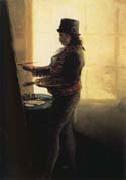 |
Francisco Goya
|
|
1746-1828
Goya is considered the 18th Century's foremost painter and etcher of Spanish culture, known for his realistic scenes of battles, bullfights and human corruption. Goya lived during a time of upheaval in Spain that included war with France, the Inquisition, the rule of Napoleon's brother, Joseph, as the King of Spain and, finally, the reign of the Spanish King Ferdinand VII. Experts proclaim these events -- and Goya's deafness as a result of an illness in 1793 -- as central to understanding Goya's work, which frequently depicts human misery in a satiric and sometimes nightmarish fashion. From the 1770s he was a royal court painter for Charles III and Charles IV, and when Bonaparte took the throne in 1809, Goya swore fealty to the new king. When the crown was restored to Spain's Ferdinand VII (1814), Goya, in spite of his earlier allegiance to the French king, was reinstated as royal painter. After 1824 he lived in self-imposed exile in Bordeaux until his death, reportedly because of political differences with Ferdinand. Over his long career he created hundreds of paintings, etchings, and lithographs, among them Maya Clothed and Maya Nude (1798-1800); Caprichos (1799-82); The Second of May 1808 and The Third of May 1808 (1814); Disasters of War (1810-20); and The Black Paintings (1820-23).
|
|
|
|
|
|
 |
Francisco de Zurbaran
|
|
1598-1664
Spanish Francisco de Zurbaran Galleries
Spanish baroque painter, active mainly at Llerena, Madrid, and Seville. He worked mostly for ecclesiastical patrons. His early paintings, including Crucifixion (1627; Art Inst., Chicago), St. Michael (Metropolitan Mus.), and St. Francis (City Art Museum, St. Louis), often suggest the austere simplicity of wooden sculpture. The figures, placed close to the picture surface, are strongly modeled in dramatic light against dark backgrounds, indicating the influence of Caravaggio. They were clearly painted as altarpieces or devotional objects. In the 1630s the realistic style seen in his famous Apotheosis of St. Thomas Aquinas (1631; Seville) yields to a more mystical expression in works such as the Adoration of the Shepherds (1638; Grenoble); in this decade he was influenced by Ribera figural types and rapid brushwork. While in Seville, Zurbur??n was clearly influenced by Velazquez. After c.1640 the simple power of Zurbaran work lessened as Murillo influence on his painting increased (e.g., Virgin and Child with St. John, Fine Arts Gall., San Diego, Calif.). There are works by Zurbar??n in the Hispanic Society of America, New York City; the National Gallery, Washington, D.C.; and the Philadelphia Museum of Art..
|
|
|
|
|
|
|
|
|
| Wholesale China Oil Painting Wholesale Oil Painting China Xiamen Portrait Reproduction on canvas Chinese Oil Painting Wholesale USA Oil Painting |
|
|
|
|
|