| |
|
Xiamen Oil Paintings, Wholesale Direct!
|
|
100% hand painted, 100% cotton canvas, 100% money back if not satisfaction. |
|
|
|
|
ART WORKS INDEX
A
B
C
D
E
F
G
H
I
J
K
L
M
N
O
P
Q
R
S
T
U
V
W
X
Y
Z
|
|
ARTISTS INDEX
A
B
C
D
E
F
G
H
I
J
K
L
M
N
O
P
Q
R
S
T
U
V
W
X
Y
Z
|
|
|
|
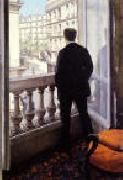 |
Gustave Caillebotte
|
|
French Impressionist Painter, 1848-1894
Gustave Caillebotte was born on August 19, 1848 to an upper-class Parisian family. His father, Martial Caillebotte (1799-1874), was the inheritor of the family textile industry and was also a judge at the Seine Tribunal de Commerce. Caillebotte father had been twice widowed before marrying Caillebotte mother, C??leste Daufresne (1819-1878), who had two more sons after Gustave, Rene (1851-1876) and Martial (1853-1910).
|
|
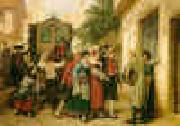 |
Gustave Brion
|
|
1824-1877 French
French painter and illustrator. His family settled in Strasbourg in 1831 and placed him in the studio of the portrait and history painter Gabriel-Christophe Gurin (1790-1846) in 1840. He then earned his living mainly by teaching drawing and copying paintings. In 1847 he successfully submitted his first work to the Salon: Farmhouse Interior at Dambach (untraced). In the summer of 1850 he moved to Paris, where he took a studio in a house shared by Realist artists. Brion exhibited regularly at the Salon: in 1852 The Towpath (untraced) was bought by the de Goncourt brothers; and in 1853 he showed the Potato Harvest during the Flooding of the Rhine in 1852 (Nantes, Mus. B.-A.), in which the influence of Gustave Courbet and Jean-Francois Millet (ii) can be seen in the Alsatian peasant figures.
|
|
 |
Gustave Boulanger
|
|
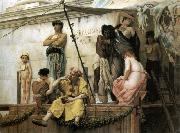
(1824-88) was a French figure painter known for his Neo-Grec style. He was born at Paris, studied with Delaroche and Jollivet, and in 1849 took the Prix de Rome. His paintings are prime examples of academic art of the time, particularly history painting. Boulanger had visited Italy, Greece, and North Africa, and his paintings reflect his attention to culturally correct details and skill in rendering the female form. His works include a Moorish Cafe (1848), Cæsar at the Rubicon (1865), the Promenade in the Street of Tombs, Pompeii (1869), and The Slave Market (1888). The recipient of many medals, he became a member of the Institut de France in 1882.
|
|
 |
Gustav Wentzel
|
|
(7 October 1859 - 10 February 1927) was a Norwegian painter. He was best known for interiors and domestic and rural scenes. His artistic style was associated with Naturalism and noted for accurate observations and attention to detail.
Gustav Wentzel was born in Christiania. He was a pupil of painter Knud Bergslien (1879-81) of and Frits Thaulow in 1883. He also studied for a time in Paris at the Academie Julian in 1884 and at Academie Colarossi with Leon Bonnat and Alfred Philippe Roll (1888-89). Wentzel first public painting was exhibited in Albert Cammermeyer bookstore during the autumn of 1879. His painting Snekkersvennen, which had been rejected by the Christiania Kunstforening, led to a lasting dispute and the establishment of an exhibition organized by the artists themselves, which eventually became an annual event called Autumn Exhibition (Høstutstillingen) in Oslo.
Among his paintings at the National Gallery of Norway are I fiskernaustet from 1881, Frokost from 1882, and Dans i Setesdal from 1887. Wentzel was decorated Knight, First Class of the Royal Norwegian Order of St. Olav in 1908
|
|
 |
Gustav Klimt
|
|
Austrian Art Nouveau Painter, 1862-1918
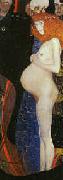
Gustav Klimt (July 14, 1862 ?C February 6, 1918) was an Austrian Symbolist painter and one of the most prominent members of the Vienna Art Nouveau (Vienna Secession) movement. His major works include paintings, murals, sketches, and other art objects, many of which are on display in the Vienna Secession gallery. Klimt's primary subject was the female body, and his works are marked by a frank eroticism--nowhere is this more apparent than in his numerous drawings in pencil.
Klimt's work is distinguished by the elegant gold or coloured decoration, often of a phallic shape that conceals the more erotic positions of the drawings upon which many of his paintings are based. This can be seen in Judith I (1901), and in The Kiss (1907?C1908), and especially in Danaë (1907). One of the most common themes Klimt utilized was that of the dominant woman, the femme fatale. Art historians note an eclectic range of influences contributing to Klimt's distinct style, including Egyptian, Minoan, Classical Greek, and Byzantine inspirations. Klimt was also inspired by the engravings of Albrecht D??rer, late medieval European painting, and Japanese Rimpa school. His mature works are characterized by a rejection of earlier naturalistic styles, and make use of symbols or symbolic elements to convey psychological ideas and emphasize the "freedom" of art from traditional culture.
|
|
 |
Gustav Graef
|
|
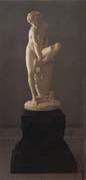
(December 14, 1821 in Königsberg - January 6, 1895 in Berlin) was a German painter, primarily of portraits and historical subjects. He studied with Theodor Hildebrandt and Friedrich Wilhelm Schadow at the Kunstakademie Desseldorf. His son Botho Graef became an art historian of some note, and his daughter was the painter Sabine Lepsius.
|
|
 |
Gustav Eberlein
|
|
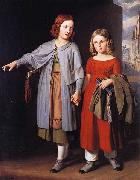
1847Spickerschausen-1926 Berlin,German sculptor. He attended the Realschule in Hannoversch Menden until 1861. He was apprenticed to a goldsmith in 1861-4 and thus learnt embossing, carving, chasing and engraving. He subsequently travelled as a journeyman, finding employment in Hildesheim, then in Kassel with the court jeweller, Ruhl. From 1867 to 1870, Eberlein trained as a sculptor under August von Kreling (1819-76), director of the Kunstgewerbeschule in Nuremberg, also working as Kreling's assistant to support his studies. On receiving a grant from Elisabeth of Prussia (the widow of Frederick William IV) for three further years of study,
|
|
|
|
|
|
 |
Gustav Adolph Hennig
|
|
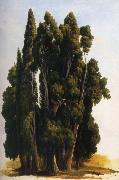
Gustav Adolph Hennig (1797-1869)Professions: Historical-scenes painter; Porträtmaler; Miniature painter; Etcher; Lithographer.
|
|
|
|
 |
Gustaf Wilhelm Palm
|
|
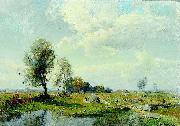
Swedish, 1810-1890,Swedish painter. He entered the Royal Academy of Arts in Stockholm in 1828, where he was a student of Carl Johan Fahlcrantz. Following a tour of Norway he went, via Copenhagen, to Berlin and Vienna for three years in order to seek a cure for an eye illness. He was influenced there by Biedermeier painting and Ferdinand Georg Waldm?ller, and also by the architectural painters Jakob Alt (1789-1872) and his son Rudolf Alt.
|
|
|
|
 |
Gustaf Rydberg
|
|
painted Skansk slatt med pilvall - motiv fran Viby in 1923
Swedish, 1835-1933
|
|
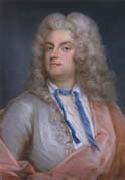 |
Gustaf Lundberg
|
|
Swedish, 1695-1786,Swedish painter and pastellist. He was orphaned early and brought up by his grandfather, the goldsmith Fredrik Richter (1636-1714). In 1710 he was briefly apprenticed to David von Krafft (1655-1724). Against von Krafft's advice, and at his own expense, he travelled to Paris in 1717. He studied first with Hyacinthe Rigaud, Nicolas de Largillierre and Jean-Fran?ois de Troy, learning to paint in a R?gence style less heavy and serious than that taught by von Krafft in Sweden. He also studied drawing under Pierre-Jacques Cazes at the Ecole des Beaux-Arts. In 1720 Rosalba Carriera came to Paris from Italy, bringing with her the fashionable technique of drawing in pastel chalks. Lundberg became her pupil and within a year had mastered the medium, charming the Parisians with his portraits. Until the arrival of Carriera, he had worked only in oils (e.g. the portrait of Gabriel Sack and his Wife Eva Bielke, 1730; priv. col.), but he now turned exclusively to pastels. He received portrait commissions from Louis XV (reg 1715-74), notably for those of his young queen Maria Leszczynska and of her parents Stanislav I Leszczynski and Catherine Opalinska (both 1725; Upplands Vesby, priv. col.), who at that time were living at Chambord. Through the agency of Carl Gustav Tessin, Lundberg was received (re?u) at the Acad?mie Royale de Peinture et de Sculpture in 1741. As his morceaux de reception he executed two portraits of Fran?ois Boucher and Charles-Joseph Nattier, shown at the Salon of 1743.
|
|
 |
Gustaf Fjaestad
|
|
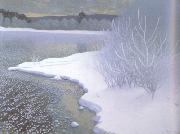
Swedish 1868-1948
Swedish painter, printmaker and designer. He trained at the Royal Academy of Arts in Stockholm in 1891-2. Subsequently he studied with Bruno Liljefors and Carl Larsson, assisting them with such decorative schemes as Larsson's fresco at the Nationalmuseum, Stockholm (1896). In 1897 he moved to the Arvika district of V?rmland, where he worked together with his wife, Maja (1873-1961), as painter, craftsman and cabinetmaker, and gathered around him a circle of artists who became known as the Racken group. He first achieved public recognition at the Stockholm Artists Union exhibition in 1898 with some of his snow landscapes, which were an immediate popular success and were often reproduced. He had his first one-man exhibition in Stockholm in 1908,
|
|
 |
Gustaf Cederstrom
|
|
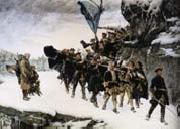
Swedish Painter, 1845-1933,was a Swedish painter, most known for his painting Karl XII:s likfärd (The funeral transport of Charles XII). He was born and raised in Stockholm. His father was Carl Emanuel Cederström and his mother was Carolina Fredrika Theresia af Ugglas. He married Amalia Katarina Jaeder in 1878
|
|
|
|
|
|
 |
Gunnar Berg
|
|
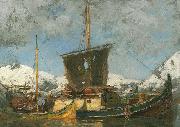
(21 May 1863 - 23 December 1893) was a Norwegian painter, known for his paintings of his native Lofoten. He principally painted memorable scenes of the everyday life of the local fishermen.
Gunnar Berg was born on Svinøya in Svolvær on Lofoten, Nordland County, Norway. He was the oldest of 12 siblings born to a landlord and merchant, Lars Thodal Walnum Berg (1830-1903) and Lovise Johnsen (1842-1921). From 1875-81, he attended Cathedral School in Trondheim, and also took private lessons in drawing and painting by the artist H. J. Johannessen. He later attended a trade school in Bergen. He was first employed as a merchant. He later studied to became an artist.
|
|
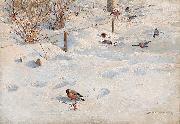 |
Gunnar aberg
|
|
Gunnar Berg (21 May 1863 -23 December 1893) was a Norwegian painter, known for his paintings of his native Lofoten. He principally painted memorable scenes of the everyday life of the local fishermen.
|
|
 |
Guillaume Voiriot
|
|
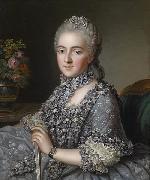
Guillaume Voiriot (Paris, 1713 - Paris, 30 November 1799) was a French portrait painter. In the years of 1746-1749 Voiriot went, at its own expense, to Italy. After his return he became a member of the painters and sculptors guild at Academie de Saint-Luc. In the years 1759 to 1771 he regularly exhibited portraits of his contemporaries in the Paris Salon. He portrayed family members, scientists, writers, actors and musicians.
|
|
 |
Guillaume Seignac
|
|
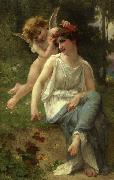
He was born in Rennes, France, in 1870, and died in 1924. He started training at the Academie Julian in Paris, where he spent 1889 through 1895. He had a lot of teachers there, including Gabriel Ferrier, and Tony Robert-Fluery. Tony Robert Fluery was a noted history and genre artist. Gabriel Farrel, on the other hand, had been an awarded Prix de Rome. He had another one named William Bouguereau.
|
|
 |
Guillaume Descamps
|
|
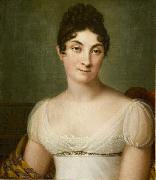
Guillaume-Desire-Joseph Descamps, a painter and engraver, was born at Lille in 1779. He was a pupil of Vincent, but, obtaining the "prix de Rome," he improved himself by travelling in Italy, and became court-painter of Murat in Naples. He died in Paris in 1858. The following paintings were executed by him:
The Women of Sparta (in the Lille Museum). 1808.
The Martyrdom of St. Andrew (in St. Andre, Lille).
Murat on board the Ceres distributing Rewards (engraved hy himself).
The Conversion of St. Augustine (in St. Eustache, Paris).
The Apotheosis of Cardinal Tommasi (in San Martino di Monti, Rome).
The Neapolitan Troops marching out against Capri.
|
|
 |
Guido Reni
|
|
1575-1642
Italian
Guido Reni Galleries
Born in Bologna into a family of musicians, Guido Reni was the son of Daniele Reni and Ginevra de?? Pozzi. As a child of nine, he was apprenticed under the Bolognese studio of Denis Calvaert. Soon after, he was joined in that studio by Albani and Domenichino. He may also have trained with a painter by the name of Ferrantini. When Reni was about twenty years old, the three Calvaert pupils migrated to the rising rival studio, named Accademia degli Incamminati (Academy of the "newly embarked", or progressives), led by Lodovico Carracci. They went on to form the nucleus of a prolific and successful school of Bolognese painters who followed Annibale Carracci to Rome. Like many other Bolognese painters, Reni's painting was thematic and eclectic in style.
By late 1601, Reni and Albani had moved to Rome to work with the teams led by Annibale Carracci in fresco decoration of the Farnese Palace. During 1601-1604, his main patron was cardinal Sfondrato. By 1604-1605, he received an independent commission for an altarpiece of the Crucifixion of St. Peter. After a few year sojourn in Bologna, he returned to Rome to become one of the premier painters during the papacy of Paul V (Borghese). From 1607-1614, he was one of the painters patronized by Borghese.
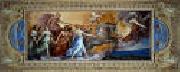
Abduction of Deianira, 1620-1621.Reni's frescoed ceiling of the large central hall of garden palace, Casino dell'Aurora located in the grounds of the Palazzo Pallavicini-Rospigliosi, is considered his masterpiece. The casino was originally a pavilion commissioned by Cardinal Scipione Borghese; the rear portion overlooks the Piazza Montecavallo and Palazzo del Quirinale. The massive fresco is framed in quadri riportati and depicts Apollo in his Chariot preceded by Dawn (Aurora) bringing light to the world. The work is restrained in classicism, copying poses from Roman Sarcophagi, and showing far more simplicity and restraint than Carracci's riotous Triumph of Bacchus and Ariadne[5] in the Farnese. Reni in this painting is allies himself more with the sterner Cavaliere d'Arpino,Lanfranco, and Albani "School" of mytho-historic painting, and less with the more crowded frescoes characteristic of Pietro da Cortona. There is little concession to perspective, and the vibrantly colored style is antithetical to the tenebrism of Caravaggio's followers. Payments showed that he was paid in 247 scudi and 54 baiocchi upon completion on 24 September 1616.
He also frescoed in Paoline Chapel of Santa Maria Maggiore in Rome as well as the Aldobrandini wings of the Vatican. According to rumor, the pontifical chapel of Montecavallo (Chapel of the Annuciation) was assigned to Reni to paint. However, because he felt underpaid by the ministers, the artist left for Bologna, leaving the role of the preeminent artist in Rome to Domenichino.
|
|
 |
Guido da Siena
|
|
Italian Byzantine Style Painter, 13th Century
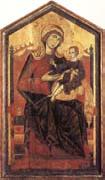
He may have made significant advances in the techniques of painting, much as Cimabue much later accomplished. However, there is some debate about this. Guido is primarily known for a painting which is now split into several pieces. The church of S. Domenico in Siena contains a large painting of the Virgin and Child Enthroned with six angels above. The Benedictine convent of the same city has a triangular pinnacle representing the Saviour in benediction, with two angels. This was once a portion of the same composition, which was originally a triptych. The principal section of this picture has a rhymed Latin inscription, giving the painter's name as Guido de Senis, with the date 1221. However, this may not be genuine, and the date may really read as 1281. There is nothing particular to distinguish this painting from other work of the same period except that the heads of the Virgin and Child are much superior ?C in natural character and graceful dignity ?C to anything painted before Cimabue. As a result, there is some dispute as to whether these heads are really the work of a man who painted in 1221, long before Cimabue. Crowe and Cavalcaselle have proposed that the heads were repainted in the 14th century, perhaps by Ugolino da Siena. If Crowe and Cavalcaselle are right, Cimabue maintains his claim to the advancement of the art. Beyond this, little is known of Guido da Siena. A picture in the Academy of Siena is attributed to him (a half-figure of the Virgin and Child, with two angels), which dates (probably) between 1250 and 1300.
|
|
 |
Guido Cagnacci
|
|
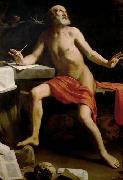
(January 19, 1601 - 1663) was an Italian painter of the late-Baroque period, belonging to the Forle painting school and to the Bolognese School.
Born in Santarcangelo di Romagna near Rimini, he died in Vienna in 1663. He worked in Rimini from 1627 to 1642. After that, he was in Forle, where absorbed the lesson of the Melozzo's painting.
Prior to that he had been in Rome, in contact with Guercino, Guido Reni and Simon Vouet. He may have had an apprenticeship with the elderly Ludovico Carracci. His initial output includes many devotional subjects. But moving to Venice under the name of Guico Baldo Canlassi da Bologna, he renewed a friendship with Nicolas Regnier, and dedicated himself to private salon paintings, often depicting sensuous naked women from thigh upwards, including Lucretia, Cleopatra, and Mary Magdalene.This allies him to a strand of courtly painting, epitomized in Florence by Francesco Furini, Simone Pignoni and others. In 1650, he moved to Venice. In 1658, he traveled to Vienna, where he remained under patronage of the emperor Leopold I.
His life was at times tempestuous, as characterized by his failed elopement (1628) with an aristocratic widow. Some contemporaries remark him as eccentric, unreliable and of doubtful morality. He is said to have enjoyed the company of cross-dressing models.
|
|
|
|
|
|
 |
GUERCINO
|
|
Italian Baroque Era Painter, 1591-1666
best known as Guercino or Il Guercino, was an Italian Baroque painter from the region of Emilia, and active in Rome and Bologna. Guercino is Italian for squinter, a nickname that was given to him because he was cross-eyed. He is especially noted for his many superb drawings. Guercino was born at Cento, a village between Bologna and Ferrara. By the age of 17 he was associated with Benedetto Gennari, a painter of the Bolognese School. By 1615 he moved to Bologna, where his work earned the praise of an elder Ludovico Carracci. He painted two large canvases, Elijah Fed by Ravens and Samson Seized by Philistines, in what appears to be a stark naturalist Caravaggesque style (although it is unlikely he had been able to see any of the Roman Caravaggios first-hand). They were painted for Cardinal Serra, Papal Legate to Ferrara. The Arcadian Shepherds (Et in Arcadia ego) was painted in 1618 contemporary with The Flaying of Marsyas by Apollo in Palazzo Pitti. His first style, he often claimed, was influenced by a canvas of Carracci in Cento. Some of his later pieces approach rather to the manner of his great contemporary Guido Reni, and are painted with more lightness and clearness. Guercino was esteemed very highly in his lifetime. He was then recommended by Marchese Enzo Bentivoglio to the Bolognese Ludovisi Pope, Pope Gregory XV. His two years (1621-23) spent in Rome were very productive. From this stay date his frescoes of Aurora at the casino of the Villa Ludovisi and the ceiling in San Crisogono (1622) of San Chrysogonus in Glory; his portrait of Pope Gregory (now in the Getty Museum, and, what is considered his masterpiece, The Burial of Saint Petronilla or St. Petronilla Altarpiece, for the Vatican (now in the Museo Capitolini). The Franciscan order of Reggio in 1655 paid him 300 ducats for the altarpiece of Saint Luke Displaying a Painting of the Madonna and Child (now in Nelson-Atkins Museum of Art, Kansas City). The Corsini also paid him 300 ducats for the Flagellation of Christ painted in 1657.
|
|
|
|
|
|
|
|
 |
GUARDI, Francesco
|
|
Italian Rococo Era Painter, 1712-ca.1793
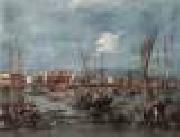
The records of his parish in Venice show that Francesco Guardi was baptized on Oct. 5, 1712. His father, Domenico, who died when Francesco was 4, had a workshop. Francesco and his elder brother, Gian Antonio, worked in a small studio, carrying out such orders as they could get for almost anything the client wanted:mythological pictures, genre, flower pieces, battle scenes, altarpieces, and even, on rare occasions, frescoes. They did not hesitate to copy compositions by other artists, but what they borrowed they always transformed into something more capricious, less stable, more fragmentary in the refraction of light. Francesco did not emerge as an independent personality until 1760, when his brother died. Then, 48 years old, he married, established his own studio, and devoted himself chiefly to painting views of Venice. For the most part he worked in obscurity, ignored by his contemporaries. He was not even admitted to the Venetian Academy until he was 72 years old. Guardi and Canaletto have always been compared to one another because the buildings they chose to paint were often the same. But the way each artist painted them is very different. Canaletto's world is constructed out of line. It provides solid, carefully drawn, three-dimensional objects that exist within logically constructed three-dimensional space. Guardi's world is constructed out of color and light. The objects in it become weightless in the light's shimmer and dissolve in a welter of brushstrokes; the space, like the forms in space, is suggested rather than described. Canaletto belonged essentially to the Renaissance tradition that began with Giotto and, as it grew progressively tighter and more controlled, pointed the way to neoclassicism. Guardi belonged to the new baroque tradition that grew out of the late style of Titian and, as it became progressively looser and freer, pointed the way toward impressionism. Such differences appear even in Guardi's early view paintings, where he was obviously trying to copy Canaletto, such as the Basin of San Marco. The famous buildings are there, but they are far in the background, insubstantial, seeming to float. In front is a fleet of fishing boats, their curving spars seeming to dance across the surface of the canvas. What is important for Guardi is not perspective but the changing clouds and the way the light falls on the lagoon. Guardi became increasingly fascinated by the water that surrounds Venice. In late works, such as the famous Lagoon with Gondola, buildings and people have been stripped away until there is nothing but the suggestion of a thin line of distant wharfs, a few strokes to indicate one man on a gondola, a long unbroken stretch of still water, and a cloudless sky. Guardi also painted the festivals that so delighted visitors to the city, such as the Marriage of Venice to the Sea. This was a symbolic ceremony in which the doge, in the great gilded galley of the head of state, surrounded by a thousand gondolas, appeared before all Venice, in Goethe's image, "raised up like the Host in a monstrance." Of all Guardi's paintings the most evocative are his caprices, the landscapes born out of his imagination though suggested by the ruined buildings on the lonely islands of the Venetian lagoon. A gentle melancholy clings to such scenes.
|
|
|
|
 |
Grunewald, Matthias
|
|
German Northern Renaissance Painter, ca.1470-1528
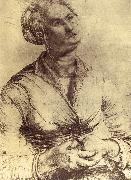
.the traditional name of a painter whose real name is believed to have been Nithardt or Neithardt. He was active at Isenheim nr. Colmar c.1514 and in Frankfurt c.1526. Gr??newald's principal work, an elaborate altarpiece of many panels painted for the monastery at Isenheim (Isenheimer Altar), is now in the Colmar museum.
|
|
 |
gruber
|
|
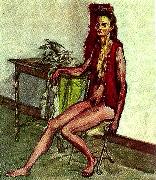
Francis Gruber (1912-1948) was a French painter and founder of the Nouveau R??alisme school.
Self-portrait 1942He was born in Nancy, the son of stained glass artist Jacques Gruber.
He first exhibited at the age of 18. While other artists were becoming more and more abstract, he preferred to paint human figures that were highly sculpted. He was influenced by Hieronymus Bosch and Albrecht D??rer and the Lorraine engraver Jacques Callot. He became friends with the Swiss artist Alberto Giacometti.
|
|
 |
gromaire
|
|
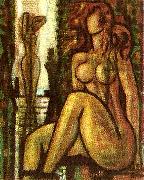
Marcel Gromaire (July 24, 1892 ?C April 11, 1971) was a French painter. He painted many works on social subjects, and is often connotated with Social Realism.
|
|
|
|
 |
GRIMMER, Abel
|
|
Flemish Baroque Era Painter, ca.1570-C.1619
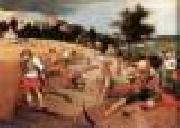
Son of Jacob Grimmer. He married Catharina Lescornet on 29 September 1591 and in 1592 became a master in the Antwerp Guild of St Luke. He is principally known for his numerous small paintings of country scenes, sometimes with a biblical theme, which often form part of a series of the Four Seasons or the Months of the Year. Some of these paintings were inspired by or even copied from prints by Pieter Bruegel I and Hans Bol, both of whose work strongly influenced Abel, even more so than did the example of his father's work, which was also an important source of inspiration. Abel's series of the Twelve Months (1592; Montfaucon-en-Velay, Haute-Loire, Chapelle Notre-Dame) are exact copies of Adriaen Collaert's prints after Hans Bol (Hollstein: Dut. & Flem., iv, nos 523-34), published by Hans van Luyck ( fl c. 1580-85) in 1585. Spring and Summer (Antwerp, Kon. Mus. S. Kst.) are almost exact copies of two prints by Pieter van der Heyden
|
|
 |
Grigory Gagarin
|
|
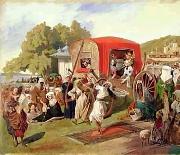
Russian: 11 May [O.S. 29 April] 1811 - 30 January [O.S. 18 January] 1893) was a Russian painter, Major General and administrator.
Grigory Gagarin was born in Saint Petersburg to the noble Rurikid princely Gagarin family. His father, Prince Grigory Ivanovich Gagarin (Saint Petersburg, 17 March 1782 - Tegernsee, 12 February 1837), was a Russian diplomat in France and later the ambassador to Italy. His father married in Saint Petersburg in 1809 his mother Yekaterina Petrovna Sojmonova (Saint Petersburg, 23 May 1790 - Moscow, 27 February 1873). Thus until the age 13 the boy was with his family in Paris and Rome and then studied in the collegium Tolomei in Siena. Grigory did not receive a formal artistic education, but took private lessons from the famous Russian painter Karl Briullov who at that time lived in Italy.
In 1832 he returned to Saint Petersburg, became acquainted with Alexander Pushkin and illustrated his works The Queen of Spades and The Tale of Tsar Saltan.He also became close to the opposition Circle of Sixteen and Mikhail Lermontov.
|
|
 |
Grigoriy Ugryumov
|
|
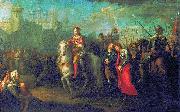
painted Alexander Nevsky in Pskov, after they victory over the Germans in 1793.
|
|
 |
Grigoriy Soroka
|
|
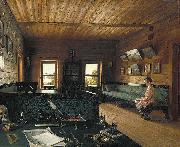
(Russian, real surname Vasilyev. November 27 [O.S. November 15] 1823-April 22 [O.S. April 10] 1864) was a Russian painter, one of the most notable members of Venetsianov school.
Soroka was born in Pokrovskoye village (Tver Guberniya), in the family of landowner Milyukov. In 1842-1847 he studied art from Alexey Venetsianov then he was returned to his owner. In 1850s-1860s he resided in his home village. He fell in love with his owners's daughter Lydia but was forcibly married to a serf woman. After the emancipation reform of 1861 in Russia, Soroka remained under the serfdom system. He made a formal complaint but it was rejected and he was flogged. Soroka's body was found in the baking room where he had hanged himself. His beloved Lydia poisoned herself soon after.
|
|
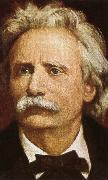 |
grieg
|
|
Period: Post-Romantic (1870-1909)
Country: Norway
Born: June 15, 1843 in Bergen, Norway
Died: September 04, 1907 in Bergen, Norway
Genres: Chamber Music, Concerto, Keyboard Music, Miscellaneous Music, Orchestral Music, Vocal Music
|
|
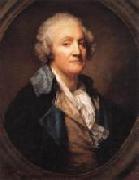 |
GREUZE, Jean-Baptiste
|
|
French Rococo Era Painter, 1725-1805
French painter and draughtsman. He was named an associate member of the Academie Royale de Peinture et de Sculpture, Paris, in 1755 on the strength of a group of paintings that included genre scenes, portraits and studies of expressive heads . These remained the essential subjects of his art for the next 50 years, except for a brief, concentrated and unsuccessful experiment with history painting in the late 1760s, which was to affect his later genre painting deeply. Though his art has often been compared with that of Jean-Simeon Chardin in particular and interpreted within the context of NEO-CLASSICISM in general, it stands so strikingly apart from the currents of its time that Greuze's accomplishments are best described, as they often were by the artist's contemporaries, as unique. He was greatly admired by connoisseurs, critics and the general public throughout most of his life. His pictures were in the collections of such noted connoisseurs as Ange-Laurent de La Live de Jully, Claude-Henri Watelet and Etienne-Francois, Duc de Choiseul. For a long period he was in particular favour with the critic Denis Diderot, who wrote about him in the Salon reviews that he published in Melchior Grimm's privately circulated Correspondance litt?raire. His reputation declined towards the end of his life and through the early part of the 19th century, to be revived after 1850, when 18th-century painting returned to favour, by such critics as Theophile Thore, Ars?ne Houssaye and, most notably, Edmond and Jules de Goncourt in their book L'Art du dix-huitieme siecle. By the end of the century Greuze's work, especially his many variations on the Head of a Girl, fetched record prices, and his Broken Pitcher (Paris, Louvre) was one of the most popular paintings in the Louvre. The advent of modernism in the early decades of the 20th century totally obliterated Greuze's reputation.
|
|
|
|
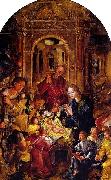 |
Gregorio Lopes
|
|
Gregorio Lopes (c. 1490 - 1550) was one of the most important Renaissance painters from Portugal.
Gregorio Lopes was educated in the workshop of Jorge Afonso, the court painter of King Manuel I. Later he himself became court painter for both Manuel I and for his successor, John III. In 1514 he married the daughter of Jorge Afonso, and in 1520 was knighted by Prince Jorge de Lencastre and entered the Order of Santiago.
The work of Gregorio Lopes mainly consists of painted religious altarpieces for various churches and monasteries in central Portugal. Between 1520 and 1525 he worked (together with Jorge Leal) in painting altarpieces for the Saint Francis Convent of Lisbon. Also in the 1520s he painted panels for the Church of Paraeso (Paradise), also in Lisbon. In his first fase, Gregorio Lopes also worked in Sesimbra, Setebal and in the Monastery of Ferreirim, in this latter case together with Cristevao de Figueiredo and Garcia Fernandes.
The painter moved in the 1530s to the city of Tomar, where he painted various panels for the Round Church of the Convent of Christ (1536 - 1539) and the main altarpiece of the Church of Saint John the Baptist (1538 - 1539). His last known works include altarpieces for the Convent of Santos-o-Novo in Lisbon (1540) and the Valverde Convent, near Évora (1545).
|
|
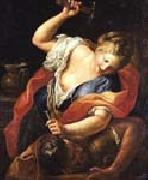 |
Gregorio Lazzarini
|
|
(1657 - 10 November 1730) was an Italian painter, mostly of religious subjects, and those from history and mythology.
Born in Venice, he initially trained with the Genovese painter Francesco Rosa, Girolamo Forabosco, and with the studio of Pietro della Vecchia. He joined the painters' guild in Venice in 1687.
|
|
 |
GRECO, El
|
|
Greek-born Spanish Mannerist Painter, 1541-1614
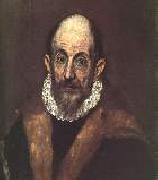
Greek painter, designer and engraver, active in Italy and Spain. One of the most original and interesting painters of 16th-century Europe, he transformed the Byzantine style of his early paintings into another, wholly Western manner. He was active in his native Crete, in Venice and Rome, and, during the second half of his life, in Toledo. He was renowned in his lifetime for his originality and extravagance and provides one of the most curious examples of the oscillations of taste in the evaluation of a painter,
|
|
 |
Greco El
|
|
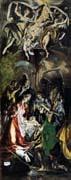
Spanish painter of Greek origin (b. 1541, Candia, d. 1614, Toledo). Paintings in Crete (until 1567) Paintings in Venice (1567-70) Paintings in Rome (1570-75) First commissions in Spain (1576-80) , He was a painter, sculptor, and architect of the Spanish Renaissance. "El Greco" (The Greek) was a nickname,a reference to his Greek origin, and the artist normally signed his paintings with his full birth name in Greek letters, (Domenikos Theotokopoulos). El Greco was born in Crete, which was at that time part of the Republic of Venice, and the centre of Post-Byzantine art. He trained and became a master within that tradition before travelling at age 26 to Venice, as other Greek artists had done. In 1570 he moved to Rome, where he opened a workshop and executed a series of works. During his stay in Italy, El Greco enriched his style with elements of Mannerism and of the Venetian Renaissance. In 1577 he moved to Toledo, Spain, where he lived and worked until his death. In Toledo, El Greco received several major commissions and produced his best known paintings. El Greco's dramatic and expressionistic style was met with puzzlement by his contemporaries but found appreciation in the 20th century.
|
|
|
|
|
|
|
|
|
| Wholesale China Oil Painting Wholesale Oil Painting China Xiamen Portrait Reproduction on canvas Chinese Oil Painting Wholesale USA Oil Painting |
|
|
|
|
|