| |
|
Xiamen Oil Paintings, Wholesale Direct!
|
|
100% hand painted, 100% cotton canvas, 100% money back if not satisfaction. |
|
|
|
|
ART WORKS INDEX
A
B
C
D
E
F
G
H
I
J
K
L
M
N
O
P
Q
R
S
T
U
V
W
X
Y
Z
|
|
ARTISTS INDEX
A
B
C
D
E
F
G
H
I
J
K
L
M
N
O
P
Q
R
S
T
U
V
W
X
Y
Z
|
|
|
|
 |
Giovanni di Paolo
|
|
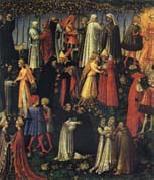
Italian Early Renaissance Painter, ca.1403-1483,major Italian painter of the Sienese school. Typical of the Sienese painters of his era, he paid scant attention to the artistic innovations made in nearby Florence, but often depended on the style established by the Sienese masters of the 14th cent. Fortunately, Giovanni di Paolo was endowed with great imagination. His first dated work (1426) was the Pecci altarpiece (major panels in Siena; predella panels in the Walters Art Gall., Baltimore). He produced a tremendous number of works during his long career. Many paintings have remained in Siena, but there are probably more examples of his art in the United States. The Metropolitan Museum has several of his paintings; among them is a delightful scene of Paradise; in the Philip Lehman collection is the exquisite Creation of the World. The Madonna and Child in a Landscape (Mus. of Fine Arts, Boston) exemplifies his inclination toward pure fantasy and disregard for the laws of perspective. Giovanni di Paolo is best represented by six highly expressive scenes from the life of St. John the Baptist (Art Inst., Chicago).
|
|
|
|
|
|
 |
Giovanni del Biondo
|
|
Italian Gothic Era Painter, active 1356-1399,was a 14th century Italian painter of the Gothic and early-Renaissance period, active 1356-1399.
|
|
 |
Giovanni dal ponte
|
|
Italian Painter, 1385-1437
He was reputed to have been a student of Spinello Aretino. He acquired the name dal Ponte due to the location of his studio at Santo Stefano a Ponte, Florence. He joined the Arte dei Medici e degli Speziali in 1410 and the Compagnia di S Luca in 1413. Outstanding debts brought him a prison sentence in 1424, but he still owed money to a carpenter three years later. By the late 1420s he had opened his own studio and formed a partnership with the painter Smeraldo di Giovanni (c. 1365-after 1442). Giovanni dal Ponte's varied and prolific production, which continued until his death, included fresco cycles, panels and the decoration of small objects. A number of allegorical panel paintings and cassoni are attributed to him. The animated, stylized figures in the Seven Liberal Arts (1435; Madrid, Prado) are shown in a garden dotted with naturalistic flowers and plants. His early work shows the impact of the Late Gothic style.
|
|
 |
Giovanni da san giovanni
|
|
1592-1636
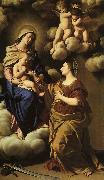
Italian painter and draughtman. He was the most distinguished of the artists working in fresco in 17th-century Florence. An eccentric personality, he was attracted by the charm and informality of northern art and by a satirical approach to Classical themes. He went to Florence in 1608 to study in the workshop of Matteo Rosselli, where he learnt both fresco and oil painting techniques and drew extensively (Baldinucci). In 1615 he painted two ceiling canvases of Putti Supporting the Impresa of Michelangelo for a room in the Casa Buonarroti and in the same period frescoed the dome of the church of the Ognissanti, Florence (completed 1615), with a choir of musician angels. He also painted five lunettes showing scenes from the Life of St Francis in the cloister (completed 1619; in situ). In 1616 his frescoed decoration of an Allegory of Florence (destr.; preparatory drawing, Florence, Uffizi, G.D.S. U. 1122F) on the fa?ade of Cosimo II de' Medici's house in Piazza della Calza won him unexpected and lasting fame. His early works also included several tabernacles, made for patrons in the town and in the surrounding countryside. The Virgin and Child with Saints
|
|
|
|
|
|
|
|
 |
Giovanni Camillo Sagrestani
|
|
(1660-1731) was an Italian painter of the Baroque era.
A native of Florence, he was a follower of the style of Carlo Cignani. His major pupil was Matteo Bonechi (1672-1726) and Giovanni Battista Ranieri del Pace. Four canvases attributed to Sagrestani can be found in the church of Santa Maria della Fraternite in Foiano della Chiana. He also executed works in the church of San Frediano in Cestello, in the Oltrarno district of Florence. Paintings in the church of SS. Annunziata in San Giovanni Valdarno are attributed to Sagrestani. An Assumption of the Virgin is found in Nancy.
|
|
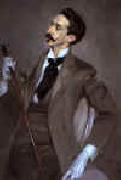 |
Giovanni Boldini
|
|
1842-1931
Italian
Giovanni Boldini Locations
Italian painter and printmaker. He received his earliest training from his father, the painter Antonio Boldini (1799-1872). From 1858 he may have attended courses given by Girolamo Domenichini (1813-91) and Giovanni Pagliarini (?1809-78) at the Civico Ateneo di Palazzo dei Diamanti, where he assiduously copied Old Masters. At 18 he was already known in Ferrara as an accomplished portrait painter. In 1862 he went to Florence, where he sporadically attended the Scuola del Nudo at the Accademia di Belle Arti. He frequented the Caffe Michelangiolo, a meeting-place of progressive artists, where he came into contact with the MACCHIAIOLI group of artists.
|
|
|
|
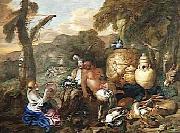 |
Giovanni Benedetto Castiglione
|
|
was an Italian Baroque artist, painter, printmaker and draftsman, of the Genoese school. He is best known now for his elaborate engravings, and as the inventor of the printmaking technique of monotyping. He was known as Il Grechetto in Italy and in France as Le Benedette.
|
|
 |
Giovanni Bellini
|
|
Italian High Renaissance Painter, ca.1430-1516
(b ?1431-6; d Venice, 29 Nov 1516). Painter and draughtsman, son of (1) Jacopo Bellini. Although the professional needs of his family background may have encouraged him to specialize at an early date in devotional painting, by the 1480s he had become a leading master in all types of painting practised in 15th-century Venice. Later, towards the end of his long life, he added the new genres of mythological painting and secular allegory to his repertory of subject-matter. His increasing dominance of Venetian art led to an enormous expansion of his workshop after c. 1490; and this provided the training-ground not only for his numerous shop-hands and imitators (generically known as Belliniani) but probably also for a number of major Venetian painters of the next generation. Throughout his career, Giovanni showed an extraordinary capacity for absorbing a wide range of artistic influences, both from within Venetian tradition and from outside. He also oversaw a technical revolution in the art of painting, involving the gradual abandonment of the traditional Italian use of egg tempera in favour of the technique of oil painting pioneered in the Netherlands. It was thanks to Giovanni Bellini that the Venetian school of painting was transformed during the later 15th century from one mainly of local significance to one with an international reputation. He thus set the stage for the triumphs of Venetian painting in the 16th century and for the central contribution that Venice was to make to the history of European art.
|
|
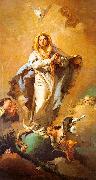 |
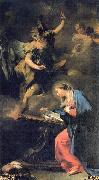
Giovanni Battista Tiepolo
|
|
Italian Rococo Era Painter, 1696-1770
Giovanni Battista Tiepolo was born in Venice on March 5, 1696. His father, who was part owner of a ship, died when Tiepolo was scarcely a year old, but the family was left in comfortable circumstances. As a youth, he was apprenticed to Gregorio Lazzarini, a mediocre but fashionable painter known for his elaborately theatrical, rather grandiose compositions.
Tiepolo soon evolved a more spirited style of his own. By the time he was 20, he had exhibited his work independently, and won plaudits, at an exhibition held at the church of S. Rocco. The next year he became a member of the Fraglia, or painters guild. In 1719 he married Cecilia Guardi, whose brother Francesco was to become famous as a painter of the Venetian scene. They had nine children, among them Giovanni Domenico and Lorenzo Baldassare, who were also painters.
In the 1720s Tiepolo carried out many large-scale commissions on the northern Italian mainland. Of these the most important is the cycle of Old Testament scenes done for the patriarch of Aquileia, Daniele Dolfin, in the new Archbishop Palace at Udine. Here Tiepolo abandoned the dark hues that had characterized his early style and turned instead to the bright, sparkling colors that were to make him famous.
|
|
|
|
|
|
 |
Giovanni Battista Pittoni
|
|
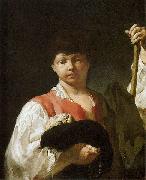
Giambattista Pittoni (June 6, 1687-November 6, 1767) was an Italian painter of the late-Baroque or Rococo period, active mainly in his native Venice.
Pittoni was born in Venice, and studied painting under his uncle Francesco Pittoni and Antonio Balestra. Little is known of his early career. He entered the Venetian painters' guild in 1716. In 1722-1723, he was commissioned to paint eThe Torture of St Thomase for San Stae in Venice, which also contains one if his later works in its sacristy. He also completed the transit of Santa Maria in Organo in Verona in 1725. In 1727, he was appointed honorary Academician of the Accademia Clementina in Bologna. In subsequent years, Pittoni never left his native Venice, but completed a number of important and lucrative commissions from German, Polish, Russian, Italian and Austrian patrons, including eThe Sacrifice of Jephthah's daughtere for the Royal Palace of Turin, a number of works for the Marshal von Schulenburg, and a eMartyrdom of St Batholomewe for the Basilica of Saint Anthony of Padua. Pittoni came to be known for his "grand-manner" canvases depicting religious, historical, and mythological subjects (such as Sophonisba and Polyxena).
By 1740, he established a studio and residence in the San Giacomo district of Venice, and took on numerous apprentices. Pittoni died at age 80 on November 6, 1767. His tomb is at the church of San Giacomo dall'Orio in Venice.
Pittoni was a co-founder of the official painter's academy in Venice (in competition to the old fraglia or painter's guild), the Accademia di Belle Arti di Venezia, and he succeeded as President (1758-1761) his contemporary Giovanni Battista Tiepolo. His mature palette was noted, as was Tiepolo's, for his lightness of tone. Besides Tiepolo, Pittoni's influences were Giovanni Battista Piazzetta, Sebastiano Ricci, and Antonio Balestra. His paintings were of a Rococo style, but later became more sedate in their approach towards Neoclassicism.
|
|
 |
Giovanni Battista Piazzetta
|
|
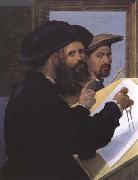
(also called Giambattista Piazzetta or Giambattista Valentino Piazzetta) (February 13, 1682 or 1683 ?C April 28, 1754) was an Italian rococo painter of religious subjects and genre scenes.
Piazzetta was born in Venice, the son of a sculptor Giacomo Piazzetta, from whom he had early training in wood carving. Starting in 1697 he studied with the painter Antonio Molinari. By Piazzetta's account, he studied under Giuseppe Maria Crespi while living in Bologna in 1703-05, although there is no record by Crespi of formal tutelage. Piazzetta did find inspiration in Crespi's art, in which the chiaroscuro of Caravaggio was transformed into an idiom of graceful charm. He was also greatly impressed by the altarpieces created by another Bolognese painter of a half-century earlier, Guercino.
Around 1710, he returned to Venice. There he won recognition as a leading artist despite his limited output and his unassuming nature, but he ultimately was less patronized, both in Venice and especially abroad, than two other eminent stars in Venetian late-Baroque/Rococo, Ricci and Tiepolo. These two painters had a luminous palette and facile ease that allowed them to carpet meters of ceiling with frescoes, although with a superficiality and glamor that is absent from Piazzetta's darker and more intimate depictions. Nonetheless,Tiepolo, who collaborated with Piazzetta on some projects, was greatly influenced by the older artist; in turn, the luminosity and brilliance of Tiepolo's palette would influence Piazzetta in his later years.
Piazzetta created an art of warm, rich color and a mysterious poetry. He often depicted peasantry, even if often in a grand fashion. He was highly original in the intensity of color he sometimes used in his shadows, and in the otherworldly quality he gave to the light which throws part of a composition into relief. The gestures and glances of his protagonists hint at unseen dramas, as in one of his best-known paintings, The Soothsayer(1740, now in Gallerie dell'Accademia, Venice). He brought similar elusiveness to works of a religious nature, such as the Sotto in su Glory of St. Dominic in the Church of Santi Giovanni e Paolo.
Also notable are his many carefully rendered drawings of half-length figures or groups of heads. Usually in charcoal or black chalk with white heightening on gray paper, these are filled with the same spirit that animates his paintings, and were purchased by collectors as independent works. He also produced engravings.
In 1750 Piazzetta became the first director of the newly founded Scuola di Nudo, and he devoted himself in the last few years of his life to teaching. He was elected a member of the Bolognese Accademia Clementina in 1727. Among the painters in his studio were Domenico Maggiotto, Francesco Dagiu (il Capella), John Henry Tischbien the Elder, Egidio Dall'Oglio, and Antonio Marinetti.[1] Among younger painters who emulated his style are Giulia Lama, Federico Bencovich, and Francesco Polazzo (1683?C1753). He died in Venice in 1754.
|
|
 |
Giovanni Battista Paggi
|
|
Italian Baroque Era Painter, 1554-1627
Italian painter and theorist. As the son of a newly inscribed nobleman, he received a Renaissance gentleman's education, but as an artist he was it seems self-taught, despite the encouragement of Luca Cambiaso. The gentleman who then set up as a painter was obliged to give his work to patrons, sometimes expecting future remuneration; but when one patron reneged on payment in 1581, Paggi mortally wounded him and was banished from Genoa. He was given protection by Francesco I de' Medici, Grand Duke of Tuscany, and settled in Florence. A fresco of St Catherine Converting Two Criminals (1582), painted for Niccol? Gaddi's family chapel at S Maria Novella and thoroughly Florentine in manner, established Paggi's reputation at the Medici court. He painted ephemeral decorations, portraits (all untraced) and altarpieces for many Florentine churches and for the cathedrals of San Gimignano (c. 1590), Pistoia (1591-3) and Lucca (1597-8), having his studio in a house owned by Federico Zuccaro.
|
|
|
|
 |
Giovanni Battista Moroni
|
|
Italian
c1520-1578
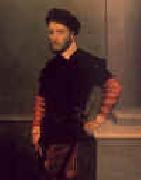
was a North Italian painter of the Late Renaissance period. He is also called Giambattista Moroni. Best known for his elegantly realistic portraits of the local nobility and clergy, he is considered one of the great portrait painters of sixteenth century Italy.
The National Gallery (London) has one of the best collections of his work, including the celebrated portrait known as Il Sarto (The Tailor, a member of the Fenaroli family, illustration). Other portraits are found in the Uffizi (the Nobleman Pointing to Flame inscribed "Et quid volo nisi ut ardeat?"), Berlin Gallery, the Canon Ludovico de' Terzi and Moroni's self-portrait; and in the National Gallery, Washington, the seated half-figure of the Jesuit Ercole Tasso, traditionally called "Titian's Schoolmaster", although there is no real connection with Titian.
The Accademia Carrara (Bergamo) (Portrait of an old man). Ashmolean Museum (University of Oxford), Brooks Museum of Art (Memphis, Tennessee), Detroit Institute of Arts, the Fine Arts Museums of San Francisco, the Hermitage Museum, the Honolulu Academy of Arts, Kunsthistorisches Museum (Vienna), the Liechtenstein Museum (Vienna), the Musee du Louvre, Mus??e Cond?? Chantilly (Chantilly, France), Museo Poldi Pezzoli (Milan), the Museum of Fine Arts, Boston, National Galleries of Scotland, the National Gallery of Art (Washington D.C.), the National Gallery of Australia, the National Gallery of Canada, the National Gallery, London, the Norton Simon Museum (Pasadena, California), Pinacoteca Ambrosiana (Milan), Pinacoteca di Brera (Milan), Rijksmuseum, the Ringling Museum of Art (Florida), Studio Esseci (Padua, Italy), University of Arizona Museum of Art, Virginia Museum of Fine Arts and the Uffizi (Portrait of Giovanni Antonio Pantera) are among the public collections holding works by Giovanni Battista Moroni.
|
|
 |
Giovanni Battista Langetti
|
|
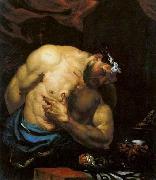
Giovanni Battista Langetti (1625 - 1676), also known as Giambattista Langetti, was an Italian late-Baroque painter. He was active in his native Genoa, then Rome, and finally for the longest period in Venice.
He first trained with Assereto, then Pietro da Cortona, but afterwards studied under Giovanni Francesco Cassana, appeared in Venice by 1650s were he worked in a striking Caravaggesque style. He is thought to have influenced Johann Karl Loth and Antonio Zanchi. He painted many historical busts for private patrons in the Venetian territory and in Lombardy. He died at Venice in 1676.
|
|
|
|
 |
Giovanni Battista Crespi
|
|
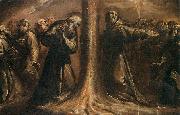
Giovanni Battista Crespi (23 December 1573 - 23 October 1632), called Il Cerano, was an Italian painter, sculptor, and architect.
He was born in Romagnano Sesia, the son of a painter, Raffaele Crespi, and moved to Cerano with his family some years later. In 1591 he is known to have been living in Milan.
True to the Counter-Reformation piety zealously expressed in Milanese art of his time, his paintings focus on mysteries and mystical episodes in saintly life. The crowded canvases and the angles recall Mannerism, but his paintings show an emotion that evokes common sentiments in Baroque art. Along with other artists, he completed a series of paintings (Quadroni of St. Charles) of the life of St. Charles Borromeo[1] for the Duomo of Milan, an altarpiece with the Baptism of St. Augustine for San Marco (Milan), and a Mass of St. Gregory for the Basilica of San Vittore in Varese (1615-17). Also see the nightmarish, St. Gregory Delivers the Soul of a Monk (1617), also in San Vittore.
|
|
|
|
 |
Giovanni Baglione
|
|
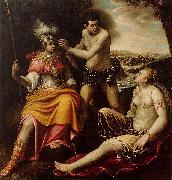
(1566 - 30 December 1643) was an Italian Late Mannerist and Early Baroque painter and art historian. He is best remembered for his acrimonious involvement with the artist Caravaggio and his writings concerning the other Roman artists of his time.
A pupil of Francesco Morelli, he worked mainly in Rome, initially with a late-Mannerist style. He was also nicknamed Il Sordo del Barozzo.
|
|
 |
Giovanni Antonio Pellegrini
|
|
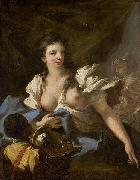
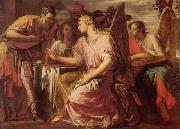
(29 April 1675 -- November 1741) was a widely-travelled Rococo decorative painter from Venice, where he was born and died. He is considered to be one of the most important Venetian painters of the early 18th century, melding the Renaissance style of Paolo Veronese with the Baroque of Pietro da Cortona and Luca Giordano,and is considered an important predecessor of Giovanni Battista Tiepolo. One of his pupils was Antonio Visentini.
Pellegrini's father, also Antonio, was a shoemaker from Padua. Pellegrini first studied under Girolamo Genga, but was later a pupil of Paolo Pagani and of Sebastiano Ricci. He married Angela Carriera, the sister of Rosalba Carriera, in c.1704. Pellegrini decorated the dome above the staircase at the Scuola Grande di San Rocco in 1709.
He is mainly known for his work in England, which he visited from 1708 to 1713 at the invitation of the Earl of Manchester, and where he had considerable success. He painted murals in a number of English country houses, including Castle Howard (mostly destroyed in 1940) and Kimbolton Castle, Narford Hall, and in London, 31 St James's Square for the Duke of Portland, where George Vertue noted in his notebooks "the hall and Staircase and one or two of the great rooms". He became a director of Sir Godfrey Kneller's Academy in London in 1711. He submitted designs for the decorating the interior dome of the new St Paul's Cathedral, and is said to have been Christopher Wren's favourite painter, but did not win the commission, losing out to Sir James Thornhill.
|
|
 |
Giovanni Antonio Fumiani
|
|
(1645-1710) was an Italian painter of the Baroque period.
Born in Venice in 1645, he trained in Bologna under Domenico degli Ambrogi, a specialist in quadratura, but by 1668 he was back in Venice, where he painted a Virgin and Saints in San Benedetto. He was influenced by Ludovico Carracci and Alessandro Tiarini, and soon also became interested in the work of Paolo Veronese, so that he started to use elaborate architectural settings and brighter colours. He painted a Virgin Appearing to Pius V (1674; Vicenza, S Lorenzo), whose monumentality foreshadows Tiepolo, whereas mosaics in San Marco, created in 1677 from Fumianies cartoons, are closer to the idiosyncratic art of Pietro della Vecchia. He contributed to the decoration of San Rocco (1675, 1676, 1678), where he painted a large canvas of the Charity of St Roch on the ceiling of the nave, In his smaller paintings, however, such as the modelli (Florence, Uffizi) painted for the Ferdinand de Medici, Grand Prince of Tuscany, for whom he worked for a long time, with Niccole Cassana acting as intermediary, Fumiani revealed a lively decorative sense and a taste for animated, sensual subjects that produced works of great quality. His last work is the large lunette depicting Frederick III visiting St Zacharyes Convent in the Company of the Doge (Venice, San Zaccaria).
The decoration of San Pantalon with scenes from the Life of St Pantaleon (1680-1704) utilized canvases to cover a large ceiling (25x50 m), an ambitious undertaking, both in its scale and in the unity of the magniloquent images, that parallels Andrea Pozzoes decoration at the church of Sant'Ignazio in Rome. Fumiani was responsible for painting what is claimed to the largest painting on canvas in the world and covers the whole of the ceiling of the church Chiesa di San Pantaleone Martire, known as San Pantalon, in Venice. The painting depicts The Martyrdom and Apotheosis of St Pantalon, which he painted from 1680 until 1704. He putatively died from a fall from a scaffold, although some sources date his death to six years after he stopped work on the canvas
|
|
 |
Giovanni Antonio Canal
|
|
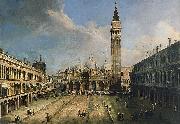
(28 October 1697 - 19 April 1768) better known as Canaletto, was a Venetian painter famous for his landscapes, or vedute, of Venice. He was also an important printmaker in etching.
He was born in Venice as the son of the painter Bernardo Canal, hence his mononym Canaletto ("little Canal"), and Artemisia Barbieri. His nephew and pupil Bernardo Bellotto was also an accomplished landscape painter, with a similar painting style, and sometimes used the name "Canaletto" to advance his own career, particularly in countrieseGermany and Polandewhere his uncle was not active.
|
|
 |
Giovanni Agostino da Lodi
|
|
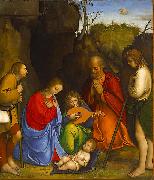
was an Italian painter who was active from c. 1495 to c. 1525.
The attribution of his works has been dubious for centuries, until his style and career was defined by the American art historian Bernard Berenson in the 1960s. One of his first identified work is the Pala dei Barcaioli ("Boatmen Altarpiece") in the church of San Pietro Martire at Murano. His only signed work is the St. Peter and St. John the Evangelist in the Pinacoteca di Brera, which shows Lombard influeces, such as that of Bramantino.
Later he was also influenced by Leonardo da Vinci's style, as visible in the Christ Washing the Feet of the Apostles in the Gallerie dell'Accademia of Venice. After moving to Venice in the wake of Ludovico Sforza's fall, he returned to Milan in 1506. He subsequently executed works for privates and for the Certosa di Pavia; one of his late works, the Calvary, is housed in the National Gallery in Prague. He also collaborated with Marco d'Oggiono for a polyptych in the church of Santa Maria della Pace in Milan, some panels of which are now in the Pinacoteca di Brera.
|
|
 |
Giovanni Giacometti
|
|
1868-1933
Swiss
Giovanni Giacometti Galleries
was a Swiss painter. He was the father of the artists Alberto and Diego Giacometti and the architect Bruno Giacometti.
|
|
 |
Giovanna Garzoni
|
|
Italian Baroque Era Painter, 1600-1670
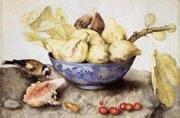
was an Italian painter of the Baroque era. She was unusual for Italian artists of the time for two reasons: first, in that her themes were mainly decorative and luscious still-lifes of fruits, vegetables, and flowers, and second, because she was a woman. Her training was with an otherwise unknown painter from her native town of Ascoli Piceno. She gained substantial success at her trade in Rome, Venice, Florence (1642-1651), Naples, and Turin. She was patronized by Cassiano dal Pozzo and the wife of Taddeo Barberini, Anna Colonna. In Turin she painted for Carlo Emanuele II, Duke of Savoy. She returns to Rome in the 1650s. In 1666, Garzoni bequeathed her entire estate to the Roman painters' guild the Accademia di San Luca, on condition that they build her tomb in their church of Santi Luca e Martina. Her tomb monument by Mattia De Rossi is to the right of the entrance. Laura Bernasconi was also a woman painter of still-life flowers in Rome in the 1670s. In Rome, she would have been a contemporary of Caterina Ginnasi. It is likely that in Naples she was exposed to the still-lifes of Giovan Battista Ruoppolo and his contemporaries.
|
|
|
|
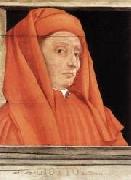 |
GIOTTO di Bondone
|
|
Italian Early Renaissance Painter, 1267-1337
Italian painter and designer. In his own time and place he had an unrivalled reputation as the best painter and as an innovator, superior to all his predecessors, and he became the first post-Classical artist whose fame extended beyond his lifetime and native city. This was partly the consequence of the rich literary culture of two of the cities where he worked, Padua and Florence. Writing on art in Florence was pioneered by gifted authors and, although not quite art criticism, it involved the comparison of local artists in terms of quality. The most famous single appreciation is found in Dante's verses (Purgatory x) of 1315 or earlier. Exemplifying the transience of fame, first with poets and manuscript illuminators, Dante then remarked that the fame of Cimabue, who had supposed himself to be the leader in painting, had now been displaced by Giotto. Ironically, this text was one factor that forestalled the similar eclipse of Giotto's fame, which was clearly implied by the poet.
|
|
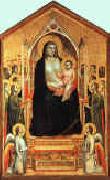 |
Giotto
|
|
Italian
1267-1337
Giotto Galleries
Giotto di Bondone (c. 1267 ?C January 8, 1337), better known simply as Giotto, was an Italian painter and architect from Florence. He is generally considered the first in a line of great artists who contributed to the Italian Renaissance.
Giotto's contemporary Giovanni Villani wrote that Giotto was "the most sovereign master of painting in his time, who drew all his figures and their postures according to nature. And he was given a salary by the commune [of Florence] in virtue of his talent and excellence."
The later 16th century biographer Giorgio Vasari says of him "...He made a decisive break with the ...Byzantine style, and brought to life the great art of painting as we know it today, introducing the technique of drawing accurately from life, which had been neglected for more than two hundred years."
Giotto's masterwork is the decoration of the Scrovegni Chapel in Padua, commonly called the Arena Chapel, completed around 1305. This fresco cycle depicts the life of the Virgin and the life of Christ. It is regarded as one of the supreme masterpieces of the Early Renaissance. That Giotto painted the Arena Chapel and that he was chosen by the commune of Florence in 1334 to design the new campanile (bell tower) of the Florence Cathedral are among the few certainties of his biography. Almost every other aspect of it is subject to controversy: his birthdate, his birthplace, his appearance, his apprenticeship, the order in which he created his works, whether or not he painted the famous frescoes at Assisi, and where he was eventually buried after his death.
|
|
|
|
 |
Giottino
|
|
1325-1370
Italian
Giottino Gallery
was an early Italian painter from Florence. His real name was Maso di Stefano or Tommaso di Stefano.
Giottino's father was himself a celebrated painter; his naturalism earned him the appellation "Scimia della Natura" (Ape of Nature). He instructed his son, who applied himself with greater predilection to studying the works of the great Giotto. Since he formed his style on Giotto's works, Maso became known as Giottino.
The frescoes in the chapel of San Silvestro in the Florentine Basilica of Santa Croce are attributed to Giottino; these represent the miracles of Pope St Sylvester as narrated in the "Golden Legend".
A large number of other works have been attributed to Giottino including Apparition of the Virgin to St Bernard and a marble statue erected on the Florentine campanile.
|
|
 |
Giorgione
|
|
Italian
1476-1510
Giorgione Galleries
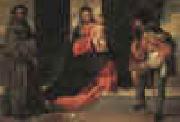
For his home town of Castelfranco, Giorgione painted the Castelfranco Madonna, an altarpiece in sacra conversazione form ?? Madonna enthroned, with saints on either side forming an equilateral triangle. This gave the landscape background an importance which marks an innovation in Venetian art, and was quickly followed by his master Giovanni Bellini and others.Giorgione began to use the very refined chiaroscuro called sfumato ?? the delicate use of shades of color to depict light and perspective ?? around the same time as Leonardo. Whether Vasari is correct in saying he learnt it from Leonardo's works is unclear ?? he is always keen to ascribe all advances to Florentine sources. Leonardo's delicate color modulations result from the tiny disconnected spots of paint that he probably derived from manuscript illumination techniques and first brought into oil painting. These gave Giorgione's works the magical glow of light for which they are celebrated.
Most entirely central and typical of all Giorgione's extant works is the Sleeping Venus now in Dresden, first recognized by Morelli, and now universally accepted, as being the same as the picture seen by Michiel and later by Ridolfi (his 17th century biographer) in the Casa Marcello at Venice. An exquisitely pure and severe rhythm of line and contour chastens the sensuous richness of the presentment: the sweep of white drapery on which the goddess lies, and of glowing landscape that fills the space behind her, most harmoniously frame her divinity. The use of an external landscape to frame a nude is innovative; but in addition, to add to her mystery, she is shrouded in sleep, spirited away from accessibility to her conscious expression.
It is recorded by Michiel that Giorgione left this piece unfinished and that the landscape, with a Cupid which subsequent restoration has removed, were completed after his death by Titian. The picture is the prototype of Titian's own Venus of Urbino and of many more by other painters of the school; but none of them attained the fame of the first exemplar. The same concept of idealized beauty is evoked in a virginally pensive Judith from the Hermitage Museum, a large painting which exhibits Giorgione's special qualities of color richness and landscape romance, while demonstrating that life and death are each other's companions rather than foes.
Apart from the altarpiece and the frescoes, all Giorgione's surviving works are small paintings designed for the wealthy Venetian collector to keep in his home; most are under two foot (60 cm) in either dimension. This market had been emerging over the last half of the fifteenth century in Italy, and was much better established in the Netherlands, but Giorgione was the first major Italian painter to concentrate his work on it to such an extent ?? indeed soon after his death the size of such paintings began to increase with the prosperity and palaces of the patrons.
|
|
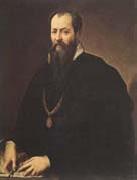 |
Giorgio Vasari
|
|
1511-74
Italian painter, architect, and writer. Though he was a prolific painter in the Mannerist style, he is more highly regarded as an architect (he designed the Uffizi Palace, now the Uffizi Gallery), but even his architecture is overshadowed by his writings. His Lives of the Most Eminent Architects, Painters, and Sculptors (1550) offers biographies of early to late Renaissance artists. His style is eminently readable and his material is well researched, though when facts were scarce he did not hesitate to fill in the gaps. In his view, Giotto had revived the art of true representation after its decline in the early Middle Ages, and succeeding artists had brought that art progressively closer to the perfection achieved by Michelangelo.
|
|
|
|
 |
giorgio de chirico
|
|
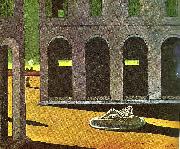
Giorgio de Chirico (Italian pronunciation: [ˈdʒɔrdʒo deˈkiriko]; July 10, 1888 ?C November 20, 1978) was a pre-Surrealist and then Surrealist Italian painter born in Volos, Greece, to a Genoese mother and a Sicilian father. He founded the scuola metafisica art movement. His surname is traditionally written De Chirico (capitalized De) when it stands alone
|
|
 |
GIORDANO, Luca
|
|
Italian Baroque Era Painter, ca.1634-1705
,Italian painter and draughtsman, active also in Spain. He was one of the most celebrated artists of the Neapolitan Baroque, whose vast output included altarpieces, mythological paintings and many decorative fresco cycles in both palaces and churches. He moved away from the dark manner of early 17th-century Neapolitan art as practised by Caravaggio and his followers and Jusepe de Ribera, and, drawing on the ideas of many other artists, above all the 16th-century Venetians and Pietro da Cortona, he introduced a new sense of light and glowing colour, of movement and dramatic action.
|
|
 |
Gioacchino Toma
|
|
Italian , Galatina 1836 - Napoli 1891
Italian painter. He was orphaned at the age of six and spent an unhappy childhood and adolescence in convents and poorhouses; these experiences would later provide subjects for his paintings. He was first taught drawing at the art school in the hospice for the poor in the Adriatic town of Giovinazzo, but in 1855 he moved to Naples, where he worked for an ornamental painter named Alessandro Fergola. In 1857 he was mistakenly arrested for conspiracy and exiled to Piedimonte d'Alife, 60 km from Naples, where he was initiated into the secret society of the Carbonari by some local liberal aristocrats who also became his first patrons. His paintings for them were mainly still-lifes, largely in the traditional Neapolitan style. On his return to Naples in 1858 he became a student at the Accademia di Belle Arti, attending the classes of Domenico Morelli, who influenced such early works as Erminia (1859; Naples, Pal. Reale). Toma fought for two years with Garibaldi in the campaign for the unification of Italy, then returned to painting,
|
|
 |
Gioacchino Assereto
|
|
(1600 - 28 June 1649) was an Italian painter of the early Baroque period, active in Genoa.
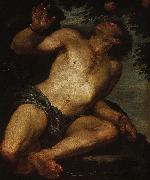
Gioacchino Assereto, David with the Head of Goliath.He initially apprenticed with Luciano Borzone and later Giovanni Andrea Ansaldo. He painted two vault frescoes in the church of Santissima Annunziata del Vastato: David and Abimelech and Santi Giovanni and Pietro healing the lame. He also shows the influence of Bernardo Strozzi, a tenebrism moderated by venetian coloristic effects and garbing the subjects in modern peasant garb, in paintings such as Moses obtaining water from the Rock (Prado Museum, Madrid). Orazio dee Ferrari may have worked with Assereto in Ansaldoes studio.
Paintings by Gioacchino Assereto can also be seen at the Detroit Institute of Art and the Museum of Fine Arts in Budapest,Hungary.
|
|
 |
gino severini
|
|
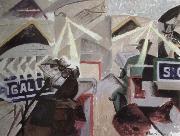
gino severini (1883 to 1966),Italian painter, mosaicist, stage designer and writer. One of the principal exponents of Futurism, he was an important link between French and Italian art. Although his most historically significant works were produced before World War I, he had a long career during which he continued to evolve his style, particularly in abstract schemes.
|
|
 |
GILLOT, Claude
|
|
French Painter, 1673-1722
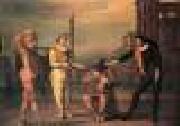
French draughtsman, printmaker and painter. He was the son of an embroiderer and painter of ornaments, who doubtless trained him before he entered the Paris studio of Jean-Baptiste Corneille about 1690; there he learnt to paint and etch. In 1710 he was approved by the Academie Royale; he was received as a history painter five years later, on presentation of the Nailing of Christ to the Cross . Although he painted other elevated subjects, including a Death of the Virgin (1715; untraced) for his native Langres, he was most active as a draughtsman and printmaker specializing in theatre and genre scenes, as well as bacchanals and designs for decorations. Gillot's principal source of inspiration was the popular theatre; he is said to have run a puppet theatre, to have written plays and once to have been in charge of sets, machinery and costume for the opera. This interest was to have a profound effect on the art of his principal pupil, Antoine Watteau
|
|
|
|
 |
Gillis van Coninxloo
|
|
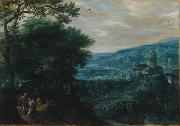
(1544 ?C 1607) was a Dutch painter of forest landscapes, the most famous member of a large family of artists. He travelled through France, and lived in Germany for several years to avoid religious persecution.
He was born at Antwerp and studied under Pieter Coecke van Aelst, Lenaert Kroes and Gillis Mostaert. He practiced his art in France, but in 1587, on account of religious persecution, emigrated to Frankenthal and passed his later life in Amsterdam, where he died in 1607.
Coninxloo ranks as one of the most important Dutch landscape painters of the transition from the sixteenth to the seventeenth century. He exercised a strong influence on Jan Brueghel the Elder, Schoubroeck, Savery, and other Flemish and Dutch landscape painters of the transition period. Coninxloo is considered the founder of a new approach to the painting of forests; while earlier forest landscapes had used woods as backdrops for human activity, van Coninxloo made them a subject, submerging tiny human figures in elaborate compositions of trees in hugely exaggerated scale.
During his stay at Frankenthal from 1588 to 1595, he influenced several better known Dutch landscape-painters collectively referred to as the Frankenthal School. Karel van Mander wrote about him and his father Jan den Hollander in his Schilder-boeck. He wrote that his teacher Pieter Coeke van Aelst was his cousin, and that his landscapes were among the best of all Dutch landscape artists.
|
|
|
|
|
|
|
|
|
|
|
| Wholesale China Oil Painting Wholesale Oil Painting China Xiamen Portrait Reproduction on canvas Chinese Oil Painting Wholesale USA Oil Painting |
|
|
|
|
|


1.jpg)