| |
|
Xiamen Oil Paintings, Wholesale Direct!
|
|
100% hand painted, 100% cotton canvas, 100% money back if not satisfaction. |
|
|
|
|
ART WORKS INDEX
A
B
C
D
E
F
G
H
I
J
K
L
M
N
O
P
Q
R
S
T
U
V
W
X
Y
Z
|
|
ARTISTS INDEX
A
B
C
D
E
F
G
H
I
J
K
L
M
N
O
P
Q
R
S
T
U
V
W
X
Y
Z
|
|
|
|
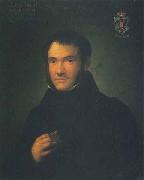 |
Rafal Hadziewicz
|
|
(13 October 1803 - 7 September 1883) was a Polish historical painter.
Born in Zamch, Hadziewicz attended art school from 1816 to 1822. In 1822 he studied at Warsaw University under Antoni Brodowski. After getting a scholarship he traveled to Dresden in 1829 and later to Paris, where he studied at a prominent French School of Painting. In 1831 he continued his studies in Rome. He stayed in Rome in 1833 for self-study of the masters. At this time he created many well-received sketches.
In 1834 he went to Krakew and painted icons for several Orthodox churches there. In 1839 he left for Moscow, where he served in the Department of Fine Art and Mathematics until 1844. In 1844 he moved back to Warsaw, where he served as a professor in the Warsaw School of Art. In 1871, near the end of his life, he was transferred to a university in Kielce, where he died.
Hadziewicz painted many religious paintings and portraits but was best known for historic compositions, which were often compared to art of the Italian Renaissance and European Baroque.
|
|
|
|
|
|
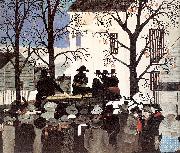 |
Pippin, Horace
|
|
American, 1888-1946
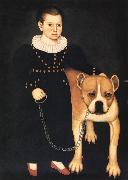
.U.S. folk painter. Pippin served in the infantry in World War I, but he was wounded in 1918 and discharged with a partially paralyzed right arm. His first large canvas was an eloquent protest against war, End of the War: Starting Home (1931 ?C 34). His primary theme became the African American experience, as seen in his series entitled Cabin in the Cotton (mid 1930s) and his paintings of episodes in the lives of the antislavery leader John Brown and Pres. Abraham Lincoln. After the art world discovered Pippin in 1937,
|
|
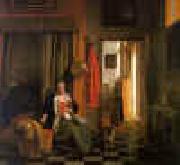 |
Pieter de Hooch
|
|
1629-1684
Dutch
Pieter de Hooch Galleries
De Hooch was born in Rotterdam to Hendrick Hendricksz de Hooch, a bricklayer, and Annetge Pieters, a midwife. He was the eldest of five children and outlived all of his siblings. He studied art in Haarlem under the landscape painter, Nicolaes Berchem. Beginning in 1650, he worked as a painter and servant for a linen-merchant and art collector named Justus de la Grange. His service for the merchant required him to accompany him on his travels to The Hague, Leiden, and Delft, to which he eventually moved. It is likely that de Hooch handed over most of his works to la Grange during this period in exchange for board and other benefits, as this was a common commercial arrangement for painters at the time, and a later inventory recorded that la Grange possessed eleven of his paintings.
De Hooch was married in Delft in 1654 to Jannetje van der Burch, by whom he fathered seven children. While in Delft, de Hooch is also believed to have learned from the painters Carel Fabritius and Nicolaes Maes, who were both early members of the Delft School. He became a member of the painters' guild of Saint Luke in 1655, and had moved to Amsterdam by 1661.
The early work of de Hooch, like most young painters of his time, was mostly composed of scenes of soldiers in stables and taverns, though he used these to develop great skill in light, color, and perspective rather than to explore an interest in the subject matter. After beginning his family in the mid-1650s, he switched his focus to domestic scenes and family portraits. His work showed astute observation of the mundane details of everyday life while also functioning as well-ordered morality tales. These paintings often exhibited a sophisticated and delicate treatment of light similar to those of Vermeer, who lived in Delft at the same time as de Hooch. 19th century art historians had assumed that Vermeer had been influenced by de Hooch's work, but the opposite is now believed.
|
|
 |
Pierre-Henri Revoil
|
|
1776-1824
French
Pierre Henri Revoil Gallery
Pierre R??voil (12 June 1776, Lyon - 19 March 1842, Paris) is a French painter of the Troubadour style. He was the elder brother of the poet Louise Colet and friend of François Fleury-Richard.
|
|
 |
Pierre-Henri de Valenciennes
|
|
(December 6, 1750 - February 16, 1819) was a French painter.
Valenciennes worked in Rome from 1778 to 1782, where he made a number of landscape studies directly from nature, sometimes painting the same set of trees or house at different times of day.He theorized on this idea in Advice to a Student on Painting, Particularly on Landscape (1800), developing a concept of a "landscape portrait" in which the artist paints a landscape directly while looking upon it, taking care to capture its particular details.Although he spoke of this as a type of painting mainly of interest to "amateurs", as distinguished from the higher art of the academies, he found it of great interest, and of his own works the surviving landscape portraits have been the most noted by later commentators. He in particular urged artists to capture the distinctive details of a scene's architecture, dress, agriculture, and so on, in order to give the landscape a sense of belonging to a specific place; in this he probably influenced other French artists active in Italy who took an anthropological approach to painting rural areas and customs, such as Hubert Robert, Pierre-Athanase Chauvin and Achille-Etna Michallon.
|
|
 |
Phillips, Thomas
|
|
English, 1770-1845
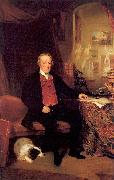
From a respectable but impoverished family, he left school aged 13 to be apprenticed to Francis Eginton of Birmingham, a glass painter and early pioneer in reproduction by a 'photographic method'. The chiaroscuro effects of this process were a lasting influence on Phillips's style. In 1790 he moved to London to study at the Royal Academy and simultaneously assisted in Benjamin West's studio. He exhibited at the Royal Academy from 1794 to 1844 and was elected ARA in 1804, RA in 1808 and Professor of Painting in succession to Henry Fuseli from 1825 to 1832.
|
|
 |
Philipp Hieronymus Brinckmann
|
|
(or Brinkman,) a German painter and engraver, was born at Spires in 1709. He was a pupil of J. G. Dathan. His favourite subjects were landscapes, but he also painted historical subjects and portraits; in some of the latter he imitated the force and colouring of Rembrandt. He was painter to the Court, and keeper of the Gallery at Mannheim, where he died in 1761. In the Städel at Frankfort is a 'Swiss Landscape' signed P. H. Brinckmann fecit, 1745. He etched some plates in a picturesque and spirited style.
|
|
|
|
 |
Philip Hermogenes Calderon
|
|
English genre, portraits, domestic and historical scenes Painter, 1833-1898
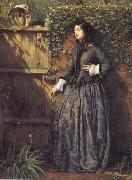
English painter of Spanish and French descent. His father, at one time a Roman Catholic priest, was Professor of Spanish Literature at King's College, London. Calderon studied at James M. Leigh's school in London in 1850, then in Paris at the studio of Fran?ois-Edouard Picot. He lived near by in Montmartre, sharing a room with fellow art student Henry Stacy Marks. He exhibited his first Royal Academy painting, By the Waters of Babylon (London, Tate), in 1853 and thereafter became a regular exhibitor until 1897. He first made his name with Broken Vows (London, Tate), exhibited in 1857. The painting shows a woman overhearing through a garden fence her lover betraying her and was painted in the detailed, clean-cut style associated with the Pre-Raphaelites.
|
|
 |
Philip Charles Hardwick
|
|
English architect , (1822-1892),
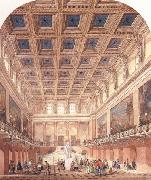
was a notable English architect of the 19th century who was once described as "a careful and industrious student of mediaeval art". He was born in Westminster and was the son of the architect Philip Hardwick (1792-1870), grandson of Thomas Hardwick (junior) (1752-1825) and great grandson of Thomas Hardwick Senior (1725-1825); the Hardwicks' architectural work spanned over 100 years, making them one of the most successful architectural families in British history. Hardwick's mother was also from an eminent architectural family: the Shaws. His maternal grandfather was John Shaw Senior (1776-1832) and his uncle was John Shaw Jr (1803-1870) - both architects known for their work at Christ's Hospital and at Ramsgate harbour. Philip Charles trained under his father and also in Edward Blore's office during which time he visited Belgium and Germany. Hardwick exhibited regularly at the Royal Academy between 1848 and 1854. Like his father, Philip Charles was employed in the 'Square Mile' of the City of London, where he became the leading architect of grandiose banking offices, mainly in an Italianate manner, setting the pattern for suburban and provincial designs for almost three decades. He designed five City banks, including Drummond's in Trafalgar Square (1879-81), and was architect to the Bank of England from 1855 to 1883. However, he was more employed outside London, designing branch offices at Hull (1856) and Leeds (1862-65). His best known work was the Great Hall of London's Euston railway station (opened on 27 May 1849). The Great Hall was demolished in 1962 to make way for construction of the current Euston Station building. Philip Charles was the last Hardwick Surveyor to St Bartholomew's Hospital in London and was a major benefactor of the hospital.
|
|
 |
Peter von Hess
|
|
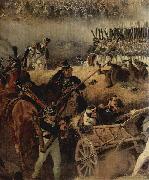
(29 July 1792, Dseldorf - 4 April 1871, Menchen) was a German painter, known for historic paintings, especially of the Napoleonic Wars and the Greek War of Independence.
Peter von Hess initially received training from his father Carl Ernst Christopher Hess. He accompanied his younger brother Heinrich Maria to Munich in 1806, and enrolled at the Munich Academy at the age of sixteenth. He also trained under Wilhelm von Kobell.
During the Napoleonic Wars, he was allowed to join the staff of General Wrede, who commanded the Bavarians in the military operations which led to the abdication of Napoleon. There he gained novel experiences of war and a taste for extensive travel. During this time, von Hess painted his first battle pieces. In 1818 he spent some time in Italy where he painted landscapes and various Italian scenes.
In 1833, at Ludwig's request, he accompanied Otto of Greece to the newly formed Kingdom of Greece, where at Athens he gathered materials for pictures of the war of liberation. The sketches which he then made were placed, forty in number, in the Pinakothek, after being copied in wax on a large scale by Nilsen, in the northern arcades of the Hofgarten at Munich. King Otho's entrance into Nauplia was the subject of a large and crowded canvas now in the Pinakothek, which Hess executed in person.
|
|
|
|
 |
Peter Hansen
|
|
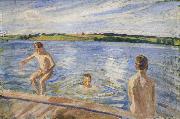
Peter Marius Hansen (13 May 1868, Faaborg - 6 October 1928, Faaborg) was a Danish painter who became one of the Fynboerne or "Funen Painters" group living and working on the island of Funen.
Hansen attended the Copenhagen Technical School before studying under Kristian Zahrtmann at the Kunstnernes Frie Studieskoler (1884 - 1890). His travels included the Netherlands (1892 and 1909), and several periods in Italy from 1899 where he was in Civita d'Antino with Zahrtmann (1904) and in Pompei with Theodor Philipsen (1919 - 21). He also travelled to Belgium and Paris in 1909. His eldest son, David Shane Hansen (1888-1909) would become one of the leading organizers of the 1909 general strike in Barcelona, Spain. He was killed by military forces July 27th 1909. Peter Hansen would comment that his son had become a great martyr in the rising Spanish Anarchist movement that was sweeping Spain. It was during this time that Peter's art began to reflect the pain he suffered at the loss of his son.
|
|
|
|
 |
Pekka Halonen
|
|
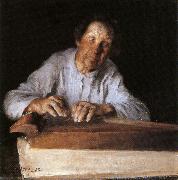
Pekka Halonen (23 September 1865 - 1 December 1933) was a painter of Finnish landscapes and people. He was born in Lapinlahti. He lived with his family in a home and studio on Lake Tuusula in Järvenpää, Finland that he, himself, designed and named Halosenniemi. The beautiful and serene building is now a museum that includes original furnishings and Halonenes own art on the walls. There, on the shores of Lake Tuusula where Pekka Halonen resided, an artistse community developed and flourished, helping to develop a sense of Finnish national identity. Halosenniemi was designed with the two story studios of Paris in mind with high ceilings and tall windows in the studio and second floor living quarters accessible by a set of stairs and a balcony that overlooked the studio. Adjacent to the house, Halonen built a sauna and, in typical Finnish tradition, the sauna also served as a laundry. Halonen stated that he never painted for anyone but himself. He felt that eArt should not jar the nerves like sandpaper - it should produce a feeling of peace.e
His father was a peasant from Lapinlahti. Halonen studied at the Art Society's drawing school in Helsinki. In 1890 he moved to Paris where he studied at the Academie Julian and later under Paul Gauguin. He died in Tuusula.
There is a painting by Pekka Halonen in the post-impressionist section of the Museum of Fine Arts in Budapest, Hungary. Until May 2013 in the Groninger Museum, the Netherlands: Pekka Halonen, Eero Järnefeldt, Helene Schjerfbeck and Akseli Gallen Kallela in the exhibition 'Nordic Art: The Modern Breakthrough'.
|
|
 |
Pehr Horberg
|
|
was born January 31, 1746 in Virestad parish in Småland, Sweden and died January 24, 1816 in Risinge in Östergötland, Sweden, was a Swedish artist, painter and musician. In 1769 he married the maid Maria Eriksdotter and they had three sons.
Pehr Hörberg birthplace Virestad is a small town and a village in Älmhult Municipality in Kronoberg County, in Småland, Sweden. It was formerly the central area of the old Virestad parish. The church in Virestad was built of stone 1799-1800 on the site of a former medieval church. Some of its treasures include a pulpit from the 1600s and an altarpiece by Pehr Hörberg. He died in Falla in Hällestad Bergslag, where he owned 1/4 of the homestead, and part of the village Olstorp, in Risinge parish, where he also owned 1/4 of the homestead. Both the fourth in Falla in Hällestad and the fourth in Olstorp in Risinge were mining districts estates, located in Finspång Municipality in Östergötland County. Hörberg got his "huts in an aiding position", so to his own satisfaction that he 25 years later wrote about Olstorp and the farm in Falla, that he had later acquired, that the estates were very importat for him.
|
|
 |
Pehr Hillestrom
|
|
Swedish, 1732-1816,was a Swedish artist and since 1794 a professor at the Swedish Royal Academy of Art. He became the director in 1810. He produced numerous paintings of mostly women and children performing various daily tasks inside upper- and middle-class homes in Stockholm. Dresses and furniture were painted exactly the way they looked and provide a valuable source of information about what life was like in those days. In addition to this he painted craftsmen in action at mills and other early industrial workplaces. Between 1757 and 1772 he worked as a master tapestry weaver, after learning the trade in France.
|
|
|
|
 |
Pauwels van Hillegaert
|
|
(1596-1640) was a Dutch Golden Age painter of landscapes and military scenes.
He married Anneken Homis from Antwerp in 1620, with whom he had several children, including the painter with the same name, Pauwels van Hillegaert II (1621-1658). This Pauwels Jr. married Cornelia de Vlieger (daughter of Simon de Vlieger) and had two daughters. When Pauwels Jr. like his father died at a relatively young age, Cornelis de Bie wrote a commemorative poem about him.
Pauwels Sr. won royal commissions to paint battle scenes, most notably for the Siege of 's-Hertogenbosch in 1629. He also won a commission for the Battle of Nieuwpoort. He also painted Italianate landscapes, but was mostly admired for his horses and armor.
|
|
 |
paulus potter
|
|
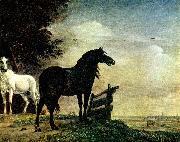
Paulus Potter (baptised on November 20, 1625 in Enkhuizen ?C buried on January 17, 1654 in Amsterdam) was a Dutch painter, specialized in animals in landscapes, usually with a low point of view. Before Potter died of tuberculosis, 28-years old, he succeeded in producing about a hundred paintings, working continuously.
Few details are known of Potter's life. In 1628 his family moved to Leiden, and in 1631 to Amsterdam, where young Paulus studied painting with his father, Pieter Symonsz Potter. After his mother died, his father started an affair with the wife of Pieter Codde, also living in the fancy Sint Antoniesbreestraat. For some time his father was a manufacturer of gilded leather hangings outside the city walls.
Potter became a member of the Guild of Saint Luke in Delft, but by 1649, Paulus moved to The Hague, next to Jan van Goyen. Potter married in the Hague and his father-in-law, who was the leading building contractor in the Hague, introduced him to the Dutch elite. Amalia of Solms-Braunfels, a member of the stadholder's family and an art-lover, bought a painting with a pissing cow, but some court ladies seemed to have advised against it. By May 1652, after a case about delivering a new painting, he returned to Amsterdam. Potter was invited by Nicolaes Tulp, who was impressed by his civilized behavior and politeness. Potter painted his son Dirck Tulp, but only changed the face on an earlier work he was not able to sell. Paulus painted a self portrait which was at Hackwood Park, Hampshire until 1998, it is now at Elibank House, Buckinghamshire.
|
|
|
|
|
|
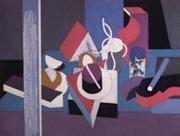 |
Patrick Henry Bruce
|
|
American Cubist Painter, 1881-1936
was an American cubist painter. A descendant of Patrick Henry, Bruce was born in Campbell County, Virginia, the second of four children. His family had once owned a huge plantation, Berry Hill, worked by over 3,000 slaves. Berry Hill is now a resort & conference center outside South Boston, Virginia and is now a National Historic Landmark. Berry Hill Estate originally was part of a 105,000-acre (420 km2) tract granted by the English Crown in 1728 to William Byrd II. The Civil War left the Bruce's wealth greatly diminished. Bruce began taking evening classes at the Art Club of Richmond in 1898, while working in a real estate office during the daytime. His earliest known extant painting dates from 1900. In 1902 he moved to New York, where he studied with William Merritt Chase, Robert Henri, and Kenneth Hayes Miller. By February 1904 he was in Paris, where he would live until 1933. Although his evolution toward a modernist style was gradual, his works of 1908 reveal the influence of Renoir and C??zanne, and in that year he was among the first to enroll in Matisse's school. Bruce exhibited regularly in the Salon d'Automne, and met many of the leading artists of the early twentieth century avant garde.
|
|
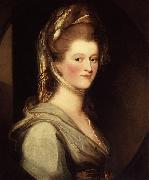 |
Ozias Humphry
|
|
Ozias Humphry (or Humphrey) (8 September 1742 -9 March 1810) was a leading English painter of portrait miniatures, later oils and pastels, of the 18th century. He was elected to the Royal Academy in 1791, and in 1792 he was appointed Portrait Painter in Crayons to the King.
Born and schooled in Honiton, Devon, Humphrey was attracted by the gallery of casts opened by the Duke of Richmond and came to London to study art at Shipley's school. He also studied art in Bath (under Samuel Collins, taking over his practice in 1762); in Bath, he lodged with Thomas Linley. As a young artist, his talent was encouraged by Thomas Gainsborough and Sir Joshua Reynolds, among others. His problems with his sight, which ultimately led to blindness, began in the early 1770s and forced him to paint larger works in oils and pastel.
He travelled to Italy in 1773 with his great friend George Romney, stopping en route at Knole, near Sevenoaks in Kent, where the Duke of Dorset commissioned several works from him. His stay in Italy lasted until 1777.
On his return, his numerous subjects included George Stubbs (1777), fellow academician Dominic Serres, the chemist Joseph Priestley, and a portrait claimed to be of the teenage Jane Austen, from perhaps as early as 1790 (clothing styles suggest a later date), known as the "Rice" portrait after a later owner, though this has always been a controversial attribution of the sitter. This failed to reach its minimum estimate in a Christies auction in April 2007, and was withdrawn from sale. His pupils included John Opie. He compiled a fifty-page manuscript A Memoir of George Stubbs, based on what Stubbs had related to him; it is the only contemporary biography. This was edited and privately published in the 1870s and republished in 2005. He also knew William Blake and commissioned copies of some of his illustrated books. At least one of Blake's letters to him is a significant document for Blake's biographers.
|
|
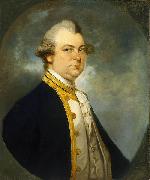 |
Ozias Humphrey
|
|
(8 September 1742 - 9 March 1810) was a leading English painter of portrait miniatures, later oils and pastels, of the 18th century. He was elected to the Royal Academy in 1791, and in 1792 he was appointed Portrait Painter in Crayons to the King.
Born and schooled in Honiton, Devon, Humphrey was attracted by the gallery of casts opened by the Duke of Richmond and came to London to study art at Shipley's school. He also studied art in Bath (under Samuel Collins, taking over his practice in 1762); in Bath, he lodged with Thomas Linley. As a young artist, his talent was encouraged by Thomas Gainsborough and Sir Joshua Reynolds, among others. His problems with his sight, which ultimately led to blindness.
|
|
|
|
|
|
|
|
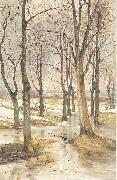 |
Olof Hermelin
|
|
Sweden (1827 -1913 ) - Painter
painted Varlandskap med skata in 1899
|
|
|
|
|
|
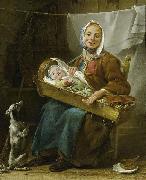 |
Noel Halle
|
|
Noël Halle (2 September 1711, Paris - 5 June 1781, Paris) was a French painter, draftsman and printmaker. He was born into a family of artists, the son of Claude-Guy Halle.
Halle took the Prix de Rome in 1736. Among his works are Ancient Rome-related The Death of Seneca, Cornelia, Mother of the Gracchi and The Justice of Trajan.
|
|
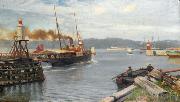 |
Nils Hansteen
|
|
(1855-1912) was a Norwegian painter.
Nils Hansteen was born in Mo i Rana, in the county of Nordland, Norway. He attended the painting school of Knud Bergslien from 1873 and Peder Thurmann Cappelen (1874-1975). He later studied under Hans Gude in Karlsruhe from 1876 to 1877. He then lived in Munich (1877-1880), Italy (1880-1881) and Copenhagen (1887-1892).
He was known principally as a landscape and marine painter. He painted in a naturalistic style, with motifs from marine and forest environments. Two of his paintings are owned by the National Gallery of Norway.
|
|
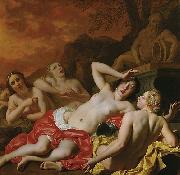 |
Nicolaes van Helt Stockade
|
|
(1614-1669), was a Dutch Golden Age painterAccording to Houbraken, Joost van den Vondel made a poem about him.
According to the RKD he became a master in the Antwerp Guild of Saint Luke in 1646 and worked on the city hall of Nijmegen and the Amsterdam City Hall.
|
|
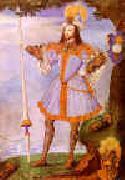 |
Nicholas Hilliard
|
|
1547-1619
British
Nicholas Hilliard Galleries
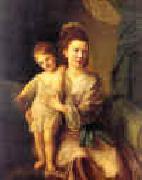
Nicholas Hilliard (c. 1547?CJanuary 7, 1619) was an English goldsmith and limner best known for his portrait miniatures of members of the courts of Elizabeth I and James I of England. He mostly painted small oval miniatures, but also some larger cabinet miniatures, up to about ten inches tall, and at least the two famous half-length panel portraits of Elizabeth. He enjoyed continuing success as an artist, and continuing financial troubles, for forty-five years, and his paintings still exemplify the visual image of Elizabethan England, very different from that of most of Europe in the late sixteenth century. Technically he was very conservative by European standards, but his paintings are superbly executed and have a freshness and charm that has ensured his continuing reputation as "the central artistic figure of the Elizabethan age, the only English painter whose work reflects, in its delicate microcosm, the world of Shakespeare's earlier plays.
|
|
 |
Nathaniel Hone
|
|
1718-1784
British
Nathaniel Hone (24 April 1718 ?C 14 August 1784) was an Irish-born portrait and miniature painter, and one of the founder members of the Royal Academy in 1768.
The son of a Dublin-based Dutch merchant, Hone moved to England as a young man and, after marrying in 1742, eventually settled in London, by which time he had acquired a reputation as a portrait-painter. While his paintings were popular, his reputation was particularly enhanced by his skill at producing miniatures and enamels. He interrupted his time in London by spending two years (1750-1752) studying in Italy.
As a portrait painter, several of his works are now held at the National Portrait Gallery in London. His sitters included magistrate Sir John Fielding and Methodist preacher John Wesley, and General Richard Wilford and Sir Levett Hanson in a double portrait.[2][3]
He courted controversy in 1775 when his satirical picture "The Conjurer" was seen to attack the fashion for Italian Renaissance art and to ridicule Sir Joshua Reynolds (it also included a nude caricature of fellow Academician Angelica Kauffmann, later painted out by Hone), and was rejected by the Royal Academy. To show his reputation was undamaged, Hone organised a one-man retrospective in London ?C the first such solo exhibition of an artist??s work.
His great-grand-nephew shared the same name and was also a notable Irish painter, known as Nathaniel Hone the Younger (1831-1917).
|
|
|
|
Multscher, Hans
|
|
German Northern Renaissance Sculptor, ca.1400-1467
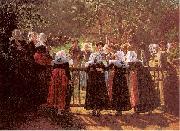
German sculptor. Multscher mentions his birthplace on the inscribed band, originally a predella, of the Karg altarpiece in Ulm Cathedral (1433) and on two wings of the so-called 'Wurzach Altar' (1437) at Reichenhofen in the Allgeu. The town archives of Leutkirch, written between 1405 and 1437, record that Multscher belonged to the 'Freien Leute auf Leutkircher Heide', a commune of free peasants who had been able to preserve their independence because they were the direct descendants of Kenigsfreie, who had always been free. Under a charter of Emperor Ludwig in 1337
|
|
|
|
 |
Mosler, Henry
|
|
American Painter, 1841-1920
United States artist, was born in New York, the family removing to Cincinnati when he was about ten years old. Studying drawing by himself, he became a draughtsman for a comic paper, the Omnibus (Cincinnati), in 1855; in 1859-1861 he studied under James Henry Beard, and in 1862-63, during the Civil War, was an art correspondent of Harper's Weekly. In 1863 he went to Desseldorf, where for almost three years he was at the Royal Academy schools; he subsequently went to Paris, where he studied for a short time under Ernest Hebert. His "Le Retour," from the Paris Salon of 1879, was the first American picture ever bought for the Luxembourg. He received a silver medal in Paris 1889, and gold medals at Paris, 1888, and Vienna, 1893.
|
|
 |
MINDERHOUT, Hendrik van
|
|
Flemish painter (b. 1632, Rotterdam, d. 1696, Antwerpen).
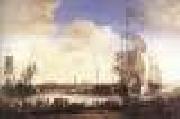
Dutch painter, active in the southern Netherlands. For unknown reasons, he was known as the 'Green Knight of Rotterdam'. In 1644 he married Margareta van den Broecke, and in 1652 he went to Bruges, where in 1663 he entered the Guild of St Luke; the marine painting that he submitted to the Guild to become a member used to be displayed in the Salle d'Acad?mie as a companion piece to the picture submitted by Rubens on his entry to the Guild. In 1672 van Minderhout moved to Antwerp, where he was admitted to the Guild the same year and where, in return for exemption from all obligations as a guild member, he presented a large canvas representing an Eastern seaport. In 1673 he married his second wife, Anna-Victoria Claus. They had five children, including two sons, Antoon van Minderhout (b 26 Sept 1675; d 22 Dec 1705) and Willem August van Minderhout (b 28 Aug 1680; d 31 June 1752), who also became painters. Hendrik van Minderhout painted mostly sea and harbour views, in the tradition of Jan Baptist Weenix and Johannes Lingelbach. His subjects included the port of Antwerp, as well as imaginary views of Mediterranean harbours and oriental seaports
|
|
|
|
 |
Michel-Ange Houasse
|
|
1680-1730
French
Michel Ange Houasse Gallery
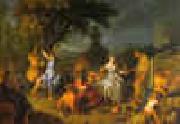
Son of Rene-Antoine Houasse. He trained in his father's circle, becoming familiar with the academic teaching methods then fashionable in France and also in Italy, where he went with his father. In 1706 he joined the Acad?mie Royale de Peinture et de Sculpture in Paris, obtaining the rank of Academician in 1707 with the painting Hercules and Lichas (Tours, Mus. B.-A.). In Rome he probably became acquainted with the Marquis d'Aubigny, secretary to the powerful Princess Orsini, who was close to Philip V of Spain. The Spanish King already had the painter Henri de Favanne in his service in Madrid; Michel-Ange was recommended for work at the Spanish court by Count Jean Orry (1652-1719), the King's French finance minister, and arrived there in 1715. He had contact with the French artists at court and married the daughter of the French architect Rene Carlier.
|
|
 |
Michael Conrad Hirt
|
|
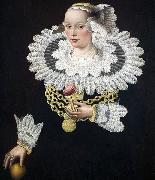
painted Portrait of Anna Rosina Tanck, wife of the mayor of Lubecker in1642
|
|
|
|
 |
MEMLING, Hans
|
|
Netherlandish Northern Renaissance Painter, ca.1435-1494
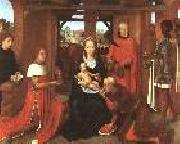
South Netherlandish painter of German origin. Together with Dieric Bouts I and Hugo van der Goes, he was one of the most important exponents of the new artistic developments that flourished in the southern Netherlands in the 15th century in the wake of Jan van Eyck, the Master of Fl?malle and Rogier van der Weyden. Their principal innovation was to apply optic realism to devotional or mystical subjects. Although Memling lived in the turbulent period of transition from the Burgundian ruling house to that of the Habsburgs, little of this is evident in his work. His commissions were almost exclusively from rich burghers in Bruges (bankers, merchants and politicians) or churchmen and the occasional aristocrat. Often they were foreigners, especially Italians, who had political or financial connections with the town, whose central economic position was to last only a few decades longer. They had Memling paint their portraits, bust or full length, in devotional paintings or on altarpieces for their chapel in Bruges or back home. He seems not to have received official commissions (from the town council or court). An exceptional proportion of this oeuvre has survived. Besides about 20 altarpieces, often in several panels and of considerable size,
|
|
 |
Melchior de Hondecoeter
|
|
1635-1695
Dutch
Melchior de Hondecoeter Gallery
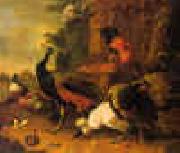
Melchior d'Hondecoeter (c. 1636 ?C April 3, 1695), Dutch animalier painter, was born at Utrecht, and died in Amsterdam. After the start of his career, he painted virtually exclusively bird subjects, usually exotic or game, in a park-like landscapes.
Being the grandson of Gillis d'Hondecoeter and son of Gijsbert d'Hondecoeter, as well as nephew of Jan Baptist Weenix, he was brought up by the last to the profession of painting, when his father died. Of Weenix we know that he married Gilles daughter Josina in 1638. Melchior was, therefore, also related to Jan Weenix. The latter told Arnold Houbraken, in his youth Melchior was extremely religious, praying very loud, so his mother and uncle doubted if they would have him trained as a painter.
In 1659 he was working in the Hague and became a member of the painters' academy at the Hague. In 1663 Hondecoeter married Susanne Tradel in Amsterdam. While she was captious and having her sisters living in their house, Hondecoeter spent much time in his garden or drinking in the tavern in the Jordaan. On the Lauriergracht, where he used to live, he was surrounded by art dealers and various painters. Later he moved to a house on Prinsengracht. In 1686 he bought a small countryhouse in Vreeland. Hondecoeter died in the house of his daughter Isabel in Warmoesstraat but was buried in Westerkerk near his house. His inventory lists a small gallow, to keep birds in the right position, and several paintings of Frans Snyders.
Melchior began his career with a different speciality from that by which he is usually known. Mr de Stuers affirms that he produced sea-pieces. One of his earliest works is a "Tub with Fish," dated 1655, in the gallery of Brunswick. But Melchior soon abandoned fish for fowl. He acquired celebrity as a painter of birds only, which he represented not exclusively, like Johannes Fyt, as the gamekeeper's perquisite after a day's shooting, or stock of a poulterer's shop, but as living beings with passions, joys, fears and quarrels, to which naturalists will tell us that birds are subject. Without the brilliant tone and high finish of Fyt, his Dutch rival's birds are full of action; and, as Burger truly says, "Hondecoeter displays the maternity of the hen with as much tenderness and feeling as Raphael the maternity of Madonnas."
|
|
|
|
 |
Meindert Hobbema
|
|
1638-1709
Dutch
Meindert Hobbema Galleries
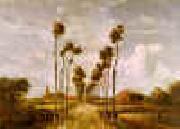
In the exercise of his craft Hobbema was patient beyond all conception. It is doubtful whether any one ever so completely mastered as he did the still life of woods and hedges, or mills and pools. Nor can we believe that he obtained this mastery otherwise than by constantly dwelling in the same neighbourhood, say in Guelders or on the Dutch Westphalian border, where day after day he might study the branching and foliage of trees and underwood embowering cottages and mills, under every variety of light, in every shade of transparency, in all changes produced by the seasons. Though his landscapes are severely and moderately toned, generally in an olive key, and often attuned to a puritanical grey or russet, they surprise us, not only by the variety of their leafage, but by the finish of their detail as well as the boldness of their touch. With astonishing subtlety light is shown penetrating cloud, and illuminating, sometimes transiently, sometimes steadily, different portions of the ground, shining through leaves upon other leaves, and multiplying in an endless way the transparency of the picture. If the chance be given him he mirrors all these things in the still pool near a cottage, the reaches of a sluggish river, or the swirl of the stream that feeds a busy mill. The same spot will furnish him with several pictures. One mill gives him repeated opportunities of charming our eye; and this wonderful artist, who is only second to Ruisdael because he had not Ruisdael's versatility and did not extend his study equally to downs and rocky eminences, or torrents and estuaries - this is the man who lived penuriously, died poor, and left no trace in the artistic annals of his country. It has been said that Hobbema did not paint his own figures, but transferred that duty to Adriaen van de Velde, Lingelbach, Barendt Gael, and Abraham Storck. As to this much is conjecture.
|
|
|
|
|
|
|
|
|
| Wholesale China Oil Painting Wholesale Oil Painting China Xiamen Portrait Reproduction on canvas Chinese Oil Painting Wholesale USA Oil Painting |
|
|
|
|
|