| |
|
Xiamen Oil Paintings, Wholesale Direct!
|
|
100% hand painted, 100% cotton canvas, 100% money back if not satisfaction. |
|
|
|
|
ART WORKS INDEX
A
B
C
D
E
F
G
H
I
J
K
L
M
N
O
P
Q
R
S
T
U
V
W
X
Y
Z
|
|
ARTISTS INDEX
A
B
C
D
E
F
G
H
I
J
K
L
M
N
O
P
Q
R
S
T
U
V
W
X
Y
Z
|
|
|
|
|
|
|
|
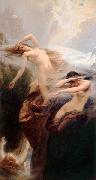 |
Herbert James Draper
|
|
(1863 - 22 September 1920) was an English Classicist painter whose career began in the Victorian era and extended through the first two decades of the 20th century.
Born in London, the son of a jeweller named Henry Draper and his wife Emma,he was educated at Bruce Castle school in Tottenham and then went on to study art at the Royal Academy. He undertook several educational trips to Rome and Paris between 1888 and 1892, having won the Royal Academy Gold Medal and Travelling Studentship in 1889. In the 1890s he worked also as an illustrator, settling in London. In 1891 he married his wife Ida , with whom he had a daughter, Yvonne.He died of arteriosclerosis at his home at 15, Abbey Road, N.W.8 on 22 September 1920
|
|
|
|
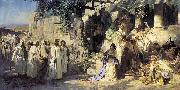 |
Henryk Siemiradzki
|
|
(1843-1902) was a Polish Academic painter. He was particularly known for his depictions of scenes from the ancient Graeco-Roman world and the New Testament.
Siemiradzki was born to a Polish szlachta family of a military physician in the village of Novobelgorod (now Pechenegi) near Kharkov, Ukraine. He studied at Kharkov Gymnasium where he learned painting under a scion of Karl Briullov, D. I. Besperchy. He entered the Physics-Mathematics School of Kharkov University but continued his painting lessons from Bespechy.
After graduating from the University with the degree of Kandidat he abandoned his scientific career and moved to Saint Petersburg to study painting at the Imperial Academy of Arts in the years 1864-1870. Upon his graduation he was awarded a gold medal. In 1870-1871 he studied under Karl von Piloty in Munich on a grant from the Academy.
|
|
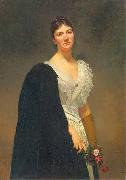 |
Henryk Rodakowski
|
|
(1823-1894) was a Polish painter.
He was befriended by the painter and activist Leon Kaplinski.
|
|
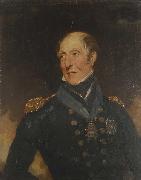 |
Henry Wyatt
|
|
(1460-1537) was an English courtier.
A Lancastrian supporter against Richard III, he was imprisoned in the Tower of London. On the accession of Henry VII, he was released and assumed high places at court. He acted as Henry's agent in Scotland.
He was admitted to the privy council, and remained high in the royal favour. He was one of Henry VII's executors, and one of Henry VIII's guardians. He was admitted to the privy council of the new king in April 1509, and became a knight of the Bath on 23 July of the same year. In 1511 he was made jointly with Sir Thomas Boleyn constable of Norwich Castle, and on 29 July of the same year was granted an estate, Maidencote, at Estgarstone in Berkshire. At the battle of the Spurs he served in the vanguard (16 August 1513).
|
|
 |
Henry William Pickersgill
|
|
English Painter, 1782-1875
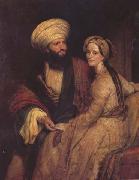
was an English painter specialising in portraits. He was a Royal Academician for almost fifty years, and painted many of the most notable figures of his time. Born in London, Pickersgill was adopted in his youth by a Mr Hall, a silk manufacturer in Spitalfields, who financed his schooling and then took him into the family business. However, when war caused difficult trading conditions, Pickersgill opted to develop his talent for painting into a career, and was a pupil of landscape artist George Arnald between 1802 - 1805 before entering the Royal Academy Schools as a student in November 1805.His early subjects were varied and included landscapes and classical and historical themes, but he eventually settled to portraiture as his speciality. His first exhibit at the Royal Academy was a portrait of his benefactor Mr Hall, and during his lifetime he showed a total of 384 paintings there. He was elected to associate membership of the Academy in November 1822 and full membership in February 1826. Pickersgill was one of the pre-eminent portrait painters of his day. William Wordsworth, George Stephenson, Jeremy Bentham, Elizabeth Barrett Browning, Lord Nelson, the Duke of Wellington and Faraday were among the many notable people who sat for him. He famously painted author James Silk Buckingham and his wife Elizabeth in Arab costume in 1816, reflecting Buckingham's own travels in the East as well as the fashion of the times for the Orient. The National Portrait Gallery, London has over 50 of his portraits in its collection, including 16 original oils and 35 engravings after him, along with a small number of portraits of Pickersgill himself by others. From 1856?C64 he was librarian of the Royal Academy. He retired from the institution in December 1872, and died at his home in Blandford Square, London at the age of 93. Pickersgill's brother Richard, son Henry Hall and nephew Frederick Richard were also painters.
|
|
 |
Henry William Beechey
|
|
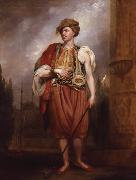
Sir Henry William Beechey (12 December 1753 - 28 January 1839), English portrait-painter, was born at Burford, the son of William Beechey (*1732) and Hannah Read (*c1732).
He was originally meant for a conveyancer, but a strong love for painting induced him to become a pupil at the Royal Academy in 1772. Some of his smaller portraits gained him considerable reputation; he began to be employed by the nobility, and in 1793 became associate of the Royal Academy. In the same year he was made portrait-painter to Queen Charlotte. His work has been described as relatively sober.
He painted the portraits of the members of the royal family, and of nearly all the most famous or fashionable persons of the time. What is considered his finest production is a review of cavalry, a large composition in the foreground of which he introduced portraits of George III, the Prince of Wales and the Duke of York, surrounded by a brilliant staff on horseback. Among his portraits were those of Lord Nelson, John Kemble, and Sarah Siddons.
George III and the Prince of Wales reviewing troops was painted in 1798, and obtained for the artist the honour of knighthood, and his election as RA (member of the Academy). This painting was destroyed in the 1992 Windsor Castle fire.
|
|
 |
Henry Warren
|
|
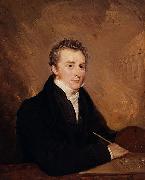
Henry White Warren (1831-1912) was an American Methodist Episcopal bishop and author, brother of William Fairfield Warren. He was born at Williamsburg, Mass., and graduated in 1853 at Wesleyan University, Middletown, Conn. He taught ancient languages at Wesleyan Academy, Wilbraham, Mass. (1853-55), and then entered the New England Conference (1855). On April 6, 1855, he married Miss Diantha Kilgore, in Lowell, Massachusetts. In 1863 he was a member of the Massachusetts Legislature.
His wife died June 21, 1867, after having borne three children: Carrie, Henry and Ellen. After serving churches about Boston he was transferred to the Philadelphia Conference (1871) and was elected Bishop (1880).
When he visited Colorado for the first time in 1879 he met the widow of John Wesley Iliff, Mrs. Elizabeth Iliff. They were married on December 27, 1883.
|
|
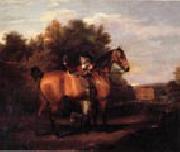 |
Henry Walton
|
|
British Painter ,
c 1746-1813
He studied in London under Johan Zoffany c. 1769, after which he completed his training at the Maiden Lane Academy. It was probably Zoffany who introduced Walton to the conversation piece, a genre in which he was to specialize. The Cricket Scene at Harrow School (1771; priv. col., see 1963 exh. cat., no. 1) reveals Walton's debt to Zoffany, but it also shows him to be an exceptional colourist and able to compose his figures with a sense of rare warmth and intimacy. By c. 1778, when he painted the Rev. Charles Tyrrell with his Family
|
|
 |
Henry Wallis
|
|
British
1830-1916
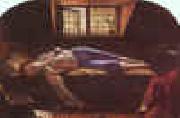
1916). English painter, writer and collector. He first studied at F. S. Cary academy and in 1848 entered the Royal Academy Schools, London. He is also thought to have trained in Paris at some time in the late 1840s or early 1850s, first in Charles Gleyre atelier and subsequently at the Ecole des Beaux-Arts. He specialized in portraits of literary figures and scenes from the lives of past writers, as in Dr Johnson at Cave, the Publisher (1854; untraced). His first great success was the Death of Chatterton (London, Tate), which he exhibited at the Royal Academy in 1856. The impoverished late 18th-century poet Thomas Chatterton, who while still in his teens had poisoned himself in despair, was a romantic hero for many young and struggling artists in Wallis day. He depicted the poet dead in his London garret, the floor strewn with torn fragments of manuscript and, tellingly, an empty phial near his hand. The painting was universally praised, not least by John Ruskin who described it as faultless and wonderful, advising visitors to examine it well, inch by inch. Although Wallis was only loosely connected with the Pre-Raphaelite movement, his method and style in Chatterton reveal the importance of that connection: the vibrant colours and careful build-up of symbolic detail are typical Pre-Raphaelite concerns. The success of Chatterton was such that, when exhibited in Manchester the following year, it was protected from the jostling crowds by a policeman. It was bought by another artist, Augustus
|
|
 |
henry wadsworth longfellow
|
|
1807-C82, American poet, b. Portland, Maine, grad. Bowdoin College, 1825. He wrote some of the most popular poems in American literature, in which he created a new body of romantic American legends. Descended from an established New England family, after college he spent the next three years in Europe, preparing himself for a professorship of modern languages at Bowdoin, where he taught from 1829 to 1835. After the death of his young wife in 1835, Longfellow traveled again to Europe, where he met Frances Appleton, who was to become his second wife after a long courtship. She was the model for the heroine of his prose romance, Hyperion (1839). From 1836 to 1854, Longfellow was professor of modern languages at Harvard, and during these years he became one of an intellectual triumvirate that included Oliver Wendell Holmes and James Russell Lowell. Although a sympathetic and ethical person, Longfellow was uninvolved in the compelling religious and social issues of his time; he did, however, display interest in the abolitionist cause.
|
|
 |
Henry Thomas Alken
|
|
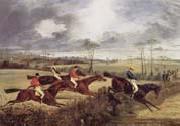
1785-1851, Painter and engraver, son of Samuel Alken. He worked in London and the provinces and was prolific in a variety of media while unadventurous in his range of subject-matter. Early instruction by the miniature painter J. T. Beaumont (1774-1851) helped to give a certain graphic precision
|
|
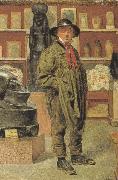 |
Henry stacy marks,R.A.
|
|
1829-1898
English painter. He studied with J. M. Leigh (1808-60) from 1847 and in January 1851 enrolled at the Royal Academy Schools. In 1852 Marks and P. H. Calderon spent five months studying in Paris under Fran?ois-Edouard Picot and at the Ecole des Beaux-Arts. The next year he made his d?but at the Royal Academy Summer Exhibition, where he exhibited annually until 1897. He was elected ARA in 1871 and RA in 1878.
|
|
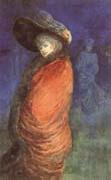 |
Henry Somm
|
|
French, 1844-1907.French painter, illustrator, designer and printmaker. He was trained at the Ecole Municipale de Dessin in Rouen under Gustave Morin (1809-86). He was obliged to sell illustrations to periodicals to make a living, contributing, among others, to Charge, Cravache, LInutile, Chronique parisienne and Courier fran?ais. His drawings were spirited, but because their humour often relied on topicality his fame was short-lived.
|
|
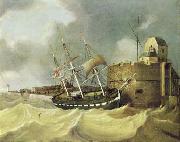 |
Henry Smartly
|
|
painted Ship QUEEN VICTORIA - a Close Call Entering Le Havre in 1843
|
|
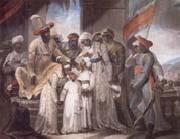 |
Henry Singleton
|
|
British Painter, 1766-1839,English painter and illustrator. His father died when he was young, and he was brought up by his uncle, the miniature painter William Singleton (d 1793). In 1782 he entered the Royal Academy Schools in London and in 1784 won a silver medal for a drawing from life, exhibiting at the Royal Academy for the first time the same year. He showed considerable promise and in 1788 won a gold medal for a painting inspired by John Dryden's ode Alexander's Feast that was especially praised by Reynolds. In 1793 Singleton was commissioned by the Royal Academy to paint the group portrait the Royal Academicians Assembled in their Council Chamber (London, RA). He soon became noted for his paintings inspired by the Bible and from literary sources, among them Manto and Tiresias (exh. 1792; London, Tate) from John Dryden's Oedipus, and for his depictions of contemporary historical events, of which the watercolour Design Commemorative of the Abolition of the Slave Trade (1807; London, BM) is an example. Many of his works were engraved in mezzotint and achieved a widespread popularity. He also painted portraits, the writer James Boswell (c. 1795; Edinburgh, N.P.G.) being one of his sitters. Many of Singleton's later works are inclined to be sentimental and were carelessly executed; they were often intended solely for engraving.
|
|
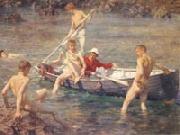 |
Henry Scott Tuke
|
|
British Painter and photographer , 1858-1929
English painter. He entered the Slade School of Art, London, in 1875, under Alphonse Legros and Sir Edward Poynter. In 1877 he won a Slade scholarship and in 1880 travelled to Italy, where he made his first nude life drawings, an important revelation to him of light, colour and the human form. From 1881 to 1883 he was in Paris and met Jules Bastien-Lepage, who encouraged his studies en plein air.
|
|
|
|
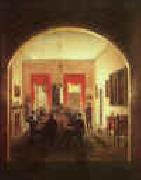 |
Henry Sargent
|
|
1770-1845
Henry Sargent Gallery
Henry Sargent (baptized November 25, 1770 ?? February 21, 1845), American painter and military man, was born in Gloucester, Massachusetts. One of seven children born to Daniel and Mary (Turner) Sargent and the brother of Lucius Manlius Sargent, he was a great-grandson of William Sargent, who received a grant of land at Gloucester in 1678. His father was a prosperous and public-spirited merchant. Henry was sent as a young boy to Dummer Academy, South Byfield, and then, the family having moved to Boston, he continued his studies under local teachers. After a period in the counting house of Thomas Handasyd Perkins, he continued his commercial apprenticeship with his father, but suddenly, as he was attaining his majority, without having previously shown special partiality for the arts of design, he determined to become an artist. An elder brother's efforts in this direction seem to have stimulated him, and his mother encouraged him. John Trumbull, who visited Boston in 1790, saw some of his work and found it promising.
In 1793 Sargent went to London, where he studied with Benjamin West and had courteous treatment from John Singleton Copley. A letter of Sargent's dated March 27, 1795 shows that he found living in London expensive and the painter's profession much depressed. He returned to Boston in 1799, still strongly conscious of "the apathy then existing towards the arts". Accordingly, in that same year he took a commission in the national army then being raised under the command of Alexander Hamilton. This service was brief, but it gave Sargent a taste for military life which motivated his long connection with the Massachusetts militia. In or shortly after 1799 he joined the Boston Light Infantry, which had been organized the year before and of which his brother, Daniel Sargent, was captain. Records of the adjutant-general's office in the Massachusetts State House show that Henry Sargent became first lieutenant of this company on October 1, 1804, and captain on March 31, 1807. Of a tall, thin, Yankee build, he was a handsome officer and an efficient drill master. During the War of 1812 his company aided in the fortification of Fort Strong, and on May 31, 1815, he was appointed aide-de-camp to the governor, with the rank of colonel. In 1812, 1815, 1816, and 1817 he was a member of the Massachusetts Senate.
On April 2, 1807, Sargent married Hannah, the daughter of Samuel and Isabella (Pratt) Welles, of Boston, and they had two daughters who died in infancy and two sons, one of whom was Henry Winthrop Sargent.
In the course of the following decade, growing deafness caused him gradually to withdraw from public services and to devote himself entirely to his painting and to mechanical inventions; he achieved no particular fame in the latter field. His painting was that of a diligent and gifted artist whose talent fell short of genius. His portraits were less masterful than those of his fellow townsman, Gilbert Stuart, with whom he was personally intimate. Like Copley, whom he somewhat resembled as a painter, Sargent enjoyed intensive elaboration of textures and accessories. He had a capacity for doing canvases that required sustained effort. The well-known Landing of the Pilgrims, at Pilgrim Hall, Plymouth, attributed to him, is not representative of his best work. Far better are the two conversation pieces, The Dinner Party (ca. 1821) and The Tea Party (ca. 1824), owned by the Museum of Fine Arts, Boston. These have something of the exquisiteness of the so-called Little Dutchmen and they give fascinating glimpses of social life in Boston homes of the early 19th century. An altar painting, The Christ Crucified, which Sargent made for the Holy Cross Church, Boston, won contemporary favor. The full-length portrait of Peter Faneuil, in Faneuil Hall, if by Sargent, to whom it is ascribed, must be a copy after John Smibert. Sargent's self-portrait is at the Museum of Fine Arts; his likenesses of Jeremy Belknap, D.D., and John Clarke, D.D., both friends of his parents, are at the Massachusetts Historical Society. Continuing to paint at intervals down into old age, he was elected in 1840 an honorary member of the National Academy of Design and in 1845, president of the newly-organized Artists' Association of Boston.
|
|
|
|
|
|
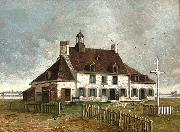 |
Henry Richard S. Bunnett
|
|
1845 -1910
David Ross McCord (1844-1930) commissioned Henry Richard S. Bunnett (1845-1910) to paint over 200 oil paintings between 1885 and 1889. The works depicted buildings, views and places around Quebec that McCord felt were of historical importance.
|
|
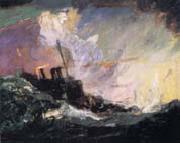 |
Henry Reuterdahl
|
|
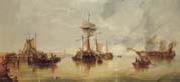
American, 1871-1925
He was best known for his paintings of Navy warships and recruiting posters for World War
|
|
 |
Henry Redmore
|
|
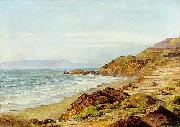
Henry Redmore was born in Hull in 1820. He lived his whole life in the North East of England, with his studio in Hull. Along with John Ward, Redmore was one of the best painters of the Hull School, although the two artists had distinctly different techniques
|
|
|
|
|
|
|
|
|
|
 |
Henry Otto Wix
|
|
Henry Otto Wix (1866 - 1922), also known as Otto Wix, was a German-born landscape and portrait painter who emigrated to the United States in the late 1890s. He studied in New York, but visited Hawaii in 1907 and 1908-9. About 1910, he moved to San Francisco, but visited Hawaii again in 1912. He also made several sketching trips to Mexico. Wixes marriage ended in divorce, resulting in depression and alcoholism. He died by his own hand in Santa Barbara, California on March 13, 1922.
Wix is best known for his landscapes in watercolor. The Honolulu Academy of Arts and the Smithsonian American Art Museum are among the public collections holding paintings by Henry Otto Wix
|
|
 |
Henry Ottmann
|
|
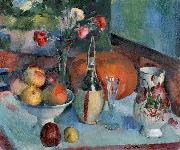
painted Nature morte aux fruits et a la fiasque de vin in 20th century
French, 1877-1927
|
|
 |
Henry Ossawa Tanner
|
|
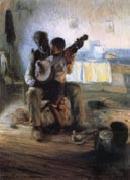
African-American Realist Painter, 1859-1937
American painter. He was one of the foremost African American artists, achieving an international reputation in the early years of the 20th century for his religious paintings. The son of an African Methodist Episcopal bishop, he studied art with Thomas Eakins from 1880 to 1882 at the Pennsylvania Academy of the Fine Arts in Philadelphia. He then worked in Philadelphia and Atlanta, GA, where he ran a photography studio and taught at Clark College.
|
|
|
|
|
|
 |
Henry Merwin Shrady
|
|
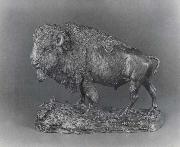
American Sculptor, 1871-1922,was the sculptor of the Ulysses S. Grant Memorial in Washington, D.C. Shrady was born in New York City. His father, George Shrady, was one of the physicians who attended former president Ulysses S. Grant during the struggle with throat cancer that led to his death on July 23, 1885. Shrady graduated from Columbia University in 1894 and spent one year thereafter at Columbia's law school. He left law school to join with his brother-in-law, Jay Gould (son of millionaire Edwin Gould, the financier), at the Continental Match Company. The company failed and Shrady contracted typhoid fever which diverted him forever from the business world. His recuperation left spare time to pursue a growing interest in art. Shrady's wife, Harrie Moore, submitted some of his paintings to an exhibition of the National Academy of Design without his knowledge and they sold quickly. He then began to teach himself sculpture using zoo animals and his pets as models. Shrady and architect William Casey Pearce won the competition to build the Ulysses S. Grant Memorial in 1902. In the twelve years Shrady spent executing the memorial, he studied biology at the American Museum of Natural History and dissected horses to gain a better understanding of animal anatomy.
|
|
|
|
 |
henry mayhew
|
|
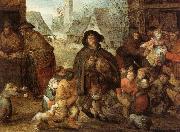
English journalist and sociologist. He studied law but soon turned to journalism. In 1841 he founded the highly successful Punch. A vivid and voluminous writer, he is best known for London Labour and the London Poor (1851 C 62), an evocation of the sights and sounds of the working-class districts of London, which influenced Charles Dickens and other writers. He also wrote plays, farces, fairy tales, and novels, some in collaboration with his brother Augustus Septimus Mayhew
|
|
 |
Henry Mark Anthony
|
|
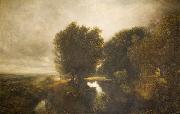
(4 August 1817 - 1 December 1886) was an English landscape artist, often favourably compared to John Constable by critics. He exhibited at many major art institutions and travelled widely, being credited with introducing the en plein air style of painting to Britain.
|
|
|
|
 |
Henry Lejeune
|
|
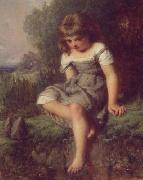
(12 December 1819 - 5 October 1904) was an English painter of landscapes, genre, literary and biblical scenes. He became well-known for his genre paintings of children.
Henry Le Jeune was born in London, the son of Anthony Le Jeune, a professional musician of Flemish origin, and the third of five children. After showing an early interest in art he was encouraged by his family to study the art collections in the British Museum.
In 1834 Le Jeune was admitted to the Royal Academy where, after winning 4 silver medals in succession, he won a gold medal in 1841 for the biblical painting "Samson Bursting his Bonds". He first exhibited at the Royal Academy in 1840 with a work entitled "Joseph Interpreting the Dream of Pharaoh's Chief Butler".
From 1845-48 he taught at the Government School of design at Somerset House, and from 1848-64 was curator and instructor at the Royal Academy. He was elected an Associate of the Royal Academy (ARA) in 1863 and an honorary retired associate in 1886.
Le Jeune married Dorothy Lewis (1815-1864) on 21 June 1844 and had five sons and three daughters. He lived in London all his life, dying in Hampstead in 1904.
|
|
|
|
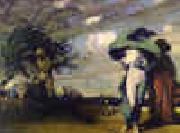 |
Henry Keller
|
|
1870-1949
Henry Keller Gallery
Henry George Keller (1869 - 1949) was an American artist who led a generation of Ohio watercolor painters of the Cleveland School. Keller's students at the Cleveland School of Art and his Berlin Heights, Ohio summer school included Charles E. Burchfield, Paul Travis, and Frank N. Wilcox.
|
|
|
|
|
|
 |
Henry J. Morgan
|
|
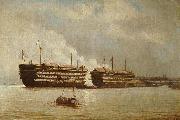
painted HMS 'Excellent' and HMS 'Illustrious' by Henry J. Morgan in 1860s
|
|
|
|
 |
Henry Inman
|
|
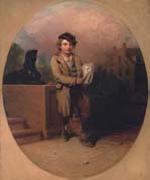
American Painter, 1801-1846,was an American portrait, genre, and landscape painter.He was born at Utica, N. Y., October 20, 1801, and was for seven years an apprentice pupil of John Wesley Jarvis in New York City. He was the first vice president of the National Academy of Design. He excelled in portrait painting, but was less careful in genre pictures. Among his landscapes are "Rydal Falls, England," "October Afternoon," and "Ruins of Brambletye." His genre subjects include "Rip Van Winkle," "The News Boy," and "Boyhood of Washington;" his portraits, those of Henry Rutgers and Fitz-Greene Halleck in the New York Historical Society, of Bishop White, Chief Justices Marshall and Nelson, Jacob Barker, William Wirt, Audubon, DeWitt Clinton, Martin Van Buren, and William H. Seward.
|
|
|
|
 |
Henry Holiday
|
|
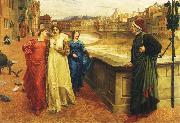
Henry Holiday (17 June 1839 - 15 April 1927) was an English historical genre and landscape painter, stained glass designer, illustrator and sculptor. He is considered to be a member of the Pre-Raphaelite school of art.
|
|
|
|
|
|
|
|
|
| Wholesale China Oil Painting Wholesale Oil Painting China Xiamen Portrait Reproduction on canvas Chinese Oil Painting Wholesale USA Oil Painting |
|
|
|
|
|