| |
|
Xiamen Oil Paintings, Wholesale Direct!
|
|
100% hand painted, 100% cotton canvas, 100% money back if not satisfaction. |
|
|
|
|
ART WORKS INDEX
A
B
C
D
E
F
G
H
I
J
K
L
M
N
O
P
Q
R
S
T
U
V
W
X
Y
Z
|
|
ARTISTS INDEX
A
B
C
D
E
F
G
H
I
J
K
L
M
N
O
P
Q
R
S
T
U
V
W
X
Y
Z
|
|
|
|
 |
MALLET, Jean-Baptiste
|
|
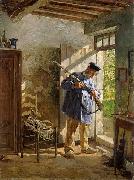
French Painter, 1759-1835,French painter. A pupil of Simon Julien in Toulon, he was then taught by Pierre-Paul Prud'hon in Paris. He exhibited at every Salon between 1793 and 1827, obtaining a second class medal in 1812 and a first class medal in 1817. He executed very few portraits (Chenier, Carcassonne, Mus. B.-A., is an exception), preferring to paint nymphs bathing and graceful classical nudes such as the Graces Playing with Cupid (Arras, Abbaye St Vaast, Mus. B.-A.). He established his reputation with gouache genre scenes of fashionable and often libertine subjects, always elegant and refined, in the style of Louis-Philibert Debucourt and Louis-Leopold Boilly, and remarkable for the delicacy and brilliance of their brushwork: for example At the Laundry Maid's and the Painful Letter (both Paris, Mus. Cognacq-Jay). They reveal a knowledge of 17th-century Dutch painting in the treatment of details (transparent crystal, reflections on silk or satin) as well as the choice of themes: Military Gallant (Paris, Mus. Cognacq-Jay). Mallet's meticulously precise paintings are one of the best records of fashionable French furnishings and interiors at the end of the 18th century and the beginning of the 19th.
|
|
|
|
|
|
|
|
|
|
|
|
 |
Lundbye, Johan Thomas
|
|
Danish Painter, 1818-1848
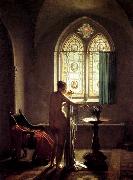
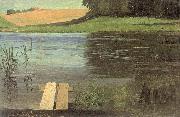
Danish painter. He studied at the Kongelige Akademi for de Sk?nne Kunster, Copenhagen, under Johan Ludvig Lund (1777-1867) and the animal painter Christian Holm (1804-46) between 1832 and 1842. Early on he was influenced by the ideas of the art historian N. L. H?yen, especially his concept of a truly national school of landscape painting. Kalundborg Church (1837; Copenhagen, Stat. Mus. Kst) depicts a historical monument familiar to all Danes, and one that had a particular nostalgic attraction for a painter born in Kalundborg. The picture is both sharply naturalistic and emphatically painterly. In Landscape Near Arres? (1838; Copenhagen, Thorvaldsens Mus.) Lundbye was more occupied with the representation of light and space. There is no anecdotal element; the lake, the open sky, the low hills, the ancient cairn, the cattle and the playing children sum up a typical Danish summer landscape. His larger canvases emphasize openness; flat expanses of land terminate in low tree-fringed horizons below vast skies. They have little of Constable's temperament or the broadness of Corot but are close to the elegiac mood of Caspar David Friedrich and Johan Christian Dahl. Danish landscape painting during the mid-1830s was greatly influenced by Romanticism
|
|
|
|
 |
Ludolf de Jongh
|
|
1616-1679
Dutch
Ludolf de Jongh Galleries
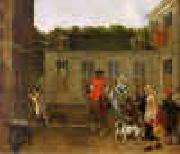
Dutch painter. He was one of the most versatile Dutch painters of the 17th century, producing portraits, genre paintings of both domestic scenes and soldier life, landscapes with hunting scenes and a few historical subjects. According to Houbraken, he studied with Cornelis Saftleven in Rotterdam, Anthonie Palamedesz. in Delft, and Jan van Bijlert in Utrecht. In 1635 he went to France, where he stayed for seven years. His earliest known paintings are portraits and genre subjects that date from after his return to Rotterdam in about 1642 and strongly reflect the style of Palamedesz.'s work. The genre subjects and numerous hunting scenes (e.g. Riders before an Inn; Geneva, Mus. A. & Hist.) painted shortly before the 1650s show the influence of van Bijlert and other Utrecht painters, especially Jacob Duck and Dirck Stoop.
|
|
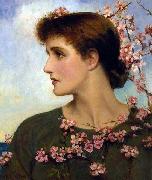 |
Louise Jopling
|
|
(16 November 1843 - 19 November 1933) was an English painter of the Victorian era, and one of the most prominent women artists of her generation.
Louise Goode was born in Manchester, fifth child of railway contractor T. S. Goode. She married at seventeen to civil servant Frank Romer. The Baroness de Rothschild, a connection of Romer's, encouraged Louise to pursue and develop her art. In the later 1860s she studied in Paris with Charles Joshua Chaplin and Alfred Stevens, and first exhibited her work at the Salon. She entered works into the Royal Academy shows, 1870-73 (as Louise Romer).
|
|
|
|
|
|
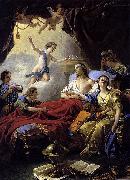 |
Louis Jean Francois Lagrenee
|
|
(December 30, 1724 - June 19, 1805) was a French painter, a pupil of Carlo Vanloo. His younger brother Jean-Jacques Lagren??e was also a painter.
Lagrenee was born in Paris. In 1755 he became a member of the Royal Academy, presenting as his diploma picture the Rape of Deianira (Louvre). He visited Saint Petersburg at the call of the empress Elizabeth, and on his return was named in 1781 director of the French Academy in Rome, a position he kept until 1787. He there painted the Indian Widow, one of his best-known works.
In 1804 Napoleon conferred on him the cross of the l??gion d'honneur, and on June 19, 1805 he died in the Louvre, of which he was honorary keeper.
|
|
 |
Louis Janmot
|
|
(21 May 1814 - 1 June 1892) was a French painter and poet.
Janmot was born in Lyon of Catholic parents who were deeply religious. He was extremely moved by the death of his brother in 1823 and his sister's in 1829. He became student at the Royal College of Lyon where he met Frederic Ozanam and other followers of his philosophy professor, Abbe Noirot. In 1831 he was admitted to the École des Beaux-Arts de Lyon and a year later, he won the highest honor, the Golden Laurel. In 1833, he came to Paris to take painting lessons from Victor Orsel and Jean-Auguste-Dominique Ingres. With other Lyon painters, he entered the Society of St. Vincent de Paul. In 1835, he went to Rome with Claudius Lavergne, Jean-Baptiste Frenet and other students and met Hippolyte Flandrin.
After his come back to Lyon in 1836, Janmot would attract the attention of critics of the Salon de Paris in conducting large-scale paintings with religious inspiration such as The Resurrection of the son of the widow of Nain (1839) or Christ in Gethsemane (1840). After 1845, he attracted the interest of Charles Baudelaire with his painting Flower of the Fields that allowed him to access to the Salon of 1846. Theophile Gautier was impressed by his Portrait of Lacordaire (1846). But the failure of his Poem of the Soul at the Universal Exhibition of 1855 disappointed him. In December of that year he married Leonie Saint-Paulet, from a noble family in Carpentras.
In 1856, Janmot obtained a commission to paint a fresco (since destroyed) representing the Last Supper for the church of St. Polycarp. Other orders followed, including the decoration of the dome of the Church of St. Francis de Sales and for the town hall that had been renovated by his friend the architect T. Desjardins. He was then appointed professor at the École des Beaux-Arts.
|
|
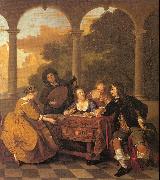 |
Loo, Jacob van
|
|
Flemish Baroque Era Painter, 1614-1670
was a Dutch painter and popularized around 1650 a close-focus concert on a loggia or terrace. So Van Loo became known for his conversation groupings with a subtle color palette, and according to Arnold Houbraken famous for his nudes. He was the founder of the Van Loo family of painters. Van Loo was born in Zeeland in the Dutch Republic. His father might have been a notary, but most time he is regarded as the son of a painter, Jan van Loo, who trained him. (As part of the city archives in Sluis have been destroyed during World War II it is impossible now to make out what is true). His early influences include Thomas de Keyser and Jacob Adriaensz Backer. In 1642, Jacob moved to Amsterdam, where his contemporaries included Rembrandt, Frans Hals, and Bartholomeus van der Helst. In 1643 he married the sister of the painter Martinus Lengele and had six children. They lived on Rozengracht, in the Jordaan and Eglon van der Neer became one of his pupils. In 1660, Van Loo fled the city after having fatally stabbed someone in his belly, during a fight in an inn. He was sentenced to death in absentia and was forever banned from the state of Holland. Van Loo settled in Paris, where he was admitted to the Acad??mie de peinture et de sculpture and where he died in 1670. Van Loo's work was done in the Baroque style, which had begun in Rome and which was becoming a Europe-wide phenomenon in this period. He was a major influence on Johannes Vermeer, when painting Diana and Her Companions. He painted portraits of Johan Huydecoper van Maarssenveen, his wife, his sister Leonara Huydecoper, married to Jan J.
|
|
|
|
 |
LINGELBACH, Johannes
|
|
Dutch Baroque Era Painter, 1622-1674
German painter, active in the Netherlands and Italy. By 1634 his family had settled in Amsterdam, where presumably Lingelbach trained as a painter. According to Houbraken, he visited France in 1642 and arrived in Italy two years later. However, he is not mentioned in any document of 1644, although he is recorded in Rome from 1647 to 1649. The artist left Rome in 1650 and by 1653 was back in Amsterdam, where he remained until his death. Lingelbach is perhaps the only one of the Dutch Italianates with a catalogue of numerous signed and dated works to document his artistic development. The first two signed works are The Blacksmith (1650; Rome, Melmeluzzi priv. col., see Briganti, Trezzani and Laureati, fig. 10.1) and Self-portrait with Violin (1650; Zurich, Ksthaus). Unfortunately no certain works survive from the previous years. Kren (1982) attributed a series of works depicting Roman trades, some formerly ascribed to Pieter van Laer, to Lingelbach's early career. The original group consisted of three small paintings: the Acquavita-seller, the Cake-seller and The Tobacconist (all Rome, Pal. Corsini). While these paintings have some striking points in common with the Melmeluzzi Blacksmith of 1650 and the signed Dentist on Horseback (1651; Amsterdam, Rijksmus.), it is still uncertain whether they belong to Lingelbach's pre-1650 work or are by another hand
|
|
|
|
 |
LINARD, Jacques
|
|
French Baroque Era Painter, ca.1600-1645
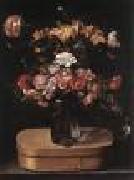
French painter. He was in Paris by 1626, and his first securely attributed still-life work is dated the following year. He lived in the Saint-Germain-des-Pr?s district, where a number of French still-life painters such as Louise Moillon and Lubin Baugin worked alongside Flemish artists specializing in this genre. In 1631 he was created Peintre et Valet de Chambre du Roi, a post that guaranteed him a degree of financial independence. Linard's works of 1627-44 were mainly of fruit and flowers; with Louise Moillon, however, he was among the first French artists to combine successfully the female form with still-life elements, as, for example, in Woman with Flowers and Woman with Fruit (both Paris, priv. col., see Far?, 1974, pp. 22-3). A painting such as Basket of Flowers (Paris, Louvre) owes something to Flemish prototypes in the anachronistic grouping of flowers that span several months. Patiently recording the flowers as they bloomed, and working on the picture from a series of drawings and sketches, Linard demonstrated his commitment to working from nature. However
|
|
 |
LIGOZZI, Jacopo
|
|
Italian painter, Florentine school (b. 1547, Verona, d. 1627, Firenze)
Italian painter, draughtsman, miniaturist and printmaker. He was one of the most productive artists in 17th-century Florence, although in the context of the Florentine Baroque, with its pageantry and decorative form, Ligozzi remained as much a foreigner in terms of his precise drawing, veristic figures and expressive content, as he was by birth. He was the son of the painter Giovanni Ermanno Ligozzi ( fl 1572-88; d before 1605) and came from a Veronese family of painters and designers of armour, tapestries and embroidery on silk. Other members of the family who were painters (Fumagalli in 1986 exh. cat.) were Jacopo's brother Francesco (d before 1635), whose career seems to have been in Verona, his cousin Francesco di Mercurio, who worked for the Medici in Florence in 1590-91
|
|
 |
LIEVENS, Jan
|
|
Dutch painter (b. 1607, Leiden, d. 1674, Amsterdam)
Dutch painter, draughtsman and printmaker. His work has often suffered by comparison with that of Rembrandt, with whom he was closely associated from 1625 to 1631. Yet Lievens's early work is equal to that of Rembrandt, although in later years he turned more towards a somewhat facile rendering of the international Baroque style favoured by his noble patrons, thus never fully realizing his early promise. Nonetheless, he became a renowned portrait painter and draughtsman, and his drawings
|
|
 |
LIEFERINXE, Josse
|
|
French painter, Provençal school (active 1493-1508 in Marseille)
South Netherlandish painter, active in France. A native of Hainaut, in the diocese of Cambrai, he may have come from Lieferinge near Enghien (Claessens). He is documented in Marseille and Aix-en-Provence from 1493 to 1505, often being described as a 'Picard painter'. In 1503 he married Michelle, one of the daughters of Jean Changenet, the most prominent painter of the time in Avignon, with whom he may have trained. The last great representative of the 'School of Avignon',
|
|
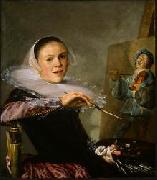 |
LEYSTER, Judith
|
|
Dutch Baroque Era Painter, 1609-1660
Dutch painter. A brewer's daughter, she had gained membership in the Haarlem painters' guild by age 24. Many of her known works, primarily portraits, genre paintings, and still lifes, were formerly attributed to her male contemporaries. Though the influence of Frans Hals is clear, she was also interested in the Baroque style of the Utrecht school. She embraced a greater range of subjects than other Dutch painters of the era
|
|
|
|
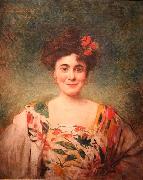 |
Leon Joseph Florentin Bonnat
|
|
(20 June 1833 - 8 September 1922) was a French painter.
He was born in Bayonne, but from 1846 to 1853 he lived in Madrid, where his father owned a bookshop. While tending his father's shop, he copied engravings of works by the Old Masters, developing a passion for drawing. In Madrid he received his artistic training under Madrazo. He later worked in Paris, where he became known as a leading portraitist, never without a commission. His many portraits show the influence of Velezquez, Jusepe de Ribera and other Spanish masters, as well as Titian and Van Dyke, whose works he studied in the Prado. Following the period in Spain Bonnat worked the ateliers of the history painters Paul Delaroche and Leon Cogniet (1854) in Paris. Despite repeated attempts, he failed to win the prix de Rome, finally receiving only a second prize. However, a scholarship from his native Bayonne allowed him to spend three years in Rome (1858 - 60) independently. During his stay in Rome, he became friends with Edgar Degas, Gustave Moreau, Jean-Jacques Henner and the sculptor Henri Chapu.
He won a medal of honor in Paris in 1869, going on to become one of the leading artists of his day. Bonnat went on to win the Grand Officer of the Legion d'honneur and became a professor at the Ecole des Beaux Arts in 1882. Bonnat was quite popular with American students in Paris. In addition to his native French, he spoke Spanish and Italian and knew English well, to the relief of many monolingual Americans. In May 1905 he succeeded Paul Dubois as director of the Ecole des Beaux-Arts. Bonnat "was a liberal teacher who stressed simplicity in art above high academic finish, as well as overall effect rather than detail," explains Julius Kaplan (see References). Bonnat's emphasis on overall effect on the one hand, and rigorous drawing on the other, put him in a middle position with respect to the Impressionists and academic painters like his friend Jean-Leon Gerôme.
|
|
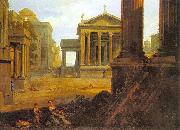 |
Lemaire, Jean
|
|
1763-64, oil on canvas, The Hermitage, St. Petersburg
|
|
|
|
 |
Lambert Jacobsz
|
|
1598-1636
Dutch
Lambert Jacobsz Gallery
Dutch painter. He was the son of a well-to-do Mennonite cloth merchant in Amsterdam. He served his apprenticeship there among the artists now called the Pre-Rembrandtists. After his marriage in 1620, commemorated by the poet Joost van den Vondel (1587-1639), he settled in Leeuwarden, his wife's native city, where he became a preacher in the Mennonite community and worked primarily as a painter. He was also active as an art dealer, as is known from his estate inventory, which records transactions in Amsterdam with the Mennonite art dealer and patron of Rembrandt, Hendrick van Uylenburgh. Two of Jacobsz.'s pupils were Govaert Flinck and Jacob Backer. His son, the painter ABRAHAM VAN DEN TEMPEL probably also studied with him before becoming Backer's pupil c. 1642-6.
|
|
|
|
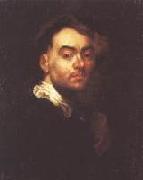 |
KUPECKY, Jan
|
|
Bohemian Baroque Era Painter, 1667-1740
Bohemian painter. He was born into a weaver's family, who, as Moravian Brethren, were forced to emigrate from Bohemia to Pezinok, Slovakia. Having met the artist Benedikt Claus (1632/3-1707), he left home at 15 to join him in Vienna, and three years later accompanied him to Italy. He worked in Venice and other north Italian towns before settling in Rome, where he made a meagre living by copying portraits. Although he attempted genre and historical paintings, portraiture became his main work. His influences ranged from prominent Venetian painters such as Bernardo Strozzi, Johann Carl Loth and Giuseppe Ghislandi to Anthony van Dyck and Hyacinthe Rigaud.
|
|
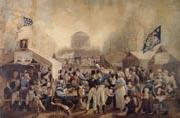 |
Krimmel John
|
|
American portrait and genre painter.
b.1789 d.1821
|
|
|
|
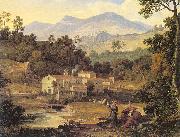 |
Koch, Joseph Anton
|
|
Austrian Painter, 1768-1839
Painter and writer. He was one of the most important landscape painters of the early 19th century. With his friend Johann Christian Reinhart he pioneered the 'heroic' landscape style by heightening the grandeur and structural clarity of classical Italianate landscapes in the tradition of Nicolas Poussin, Claude Lorrain and Gaspard Dughet. His work reflects a transitional period in European art. Largely under the influence of Asmus Carstens, Koch subscribed to many Neo-classical principles, but his work also has Romantic aspects. His interest in the natural sciences and Romantic philosophy betrayed an increasingly modern world-view, but he also embraced the medievalism of the Nazarenes.
|
|
|
|
|
|
|
|
|
|
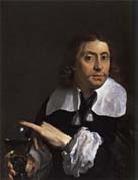 |
Karel du jardin
|
|
1626-78
Dutch painter, etcher and draughtsman. His father was Chaarles de Jardin (Gardyn; c. 1599-before 1650), a fat-renderer, and his mother was Catalyn Borchout (1588-before 1650). They had at least one other child, Herbert, who must have died by 1651
|
|
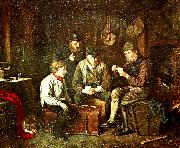 |
k. e. jansson
|
|
Karl Emanuel Jansson, född 7 juli 1846 i Finström, Åland, död 1 juni 1874 i Jomala, var en åländsk konstnär. Han var näst äldst av sju syskon. Han far, Jan Jansson, var en bonde i Pålsböle.
Sina konstnärliga inspiration fick han av sockenmålaren G Kjellgren, vid sex-sju års ålder, när han där lärde sig att läsa och skriva. Efter avlutad skolgång sattes han i skomakarlära. Efter ett år drogs han till Kjellgren och fungerade som hans hjälpreda. Kyrkoherden Frans von Knorring såg i slutet av 1859 några av hans teckningar. Han sände några till Finska Konstföreningens direktion och lovordade Karl.
Förening gav ett bidrag för att kunna studera vid Finska Konstföreningens ritskola i Åbo, under ledning av Robert Wilhelm Ekman. Av Ekman fick han husrum, rit- och målningsmaterial och en hel del extra undervisning. Karl gjorde stora framsteg under de 2 åren han målade med Ekman.
Jansson flyttade hösten 1862 till Stockholm, för att kunna utvecklas mer som artist, och inskrevs som elev vid Kongl. Akademin för de fria konsterna. Han tog anatomiexamen 1863. Han levde under svåra ekonomiska förhållanden och hade svårt att sälja sina verk.
Jansson fick hård kritik för de målningar han sände hem, exempelvis, Babian ätande en råtta, och konstföreningen betraktade dem med avsky. Han började då kritisera sig själv allt mer och mer, och den inställningen behöll han. Han fick inte den uppmärksammad han behövde. Tavlan Den förlorade sonens återkomst, belönades med ett pris. Han avslutade sin utbildning vid akademien 1867 med mycket beröm. Jansson lyckades utverka statsstöd för studier i Dusseldorf och reste dit på hösten 1868. Han åkte hem igen sommaren 1870 och tillbringade ett år på Åland innan han återvände till Dusseldorf.
Han var nu märkt av en tilltagande lungsjukdom. De sista verk han fullbordade var Talmannen och En slant i håven. För att lindra sin sjukdom reste han till Rom i mars 1872. Efter några månader åkte han runt till olika kurorter (Davos, Meran) men inget förbättrade hans tillstånd. Efter en liten tid i D??sseldorf kom han hem till Åland sensommaren 1873.
Karl flyttade in på Jomala gård, där lagman Lönnblad och hans fru tog hand om honom. Han målade några verk, vilka blev ofullbordade. På dödsbädden fick han veta att han belönats på världsutställningen i Wien för sina konstverk Klöveress och Talmannen, samt att han blivit medlem i konstakademin i Sankt Petersburg. Han dog 1 juni 1874, inte ens fylld 28 år.
|
|
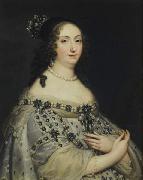 |
Justus van Egmont
|
|
Justus van Egmont (Leiden, 22 September 1601 - Antwerp, 8 January 1674) was a Dutch Golden Age painter and designer of tapestry.
Justus van Egmont moved to Antwerp at age 14 with his family where he became apprenticed to the painter Caspar van den Hoecke (ca. 1585 - ca 1648). In 1618, three years later, he undertook a Grand Tour to Italy in the manner of other artists of his day. This was considered a necessary rite of passage for artists after Karel van Mander published his Schilderboeck in 1604.
|
|
|
|
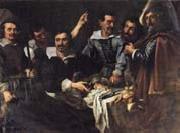 |
Justus Suttermans
|
|
(b Antwerp, bapt 28 Sept 1597; d Florence, 24 April 1681).
Flemish painter
Flemish painter,He is chiefly notable for his portraits of members of the Medici family as he was his court painter. His work can be found in both the Palatina Gallery and the Uffizi Gallery in Florence, and in many other galleries around the globe. During his lifetime he was feted as the finest portrait painter in Italy. He studied early on in Flanders and Antwerp, possibly with artists such as Villem de Vos, a nephew of the painter Marten de Vos and also Frans Pourbus the younger. He was eventually invited to Florence under the patronage of the Medici Family where he studied Italian portraitists such as Il Guercino, the Spanish Diego Velazquez and France's Pierre Mignard.
|
|
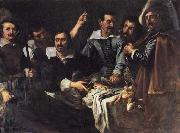 |
Justus Sustermans
|
|
(28 September 1597 - 23 April 1681), also known as Giusto Sustermans, was a Flemish painter in the Baroque style. He was born in Antwerp and died in Florence.
Sustermans is chiefly notable for his portraits of members of the Medici family as he was their court painter. His work can be found in both the Palatina Gallery and the Uffizi Gallery in Florence, and in many other galleries around the globe. During his lifetime he was feted as the finest portrait painter in Italy.
|
|
|
|
|
|
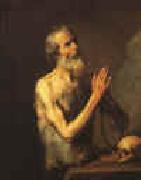 |
Jusepe de Ribera
|
|
1591-1652
Spanish
Jusepe de Ribera Galleries
Jusepe de Ribera (January 12, 1591 - 1652) was a Spanish Tenebrist painter and printmaker, also known as Jos?? de Ribera in Spanish and as Giuseppe Ribera in Italian. He was also called by his contemporaries and early writers Lo Spagnoletto, or "the Little Spaniard". Ribera was a leading painter of the Spanish school, although his mature work was all done in Italy.
In his earlier style, founded sometimes on Caravaggio and sometimes on the wholly diverse method of Correggio, the study of Spanish and Venetian masters can be traced. Along with his massive and predominating shadows, he retained from first to last a great strength in local coloring. His forms, though ordinary and sometimes coarse, are correct; the impression of his works gloomy and startling. He delighted in subjects of horror. In the early 1630s his style changed away from strong contrasts of dark and light to a more diffused and golden lighting. Salvator Rosa and Luca Giordano were his most distinguished followers, who may have been his pupils; others were also Giovanni Do, Enrico Fiammingo, Michelangelo Fracanzani, and Aniello Falcone, who was the first considerable painter of battle-pieces.
Among Ribera's principal works could be named "St Januarius Emerging from the Furnace" in the cathedral of Naples; the "Descent from the Cross" in the Certosa, Naples, the "Adoration of the Shepherds" (a late work, 1650), now in the Louvre; the "Martyrdom of St Bartholomew" in the Prado; and the "Pieta" in the sacristy of San Martino, Naples. His mythologic subjects are often as violent as his martyrdoms: for example, "Apollo and Marsyas", with versions in Brussels and Naples, or the "Tityus" in the Prado . The Prado and Louvre contain numbers of his paintings; the National Gallery, London, three. He executed several fine male portraits and a self-portrait. He was an important etcher, the most significant Spanish printmaker before Goya, producing about forty prints, nearly all in the 1620s.
|
|
|
|
 |
Juriaen van Streeck
|
|
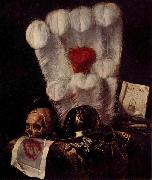
(1632 - 1687) was a Dutch Golden Age painter of still lifes.
According to Houbraken, he was good at all sorts of still life subjects, including helmets, books, letters, musical instruments, and skulls or dead animals to indicate the transcience of life.
He was a follower of Willem Kalf and influenced Barend van der Meer.Houbraken also wrote an entry for his son Hendrick van Streeck, who became a student of Emanuel de Witte and painted church interiors.
|
|
 |
Juliusz Kossak
|
|
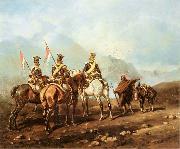
(Nowy Wiśnicz, 15 December 1824 - 3 February 1899, Krakew) was a Polish historical painter and master illustrator who specialized in battle scenes, military portraits and horses. He was the progenitor of an artistic family that spanned four generations. father of painter Wojciech Kossak and grandfather of painter Jerzy Kossak.
Juliusz Kossak grew up in Lwew during the military partitions of Poland. He obtained a degree in law at the Lwew University encouraged by his mother. At the same time he studied painting with Jan Maszkowski and Piotr Michałowski. Beginning in 1844 Kossak worked on commissions for the local aristocracy in Malopolska, Podolia and Wolyn. He married Zofia Gałczyka in 1855 and together they left for Paris where they spent five years. His sons were born there, the twin brothers: Wojciech and Tadeusz (on New Year's Eve 1856-1857) and the younger Stefan in 1858. The family came to Warsaw in 1860 where Kossak obtained a position as the head illustrator and engraver for Tygodnik Illustrowany magazine. They moved to Munich for a year and in 1868 settled in Krakew blessed with five children already. Kossak bought a small estate there, known as Kossakewka, famed for artistic and literary salon frequented by Adam Asnyk, Henryk Sienkiewicz, Stanisław Witkiewicz, Jezef Chełmoki and many others. Juliusz Kossak lived and worked there till the end of his life. In 1880 he was awarded the Cross of Order of Merit by Emperor Franz Joseph of Austria-Hungary for his lifetime achievements as an artist.
|
|
 |
Julius von Blaas
|
|
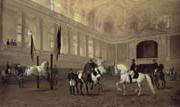
1845-1923,was an Italian painter, the second son of Karl, born at Albano, Italy. He studied under his father, devoted himself principally to equestrian subjects, and went to Rome where he painted genre scenes from the Campagna. His "Race of Intoxicated Slavonic Peasants" (1869) is in the Imperial Museum of Vienna, as is "Antlassritt" (1899). Julius von Blaas was much employed by the Austrian court as a portrait painter and became professor in the Academy of Vienna.
|
|
|
|
|
|
|
|
|
| Wholesale China Oil Painting Wholesale Oil Painting China Xiamen Portrait Reproduction on canvas Chinese Oil Painting Wholesale USA Oil Painting |
|
|
|
|
|