| |
|
Xiamen Oil Paintings, Wholesale Direct!
|
|
100% hand painted, 100% cotton canvas, 100% money back if not satisfaction. |
|
|
|
|
ART WORKS INDEX
A
B
C
D
E
F
G
H
I
J
K
L
M
N
O
P
Q
R
S
T
U
V
W
X
Y
Z
|
|
ARTISTS INDEX
A
B
C
D
E
F
G
H
I
J
K
L
M
N
O
P
Q
R
S
T
U
V
W
X
Y
Z
|
|
|
|
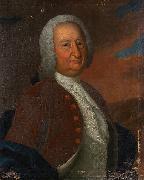 |
Jons Pilo
|
|
Jöns Pilo (1707-1750)Aliases: Jons O. Pijhlou; Jons O. Pijlou; Jons O. PiloProfessions: Painter
|
|
|
|
|
|
|
|
 |
jonathan miller
|
|
(born July 21, 1934, London, Eng.) British director, writer, and actor. After earning a medical degree at Cambridge University, he made his professional stage debut at the Edinburgh Festival in the hit satirical revue Beyond the Fringe (1960).
|
|
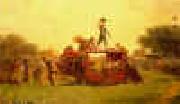 |
Jonathan Eastman Johnson
|
|
1824-1906
Jonathan Eastman Johnson Galleries
Eastman Johnson (July 29, 1824 - April 5, 1906) was an American painter, and Co-Founder of the Metropolitan Museum of Art, New York City, with his name inscribed at its entrance. Best known for his genre paintings, paintings of scenes from everyday life, and his portraits both of everyday people, he also painted portraits of prominent Americans such as Abraham Lincoln, Nathaniel Hawthorne, Ralph Waldo Emerson, and Henry Wadsworth Longfellow. His later works often show the influence of the 17th century Dutch masters whom he studied while living in The Hague, and he was even known as The American Rembrandt in his day.
Johnson's style is largely realistic in both subject matter and in execution. His original photorealistic charcoal sketches were not strongly influenced by period artists, but are informed more by his lithography training. Later works show influence by the 17th century Dutch and Flemish masters, and also by Jean François Millet. Echoes of Millet's The Gleaners can be seen in Johnson's The Cranberry Harvest, Island of Nantucket although the emotional tone of the work is far different.
His careful portrayal of individuals rather than stereotypes enhances the realism of his paintings. Ojibwe artist Carl Gawboy notes that the faces in the 1857 portraits of Ojibwe people by Johnson are recognizable in people in the Ojibwe community today. Some of his paintings such as Ojibwe Wigwam at Grand Portage display near photorealism long before the photorealism movement but in keeping with the American tradition of realism that can be seen in the works of Charles Willson Peale whose painting The Stairway Group is said to have fooled George Washington.
His careful attention to light sources contributes to the realism. Portraits Girl and Pets and The Boy Lincoln make use of single light sources in a manner that echoes the 17th Century Dutch Masters.
|
|
 |
Jonas Lie
|
|
Jonas Lauritz Idemil Lie (6 November 1833 - 5 June 1908) was a Norwegian novelist, poet, and playwright who is considered to have been one of the Four Greats of 19th century Norwegian literature, together with Henrik Ibsen, Bjornstjerne Bjørnson and Alexander Kielland.
|
|
|
|
|
|
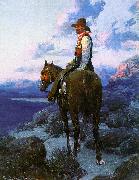 |
Johnson, Frank Tenney
|
|
American Painter, 1874-1939
was a painter of the american west, and he popularized a style of painting cowboys which became known as "The Johnson Moonlight Technique". Somewhere on the Range is an example of Johnson's moonlight technique. To paint his paintings he used knives, fingers and brushes. Johnson was born in Pottawattamie County, Iowa, on his family's farm along the old Overland Trail near a town then called Big Grove and now known as Oakland. Johnson's mother died in December 1886, and by 1888 the family had moved to Milwaukee. There, in 1893, he enrolled in the Milwaukee School of Art (absorbed by Milwaukee State Normal School in 1913), where he studied with a well-known painter of western subjects, Richard Lorenz.
|
|
|
|
|
|
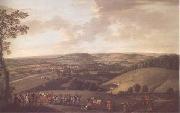 |
John Wootton
|
|
1682 - 1764
English painter. He probably received some instruction from Jan Wyck in the 1690s, and he was possibly patronized from an early age by the aristocratic households of Beaufort and Coventry (as was Wyck), perhaps while working as a page to Lady Anne Somerset at Snitterfield House, Warwicks. However, there seems to be no real evidence for this save his early painted view of the house and the family's later acquisition of many of his works. Joseph Farington saw a painting of Diana and the Nymphs (1707; untraced) at Antony House, Cornwall, but Wootton's earliest extant dated work is the horse portrait Bonny Black (1711; Belvoir Castle, Leics). By this time he had begun to establish himself in London, having moved there before his first marriage, to Elizabeth Walsh, in 1706.
|
|
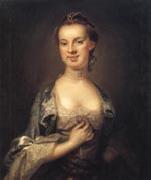 |
John Wollaston
|
|
English-born American Rococo Era Painter, active 1742-1775
|
|
|
|
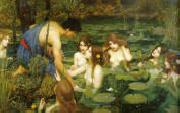 |
John William Waterhouse
|
|
English Pre-Raphaelite Painter, 1849-1917
English painter. His father was a minor English painter working in Rome. Waterhouse entered the Royal Academy Schools in London in 1870. He exhibited at the Society of British Artists from 1872 and at the Royal Academy from 1874. From 1877 to the 1880s he regularly travelled abroad, particularly to Italy. In the early 1870s he had produced a few uncharacteristic Orientalist keepsake paintings, but most of his works in this period are scenes from ancient history or classical genre subjects, similar to the work of Lawrence Alma-Tadema (e.g. Consulting the Oracle, c. 1882; London, Tate). However, Waterhouse consistently painted on a larger scale than Alma-Tadema. His brushwork is bolder, his sunlight casts harsher shadows and his history paintings are more dramatic.
|
|
|
|
 |
John William Inchbold
|
|
1830-1888
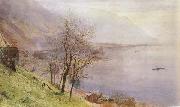
English painter. He spent his early years in Leeds, where his father was a newspaper proprietor, but came to London around 1846 to study lithography in the firm of Day & Haghe. His obituary in The Athenaeum records that he went on to study at the Royal Academy Schools, but his name does not appear in the registers. He exhibited watercolours at the Society of British Artists in 1849 and 1850 and at the Royal Academy in 1851. At this period his work has a fluidity and a freedom of handling that is closer to Richard Parkes Bonington than to the prevailing style of Victorian watercolours. Around 1852 he came under the influence of the Pre-Raphaelite movement and radically altered his style. His oil painting of the Chapel, Bolton (exh. RA 1853; Northampton, Cent. Mus. & A.G.) is a meticulously rendered view of the abbey ruins in the Pre-Raphaelite manner. This was followed the next year by At Bolton (Leeds, C.A.G.), another view of Bolton Abbey, this time with a deer prominent in the foreground. Both paintings illustrate lines from William Wordsworth's poem 'The White Doe of Ryleston'. Wordsworth was also the inspiration for the small painting Study in March
|
|
 |
John William Hill
|
|
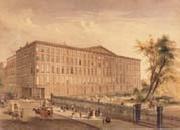
English Painter, 1812-1879,Painter and illustrator, son of John Hill. At the age of seven he moved to Philadelphia, PA, with his family. In 1822 he moved to New York, where he was apprenticed to his father for seven years. During this time, he worked on the aquatint plates for William Guy Wall's Hudson River Portfolio (1821-5), which influenced his early paintings.
|
|
 |
John William Godward
|
|
English
1861-1922
Godward was a Victorian Neo-classicist, and therefore a follower in theory of Frederic Leighton. However, he is more closely allied stylistically to Sir Lawrence Alma-Tadema, with whom he shared a penchant for the rendering of Classical architecture, in particular, static landscape features constructed from marble.
The vast majority of Godward's extant images feature women in Classical dress, posed against these landscape features, though there are some semi-nude and fully nude figures included in his oeuvre (a notable example being In The Tepidarium (1913), a title shared with a controversial Alma-Tadema painting of the same subject that resides in the Lady Lever Art Gallery). The titles reflect Godward's source of inspiration: Classical civilisation, most notably that of Ancient Rome (again a subject binding Godward closely to Alma-Tadema artistically), though Ancient Greece sometimes features, thus providing artistic ties, albeit of a more limited extent, with Leighton.
Given that Classical scholarship was more widespread among the potential audience for his paintings during his lifetime than in the present day, meticulous research of detail was important in order to attain a standing as an artist in this genre. Alma-Tadema was, as well as a painter, an archaeologist who attended historical sites and collected artefacts that were later used in his paintings: Godward, too, studied such details as architecture and dress, in order to ensure that his works bore the stamp of authenticity. In addition, Godward painstakingly and meticulously rendered those other important features in his paintings, animal skins (the paintings Noon Day Rest (1910) and A Cool Retreat (1910) contain superb examples of such rendition) and wild flowers (Nerissa (1906), illustrated above, and Summer Flowers (1903) are again excellent examples of this).
The appearance of beautiful women in studied poses in so many of Godward's canvases causes many newcomers to his works to categorise him mistakenly as being Pre-Raphaelite, particularly as his palette is often a vibrantly colourful one. However, the choice of subject matter (ancient civilisation versus, for example, Arthurian legend) is more properly that of the Victorian Neoclassicist: however, it is appropriate to comment that in common with numerous painters contemporary with him, Godward was a 'High Victorian Dreamer', producing beautiful images of a world which, it must be said, was idealised and romanticised, and which in the case of both Godward and Alma-Tadema came to be criticised as a world-view of 'Victorians in togas'.
|
|
 |
John William Edy
|
|
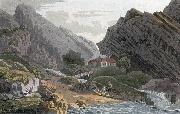
John William Edy (1760 - 1820) was an English painter. He worked for the publisher John Boydell in London, often anonymously. In the summer of 1800 Edy visited Norway on an assignment for Boydell together with the landscape painter William Fearnside. They were in Norway from July 31 and until the end of September the same year.
|
|
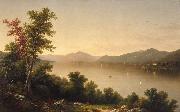 |
John William Casilear
|
|
(June 25, 1811 - August 17, 1893) was an American landscape artist belonging to the Hudson River School.
Casilear was born in New York City. His first professional training was under prominent New York engraver Peter Maverick in the 1820s, then with Asher Durand, himself an engraver at the time. Casilear and Durand became friends, and both worked as engravers in New York through the 1830s.
By the middle 1830s Durand had become interested in landscape painting through his friendship with Thomas Cole. Durand, in turn, drew Casilear's attention to painting. By 1840 Casilear's interest in art was sufficiently strong to accompany Durand, John Frederick Kensett, and artist Thomas P. Rossiter on a European trip during which they sketched scenes, visited art museums, and fostered their interest in painting.
Casilear gradually developed his talent in landscape art, painting in the style that was later to become known as the Hudson River School. By the middle 1850s he had entirely ceased his engraving career in favor of painting full-time. He was elected a full member of the National Academy of Design in 1851, having been an associate member since 1831, and exhibited his works there for over fifty years.
Casilear died in Saratoga Springs, New York in 1893.
|
|
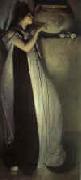 |
John White Alexander
|
|
1865-1915
John White Alexander Galleries
Alexander was born in Allegheny, Pennsylvania, now a part of Pittsburgh, Pennsylvania. Orphaned in infancy, he was reared by his grandparents and at the age of 12 became a telegraph boy in Pittsburgh. His talent at drawing attracted the attention of one of his employers, who assisted him to develop them. He moved to New York at the age of eighteen and worked in an office at Harper's Weekly, where he was an illustrator and political cartoonist at the same time that Abbey, Pennell, Pyle, and other celebrated illustrators labored there. After an apprenticeship of three years, he travelled to Munich for his first formal training. Owing to the lack of funds, he removed to the village of Polling, Bavaria, and worked with Frank Duveneck. They travelled to Venice, where he profited by the advice of Whistler, and then he continued his studies in Florence, the Netherlands, and Paris.
In 1881 he returned to New York and speedily achieved great success in portraiture, numbering among his sitters Oliver Wendell Holmes, John Burroughs, Walt Whitman, Henry G. Marquand, R. A. L. Stevenson, and president McCosh of Princeton University. His first exhibition in the Paris Salon of 1893 was a brilliant success and was followed by his immediate election to the Soci??t?? Nationale des Beaux Arts. Many additional honors were bestowed on him. In 1901 he was named Chevalier of the Legion of Honor, and in 1902 he became a member of the National Academy of Design. He was a member of the American Academy of Arts and Letters. Among the gold medals received by him were those of the Paris Exposition (1900) and the World's Fair at St. Louis (1904).
Many examples of his paintings are on display in museums and public places in the United States and in Europe, including the Metropolitan Museum of Art, the Brooklyn Art Museum, the Los Angeles County Museum of Art, the Museum of Fine Arts, Boston, the Butler Institute, and the Library of Congress in Washington D.C. In addition, in the entrance hall to the Art Museum of the Carnegie Institute in Pittsburgh, a series of Alexander's murals entitled "Apotheosis of Pittsburgh" (1905-1907) covers the walls of the three-storey atrium area.
Alexander was married to Elizabeth Alexander Alexander, to whom he was introduced in part because of their shared last name. Elizabeth was the daughter of James Waddell Alexander, President of the Equitable Life Assurance Society at the time of the Hyde Ball scandal. The Alexanders had one child, the mathematician James Waddell Alexander II.
Alexander's original and highly individual art is based upon a very personal interpretation of humanity. He died in New York.
|
|
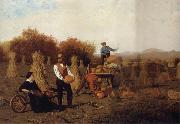 |
John Whetten Ehninger
|
|
American Painter, 1827-1889,American painter and illustrator. After graduating from Columbia College, New York, in 1847, he immediately departed for Europe to pursue artistic training. He visited Italy and France, but staying in Germany, specifically D?sseldorf, was his main objective. There he studied with Karl Friedrich Lessing, Carl Ferdinand Sohn and fellow American Emanuel Leutze, and in Paris he was instructed by Thomas Couture. During the early 1850s he travelled between America and Europe but finally settled in New York in 1853 until his move to Saratoga Springs after marrying in 1877. Ehninger exhibited regularly at the National Academy of Design, New York, where he was elected a full member in 1860.
|
|
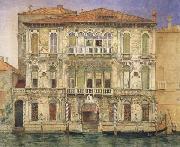 |
John wharlton bunney
|
|
1828-1882
was an English topographical and landscape artist of the nineteenth century. His father was a merchant captain whom Bunney, as a boy, accompanied on several voyages around the world. Bunney demonstrated a strong talent for drawing and draftsmanship from an early age. The young Bunney became a follower of John Ruskin; he studied with Ruskin at the Working Men's College soon after its founding in 1854, and later worked as a clerk for Smith, Elder & Co., Ruskin's publisher. Bunney was able to give up his clerical job and make his living by his art and art teaching by 1859; Ruskin commissioned him to execute a series of drawings in Italy and Switzerland.Bunney married Elizabeth Fallon in 1863. The couple settled in Florence; they would have four children. Bunney worked for Ruskin's St. George's Company (later the Guild of St George) in northern Italy for the remainder of his life. In his career there, Bunney produced a noteworthy pictorial record of Italy in his era. Ruskin said that Bunney's work was "so faithful and careful as almost to enable the spectator to imagine himself on the spot." Bunney was a friend of many of the Pre-Raphaelites, especially William Holman Hunt. From 1870 on, Bunney lived and painted in Venice. In 1876 Ruskin commissioned Bunney to paint a picture that included the entire western facade of St. Mark's Basilica
|
|
 |
John Wesley Jarvis
|
|
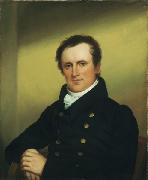
(1781 - January 14, 1839), American painter, nephew of Methodist leader John Wesley, was born at South Shields, England, and was taken to the United States at the age of five.
He was one of the earliest American painters to give serious attention to the study of anatomy. He lived at first in Philadelphia, afterwards establishing himself in New York City, where he enjoyed great popularity, though his conviviality and eccentric mode of life affected his work. He visited Baltimore, Charleston, and New Orleans, entertaining much and painting portraits of prominent people, particularly in New Orleans, where General Andrew Jackson was one of his sitters. He had for assistants at different times both Thomas Sully and Henry Inman. He affected singularity in dress and manners, and his mots were the talk of the day. But his work deteriorated, and he died in great poverty in New York City.
|
|
 |
John Webber
|
|
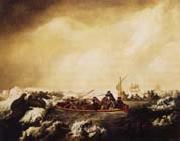
(1751-1793), Landscape painter, was an English artist best known for his images of early Alaska and Hawaii. Webber was born on October 6, 1751 in London, educated in Switzerland and studied painting at Paris[2]. Webber served as official artist on Captain James Cook??s third voyage of discovery around the Pacific (1776-1780) aboard HMS Resolution. At Adventure Bay in January 1777 he did drawings of "A Man of Van Diemen's Land" and "A Woman of Van Diemen's Land". He also did many drawings of scenes in New Zealand and the South Sea islands. On this voyage, during which Cook lost his life in a fight in Hawaii, Webber became the first European artist to make contact with Hawaii, then called the Sandwich Islands. He made numerous watercolor landscapes of the islands of Kauai and Hawaii, and also portrayed many of the Hawaiian people. Back in England in 1780 Webber exhibited around 50 works at Royal Academy exhibitions between 1784 and 1792, and was elected an associate of the Royal Academy in 1785 and R.A. in 1791. Most of his work were landscapes. Sometimes figures were included as in "A Party from H.M.S. Resolution shooting sea horses", which was shown at the academy in 1784, and his "The Death of Captain Cook" became well known through an engraving of it. Another version of this picture is in the William Dixson gallery at Sydney. Webber died in London in 1793.
|
|
|
|
|
|
|
|
 |
John Vanderlyn
|
|
1775-1852
John Vanderlyn (October 18, 1775 ?C September 23, 1852) was a American neoclassicist painter, was born at Kingston, New York.
He was employed by a print-seller in New York, and was first instructed in art by Archibald Robinson (1765-1835), a Scotsman who was afterwards one of the directors of the American Academy. He went to Philadelphia, where he spent time in the studio of Gilbert Stuart and copied some of Stuart's portraits, including one of Aaron Burr, who placed him under Gilbert Stuart as a pupil.
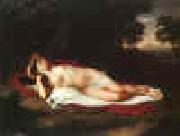
He was a proteg?? of Aaron Burr who in 1796 sent Vanderlyn to Paris, where he studied for five years. He returned to the United States in 1801 and lived in the home of Burr, then the Vice President, where he painted the well-known likeness of Burr and his daughter. In 1802 he painted two views of Niagara Falls, which were engraved and published in London in 1804. He returned to Paris in 1803, also visiting England in 1805, where he painted the Death of Miss McCrea for Joel Barlow. Vanderlyn then went to Rome, where he painted his picture of Marius amid the Ruins of Carthage, which was shown in Paris, and obtained the Napoleon gold medal there. This success caused him to remain in Paris for seven years, during which time he prospered greatly. In 1812 he showed a nude Ariadne (engraved by Durand, and now in the Pennsylvania Academy), which increased his fame. When Aaron Burr fled to Paris, Vanderlyn was for a time his only support.
Vanderlyn returned to the United States in 1815, and painted portraits of various eminent men, including Washington (for the U.S. House of Representatives), James Monroe, John C. Calhoun, Governor Joseph C. Yates, Governor George Clinton, Andrew Jackson, and Zachary Taylor. He also exhibited panoramas and had a "Rotunda" built in New York City which displayed panoramas of Paris, Athens, Mexico, Versailles (by himself), and some battle-pieces; but neither his portraits nor the panoramas brought him financial success, partly because he worked very slowly.
In 1842, through friendly influences, he was commissioned by Congress to paint The Landing of Columbus. Going to Paris, he hired a French artist, who, it is said, did most of the work. It was engraved for the United States five-dollar banknotes. He died in poverty at Kingston, New York, on 23 September 1852.
Vanderlyn was the first American to study in France instead of in England, and to acquire accurate draughtsmanship. He was more academic than his fellows; but, though faithfully and capably executed, his work was rather devoid of charm, according to the 1911 Encyclopaedia Britannica. His Landing of Columbus has been called (by Appleton's Cyclopedia) "hardly more than respectable."
His other works include portraits of Monroe, and Robert R Livingston (New York Historical Society).
|
|
 |
John Vanderbank
|
|
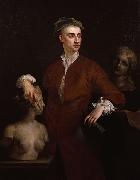
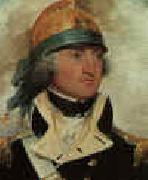
John Vanderbank (9 September 1694 - 23 December 1739) was an English portrait painter and book illustrator, who enjoyed a high reputation for a short while during the reign of King George I, but who died relatively young due to an intemperate and extravagant lifestyle.
Vanderbank was born in London, the eldest son of John Vanderbank Snr. His father was a Huguenot tapestry weaver, born in Paris, but who was forced to flee to Holland before coming to England where he became head of a Soho tapestry weaving factory.
Vanderbank studied under Sir Godfrey Kneller at James Thornhill's art academy in Great Queen Street from 1711 until 1720, when he joined with Louis Cheron to found his own academy in St. Martin's Lane. The venture proved a failure, and in 1729 he went to France to avoid his creditors. On his return he entered "the liberties of the Fleet" - mansion houses near Fleet prison, London, in which certain privileged prisoners could serve out their sentences in return for payment.
It was noted by George Vertue that "only intemperance prevented Vanderbank from being the greatest portraitist of his generation." He died of Tuberculosis in Holies Street, Cavendish Square, London, on 23 Dec. 1739, aged about 45, and was buried in Marylebone church.
|
|
 |
John Trumbull
|
|
1756-1843
John Trumbull Gallery
Trumbull was born in Lebanon, Connecticut, to Jonathan Trumbull, who was Governor of Connecticut from 1769 to 1784. He entered the 1771 junior class at Harvard University at age fifteen and graduated in 1773. Due to a childhood accident, Trumbull lost use of one eye, which may have influenced his detailed painting style.
As a soldier in the American Revolutionary War, Trumbull rendered a particular service at Boston by sketching plans of the British works, and witnessed the famous Battle of Bunker Hill. He was appointed second personal aide to General George Washington, and in June 1776 deputy adjutant-general to General Horatio Gates, but resigned from the army in 1777.
In 1780 he traveled to London where he studied under Benjamin West, who suggested to him that he paint small pictures of the War of Independence and miniature portraits, of which he produced about 250 in his lifetime.
On September 23, 1780 and October 2, 1780, British agent Major John Andr?? was, respectively, captured and hanged as a spy in America. News reached Europe, and as an officer of similar rank as Andr?? in the Continental Army, Trumbull was imprisoned for seven months in London's Tothill Fields Bridewell.
In 1784 he was again in London working under West, in whose studio he painted his Battle of Bunker Hill and Death of Montgomery, both of which are now in the Yale University Art Gallery.
In 1785 Trumbull went to Paris, where he made portrait sketches of French officers for The Surrender of Cornwallis, and began, with the assistance of Jefferson, Declaration of Independence, well-known from the engraving by Asher Brown Durand. This latter painting was purchased by the United States Congress along with his Surrender of General Burgoyne, Surrender at Yorktown, and Washington Resigning his Commission, and these paintings now hang in the United States Capitol. Trumbull's The Sortie Made by the Garrison of Gibraltar, 1789, owned by the Boston Athenaeum, is now in the Boston Museum of Fine Arts.
|
|
 |
John Thomson
|
|
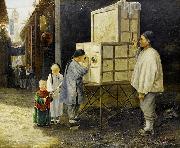
John Thomson (14 June 1837 - 29 September 1921) was a pioneering Scottish photographer, geographer and traveller. He was one of the first photographers to travel to the Far East, documenting the people, landscapes and artifacts of eastern cultures. Upon returning home, his work among the street people of London cemented his reputation, and is regarded as a classic instance of social documentary which laid the foundations for photojournalism. He went on to become a portrait photographer of High Society in Mayfair, gaining the Royal Warrant in 1881.
The son of William Thomson, a tobacco spinner and retail trader, and his wife Isabella, Thomson was born the eighth of nine children in Edinburgh in the year of Queen Victoria's accession. After his schooling in the early 1850s, he was apprenticed to a local optical and scientific instrument manufacturer, thought to be James Mackay Bryson. During this time, Thomson learned the principles of photography and completed his apprenticeship around 1858.
During this time he also undertook two years of evening classes at the Watt Institution and School of Arts (formerly the Edinburgh School of Arts, later to become Heriot-Watt University). He received the "Attestation of Proficiency" in Natural Philosophy in 1857 and in Junior Mathematics and Chemistry in 1858. In 1861 he became a member of the Royal Scottish Society of Arts, but by 1862 he had decided to travel to Singapore to join his older brother William, a watchmaker and photographer.
|
|
 |
John Thomas Serres
|
|
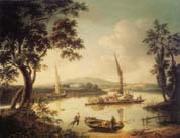
1759-1825 English painter, born in London in December 1759. He was the eldest son of Dominic (1722-93), a successful marine painter who was to be one of the founder members of the Royal Academy.Son of Dominic Serres. John Thomas Serres's colourful career began with landscape painting. He later travelled extensively, spending periods in Paris (1789), Rome and Naples (1790-91), before succeeding his father to the office of Marine Painter to George III in 1793. He worked promisingly as a painter (in both oils and watercolour) of sea-pieces in the European tradition, advanced in England by Phillipe Jacques de Loutherbourg. After becoming Marine Draughtsman to the Admiralty in 1800 he took on the less challenging employment of making drawings and elevations of the west coasts of France and Spain. This connection with the Navy was probably related to his appointment as drawing instructor at Chelsea Naval School, London.
|
|
 |
John Thomas Baines
|
|
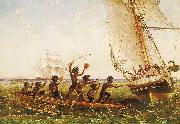
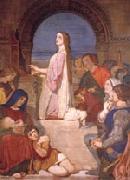
(John) Thomas Baines (27 November 1820 - 8 May 1875) was an English artist and explorer of British colonial southern Africa and Australia. Born in King's Lynn, Norfolk, Baines was apprenticed to a coach painter at an early age. When he was 22 he left England for South Africa aboard the "Olivia" (captained by a family friend William Roome) and worked for a while in Cape Town as a scenic and portrait artist, and as official war artist during the so-called Eighth Frontier War for the British Army.
|
|
 |
John Tenniel
|
|
English Golden Age Cartoonist and Illustrator.
(1820-1914)
English illustrator and painter. Impatient with the hierarchic structure of the curriculum at the Royal Academy schools in London, he left to follow a less formal education at the Clipstone Street Art Society's life and anatomy classes and in the British Museum's sculpture galleries and Print Room. His research into the history of costume and armour provided material for his early oils of chivalric scenes, which he exhibited at the Royal Academy (1837-42, 1851). Tenniel was among the artists commissioned to decorate the New Palace of Westminster, and he went in 1845 on a state-sponsored trip to Munich to study fresco technique. His contact with the school of Peter Cornelius while there confirmed his emphatic preference for a precisely drawn line.
|
|
 |
John sturgess
|
|
fl.1864-1903
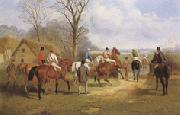
was a hunting and racing artist and lithographer who worked mainly for the Illustrated London News between 1875 and 1885, and also exhibited widely in the London galleries, in particular at the Royal Society of British Artists and also at the Royal Hibernian Society in Dublin. He was known for being an accomplished illustrator of books and magazines, but is probably best remembered for his portrait of Blair Athol, the winner of the Derby in 1864.
|
|
 |
John Steuart Curry
|
|
American Regionalist Painter,
b.1897 d.1946
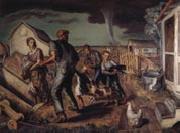
American painter and illustrator. As one of the 'Regionalist triumvirate', with Thomas Hart Benton and Grant Wood, he has been most often characterized as a faithful chronicler of rural life in Kansas. From 1916 to 1918 he was at the School of the Art Institute of Chicago. In 1919 he began study in the studio of Harvey Dunn (1884-1952) in Tenafly, NJ. After seven years as an illustrator in and around New York, he went to Paris in 1926 to study with the Russian Academician Vasily Shukhayev. Ironically, it was on Curry's return to the East Coast the following year that he began to earn his reputation as a Regionalist by painting memories of Kansas from his studio in the fashionable art colony of Westport, CT. Baptism in Kansas
|
|
 |
John Smibert
|
|
1688-1751
John Smibert Gallery
John Smybert (or Smibert) (1688 - 1751), Scottish American artist, was born in Edinburgh and died in Boston, Massachusetts.
He studied under Sir James Thornhill, and in 1728 accompanied Bishop Berkeley to America, with the intention of becoming professor of fine arts in the college which Berkeley was planning to found in Bermuda. The college, however, was never established, and Smybert settled in Boston, where he married in 1730.
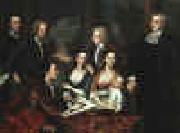
In 1731 he painted "Dean George Berkeley and His Family," also called "The Bermuda group", now in the Yale University Art Gallery, Yale University, a group of eight figures; it is maintained that the person furthest to the left is actually the artist himself. He painted portraits of Jonathan Edwards and Judge Edmund Quincy (in the Boston Art Museum), Mrs Smybert, Peter Faneuil and Governor John Endecott (in the Massachusetts Historical Society), John Lovell (Memorial Hall, Harvard University), and probably one of Sir William Pepperrell; and examples of his works are owned by Harvard and Yale Universities, by Bowdoin College, by the Massachusetts Historical Society, and by the New England Historical and Genealogical Society.
Portrait of Edmund Quincy, attributed to John Smybert
Plaque at Granary Burying Ground in Boston commemorating SmybertBetween 1740-42, he served as architect for the original Faneuil Hall, which he designed in the style of an English country market. The hall burned down in 1761 but was restored, and then in 1806 greatly expanded and modified by Charles Bulfinch.
His son Nathaniel was also a painter. Smybert lies in an unmarked grave in the Granary Burying Ground in Boston.
|
|
 |
John Smart
|
|
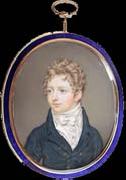
English Rococo Era Miniaturist, ca.1741-1811,English miniature painter, was born in Norfolk; he became a pupil of Cosway, and is frequently alluded to in his correspondence.
This artist was director and vice-president of the Incorporated Society of Artists, and exhibited with that society. He went to India in 1788 and obtained a number of commissions in that country. He settled down in London in 1797 and there died. He married Edith Vere, and is believed to have had only one son, who died in Madras in 1809.
He was a man of simple habits, and a member of the Society of Sandemanians. Many of his pencil drawings still exist in the possession of the descendants of a great friend of his only sister. Several of his miniatures are in Australia and belong to a cadet branch of the family.
His work is entirely different from that of Cosway, quiet and grey in its colouring, with the flesh tints elaborated with much subtlety and modelled in exquisite fashion. He possessed a great knowledge of anatomy, and his portraits are drawn with greater anatomical accuracy and possess more distinction than those of any miniature painter of his time.
|
|
 |
John sloan
|
|
American Ashcan School Painter, 1871-1951
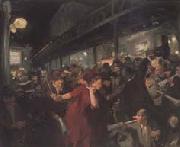
American painter and etcher, b. Lock Haven, Pa. He studied at the Pennsylvania Academy of the Fine Arts and worked for 12 years as an illustrator on the Philadelphia Inquirer and Philadelphia Press. In 1905 he went to New York City, where he worked as an illustrator. A member of the Eight, he was active in organizing the Society of Independent Artists and was its president from 1918. Long a popular teacher at the Art Students League of New York City, he was elected president in 1930. His scenes of city life and his nude studies are in leading museums throughout the United States. Characteristic are McSorley's Bar (Detroit Inst. of Arts); Renganeschi's, Saturday Night (Art Inst., Chicago); Wake of the Ferry (Phillips Memorial Gall., Washington, D.C.); and Nude with Nine Apples (Whitney Mus., New York City).
|
|
 |
John Skinner Prout
|
|
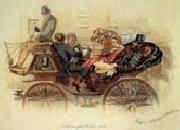
(1805-76), nephew of the famous English watercolourist Samuel Prout (1783-1852)
|
|
 |
John Singleton Copley
|
|
American Colonial Era Painter, 1738-1815
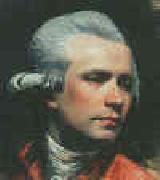
John Singleton Copley (1738[1] - 1815) was an American painter, born presumably in Boston, Massachusetts and a son of Richard and Mary Singleton Copley, both Irish. He is famous for his portrait paintings of important figures in colonial New England, depicting in particular middle-class subjects. His paintings were innovative in their tendency to depict artifacts relating to these individuals' lives.
|
|
 |
John Singer Sargent
|
|
1856-1925
John Singer Sargent Locations
John Singer Sargent (January 12, 1856 ?C April 14, 1925) was the most successful portrait painter of his era. During his career, he created roughly 900 oil paintings and more than 2,000 watercolors, as well as countless sketches and charcoal drawings. His oeuvre documents worldwide travel, from Venice to the Tyrol, Corfu, the Middle East, Montana, Maine, and Florida.
Before Sargent??s birth, his father FitzWilliam was an eye surgeon at the Wills Hospital in Philadelphia. After his older sister died at the age of two, his mother Mary (n??e Singer) suffered a mental collapse and the couple decided to go abroad to recover. They remained nomadic ex-patriates for the rest of their lives. Though based in Paris, Sargent??s parents moved regularly with the seasons to the sea and the mountain resorts in France, Germany, Italy, and Switzerland. While she was pregnant, they stopped in Florence, Italy because of a cholera epidemic, and there Sargent was born in 1856. A year later, his sister Mary was born. After her birth FitzWilliam reluctantly resigned his post in Philadelphia and accepted his wife??s entreaties to remain abroad. They lived modestly on a small inheritance and savings, living an isolated life with their children and generally avoiding society and other Americans except for friends in the art world. Four more children were born abroad of whom two lived past childhood.
Though his father was a patient teacher of basic subjects, young Sargent was a rambunctious child, more interested in outdoor activities than his studies. As his father wrote home, ??He is quite a close observer of animated nature.?? Contrary to his father, his mother was quite convinced that traveling around Europe, visiting museums and churches, would give young Sargent a satisfactory education. Several attempts to give him formal schooling failed, owning mostly to their itinerant life. She was a fine amateur artist and his father was a skilled medical illustrator. Early on, she gave him sketchbooks and encouraged drawing excursions. Young Sargent worked with care on his drawings, and he enthusiastically copied images from the Illustrated London News of ships and made detailed sketches of landscapes. FitzWilliam had hoped that his son??s interest in ships and the sea might lead him toward a naval career.
At thirteen, his mother reported that John ??sketches quite nicely, & has a remarkably quick and correct eye. If we could afford to give him really good lessons, he would soon be quite a little artist.?? At age thirteen, he received some watercolor lessons from Carl Welsch, a German landscape painter. Though his education was far from complete, Sargent grew up to be a highly literate and cosmopolitan young man, accomplished in art, music, and literature. He was fluent in French, Italian, and German. At seventeen, Sargent was described as ??willful, curious, determined and strong?? (after his mother) yet shy, generous, and modest (after his father). He was well-acquainted with many of the great masters from first hand observation, as he wrote in 1874, ??I have learned in Venice to admire Tintoretto immensely and to consider him perhaps second only to Michael Angelo and Titian.??
|
|
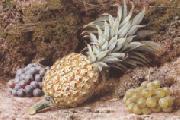 |
John Sherrin
|
|
1819-1896
Pencil and watercolour heightened with bodycolour
12x16in
30.5x40.6cm
|
|
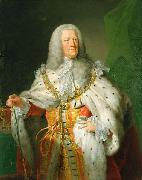 |
John Shackleton
|
|
was a British painter and draughtsman who produced history paintings and portraits. His parents and origins are unknown.
Shackleton painted several surviving portraits, for example of Henry Pelham (National Portrait Gallery), William Windham (1717 - 1761; now at Felbrigg Hall, Norfolk), and of John Bristowe, steward to the first duke of Newcastle (now in the Reitlinger Museum of Fine Art, Maidenhead).
From 1749 he was Principal Painter in Ordinary to George II and George III. He continued to be paid for portraits of the king and queen up even during 1765 - 6, when their official portraits were being done by Allan Ramsay. Several examples of his and his studio's output of royal portraits survive - one of George II dated 1755 is in the Scottish National Portrait Gallery, Edinburgh; another of George II in Room 2 of the British Museum, London (commissioned by the museum in 1759 - the Museum also holds engravings after his paintings), along with two more of George II in the Royal Collection and others in Fishmongers' Hall, London, and Maidenhead Museum.
|
|
 |
John Seymour Lucas
|
|
(21 December 1849 - 8 May 1923) was a Victorian English historical and portrait painter as well as an accomplished theatrical costume designer. He was born into an artistic London family, and originally trained as a woodcarver, but turned his attention to portrait painting and entered first the St. Martin's Lane Art School and later the Royal Academy Schools. Here he met his French wife, fellow artist Marie Cornelissen, whom he married in 1877. Lucase artistic education included extensive travels around Europe, particularly Holland and Spain, where he studied the Flemish and Spanish Masters. He first started exhibiting in 1872, was elected an associate member of the Royal Academy in 1876 and a full Royal Academician in 1898.
John Seymour Lucas was first and foremost a historical genre painter with a particular talent for realism in the depiction of costumes and interiors. Inspired by van Dyck and particularly Diego Velezquez, he excelled in depicting scenes from the English 16th to 18th century Tudor and Stuart periods, including in particular the Spanish Armada, Preparing for the Voyage, the English Civil War and the Jacobite rebellions.
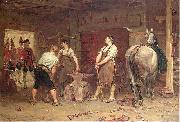
His first major work to achieve widespread public acclaim was Rebel Hunting after Culloden, executed in 1884. It was praised not only for the obvious tension between the muscular blacksmiths and the redcoated forces of law and order (or repression) but for the extraordinary realism in the depiction of the rough smithy and glowing horsehoe on the anvil. In 1885 his next major work whas "Preparing for the Voyage".
As his reputation grew, Lucas increasingly mixed in society circles, and became firm friends with the famous society portrait painter John Singer Sargent who was his almost exact contemporary. A portrait of Lucas executed by John Singer Sargent is displayed in Tate Britain. Towards the 1890s John Seymour Lucas executed a number of major works for prestigious public buildings or royal clients. These include: The Flight of the Five Members (Houses of Parliament), The Granting of the Charter of the City of London (Royal Exchange), Reception by HM King Edward VII of the Moorish Ambassador (Royal Collection), HRH the Prince of Wales in German Uniform (Royal Collection)
Apart from executing over 100 major oil paintings and a host of drawings, Lucas was renowned as a set and costume designer for the historical dramas popular on the late Victorian and early Edwardian stages. One of his more unusual commissions was the "Duke of Normandy" costume for the ill-fated prince Alfred of Saxe Coburg-Gotha for the Devonshire House Ball in 1897. Lucas was also a prolific watercolour painter and was elected a member of the Institute of Painters in Water Colours in 1877.
During most of his artistic career, John Seymour Lucas lived in a purpose-built studio in South Hampstead, London, designed for him by his friend and fellow artist, architect Sydney Williams-Lee.
He retired from painting towards the end of World War I, and moved to Blythburgh, Suffolk, where re-designed a house next to the church known as 'The Priory'. Lucas died in 1923 and is interred in Blythburgh church yard. His son, Sydney Seymour Lucas, was also an artist, and illustrator.
|
|
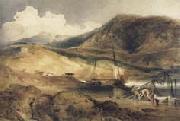 |
John sell cotman
|
|
English Romantic Painter, 1782-1842
English painter and etcher. Cotman was born in the parish of St Mary Coslany, Norwich, the son of Edmund Cotman, a hairdresser, later a haberdasher, and Ann Sell. In 1793 he entered Norwich Grammar School as a 'freeplacer'. In 1798 he moved to London, where he worked as an assistant to the publisher Rudolph Ackermann. Following in the footsteps of Turner and Thomas Girtin he joined Dr Monro's 'Academy' in 1799 and became a member of the sketching society that had developed around the personality and talent of Girtin.
|
|
 |
john scarlett davis
|
|
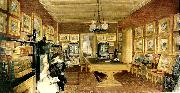
John Scarlett Davis (1 September 1804 - 29 September 1845), or Davies, was an English painter of the first half of the nineteenth century.
Davis was born in Leominster, the son of James Davis, a watchmaker; Scarlett was his mother's maiden name. At the age of eleven, Davis won an award from the local society for the encouragement of the arts. He was educated at the Royal Academy of Art School in London, and began exhibiting his works at the annual Royal Academy shows in 1825. He was influenced by the work of his contemporary, Richard Parkes Bonington.
Davis painted portraits, landscapes, and church interiors, and developed a distinctive specialty in painting the interiors of art galleries. His picture The Interior of the British Institution Gallery (1829) records a collection of Old Masters. His watercolor of the collection of Benjamin Godfrey Windus (1835) shows the Turner pictures on the walls. (John Ruskin studied those Turners while writing his Modern Painters.) Davis painted the interiors of the Louvre as well. Between 1842 and 1845 he was commissioned to draw copies of the paintings in the collections of the British royal palaces.
Davis painted scenes on the Continent during his travels there. He was in Florence in 1834, and Amsterdam in 1841. He painted the interior of the Uffizi Gallery.
Davis's later years were marred by alcoholism and spells of imprisonment. His posthumous reputation suffered as a result.
Davis's name is almost identical to that of John Scarlett-Davies, a modern video artist and director.
|
|
|
|
|
|
|
|
|
| Wholesale China Oil Painting Wholesale Oil Painting China Xiamen Portrait Reproduction on canvas Chinese Oil Painting Wholesale USA Oil Painting |
|
|
|
|
|