| |
|
Xiamen Oil Paintings, Wholesale Direct!
|
|
100% hand painted, 100% cotton canvas, 100% money back if not satisfaction. |
|
|
|
|
ART WORKS INDEX
A
B
C
D
E
F
G
H
I
J
K
L
M
N
O
P
Q
R
S
T
U
V
W
X
Y
Z
|
|
ARTISTS INDEX
A
B
C
D
E
F
G
H
I
J
K
L
M
N
O
P
Q
R
S
T
U
V
W
X
Y
Z
|
|
|
|
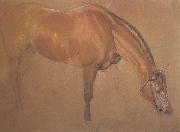 |
Sir edwin landseer,ra
|
|
1802-1873
Painter, draughtsman, sculptor and etcher, brother of (3) Charles Landseer. He became the best-known member of the family and was one of the most highly respected and popular British painters of the 19th century. He was first trained by his father, who taught him etching, and he then studied with Benjamin Robert Haydon and at the Royal Academy Schools in London. Precociously gifted, he drew competently from childhood and in 1813 he won the Silver Palette for draughtsmanship at the Society of Arts. In 1815 he exhibited at the Royal Academy for the first time, showing some drawings of a mule and of the heads of dogs. From an early age he was a frequent visitor to the menagerie in Exeter Change in the Strand, London, where he drew lions, monkeys and other animals.
|
|
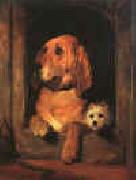 |
Sir Edwin Landseer
|
|
1803-1874
British
Sir Edwin Landseer Galleries
Landseer was something of a child prodigy whose artistic talents were recognized early on; he studied under several artists, including his father John Landseer, an engraver, and Benjamin Robert Haydon, the well-known and controversial history painter who encouraged the young Landseer to perform dissections in order to fully understand animal musculature and skeletal structure.
At the age of just 13, in 1815, Landseer exhibited works at the Royal Academy. He was elected an Associate of the Royal Academy at the age of 24, and an Academician of the Royal Academy five years later in 1831. He was knighted in 1850, and although elected President of the Royal Academy in 1866 he declined the invitation.
Landseer was a notable figure in 19th century British art, and his works can be found in Tate Britain, the Victoria and Albert Museum, Kenwood House and the Wallace Collection in London. He also collaborated with fellow painter Frederick Richard Lee.
Windsor Castle in Modern Times (1841-1845)
Queen Victoria and her family at Windsor Castle.Landseer's popularity in Victorian Britain was considerable. He was widely regarded as one of the foremost animal painters of his time, and reproductions of his works were commonly found in middle-class homes. Yet his appeal crossed class boundaries, for Landseer was quite popular with the British aristocracy as well, including Queen Victoria, who commissioned numerous portraits of her family (and pets) from the artist. Landseer was particularly associated with Scotland and the Scottish Highlands, which provided the subjects (both human and animal) for many of his important paintings, including his early successes The Hunting of Chevy Chase (1825-1826) and An Illicit Whiskey Still in the Highlands (1826-1829), and his more mature achievements such as the majestic stag study Monarch of the Glen (1851) and Rent Day in the Wilderness (1855-1868).
Saved (1856)
Landseer's paintings of dogs were highly popular among all classes of society.So popular and influential were Landseer's paintings of dogs in the service of humanity that the name Landseer came to be the official name for the variety of Newfoundland dog that, rather than being black or mostly black, features a mix of both black and white; it was this variety Landseer popularized in his paintings celebrating Newfoundlands as water rescue dogs, most notably Off to the Rescue (1827), A Distinguished Member of the Humane Society (1838), and Saved (1856), which combines Victorian constructions of childhood with the appealing idea of noble animals devoted to humankind ?? a devotion indicated, in Saved, by the fact the dog has rescued the child without any apparent human direction or intervention.
In his late 30s Landseer suffered what is now believed to be a substantial nervous breakdown, and for the rest of his life was troubled by recurring bouts of melancholy, hypchondria, and depression, often aggravated by alcohol and drug use (Ormond, Monarch 125). In the last few years of his life Landseer's mental stability was problematic, and at the request of his family he was declared insane in July 1872.
Landseer's death on 1 October 1873 was widely marked in England: shops and houses lowered their blinds, flags flew at half-staff, his bronze lions at the base of Nelson's column were hung with wreaths, and large crowds lined the streets to watch his funeral cortege pass (Ormond, Monarch 135). Landseer was buried in St Paul's Cathedral, London .
|
|
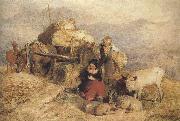 |
Sir edwin henry landseer,R.A.
|
|
1802-1873
Painter, draughtsman, sculptor and etcher, brother of (3) Charles Landseer. He became the best-known member of the family and was one of the most highly respected and popular British painters of the 19th century. He was first trained by his father, who taught him etching, and he then studied with Benjamin Robert Haydon and at the Royal Academy Schools in London. Precociously gifted, he drew competently from childhood and in 1813 he won the Silver Palette for draughtsmanship at the Society of Arts. In 1815 he exhibited at the Royal Academy for the first time, showing some drawings of a mule and of the heads of dogs. From an early age he was a frequent visitor to the menagerie in Exeter Change in the Strand, London,
|
|
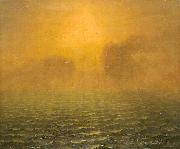 |
Simon Mathurin Lantara
|
|
(24 March 1729 - 22 December 1778) was a French landscape painter.
He was born at Oncy. His father was a weaver, and he himself began life as a herdboy; but, having attracted the notice of Gille de Reumont, a son of his master, he was placed under a painter at Versailles. Endowed with great facility and real talent, his powers found ready recognition; but he found the constraint of a regular life and the society of educated people unbearably tiresome; and as long as the proceeds of the last sale lasted he lived careless of the future in the company of obscure workmen. Rich amateurs more than once attracted him to their houses, only to find that in ease and high living Lantara could produce nothing. He died in Paris in 1778.
His works, now much prized, are not numerous; the Louvre has one landscape, Morning, signed and dated 1761. Émile Bernard, Joseph Vernet, and others are said to have added figures to his landscapes and sea-pieces. Engravings after Lantara will be found in the works of Lebas, Piquenot, Duret, Mouchy and others. In 1809 a comedy called Lantara, or the Painter in the Pothouse, was brought out at the Vaudeville with great success.
|
|
|
|
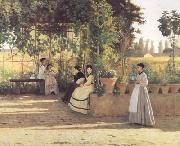 |
Silvestro lega
|
|
Italian Realist Painter, 1826-1895
Italian painter. From 1843 to 1847 he attended the Accademia di Belle Arti, Florence, studying drawing under Benedetto Servolini (1805-79) and Tommaso Gazzarini (1790-1853), then, briefly, painting under Giuseppe Bezzuoli. About 1847 he entered Luigi Mussini's school (see PURISMO), where the teaching emphasized the 15th-century Florentine principles of drawing and orderly construction. Then and for some years afterwards he continued to attend the Scuola del Nudo of the Accademia. After fighting in the military campaigns for Italian independence (1848-9) Lega resumed his training, this time under Antonio Ciseri, executing his first large-scale painting, Doubting Thomas (1850; Modigliana, Osp. Civ.). In 1852 he won the Concorso Trienniale dell'Accademia with David Placating Saul
|
|
|
|
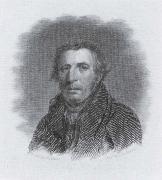 |
Samuel Lovett Waldo
|
|
American Painter, 1783-1861
American painter. After attending a country school and working on his father farm, he decided at the age of 16 to become an artist. He took lessons from Joseph Steward (1753-1822), a retired minister who operated a portrait studio in Hartford, CT. Waldo opened his own studio in Hartford in 1803, before moving on to paint portraits in Litchfield, CT, and Charleston, SC. In 1806, bearing letters of introduction to Benjamin West and John Singleton Copley, Waldo travelled to London, where he studied at the Royal Academy. His portrait of Mr M Dougle (untraced) was shown at the Royal Academy in 1808.
|
|
 |
Samuel Lancaster Gerry
|
|
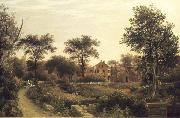
(1813-1891) was an artist in 19th-century Boston, Massachusetts. He painted portraits, and also landscapes of the White Mountains and other locales in New England. He was affiliated with the New England Art Union, and the Boston Artists' Association. In 1857 he co-founded the Boston Art Club.
Born in Boston, Gerry was self-taught as an artist. He showed works in many public settings, such as the 1841 exhibit of the Massachusetts Charitable Mechanic Association; and an 1879 exhibit of contemporary art at the Museum of Fine Arts, Boston. He attended the 1860 convention of the National Art Association in Washington, DC.
New England Homestead, 1839, by S.L. GerryStudents of Gerry included H. Frances Osborne, Samuel Green Wheeler Benjamin, Fannie Elliot Gifford, Charles Wesley Sanderson, and J. Frank Currier. With the exception of three years abroad, his professional life was passed chiefly in Boston
|
|
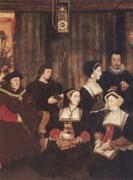 |
Rowland Lockey
|
|
English Baroque Era Painter, ca.1565-1616,was an English painter and goldsmith. The son of Leonard Lockey, a crossbow maker of the parish of St Bride's, Fleet Street, London, Lockey was apprenticed to Queen Elizabeth's miniaturist and goldsmith Nicholas Hilliard for eight years beginning Michaelmas 1581[1] and was made a freeman or master of the Worshipful Company of Goldsmiths by 1600. He worked mainly as a copyist of earlier portraits to make up sets of oil paintings for the fashionable long galleries of great houses, but signed or documented portrait miniatures on vellum and a signed title page engraving for the 1602 Bishops' Bible also survive.
|
|
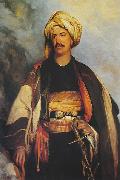 |
Robert Scott Lauder
|
|
Robert Scott Lauder (25 June 1803 - 21 April 1869) was a Scottish mid-Victorian artist who described himself as a "historical painter". He was one of the original members of the Royal Scottish Academy.
Lauder was born at Silvermills, Edinburgh, on 25 June 1803, the third son of John Lauder of Silvermills (died 1838), Burgess of Edinburgh and proprietor of the tannery at Silvermills, by his wife Helen Tait (d.1850). After attending the Royal High School he went to London, where his eldest brother William was engaged in the family business.
He returned to Edinburgh about 1826 and was elected one of the original members of the Royal Scottish Academy in 1830. On 9 September 1833 at St.Cuthberts in Edinburgh he married Isabella Ramsay Thomson and they then went abroad, accompanied by his younger artist-brother, James Eckford Lauder. Robert studied for some years in Rome, Florence, Bologna, Venice and Munich.
Lauder returned to London in 1838 where he lived for several years, where his three children - Isabella, John, and Robert, were baptised at St.Thomases Church, Southwark, in 1840, 1841, and 1844. Whilst in London he exhibited at the Royal Academy and competed in the Westminster Hall competition of 1847, sending his Christ walking on the Sea, which was subsequently purchased by Lady Angela Burdett-Coutts, 1st Baroness Burdett-Coutts. He became the first president of the short-lived National Institution of Fine Arts and also exhibited there.
He later removed back to Edinburgh in 1849 where both his sons - Robert Scott Lauder (born 1844), who became a physician, and John Thomson Lauder (1841-1865) - attended the Edinburgh Academy. Sir Walter Scott's novels provided him with subjects for many of his most successful historical paintings. About 1860 he suffered a paralytic stroke and did not practice after 1861. He died at Edinburgh from a bout of bronchitis on 21 April 1869, still paralysed. He is buried in Warriston Cemetery in Edinburgh.
|
|
|
|
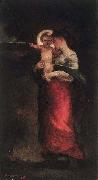 |
Robert Loftin Newman
|
|
(November 10, 1827 - March 31, 1912). was an American painter and stained-glass designer. He specialized in oil on canvas as his medium. He is sometimes associated with Albert Pinkham Ryder as a painter of mood. His works include Good Samaritan, painted in 1886, Flight into Egypt, Harvest Time, Sailboat Manned by Two Men, and The Bather.
He was born in Richmond, Virginia and moved to Clarksville, Tennessee when he was 11 years of age. Later, as a young adult, he studied art in New York, England, and France. Newman served briefly as an artillery lieutenant for the Confederate Army during the American Civil War. He died of asphyxiation from a gas leak from a stove on March 31, 1912.
|
|
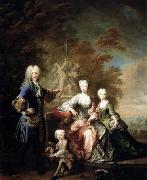 |
Robert Levrac Tournieres
|
|
Thomas William Robertson (9 January 1829 ?C 3 February 1871), usually known professionally as T. W. Robertson, was an Anglo-Irish dramatist and innovative stage director best known for a series of realistic or naturalistic plays produced in London in the 1860s that broke new ground and inspired playwrights such as W.S. Gilbert and George Bernard Shaw.
|
|
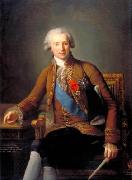 |
Robert Lefevre
|
|
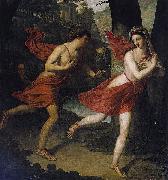
(24 September 1755, Bayeux - 3 October 1830, Paris) was a French painter of portraits, history paintings and religious paintings. He was heavily influenced by Jacques-Louis David and his style s reminiscent of the antique.
Robert Lefevre made his first drawings on the papers of a procureur to whom his father had apprenticed him. With his parents' consent, he abandoned this apprenticeship and walked from Caen to Paris to become a student of Jean-Baptiste Regnault (in whose studio he met and became friends with Charles Paul Landon). At the 1791 Paris Salon he exhibited his Dame en velours noir, the point of departure for his reputation. Lefevre made 1805 the portait empress Josephine. 1807 manufactured the counterpart of emperor Napoleon Louis-Andre-Gabriel Bouchet. Napoleon gave both paintings to the city Aachen 1807, where they are today in the city hall and decorate the entrance hall. His other portraits of Napoleon, Josephine, Madame Laetitia, Guerin, Carle Vernet (a portrait which is now at the Louvre) and pope Pius VII made him a fashionable portrait artist and one of the main portraitists of the imperial personalities, a reputation sealed by his portrait of Napoleon's new wife Marie Louise.
|
|
 |
Robert Lefere
|
|
Robert Jacques François Faust Lefevre (24 September 1755, Bayeux - 3 October 1830, Paris) was a French painter of portraits, history paintings and religious paintings. He was heavily influenced by Jacques-Louis David and his style s reminiscent of the antique.
Robert Lefevre made his first drawings on the papers of a procureur to whom his father had apprenticed him. With his parents' consent, he abandoned this apprenticeship and walked from Caen to Paris to become a student of Jean-Baptiste Regnault (in whose studio he met and became friends with Charles Paul Landon). At the 1791 Paris Salon he exhibited his Dame en velours noir, the point of departure for his reputation. Lefevre made 1805 the portrait empress Josephine. 1807 manufactured the counterpart of emperor Napoleon Louis-Andre-Gabriel Bouchet. Napoleon gave both paintings to the city Aachen 1807, where they are today in the city hall and decorate the entrance hall. His other portraits of Napoleon, Josephine, Madame Laetitia, Guerin, Carle Vernet (a portrait which is now at the Louvre) and pope Pius VII made him a fashionable portrait artist and one of the main portraitists of the imperial personalities, a reputation sealed by his portrait of Napoleon's new wife Marie Louise.
On the Bourbon Restoration Robert Lefevre painted a portrait of Louis XVIII for the Chambre des Pairs and received the cross of the Legion d'honneur and the title of First Painter to the King, losing the latter on the July Revolution. He painted a large number of portraits and history paintings. The main example of his portraits are those of Malherbe (Bibliotheque publique de Caen), Charles X, the duchesse deAngouleme, the duchesse de Berry, Charles-Pierre-François Augereau duc de Castiglione (Musee de Versailles), and of Dominique Vivant-Denon. Two of his mythological paintings - Love sharpening his arrows and Love disarmed by Venus (t. 1,84 sur 1,30 ), were engraved by Desnoyers - the latter is reproduced in le Nu Ancien et Moderne. His most notable history paintings are his Phocion getting ready to drink hemlock, Roger delivering Angelique, Heloïse and Abelard and a Crucifixion for the Mont Valerien. His last painting was The Apotheosis of Saint Louis for the Cathedral of La Rochelle.
|
|
|
|
|
|
 |
Pryanishnikov Illarion
|
|
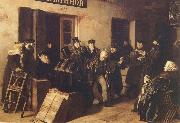
1840-1894,Russian painter. He studied from 1856 to 1866 at the School of Painting, Sculpture and Architecture in Moscow and subsequently taught there (1873-94). Among his pupils were Sergey Ivanov and Sergey Korovin. Pryanishnikov was among the fifteen founder-members of the Peredvizhniki (WANDERERS) and contributed two works to their first exhibition. His narrative pictures of the 1860s embodied the critical trend in early Russian Realism and focused on the trials and sorrows of the lower classes; his Jokers (1865; Moscow, Tret yakov Gal.) shows a petty clerk performing stunts for the amusement of some wealthy merchants. The Convoy of Empty Sleds (1871; Kharkiv, Mus. F.A.) conveys a fine sense of the bleak winter landscape. His later work added northern scenery and genre scenes to his repertory as in Saviour Day in the North (1887; Moscow, Tret yakov Gal.) and Return from the Fair (1883; St Petersburg, Rus. Mus.). Pryanishnikov is also known for his hunting scenes. In 1893 he became a member of the St Petersburg Academy of Arts.
|
|
|
|
|
|
|
|
 |
Pietro Longhi
|
|
1702-1785
Italian
Pietro Longhi Galleries
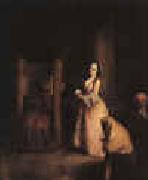
Pietro Longhi was born in Venice in the parish of Saint Maria, first child of the silversmith Alessandro Falca and his wife, Antonia. He adopted the Longhi last name when he began to paint. He was initially taught by the Veronese painter Antonio Balestra, who then recommended the young painter to apprentice with the Bolognese Giuseppe Maria Crespi, who was highly regarded in his day for both religious and genre painting. He was married in 1732 to Caterina Maria Rizzi.
Among his early paintings are some altarpieces and religious themes. In 1734, he completed frescoes in the walls and ceiling of the hall in Ca' Sagredo, representing the Death of the giants. Henceforward, his work would lead him to be viewed in the future as the Venetian William Hogarth, painting subjects and events of everyday life in Venice. The gallant interior scenes reflect the 18th century's turn towards the private and the bourgeois.
Many of his paintings show Venetians at play, such as the depiction of the crowd of genteel citizens awkwardly gawking at a freakish Indian rhinoceros (see image). This painting chronicles Clara the rhinoceros brought to Europe in 1741 by a Dutch sea captain and impresario from Leyden, Douvemont van der Meer. This rhinoceros was exhibited in Venice in 1751. There are two versions of this painting, nearly identical except for the unmasked portraits of two men in Ca' Rezzonico version. Ultimately, there may be a punning joke to the painting, since the young man on the left holds aloft the sawed off horn (metaphor for cuckoldry) of the animal. Perhaps this explains the difference between the unchaperoned women.
Other paintings chronicle the daily activities such as the gambling parlors (Riddoti) that proliferated in the 18th century. In some, the insecure or naive posture and circumstance, the puppet-like delicacy of the persons, seem to suggest a satirical perspective of the artists toward his subjects. Nearly half of the figures in his genre paintings are faceless, hidden behind Venetian Carnival masks. Like Crespi before him, Longhi was commissioned to paint seven canvases documenting the seven Catholic sacraments.
Longhi is well-known as a draughtsman, whose drawings were often done for their own sake, rather than as studies for paintings. Pietro's son, Alessandro, was also an accomplished painter.
A paraphrase of Bernard Berenson states that "Longhi painted for the Venetians passionate about painting, their daily lives, in all dailiness, domesticity, and quotidian mundane-ness. In the scenes regarding the hairdo and the apparel of the lady, we find the subject of gossip of the inopportune barber, chattering of the maid; in the school of dance, the amiable sound of violins. It is not tragic... but upholds a deep respect of customs, of great refinement, with an omnipresent good humor distinguishes the paintings of the Longhi from those of Hogarth, at times pitiless and loaded with omens of change".
|
|
 |
Pietro Antonio Lorenzoni
|
|
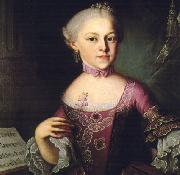
Pietro Antonio Lorenzoni (1721 - 1782) was an Italian painter who is believed to have painted several portraits of Wolfgang Amadeus Mozart and his family: "The Boy Mozart" (1763), his sister Maria Anna Mozart in "Nannerl as a Child" (1763) and a portrait of their father Leopold Mozart (c. 1765). He arrived in Salzburg, Austria in the 1740s and first wanted to paint Wolfgang and Nannerl. His protege, Johann Nepomuk della Croce, painted a Mozart family portrait in 1780.
|
|
|
|
|
|
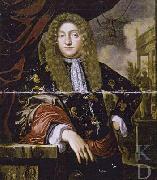 |
Pieter Leermans
|
|
Pieter Leermans (ca.1635, Leiden - 1706), was a Dutch Golden Age painter.
he was a portrait painter of historical allegories. He is also known as Lieremans
Little is known of his life, but he is considered to be one of the Leiden fijnschilders
|
|
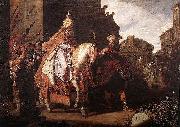 |
Pieter Lastman
|
|
(1583 - 4 April 1633 (buried)) was a Dutch painter . Lastman is considered important because of his work as a painter of history pieces and because his pupils included Rembrandt and Jan Lievens. In his paintings Lastman paid a lot of attention to the faces, hands and feet.
Pieter Lastman was born in Amsterdam, the son of a town-beadle, who was dismissed in 1578 for being a Catholic. His mother was an appraiser of paintings and goods. His apprenticeship was with Gerrit Sweelinck, the brother of Jan Pieterszoon Sweelinck. Between approximately 1604 and 1607 Lastman was in Italy, where he was influenced by Caravaggio (as were the painters of the Utrecht School a few years later) and by Adam Elsheimer. Back in Amsterdam he moved in with his mother in the Sint Antoniesbreestraat, living next to mayor Geurt van Beuningen. Lastman never married although he promised to marry the sister of Gerbrand Adriaensz Bredero. Because of his health Lastman moved in with his brother in 1632. He died the next year and was buried in the Oude Kerk.
|
|
 |
Pierre-Nicolas Legrand
|
|
(Pont-l'Éveque, 1758 - Bern, 1829) was a French painter.
Pupil of Descamps at the ole des Beaux-Arts de Rouen, along with Beljambe and Lequeu, Legrand won a second extraordinary prize in drawing, aged only 15. In 1782, he went to the ole des Beaux-Arts de Paris.
Circa 1794, Legrand de Serant departed for Bern, where he produced a variety of drawings for local notabilities and illustrated a novel by Isabelle de Charriere.
Legrand de Serant was a member of the Academie de Lille.
|
|
|
|
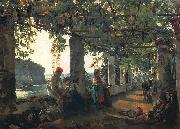 |
Pier Leone Ghezzi
|
|
(Rome, 28 June 1674 - Rome, 6 March 1755) was an Italian Rococo painter and caricaturist active in Rome.
Caricature of composer Antonio Vivaldi by Pier Leone GhezziGhezzi was born in Rome. His father, Giuseppe Ghezzi, (1634-1721), also trained Antonio Amorosi, and was a secretary to the Roman Accademia di San Luca. Pier Leone himself joined the Academy in 1705 and he executed a painting, the Allegory of Gratitude, to be donated to the institution, as was customary.
He was the godson of Carlo Maratta. Pier Leone is known for his frescoes in the Villa Falconieri of Frascati.
His pen and gouache caricatures are much freer in emotion than his state portraiture, and often depict named individuals or professions in satirical fashion.
|
|
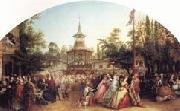 |
Phoebus Levin
|
|
fl. 1836-1878 was born in Berlin but exhibited in London from 1855-1878
|
|
|
|
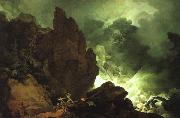 |
Philip James de Loutherbourg
|
|
1740-1812
French (Resident in UK)
Philip James de Loutherbourg Gallery
Philip James de Loutherbourg, also seen as Philippe-Jacques and Philipp Jakob and with the appellation the Younger (31 October 1740 ?C 11 March 1812) was an English artist of French origin.
He was born in Strasbourg, where his father, the representative of a Polish family, practised miniature painting; but he spent the greater part of his life in London, where he was naturalized, and exerted a considerable influence on the scenery of the English stage, as well as on the artists of the following generation. De Loutherbourg was intended for the Lutheran ministry, and was educated at the University of Strasbourg.
As the calling, however, was foreign to his nature, he insisted on being a painter, and placed himself under Charles-Andr?? van Loo in Paris. The result was an immediate and precocious development of his powers, and he became a figure in the fashionable society of that day. In 1767 he was elected into the French Academy below the age required by the law of the institution, and painted landscapes, sea storms, battles, all of which had a celebrity above those of the specialists then working in Paris. His debut was made by the exhibition of twelve pictures, including Storm at Sunset, Night, Morning after Rain.
He is next found travelling in Switzerland, Germany and Italy, distinguishing himself as much by mechanical inventions as by painting. One of these, showing quite new effects produced in a model theatre, was the wonder of the day. The exhibition of lights behind canvas representing the moon and stars, the illusory appearance of running water produced by clear blue sheets of metal and gauze, with loose threads of silver, and so on, were his devices. In 1771 he came to London, and was employed by David Garrick, who offered him £500 a year to apply his inventions to Drury Lane, and to superintend the scene-painting, which he did with complete success, making a new era in the adjuncts of the stage. Garrick's own piece, the Christmas Tale, and the pantomime, 1781-1782, introduced the novelties to the public, and the delight not only of the masses, but of Reynolds and the artists, was unbounded. The green trees gradually became russet, the moon rose and lit the edges of passing clouds, and all the world was captivated by effects we now take little notice of. A still greater triumph awaited him on his opening an entertainment called the Eidophusikon, which showed the rise, progress and result of a storm at sea that which destroyed the great Indiaman, the Halsewell,and the Fallen Angels raising the Palace of Pandemonium. De Loutherbourg has been called the inventor of the panorama, but this honor does not belong to him, although it first appeared about the same time as the eidophusicon. The first panorama was painted and exhibited by Scottish painter Robert Barker.
|
|
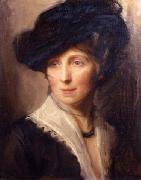 |
Philip de Laszlo
|
|
MVO (born 30 April 1869, Budapest - died 22 November 1937, London) was a Hungarian painter known particularly for his portraits of royal and aristocratic personages.
Leszle was born in Budapest as Laub Felöp Elek (Hungarian style with the surname first), the eldest son of a Jewish tailor. The family changed its name to Leszle in 1891. He apprenticed at an early age to a photographer while studying art, eventually earning a place at the National Academy of Art, where he studied under Bertalan Szekely and Keroly Lotz. He followed this with studies in Munich and Paris. Leszle's portrait of Pope Leo XIII earned him a Grand Gold Medal at the Paris International Exhibition in 1900. In 1903 Leszle moved from Budapest to Vienna. In 1907 he moved to England and remained based in London for the remainder of his life, although traveling the world to fulfill commissions.
|
|
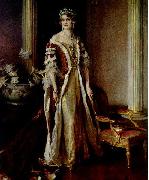 |
Philip Alexius de Laszlo
|
|
Philip Alexius de Laszlo, MVO (30 April 1869 Budapest - 22 November 1937 London) was a Hungarian painter known particularly for his portraits of royal and aristocratic personages.
Laszlo was born in Budapest as Laub Fulop Elek (Hungarian style with the surname first), the eldest son of a Jewish tailor. The family changed its name to Laszlo in 1891.
As a young man, Laszlo apprenticed to a photographer while studying art, eventually earning a place at the National Academy of Art, where he studied under Bertalan Szekely and Karoly Lotz. He followed this with studies in Munich and Paris. Laszlo's portrait of Pope Leo XIII earned him a Grand Gold Medal at the Paris International Exhibition in 1900.
In 1903 Laszlo moved from Budapest to Vienna. In 1907 he moved to England. He remained based in London for the rest of his life while traveling the world to fulfill commissions.
Laszlo's patrons awarded him numerous honors and medals. In 1909 he was named an honorary Member of the Royal Victorian Order by King Edward VII of the United Kingdom. In 1912 he was ennobled by King Franz Joseph of Hungary; his surname became "Laszlo de Lombos". The family later shortened the name to "de Laszlo".
Laszlo became a British citizen in 1914 but was interned for over twelve months in 1917 and 1918 during the First World War.
|
|
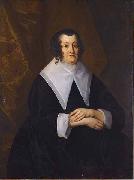 |
Petere Lely
|
|
painted Julia Fasey, Lady Crewe in 17th century
|
|
|
|
 |
Percy Lindsay
|
|
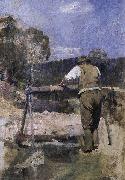
Percival (Percy) Charles Lindsay (1870 - 1952) was an Australian landscape painter, illustrator and cartoonist, born in Creswick, Victoria. Percy was the first child born to Jane Lindsay (nee Williams) and Dr Robert Charles Lindsay. His siblings included the well known artists: Sir Lionel Lindsay, Norman Lindsay, Ruby Lindsay and Sir Daryl Lindsay.
Percy first began painting while at school and further developed his skills during the late 1880s. Tuition from Fred Sheldon and Walter Withers saw him develop his painting skills to a professional level.
Percy moved to Melbourne in the 1890s and worked as an illustrator and cartoonist. During his time in Melbourne Percy was at the centre of the cities bohemian art community. In 1918 he moved with his wife and child to Sydney where he continued to paint landscapes while working as a cartoonist on the Bulletin magazine.
|
|
|
|
|
|
|
|
 |
Pasternak, Leonid
|
|
Russian, 1862-1945
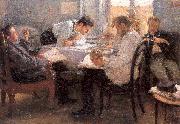
Russian painter of Ukrainian birth. From 1881 to 1883 Pasternak studied painting privately with Professor Yevgraf Semyonovich Sorokin (1821-92), while working towards a degree in medicine. Switching to law, he also spent several terms studying drawing at the Akademie in Munich between 1883 and 1885. He had his first success in 1889 when his large genre painting in oil, News from Home (1.10*1.52 m, 1888; Moscow, Tret'yakov Gal.), was bought by the influential collector Pavel Tret'yakov. The painting reflects the influence of his German teachers in the sombre tones and the emphasis on the realism of the figures and setting. In 1889 he settled in Moscow and established his own art school.
|
|
|
|
|
|
|
|
 |
Ottavio Leoni
|
|
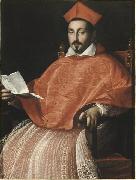
Ottavio Leoni (1578 - 1630) was an Italian painter and printmaker of the early-Baroque, active mainly in Rome.
He was born in Rome, where he first trained with his father, Lodovico Leoni. He painted altarpieces for churches in Rome such as an Annunciation for Sant'Eustachio and a Virgin and child with St. Giacinto for Santa Maria della Minerva, and a Saints Charles, Francis, & Nicholas for Sante Urbano. He became a member, and later president, of the Accademia di San Luca and a Cavalieri of the Order of Christ, on which occasion he presented the church of the Academy the Martyrdom of St. Martina. He died in Rome. Ottavio Leoni was also the engraver of a set of portraits of painters. His portrait of Michelangelo Merisi Caravaggio is the only documented portrait of the painter by another artist.
His work is exhibited in places such as Fine Arts Museums of San Francisco; Museum of Fine Arts, Boston; National Gallery of Art; Bowes Museum; Courtauld Institute of Art; Los Angeles County Museum of Art; and Palazzo Ruspoli, Rome, Italy.
|
|
|
|
|
|
 |
Orsi, Lelio
|
|
Italian, approx. 1508-87
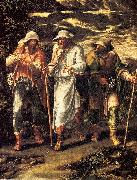
.Italian painter and draughtsman. A prominent Emilian artist of the mid-16th century, he was influenced by Correggio as well as by the late Mannerist style of Giulio Romano. His large-scale works seem to have been mainly secular decorations, notably illusionistic fa?ades, of which only fragments are extant. Their energy and expressiveness are apparent, however, in the surviving paintings of smaller dimensions. Orsi's sole documented architectural work is the Collegiata di S Stefano, Novellara
|
|
|
|
|
|
|
|
|
| Wholesale China Oil Painting Wholesale Oil Painting China Xiamen Portrait Reproduction on canvas Chinese Oil Painting Wholesale USA Oil Painting |
|
|
|
|
|