| |
|
Xiamen Oil Paintings, Wholesale Direct!
|
|
100% hand painted, 100% cotton canvas, 100% money back if not satisfaction. |
|
|
|
|
ART WORKS INDEX
A
B
C
D
E
F
G
H
I
J
K
L
M
N
O
P
Q
R
S
T
U
V
W
X
Y
Z
|
|
ARTISTS INDEX
A
B
C
D
E
F
G
H
I
J
K
L
M
N
O
P
Q
R
S
T
U
V
W
X
Y
Z
|
|
|
|
|
|
|
|
Multscher, Hans
|
|
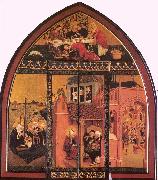
German Northern Renaissance Sculptor, ca.1400-1467
German sculptor. Multscher mentions his birthplace on the inscribed band, originally a predella, of the Karg altarpiece in Ulm Cathedral (1433) and on two wings of the so-called 'Wurzach Altar' (1437) at Reichenhofen in the Allgeu. The town archives of Leutkirch, written between 1405 and 1437, record that Multscher belonged to the 'Freien Leute auf Leutkircher Heide', a commune of free peasants who had been able to preserve their independence because they were the direct descendants of Kenigsfreie, who had always been free. Under a charter of Emperor Ludwig in 1337
|
|
|
|
|
|
|
|
|
|
|
|
|
|
|
|
|
|
|
|
|
|
|
|
|
|
 |
Mosler, Henry
|
|
American Painter, 1841-1920
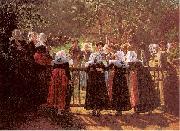
United States artist, was born in New York, the family removing to Cincinnati when he was about ten years old. Studying drawing by himself, he became a draughtsman for a comic paper, the Omnibus (Cincinnati), in 1855; in 1859-1861 he studied under James Henry Beard, and in 1862-63, during the Civil War, was an art correspondent of Harper's Weekly. In 1863 he went to Desseldorf, where for almost three years he was at the Royal Academy schools; he subsequently went to Paris, where he studied for a short time under Ernest Hebert. His "Le Retour," from the Paris Salon of 1879, was the first American picture ever bought for the Luxembourg. He received a silver medal in Paris 1889, and gold medals at Paris, 1888, and Vienna, 1893.
|
|
|
|
|
|
 |
Mose Bianchi
|
|
(Monza, 1840-1904) was an Italian painter.
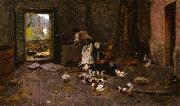
The family moved from Monza to Milan and Bianchi enrolled at the Brera Academy. Having interrupted his studies to serve in the second war of independence, he returned to attend the school of painting directed by Giuseppe Bertini. The award of a grant in 1867 enabled him to visit Venice and then Paris in 1869. He took part with some success at the Brera exhibitions and the Vienna Exhibition of 1873. It was in this period that he began to paint genre scenes in 18th-century settings and numerous portraits, soon becoming one of the artists most in demand with the Milanese middle classes. He returned to Venice in 1879 and visited Chioggia for the first time. Both places were to be featured also in later years in a series of intense views exhibited at exhibitions in Milan and Venice alongside genre scenes, views of Milan and landscapes of the countryside around Gignese.
|
|
|
|
 |
Morton Schamberg
|
|
American Painter and Architect ,
b.1881-d.1918
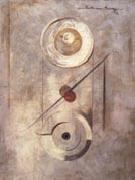
American painter and photographer. After training as an architect at the University of Pennsylvania, Philadelphia (A.B., 1903), he studied painting at the Pennsylvania Academy of the Fine Arts, also in Philadelphia, from 1903 to 1906 under William Merritt Chase, with whom he travelled to Europe. From 1907 to 1909 he lived mostly in Paris, where he saw the work of major avant-garde artists, including C?zanne, Picasso and Matisse, and benefited from contact with Leo Stein, an important collector and writer. By 1909 Schamberg had responded to the example of C?zanne's paintings, including simplified and more solid forms in his own work. Following his participation in the Armory Show in 1913, Cubism became the dominant element of his art, modified in such works as Figure B, Geometric Patterns
|
|
 |
Mortimer Menpes
|
|
British Painter, 1855-1939
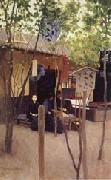
was a war artist and engraver, author, printmaker and illustrator. Menpes was born at Port Adelaide on 22 February 1855, the second son of property developer James Menpes, who with his wife, Ann, had settled in Australia in 1839. Educated at a private school, he attended classes at the Adelaide school of design, but his formal art training began at the South Kensington School of Art in 1878, after his family had moved back to England in 1875. Edward Poynter was a fellow student at the school. Menpes first exhibited at a Royal Academy exhibition in 1880. Over the following 20 years 35 of his paintings and etchings appeared at the Academy. He set off on a sketching tour of Brittany in 1880 and thereby met James McNeill Whistler, becoming his pupil and at one stage sharing a flat with him at Cheyne Walk on the Embankment in London. Here he was taught etching by Whistler, whose influence, together with that of Japanese design, is evident in his later work. His 1887 trip to Japan led to his first one-man exhibition at Dowdeswell's Gallery (1878-1912) in London. Menpes bought a property at 25 Cadogan Gardens in Sloane Square in 1888 and decorated it in the Japanese style. Whistler and Menpes quarreled in 1888 over the interior design of the house, which Whistler felt was a brazen copying of his own ideas. The house was sold in 1900, and Menpes retired to Kent. In 1900, after the outbreak of the Boer War, Menpes was sent to South Africa as a war artist for the weekly Black and White. With the war's end in 1902 he travelled widely, visiting Burma, Egypt, France, India, Italy, Japan, Kashmir, Mexico, Morocco, and Spain and producing illustrated books of those countries. His book on the Delhi Darbar of illustrated Curzon's grand spectacle of 1903. He married Rosa Mary Grosse in London in 1875. She too, was from Australia and died 23 August 1936. They produced a son, Mortimer James (b. 1879) and two daughters, Rose Maud Goodwin and Dorothy Whistler. Dorothy, Whistler's godchild, married a Mr. Flower and died in Minehead in July 1973 aged 89.
|
|
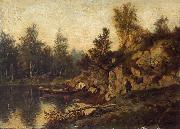 |
Morten Muller
|
|
(13 February 1828 - 10 February 1911) was a Norwegian landscape painter.
Morten Muller was born in Holmestrand, in Vestfold County, Norway. Morten Miller began his art studies with Adolph Tidemand and Hans Gude in Desseldorf, Germany from 1847 to 1848. From 1850 he was again a student at the Art Academy in Desseldorf, with Johann Wilhelm Schirmer as a teacher.
From 1850-51, Muller painted with the Swedish landscape painter Marcus Larson in Stockholm. From 1866 to 1873, Morten Muller lived in Oslo, where he taught together with Knud Bergslien, first at the art school operated by Johan Fredrik Eckersberg. Later he continued working with Knud Bergslien at the Bergslien school of Art. From 1875, when Muller returned to Desseldorf, where he lived the rest of his life. Among his landscape motifs are fjords and pine forests. He is represented with several works in the National Gallery of Norway.
In 1875, Morten Muller was appointed as a painter to the Swedish Royal Court. He was knighted into the Order of Vasa in 1869 and in 1874 became an honorary member of the Royal Swedish Academy of Arts in Stockholm.
|
|
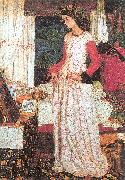 |
Morris, William
|
|
English Pre-Raphaelite Writer and Designer, 1834-1896
English designer, writer and activist. His importance as both a designer and propagandist for the arts cannot easily be overestimated, and his influence has continued to be felt throughout the 20th century. He was a committed Socialist whose aim was that, as in the Middle Ages, art should be for the people and by the people, a view expressed in several of his writings. After abandoning his training as an architect, he studied painting among members of the Pre-Raphaelites.
|
|
|
|
|
|
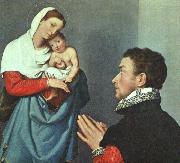 |
MORONI, Giovanni Battista
|
|
Italian Mannerist Painter, ca.1520-1578
.Italian painter. He was the most significant painter of the 16th-century school of Bergamo and is best known for his portraits, which feature a naturalistic rendering of both faces and costume and an objective approach to character.
|
|
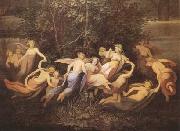 |
Moritz von Schwind
|
|
Austrian Romantic Painter, 1804-1871
Austrian painter and illustrator. He studied at the Akademie der Bildende K?nste in Vienna (1821-3), where he was influenced by the Biedermeier genre painter Peter Krafft and the Nazarene painter Ludwig Ferdinand Schnorr von Carolsfeld. He made copies after the Old Masters at the Belvedere in Vienna, exploring especially D?rer, Albrecht Altdorfer, Raphael and Titian, which completed his early, largely autodidactic experience of art. His friendship with Franz Schubert, the poet and playwright Franz Grillparzer and the painters Ferdinand and Friedrich Olivier, as well as the cultural environment of Biedermeier Vienna in his years there between 1823 and 1828, shaped his spiritual development as a painter. His love of music inspired his later 'symphonic' compositions and flowing linear rhythms. Extensive reading of the work of Romantic writers such as Achim von Arnim, Clemens von Brentano, Ludwig Tieck, Friedrich Heinrich von Hagen and the brothers Jacob and Wilhelm Grimm helped prepare his mature pictorial themes of fairytales, legends and sagas. He was unsuccessful as a painter and eked out a meagre livelihood by drawing naturalistic genre scenes for engravers, while occasionally selling a painting. Walk before the City Gate
|
|
 |
Moritz Kellerhoven
|
|
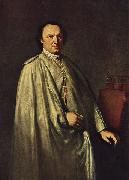
(1758-1830), sometimes referenced as Moritz Keller Hoven, was an Austrian painter and etcher.
Kellerhoven was born in Duchy of Berg, and spent some time studying art in Antwerp, Vienna, and Italy. He specialized in painting portraits, including many royal subjects. Kellerhoven died in Munich in 1830.
|
|
 |
Moritz Daniel Oppenheim
|
|
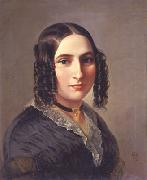
(January 7, 1800, Hanau, Germany - February 26, 1882, Frankfurt am Main) was a German painter who is often regarded as the first Jewish painter of the modern era. His work was informed by his cultural and religious roots at a time when many of his German Jewish contemporaries chose to convert. Oppenheim is considered by the scholar Ismar Schorsch to be in sympathy with the ideals of the Wissenschaft des Judentums movement, because he remained "fair to the present" without denying his past.
Oppenheim was born to Orthodox Jewish parents at Hanau, Germany in 1800; he died at Frankfurt am Main in 1882. His niece was the wife of student and fellow painter Benjamin Prins, Rosa Benari.
He received his first lessons in painting from Westermayer, in Hanau, and entered the Munich Academy of Arts at the age of seventeen. Later he visited Paris, where Jean-Baptiste Regnault became his teacher, and then went to Rome, where he studied with Bertel Thorwaldsen, Barthold Georg Niebuhr, and Friedrich Overbeck. There he studied the life of the Jewish ghetto and made sketches of the various phases of its domestic and religious life, in preparation for several large canvases which he painted upon his return to Germany. In 1825 he settled at Frankfurt, and shortly after exhibited his painting David Playing Before Saul, to see which a great number of admirers from all parts of Europe visited his studio. In 1832, at the instance of Goethe, Charles Frederick, Grand Duke of Saxe-Weimar-Eisenach conferred upon him the honorary title of professor.
|
|
 |
Morgenstern, Christian
|
|
German, 1805-1867
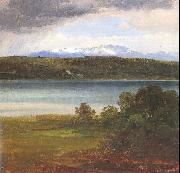
German painter. After training from 1824 with Siegfried Bendixen (1786-1864) in Hamburg, he studied at the Kunstakademi in Copenhagen in 1827 and made sketching trips to Sweden and Norway. He then settled permanently in Munich. He was influenced in particular by 17th-century Dutch painters, notably Jacob van Ruisdael, the Copenhagen plein-air painters, the emerging Norwegian landscape school and the early Realist painters working in Munich, such as Johann Georg von Dillis. Morgenstern explored objective, pure landscape painting with intimate motifs in such works as Beech-tree Trunks in Fredericksdal near Copenhagen (1828; Hamburg, Ksthalle). He also painted scenes combining closely rendered foreground details with extensive,
|
|
 |
Morgan, Evelyn De
|
|
English, 1855-1919
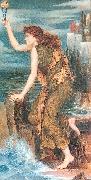
Painter, wife of William De Morgan. She was a pupil of her uncle, the painter Roddam Spencer Stanhope. In 1873-5 she attended the Slade School of Art, London. While there, she was awarded a Slade scholarship entitling her to financial assistance for three years. The scholarship required that she draw in charcoal from the nude, but she eventually declined it because she did not wish to continue working in this technique, although she excelled in it. She was influenced by the work of the Pre-Raphaelite artists and became a follower of Burne-Jones. In 1877 she first exhibited at the Grosvenor Gallery, London, and continued to show there thereafter. From 1875 she spent several winters in Florence working and studying; some of her work is reminiscent of Botticelli, possibly because of her visits to Florence. She often depicted women in unfamiliar ways though in a manner more in tune with a female perspective.
|
|
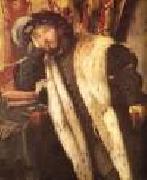 |
MORETTO da Brescia
|
|
Italian High Renaissance Painter, 1498-1554
Italian painter. Together with Romanino and Giovanni Girolamo Savoldo, he was one of the most distinguished painters of Brescia of the 16th century. Influenced by both Lombard verism and contemporary Venetian painters, Moretto created an individual style in which realism and Venetian light and colour were perfectly balanced. He was personally involved in the local movement of Roman Catholic reform, and this is reflected in his direct, solemn and often moving depictions of religious subjects.
|
|
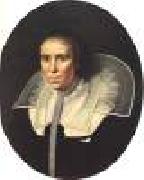 |
MOREELSE, Paulus
|
|
Dutch Baroque Era Painter, 1571-1638
Dutch painter, draughtsman, architect and urban planner. He was from a well-to-do family, which settled in Utrecht c. 1568. According to van Mander, Paulus studied with the Delft portrait painter Michiel van Mierevelt and was in Italy before 1596, the year he became an independent master in the saddlemakers' guild, to which Utrecht painters then belonged. On 8 June 1602 he married Antonia Wyntershoven, by whom he had at least ten children. The most famous of his many pupils was Dirck van Baburen, who studied with him in 1611, when the Utrecht artists set up their own Guild of St Luke. Moreelse was instrumental in this and became its first dean. In 1618, after a series of political disagreements, a number of citizens, including Moreelse and the painter Joachim Wtewael, petitioned the town council to resign. When that occurred, Moreelse became a member of the new council and continued to hold various public offices until his death. He was a strong supporter of plans to found a university in Utrecht and was closely involved in the preparations and in its opening in 1636
|
|
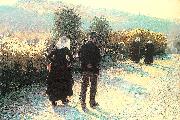 |
Morbelli, Angelo
|
|
Italian, 1853-1919
Italian painter. He received his first lessons in drawing in Alessandria, and in 1867 he travelled on a local study grant to Milan, where he was based for the rest of his life. He enrolled at the Accademia di Brera and from 1867 to 1876 studied drawing and painting there under Raffaele Casnedi and Giuseppe Bertini, whose influence is seen in both the subject-matter and technique of his early works. These include perspectival views, anecdotal genre scenes and history paintings. In the Dying Goethe (1880; Alessandria, Pin. Civ.) the theatrical setting, enriched by a sophisticated execution and a well-modulated use of colour, derives from the teaching of Casnedi and Bertini, while the historic-romantic quality of this painting also recalls the style of Francesco Hayez. In the years that followed, Morbelli began to concentrate more on themes such as labour and the life of the poor, influenced perhaps by Realist painters of the 1880s such as Achille D'Orsi, Francesco Paolo Michetti and Teofilo Patini. Morbelli's Return to the Stable
|
|
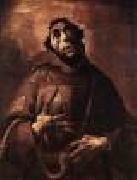 |
MORAZZONE
|
|
Italian Baroque Era Painter, 1573-1625
|
|
 |
Moran, Thomas
|
|
American Hudson River School Painter, 1837-1926
American painter and printmaker of English birth. His brothers Edward (1829-1901), John ( 1831-1902) and Peter (1841-1914) were also active as artists. His family emigrated from England and in 1844 settled in Philadelphia where Moran began his career as an illustrator. He was guided by his brother Edward, an associate of the marine painter James Hamilton, whose successful career afforded an example for Moran. Between the ages of 16 and 19 Moran was apprenticed to the Philadelphia wood-engraving firm Scattergood & Telfer; he then began to paint more seriously in watercolour and expanded his work as an illustrator. In the 1860s he produced lithographs of the landscapes around the Great Lakes. While in London in 1862 (the first of many trips to England), he was introduced to the work of J. M. W. Turner, which remained a vital influence on him throughout his career. Moran owned a set of the Liber studiorum and was particularly impressed by Turner's colour and sublime conception of landscape. With his wife, Mary Nimmo Moran (1842-99), an etcher and landscape painter, he participated in the Etching Revival, scraping fresh and romantic landscapes and reproductive etchings
|
|
 |
Moran, Edward
|
|
English-born American, 1829-1901
American painter of marine and historical subjects, b. England. He came to the United States with his family in 1844. In 1899 he completed a series of 13 paintings illustrating epochs in the maritime history of America from the landing of Leif Ericsson to the return of Admiral Dewey's fleet from the Philippines in 1899 (Pennsylvania Mus. of the Fine Arts, Philadelphia). His brother Thomas Moran, 1837?C1926, was an American landscape painter, illustrator, and etcher. He accompanied the exploring expeditions of Professor F. V. Hayden to the Yellowstone River (1871) and of Major J. W. Powell down the Colorado River (1873). Subsequently, he made the illustrations on wood for both expeditions' reports and the sketches from which he painted the two large canvases now in the Capitol at Washington, D.C., The Grand Canyon of the Yellowstone and Chasm of the Colorado. In 1884 he became a member of the National Academy of Design. As a painter Moran was strongly influenced by the art of Turner. Other examples of his painting are Bringing Home the Cattle (Buffalo, N.Y., Mus.); The Grand Canal, Venice; The Dream of the Orient; and Tower of Cortez, in Mexico, a watercolor. He also produced many etchings and magazine illustrations on wood.
|
|
 |
MORALES, Luis de
|
|
Spanish Mannerist Painter, ca.1520-1586
Spanish painter. The origins of his highly individual style are complex. His meticulous technique and the prominent echoes of the style and forms of Leonardo da Vinci and Raphael indicate the formative influence of Italianizing Flemish painters. This accords with Palomino's statement that Morales was trained in Seville by the Flemish Mannerist painter Peeter de Kempeneer (known in Spain as Pedro de Campara), who is recorded in Spain from 1537. It has been suggested that Morales visited Italy c. 1540, but this seems most unlikely.
|
|
|
|
|
|
|
|
 |
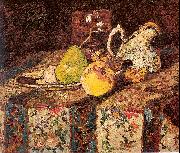
Moore, Albert Joseph
|
|
English Classicist Painter, 1841-1893
He showed precocious artistic talent as a child and entered the Royal Academy Schools in London in 1858. His early work shows a Pre-Raphaelite influence common to his generation. The watercolour Study of an Ash Trunk (1857; Oxford, Ashmolean) is very Ruskinian in its precise handling of naturalistic detail. Moore made two visits abroad: in 1859 to France with the architect William Eden Nesfield and in the winter of 1862-3 to Rome with his brother John Collingham Moore. Elijah's Sacrifice (1863; exh. RA 1865; Bury St Edmunds, A.G.), one of Moore's earliest large-scale oil paintings, was executed while he was in Rome. Its biblical subject and sombre tone are typical of his output in the early 1860s and relate to the work of Ford Madox Brown and Edward Armitage.
|
|
 |
Monticelli, Adolphe-Joseph
|
|
French, 1824-1886
French painter. In 1846, after studying at the Ecole d'Art in Marseille, Monticelli left Provence to study in Paris with Paul Delaroche. Although he had been trained to work in a Neo-classical style by his teachers in Marseille, in Paris he admired the Troubadour pictures of such artists as Pierre R?voil and Fleury Richard and the bold colours and rich surface impasto of Delacroix's oil sketches. He also copied many of the Old Masters in the Louvre. When he returned to Marseille in 1847 Emile Loubon (1809-63), newly appointed director of the Ecole de Dessin in Marseille and a friend of many realist landscape painters in Paris, encouraged him and another local painter, Paul Guigou
|
|
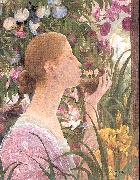 |
Montald, Constant
|
|
Belgian Painter, 1862-1944
Belgian painter, illustrator and teacher. He studied at the Koninklijke Academie of Ghent, and first made his mark by winning the Prix de Rome in 1886 with Diagorus Borne in Triumph. This success allowed him to travel throughout Europe and the Near East. In 1896 he took part in the first Salon d'Art Id?aliste, organized by Jean Delville, and exhibited there regularly. In the same year he became professor of decorative art at the Acad?mie Royale des Beaux-Arts in Brussels, a post he held for the next 37 years. He was a founder-member of L'Art Monumental in 1920
|
|
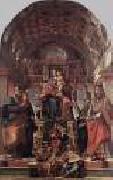 |
MONTAGNA, Bartolomeo
|
|
Italian Early Renaissance Painter, 1450-1523
Painter and draughtsman. Montagna is first documented in 1459 in Vicenza as a minor and, still a minor, in 1467. In 1469 he is recorded as a resident of Venice. In 1474 he was living in Vicenza where, in 1476 and 1478, he was commissioned to paint altarpieces (now lost). He has variously been considered a pupil of Andrea Mantegna (Vasari), Giovanni Bellini, Antonello da Messina, Alvise Vivarini, Domenico Morone and Vittore Carpaccio. While none of these artists, except Carpaccio, was irrelevant to Montagna's stylistic formation, scholars agree that Giovanni Bellini was the primary influence on his art. He may have worked in Bellini's shop around 1470. Several of Montagna's paintings of the Virgin and Child in which the influence of Antonello da Messina is especially marked (e.g. two in Belluno, Mus. Civ.; London, N.G., see Davies, no. 802) are likely to be close in date to Antonello's sojourn in Venice (1475-6); they are therefore best considered Montagna's earliest extant works (Gilbert, 1967) rather than as an unexplained parenthesis around 1485 between two Bellinesque phases (Puppi, 1962). These early paintings appear to be followed by others in which the geometrically rounded forms derived from Antonello become more slender and sharper-edged. Their figures are imbued with a deeply felt, individual humanity, sometimes austere and minatory, sometimes tender. Among them are some larger-scale works, for example the Virgin and Child Enthroned with SS Nicholas and Lucy (Philadelphia, PA, Mus. A.) and a Virgin and Child Enthroned with SS Ansanus, Anthony Abbot, Francis and Jerome
|
|
|
|
|
|
|
|
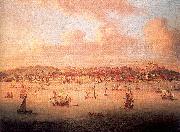 |
Monamy, Peter
|
|
English Painter, 1681-1749
English painter. It seems likely that his family origins and name were French. The Painter-Stainers' Company records that he was apprenticed as a house painter to William Clarke from 1696, but by 1710 he had become a marine artist, filling the gap in the market left by the death of Willem van de Velde the younger in 1707. Most of his subsequent career was devoted to careful imitations of van de Velde's style (and, in some cases, of particular pictures), by which, according to Vertue, 'he distinguished himself and came into reputation'. He maintained his links with the Painter-Stainers, of which he had been made a freeman in 1703
|
|
 |
MOMPER, Joos de
|
|
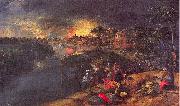
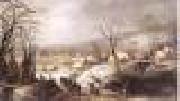
Flemish painter (b. 1564, Antwerpen, d. 1634/35, Antwerpen).
also known as Josse de Momper, is one of the most important Flemish landscape painters between Pieter Brueghel the Elder and Peter Paul Rubens. Brueghel's influence is clearly evident in this many of de Momper's paintings. Born in 1564 in Antwerp, Joos de Momper was first apprenticed to his father. In the 1580s, he travelled to Italy to study art. De Momper primarily painted landscapes, the genre for which he was well-regarded during his lifetime. He painted both fantasy landscapes, viewed from a high vantage point and employing a conventional Mannerist color transition of brown in the foreground to green and finally blue in the background, and more realistic landscapes with a lower viewpoint and more natural colors. His wide panoramas also feature groups of figures.
|
|
|
|
|
|
|
|
|
| Wholesale China Oil Painting Wholesale Oil Painting China Xiamen Portrait Reproduction on canvas Chinese Oil Painting Wholesale USA Oil Painting |
|
|
|
|
|