| |
|
Xiamen Oil Paintings, Wholesale Direct!
|
|
100% hand painted, 100% cotton canvas, 100% money back if not satisfaction. |
|
|
|
|
ART WORKS INDEX
A
B
C
D
E
F
G
H
I
J
K
L
M
N
O
P
Q
R
S
T
U
V
W
X
Y
Z
|
|
ARTISTS INDEX
A
B
C
D
E
F
G
H
I
J
K
L
M
N
O
P
Q
R
S
T
U
V
W
X
Y
Z
|
|
|
|
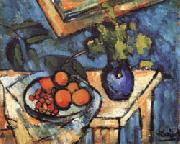 |
maurice de vlaminck
|
|
maurice de vlaminck,1876 to 1958,French painter, printmaker, draughtsman and writer. His nature, character, tastes and way of life were in perfect harmony with the freedom, daring and violence of his painting. He was brought up in a musical environment: his father, of Flemish origin, was a violin teacher and his mother, from Lorraine, was a piano teacher. He studied music himself to quite a high standard and later played the double-bass (and sometimes the bass drum, a source of considerable pleasure) in his regimental band. His family had come to live at Le V?sinet near Paris, and he spent his childhood both there and later at Chatou on the Seine. From 1892 he began to take an interest in painting, though he worked as a mechanic and became a racing cyclist.
|
|
|
|
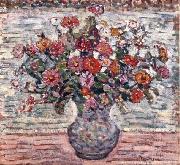 |
Maurice Brazil Prendergast
|
|
(October 10, 1858 - February 1, 1924) was a U.S. Post-Impressionist artist who worked in oil, watercolor, and monotype. Technically, he was a member of The Eight, but the delicacy of his compositions and mosaic-like beauty of his designs had little in common with the philosophy of the group.
Prendergast was born in St. John's, a city in Newfoundland, Canada. With the failure of his father's subarctic trading post, the family moved to Boston.
|
|
 |
Maurice Braun
|
|
1877-1941
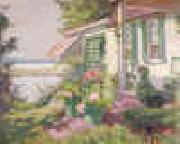
Maurice Braun (1877-1941) was an American artist who became known for wonderful Impressionist landscapes of southern California. He was born in Hungary on October 1, 1877, however by the age of four young Maurice and the Braun family had migrated to the United States and settled in New York City. His professional studies took him to the National Academy of Fine Arts where he studied the French tradition under Francis C. Jones, George W. Maynard and Edgar M. Ward. In 1901 Braun trained under the famous American painter William Merritt Chase (1849-1916). He established himself as a figure and portrait painter in New York City, but in 1909 he left for California where he was inspired and reveled in the new colors, forms, light and atmosphere of the region -- his paintings reflect a deep respect and appreciation for nature. Maurice Braun died in San Diego, California on November 7, 1941.
|
|
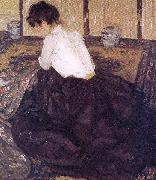 |
Maurer, Alfred Henry
|
|
American Painter, 1868-1932
American painter. He studied at the National Academy of Design, New York, in 1884 and briefly at the Acad?mie Julian, Paris, during 1897. He received critical success with academic paintings of single female figures in interiors and genre scenes of caf? society, which reflected the influence of the work of James Abbott McNeill Whistler and William Merritt Chase, for example At the Caf? (c. 1905; St Petersburg, Hermitage). His long residence in Paris from 1897, his participation in various independent salons and his association with Leo and Gertrude Stein led to his interest in avant-garde art. He may have been one of a group of Americans who studied briefly with Henri Matisse. By 1907 he was producing vigorously painted Fauvist landscapes, such as Landscape with Red Tree
|
|
|
|
 |
MAULBERTSCH, Franz Anton
|
|
Austrian Painter, 1724-1796
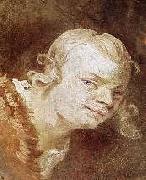
Austrian painter. His work as a painter of both oil paintings and frescoes on religious, mythological and occasionally worldly themes spanned the second half of the 18th century, adapting a Late Baroque training to the onset of Neo-classicism but remaining strikingly individual throughout. His fresco work, mostly still in situ in widespread central European locations, came at the end of an artistic tradition and was for long neglected, being far from major cultural centres; but it is now seen to establish him as one of the leading painters of his century
|
|
|
|
|
|
|
|
 |
mattsleiderstam
|
|
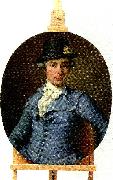
Adolf Ludvig Stierneld, född den 1 september 1755 i Stockholm död den 31 juli 1835 på Gripsholm, var en svensk friherre, politiker, hovman och samlare av historiska dokument, vilken av senare historisk forskning avslöjats som en av Sveriges mest förslagna och produktiva dokumentförfalskare.
Stierneld var son till Samuel Gustaf Stierneld, vilken var chef för Västmanlands regemente, och vilken lär ha antecknat sitt regemente bland den nyföddes faddrar. Sonen inskrevs även endast sex månader gammal som volontär i samma kår. Oaktat denna militärståtliga början hann sonen ej längre än till ryttmästare vid livregementet, vartill han utnämndes 1781.
Inom hovet anställdes Stierneld som kammarherre hos drottning Sofia Magdalena 1778. Han kom dock snart på mindre vänlig fot med Gustav III och tillhörde vid 1786 och 1789 års riksdagar ledarna för oppositionen inom adelsståndet. När kungen beredde sig att genomföra sina envåldsplaner, hörde Stierneld till de motståndare som arresterades. Till följd av sina förbindelser med ryske ministern hade han åsamkat sig konungens synnerliga ovilja, och när de övriga arresterade frigavs, sändes Stierneld till Varbergs fästning, där han kvarhölls till 1790.
Genom sitt 1790 ingångna giftermål med grevinnan Kristina Charlotta Gyldenstolpe, dotter till Gustav III:s gunstling Nils Philip Gyldenstolpe, kom Stierneld snart åter på mera vänlig fot med hovet och blev 1792 överkammarherre. Vid riksdagen 1800 sågs han också, i likhet med andra ur 1789 års opposition (Magnus Fredrik Brahe, Claes Axel Lewenhaupt med flera) i hovpartiets främsta led.
|
|
 |
Mattia Preti
|
|
1613-1699 Italian Mattia Preti Gallery
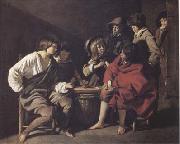
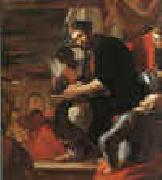
Born in the small town of Taverna in Calabria, Preti was sometimes called Il Cavalier Calabrese (the Knight of Calabria). His early apprenticeship is said to have been with the "Caravaggist" Giovanni Battista Caracciolo, which may account for his life-long interest in the style of Caravaggio.
Probably before 1630, Preti joined his brother Gregorio (also a painter), in Rome, where he became familiar with the techniques of Caravaggio and his school as well as with the work of Guercino, Rubens, Reni, Giovanni Lanfranco. In Rome, he painted fresco cycles in Sant'Andrea della Valle and San Carlo ai Catinari. Between 1644 and 1646, he may have spent time in Venice, but remained based in Rome until 1653, returning later in 1660-61. He painted frescoes for the church of San Biago at Modena (app. 1651-2) and participated in the fresco decoration of the Palazzo Pamphilj in Valmontone (documented 1660-61), where he worked along with Pier Francesco Mola, Gaspar Dughet, Francesco Cozza, Giovanni Battista Tassi (il Cortonese), and Guglielmo Cortese.
Jacob blessing his grandchildren, Ephraim and Manasseh, in the presence Joseph and their mother Asenath. Whitfield Fine Art Gallery, London.During most of 1653-1660, he worked in Naples, where he was influenced by the other major Neapolitan painter of his era, Luca Giordano. One of Preti's masterpieces were a series of large frescoes, ex-votos of the plague (which were painted on seven city gates but have since been lost to the ravages of time), depicting the Virgin or saints delivering people from the plague. Two sketches are in the Capodimonte Museum in Naples. The bozzetto of the Virgin with the baby Jesus looming over the dying and their burial parties envisions a Last Judgement presided over by a woman. Preti's salary for the work was 1500 ducats. Preti also won a commission to supervise the construction, carving, and gilding for the nave and transept of San Pietro a Maiella.
Having been made a Knight of Grace in the Order of St John, he visited the order??s headquarters in Malta in 1659 and spent most of the remainder of his life there. Preti transformed the interior of St. John's Co-Cathedral in Valletta, with a huge series of paintings on the life and martyrdom of St. John the Baptist (1661-1666). In Malta one also can find many paintings of Preti in private collections and in parish churches. His increased reputation led to an expanded circle of patrons, and he received commissions from all over Europe.
Preti was fortunate to enjoy a long career and have a considerable artistic output. His paintings, representative of the exuberant late Baroque style, are held by many great museums, including important collections in Naples, Valletta, and in his hometown of Taverna.
|
|
|
|
 |
Matthijs Maris
|
|
Dutch Painter, 1839-1917
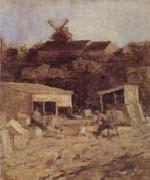
Brother of Jacob Maris. In 1851 he was apprenticed for one year to Isaac Elink Sterk (1808-71); from 1852 to 1855 he attended classes at the Academie in The Hague, and in 1854 he joined the studio of Louis Meijer, where his brother Jacob was also working. It was due to Meijer that in 1855 he was granted a monthly allowance by Queen Sophie to continue his training in Antwerp, where he moved in with Jacob. Through his studies at the Academie, Matthijs met the German painter Georg Laves, who introduced him to the work of the 19th-century German Romantic painters, in particular Ludwig Richter.
|
|
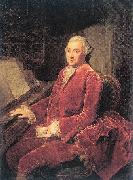 |
Matthieu, Georg David
|
|
German, 1737-1778
German painter and engraver. He received his training as a painter from his father, the Prussian court painter David Matthieu (1697-1755), and his stepmother and aunt, the painter Anna Rosina Lisiewska (1713/16-83). He apparently travelled outside Germany and is known to have gone to Stralsund with the painter Philipp Hackert in 1762. His portraits from this period, including one of Princess Charlotte of Mecklenburg-Strelitz, who married King George III of England,
|
|
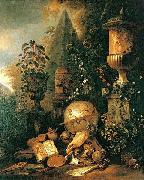 |
Matthias Withoos
|
|
(1627-1703), also known as Calzetta Bianca and Calzetti, was a Dutch painter of still lifes and city scenes, best-known for the details of insects, reptiles and undergrowth in the foreground of his pictures.
Withoos was born in Amersfoort. He studied under Jacob van Campen, at his painters' school just outside the city at his country house, and then with Otto Marseus van Schrieck. When he was 21, Withoos made a trip to Rome with Van Schrieck, and Willem van Aelst. There they joined the group of northern artists known as the "Bentvueghels" ("Birds of a feather"), and Withoos went by the alias "Calzetta Bianca" ("White Hose") a translation of his name into Italian. Withoos' work caught the eye of the cardinal Leopoldo de Medici, who commissioned various paintings from him.
In 1653, the artist returned to Amersfoort.When French troops occupied Amersfoort in the "Disastrous Year" of 1672, Withoos fled from Amersfoort to Hoorn, where he would remain until his death in 1703.
|
|
|
|
|
|
 |
Matthias Grunewald
|
|
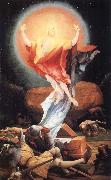
German Northern Renaissance Painter, ca.1470-1528,was an important German Renaissance painter of religious works, who ignored Renaissance classicism to continue the expressive and intense style of late medieval Central European art into the 16th century. Only ten paintings (several consisting of many panels) and thirty-five drawings survive, all religious, although many others were lost at sea in the Baltic on their way to Sweden as war booty. His reputation was obscured until the late nineteenth century, and many of his paintings were attributed to Albrecht D??rer, who is now seen as his stylistic antithesis. His largest and most famous work is the Isenheim Altarpiece in Colmar, Alsace (now in France). The details of his life are unusually unclear for a painter of his significance at this date, despite the fact that his commissions show that he had reasonable recognition in his own lifetime. His real name remains uncertain, but was definitely not Grunewald; this was a mistake by the 17th-century writer, Joachim von Sandrart, who confused him with another artist. He is documented as "Master Mathis" or "Mathis the Painter" (Mathis der Maler), and as using as surname both Gothart and Neithardt - this last may have been his surname, or more likely that of his wife. He was probably born in Wurzburg in the 1470s. It is possible he was a pupil of Hans Holbein the Elder. From about 1500 he seems to have lived at Seligenstadt, when not working elsewhere. His first dated painting is probably in Munich, dated 1503 on a much later note which apparently records an older inscription. From about 1510 to 1525 he served in the Rhineland as court painter,
|
|
 |
Matthias Grunewald
|
|
German
1475-1528
Matthias Grunewald Galleries
Only religious works are included in his small surviving corpus, the most famous being the Isenheim Altarpiece, completed 1515, now in the Musee d'Unterlinden, Colmar. Its nine images on twelve panels contain scenes of the Annunciation, Mary bathing Christ, Crucifixion, Entombment of Christ, Resurrection, Temptation of St. Anthony and saints. As was common in the preceding century, there are different views, depending on the arrangement of the wings; but the three views available here are exceptional. The third view discloses a carved and gilded wood altarpiece in the centre. As well as being by far his greatest surviving work, the altarpiece contains most of his surviving painting by area, being 2.65 metres high and over 5 metres wide at its fullest extent.
His other works are in Germany, except for a small Crucifixion in Washington and another in Basel, Switzerland. He was asked in about 1510 to paint four saints in grisaille for the outside of the wings of Durer's Heller Altarpiece in Frankfurt. D??rer's work was destroyed by fire and only survives in copies, but fortunately the wings have survived. There are also the late Tauberbischofsheim altarpiece in Karlsruhe, and the Establishment of the Santa Maria Maggiore in Rome (1517-1519), Freiburg, Augustinermuseum. A large panel of Saint Erasmus and Saint Maurice in Munich probably dates from 1521-24, and was apparently part of a larger altarpiece project, the rest of which has not survived. Other works are in Munich, Karlsruhe, and Rhineland churches. Altogether four somber and awe-filled Crucifixions survive. The visionary character of his work, with its expressive colour and line, is in stark contrast to Albrecht Durer's works. His paintings are known for their dramatic forms, vivid colors, and depiction of light.
|
|
|
|
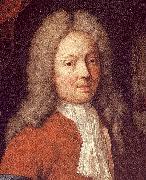
Matthew Ridley Corbet,ARA
|
|
1850-1902
was a Victorian neoclassical painter who attended classes at the Slade School of Art under Alexander Davis Cooper and later at the Royal Academy Schools under Frederic Leighton, President of the Academy. Corbet went to Italy in 1880 and met Giovanni Costa, one of Leighton's friends in Rome. For the next three years he stayed and painted with Costa, eventually becoming one of the leading figures of the Macchiaioli school. He concentrated on Italian landscapes and exhibited at the Grosvenor Gallery, the New Gallery, the Royal Academy and the Paris Salon.
|
|
|
|
|
|
 |
Mattheus Terwesten
|
|
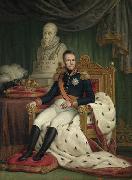
Mattheus Terwesten (1670-1757) was a Dutch painter of portraits, architectural, and historical themes. He was court painter to Frederick William I of Prussia and professor of the art academy in Berlin.
Mattheus Terwesten studied with his brother Augustinus Terwesten, Willem Doudyns, and Daniel Mijtens the Younger. In 1695 he traveled via Berlin to Rome, where he stayed until 1699. In Rome he became a member of the painters' circle known as the Bentvueghels, where he earned the nickname "Arend", or eagle. In 1710 he joined his older brother Augustinus and younger brother Ezaias, and when Augustinus died in 1711, he succeeded him as court painter in Berlin, while Ezaias went to Italy, where he married and settled permanently.
His pupils were Herman Diederik Cuipers, Pieter van Cuyck (I), Jan van Gool, Johan Graham, Hendrik van Hulst, Jacob van Nachenius, Andries Storck, and his two sons Augustinus (II) and Pieter Terwesten.
|
|
 |
Mattheus Ignatius van Bree
|
|
was a Belgian painter, sculptor and architect.
He was born at Antwerp in 1773, was instructed by Regemorter; he afterwards went to Paris, and after having obtained by a 'Cato in Utica' the second prize for Rome, he went to that city in 1797e returning to his native country in 1804.[1] He painted numerous historical pictures, some of which are of large dimensions, and obtained a high reputation in Flanders. His conceptions are frequently poetical, and his compositions graceful, delineated with a light, free, and spirited pencil ; but his colouring is rather too florid in some instances.
He was first professor at the Academy of Fine Arts at Antwerp, and in 1827 its director. Member of several other scientific institutions like the academies of Amsterdam, Rome, Munich and New York. Among his most important works are 'The Patriotism of the Burgomaster Van der Werft,' in the Town-Hall at Leyden, and 'The Death of Rubens,' in the Museum at Antwerp. He brought forward some of the most eminent of the later Flemish painters, among whom are Wappers, De Keyser, F. de Braekeleer, and others of whom their country is justly proud. Van Bree died at Antwerp in 1839.
|
|
 |
Matthaus Gunther
|
|
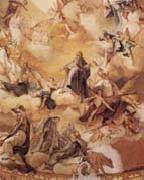
the most prolific fresco painter of the eight- eenth century in central Europe.
German, 1705-1788
He was an important German painter and artist of the Baroque and Rococo era. Gunther helped develop the rococo style of painting in Bavaria and Tyrol, working on over 40 churches. His known work includes about 70 frescoes and 25 panels. In particular, he was known for his life-like imagery and lively coloring. Gunther studied in Munich from 1723 to 1728 with Cosmas Damian Asam, the older of the two Asam brothers, and perfected his fresco painting in Augsburg. He frequently worked with some of the greatest artists of his time, including the architect Johann Michael Fischer and the plasterer Johann Michael Feuchtmayer and his brother Franz Xaver.
|
|
 |
Mattew Ridley Corbet,ARA
|
|
1850-1902
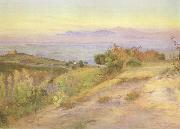
was a Victorian neoclassical painter who attended classes at the Slade School of Art under Alexander Davis Cooper and later at the Royal Academy Schools under Frederic Leighton, President of the Academy. Corbet went to Italy in 1880 and met Giovanni Costa, one of Leighton's friends in Rome. For the next three years he stayed and painted with Costa, eventually becoming one of the leading figures of the Macchiaioli school. He concentrated on Italian landscapes and exhibited at the Grosvenor Gallery, the New Gallery, the Royal Academy and the Paris Salon.
|
|
 |
Matteo Rosselli
|
|
Italian Baroque Era Painter, 1578-1650
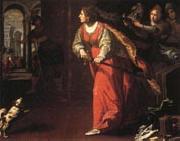
Italian painter. An influential artist of the early 17th century in Florence, he is described by the early sources as being of a gentle disposition and as a dedicated and dignified painter, although he lacked originality and power. His work is characterized by the simplicity, descriptive naturalism and refined colour of the Counter-Reformation art created by such Tuscan artists as Santi di Tito, Bernardino Poccetti, Lodovico Cigoli and Domenico Passignano, yet he was also responsive to Venetian and Emilian art. The son of Alfonso Rosselli and Elena Coppi, he received his early education in Gregorio Pagani's studio, which he attended from as early as 1587. His initial inclination was towards classical and balanced compositions, in which the influence of Andrea del Sarto, whose frescoes he copied in the Chiostro dello Scalzo, is clear. On 26 February 1599 he was admitted to the Accademia del Disegno and in 1605 went to be with Passignano in Rome for six months, greatly enriching his artistic experiences through this contact. He returned to Florence in the same year and, on Pagani's death (1605), completed his master's unfinished works with great success. Pagani's influence can be seen in the bright colours of Rosselli's Adoration of the Magi (1607; Montevarchi, Arezzo, S Andrea). To 1610 belong two monochrome paintings depicting Henry IV at Nantes and Henry IV at Gaudebec
|
|
|
|
|
|
|
|
|
|
|
|
 |
Mather Brown
|
|
American Painter, 1761-1831
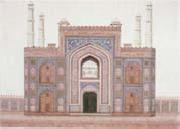
was a portrait and historical painter, born in Boston, Massachusetts but active in England. Brown was the son of Gawen and Elizabeth (Byles) Brown, and descended from the Rev. Increase Mather on his mother's side. He was taught by his aunt and around 1773 (age 12) became a pupil of Gilbert Stuart. He arrived in London in 1781 to further his training in Benjamin West's studio, entered the Royal Academy schools in 1782 with plans to be a miniature painter, and began to exhibit a year later. In 1784 he painted two religious paintings for the church of St Mary??s-in-the-Strand, which led Brown to found a partnership with the painter Daniel Orme for the commercialization of these and other works through exhibition and the sale of engravings. Among these were large paintings of scenes from English history, as well as scenes from Shakespeare's plays. However, despite their success he began to concentrate on portraiture. His first successes were with American sitters, among others his patron John Adams and family in 1784?C85; this painting is now in the Boston Athenaeum. In 1785?C86 he painted the first portrait of Thomas Jefferson, who was visiting London. He also painted Sir William Pepperrell. His 1788 full-length portrait of Prince Frederick Augustus in the uniform of Colonel of the Coldstream Guards led to appointment as History and Portrait Painter to the Prince, later the Duke of York and Albany. Other paintings include the Prince of Wales, later George IV (about 1789), Queen Charlotte, and Cornwallis. A self-portrait now belongs to the American Antiquarian Society, Worcester, Massachusetts. A falling off of patronage in the mid-1790s, and failure to be elected to the Royal Academy, led Brown to leave London in 1808 for Bath, Bristol, and Liverpool.
|
|
 |
Matevz Langus
|
|
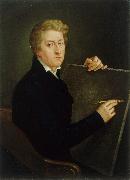
Matevž Langus, slovenski slikar in freskant, * 9. september 1792, Kamna Gorica pri Kropi, † 19. julij 1855, Ljubljana.
Rodil se je v fužinarskem kraju pod Jelovico v kovaški družini. Sprva je delal kot žebljar v domači vasi, nato pa se je šolal v Celovcu v delavnici Johanna Schreibersa, pri katerem je ostal šest let. Leta 1817 se je vrnil na Kranjsko in se naselil v Ljubljani. Kasneje bil po priporočilu profesorja Kavčiča sprejet na dunajsko akademijo, vendar je zaradi gmotnih težav opravil le dva letnika študija. Leta 1821 se je ponovno naselil v Ljubljani kot poklicni slikar. V letih 1824 do 1826 je živel v Rimu, kjer je bil vpisan na rimsko Francosko akademijo (L'Academie de France).
|
|
 |
Mateo cerezo
|
|
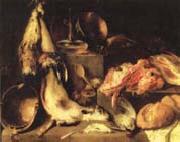
Spanish gifted painter and colorist , c.1626-1666
|
|
|
|
|
|
|
|
|
|
|
|
|
|
|
|
 |
Master of the Schotten Altarpiece
|
|
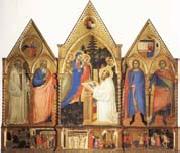
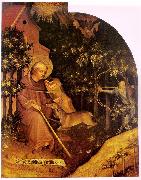
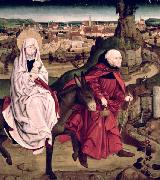
was a German painter, active in Nuremberg during the 14th and 15th centuries. His name is derived from an altarpiece dated to about 1390, which once stood in the church of St. Mary in Schotten. The altarpiece was dismantled in 1828.
|
|
|
|
|
|
|
|
|
|
|
|
|
|
|
|
|
|
|
|
|
| Wholesale China Oil Painting Wholesale Oil Painting China Xiamen Portrait Reproduction on canvas Chinese Oil Painting Wholesale USA Oil Painting |
|
|
|
|
|