| |
|
Xiamen Oil Paintings, Wholesale Direct!
|
|
100% hand painted, 100% cotton canvas, 100% money back if not satisfaction. |
|
|
|
|
ART WORKS INDEX
A
B
C
D
E
F
G
H
I
J
K
L
M
N
O
P
Q
R
S
T
U
V
W
X
Y
Z
|
|
ARTISTS INDEX
A
B
C
D
E
F
G
H
I
J
K
L
M
N
O
P
Q
R
S
T
U
V
W
X
Y
Z
|
|
|
|
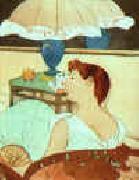 |
Mary Cassatt
|
|
1844-1926
Mary Cassatt Galleries
Within months of her return to Europe in the autumn of 1871, Cassatt??s prospects had brightened. Her painting Two Women Throwing Flowers During Carnival was well received in the Salon of 1872, and was purchased. She attracted much favorable notice in Parma and was supported and encouraged by the art community there: ??All Parma is talking of Miss Cassatt and her picture, and everyone is anxious to know her??.
After completing her commission for the archbishop, Cassatt traveled to Madrid and Seville, where she painted a group of paintings of Spanish subjects, including Spanish Dancer Wearing a Lace Mantilla (1873, in the National Museum of American Art, Smithsonian Institution). In 1874, she made the decision to take up residence in France. She was joined by her sister Lydia who shared an apartment with her. Cassatt continued to express criticism of the politics of the Salon and the conventional taste that prevailed there. She was blunt in her comments, as reported by Sartain, who wrote: ??she is entirely too slashing, snubs all modern art, disdains the Salon pictures of Cabanel, Bonnat, all the names we are used to revere??. Cassatt saw that works by female artists were often dismissed with contempt unless the artist had a friend or protector on the jury, and she would not flirt with jurors to curry favor. Her cynicism grew when one of the two pictures she submitted in 1875 was refused by the jury, only to be accepted the following year after she darkened the background. She had quarrels with Sartain, who thought Cassatt too outspoken and self-centered, and eventually they parted. Out of her distress and self-criticism, Cassatt decided that she needed to move away from genre paintings and onto more fashionable subjects, in order to attract portrait commissions from American socialites abroad, but that attempt bore little fruit at first.
In 1877, both her entries were rejected, and for the first time in seven years she had no works in the Salon. At this low point in her career she was invited by Edgar Degas to show her works with the Impressionists, a group that had begun their own series of independent exhibitions in 1874 with much attendant notoriety. The Impressionists (also known as the ??Independents?? or ??Intransigents??) had no formal manifesto and varied considerably in subject matter and technique. They tended to prefer open air painting and the application of vibrant color in separate strokes with little pre-mixing, which allows the eye to merge the results in an ??impressionistic?? manner. The Impressionists had been receiving the wrath of the critics for several years. Henry Bacon, a friend of the Cassatts, thought that the Impressionists were so radical that they were ??afflicted with some hitherto unknown disease of the eye??. They already had one female member, artist Berthe Morisot, who became Cassatt??s friend and colleague.
Degas, Portrait of Miss Cassatt, Seated, Holding Cards, c. 1876-1878, oil on canvasCassatt admired Degas, whose pastels had made a powerful impression on her when she encountered them in an art dealer's window in 1875. "I used to go and flatten my nose against that window and absorb all I could of his art," she later recalled. "It changed my life. I saw art then as I wanted to see it." She accepted Degas' invitation with enthusiasm, and began preparing paintings for the next Impressionist show, planned for 1878, which (after a postponement because of the World??s Fair) took place on April 10, 1879. She felt comfortable with the Impressionists and joined their cause enthusiastically, declaring: ??we are carrying on a despairing fight & need all our forces??. Unable to attend cafes with them without attracting unfavorable attention, she met with them privately and at exhibitions. She now hoped for commercial success selling paintings to the sophisticated Parisians who preferred the avant-garde. Her style had gained a new spontaneity during the intervening two years. Previously a studio-bound artist, she had adopted the practice of carrying a sketchbook with her while out-of-doors or at the theater, and recording the scenes she saw.
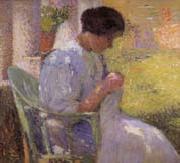
Summertime, c. 1894, oil on canvasIn 1877, Cassatt was joined in Paris by her father and mother, who returned with her sister Lydia. Mary valued their companionship, as neither she nor Lydia had married. Mary had decided early in life that marriage would be incompatible with her career. Lydia, who was frequently painted by her sister, suffered from recurrent bouts of illness, and her death in 1882 left Cassatt temporarily unable to work.
Cassatt??s father insisted that her studio and supplies be covered by her sales, which were still meager. Afraid of having to paint ??potboilers?? to make ends meet, Cassatt applied herself to produce some quality paintings for the next Impressionist exhibition. Three of her most accomplished works from 1878 were Portrait of the Artist (self-portrait), Little Girl in a Blue Armchair, and Reading Le Figaro (portrait of her mother).
Degas had considerable influence on Cassatt. She became extremely proficient in the use of pastels, eventually creating many of her most important works in this medium. Degas also introduced her to etching, of which he was a recognized master. The two worked side-by-side for awhile, and her draftsmanship gained considerable strength under his tutelage. He depicted her in a series of etchings recording their trips to the Louvre. She had strong feelings for him but learned not to expect too much from his fickle and temperamental nature. The sophisticated and well-dressed Degas, then forty-five, was a welcome dinner guest at the Cassatt residence.
The Impressionist exhibit of 1879 was the most successful to date, despite the absence of Renoir, Sisley, Manet and C??zanne, who were attempting once again to gain recognition at the Salon. Through the efforts of Gustave Caillebotte, who organized and underwrote the show, the group made a profit and sold many works, although the criticism continued as harsh as ever. The Revue des Deux Mondes wrote, ??M. Degas and Mlle. Cassatt are, nevertheless, the only artists who distinguish themselves??and who offer some attraction and some excuse in the pretentious show of window dressing and infantile daubing??.
Cassatt displayed eleven works, including La Loge. Although critics claimed that Cassatt??s colors were too bright and that her portraits were too accurate to be flattering to the subjects, her work was not savaged as was Monet's, whose circumstances were the most desperate of all the Impressionists at that time. She used her share of the profits to purchase a work by Degas and one by Monet. She exhibited in the Impressionist Exhibitions that followed in 1880 and 1881, and she remained an active member of the Impressionist circle until 1886. In 1886, Cassatt provided two paintings for the first Impressionist exhibition in the United States, organized by art dealer Paul Durand-Ruel. Her friend Louisine Elder married Harry Havemeyer in 1883, and with Cassatt as advisor, the couple began collecting the Impressionists on a grand scale. Much of their vast collection is now in the Metropolitan Museum of Art in New York City. She also made several portraits of family members during that period, of which Portrait of Alexander Cassatt and His Son Robert Kelso (1885) is one of her best regarded. Cassatt??s style then evolved, and she moved away from Impressionism to a simpler, more straightforward approach. She began to exhibit her works in New York galleries as well. After 1886, Cassatt no longer identified herself with any art movement and experimented with a variety of techniques.
|
|
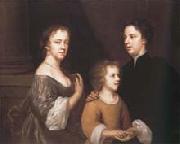 |
Mary Beale
|
|
English Baroque Era Painter, 1633-1699
was an English portrait painter. She became one of the most important portrait painters of 17th century England, and has been described as the first professional female English painter. Beale was born in Barrow, Suffolk, the daughter of John Cradock, a Puritan rector. Her mother, Dorothy, died when she was 10. She married Charles Beale, a cloth merchant from London, in 1652, at the age of 18. Her father and her husband were both amateur painters, her father being a member of the Painter-Stainers' Company, and she was acquainted with local local artists, such as Nathaniel Thach, Matthew Snelling, Robert Walker and Peter Lely. She became a semi-professional portrait painter in the 1650s and 1660s, working from her home, first in Covent Garden and later in Fleet Street. The family moved to a farmhouse in Allbrook, Hampshire in 1665 due to financial difficulties, her husband having lost his position as a clerk of patents, and also due to the Great Plague in London. For the next five years, a 17th-century two storey timber-framed building was her family home and studio. She returned to London in 1670, where she established a studio in Pall Mall, with her husband working as her assistant, mixing her paints and keeping her accounts. She became successful, and her circle of friends included Thomas Flatman, poet Samuel Woodford, Archbishop of Canterbury John Tillotson, and Bishops Edward Stillingfleet and Gilbert Burnet. She became reacquainted with Peter Lely, now Court Artist to Charles II. Her later work is heavily influenced by Lely, being mainly small portraits or copies of Lely's work. Her work became unfashionable after his death in 1680.
|
|
 |
Marx Reichlich
|
|
1460-1520
German
Marx Reichlich Gallery
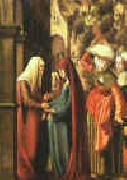
Austrian painter. His name, which first appeared in records of Salzburg citizens in 1494, has been linked (Semper) to an artist who signed some of his paintings with the initials M R. The earliest of the initialled panels, the Adoration of the Magi with the Donor Heinrich Mentlberger (1489; Innsbruck, ex-Wilten Abbey Church; Innsbruck, Tirol. Landesmus.), suggests that Reichlich had trained with the Tyrolean artists Friedrich Pacher and Michael Pacher. The latter lived in Salzburg from 1495 to 1498, and the stylistic association with him visible in the Perckhamer Altarpiece (c. 1495-8; Austria, priv. col., see Oberhammer, nos 1-12) may account for Reichlich's having become a citizen in Salzburg. The connections with both Pachers and the fact that Reichlich received several commissions in Neustift (Novacella, nr Bressanone) suggest that his origins were in that region. According to a receipt dated 1499, he painted a panel (untraced) for the Benediktinerstift of St Lambrecht in Styria. In 1508 Emperor Maximilian I commissioned him to restore the frescoes (in situ) in Schloss Runkelstein near Bozen (Bolzano). The latest panels signed with the initials M R make up part of a double-winged altarpiece (Heiligenblut, St Vincent) that was completed by one 'Wolffgang Maller' in 1520, perhaps because Reichlich was no longer living. Also attributed to Reichlich on stylistic, technical and circumstantial grounds are eight portraits (c. 1519-20) formerly assigned to a 'Master of the Angrer Portrait' whose name was derived from the riveting bust-length portrait of Canon Gregor Angrer of Brixen (1519; Innsbruck, Tirol. Landesmus.).
|
|
|
|
|
|
 |
Martinus Rorbye
|
|
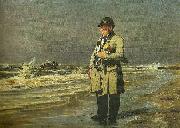
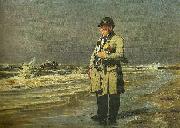
(17 May 1803 - 29 August 1848) was a Danish painter, known both for genre works and landscapes. He was a central figure of the Golden Age of Danish painting during the first half of the 19th century.
The most traveled of the Danish Golden Age painters, he traveled both north to Norway and Sweden and south to Italy, Greece and Constantinople. He was also the first Danish painter to take to painting in Skagen at the northern top of Jutland, almost half a century before the thriving community of Skagen Painters formed and came to fame.
Martinus Rørbye was born in Drammen in Norway to Danish parents Ferdinand Henrik Rørbye and his wife Frederikke Eleonore Catherine de Stockfleth. His father was a warehouse manager and later Superintendent of War, and had moved the family to Norway shortly before Martinus' birth. The family returned to Denmark when Martinus was 12 years old, shortly after the cession of Norway from Denmark in 1814.
Martinus was not inclined to schooling, but in 1820 started his studies at the Royal Danish Academy of Fine Arts at 17 years of age. He studied under Christian August Lorentzen and Christoffer Wilhelm Eckersberg, a strong influence on a generation of artists during the Danish Golden Age. Rørbye was a favorite student of Eckersberg, and they formed a close association. He took to Eckersberges careful attention to nature and his strivings to capture details realistically. He was also greatly influenced by Lorentzenes use of color.
He won the Academyes small silver medal in 1824, and the large silver medal in 1828. He competed for the gold medal and won a cash prize. In 1829 he won the small gold medal for his painting Christ healing the blind, which remains in the ownership of the Royal Danish Academy. He never won the large gold medal in spite of repeated attempts.
|
|
|
|
 |
Martin, Henri
|
|
French Post-Impressionist Painter, 1860-1943
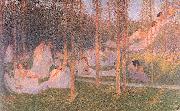
French painter. After winning the Grand Prix at the Ecole des Beaux-Arts in Toulouse, he moved to Paris (1879) to study at the Ecole des Beaux-Arts there under Jean-Paul Laurens, who encouraged his interest in Veronese and other Venetian painters. The literary inspiration of his early work was reflected in such paintings as Paolo de Malatesta and Francesca da Rimini in Hell (1883; Carcassonne, Mus. B.-A.) based on Dante, for which he won a medal at the Salon of 1883. During his subsequent study in Rome, however, on a fellowship awarded to him at the Salon,
|
|
 |
Martin van Meytens
|
|
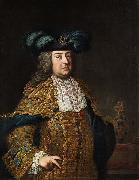
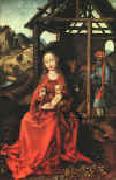
(June 24, 1695 - March 23, 1770) was a Swedish-Austrian painter who painted members of the royal Court of Austria such as Marie Antoinette, Maria Theresa of Austria, Francis I, Holy Roman Emperor, the Emperor's family and others. His painting style has inspired many other painters to paint in a similar format.
|
|
 |
Martin Schongauer
|
|
1430-1491
German
Martin Schongauer Galleries
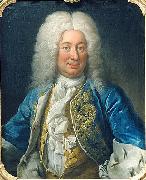
His father was a goldsmith named Casper, a native of Augsburg, who had settled at Colmar, where the chief part of Martin's life was spent. He may well have been trained by Master E. S.; A. Hyatt Mayor saw both their styles in different parts of one engraving, and all the works with Schongauer's M†S monogram show a fully developed style. Schongauer established at Colmar a very important school of engraving, out of which grew the "Little Masters" of the succeeding generation, and a large group of Nuremberg artists.
As a painter, Schongauer was a follower of the Flemish Rogier van der Weyden, and his rare existing pictures closely resemble, both in splendour of color and exquisite minuteness of execution, the best works of contemporary art in Flanders.
Porträt einer jungen Frau, by Martin Schongauer, c. 1478, located in Sammlung Heinz Kisters, Kreuzlingen (Schweiz) in GermanyAmong the very few paintings which can with certainty be attributed to him, the chief is a magnificent altar-piece in the church of Saint Martin at Colmar. The Mus??e d´Unterlinden in Colmar possesses eleven panels by him, and a small panel of David with Goliath's Head in the Munich Gallery is attributed to him. The miniature painting of the Death of the Virgin in the National Gallery, London is probably the work of some pupil. In 1488 Schongauer died at Colmar, according to the register of Saint Martin Church. Other authorities state that his death occurred in 1491.
The main work of Schongauer's life was the production of a large number of beautiful engravings, which were largely sold, not only in Germany, but also in Italy and even in England and Spain. Vasari says that Michelangelo copied one of his engravings, the Trial of Saint Anthony. His style shows no trace of Italian influence, but a very clear and organised Gothic.
His subjects are mainly religious, but include comic scenes of ordinary life such as the Peasant family going to market or the Two apprentices fighting. one hundred and sixteen engravings are generally recognised as by his hand, and since several are only known from a single impression, there were probably others that are now lost. Many of his pupils' plates as well as his own are signed, M†S, as are many copies probably by artists with no connection to him.
Crucifixion by Schongauer.Among the most renowned of Schongauer's engravings are the series of the Passion and the Death and Coronation of the Virgin, and the series of the Wise and Foolish Virgins. All are remarkable for their miniature-like treatment, their brilliant touch, and their chromatic force. Some, such as the Death of the Virgin and the Adoration of the Magi are richly-filled compositions of many figures, treated with much largeness of style in spite of their minute scale.
He established the system of depicting volume by means of cross-hatching (lines in two directions) which was further developed by D??rer, and was the first engraver to curve parallel lines, probably by rotating the plate against a steady burin. He also developed a burin technique producing deeper lines on the plate, which meant that more impressions could be taken before the plate became worn.
The British Museum and other major print rooms possess fine collections of Schongauer's prints.
|
|
 |
Martin Mijtens d.a.
|
|
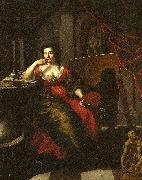
Martin Mijtens d.ä., Martin Meytens, Martin Mytens, född 1648 i Haag, Holland, död 1736 i Stockholm och begravd i Maria Kyrkan, nederländsk konstnär. Far till Martin Mijtens d.y. och son till porträttmålaren Isaac Mijtens.
Mijtens kom till Stockholm före eller under år 1677 och fann där ett så tacksamt fält för sin konst, att han beslöt stanna och 1681 satte han bo. Av hans första verk finns prov i Vibyholms och andra samlingar. De visar, att han hade en fin pensel, behaglig, varm, fastän tunn färg samt livlig och karakteristisk uppfattning av de skildrade. Med sina gråaktiga fonder, de ofta gulbruna draperierna och den enkla, naiva framställningen bildar Mijtens vid denna tid en bestämd motsats till David Klöcker Ehrenstrahl. Men dennes anseende och den gunst hans målningssätt vunnit var så stora, att även Mijtens måste böja sig. Så småningom blir hans bilder något anspråksfullare och djärvare, åtbörder och minspel kraftigare, bisakerna rikare, tonen i det hela mer högstämd, utan att personligheten försummas eller återgivningen av hudfärg överger den varma, åt gult dragande hållningen. Många bilder från denna hans andra period, som ungefär omfattar åren 1685- 1700, finns på Skoklosters slott, där Nils Bielke och hans grevinna, Eva Horn (i landskap), hör till mästarens bästa målningar, och på Vibyholm, i Uppsala (professor Schwedes porträtt i Uppsala museum och Olof Rudbeck d.ä.:s förträffliga bild, 1696, i medicinska fakultetens sessionsrum), i Hammers samling och på inte så få andra ställen. Konstnärens vana att högst sällan signera har gjort, att bilderna från dessa år ofta har blandats ihop med Ehrenstrahls och gått under den senares namn. Säkra skiljetecken är emellertid draperierna, som hos Mijtens saknar stil och ofta verkar tämligen slappt tecknade, och även det livligare åtbördsspelet. Man vet, att Mijtens, trots sin medtävlares anseende, var mycket eftersökt som porträttmålare och samlade förmögenhet på sin konst, så att han kunde bl.a. förvärva ett ej obetydligt konstgalleri. Han var även alltifrån 1692 och ganska länge kyrkoråd i den lilla holländska församlingen i Stockholm. 1697 och 1701 företog han resor till hembygden, den förra gången åtföljd av sin unge lärjunge Lucas von Breda. Utom denne ej obetydande konstnär utbildade Mijtens även sin son , som under det i Tyskland antagna namnet van Meytens berömde målaren (se denne), samt G. de Mar??es och möjligen flera. Man kan säga att omkring år 1700 vidtog Mijtens tredje maner. Karnationen får en dragning åt rött, som slutligen blir nästan stötande (t. ex. i Fabritius och prins Alexander av Georgiens porträtt på Gripsholms slott), teckningen vårdslösas mer, och de granna röda eller djupblå draperierna är stillösare och hårdare målade än förr. Dock lever ännu inte litet av den forna kraften i karaktärsteckningen, och anordningen bibehåller i mycket den förra prydligheten. Även denna hans nedgång finnes ej sällan företrädd i svenska samlingar. Märkligt är ett självporträtt (nu på Fånö i Uppland), emedan det enligt sägnen skall vara målat på hans höga ålderdom och under sinnessvaghet (om denna vet man för övrigt inget). Utom måleriet idkade han även gravyr samt utförde ett porträtt af Karl XI i svart maner och möjligen ett par andra blad i samma art (Gustaf Adolf de la Gardie, Georg Stiernhielm). Mijtens skall, enligt gammal uppgift, ha avlidit i Stockholm 1736; enligt en urkund levde han ännu i juli 1730. Hans målningssamling såldes av hans arvingar till preussiske överstemarskalken greve Gotter och kom inte långt därefter till storhertigen af W??rttemberg. Carl Gustaf Tessin, som tycks ha hyst mycken ringaktning för Mijtens omtalar dock, att denna samling på sin tid ansågs som den enda framstående i riket (utom grefve Johan Gabriel Stenbocks). Att Carl Gustaf Tessin vid samma tillfälle kallar Mijtens "en gammal färgskämmare" och även annars talar illa om hans konst, tycks visa att Mijtens vid mitten af 1700-talet var fullkomligt bortglömd, åtminstone sådan han varit under sin bästa tid. Sedan finns han ej heller mycket omtalad. Först genom konstföreningens utställning 1841 och Nils Arfwidssons anmälan av honom i Frey återupptäcktes han; och man fann då, att Sverige i honom ägt en konstnär av sådan betydelse, att han kan mäta sig även med våra största mästare. Hans inflytande på den svenska konstens fortbildning blev dock ej särskilt stort. David Klöcker Ehrenstrahl och David von Krafft ställer honom i det avseendet fullkomligt i skuggan.
|
|
 |
martin mijtens d.a
|
|
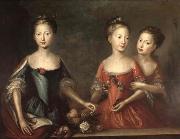
Martin Mijtens d.ä., Martin Meytens, Martin Mytens, född 1648 i Haag, Holland, död 1736 i Stockholm och begravd i Maria Kyrkan, nederländsk konstnär. Far till Martin Mijtens d.y. och son till porträttmålaren Isaac Mijtens.
Mijtens kom till Stockholm före eller under år 1677 och fann där ett så tacksamt fält för sin konst, att han beslöt stanna och 1681 satte han bo. Av hans första verk finns prov i Vibyholms och andra samlingar. De visar, att han hade en fin pensel, behaglig, varm, fastän tunn färg samt livlig och karakteristisk uppfattning av de skildrade. Med sina gråaktiga fonder, de ofta gulbruna draperierna och den enkla, naiva framställningen bildar Mijtens vid denna tid en bestämd motsats till David Klöcker Ehrenstrahl. Men dennes anseende och den gunst hans målningssätt vunnit var så stora, att även Mijtens måste böja sig. Så småningom blir hans bilder något anspråksfullare och djärvare, åtbörder och minspel kraftigare, bisakerna rikare, tonen i det hela mer högstämd, utan att personligheten försummas eller återgivningen av hudfärg överger den varma, åt gult dragande hållningen. Många bilder från denna hans andra period, som ungefär omfattar åren 1685- 1700, finns på Skoklosters slott, där Nils Bielke och hans grevinna, Eva Horn (i landskap), hör till mästarens bästa målningar, och på Vibyholm, i Uppsala (professor Schwedes porträtt i Uppsala museum och Olof Rudbeck d.ä.:s förträffliga bild, 1696, i medicinska fakultetens sessionsrum), i Hammers samling och på inte så få andra ställen. Konstnärens vana att högst sällan signera har gjort, att bilderna från dessa år ofta har blandats ihop med Ehrenstrahls och gått under den senares namn. Säkra skiljetecken är emellertid draperierna, som hos Mijtens saknar stil och ofta verkar tämligen slappt tecknade, och även det livligare åtbördsspelet. Man vet, att Mijtens, trots sin medtävlares anseende, var mycket eftersökt som porträttmålare och samlade förmögenhet på sin konst, så att han kunde bl.a. förvärva ett ej obetydligt konstgalleri. Han var även alltifrån 1692 och ganska länge kyrkoråd i den lilla holländska församlingen i Stockholm. 1697 och 1701 företog han resor till hembygden, den förra gången åtföljd av sin unge lärjunge Lucas von Breda. Utom denne ej obetydande konstnär utbildade Mijtens även sin son , som under det i Tyskland antagna namnet van Meytens berömde målaren (se denne), samt G. de Marees och möjligen flera. Man kan säga att omkring år 1700 vidtog Mijtens tredje maner. Karnationen får en dragning åt rött, som slutligen blir nästan stötande (t. ex. i Fabritius och prins Alexander av Georgiens porträtt på Gripsholms slott), teckningen vårdslösas mer, och de granna röda eller djupblå draperierna är stillösare och hårdare målade än förr. Dock lever ännu inte litet av den forna kraften i karaktärsteckningen, och anordningen bibehåller i mycket den förra prydligheten. Även denna hans nedgång finnes ej sällan företrädd i svenska samlingar. Märkligt är ett självporträtt (nu på Fånö i Uppland), emedan det enligt sägnen skall vara målat på hans höga ålderdom och under sinnessvaghet (om denna vet man för övrigt inget). Utom måleriet idkade han även gravyr samt utförde ett porträtt af Karl XI i svart maner och möjligen ett par andra blad i samma art (Gustaf Adolf de la Gardie, Georg Stiernhielm). Mijtens skall, enligt gammal uppgift, ha avlidit i Stockholm 1736; enligt en urkund levde han ännu i juli 1730. Hans målningssamling såldes av hans arvingar till preussiske överstemarskalken greve Gotter och kom inte långt därefter till storhertigen af Werttemberg. Carl Gustaf Tessin, som tycks ha hyst mycken ringaktning för Mijtens omtalar dock, att denna samling på sin tid ansågs som den enda framstående i riket (utom grefve Johan Gabriel Stenbocks). Att Carl Gustaf Tessin vid samma tillfälle kallar Mijtens "en gammal färgskämmare" och även annars talar illa om hans konst, tycks visa att Mijtens vid mitten af 1700-talet var fullkomligt bortglömd, åtminstone sådan han varit under sin bästa tid. Sedan finns han ej heller mycket omtalad. Först genom konstföreningens utställning 1841 och Nils Arfwidssons anmälan av honom i Frey återupptäcktes han; och man fann då, att Sverige i honom ägt en konstnär av sådan betydelse, att han kan mäta sig även med våra största mästare. Hans inflytande på den svenska konstens fortbildning blev dock ej särskilt stort. David Klöcker Ehrenstrahl och David von Krafft ställer honom i det avseendet fullkomligt i skuggan.
|
|
 |
Martin Maingaud
|
|
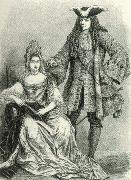
Martin Maingaud (died 1725; fl.1692-c.1725) was a French portraitist.
|
|
 |
martin luther
|
|
Born: 10 November 1483
Birthplace: Eisleben, Germany
Died: 18 February 1546
Best Known As: German monk who started Protestant Reformation
|
|
 |
Martin Johnson Heade
|
|
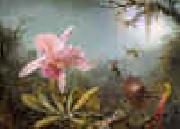
American Hudson River School Painter, 1819-1904 Martin Johnson Heade (August 11, 1819-September 4, 1904) was a prolific American painter known for his salt marsh landscapes, seascapes, portraits of tropical birds, and still lifes. His painting style and subject matter, while derived from the romanticism of the time, is regarded by art historians as a significant departure from that of his peers.
Art historians have come to disagree with the common view that Heade is a Hudson River School painter, a view given wide currency by Heade's inclusion in a landmark exhibition of Hudson River School landscapes at the Metropolitan Museum of Art in 1987.
The leading Heade scholar and author of Heade's catalogue raisonn??, Theodore E. Stebbins, Jr., wrote some years after the 1987 Hudson River School exhibition that "...other scholars??myself included??have increasingly come to doubt that Heade is most usefully seen as standing within that school."
According to the Heade catalogue raisonn??, only around 40 percent of his paintings were landscapes. The remaining majority were still lifes, paintings of birds, and portraits, subjects unrelated to the Hudson River School. Of Heade's landscapes, perhaps only 25 percent were painted of traditional Hudson River School subject matter.
Heade had less interest in topographically accurate views than the Hudson River painters, and instead focused on mood and the effects of light. Stebbins writes, "If the paintings of the shore as well as the more conventional compositions...might lead one to think of Heade as a Hudson River School painter, the [marsh scenes] make it clear that he was not."
|
|
 |
Martin Johann Schmidt
|
|
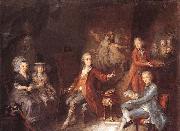
Austrian Painter, 1718-1801,was one of the most outstanding Austrian painters of the late Baroque/Rococo along with Franz Anton Maulbertsch. A son of the sculptor Johannes Schmidt and a pupil of Gottlieb Starmayr, he spent most of his life at Stein, where he mostly worked in the numerous churches and monasteries of his Lower Austrian homeland. While the evolution of his style after 1750 shows that he had either spent a formative period in northern Italy or had at least had extensive contact with northern Italian works of art prior to that date, his works are also clearly influenced by Rembrandt (visible above all in his etchings) and the great fresco-painters of the Austrian Baroque, Paul Troger and Daniel Gran. Despite not having received formal academic training, in 1768 he was made a member of the imperial academy at Vienna due to his artistic merits, which by that time had already been recognized by a wider public inside and outside of Austria. Primarily he painted devotional images for private devotion and churches, including a considerable number of large altar paintings. His lively and colourful style made him extremely popular with people from all levels of society already during his lifetime. From 1780 mythological and low-life themes became increasingly frequent, only to be replaced by a renewed concentration on religious topics during the very last years of Schmidt's life. He was at that an important draughtsman and has left numerous etchings which clearly show Rembrandt's influence. While his earlier works typically show a warm chiaroscuro, from about 1770 he used increasingly stronger and more lively colours. Simultanueously, both his style and his brush technique became much more free, making him, like Franz Anton Maulbertsch, an important predecessor of impressionism. In this aspect, his mature style is completely contrary to neoclassicism, the style which increasingly dominated European art after about 1780.
|
|
|
|
 |
Martin Drolling
|
|
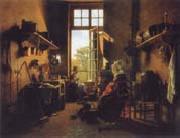
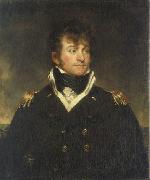
French Academic Painter, 1752-1817,After receiving initial training from an unknown painter in Selestat, Drolling moved to Paris, where he attended courses at the Acad?mie Royale. He supplemented his education there by studying Flemish and Dutch Old Masters in the collection at the Luxembourg Palace. From the Flemish school he derived his own rich impasto, while the Dutch was to influence him in his meticulous, supremely descriptive and unsentimental style of painting as well as his choice of subject-matter: unfussy bourgeois interiors and frank portraits. Drolling first exhibited at the Salon de la Correspondance in 1781 and again in 1782 and 1789. After the French Revolution he was able to participate in the Salon at the Louvre, despite the fact that he had never become a member of the Academie Royale. He exhibited from 1793 to 1817, although the majority of his works extant today were shown after 1800. From 1802 to 1813 he was employed by the Sevres porcelain manufactory, and many of his designs were engraved.
|
|
 |
Martin Archer Shee
|
|
RA (December 23, 1769 - August 13, 1850) was a British portrait painter and president of the Royal Academy.
He was born in Dublin, of an old Catholic Irish family, and his father, a merchant, regarded the profession of a painter as an unsuitable occupation for a descendant of the Shees. Martin Shee nevertheless studied art in the Dublin Society, and came to London. There, in 1788, he was introduced by William Burke to Joshua Reynolds, on whose advice he studied in the schools of the Royal Academy. In 1789 he exhibited his first two pictures, the "Head of an Old Man" and "Portrait of a Gentleman." Over the next ten years he steadily increased in practice. He was chosen an associate of the Royal Academy in 1798, in 1789 he married, and in 1800 he was elected a Royal Academician. He moved to George Romney's former house in Cavendish Square, and set up as his successor.
Shee continued to paint with great readiness of hand and fertility of invention, although his portraits were eclipsed by more than one of his contemporaries, and especially by Thomas Lawrence. The earlier portraits of the artist are carefully finished, easy in action, with good drawing and excellent discrimination of character. They show an undue tendency to redness in the flesh painting defect which is still more apparent in his later works, in which the handling is less "square," crisp and forcible. In addition to his portraits he executed various subjects and historical works, such as Lavinia, Belisarius, his diploma picture "Prospero and Miranda", and the "Daughter of Jephthah."
In 1805 he published a poem consisting of Rhymes on Art, and a second part followed in 1809. Lord Byron spoke well of it in his English Bards and Scotch Reviewers. Shee published another small volume of verse in 1814, entitled The Commemoration of Sir Joshua Reynolds, and other Poems, but this was less successful. He also produced a tragedy, Alasco, set in Poland. The play was accepted at Covent Garden, but was refused a licence, on the grounds that it contained treasonable allusions, and Shee angrily resolved to make his appeal to the public. He carried out his threat in 1824, but Alasco was still on the list of unacted dramas in 1911. He also published two novels - "Oldcourt" (1829, in 3 volumes) and "Cecil Hyde" (1834).
|
|
 |
Martin Drolling
|
|
1752-1817
B.Oberbergheim
French Martin Drolling Art Gallery
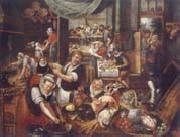
After receiving initial training from an unknown painter in Selestat, Drolling moved to Paris, where he attended courses at the Academie Royale. He supplemented his education there by studying Flemish and Dutch Old Masters in the collection at the Luxembourg Palace. From the Flemish school he derived his own rich impasto, while the Dutch was to influence him in his meticulous, supremely descriptive and unsentimental style of painting as well as his choice of subject-matter: unfussy bourgeois interiors and frank portraits. Drolling first exhibited at the Salon de la Correspondance in 1781 and again in 1782 and 1789. After the French Revolution he was able to participate in the Salon at the Louvre, despite the fact that he had never become a member of the Academie Royale. He exhibited from 1793 to 1817, although the majority of his works extant today were shown after 1800. From 1802 to 1813 he was employed by the Sevres porcelain manufactory, and many of his designs were engraved.
|
|
 |
Marten van Cleve
|
|
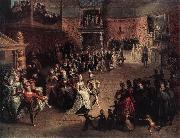
Flemish, 1527-1581,Brother of Hendrik van Cleve III. His presumed date of birth is derived from a document of 2 April 1567 in which he declared his age to be 40. In 1551-2 he became a master in the Antwerp Guild of St Luke and, according to van Mander, followed his brother into the studio of Frans Floris. If this is correct, it was probably c. 1553-5, for motifs drawn from Floris's work appear in Marten van Cleve's paintings executed during these years. Marten married Maria de Greve on 7 January 1556, apparently setting up his own studio at about the same time. Apprentices are regularly recorded from 1558 onwards, and it is probable that his own sons, Gillis II, Marten the younger, Joris and Nicolaas, also worked in the studio. Throughout the 1560s and 1570s Marten van Cleve's workshop was very productive, but the majority of works painted consisted of copies of his own originals. Van Mander's statement that the artist collaborated with a number of landscape painters, including his brother Hendrik III, Gillis van Coninxloo III, Gillis Mostaert and Jacob Grimmer, is confirmed by 17th-century inventories.
|
|
|
|
 |
Marten Pepijn
|
|
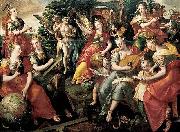
Belgium (1575-1643 ) - Painter
Date of Birth: 1575
Date of Death: 1643
|
|
 |
Marten de Vos
|
|
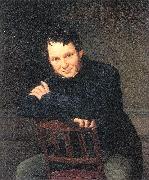
(1532-1603), also Maarten, was a leading Antwerp painter and draughtsman in the late sixteenth century.
|
|
 |
Marstrand, Wilhelm
|
|
Danish, 1810-1873
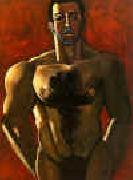
Danish painter and illustrator. He was a student of C. W. Eckersberg at the Kunstakademi in Copenhagen (1825-33). His art reflects his constant observation of the world around him, in particular middle-class society, and the narrative element dominated his pictures of crowds in the city streets. Throughout his life he sought inspiration from literature and the theatre. In his early genre painting Moving Day Scene (1831; Niv?, Nivaagaards Malsaml.) it was the popular novelty of vaudeville that interested him. The October Festival (1839; Copenhagen, Thorvaldsens Mus.) reveals how Marstrand's five-year stay (1836-41) in Italy opened his eyes to the classical ideal of beauty. It was, however, an ideal that found little response in contemporary Denmark, and he turned towards a more anecdotal and humorous approach. In Scene of Country Life (1843; Copenhagen, Kon. Dan. Kstakad.), painted as a set subject for the Kunstakademi, Marstrand took as his theme a scene from Erasmus Montanus, a play by the 18th-century Danish poet and playwright Ludvig Holberg. Thereafter Holberg's comedies provided an inexhaustible source that satisfied Marstrand's need to pursue his investigations of human character. Family life similarly interested him throughout his career, as in his Scene of Daily Life (1857; Copenhagen, Stat. Mus. Kst). Such group portraits as The Waagepetersen Family (1836; Copenhagen, Stat. Mus. Kst) show an equal concern to depict the quiet details of Danish domestic life. Marstrand continued to travel abroad in search of inspiration. His stay in Venice in 1853-4 was particularly important; his studies there of the great Venetian painters improved his understanding of the handling of colour, as seen clearly in the many historical and religious paintings of his last years. Of particular interest is his mural decoration of Christian IV's chapel in Roskilde Cathedral (1864-6) with scenes from the life of the Danish monarch. Marstrand's paintings have a certain facetiousness which often obscures a much deeper philosophical content. For this reason, it is his drawings that arouse more admiration.
|
|
|
|
 |
Marsden Hartley
|
|
1877-1943
Marsden Hartley (January 4, 1877 - September 2, 1943) was an American Modernist painter and poet in the early 20th century. Hartley was born in Lewiston, Maine, USA. He began his art training at the Cleveland Institute of Art after moving to Cleveland, Ohio in 1892.
At the age of 22, he moved to New York City, where he attended the National Academy of Design and studied painting at the Art Students League of New York under William Merritt Chase. A great admirer of Albert Pinkham Ryder, Hartley would visit Ryder's studio in Greenwich Village as often as possible. While in New York, he came to the attention of Alfred Stieglitz and became associated with Stieglitz' 291 Gallery Group. Hartley had his first major exhibition at the 291 Gallery in 1909 and another in 1912. He was in the cultural vanguard, in the same milieu as Gertrude Stein, Hart Crane, Charles Demuth, Georgia O'Keeffe, Fernand Leger, Ezra Pound, among many others.
Hartley, who was gay, painted Portrait of a German Officer (1914), which was an ode to Karl von Freyburg, a Prussian lieutenant of whom he became enamored before von Freyburg's death in World War I.
|
|
 |
Marsal, Mariano Fortuny y
|
|
Spanish, 1838-1874
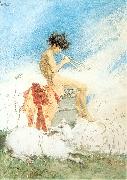
Painter and etcher. His work drew both on earlier Spanish art, especially the paintings and etchings of Goya, and on contemporary foreign works, notably the paintings of the Italian Macchiaioli and those of the French artist Ernest Meissonier.
|
|
|
|
|
|
 |
Marquet, Albert
|
|
French Fauvist Painter, 1875-1947
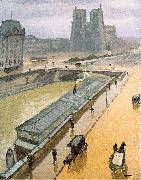
.French painter and draughtsman. In 1890 he was taken by his family to live in Paris so that he could study drawing at the Ecole Nationale Superieure des Arts Decoratifs. There he met Henri Matisse, with whom he formed a lasting friendship and with whom he studied from 1894 to 1898 at the Ecole des Beaux-Arts under Gustave Moreau. In the Louvre, Marquet made copies after Poussin, Velezquez, Claude Lorrain and particularly Chardin, of whose House of Cards he produced copies in 1894 and 1904
|
|
|
|
|
|
 |
Maron, Anton von
|
|
Austrian, 1733-1808
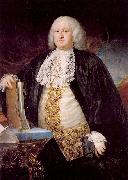
Austrian painter. He studied at the Vienna Akademie and, in 1755, he went to Rome, where he was based for the rest of his life. From 1756 to 1761 he was first the pupil then the assistant of Anton Raphael Mengs. In 1765 he married Mengs's sister, the miniature painter Theresia Concordia Mengs. After collaborating on Mengs's fresco paintings in Rome (at S Eusebio and the Villa Albani; both in situ), Maron, working independently in Rome, spent some time on altar pictures (S Maria dell'Anima) and on various decorative projects. Mengs's influence is evident in Maron's ceiling pictures in the casino of the Villa Borghese (1784; in situ), where five paintings tell the Story of Aeneas and Dido in the style of quadri riportati, using clear construction, sharply defined drawing and a historical concept based on antiquity. Although he received many commissions for this type of work, Maron's true gifts lay in the field of portraiture. Along with Pompeo Batoni, Maron was the most celebrated portrait painter in 18th-century Rome, and he received an enormous number of commissions from princes, diplomats and church dignitaries and from English aristocrats visiting Rome as part of their Grand Tour. Maron painted such sitters in the same style as did Batoni, usually full-length and life-size, in elegantly fashionable dress, against backgrounds of Classical sculptures and views of Rome. Portraits such as those of Francis, Prince of Anhalt Dessau
|
|
 |
Marmion, Simon
|
|
French-born Flemish Northern Renaissance Painter, ca.1425-1489
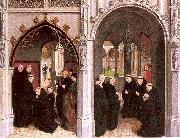
French illuminator and painter. He was trained in Amiens and established a productive workshop in Valenciennes, but at the end of his career appears to have had connections with manuscript painting in the southern Netherlands. Although no signed or documented works survive, many illuminated manuscripts and some panel paintings have been convincingly attributed to him and his workshop. On the basis of these he has been recognized as an important figure in the development of both French and Netherlandish painting.
|
|
|
|
 |
Marlow, William
|
|
English, 1740-1813
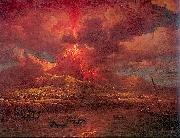
English painter. From c. 1756 to 1761 he was a pupil of Samuel Scott, the topographical and marine painter; he also studied at the St Martin's Lane Academy, London. Throughout his career Marlow made oils and watercolours of London views, for example Near Westminster Bridge, Evening (London, Guildhall A.G.), which shows his balanced, classical sense of composition, sensitivity to lighting effects and smooth handling of oil paint. Between 1765 and 1766 Marlow travelled in France and Italy, making numerous drawings of ruins, which provided the subjects for many paintings finished on his return to London. An Oxcart in the Grotto of Posillipo (c. 1770; New Haven, CT, Yale Cent. Brit. A.) exemplifies his bold, blue-toned watercolour style, with washes applied in loose blotches to emphasize the picturesque roughness of masonry and terrain. The handling has much in common with Canaletto, whom Marlow copied; a letter of 1771 from Horace Walpole to Sir Horace Mann (see 1956 exh. cat., p. 3) records that two views of Verona by Marlow were mistakenly sold as Canalettos. Marlow specialized in souvenirs of the Grand Tour, portraits of country houses, seascapes and river scenes. He visited many parts of Britain and Ireland in search of subjects, such as Powys Castle, Montgomeryshire (U. Manchester, Whitworth A.G.).
|
|
|
|
|
|
 |
mark tobev
|
|
Tropicalia, also known as Tropicalismo, is a Brazilian art movement that arose in the late 1960s and encompassed theatre, poetry, and music, among other forms. Tropicalia was influenced by poesia concreta (concrete poetry), a genre of Brazilian avant-garde poetry embodied in the works of Augusto de Campos, Haroldo de Campos, and Decio Pignatari, among a few others. However, Tropicalia is associated almost exclusively with the musical expression movement, both in Brazil and internationally, which arose from the fusion of several musical genres, like Brazilian and African rhythms and rock and roll.
|
|
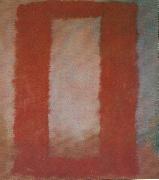 |
mark rothko
|
|
Mark Rothko, born Marcus Rothkowitz (September 25, 1903 - February 25, 1970), was a Russian-born American painter. He is classified as an abstract expressionist, although he himself rejected this label, and even resisted classification as an abstract painter.
|
|
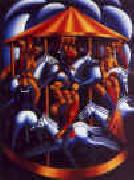 |
Mark Gertler
|
|
British
1891-1939
Mark Gertler Gallery
English painter. He was the son of Polish Jews and was brought up in Whitechapel in severe poverty until his father furrier workshop became moderately successful. As a child he knew nothing of art except advertisements and the work of pavement artists. He was 14 before he heard of any art institutions, and his career was determined by the discovery of W. P. Frith Autobiography in a secondhand bookshop. In 1906 he began attending art classes at the Regent Street Polytechnic in London, as well as a series of talks on Dutch and Flemish painting. His earliest still-lifes show the influence of Dutch 17th-century painting and the work of Chardin. Gertler left the Polytechnic for financial reasons in 1907 and apprenticed himself to Clayton and Bell, a firm of glass painters. In 1908 he won a prize in a national art competition and, on the strength of this, successfully applied for financial assistance from the Jewish Educational Aid Society, using William Rothenstein as a referee. That autumn he entered the Slade School of Fine Art, where he was taught by Henry Tonks and Philip Wilson Steer. He won several prizes and scholarships and fell in love with Dora Carrington. This and other friendships established at the Slade introduced him into a society that gave him a new perspective on his own family background. While writing delightedly to others of his nice friends among the upper classes, his paintings
|
|
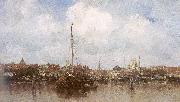 |
Maris, Jacob
|
|
Dutch, 1837-1899
was a Dutch painter, who with his brothers Willem and Matthijs belonged to what has come to be known as the Hague School of painters. Maris studied at the Antwerp Academy, and subsequently in Hubertus van Hove's studio during a stay in Paris from 1865 till 1871. He returned to Holland when the Franco-Prussian War broke out, and died there in August 1899. Though he painted, especially in early life, domestic scenes and interiors invested with deeply sympathetic feeling, it is as a landscape painter that Maris excelled. He was the painter of bridges and windmills, of old quays, massive towers, and level banks; even more was he the painter of water, and misty skies, and chasing clouds. In all his works, whether in water or oil color, and in his etchings, the subject is always subordinate to the effect. His art is suggestive rather than decorative, and his force does not seem to depend on any preconceived method, such as a synthetical treatment of form or gradations of tone. And yet, though his means appear so simple, the artist's mind seems to communicate with the spectator's by directness of pictorial instinct, and we have only to observe the admirable balance of composition and truthful perspective to understand the sure knowledge of his business that underlies such purely impressionist handling. Maris has shown all that is gravest or brightest in the landscape of Holland, all that is heaviest or clearest in its atmosphere for instance, in the " Grey Tower, Old Amsterdam," in the " Landscape near Dordrecht," in the " Sea-weed Carts, Scheven-ingen," in " A Village Scene," and in the numerous other pictures which have been exhibited in the Royal Academy, London, in Edinburgh (1885), Paris, Brussels
|
|
|
|
 |
Mariotto Albertinelli
|
|
(October 13, 1474 - November 5, 1515) was a High Renaissance Italian painter of the Florentine school, closely involved with Fra Bartolomeo and influenced by Raphael.
He was born in Florence.
Already as a 12-year old boy, he became a pupil of Cosimo Rosselli, and a fellow-pupil with Fra Bartolomeo with whom he formed such an intimate brotherly rapport that in 1494 the two started their own studio in Florence. Vasari's opinion was that Mariotto was not so well grounded in drawing as Bartolomeo, and he tells that, to improve his hand he had taken to drawing the antiquities in the Medici garden, where he was encouraged by Madonna Alfonsina, the mother of Duke Lorenzo II de' Medici. When the Medici were temporarily banished in 1494, he returned to his friend, whose manner he copied so assiduously, according to Vasari, that his works were taken for Baccio's. When, in the wake of Savonarola's morality campaign, Baccio joined the Dominican order as Fra Bartolomeo in 1500 and gave up painting, Albertinelli, beside himself with the loss, would have joined him; but, spurred by his success in completing an unfinished Last Judgment of Bartolomeo's, he resolved to carry on alone. Among his many students were Jacopo da Pontormo, Innocenzo di Pietro Francucci da Imola and Giuliano Bugiardini.
Mariotto was a most restless person and carnal in the affairs of love and apt to the art of living, and, taking a dislike to the studies and brain-wracking necessary to painting, being also often stung by the tongues of other painters, as is their way, he resolved to give himself to a less laborious and more jovial profession, and so opened the most lovely hostelry outside the Porta San Gallo, and at the sign of the Dragon at the Ponte Vecchio a tavern and inn. This life he led for many months, saying that he had taken up an art that was without muscles, foreshortening or perspective and, better still, without faultfinding, and that the art that he had given up imitated flesh and blood, but this one created flesh and blood; in this if you had good wine you heard yourself praised, but in that every day you were blamed. But at last the low life became an annoyance to him, and, filled with remorse, he returned to painting.
|
|
|
|
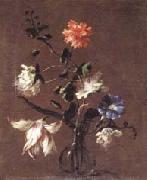 |
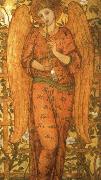
Mario Dei Fiori
|
|
Italian painter , Penna Fermana 1603- Rome 1673
Italian painter. He was the first and most famous Roman painter to specialize in flower-pieces and one of only four still-life artists included by Leone Pascoli in his collection of artists' biographies. The early sources and old inventories attribute many flower paintings in distinguished Roman collections to the Caravaggesque painter Tommaso Salini, and since the 18th century Mario's name has been linked with his, and it has been assumed that he trained with Salini. This apprenticeship is difficult to document, yet a comparison of Mario's pictures with inventory descriptions of works by Salini confirms that Mario was influenced by his art. To the minute observation of various kinds of flowers, Mario added a refined sense of design and an interest in effects of light, still linked to Caravaggio in the use of a dark background.
|
|
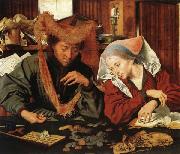 |
Marinus van Reymerswaele
|
|
Flemish Northern Renaissance Painter, ca.1490-1567
South Netherlandish painter. He has been identified with Marino di Sirissea and with Marinus de Seeu, painter of Romerswaelen, mentioned respectively by Guicciardini and van Mander. He could quite possibly have been Moryn Claessone, native of Zeeland, who enrolled as a pupil of 'Simon the glassmaker' in the Antwerp Guild of St Luke in 1509. In that case he would have been born c. 1490-95. Claes van Ziericsee, an artist who became master of the Guild in 1475, is assumed to have been his father though this cannot be proved conclusively. Van Reymerswaele's work corresponds closely with Antwerp painting of the beginning of the 16th century
|
|
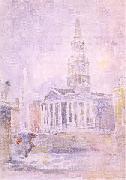 |
Marin, John
|
|
American Painter, 1870-1953
American painter and printmaker. He attended Stevens Institute in Hoboken, NJ, and worked briefly as an architect before studying at the Pennsylvania Academy of the Fine Arts in Philadelphia from 1899 to 1901 under Thomas Pollock Anshutz and Hugh Breckenridge (1870-1937). His education was supplemented by five years of travel in Europe where he was exposed to avant-garde trends. While abroad, he made etchings of notable and picturesque sites
|
|
 |
marin mersenne
|
|
French mathematician,philosopher and theorist. One of the leading French thinkers of the 17th century, he lived in Paris from 1619 as a Jesuit priest. His work is central to the academic and scientific movements of his time, and a major part of it is devoted to music. On the basis of practical experiment and observations, he made important discoveries concerning the nature and behaviour of sound, which are the foundation of the science of acoustics in later times. He also wrote on the theory and practice of music. His principal musical treatise is the Harmonie universelle
|
|
|
|
|
|
|
|
|
| Wholesale China Oil Painting Wholesale Oil Painting China Xiamen Portrait Reproduction on canvas Chinese Oil Painting Wholesale USA Oil Painting |
|
|
|
|
|


1.jpg)