| |
|
Xiamen Oil Paintings, Wholesale Direct!
|
|
100% hand painted, 100% cotton canvas, 100% money back if not satisfaction. |
|
|
|
|
ART WORKS INDEX
A
B
C
D
E
F
G
H
I
J
K
L
M
N
O
P
Q
R
S
T
U
V
W
X
Y
Z
|
|
ARTISTS INDEX
A
B
C
D
E
F
G
H
I
J
K
L
M
N
O
P
Q
R
S
T
U
V
W
X
Y
Z
|
|
|
|
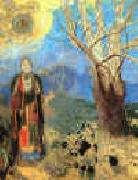 |
Odilon Redon
|
|
French Symbolist Painter, 1840-1916
Bertrand-Jean Redon, better known as Odilon Redon (April 20, 1840 ?C July 6, 1916) was a Symbolist painter and printmaker, born in Bordeaux, Aquitaine, France. Odilon was a nickname derived from his mother, Odile.
Redon started drawing as a young child, and at the age of 10 he was awarded a drawing prize at school. At age 15, he began formal study in drawing but on the insistence of his father he switched to architecture. His failure to pass the entrance exams at Paris?? Ecole des Beaux-Arts ended any plans for a career as an architect, although he would later study there under Jean-L??on Gerôme.
Back home in his native Bordeaux, he took up sculpture, and Rodolphe Bresdin instructed him in etching and lithography. However, his artistic career was interrupted in 1870 when he joined the army to serve in the Franco-Prussian War.
At the end of the war, he moved to Paris, working almost exclusively in charcoal and lithography. It would not be until 1878 that his work gained any recognition with Guardian Spirit of the Waters, and he published his first album of lithographs, titled Dans le R??ve, in 1879. Still, Redon remained relatively unknown until the appearance in 1884 of a cult novel by Joris-Karl Huysmans titled, À rebours (Against Nature). The story featured a decadent aristocrat who collected Redon's drawings.
In the 1890s, he began to use pastel and oils, which dominated his works for the rest of his life. In 1899, he exhibited with the Nabis at Durand-Ruel's. In 1903 he was awarded the Legion of Honor. His popularity increased when a catalogue of etchings and lithographs was published by Andr?? Mellerio in 1913 and that same year, he was given the largest single representation at the New York Armory Show. In 1923 Mellerio published: Odilon Redon: Peintre Dessinateur et Graveur. An archive of Mellerio's papers is held by the Ryerson & Burnham Libraries at the Art Institute of Chicago.
In 2005 the Museum of Modern Art launched an exhibition entitled "Beyond The Visible", a comprehensive overview of Redon's work showcasing more than 100 paintings, drawings, prints and books from The Ian Woodner Family Collection. The exhibition ran from October 30, 2005 to January 23, 2006.
|
|
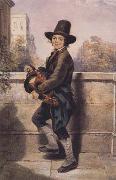 |
Octavius Oakley
|
|
1800-1867
was a Victorian watercolourist. Oakley initially worked for a cloth manufacturer near Leeds in Yorkshire. He developed into a specialist of portraits in watercolour and enjoyed the patronage of the Duke of Devonshire. From living in Derby where he depicted rustic scenes, he moved to Leamington Spa in Warwickshire in 1836, but returned to London in the 1840s and worked there until his death, producing paintings of street scenes and gypsies and their lifestyle. His emphasis on gypsy paintings which he exhibited at the Royal Watercolour Society earned him the name 'Gypsy Oakley'. Oakley met Thomas Baker in Leamington Spa where Baker was living and working and in 1841
|
|
 |
Octave Tassaert
|
|
Paris 1800-1874
was a French painter of portraits and genre, religious, historical and allegorical paintings, as well as a lithographer and engraver, though this family was of Flemish origin. He was the grandson of the sculptor Jean-Pierre-Antoine Tassaert. Octave's first artistic training came from his father Jean-Joseph-François Tassaert (1765-c. 1835) and his older brother Paul (?-1855), before he was apprenticed to the engraver Alexis-François Girard (1787-1870). Next he studied at the École des Beaux-Arts (1817-25) from 1817 through 1825, under Guillaume Guillon-Lethi??re, but never won the school's Prix de Rome. Winning popular but not critical success, his works showing poor people's lives were felt melodramatic by critics but acclaimed by the public. His submission to the 1855 World Exhibition was well received by the critics, but Octave ceased to exhibit after the 1857 Salon, withdrawing more and more from the formal art world. Collectors of his works included Alfred Bruyas and Alexandre Dumas, fils, but in 1863 Octave stopped painting altogether and tried to become a poet (though none of his works are extant),
|
|
|
|
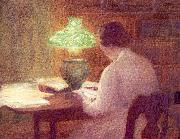 |
Ochtman, Mina Fonda
|
|
American, 1862-1924
was the wife of the American painter Leonard Ochtman and a notable American Impressionist in her own right. She was a part of the Cos Cob Art Colony and lived in Greenwich, Connecticut. Their daughter, Dorothy Ochtman Del Mar, was also a painter of note.
|
|
 |
OCHTERVELT, Jacob
|
|
Dutch Baroque Era Painter, 1634-1682
Dutch painter. According to Houbraken, he and Pieter de Hooch were fellow students of the Dutch Italianate Nicolaes Berchem in Haarlem, probably between 1646, when Berchem returned from Italy, and 1655, when Ochtervelt married Dirkje Meesters in the Dutch Reformed Church in Rotterdam. Ochtervelt's earliest known works reveal the influences of a number of Dutch Italianate painters. Landscapes with figures, such as Hunters and Shepherds in a Landscape (1652; Karl-Marx-Stadt, St?dt. Kstsamml.), owe much to Berchem in subject and composition. They may also have been partly inspired by similar landscapes by Jan Baptist Weenix and Ludolf de Jongh. Towards the mid-1650s Ochtervelt began painting garden scenes
|
|
|
|
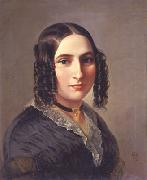 |
Moritz Daniel Oppenheim
|
|
(January 7, 1800, Hanau, Germany - February 26, 1882, Frankfurt am Main) was a German painter who is often regarded as the first Jewish painter of the modern era. His work was informed by his cultural and religious roots at a time when many of his German Jewish contemporaries chose to convert. Oppenheim is considered by the scholar Ismar Schorsch to be in sympathy with the ideals of the Wissenschaft des Judentums movement, because he remained "fair to the present" without denying his past.
Oppenheim was born to Orthodox Jewish parents at Hanau, Germany in 1800; he died at Frankfurt am Main in 1882. His niece was the wife of student and fellow painter Benjamin Prins, Rosa Benari.
He received his first lessons in painting from Westermayer, in Hanau, and entered the Munich Academy of Arts at the age of seventeen. Later he visited Paris, where Jean-Baptiste Regnault became his teacher, and then went to Rome, where he studied with Bertel Thorwaldsen, Barthold Georg Niebuhr, and Friedrich Overbeck. There he studied the life of the Jewish ghetto and made sketches of the various phases of its domestic and religious life, in preparation for several large canvases which he painted upon his return to Germany. In 1825 he settled at Frankfurt, and shortly after exhibited his painting David Playing Before Saul, to see which a great number of admirers from all parts of Europe visited his studio. In 1832, at the instance of Goethe, Charles Frederick, Grand Duke of Saxe-Weimar-Eisenach conferred upon him the honorary title of professor.
|
|
|
|
|
|
|
|
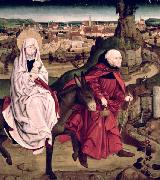 |
Master of the Schotten Altarpiece
|
|
was a German painter, active in Nuremberg during the 14th and 15th centuries. His name is derived from an altarpiece dated to about 1390, which once stood in the church of St. Mary in Schotten. The altarpiece was dismantled in 1828.
|
|
|
|
|
|
|
|
|
|
|
|
|
|
|
|
|
|
|
|
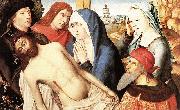 |
Master of the Legend of St. Lucy
|
|
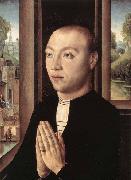
(fl. 1480-1510) was an unidentified Early Netherlandish painter who worked in Bruges, now a city in Belgium. His name comes from for an altarpiece in the church of Saint James in Bruges, which is dated 1480 and depicts three scenes from the life of Saint Lucy. Since then, twenty-five to thirty-five paintings have been attributed to the same hand. He may have trained Spanish students at his studio in Bruges. Many of them are characterized by views of the city of Bruges in the background, and can be dated according to the level of construction of its belfry. He may have trained with Dieric Bouts, and was certainly influenced by Bruges' greatest artist at the time, Hans Memling.
|
|
|
|
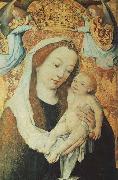 |
Master of the Housebook
|
|
German Northern Renaissance Painter, 15th Century, German graphic artist. The master is named for a series of vigorous and sophisticated drawings of everyday life found in the Hausbuch at Castle Wolfegg. Many of his engravings are in the Rijksmuseum, Amsterdam. His work is thought to have influenced Bosch, Bruegel, and Durer.
|
|
|
|
|
|
|
|
|
|
|
|
|
|
|
|
 |
Master of Saint Giles
|
|
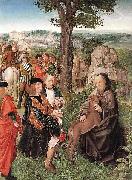
The Master of Saint Giles (French: Maître de Saint-Gilles) was a Franco-Flemish painter active, probably in Paris, about 1500, working in a delicate Late Gothic manner, with rendering of textures and light and faithful depictions of actual interiors that show his affinities with Netherlandish painting. It is not clear whether the Master of Saint Giles was a French painter who trained in the Low Countries (perhaps more likely), or a Netherlander who emigrated to France.
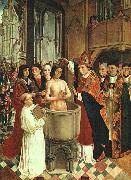
His pseudonym was given him by Max Friedländer, who reconstructed part of the anonymous painter's oeuvre, starting from two panels devoted to Saint Giles (a Miracle and a Mass) in the National Gallery, London, that were part of the lefthand shutter of an altarpiece, and two further panels now in Washington from the same altarpiece. The hand of an assistant can be discerned in the Baptism of Clovis at the National Gallery of Art, Washington, who also have a panel with Episodes from the Life of a Bishop-Saint - perhaps Saint Leu, Saint Denis or Saint Remy. All four panels have, or had, single grisaille figures of saints (Saints Peter, Giles, Denis and an unidentified bishop-saint) in niches, imitating sculpture, on the reverse. The Washington pair, which were in poor condition, have been separated and are lost, although photographs exist. Undoubtedly there were further panels, whose subjects cannot be guessed, as the combination of scenes is original.
|
|
|
|
 |
Master of Moulins
|
|
French
1480-1500 Master of Moulins Gallery
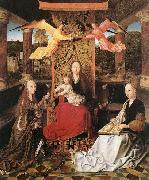
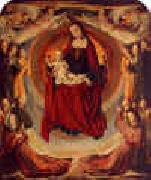
Until the late 20th century, the name of the painter of the Moulins Triptych was unknown, although art historians identified a number of other works that were evidently by the same hand. The first monograph on the Master of Moulins, written in 1961 by Madeleine Huillet d'Istria, argued that this artist did not actually exist, and that more than 12 different artists were responsible for the corpus of works traditionally ascribed to him. The Master's identity was established after an inscription was found on the reverse of a damaged painting, Christ with Crown of Thorns (1494) in the Royal Museums of Fine Arts of Belgium, Brussels, identifying the artist as Jean Hey, teutonicus and pictor egregius ("the famous painter"), and identifying the patron as Jean Cueillette, who was secretary to the King and an associate of the Bourbon family. Stylistic similarities link this painting to the works attributed to the Master of Moulins. The Master of Moulins appears to have been the court painter for the Bourbons, and from a surviving account for 1502-03, it is clear that the court painter's name was Jean; other candidates once considered plausible, such as Jean Perr??al and Jean Prevost, have proven untenable in the light of subsequent research. The term "Teutonicus", or "German" included Flemings at this date.
|
|
|
|
|
|
 |
MASTER of Heiligenkreuz
|
|
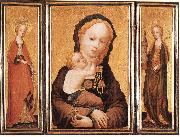
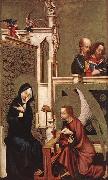
Austrian Northern Renaissance Painter, 15th Century,was an Austrian painter active at the beginning of the fifteenth century; a tentative lifespan of 1395 to 1430 has been put forth, but this appears highly conjectural. His name is taken from a diptych that once belonged to the Cistercian Abbey of Heiligenkreuz, located in southeastern Austria near the present-day border with Hungary. The left panel depicts the Annunciation on the obverse; the reverse is a depiction of the Madonna and Child. The right panel depicts the Mystical Marriage of Saint Catherine, with Saint Dorothy on its reverse. Details of costume and iconography combine with associations with the International Style to indicate a date of around the first decade of the fifteenth century.
It was initially proposed, by Betty Kurth in 1922, that the artist was French and had some association with the court in Paris. Other writers have disagreed, and various nationalities including French, Austrian, German, or Bohemian have been posited for the Master. Some have further suggested that he was an itinerant court artist, trained in France but active in Austria. Various clues have been used in an attempt to describe his nationality. These include his use of finely-worked gold decoration, in which some have seen a link to Franco-Burgundian goldsmith's work of the late fourteenth century. Others, instead, see it as a link to the school of panel painting then active at the court in Prague. Consequently, it seems highly unlikely that the artist's nationality will be conclusively established.
|
|
 |
Master of Frankfurt
|
|
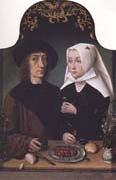
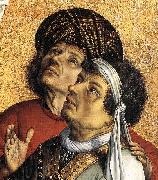
Flemish Northern Renaissance Painter, 1460-ca.1533.South Netherlandish painter. He takes his name from two paintings commissioned by patrons from Frankfurt am Main. His chief importance lies in his continuing the great tradition of 15th-century Netherlandish painting (particularly the compositions of Rogier van der Weyden and Hugo van der Goes) well into the 16th century, his development of a markedly earthy figure type, his apparently innovative management of a large workshop that 'mass-produced' paintings for the open market and his status
|
|
 |
Master Of Flemalle
|
|
Robert Campin (c. 1375 - 26 April 1444), now usually identified as the artist known as the Master of Flemalle, is usually considered the first great master of Flemish and Early Netherlandish painting. This had been a matter of controversy for decades; Campin's life is relatively well documented for the period, but no works in assessable condition could be securely connected with him, whilst a corpus of work had been attached to the unidentified "Master of Flemalle", named after the supposed origin of a work.
Campin seems to have had relatives in Valenciennes. He first appears as settled in Tournai from the archives of 1405-6, as a free master of the guild of painters, and he bought citizenship in 1410, which suggests he was not born there. He eventually attained the office of dean of the guild, and wardenship of a church and other civic offices, and was running a large workshop. By 1432, however, he lost his civic positions because of scandals, and probably his role in political disturbances in the city. In 1429 he was found guilty of withholding evidence, and sentenced to go on a pilgrimage, and in 1432 was convicted of adultery and banished for a year. Margaret of Burgundy, wife of the Count of Holland and sister of John the Fearless, Duke of Burgundy intervened on his behalf, and this was reduced to a fine. The dated Werl Altarpiece (1438) shows he continued to work (the two outer wings are in the Prado; the main panel is lost).
|
|
|
|
 |
Master of Avila
|
|
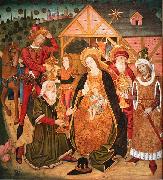
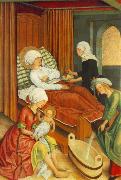
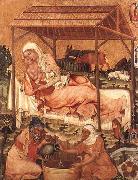
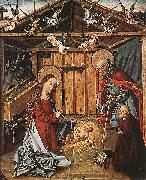
15 Master of Avila Nativity 1474-76 Oil on wood Museo Lezaro Galdiano, Madrid This is the finest work of the master, it forms part of a triptych as the central panel. The left panel was the Annunciation to the Shepherds while the right panel represented the Annunciation to the Magi. The composition follows the example of Gallego's paintings and the use of the cool colors
|
|
|
|
|
|
|
|
|
|
 |
Ludwig von Hofmann
|
|
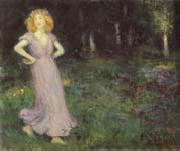
German, 1861-1945,was a German painter. His style was impressionist, and he painted many paintings, like his famous painting "Rain", in a mixture of impressionist and classical.He was also blind in one eye.
|
|
|
|
|
|
 |
Louis Gallait
|
|
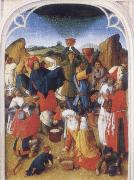
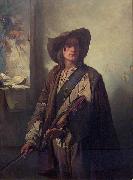
(9 or 10 May 1810 - 20 November 1887) was a Belgian painter. His d his reputation especially with the large painting of Charles V's abdication. Gallait's works were considered as the basis for a desirable renewal of historical paintings because of the realism, costume faithfulness and colorful posture of his paintings. His last artwork was sent on tour in Germany and that led to new signals even among German historians. He was also a distinguished portrait painter.
Gallait died in Brussels in 1887. There is a painting by Louis Gallait at the Norton Art Museum in West Palm Beach, Florida ("Art and Liberty").
|
|
 |
Leo von Klenze
|
|
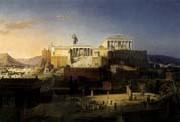
German Architect and Painter, 1784-1864,was a German neoclassicist architect, painter and writer. Court architect of Bavarian King Ludwig I, Leo von Klenze was one of the most prominent representatives of Greek revival style. Von Klenze studied architecture in Berlin and Paris. Between 1808 and 1813 he was a court architect of Jerome Bonaparte, King of Westphalia. Later he moved to Bavaria and in 1816 began to work as court architect of Ludwig I. The King's passion for Hellenism shaped the architectural style of von Klenze. He built many neoclassical buildings in Munich, including the Ruhmeshalle and Monopteros temple. On Konigsplatz he designed probably the best known modern Hellenistic architectural ensemble. Near Regensburg he built the Walhalla temple, named after Valhalla, the home of gods in Norse mythology. When Greece won its independence, Ludwig I's son Otto became the country's first king. Von Klenze was invited to Athens to submit plans of city reconstruction in the style of Ancient Greece. Russian Emperor Nicholas I commissioned von Klenze to design a building for the New Hermitage, a public museum that housed Greek, Roman, and Egyptian antiquities. Von Klenze also designed and arranged museum galleries in Munich, including the Glyptothek and Alte Pinakothek. Von Klenze was not only an architect, but also an accomplished painter and draughtsman. In many of his paintings ancient buildings were depicted. Those served as models for his own architectural projects. Klenze studied ancient architecture during his travels to Italy and Greece. He also participated in excavations of ancient buildings in Athens and submitted projects for the restoration of the Acropolis. Klenze collected works of important contemporary German painters. He sold his collection, including 58 landscapes and genre paintings, to King Ludwig I in 1841.
|
|
|
|
|
|
|
|
|
| Wholesale China Oil Painting Wholesale Oil Painting China Xiamen Portrait Reproduction on canvas Chinese Oil Painting Wholesale USA Oil Painting |
|
|
|
|
|