| |
|
Xiamen Oil Paintings, Wholesale Direct!
|
|
100% hand painted, 100% cotton canvas, 100% money back if not satisfaction. |
|
|
|
|
ART WORKS INDEX
A
B
C
D
E
F
G
H
I
J
K
L
M
N
O
P
Q
R
S
T
U
V
W
X
Y
Z
|
|
ARTISTS INDEX
A
B
C
D
E
F
G
H
I
J
K
L
M
N
O
P
Q
R
S
T
U
V
W
X
Y
Z
|
|
|
|
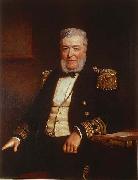 |
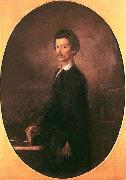
Stephen Pearce
|
|
(London, 1819-904) was a portrait and equestrian painter. Forty-four portraits which he painted are in the National Portrait Gallery in London, which also contains two self-portraits.
|
|
|
|
|
|
 |
Soma Orlai Petrich
|
|
(October 22, 1822, Mezőbereny - June 5, 1880, Budapest) was a Hungarian painter. Petrich was born to a Serbian father and Hungarian mother.
He originally wanted to become a writer. He was a pupil of Jakab Marastoni in 1846 and attended Ferdinand Georg Waldmeller's school in Vienna from 1847. He often painted historical themese and in his lithographs he portrayed experiences during the war of independence. He studied from Kaulbach in Munich from 1850. He painted "The Corpse of Louis II" in 1851, a decade before Bertalan Szekely's painting. He was also a popular portraitist.
|
|
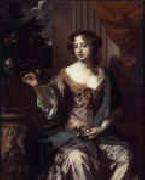 |
Sir Peter Lely
|
|
1618-1680
Dutch (Resident In UK)
Sir Peter Lely Art Locations
Sir Peter Lely (14 September 1618 - 30 November 1680) was a painter of Dutch origin. He was the most popular portrait artist in England from soon after he arrived in the country in the 1640s to his death. He also owned a major collection of art, especially drawings by other artists.
Lely was born Pieter van der Faes to Dutch parents in Soest in Westphalia,[1] where his father was an officer serving in the armed forces of the Elector of Brandenburg. Lely studied painting in Haarlem, where he may have been apprenticed to Pieter de Grebber. He become a master of the Guild of Saint Luke in Haarlem in 1637. He is reputed to have adopted the surname "Lely" (also occasionally spelled Lilly) from a heraldic lily on the gable of the house where his father was born in The Hague.
He arrived in London in around 1641. His early English paintings, mainly mythological or religious scenes, or portraits set in a pastoral landscape, show influences from Anthony van Dyck and the Dutch baroque. Lely's portraits were well received, and he succeeded Anthony van Dyck as the most fashionable portrait artist in England. He became a freeman of the Painter-Stainers' Company in 1647 and was portrait artist to Charles I, but his talent ensured that his career was uninterrupted by Charles's execution, and he served Oliver Cromwell, whom he painted "warts and all", and Richard Cromwell. In the years around 1650 the poet Sir Richard Lovelace wrote two poems about Lely ?? Peinture and "See what a clouded majesty...."
Two ladies from the Lake family, 1650. Held by the Tate Gallery.[1]After the English Restoration in 1660, Lely was appointed as Charles II's Principal Painter in Ordinary in 1661, with a stipend of £200 per year, as Van Dyck had enjoyed in the previous Stuart reign. Lely became a naturalised British subject in 1662.
Demand was high, and Lely and his school were prolific. After Lely painted a sitter's head, Lely's pupils would often complete the portrait in one of a series of numbered poses. As a result Lely is the first English painter who has left "an enormous mass of work." Among his most famous paintings are a series of 10 portraits of ladies from the Royal court, known as the "Windsor Beauties", formerly at Windsor Castle but now at Hampton Court Palace; a similar series for Althorp; a series of 12 of the admirals and captains who fought in the Second Anglo-Dutch War, known as the "Flagmen of Lowestoft", now mostly owned by the National Maritime Museum in Greenwich; and his Susannah and the Elders at Burghley House. His most famous non-portrait work is probably Nymphs by a fountain in Dulwich Picture Gallery.
Lely played a significant role in introducing the mezzotint to Britain, as he realized its possibilities for publicising his portraits. He encouraged Dutch mezzotinters to come to Britain to copy his work, laying the foundations for the English mezzotint tradition.
Lely was knighted in 1680. He died soon afterwards at his easel in Covent Garden, while painting a portrait of the Duchess of Somerset. He was buried at St Paul's Church, Covent Garden. He collected Old Masters during his life, with examples by Veronese, Titian, Claude Lorrain and Rubens, and a fabulous collection of drawings. His collection was broken up and sold after his death, raising the immense sum of £26,000. Some items in it which had been acquired by Lely from the Commonwealth dispersal of Charles I's art collections, such as the Lely Venus, were re-acquired by the royal collection.
|
|
|
|
|
|
 |
Sir Edward john poynter,bt.,P.R.A
|
|
1836-1919
English painter, draughtsman, decorative designer and museum official. He came from an artistic family: his great-grandfather was Thomas Banks the sculptor, and Ambrose Poynter, his father, was an architect and watercolour painter. Edward began studying art in 1852 under Thomas Shotter Boys, a friend of his father. In 1853-4 Poynter visited Rome, where he was greatly impressed by the large-scale academic painting of Frederic Leighton. Returning to London, he studied at Leigh's Academy and the studio of William Dobson (1817-1898). Poynter entered the Royal Academy Schools in 1855 but his admiration for French painting led him to Charles Gleyre's studio in Paris the following year. He remained there until 1859, with fellow students George Du Maurier, Thomas Armstrong and Whistler; their activities are described in Du Maurier's novel Trilby (1894). At this time Poynter received his first commissions for decorative work. He began designing stained glass and painting furniture and, after his return to England, he was employed by his friend the architect William Burges to decorate the ceiling of Waltham Abbey, Essex, in 1860.
|
|
|
|
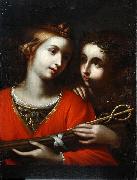 |
Simone Pignoni
|
|
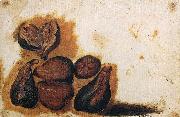
Simone Pignoni (April 17, 1611 - December 16, 1698) was an Italian painter of the Baroque period.
He apprenticed with Fabrizio Boschi, then with the more academic and puritanical Domenico Passignano, and finally with Francesco Furini. He is best known for painting in a style reminiscent of the morbidly sensual Furini. Reflective of this obsession is his self-portrait, c. 1650, in which he depicts himself building up a plump naked female from a skeleton. The biographer Baldinucci, in what little he notes of the painter, recalls him as the scandalous imitator of (Furini's) licentious inventions.
A more complete biography was recorded by his pupil Giovanni Camillo Sagrestani. Described as endowed with a bizarre and amenable intelligence, Pignoni apparently had a late-life conversion to more pious painting. There is one episode recalled that during a serious illness because in his life he had focused on studying about female forms, and (now) having resigned himself to the impending infinity, his spiritual father urged him to purge those errors with the flame, and once guided by a good disposition, he suddenly was cured by the Lord. It must be noted that Baldinucci's biography of Furini, also recorded a similar, near-death renunciation of his art of the naked figure.
Among his more conventional works are a St. Agatha cured by St. Peter (attributed) in the Museo Civico di Trieste. A St. Louis providing a banquet for the poor (c. 1682) now in the church of Santa Felicita in Florence, commissioned by Conte Luigi Gucciardini. A Madonna and child in glory with archangels Saints Michael and Raphael in battle armor and San Antonio of Padua (1671) for the Cappella di San Michele in Santissima Annunziata. He painted an Allegory of Peace in Palazzo Vecchio. A Penitent Magdalen has been attributed to Pignoni is found in the Pitti Palace. In San Bartolomeo in Monteoliveto, he painted a Madonna appearing to Blessed Bernardo Tolomeo.
|
|
 |
Simone Peterzano
|
|
(c. 1540 - c. 1596) was an Italian painter of the later Mannerism, native of Bergamo. He is mostly known as the master of Caravaggio.
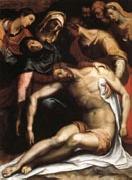
He was a pupil of Titian in Venice, Peterzano debuted in Milan with the counterfaçade frescoes in San Maurizio al Monastero Maggiore (1573), influenced by Veronese and Tintoretto. In the same year he painted two canvasses with Histories of Sts. Paul and Barnabas for the church of San Barnaba, also in Milan. Also from the same period are a Piete in the church of San Fedele and a Pentecost for San Paolo Converso (now in Sant'Eufemia).
Between 1578 and 1582 Peterzano executed frescoes in the presbytery of Garegnano Charterhouse, considered one of his masterworks. His last works, characterized by a cold monumental style, include a fresco with Stories of St. Anthony of Padua for the church of Sant'Angelo, a canvas with Madonna with Child and Saints for the parish church of Bioggio (Canton Ticino) and an altarpiece with St. Ambrose between Sts. Gervasius and Protasius in the Duomo of Milan (1592, now in the Pinacoteca Ambrosiana).
|
|
|
|
 |
Simon Pietersz Verelst
|
|
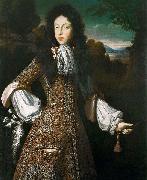
(1644, The Hague - 1710, London), was a Dutch Golden Age painter.
According to the RKD he was the son of Pieter Harmensz Verelst and became a pupil in the Confrerie Pictura at the same time as his brother Herman in 1663. In 1668 he moved to London and called himself "the God of Flowers", but is known for portraits as well as flower and fruit still life paintings.
|
|
|
|
|
|
 |
Sebastiano del Piombo
|
|
1485-1547 Italian Sebastiano del Piombo Galleries
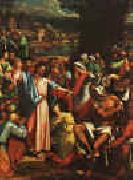
Italian painter. He was one of the most important artists in Italy in the first half of the 16th century, active in Venice and Rome. His early, Venetian, paintings are reminiscent of Giovanni Bellini and to a lesser extent of Giorgione. With his move to Rome in 1511 he came under the influence of Raphael and then of Michelangelo, who supplied him with drawings. After the death of Raphael (1520) he was the leading painter working in Rome and was particularly noted as a portrait painter. In his finest works, such as the Piete (1513; Viterbo, Mus. Civ.) and the Flagellation (1516-24; Rome, S Pietro in Montorio), there is a remarkable fusion of the Venetian use of colour and the grand manner of central Italian classicism.
|
|
|
|
|
|
|
|
 |
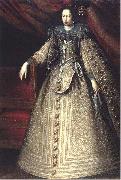
Sarah Miriam Peale
|
|
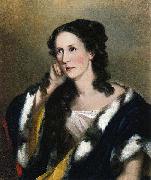
(Philadelphia, Pennsylvania, May 19, 1800 - February 4, 1885, Philadelphia) was an American portrait painter, one of the notable family of artists descended from the miniaturist and still-life painter James Peale, who was her father. She is noted as a portrait painter, mainly of politicians and military figures. Lafayette sat for her four times.
Sarah was James Peale's youngest daughter and was trained by her father, and uncle Charles Willson Peale. She served as a studio assistant to her father. Her first public works date from 1816 with subjects such as flowers and still-life but soon turned to portraiture, In 1818, she spent three months with Rembrandt Peale, her cousin, in Baltimore, and again in 1820 and 1822. He influenced her painting style and subject matter. For 25 years, she painted in Baltimore (1822-47) and, intermittently, in Washington, D.C.
She was accepted to the Pennsylvania Academy of Fine Arts in 1824 along with her sister Anna Claypoole Peale, the first women to achieve this distinction. Over 100 commissioned portrait paintings are known from her time in Baltimore and she was the most prolific artist in the city during that era. Her subjects were wealthy Baltimore residents and politicians from Washington DC.
|
|
 |
Santo Peranda
|
|
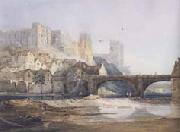
(1566-1638) was an Italian painter of the late-Renaissance period.
He was a pupil of the painter Leonardo Corona and later Palma il Giovane. Also known as Santa Peranda. He painted a Descent from the cross for San Procolo in Venice. He painted The defeat of the Saracens for the Ducal Palace of Modena. He painted the Gathering of the Manna for the church of the San Bartolome. In 1623 he finished Glorious Mysteries for the church of San Nicole in Treviso. Among his pupils were Francesco Maffei, Matteo Ponzone, and Filippo Zaniberti.
|
|
|
|
|
|
 |
Samuel Prout
|
|
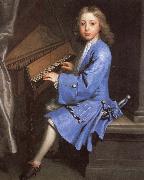
English Painter, 1783-1852
was an English water-colour painter. He was born at Plymouth, and spent whole summer days, in company with Benjamin Haydon, drawing the quiet cottages, rustic bridges and romantic watermills of the beautiful valleys of Devon. He made a journey through Cornwall to try his hand in furnishing sketches for Britton's Beauties of England. In 1803 he moved to London, where he stayed until 1812. In London, Prout saw new possibilities, and endeavoured to correct and improve his style by studying the works of the rising school of landscape. To earn a living, he painted marine pieces for Palser the printseller, took students, and published drawing books for learners. He was one of the first to use lithography in his artwork. It was not however until about 1818 that Prout discovered his niche. Happening time to make his first visit to the Continent, and to study the quaint streets and market-places of continental cities, he suddenly found himself in a new and enchanting province of art. His eye caught the picturesque features of the architecture, and his hand recorded them with skill. The composition of his drawings was exquisitely natural; their colour exhibited "the truest and happiest association in sun and shade"; the picturesque remnants of ancient architecture were rendered with the happiest breadth and largeness, with the heartiest perception and enjoyment of their time-worn ruggedness
|
|
 |
samuel pepys
|
|
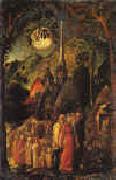
Born: 23 February 1633
Birthplace: London, England
Died: 16 May 1703
Best Known As: Author of Samuel Pepys' diaries
|
|
|
|
 |
Samuel Palmer
|
|
1805-1881
British
Samuel Palmer Galleries
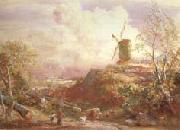
English painter, draughtsman and etcher. Palmer was a key figure of English Romantic painting who represented, at least in his early work, its pastoral, intuitive and nostalgic aspects at their most intense. He is widely described as a visionary and linked with his friend and mentor William Blake, though he stood at an almost opposite extreme in his commitment to landscape and his innocent approach to its imagery. He had none of Blake irony or complexity and was inspired by a passionate love of nature that found its philosophical dimension in unquestioning Neo-Platonism.
|
|
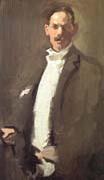 |
Samuel John Peploe
|
|
Scottish Painter, 1871-1935,Scottish painter. He studied at the Royal Scottish Academy schools from 1893 to 1894, and then at the Academie Julian and Acad?mie Colarossi in Paris, where he shared rooms with Robert Brough. The influence of the rustic realism of French painters and of the Glasgow Boys is clear in landscape drawings and paintings executed in Edinburgh from the mid-1890s. His still-life studies reveal the influence of the work of both Manet and Hals, which he saw in European galleries, with their combinations of thick impasto and fluid brushwork, dark background, strong lighting and meticulous handling of tones. Between 1900 and c. 1910, when he moved to Paris, he painted in Edinburgh, on sketching holidays in Scotland and in northern France with John Duncan Fergusson, and exhibited in Edinburgh, Glasgow and London.
|
|
|
|
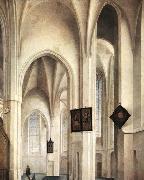 |
SAENREDAM, Pieter Jansz
|
|
Dutch Baroque Era Painter, 1597-1665,Painter and draughtsman, son of Jan Saenredam. His paintings of churches and the old town halls in Haarlem, Utrecht and Amsterdam must have been appreciated by contemporary viewers principally as faithful representations of familiar and meaningful monuments. Yet they also reveal his exceptional sensitivity to aesthetic values; his paintings embody the most discriminating considerations of composition, colouring and craftsmanship. His oeuvre is comparatively small, the paintings numbering no more than 60, and each is obviously the product of careful calculation and many weeks of work. Their most striking features, unusual in the genre, are their light, closely valued tonalities and their restrained, restful and delicately balanced compositions. These pictures, always executed on smooth panels, are remarkable for their sense of harmony and, in some instances, serenity. Here, perhaps, lies a trace of filial fidelity to the Mannerist tradition of refinement and elegance, of lines never lacking in precision and grace. But Mannerist figures and the more comparable components of strap- and scrollwork embellishment lack the tension and clarity of Saenredam's designs, which also have a completeness reminiscent of the fugues of Gerrit Sweelinck (1566-?1628).
|
|
|
|
|
|
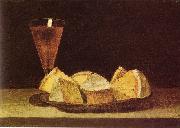 |
Rubens Peale
|
|
Rubens Peale (May 4, 1784 - July 17, 1865) was an American artist and museum director. Born in Philadelphia, he was a son of artist-naturalist, Charles Willson Peale.
|
|
|
|
|
|
|
|
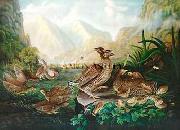 |
Robert Havell Jr Prints
|
|
1793-1878
Engraver and painter, cousin of William Havell. He learnt the art of aquatint engraving from his father, Robert Havell I. He worked first in the family engraving business and then c. 1825-7 with Colnaghi in London. In 1827 he undertook the execution in aquatint of the plates for John James Audubon Birds of America, published in parts in London between 1827 and 1838. Havell engraved 425 of the plates and reworked the ten that had been engraved by William Home Lizars in Edinburgh. Havell father printed and coloured some of the double elephant folio sheets in 1827-8 after which Havell took on those tasks himself, establishing himself as a master of aquatint. Among his other important works in the medium are the plates for Mrs E. Bury Selection of Hexandrian Plants (London, 1831-4). In 1839, at Audubon invitation, Havell moved with his family to New York and embarked on a new career as a landscape painter in the style of the Hudson River school, while also working as an engraver. He settled in the Hudson River villages of Ossining (1841) and Tarrytown (1857) but painted throughout north-eastern America. View of Deerfield, Massachusetts (1847; Hist. Deerfield, MA) is characteristic of his quietly romantic idealization of his subjects. Niagara Falls from the Chinese Pagoda (1845; New York, Pub. Lib.), engraved by Havell after one of his paintings, is among the best known of his American aquatints. Though his reputation rests largely on his work for Audubon, his original subjects gave him greater opportunities to display the full range of his aquatint technique.
Part of the Havell family
|
|
|
|
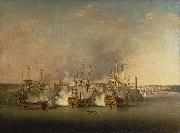 |
Richard Paton
|
|
was a British marine painter.
Paton spent his artistic career in London, where he is said to have been born, although no record of his birthplace or parentage is known. He is said to have grown up in poverty, and he is described as "self-taught". Some critics have discerned an influence of Samuel Scott's works, and also of Charles Brooking. Any such influence is hardly evident.
According to an account by Harry Parker, in "The Mariner's Mirror", March 1912, p 85, while Paton was begging "on Tower Hill, he attracted the attention of Admiral Sir Charles Knowles (died 1777), who happened to be passing that way, and who, taking a fancy to the boy, offered to take him to sea". He was assistant to the shipes painter on Knowles' ship, gaining knowledge in both painting and seamanship. In 1742, he started working at the Excise Office.
His first exhibition was in 1758 on the premises of the London-based Society of Artists, where he continued to exhibit up to 1770. The Royal Academy hosted his works between 1762 and 1780.
Paton's specialities were marine and naval paintings. He painted naval actions of wars ongoing at the time of painting such as the Seven Years War of 1756-1763 and later The American Revolutionary War, as well as earlier events such as the battles of the War of the Quadruple Alliance which took place when he was a baby. The paintings include many dramatic effects such as battles at night, the shooting of cannons and the effect of bombardments. There are, however, also less militant themes such as ships becalmed. His "sublime depiction of the sky" was considered especially noteworthy. Prints of his works, made among others by Pierre-Charles Canot, made them widely known.
|
|
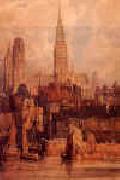 |
Richard Parkes Bonington
|
|
1802-1828
Richard Parkes Bonington Locations
English painter. His father, also called Richard (1768-1835), was a provincial drawing-master and painter, exhibiting at the Royal Academy and the Liverpool Academy between 1797 and 1811. An entrepreneur, he used his experience of the Nottingham lace-manufacturing industry to export machinery illegally to Calais, setting up a business there in late 1817 or early 1818. In Calais the young Richard Parkes Bonington became acquainted with Louis Francia, with whom he consolidated and expanded whatever knowledge of watercolour technique he had brought with him from England. Under Francias direction Bonington left Calais for Paris where, probably not before mid- or late 1818, he met Eugene Delacroix. The latters recollection of Bonington at this time was of a tall adolescent who revealed an astonishing aptitude in his watercolour copies of Flemish landscapes. Once in Paris Bonington embarked on an energetic and successful career, primarily as a watercolourist. In this he was supported by his parents who sometime before 1821 also moved to Paris, providing a business address for him at their lace company premises.
|
|
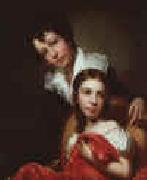 |
Rembrandt Peale
|
|
1778-1860
Rembrandt Peale Galleries
Rembrandt Peale (February 22, 1778 ?C October 3, 1860) was a 19th century American artist that received critical acclaim for his portraits of presidents George Washington and Thomas Jefferson. Although modern art critics would consider Peale??s artwork as French neoclassical, its dark and stylized characteristics are similar to 15th and 16th century paintings.
Rembrandt Peale was born the third of six surviving children (eleven had died) to his mother, Rachel Brewer, and father, Charles Willson Peale in Bucks County, Pennsylvania, on February 22, 1778. The father, Charles, also a notable artist, taught each child to paint scenery and portraiture, and Rembrandt was no exception. Charles tutored Rembrandt about the importance of having a strong mind from learning arts and sciences. At the age of eight, Rembrandt discovered drawing, and at thirteen, painted his first known self-portrait. Later on in his life, Rembrandt Peale "often showed this painting to young beginners, to encourage them to go from 'bad' to better..." like his steady progressions to become a successful portraitist.
A year after his mother??s death and remarriage of his father, Rembrandt Peale left the school of the arts, thereby applying his time to completing his first ever self-portrait at the age of 13. The canvas illustrates early mastery of a young aspiring artist, seeming very mature. The clothes, however give the notion that Peale over-exaggerated what a 13 year old would look like. This style demonstrates early forms of neoclassicism by the looks of Peale's angel-like hair, the way it waves and curls in such a fashion so as to depict an angel from a general Renaissance artist's works of art.
In July of 1787, Charles Willson Peale introduced his son Rembrandt to George Washington, where the young aspirant artist watched his father paint the remarkable figure of the country. In 1795, at the age of 17, Rembrandt painted an aging Washington, though the painter had depicted the politician as far more aged than the original facial characteristics. It did, nevertheless attain praise and Rembrandt had begun his debut.
At the age of 20, Rembrandt married 22-year-old Eleanor May Short (1776-1836) at St. Joseph's Catholic Church in Philadelphia. During their marriage, Rembrandt and Eleanor had nine children: Rosalba, Eleanor, Sarah Miriam, Michael Angelo, and Emma Clara among them.
In 1822, Peale moved to New York City where he embarked on an attempt to paint what he hoped would become the "standard likeness" of Washington. He studied portraits by other artists including John Trumbull, Gilbert Stuart and his own father, as well as his own 1795 picture which had never truly satisfied him. His resulting work Patriae Pater, completed in 1824, depicts Washington through an oval window, and is considered by many to be second only to Gilbert Stuart's iconic Athenaeum painting of the first president. Peale subsequently attempted to capitalize on the success of what quickly became known as his "Porthole" picture. Patriae Pater was purchased by Congress in 1832 and still hangs in the U.S. Capitol.
Later on, Peale made over 70 detailed replicas of the same "father of our country", the first President of the United States. Peale continued to paint other noted portraits, such as those of the third president Thomas Jefferson while he was in office (1805), and later on a portrait of Chief Justice John Marshall.
|
|
|
|
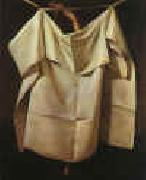 |
Raphaelle Peale
|
|
1774-1825
Peale was born in Philadelphia as the son and first child of Rachel and Charles Willson Peale, a famous portraitist.
Lived in Philadelphia, on a home at the corner of 3rd and Lombard.
Married Martha (Patty) McGlathery at the age of 20.
First first professional exhibition was in 1795 at the age of 21.
Artist. Born Raphaelle Peale in Annapolis, Maryland on February 17, 1774, the fifth child, though eldest surviving, of Charles Willson Peale and his first wife Rachel Brewer. As with all the Peale children, Raphael was trained by his father as an artist. Early in his career, the pair collaborated on portraits. On some commissions, Raphael painted miniatures while his brother, Rembrandt, painted full size portraits.
In 1792, he made a trip to South America in order to collect specimens for the Peale's Museum. In 1797, with his brother Rembrandt, he traveled to Charleston, South Carolina, where they attempted to establish another museum. The plan fell through, however, and Raphael returned to painting miniatures.
He married Martha McGlathery at about that same time, and with her had eight children. For about two years beginning in 1803, Raphael toured Virginia with the ??physiognotrace,' a profile making machine, with which he was briefly successful. In August 1808, he was hospitalized with delirium tremens, exacerbated by severe gout. By 1813, he was unable to walk without crutches. After the downturn in his health, in an era when most artists considered still life a subject worthy only of amateurs, he devoted himself almost exclusively to still life painting. It is for these works he is best known. Raphael Peale is today considered the founder of the American Still Life school. His work was on frequent exhibit at the Pennsylvania Academy of the Fine Arts between 1814 and 1818. After reportedly indulging in a night of heavy drinking, his health destroyed, Raphael died on March 3, 1825 at age 51 at his home in Philadelphia.
Peale's tightly grouped still lifes are often permeated with a delicate melancholy akin to that which characterized the life of the artist; he was an alcoholic who suffered the effects of arsenic and mercury poisoning caused by his work as a taxidermist in his father's museum. His spare, essential style may have been influenced by the Spanish still lifes he studied in Mexico and by the works of Juan Sanchez Cotan, exhibited at the Pennsylvania Academy in 1818.
|
|
|
|
|
|
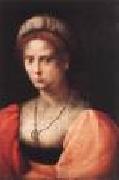 |
PULIGO, Domenico
|
|
Italian Painter, 1492-1527
He trained in Florence with Ridolfo Ghirlandaio and in the workshops of Antonio del Ceraiuolo ( fl 1st half 16th century) and Andrea del Sarto. What may be his earliest surviving work, the Virgin and Child with St John (c. 1513; Rome, Pal. Venezia), reflects the style of Ghirlandaio. Other early paintings, however, such as the Holy Family (Florence, Gal. Corsini), show the influence of Fra Bartolommeo and Andrea del Sarto and are little affected by Ghirlandaio. The Virgin and Child with the Infant St John (c. 1522; Florence, Pitti) clearly reflects the examples of Fra Bartolommeo and Raphael, with the figures in the manner of Andrea del Sarto. The figure of the Christ Child may derive from Raphael's Madonna of the Pinks (c. 1507-8; Alnwick Castle, Northumb., on loan to London, N.G.). Over a dozen drawings have been attributed to Puligo, but none relates to his extant work or resembles his style of painting. Vasari described him as a particularly lazy artist, which may account for this scarcity of drawings and for the frequency of borrowed motifs and repeated compositions in his smaller religious paintings. Such borrowing often resulted in a lack of harmony in his compositions, as in the Pitti Virgin and Child. The influence of the more sculptural forms of Andrea del Sarto's work of the 1520s can be seen in the Mary Magdalene (c. 1525; Ottawa, N.G.).
|
|
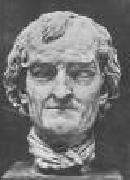 |
PUGET, Pierre
|
|
French Baroque Era Sculptor, 1620-1694
French sculptor, painter, draughtsman and architect. Puget was one of the outstanding artists of his century, but his style, formed by the Italian Baroque, did not however always find favour in the classicizing atmosphere of the French court, where Jean-Baptiste Colbert would describe him in 1670 as 'a man who goes a little too fast, and whose imagination is a little too heated'. Although the son of a master mason, Simon Puget (d 1623), Puget was largely self-taught, as were his brother Gaspard Puget (1615-after 1683), an architect, and his son Fran?ois Puget (1651-1707), a painter. Apprenticed in 1634 to a wood-carver, Jean Roman, in Marseille, he left in 1638 for Italy, spending some years in Florence and Rome close to Pietro da Cortona, presumably as a stuccoist and painter, although his part in the decoration of the Palazzo Pitti, Florence, Cortona's main project of these years, is not clear. From 1643 he practised sculpture and painting at the Toulon Arsenal, France's largest naval shipyard, where he was appointed to the wood-carving workshop: around 1645, for instance, he designed and supervised the decoration of the ship Le Magnifique (in 1646 renamed La Reine; destr.). According to some sources, in 1646 he made a second journey to Italy,
|
|
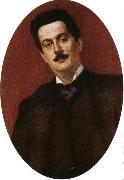 |
puccini
|
|
Period: Post-Romantic (1870-1909)
Country: Italy
Born: December 22, 1858 in Lucca, Italy
Died: November 29, 1924 in Brussels, Belgium
Genres: Chamber Music, Miscellaneous Music, Opera, Vocal Music
|
|
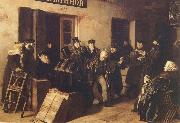 |
Pryanishnikov Illarion
|
|
1840-1894,Russian painter. He studied from 1856 to 1866 at the School of Painting, Sculpture and Architecture in Moscow and subsequently taught there (1873-94). Among his pupils were Sergey Ivanov and Sergey Korovin. Pryanishnikov was among the fifteen founder-members of the Peredvizhniki (WANDERERS) and contributed two works to their first exhibition. His narrative pictures of the 1860s embodied the critical trend in early Russian Realism and focused on the trials and sorrows of the lower classes; his Jokers (1865; Moscow, Tret yakov Gal.) shows a petty clerk performing stunts for the amusement of some wealthy merchants. The Convoy of Empty Sleds (1871; Kharkiv, Mus. F.A.) conveys a fine sense of the bleak winter landscape. His later work added northern scenery and genre scenes to his repertory as in Saviour Day in the North (1887; Moscow, Tret yakov Gal.) and Return from the Fair (1883; St Petersburg, Rus. Mus.). Pryanishnikov is also known for his hunting scenes. In 1893 he became a member of the St Petersburg Academy of Arts.
|
|
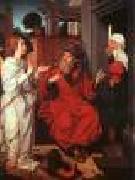 |
PROVOST, Jan
|
|
Flemish Northern Renaissance Painter, 1465-1529
|
|
|
|
|
|
|
|
|
| Wholesale China Oil Painting Wholesale Oil Painting China Xiamen Portrait Reproduction on canvas Chinese Oil Painting Wholesale USA Oil Painting |
|
|
|
|
|