| |
|
Xiamen Oil Paintings, Wholesale Direct!
|
|
100% hand painted, 100% cotton canvas, 100% money back if not satisfaction. |
|
|
|
|
ART WORKS INDEX
A
B
C
D
E
F
G
H
I
J
K
L
M
N
O
P
Q
R
S
T
U
V
W
X
Y
Z
|
|
ARTISTS INDEX
A
B
C
D
E
F
G
H
I
J
K
L
M
N
O
P
Q
R
S
T
U
V
W
X
Y
Z
|
|
|
|
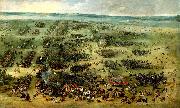 |
Peter Snayers
|
|
(1592 - 1666 or 1667) was a Flemish Baroque painter known for representations of historical battle scenes.Born in Antwerp, he studied under Sebastiaen Vrancx before joining Antwerp's Guild of St. Luke in 1612. By 1628, Snayers was a citizen in Brussels.
|
|
|
|
|
|
 |
Peter Purves Smith
|
|
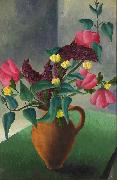
Peter Purves Smith (26 March 1912 - 23 July 1949), born Charles Roderick Purves Smith, was an Australian painter. Born in Melbourne, Purves Smith studied at the Grosvenor School of Modern Art in London and under progressive art teacher George Bell in Melbourne.
|
|
 |
Peter Paul Rubens
|
|
Flemish Baroque Era Painter, 1577-1640
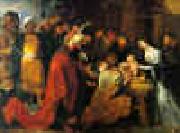
Peter Paul Rubens (June 28, 1577 ?C May 30, 1640) was a prolific seventeenth-century Flemish Baroque painter, and a proponent of an exuberant Baroque style that emphasized movement, color, and sensuality. He is well-known for his Counter-Reformation altarpieces, portraits, landscapes, and history paintings of mythological and allegorical subjects.
In addition to running a large studio in Antwerp which produced paintings popular with nobility and art collectors throughout Europe, Rubens was a classically-educated humanist scholar, art collector, and diplomat who was knighted by both Philip IV, king of Spain, and Charles I, king of England.
Rubens was a prolific artist. His commissioned works were mostly religious subjects, "history" paintings, which included mythological subjects, and hunt scenes. He painted portraits, especially of friends, and self-portraits, and in later life painted several landscapes. Rubens designed tapestries and prints, as well as his own house. He also oversaw the ephemeral decorations of the Joyous Entry into Antwerp by the Cardinal-Infante Ferdinand in 1635.
His drawings are mostly extremely forceful but not detailed; he also made great use of oil sketches as preparatory studies. He was one of the last major artists to make consistent use of wooden panels as a support medium, even for very large works, but he used canvas as well, especially when the work needed to be sent a long distance. For altarpieces he sometimes painted on slate to reduce reflection problems.
His fondness of painting full-figured women gave rise to the terms 'Rubensian' or 'Rubenesque' for plus-sized women. The term 'Rubensiaans' is also commonly used in Dutch to denote such women.
|
|
 |
Peter Parler
|
|
German Gothic Era Sculptor,
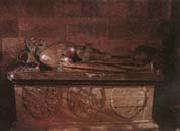
1330-1399,was a German architect, best-known for building Saint Vitus Cathedral and Charles Bridge in Prague, where he lived from about 1356.
His father, master builder Heinrich Parler (the name deriving from "parlerius", speaker and head of the masons), had moved to Schwäbisch Gm??nd from Cologne, to lead the reconstruction works of the Holy Cross parish church. Members of the large Parler family worked in construction works around all of Europe.
Peter Parler became the master mason of Saint Vitus Cathedral in 1352, after the death of its original architect, Matthias of Arras. Apart from the cathedral, he was the main designer of the New Town of Prague and built Charles Bridge and its towers. In the Royal Palace of Prague Castle, Parler built the All Saints' Chapel. After the fire of 1541 it was redecorated in the Baroque style.
He was apparently the architect of the Church of Our Lady (Frauenkirche) built in the market square of Nuremberg, to replace the synagogue torn down in the pogrom of 1349 following the plague. Between 1360-78 Parler built the chancel of the St. Bartholomew church in Kolin. He died in Prague in 1399, and was buried in the St. Vitus cathedral. His work was continued by his sons Wenzel and Johann.
|
|
 |
Peter Nicolai Arbo
|
|
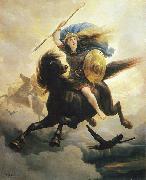
(June 18, 1831 - October 14, 1892) was a Norwegian painter, who specialized in painting motifs from Norwegian history and images from Norse mythology. He is above all noted for Åsgardsreien, a dramatic motif based on a Norwegian folk legend and Valkyrie, which depicts a female figure from Norse mythology.
Peter Nicolai Arbo grew up at Gulskogen Manor in Gulskogen, a borough in Drammen, Norway. He was the son of headmaster Christian Fredrik Arbo (1791-1868) and his wife Marie Christiane von Rosen. His brother Carl Oscar Eugen Arbo was a military medical doctor and a pioneer in Norwegian anthropologic studies. Arbo's childhood home, Gulskogen, was built in 1804 as a summer residence for his older cousin, lumber dealer and industrialist Peter Nicolai Arbo.Arbo started his art education with a year at the Art School operated by Frederick Ferdinand Helsted (1809-1875) in Copenhagen 1851-1852. After this, he studied at the art academy in Dusseldorf. From 1853 to 1855 he studied under of Karl Ferdinand Sohn, professor of The Dusseldorf School of Art, and from 1857-1858 under J. E. Henthen who was a battle and animal painter. At Dusseldorf he was for some time a private student of the history painter C. Mengelberg. He had contact with Adolph Tidemand and became a good friend of Hans Gude both of whom were professors at the art academy in Dusseldorf.
|
|
 |
Peter Monamy
|
|
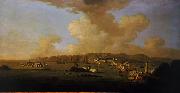
was an English marine painter who lived between 1681 and 1749.
Peter Monamy was baptised at the church of St Botolph's-without-Aldgate, London, England, on 12 January 1681 (new style). He was the last known surviving child of Peter, or Pierre, Monamy, born 1650 in Guernsey, and his English wife, Dorothy Gilbert; and the grandson of Andre Monamy, 1612-1680, who had been a strongly committed Commonwealth Parliamentarian in Guernsey during the 1650s. Dorothy Gilbert was the daughter of James Gilbert, who was Master of the Worshipful Company of Gunmakers in 1670 and 1672. The Monamy family had been prominent merchants and residents of Guernsey since at least the 1560s, and in the Channel Islands since the 1530s. The painter's father, Pierre, had a brother named Andre, or Andrew, who was active in London as a merchant trader in salt and wool, during the late 17th and early 18th centuries. In December, 1696, Andrew Monamy, together with his cousin, Daniel Le Febvre, is described as "guardian" of the children of Peter (i.e. Pierre) Monamy, deceased. The elder Peter Monamy appears to have died in about 1685.
On 3 September 1696, Peter Monamy, aged 15, was bound as an apprentice for seven years by indenture to William Clark, a former (1687) Master of the Worshipful Company of Painter-Stainers, one of London's ancient guilds of craftsmen. Clark is recorded in several capacities in the London of the late 17th century, as a constable and juryman, with premises in Thames Street, and on London Bridge, and practised as what would today be called an interior decorator, with a thriving business. House decoration comprised a wide range of activities, including the provision of paintings as overdoors, and on panelling, house murals on canvas as well as decorative sign-boards for trade establishments. William Clark died before January, 1704, when his will was proved.
|
|
 |
Peter Johannes Brandl
|
|
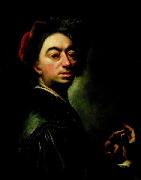
Petr Brandl (Peter Johannes Brandl or Jan Petr Brandl) (October 24, 1668 - September 24, 1735) was a painter of the late Baroque, famous in his time but - due to isolation behind the Iron Curtain - rather forgotten until recently. He was of German-speaking Austrian descent in the bilingual kingdom of Bohemia. His mother was from Czech peasant family, that lived in Přestanice (a village in Bohemia, now part of Hlavnovice). According to the Grove Dictionary of Art and other sources, Brandl was born into a craftsmanes family (his father seems to have been a goldsmith) and apprenticed around 1683 - 1688 to Kristien Schröder (1655 - 1702).
Brandl employed strong chiaroscuro, areas of heavy impasto and very plastic as well as dramatic figures. The major art museum in Prague, called the National Gallery, has an entire hall devoted to the artist's works, including the wonderful "Bust of an Apostle" from some time before 1725.
|
|
|
|
|
|
 |
Peter ilsted
|
|
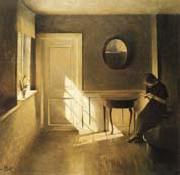
1861-1933,was a leading Danish artist and printmaker. Ilsted, Carl Holsoe and Ilstedes brother-in-law, Vilhelm Hammershoi, were the leading artists in early 20th century Denmark. All three artists were members of The Free Exhibition, a progressive art society created around 1890. They are famous for painting images of "Sunshine and Silent Rooms", all in subtle colors. Their works reflects the orderliness of a tranquil life EC- similar to the earlier works of Vermeer. Their art was later referred to as the Copenhagen Interior School. These interiors evoke at once a sense of calm, as well as a sense of mystery. The orderly room are often viewed from behind -- causing one to wonder if the scenes are really tranquil or something else. James McNeill Whistler, Duret and important art critics were early admirers and collectors of Ilsted's work. Ilsted was Hammershoi's brother-in-law. While at first glance their work appears similar, it is in fact quite different. Hammershoi's work has an aloof austerity, in contrast to Ilsted's scenes of common life. Though sometimes Hammershoi's colorful early pictures are reminiscent of James Tissot, his work is quintessentially Danish. However, Ilsted was more of a technician, and he made considerable contributions in the field of graphic art. Ilstedes mezzotints (colored a la poupee) were very popular and important in his day. They were an innovation in the media. Ilsted exhibited his work all over Europe, in London in 1907, in Germany and at the Paris Salon. It is there that his work was first exposed to Europe's art community. Ilsted was a great success in his lifetime and won many awards and accolades for his work. He was the only member of the group to also focus on printmaking. Ilstedes achievements in mezzotints were revolutionary. Some of his mezzotints, most of which were created in black as well as color editions, are considered among the greatest ever made.
|
|
 |
Peter Hansen
|
|
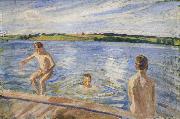
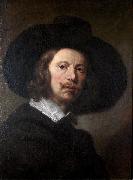
Peter Marius Hansen (13 May 1868, Faaborg - 6 October 1928, Faaborg) was a Danish painter who became one of the Fynboerne or "Funen Painters" group living and working on the island of Funen.
Hansen attended the Copenhagen Technical School before studying under Kristian Zahrtmann at the Kunstnernes Frie Studieskoler (1884 - 1890). His travels included the Netherlands (1892 and 1909), and several periods in Italy from 1899 where he was in Civita d'Antino with Zahrtmann (1904) and in Pompei with Theodor Philipsen (1919 - 21). He also travelled to Belgium and Paris in 1909. His eldest son, David Shane Hansen (1888-1909) would become one of the leading organizers of the 1909 general strike in Barcelona, Spain. He was killed by military forces July 27th 1909. Peter Hansen would comment that his son had become a great martyr in the rising Spanish Anarchist movement that was sweeping Spain. It was during this time that Peter's art began to reflect the pain he suffered at the loss of his son.
|
|
|
|
 |
Peter Franchoys
|
|
Peter, Peeter or Pieter Franchoys or Francois (1606-1654) was a Flemish Baroque painter from Mechelen, who painted an altarpiece of Calvary influenced by Anthony van Dyck for the St. Gummarus church in Lier, Belgium.
[edit] Biography
He first learned to paint from his father, Lucas Franchoys the Elder, and later from Gerard Seghers in Antwerp . In 1631 he traveled in France and is recorded being in Fontainebleau. In 1646 he became a member of the Mechelen schutterij and in 1649 he became a master in the Guild of St. Luke there.
According to Houbraken he was known for his landscapes with small figures, that attracted the admiration of Archduke Leopold Wilhelm of Austria, for whom he painted many years.
His work is memorialized in the Gulden Cabinet of the poet from Lier, Cornelis de Bie.
|
|
 |
Peter F Rothermel
|
|
1817-1895
Peter F Rothermel Gallery
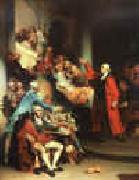
Rothermel was born in Nescopeck, Pennsylvania in 1817, although some date his birth earlier in 1813 or 1814. He studied under John R. Smith and Bass Otis before studying in various places in Europe. He specialized in portraits and dramatic historical paintings. He served as Vice President of the Artists' Fund Society in 1844 and as Director of the Pennsylvania Academy of Fine Arts from 1847 to 1855.
His most famous paintings include Patrick Henry before the Virginia House of Burgesses (1851) and a massive oil painting of the Battle of Gettysburg that hangs in the State Museum of Pennsylvania. This latter work was commissioned by Gettysburg lawyer David McConaughy. Another of his more popular historical works is Columbus Before the Queen, painted in 1844.
|
|
|
|
 |
Peter Cramer
|
|
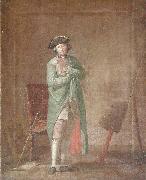
(1726 - 1782) was a self-taught artist who prepared the drawings for the illustration of Norden's 'Travels in Egypt,' and then became a decorative and theatrical painter. Together with this occupation he executed popular Danish scenes in the style of Teniers, and several of his pictures were engraved by Haas, Kleve, and Clemens. He died at Copenhagen in 1782.
|
|
 |
Peter Buell Porter
|
|
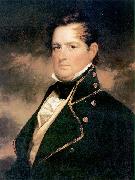
(August 14, 1773 - March 20, 1844) was an American lawyer, soldier and politician who served as United States Secretary of War from 1828 to 1829.
He graduated from Yale College in 1791, studied law in Litchfield, Connecticut, was admitted to the bar, and commenced practice in Canandaigua, New York in 1793. He served as clerk of Ontario County from 1797 to 1804 and was a member of the New York State Assembly in 1802 and again in 1828.
In the fall of 1809, Porter moved to Black Rock, New York and was elected as a Democratic-Republican to the Eleventh and Twelfth United States Congresses, serving from March 4, 1809 to March 3, 1813, but declined renomination. During his service in Congress, he was a leading figure among Congressional "war hawks" and Chairman of the Committee that recommended preparation for war with Great Britain. At the same time, from 1810 to 1816, he was a member of the Erie Canal Commission, a commission on inland navigation established in 1810 by the New York state Legislature to survey a canal route from the Hudson River to the Great Lakes.
During the War of 1812, Porter was initially quartermaster general of the New York State Militia from May to October 1812. He participated in and criticized General Alexander Smyth's abortive operations against British Canada in 1812, culminating in a bloodless duel between the two. The historian John R. Elting wrote of the duel, stating "Unfortunately, both missed."[1] He later raised and commanded a brigade of New York militia that incorporated a Six Nations Indian contingent and led his command with distinction. For his actions, he was presented a gold medal under joint resolution of Congress dated November 3, 1814 "for gallantry and good conduct" during the Battle of Chippewa, the Battle of Niagara, and the Battle of Erie.
Porter was Secretary of State of New York from February 1815 to February 1816. He was also elected to the Fourteenth United States Congress. Although his term in Congress began on March 4, 1815, the actual Session began only in December, and he took his seat on December 11, 1815. On January 23, 1816, he resigned, having been appointed a Commissioner under the Treaty of Ghent, which caused a controversy as to the constitutionality of sitting in Congress and holding this commissionership at the same time.
In 1817, his political friends of Tammany Hall printed ballots with his name and distributed them among their followers to vote for Porter for Governor of New York at the special election which was held after the resignation of Governor Daniel D. Tompkins. DeWitt Clinton, the otherwise unopposed candidate, was fiercely hated by the Tammany organization, and Porter received about 1,300 votes although he was not really running for the office. Porter became a regent of the University of the State of New York in 1824, and served in that capacity until 1830.
From May 16, 1828 to March 9, 1829, Porter served as Secretary of War in the Cabinet of President John Quincy Adams, and was an advocate for the removal of Eastern Indians beyond the Mississippi. He moved to Niagara Falls in 1836 and was a presidential elector on the Whig ticket in 1840. He died at Niagara Falls in 1844, and was interred in Oakwood Cemetery. Fort Porter and Porter Avenue at Buffalo were named in his honor.
|
|
|
|
 |
Peter Birmann
|
|
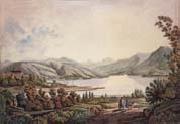
Swiss, 1758-1844,He began his career as a portrait painter in Basle and Pruntrut but in 1775 moved to Berne, where he took up landscape painting. From 1777 to 1781 he worked with Johann Ludwig Aberli and was also a colour-printer with the publisher Abraham Wagner (1734-82). In 1781 he went to Rome, where he remained for ten years working for Louis Ducros and for Giovanni Volpato. While in Rome he painted landscapes in watercolour and drew in bistre, using a soft brush and making little use of the pen. He also sketched in the Alban Hills, being particularly attracted to the waterfalls at Tivoli and Terni. He became a member of Goethe's circle in Rome, and, under the influence of its members, he adopted Claude as his model. His watercolours and bistre drawings, enlivened by Greco-Roman or contemporary staffage, became more tranquil, more classical in style and increasingly strengthened with pen outlines. In 1792 he returned to Basle to teach. He soon became an art dealer, opened his own shop and set up his own publishing house, and in 1802 he printed his best-known work, a series of aquatints of Voyage pittoresque de Basle ? Bienne par les vallons de Mottiers-Grandval. From 1802 to 1804 he showed at the annual exhibitions of the K?nstlergesellschaft in Zurich, and in 1804 and 1810 in Berne he exhibited work in oils, a medium that was becoming increasingly important for him. In 1805 he was commissioned by the publishing house of Artaria & Co. in Vienna to sketch the scenery in the region of the north Italian lakes. For the next 30 years he continued to paint and draw, but after 1834 he tended to repeat the locales and compositions of his earlier landscapes.
|
|
|
|
|
|
|
|
|
|
 |
Peter Fendi
|
|
1796-1842
Austrian
Peter Fendi Location
He was born in Vienna, Salzburg at (1796-09-04), and died in Vienna at 1842-08.
|
|
 |
PESNE, Antoine
|
|
French painter (1683-1757)
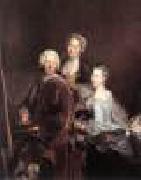
French painter active in Prussia. He studied with his father, the portrait painter Thomas Pesne (1653-1727), and with his maternal great-uncle, Charles de La Fosse. In 1703, as a pupil at the Academie Royale, he would have won the Prix de Rome with his Moses and the Daughters of Jethro (untraced), had not Jules Hardouin Mansart, adviser to the Academie, deemed all entries that year unworthy. Nevertheless Pesne left for Italy, making the acquaintance of Jean Raoux in Venice and being allowed the use of a studio in Rome by Charles Porson, Director of the Academie de France. While in Venice, Pesne painted the portrait of Friedrich Ernst von Knyphausen
|
|
 |
PESELLINO
|
|
Italian Early Renaissance Painter, 1422-1457
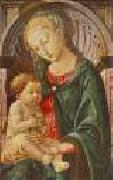
Italian painter. According to the catasto (land registry declaration) return of his grandfather PESELLO, Francesco di Stefano was five years old in 1427. He was the son of the painter Stefano di Francesco (d 1427), who married Pesello's eldest daughter. By the early 1440s, perhaps after initial training in his grandfather's workshop on the Corso degli Adimari, Florence, Pesellino appears to have joined Fra Filippo Lippi's workshop. He may have been the 'Franciesco di Stefano pittore' who enrolled in the Compagnia di S Luca in 1447. In August 1453 Pesellino went into partnership with Piero di Lorenzo di Pratese (d 1487) and Zanobi di Migliore, and numerous replicas of popular Virgin and Child compositions by Pesellino
|
|
 |
PERUGINO, Pietro
|
|
Italian painter, Umbrian school (b. 1450, Citta della Pieve, d. 1523, Perugia).
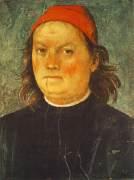
Italian painter and draughtsman. He was active in Perugia, Florence and Rome in the late 15th century and early 16th. Although he is now known mainly as the teacher of Raphael, he made a significant contribution to the development of painting from the style of the Early Renaissance to the High Renaissance. The compositional model he introduced, combining the Florentine figural style with an Umbrian use of structure and space,
|
|
|
|
|
|
 |
PERRONNEAU, Jean-Baptiste
|
|
French Rococo Era Painter, ca.1715-1783
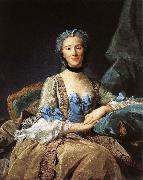
French pastellist, painter and engraver. He was, with his older contemporary Maurice Quentin de La Tour, the most important pastel artist and portrait painter in 18th-century France. Perronneau trained first with the engraver Laurent Cars and then with the successful portrait painter Hubert Drouais. His work as an engraver, which includes prints after Charles-Joseph Natoire, Fran?ois Boucher, Edme Bouchardon and Carle Vanloo (see Vaillat and Ratouis de Limay,), did not continue beyond the 1730s. Nevertheless, his involvement with Cars, much of whose work consisted in the reproduction of portraits by artists such as Hyacinthe Rigaud, left its mark on the composition of his pastels, most of which employ the bust-length format, often within a feigned stone oval typical of 17th- and 18th-century engraved portraits. His early pastel portrait of Mme Desfriches (1744; France, A.M. Ratouis de Limay priv. col.), mother of his friend and patron, the Orl?ans collector Aignan-Thomas Desfriches,
|
|
 |
Perov, Vasily
|
|
Russian Painter, 1834-1882
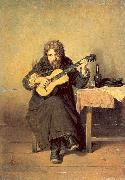
Russian painter. Son of a public prosecutor, he studied intermittently at Arzamas from 1846 to 1849 at the Art School of Alexander Stupin (1776-1862), a classicist painter whose School was the first of its type in provincial Russia, and during the 1850s at the Moscow School of Painting, Sculpture and Architecture under Sergey Zaryanko. The work of Pavel Fedotov, pictorial satire in the press and genre scenes by the Old Dutch masters and William Hogarth were the greatest formative influences on Perov. His early works, permeated by a Biedermeier romantic spirit, combine detailed brushwork with anecdotal narrative and aim at criticizing social behaviour in line with the contemporary democratic doctrines of such writers as Nikolay Chernyshevsky. Such anti-clerical pictures as the Village Sermon (1861; Moscow, Tret'yakov Gal.) are distinguished by a particular irony. As in the prose of Nikolai Leskov, which has many affinities with Perov's painting, there is a conflict between feelings of love and hatred, and between an intimate knowledge of the daily life of the people and an alienating irony. In 1862-4 Perov travelled abroad, working mainly in Paris, where he painted a series of vivid genre scenes of city life. Perov's success as a genre painter reached its peak in the latter half of the 1860s. His compositions become more laconic and expressive; overcoming an indisciplined use of colour, he achieved an impressive unity with an austere greyish-brown palette. Such works as the Drowned Girl (1867) and the Last Tavern by the City Gates
|
|
 |
Perino Del Vaga
|
|
Italian Mannerist Painter, ca.1501-1547
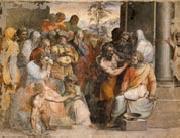
Italian painter and draughtsman. He trained in Florence, first with Andrea de' Ceri and from the age of 11 with Ridolfo Ghirlandaio. According to Vasari, he practised drawing by copying Michelangelo's cartoon for the Battle of Cascina (destr.). For Pope Leo X's entry into Florence in November 1515 he painted an allegorical figure on one of the twelve triumphal arches. Soon after, an obscure Florentine painter called Vaga took Perino to Rome, where he became known as del Vaga. There he continued his drawing studies, copying from works of antiquity and Michelangelo's ceiling in the Sistine Chapel. On the recommendation of Giulio Romano and Giovanni Francesco Penni, he joined Raphael's workshop, where he learnt stuccowork and how to design grotesques, through assisting Giovanni da Udine in the Vatican Logge. Soon he was painting scenes from Raphael's designs, and five or six ceiling frescoes in the Logge, including the Story of Joshua and the Story of David, are generally accepted as his.
|
|
 |
Pericles Pantazis
|
|
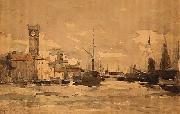
(Athens, 1849-1884) was a major Greek impressionist painter of the 19th century that gained a great reputation as an artist initially in Belgium.
Pantazis studied painting at the Athens School of Fine Arts from 1861 to 1871 with Nikiforos Lytras as his teacher. He continued for one year his studies in Munich and he then left for Marseille and Paris.In Paris he was taught by Gustave Courbet and Antoine Chintreuil. At this period he was introduced to the works of Eugene Boudin, Johan Barthold Jongkind and of the impressionists Manet, Camille Pissarro and Degas.
In 1873, with a reference letter from Manet, he moved to Brussels in Belgium. A notable Greek wine businessman Jean Économou was particularly interested in his skills and commissioned a large number of Pantazis paintings. In Belgium, Pantazis became a member of an anti-academic artistic group called Circle de la pâte (meaning the circle of colour), and a member of Les XX.
He became close friends with painter Guillaume Vogels and sculptor Auguste Philippette whose sister he married few years later. In Brussels, initially he worked as a home decorator for Guillaume Vogels but later he was dedicated to painting as he became increasingly known for his talent. In 1878 he represented Greece at the International Art Biennalle of Paris. He died before he turned 35 years old from chronic tuberculosis.
|
|
|
|
 |
PEREDA, Antonio de
|
|
Spanish Baroque Era Painter, ca.1611-1678
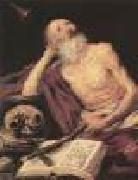
Spanish painter. He was the son of a minor painter of the same name (d 1622) and, after his father died, about 1627 he moved to Madrid with his mother. There he entered the studio of Pedro de las Cuevas, and his fellow pupils included such artists as Juan Carreeo de Miranda, Francisco Camilo, Jusepe Leonardo and Antonio Arias Fernendez. He must also have known and studied the work of many masters esteemed at court, particularly Vicente Carducho, echoes of whose work can be found in the former's early paintings. Pereda received protection early on from a member of the Royal Council, Francisco de Tejada, and later from Giovanni Battista Crescenzi, a painter and patron who was in Spain from 1617. Pereda probably completed his training through contact with Crescenzi's collection and eventually he lived in Crescenzi's house. In 1634 Pereda executed Aid to Genoa (Madrid, Prado) for the decoration of the Salen de Reinos in the Casen Buen Retiro, Madrid, a project involving all the leading artists of Madrid, including Carducho, Velezquez, Zurbaren and Jose Leonardo. The death of Crescenzi in 1635 deprived Pereda of further court commissions and seems to have stopped him painting any further secular works other than still-lifes. Also in 1635 he began a well-documented career as a religious painter, producing large altar paintings and many other medium-sized works, probably for private worship. Outstanding among these is the Immaculate Conception (1637) in the Convento de los Felipenses, Alcale de Henares (Madrid). The important allegorical painting Vanitas
|
|
|
|
 |
Percy Lindsay
|
|
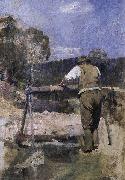
Percival (Percy) Charles Lindsay (1870 - 1952) was an Australian landscape painter, illustrator and cartoonist, born in Creswick, Victoria. Percy was the first child born to Jane Lindsay (nee Williams) and Dr Robert Charles Lindsay. His siblings included the well known artists: Sir Lionel Lindsay, Norman Lindsay, Ruby Lindsay and Sir Daryl Lindsay.
Percy first began painting while at school and further developed his skills during the late 1880s. Tuition from Fred Sheldon and Walter Withers saw him develop his painting skills to a professional level.
Percy moved to Melbourne in the 1890s and worked as an illustrator and cartoonist. During his time in Melbourne Percy was at the centre of the cities bohemian art community. In 1918 he moved with his wife and child to Sydney where he continued to paint landscapes while working as a cartoonist on the Bulletin magazine.
|
|
 |
Percy Gray
|
|
1869-1952
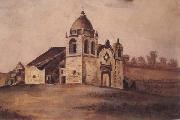
was an American painter. Gray was born into a San Francisco family endowed with a broad literary and artistic background. He studied under Arthur Frank Mathews at the San Francisco School of Design and later under William Merritt Chase. While he had some early Impressionistic tendencies, his primary expression was under the Tonalism Mathews had brought back from Paris. He is known for his extraction of beauty from the Northern California landscape. Alexander Gray, Percy's father, was born in England, but found his way to a successful insurance business in San Francisco. As the byproduct of a childhood illness, Percy realized he had talents in art. From 1886 to 1888 he attended the California School of Design, then led by Mathews. From there he went on to become a newspaper illustrator, obtaining a job with the New York Journal. In New York he also studied at the Art Students League. He was dispatched from New York to cover the 1906 San Francisco earthquake, but decided to remain in his native city where he would then take up his painting career. Gray's first pieces, headland seascapes, were exhibited in 1907; soon thereafter he addressed in watercolor eucalyptus groves and fields of California wildflowers. These subjects would become signatures of his work. Originally Gray's works were oils; however, he eventually developed an allergy to oil paints, and therefore switched to using watercolors as his primary medium. [1] From early on the critics marvelled at his ability to infuse realistic depictions of nature with a mystical and poetic quality. He was clearly applying the precepts of his mentor William Merritt Chase in exaggeration of light and color. From 1912 to 1923 Gray lived in Burlingame, California about twenty miles south of San Francisco, while keeping his studio in the city itself. At the 1915 Panama-Pacific International Exposition he won a bronze medal for his watercolor Out of the Desert, Oregon. Having been a bachelor for 53 years, Gray surprised his friends by marrying. He and his bride moved to the Bonificio Adobe in Monterey, where seascapes and cypress dominated his later works.
|
|
 |
percy bysshe shelley
|
|
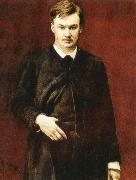
Born: 4 August 1792
Birthplace: Near Sussex, England
Died: 8 July 1822 (drowning)
Best Known As: 19th century romantic poet
|
|
|
|
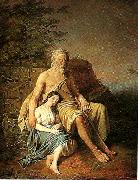 |
per wickenberg
|
|
1812-1846
Per Gabriel Wickenberg, född 1 oktober 1812 i Malmö, död 19 december 1846 i Pau, var en svensk konstnär.
Per Wickenberg kom från enkla förhållanden, hans far var fanjunkare, men visade tidigt en talang för teckning och måleri. 1831 skedde en insamling till hans förmån i Malmö, mend vars hjälp han fick möjlighet att komma till Stockholm att studera konst. Han besvärades tidigt av en ögonsjukdom, och med hjälp av bidrag från Konstföreningen i Stockholm fick han 1836 hjälp att resa till Tyskland för att söka bot. Efter tillfrisknandet valde han att stanna en tid i Berlin och vann där ett gott erkännande för sina tavlor. 1838 reste han till Paris, och vann där samma år guldmedalj på salongen för sin tavla "Nordiskt vinterlandskap". Wickenberg blev 1839 agre och 1842 ledamot av Konstakademien, under det att han stannade kvar i Paris. Wickenbergs ögonsjukdom återkom dock, och han insjuknade även i tuberkulos. Vintern 1843-44 uppehöll han sig i Nice, för att kurera sig, men förgåves, och 1846 avled han, bara 34 år gammal.
1842 tilldelades han Vasaorden och Hederslegionens kors.
|
|
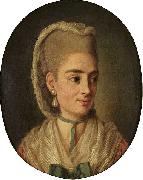 |
Per Krafft the Elder
|
|
(16 January 1724, Arboga - 7 November 1793, Stockholm) was a Swedish portraitist. He was the father of the artists Per Krafft the Younger and Wilhelmina Krafft.
|
|
|
|
|
|
|
|
 |
Penleigh boyd
|
|
Australia artist
1890-1923
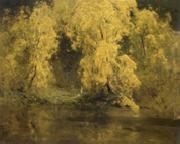
was an Australian artist. Penleigh Boyd was a member of the Boyd artistic dynasty: his parents Arthur Merric Boyd (1862-1940) and Emma Minnie Boyd (n??e ?? Beckett) were well-known artists of the day, and his brothers included Merric Boyd the ceramacist (1888-1959) and the novelist Martin Boyd (1893-1972). His son Robin Boyd (1919-1971) was a noted writer and architectural critic, and his nephews Arthur Boyd and David Boyd became prominent artists. Born in England at Penleigh House, Westbury, Wiltshire, Boyd received his artistic training from his parents and at the National Gallery Art School. He had his first exhibition at the Victorian Artists' Society at 18, and exhibited at the Royal Academy in London at 21. He won second prize in the Australian Federal Government's competition for a painting of the site of the new national capital, Canberra. He won the Wynne Prize in 1914 with Landscape. He served in the AIF (Australian Infantry Forces) in France in World War I, and was invalided out after being badly gassed at the battle of Ypres in 1917. His career was cut short when he was killed in a car accident near Warragul, Victoria in 1923. Penleigh Boyd is best known as a landscapist with an accomplished handling of evanescent effects of light. A notable influence was artist E. Phillips Fox, who introduced him to plein air techniques when they were neighbours in Paris in 1912-1913.
|
|
 |
PENCZ, Georg
|
|
German Northern Renaissance Painter, ca.1500-1550
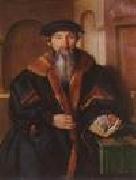
German painter, draughtsman and engraver. He arrived in Nuremberg in 1523 and entered Albrecht D?rer's workshop. On 12 January 1525 he was imprisoned with the brothers Barthel Beham and Sebald Beham and charged with disseminating the radical views of Thomas M?ntzer (c. 1490-1525) concerning religion and government. The council banished them from Nuremberg, but, after an appeal and intercession by Graf Albrecht von Mansfeld, Pencz was sent to nearby Windsheim, and on 16 November all three were pardoned, though placed under orders regarding their future behaviour.
|
|
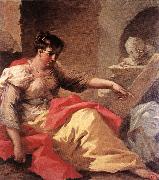 |
PELLEGRINI, Giovanni Antonio
|
|
Italian Rococo Era Painter, 1675-1741
Italian painter. With Sebastiano Ricci and Jacopo Amigoni he was the most important Venetian history painter of the early 18th century. By uniting the High Renaissance style of Paolo Veronese with the Baroque of Pietro da Cortona and Luca Giordano, he created graceful decorations that were particularly successful with the aristocracy of central and northern Europe. He travelled widely, working in Austria, England, the Netherlands, Germany and France.
|
|
|
|
|
|
|
|
|
| Wholesale China Oil Painting Wholesale Oil Painting China Xiamen Portrait Reproduction on canvas Chinese Oil Painting Wholesale USA Oil Painting |
|
|
|
|
|