| |
|
Xiamen Oil Paintings, Wholesale Direct!
|
|
100% hand painted, 100% cotton canvas, 100% money back if not satisfaction. |
|
|
|
|
ART WORKS INDEX
A
B
C
D
E
F
G
H
I
J
K
L
M
N
O
P
Q
R
S
T
U
V
W
X
Y
Z
|
|
ARTISTS INDEX
A
B
C
D
E
F
G
H
I
J
K
L
M
N
O
P
Q
R
S
T
U
V
W
X
Y
Z
|
|
|
|
 |
Salvator Rosa
|
|
1615-1673
Italian
Salvator Rosa Galleries
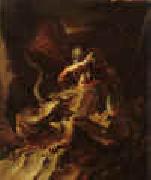
Salvatore Rosa (1615 - March 15, 1673) was an Italian Baroque painter, poet and printmaker, active in Naples, Rome and Florence. As a painter, he is best known as an "unorthodox and extravagant" and a "perpetual rebel" proto-Romantic. His life and writings were equally colorful.
He continued apprenticeship with Falcone, helping him complete his battlepiece canvases. In that studio, it is said that Lanfranco took notice of his work, and advised him to relocate to Rome, where he stayed from 1634-6.
Returning to Naples, he began painting haunting landscapes, overgrown with vegetation, or jagged beaches, mountains, and caves. Rosa was among the first to paint "romantic" landscapes, with a special turn for scenes of picturesque often turbulent and rugged scenes peopled with shepherds, brigands, seamen, soldiers. These early landscapes were sold cheaply through private dealers. This class of paintings peculiarly suited him.
He returned to Rome in 1638-39, where he was housed by Cardinal Francesco Maria Brancaccio, bishop of Viterbo. For the Chiesa Santa Maria della Morte in Viterbo, Rosa painted his first and one of his few altarpieces with an Incredulity of Thomas.
While Rosa had a facile genius at painting, he pursued a wide variety of arts: music, poetry, writing, etching, and acting. In Rome, he befriended Pietro Testa and Claude Lorraine. During a Roman carnival play he wrote and acted in a masque, in which his character bustled about Rome distributing satirical prescriptions for diseases of the body and more particularly of the mind. In costume, he inveighed against the farcical comedies acted in the Trastevere under the direction of Bernini.
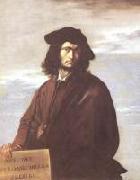
While his plays were successful, this also gained him powerful enemies among patrons and artists, including Bernini himself, in Rome. By late 1639, he had had to relocate to Florence, where he stayed for 8 years. He had been in part, invited by a Cardinal Giancarlo de Medici. Once there, Rosa sponsored a combination of studio and salon of poets, playwrights, and painters --the so called Accademia dei Percossi ("Academy of the Stricken"). To the rigid art milieu of Florence, he introduced his canvases of wild landscapes; while influential, he gathered few true pupils. Another painter poet, Lorenzo Lippi, shared with Rosa the hospitality of the cardinal and the same circle of friends. Lippi encouraged him to proceed with the poem Il Malmantile Racquistato. He was well acquainted also with Ugo and Giulio Maffei, and housed with them in Volterra, where he wrote four satires Music, Poetry, Painting and War. About the same time he painted his own portrait, now in the National Gallery, London.
|
|
 |
salvadore dali
|
|
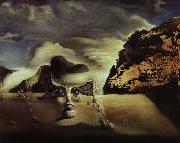
Born: 11 May 1904
Birthplace: Figueres, Spain
Died: 23 January 1989 (Heart failure)
Best Known As: Surrealist artist with the curly mustache
|
|
 |
SALUCCI, Alessandro
|
|
Italian painter, Roman school (b. 1590, Firenze, d. 1655/60, Roma). Italian painter. He specialized in imaginary architectural perspectives and harbour views, in which the figures were executed by other artists, most notably Jan Miel and Michelangelo Cerquozzi. His pictures were praised by contemporary and near contemporary writers, including Carlo Malvasia, and during the 17th century were popular with private collectors in both Florence and Rome. However, many of the paintings mentioned in contemporary sources remain untraced. He is first documented in Rome in 1628, when, with Andrea Sacchi and Pietro da Cortona, he worked on the fresco decorations of the Villa Sacchetti (now Chigi), Castelfusano (nr Ostia), to which he contributed personifications of the River Nile and the River Rh?ne (in situ). He became a member of the Accademia di S Luca in Rome in 1634, and after 1635 he was engaged on frescoes (in situ) depicting sacred subjects in S Maria in Vallicella, Rome. From the mid-1630s onward Salucci collaborated with Miel on the imaginary architectural subjects for which he is best known, including the Perspective with Portico
|
|
 |
Salomon van Ruysdael
|
|
Salomon van Ruysdael (c. 1602, Naarden - buried Nov 3, 1670, Haarlem) was a Dutch landscape painter. He was the uncle of Jacob van Ruisdael.
|
|
|
|
 |
Salomon Koninck
|
|
Dutch Baroque Era Painter, 1609-1656,was a Dutch painter of genre scenes and portraits and engraver. Koninck was the son of a goldsmith, originally from Antwerp, and was a nephew of Philips de Koninck. Salomon became a pupil of Pieter Lastman, David Colijns, Francois Venants and Claes Corneliszoon Moeyaert. From 1630 he was a member of the Sint Lucasgilde. He moved in the circles of Rembrandt and the academy of Hendrick van Uylenburgh, making many copies of Rembrandt's compositions. His paintings have a warm colour palette and include "the philosopher".
|
|
 |
Salomon Gessner
|
|
Swiss Painter, 1730-1788,a bookseller's son, was apprenticed to the bookseller Spener in Berlin. Giving up this employment, he lived for a time by painting and engraving, for which he had a considerable talent. In 1750 he settled in Zurich, continuing to live by painting, including painting on porcelain. He began to write idylls in poetic prose, beginning with Daphnis (1754). His Idyllen (1756) achieved a nation-wide success. In Der Tod Abels (1758) he attempted an epic in prose, which was followed by two plays (Schaferspiele), two stories, including Der erste Schiffer, and a few more idylls, Neue Idyllen (1772). In his idylls, Geßner, who is indebted to Theocritus and Virgil, creates an idealized, orderly, almost horticultural state of nature, from which everything rough and craggy has been eliminated; his shepherds are similarly untouched by the ruder aspects of country life. His work embodies the city-dweller's longing for a nature which he does not know, and this explains its instant popularity. W. Raabe uses Gebner's Idyllen, the publication of which coincided with the outbreak of the Seven Years War
|
|
 |
Salomon de Caus
|
|
b France, 1576; bur Paris, 28 Feb 1626,He was a Huguenot from the Dieppe region (Normandy). Between c. 1595 and 1598 he visited Italy, where he was strongly influenced by the gardens laid out c. 1570 by Bernardo Buontalenti at Pratolino, near Florence, and by their mechanical artifices. De Caus's work also reveals a knowledge of the gardens of the Villa d'Este in Tivoli. From c. 1598 to 1610 he was in Brussels, in the service of the Stadholder of the Netherlands, Albert, Archduke of Austria. There he was the engineer responsible for wells, fountains and the automatic works in the two grottoes (destr. 1768) in the garden of the Stadholder's residence. From 1610 he lived in England, moving in the artistic circle of Henry, Prince of Wales, to whom he taught drawing and for whom he built a picture gallery at Richmond. Together with Constantino de' Servi (1554-1622) he was engineer and supervisor of the waterworks at Richmond Palace. De Caus dedicated his first book, La Perspective (1612), to Prince Henry and included garden designs for the Prince in his second book, Les Raisons des forces movvantes (1615). He worked at several sites in England, including Somerset House in London, where he is thought to have erected a Parnassus, and at Greenwich Palace, Hatfield House and Gorhambury House (Herts) and Wilton House (Wilts). Nothing has survived of his work of this period.
|
|
 |
Salomon de Bray
|
|
(Amsterdam, 1597 - Haarlem, 11 May 1664) was a Dutch Golden Age architect and painter.
De Bray established himself in Haarlem before 1617, where he is registered as being a member of the schutterij that year in the St. Adrian's cloveniers.[1] He probably followed draftsmanship and painting lessons in the small academy started by Karel van Mander, Hendrick Goltzius and Cornelis van Haarlem, and where he married in 1625. He is registered as a pupil of Goltzius and Cornelis van Haarlem, but he probably started his training in Amsterdam with Jan Pynas, Nicolaes Moeyaert and Pieter Lastman.He painted history paintings, portraits and landscapes. As a Catholic he probably also made altar pieces for the Haarlem underground Catholic churches known as mission stations, or staties. He was a member of the Chamber of rhetoric called "De Wijngaertranken". This is probably how he met his wife Anna, the sister of the painter Jan and the poet Jacob Westerbaen. They married in 1625 and in 1630 he became a member of the Haarlem Guild of St. Luke. He cooperated with fellow Haarlem lukasguild member Jacob van Campen in the decoration of Huis ten Bosch in The Hague. His works draw on the spirit of the Dutch classicism beginning at that time, and are comparable with those of Pieter de Grebber.
Transcription of Salomon de Bray's proposed hierarchy of the guild in 1631. The Haarlem archivist C.J. Gonnet published a book in 1877 on the Haarlem St. Lukasgilde archives. This was meant for historians wishing to do research on Haarlem painting, but who could not read the old handwriting.De Bray was also active as a designer of silverwork, as a poet, as an architect and as a town planner for the city council of Haarlem. He designed an ambitious plan to expand the city on the North side that was partially implemented in the decades after his death. He became headman of the Guild of St. Luke and even prepared a new charter for the guild (that was never ratified) in 1631. As an architect, he was involved in the construction or expansion of Haarlem's City Hall, Zijlpoort, and St. Annakerk (Church of St. Anne), and Nijmegen's city orphanage. One of his poems was set to music by his friend the composer Cornelis Padbru??.
Salomon de Bray was the father of ten children, of whom three (Dirck de Bray, Jan de Bray, and Joseph de Bray) became notable artists. He probably died of the plague that hit Haarlem in 1664, as he and his children Jacob, Josef, Juliana and Margaretha all died in April and May of that year. His wife had already died the previous year. He was buried in the Sint-Bavokerk in Haarlem.
In 1631 Salomon de Bray wrote "Architectura Moderna" which provided a biography and descriptions of buildings built by Hendrick de Keyser, one of the key Dutch architects of the period
|
|
|
|
|
|
 |
SALINI, Tommaso
|
|
Italian painter, Roman school (b. 1575, Roma, d. 1625, Roma).Italian painter. He has long been famed as a witness in the lawsuit of 1603 brought by his friend and biographer, Giovanni Baglione, against Caravaggio. His activity as a painter of religious works, still-lifes and genre paintings has been reconstructed in the decades following 1950, although his chronology remains uncertain. He entered the Accademia di S Luca in 1605 but was afterwards expelled on account of his 'difetto', to be readmitted in 1618. He was decorated with the Order of the Golden Spur and became a member of the Congregazione di Virtuosi al Pantheon.
|
|
|
|
|
|
 |
SAFTLEVEN, Cornelis
|
|
Dutch painter (b. 1607, Gorinchem, d. 1681, Rotterdam).Painter and draughtsman. After training as a painter in Rotterdam, he may have visited Antwerp c. 1632-4. From c. 1634 he was in Utrecht, where his brother (2) Herman the younger had settled, and they collaborated on a portrait of Godard van Reede and his Family (1634-5; Maarssen, Slot Zuylen). In 1637 Cornelis was back in Rotterdam, where in 1648 he married Catharina van der Heyden (d Rotterdam, 1654). The year after her death, he married Elisabeth van der Avondt. He became dean of the Guild of St Luke in Rotterdam in 1667.
|
|
 |
SAENREDAM, Pieter Jansz
|
|
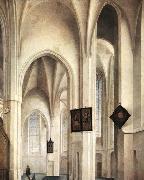
Dutch Baroque Era Painter, 1597-1665,Painter and draughtsman, son of Jan Saenredam. His paintings of churches and the old town halls in Haarlem, Utrecht and Amsterdam must have been appreciated by contemporary viewers principally as faithful representations of familiar and meaningful monuments. Yet they also reveal his exceptional sensitivity to aesthetic values; his paintings embody the most discriminating considerations of composition, colouring and craftsmanship. His oeuvre is comparatively small, the paintings numbering no more than 60, and each is obviously the product of careful calculation and many weeks of work. Their most striking features, unusual in the genre, are their light, closely valued tonalities and their restrained, restful and delicately balanced compositions. These pictures, always executed on smooth panels, are remarkable for their sense of harmony and, in some instances, serenity. Here, perhaps, lies a trace of filial fidelity to the Mannerist tradition of refinement and elegance, of lines never lacking in precision and grace. But Mannerist figures and the more comparable components of strap- and scrollwork embellishment lack the tension and clarity of Saenredam's designs, which also have a completeness reminiscent of the fugues of Gerrit Sweelinck (1566-?1628).
|
|
 |
SACCHI, Andrea
|
|
Italian painter, Roman school (b. 1599, Nettuno, d. 1661, Roma).Italian painter and designer. He occupied an important position, midway between Annibale Carracci and Carlo Maratti, in the development of a more restrained, less decorative painting in 17th-century Rome, a trend that culminated in the 18th century with Pompeo Batoni. Sacchi trained with Francesco Albani, Carracci's student, and taught Maratti. His often expressed devotion to the art of Raphael and Carracci and his criticism of the views of Pietro da Cortona and Gianlorenzo Bernini made him, with Nicolas Poussin and Alessandro Algardi, one of the most significant representatives of a stylistic and aesthetic opposition to the more flamboyant, extrovert aspects of the High Baroque. Sacchi did not, however, share Poussin's passionate interest in Classical antiquity, nor was his mature work as cerebral. Yet his mature style, less richly coloured than his early manner and more restrained emotionally,
|
|
 |
S.T.Gill
|
|
Australian original water-colour drawings and prints
b.1818-d.1880
also known by his signature S.T.G., was and English-born Australian artist. Gill was born in Perriton, Somerset, England, the eldest of five children. His father, the Reverend Samuel Gill, became headmaster of a school at Plymouth, and the son was educated first at this school and then at Dr Seabrook's Academy, Plymouth. Having moved to London, he was employed as a draughtsman and watercolour painter by the Hubard Profile Gallery, before departing for the colony of South Australia in 1839 with his parents.
|
|
 |
RUYSDAEL, Salomon van
|
|
Dutch Baroque Era Painter, ca.1600-1670.
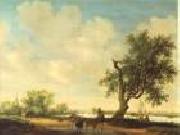
Dutch painter. He is best known for his atmospheric, almost monochromatic, river scenes, painted in the 1630s during the 'tonal phase' of Dutch art. His work in this genre is very close in style to that of Jan van Goyen, and their paintings have often been confused.
|
|
|
|
 |
Rudolf Swoboda
|
|
1859 - 1914
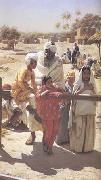
was a 19th-century Austrian painter, born in Vienna. He studied under Leopold Carl M??ller, and voyaged with him to Egypt in 1880. He was a well-known Orientalist. In 1886, Queen Victoria commissioned Swoboda to paint several of a group of Indian artisans who had been brought to Windsor as part of the Golden Jubilee preparations. Victoria liked the resulting paintings so much that she paid Swoboda's way to India to paint more of her Indian subjects.Swoboda painted many of the ordinary people of India in a grouping of small (no more than eight inches high) paintings which resulted. While in India, he stayed, part of the time, with John Lockwood Kipling, and met his son Rudyard Kipling. The younger Kipling was unimpressed with Swoboda, writing to a friend about two "Austrian maniacs" who thought they were "almighty" artists aiming to "embrace the whole blazing East".Upon his return from India, he also painted (in 1888 and 1889) two portraits of Abdul Karim,
|
|
|
|
|
|
 |
ROSA, Salvator
|
|
Italian Baroque Era Painter, 1615-1673
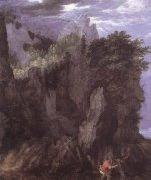
Italian painter, draughtsman, etcher, poet and actor. He was one of the most original artists and extravagant personalities of the 17th century. His most popular and influential works were his landscapes, the wild and mountainous beauty of which contrasted with the pastoral scenes of Claude Lorrain. Yet Rosa also painted macabre subjects, erudite philosophical allegories and grand historical themes; he was, moreover, the most significant satirical poet of the Italian 17th century, and there is a close relationship between his poetry and painting. His earliest biographers, Filippo Baldinucci and Giovanni Battista Passeri, both of whom knew him well, described at length his fiery temperament
|
|
 |
Roelant Savery
|
|
Flemish Northern Renaissance Painter, 1576-1639 . was a Flanders-born Dutch baroque painter of the Golden Age. Like so many other artists, Savery's Anabaptist family fled North from the Spanish occupied Southern Netherlands when Roelant was about 4 years old and settled in Haarlem around 1585. He was taught painting by his older brother Jacob Savery (c.1565-1603) and Hans Bol. After his schooling, Savery traveled to Prague around 1604, where he became court painter of the Emperors Rudolf II (1552-1612) and Mathias (1557-1619), who had made their court a center of mannerist art. Between 1606-1608 he traveled to Tyrol to study plants. Gillis d'Hondecoeter became his pupil.[3] Before 1616 Savery moved back to Amsterdam, and lived in the Sint Antoniesbreestraat. In 1618 he settled in Utrecht, where he joined the artist's guild a year later. His nephew Hans would become his most important assistant. In 1621 Savery bought a large house on the Boterstraat in Utrecht. The house had a large garden with flowers and plants, where a number of fellow painters, like Adam Willaerts were frequent visitors. Savery had kept his house in Amsterdam, and had one child baptized in Nieuwe Kerk (Amsterdam).[4] Savery was friends with still life painters like Balthasar van der Ast and Ambrosius Bosschaert. In the 1620s he was one of the most successful painters in Utrecht, but later his life got troubled, perhaps because of heavy drinking. Though he would have pupils until the late 1630s
|
|
 |
Roelandt Savery
|
|
1576-1639
Roelandt Savery Gallery
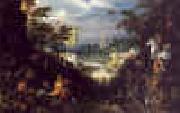
Like so many other artists, Savery's Anabaptist family fled North from the Spanish occupied Southern Netherlands when Roelant was about 4 years old and settled in Haarlem around 1585. He was taught painting by his older brother Jacob Savery (c.1565-1603) and Hans Bol.
After his schooling, Savery traveled to Prague around 1604, where he became court painter of the Emperors Rudolf II (1552-1612) and Mathias (1557-1619), who had made their court a center of mannerist art. Between 1606-1608 he traveled to Tyrol to study plants. Gillis d'Hondecoeter became his pupil.
Before 1616 Savery moved back to Amsterdam, and lived in the Sint Antoniesbreestraat. In 1618 he settled in Utrecht, where he joined the artist's guild a year later. His nephew Hans would become his most important assistant.
In 1621 Savery bought a large house on the Boterstraat in Utrecht. The house had a large garden with flowers and plants, where a number of fellow painters, like Adam Willaerts were frequent visitors. Savery had kept his house in Amsterdam, and had one child baptized in Nieuwe Kerk (Amsterdam).
Savery was friends with still life painters like Balthasar van der Ast and Ambrosius Bosschaert. In the 1620s he was one of the most successful painters in Utrecht, but later his life got troubled, perhaps because of heavy drinking. Though he would have pupils until the late 1630s, amongst which Allaert van Everdingen and Roelant Roghman, he went bankrupt in 1638 and died half a year later.
|
|
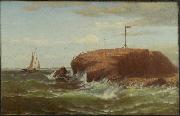 |
Robert Swain Gifford
|
|
(December 23, 1840 - January 13, 1905) was an American landscape painter. He was influenced by the Barbizon school.
Much of his work focuses on the landscapes of New England, where he was born. He, along with Victorian contemporaries from the White Mountain and Hudson River Schools, helped immortalize the majestic cliffs of Grand Manan in the Bay of Fundy. His painting from the island, "Pettes Cove," is illustrative of his masterful marine work.
In the 1870s, he undertook several journeys to Europe and the Middle East and painted some subjects from those regions. In 1899, he was an artist on the famous Harriman Alaska Expedition.
Some of his works hang in the most prominent galleries in the USA, including the Fine Arts Museums of San Francisco, the Metropolitan Museum of Art, New York, and the Smithsonian American Art Museum, Washington DC. He was a member of the Society of American Artists.
|
|
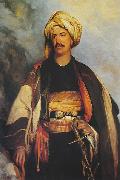 |
Robert Scott Lauder
|
|
Robert Scott Lauder (25 June 1803 - 21 April 1869) was a Scottish mid-Victorian artist who described himself as a "historical painter". He was one of the original members of the Royal Scottish Academy.
Lauder was born at Silvermills, Edinburgh, on 25 June 1803, the third son of John Lauder of Silvermills (died 1838), Burgess of Edinburgh and proprietor of the tannery at Silvermills, by his wife Helen Tait (d.1850). After attending the Royal High School he went to London, where his eldest brother William was engaged in the family business.
He returned to Edinburgh about 1826 and was elected one of the original members of the Royal Scottish Academy in 1830. On 9 September 1833 at St.Cuthberts in Edinburgh he married Isabella Ramsay Thomson and they then went abroad, accompanied by his younger artist-brother, James Eckford Lauder. Robert studied for some years in Rome, Florence, Bologna, Venice and Munich.
Lauder returned to London in 1838 where he lived for several years, where his three children - Isabella, John, and Robert, were baptised at St.Thomases Church, Southwark, in 1840, 1841, and 1844. Whilst in London he exhibited at the Royal Academy and competed in the Westminster Hall competition of 1847, sending his Christ walking on the Sea, which was subsequently purchased by Lady Angela Burdett-Coutts, 1st Baroness Burdett-Coutts. He became the first president of the short-lived National Institution of Fine Arts and also exhibited there.
He later removed back to Edinburgh in 1849 where both his sons - Robert Scott Lauder (born 1844), who became a physician, and John Thomson Lauder (1841-1865) - attended the Edinburgh Academy. Sir Walter Scott's novels provided him with subjects for many of his most successful historical paintings. About 1860 he suffered a paralytic stroke and did not practice after 1861. He died at Edinburgh from a bout of bronchitis on 21 April 1869, still paralysed. He is buried in Warriston Cemetery in Edinburgh.
|
|
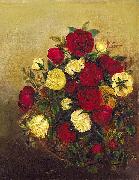 |
Robert Scott Duncanson
|
|
(1821 - December 21, 1872) was born in Seneca County, New York in 1821.Duncansones father was a Canadian of Scottish descent and his mother was an African American, thus making him ea freeborn person of color.e Duncanson, an artist who is relatively unknown today, painted America, both physically and figuratively, at a time when the country was in turmoil. Beautiful and serene, Duncansones work sheds light on American art that has been forgotten over the years.
|
|
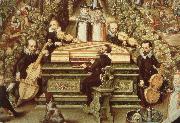 |
robert schumann
|
|
Date of birth: June 8, 1810 at Zwickau, Germany
Died: Jul 29, 1856 in Endenich, Germany Death: July 29, 1856 at Endenich, Germany
|
|
 |
Robert Salmon
|
|
1775-1844
American painter of English origin. Having trained and painted in England and Scotland, he moved to Boston in 1828, painting in a 'little hut' near the wharves of South Boston. Reportedly an eccentric, he became a successful painter of marine views, adopting a range of different scales, including small wooden panels, larger canvases and theatre backdrops. Moonlight Coastal Scene (1836; St Louis, MO, A. Mus.) is typical of his works on panel, and it demonstrates his use of light to silhouette form. There are no extant examples of the panoramic views done as backdrops; his canvases such as Wharves of Boston (1829; Boston, MA, Old State House) and View of Charlestown (1833; Annapolis, MD, US Naval Acad. Mus.) are full of carefully delineated figures, minute and accurate details of the ships and their rigging, and, most importantly, large expanses of sky dominated by strong light. Salmon's portrayal of light-filled water and sky, increasingly luminous in the late 1830s and early 1840s, has caused him to be considered by some as the father of LUMINISM (i). He used a low viewpoint and contrasted a distant shoreline and small-scale figures in the foreground in a manner that prefigured the work of Fitz Hugh Lane and Martin Johnson Heade, both of whom were influenced by Salmon's manipulation of scale, light and subject-matter. It appears that he returned to England before his death.
|
|
 |
Robert S.Duncanson
|
|
American artist .
1821-1872
A self-taught mulatto artist and a landscape painter of the Hudson River school tradition, Duncanson was the first Afro-American artist to receive international recognition. Born into a family of painters and handymen, Duncanson first worked as a house-painter and glazier in Monroe, MI. By 1841 he was in Cincinnati, OH, where he learnt to paint by executing portraits and copying prints. Throughout the 1840s he travelled as an itinerant artist between Cincinnati, Monroe and Detroit.
|
|
 |
Ridolfo Schadow
|
|
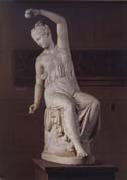
1786-1822 Rome,Sculptor, son of Johann Gottfried Schadow. He trained in his father's studio in Berlin, exhibiting statues and reliefs at the Berlin Akademie exhibitions between 1802 and 1810. Work from this period included both mythological and religious subjects, such as the plaster relief The Flood (c. 1804; Berlin, Alte N.G.). In 1810, with his brother Wilhelm Schadow, Ridolfo moved to Rome, in 1811 taking over the Roman sculpture studio of Christian Daniel Rauch. Schadow's first Roman work, a statue of Paris (destr.; several copies, e.g. bronze, 1820; Potsdam, Schloss Charlottenhof) was exhibited at the Berlin Akademie in 1812, and it reveals the influence of the Danish sculptor Bertel Thorvaldsen. Although homesickness and lack of confidence drove Schadow briefly back to Berlin, he soon returned to Rome, along with Rauch. From this point Schadow's work is markedly individual: he brought a realistic, genre treatment to his figures, which drew on both classical tradition and the formal language of idealizing early 19th-century painting. He chose subjects that offered scope for idealization within a realistic context, as in the seated figures of a Woman Fastening her Sandals (marble, 1813; Munich, Bayer. Nmus.), a Woman Spinning (marble, 1816; Cologne, Wallraf-Richartz-Mus.) and a Girl with Doves (Innocence) (marble, 1820; Berlin, Alte N.G.). Under the influence of his brother Wilhelm and of Friedrich Overbeck, Schadow converted to Catholicism in 1814. His early death interrupted work on the plaster model for a sculptural group,
|
|
 |
RICCI, Sebastiano
|
|
Italian painter, Venetian school (b. 1659, Belluno, d. 1734, Venezia).Painter and draughtsman. He painted light and colourful religious, historical and mythological subjects with a fluid, painterly touch. His rediscovery of Paolo Veronese, whose settings and costumes he borrowed, was important to later Venetian painters. Sebastiano was an itinerant artist, celebrated throughout Europe.
|
|
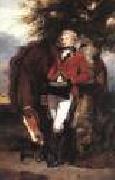 |
REYNOLDS, Sir Joshua
|
|
English Rococo Era Painter, 1723-1792
English painter, collector and writer. The foremost portrait painter in England in the 18th century, he transformed early Georgian portraiture by greatly enlarging its range. His poses, frequently based on the Old Masters or antique sculpture, were intended to invoke classical values and to enhance the dignity of his sitters. His rich colour, strong lighting and free handling of paint greatly influenced the generation of Thomas Lawrence and Henry Raeburn. His history and fancy pictures explored dramatic and emotional themes that became increasingly popular with both artists and collectors in the Romantic period. As first president of the Royal Academy in London, he did more than anyone to raise the status of art and artists in Britain. His Discourses on Art, delivered to the students and members of the Academy between 1769 and 1790,
|
|
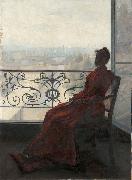 |
Rene Schutzenberger
|
|
Rene Schutzenberger (Mulhouse July 29, 1860, Paris December 31, 1916), also known as Paul Rene Schutzenberger, was a French painter.
Born in an Alsatian family of famous brewers, his father Paul Schutzenberger (1829-1897) was a French chemist. The painter Louis-Frederic Schutzenberger (1825-1903) was his cousin.
He studied at the Academie Julian under Jean-Paul Laurens.
He started to exhibit at the Salon des artistes français since 1891, at the Salon des Independants since 1902 and at the Societe Nationale des Beaux-Arts since 1907. He got an honourable mention at the Salon of 1897 and at the Universal Exhibition of 1900.
He practices genre painting, portraits, nudes and landscapes. He treats subjects of the daily life and intimists subjects. His style is close to the Post-Impressionism movement. His drawings are influenced by the Nabis.
|
|
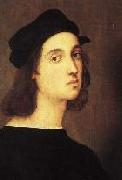 |
RAFFAELLO Sanzio
|
|
Italian High Renaissance Painter, 1483-1520
Italian painter and architect. As a member of Perugino's workshop, he established his mastery by 17 and began receiving important commissions. In 1504 he moved to Florence, where he executed many of his famous Madonnas; his unity of composition and suppression of inessentials is evident in The Madonna of the Goldfinch (c. 1506). Though influenced by Leonardo da Vinci's chiaroscuro and sfumato, his figure types were his own creation, with round, gentle faces that reveal human sentiments raised to a sublime serenity. In 1508 he was summoned to Rome to decorate a suite of papal chambers in the Vatican. The frescoes in the Stanza della Segnatura are probably his greatest work; the most famous, The School of Athens (1510 C 11), is a complex and magnificently ordered allegory of secular knowledge showing Greek philosophers in an architectural setting. The Madonnas he painted in Rome show him turning away from his earlier work's serenity to emphasize movement and grandeur, partly under Michelangelo's High Renaissance influence. The Sistine Madonna (1513) shows the richness of colour and new boldness of compositional invention typical of his Roman period. He became the most important portraitist in Rome, designed 10 large tapestries to hang in the Sistine Chapel, designed a church and a chapel, assumed the direction of work on St. Peter's Basilica at the death of Donato Bramante,
|
|
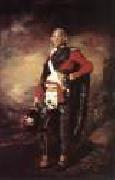 |
RAEBURN, Sir Henry
|
|
Scottish Romantic Painter, 1756-1823
Scottish painter. He is perhaps the best known of all Scottish painters, with a critical reputation rivalling that of Allan Ramsay. He was almost exclusively a portrait painter, and his work did much to define Scottish society in a period of immense vigour and intellectual distinction. The demand for his work was sufficient to sustain a career wholly in Scotland, although he occasionally regretted his lack of first-hand knowledge of portrait painting in London. His working life, which was largely confined to Edinburgh
|
|
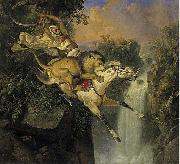 |
Raden Saleh
|
|
(1807 or 1811 - April 23, 1880) is one of the best known painters from Indonesia and a pioneer of modern Indonesian art.
He was considered to be the first modern artist from the Dutch East Indies (now Indonesia), and his paintings corresponded with nineteenth-century romanticism which was popular in Europe at the time. He also expressed his cultural roots and inventiveness in his work.
Raden Saleh, was born into a noble Javanese family. He was grandson of Sayyid Abdullah Bustaman from his mother's side. His father was Sayyid Husen bin Alwi bin Awal bin Yahya, an indonesian of arab descent.
|
|
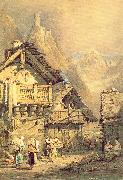 |
Prout, Samuel
|
|
English Painter, 1783-1852
Painter, draughtsman and writer. Together with his fellow pupil Benjamin Robert Haydon, Prout was encouraged to study drawing by the headmaster of his grammar school in Plymouth. In 1801 he met the topographer and antiquarian John Britton, who, impressed with his work, invited him to London the following year to make drawings of antiquarian subjects and copy works of other artists, including Thomas Hearne, William Alexander and J. M. W. Turner.
|
|
|
|
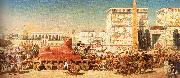 |
Poynter, Sir Edward John
|
|
English Classicist Painter, 1836-1919
English painter, draughtsman, decorative designer and museum official. He came from an artistic family: his great-grandfather was Thomas Banks the sculptor, and Ambrose Poynter, his father, was an architect and watercolour painter. Edward began studying art in 1852 under Thomas Shotter Boys, a friend of his father. In 1853-4 Poynter visited Rome, where he was greatly impressed by the large-scale academic painting of Frederic Leighton. Returning to London, he studied at Leigh's Academy and the studio of William Dobson (1817-1898). Poynter entered the Royal Academy Schools in 1855 but his admiration for French painting led him to Charles Gleyre's studio in Paris the following year. He remained there until 1859, with fellow students George Du Maurier, Thomas Armstrong and Whistler; their activities are described in Du Maurier's novel Trilby (1894). At this time Poynter received his first commissions for decorative work. He began designing stained glass and painting furniture and, after his return to England, he was employed by his friend the architect William Burges to decorate the ceiling of Waltham Abbey, Essex, in 1860.
|
|
|
|
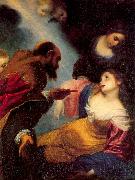 |
Pignoni, Simone
|
|
Italian, 1611-98
Italian painter and draughtsman. He is best known for his many pictures of voluptuous female nudes, which developed the morbidly sensual style of Francesco Furini. His Self-portrait (c. 1650; Florence, Uffizi), in which he depicts himself building up a rounded female form from a skeleton, conveys his fascination with the subject. He had an early education in Latin, followed by an apprenticeship in the workshop of the bookbinder Zanobi Pignoni, a close relative. Domenico Passignano, who frequented the workshop, suggested that Pignoni be apprenticed to Fabrizio Boschi (1570-1642), one of his own former pupils. Pignoni began to study under Boschi
|
|
 |
Pieter Soutman
|
|
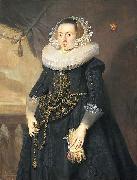
(1593-1601 - 16 August 1657) was a Dutch Golden Age painter and printmaker from Haarlem.
|
|
 |
Pieter Saenredam
|
|
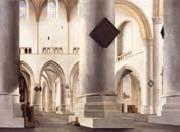
b. 1597, Assendelft, d. 1665, Haarlem,Painter and draughtsman, son of Jan Saenredam. His paintings of churches and the old town halls in Haarlem, Utrecht and Amsterdam must have been appreciated by contemporary viewers principally as faithful representations of familiar and meaningful monuments. Yet they also reveal his exceptional sensitivity to aesthetic values; his paintings embody the most discriminating considerations of composition, colouring and craftsmanship. His oeuvre is comparatively small, the paintings numbering no more than 60, and each is obviously the product of careful calculation and many weeks of work. Their most striking features, unusual in the genre, are their light, closely valued tonalities and their restrained, restful and delicately balanced compositions. These pictures, always executed on smooth panels, are remarkable for their sense of harmony and, in some instances, serenity. Here, perhaps, lies a trace of filial fidelity to the Mannerist tradition of refinement and elegance, of lines never lacking in precision and grace. But Mannerist figures and the more comparable components of strap- and scrollwork embellishment lack the tension and clarity of Saenredam's designs, which also have a completeness reminiscent of the fugues of Gerrit Sweelinck (1566-?1628).
|
|
 |
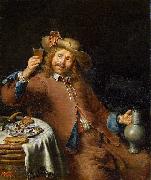
Pieter Jansz. Saenredam
|
|
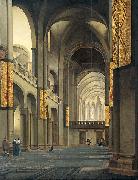
(June 9 1597 - buried May 31 1665) was a painter of the Dutch Golden Age, known for his distinctive paintings of whitewashed church interiors.
Saenredam was born in Assendelft, the son of the Northern Mannerist printmaker and draughtsman Jan Pietersz Saenredam (1565-1607), a follower of Goltzius whose sensuous naked goddesses are in great contrast with the work of his son. In 1612 he moved to Haarlem, where he became a pupil of Frans de Grebber and lived for the rest of his life. In 1614 he became a member of the Haarlem Guild of St. Luke. He died in Haarlem.
A contemporary of the painter-architects Jacob van Campen, Salomon de Bray, and Pieter Post, he is noted for his surprisingly modern paintings of church interiors, the great bulk of his production. Saenredam achieved this modern look by using very even light, subtlely modulated, and by removing detailed depiction of textures, in meticulously measured and drawn sketches. He would make these sketches in pencil, pen, and chalk, then and add in watercolor to help give the sketch texture and color. The sketches are detailed, conveying the interior atmosphere through the clever use of light and graduated shadows. Saenredam often deliberately omitted people and church furniture from work, thus focusing more attention on buildings and their architectural forms. Only after having made precise measurements, and precise sketches and drawings of the churches, he would take them to his studio where he started to create his paintings, often after a delay of many years. His emphasis on even light and geometry is brought out by comparing his works with those of the rather younger Emanuel de Witte, who included people, contrasts of light and such clutter of church furniture as remained in Calvinist churches, all usually ignored by Saenredam. Unlike de Witte's, Saenredam's views are usually roughly aligned with a main axis of the church.
|
|
 |
Pieter Jansz Saenredam
|
|
1597-1665
Dutch
Pieter Jansz Saenredam Gallery
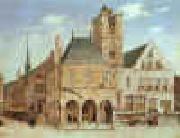
Saenredam was the son of the print maker and draughtsman Jan Pietersz Saenredam (1565-1607), who was born in Zaandam or, in those days, Saenredam. In 1612 he moved to Haarlem, where he became a pupil of Frans de Grebber and lived the rest of his life.
A contemporary of Rembrandt, he is noted chiefly for his surprisingly modern paintings of churches. Saenredam achieved this modern look by meticulously measuring and making sketches of the churches he wanted to paint. He would make these sketches in pencil, pen, and chalk, then and add in water colors to help give the sketch texture and color. The sketches are very architectural in detail, they convey the interior atmosphere through the clever use of light and graduated shadows. Saenredam often deliberately left people out of his work, thus also focusing more attention on buildings and their architectural forms. Only after having made precise measurements, and precise sketches and drawings of the churches, he would take them to his studio where he started to create his paintings.
The Reformation led to a rise in Protestant art, of which Saenredam??s Interior of the St. Martin's Dom in Utrecht is an example. As a Catholic church the Dom had been built with adornments. Then, in the epoch of the Eighty Years War and with the church getting in Protestant hands, it was ??cleaned?? of Catholic influences. The altarpieces and statuary were removed, and the walls and ceiling were white washed. The painting shows the church not long after its make-over. The sparse interior with illuminated corridors reflect Protestant ideals, new for Saenredam's time.
Alternatively, the paintings of church interiors by Saenredam and other 17th century Dutch painters have been interpreted as having less to do with religion and more with the new-found interest in perspective and with the Dutch interpretation (known as Dutch Classicism) of Palladio??s theories of proportion, balance and symmetry.
In any case, Saenredam wanted to memorialize his country during this time of change by documenting many of the country??s buildings. Many artists before him had specialized in imaginary and fanciful architecture, but Saenredam was the first to focus on existing buildings. According to the J. Paul Getty Trust ??Saenredam??s church paintings??owe their poetry to his remarkable blend of fact and fiction. He began by making site drawings of buildings that record measurements and detail with archaeological thoroughness.?? This meticulous preparation helped him to create such accurate and enchanting paintings. The measurements aided him in using scientific linear perspective, just like Andrea Pozzo. He was able to use his measurements to create a realistic image with depth.
The Utrecht Archives houses a large number of Saenredam's drawings. In the season 2000-2001 the Centraal Museum at Utrecht held a major exhibition of his drawings and paintings. Perhaps his best known works are a pair of oil paintings both titled Interior of the Buurkerk, Utrecht. One hangs in London's National Gallery, the other in the Kimbell Art Museum in Fort Worth, Texas. In their simplicity and semi-abstract formalism, they foreshadow more modern works such as those of Mondrian and Feininger.
|
|
 |
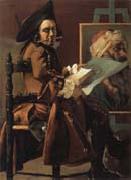
Pieter Cornelisz. van Slingelandt
|
|
(20 October 1640 - 7 November 1691) was a Dutch Golden Age painter.
According to Houbraken, his teacher was Gerard Dou, who he imitated so well that many of his works were later misattributed to him. According to Houbraken he was rather introverted and very methodical and conscientious, spending months on his works and striving for perfection. Houbraken especially liked a piece where a maid holds a mouse by the tail as a cat jumps for it.
Houbraken wrote that while Slingelandt was working on a family portrait for the gentleman Francois Meerman (1630-1672),
|
|
 |
Pierre Subleyras
|
|
1699-1749
French painter, draughtsman and printmaker, active in Italy. He was one of the foremost French painters of portraits and religious compositions of the first half of the 18th century. From 1728 he lived in Rome, first as a student and then as an independent master working principally for the religious orders.
|
|
|
|
|
|
|
|
|
| Wholesale China Oil Painting Wholesale Oil Painting China Xiamen Portrait Reproduction on canvas Chinese Oil Painting Wholesale USA Oil Painting |
|
|
|
|
|