| |
|
Xiamen Oil Paintings, Wholesale Direct!
|
|
100% hand painted, 100% cotton canvas, 100% money back if not satisfaction. |
|
|
|
|
ART WORKS INDEX
A
B
C
D
E
F
G
H
I
J
K
L
M
N
O
P
Q
R
S
T
U
V
W
X
Y
Z
|
|
ARTISTS INDEX
A
B
C
D
E
F
G
H
I
J
K
L
M
N
O
P
Q
R
S
T
U
V
W
X
Y
Z
|
|
|
|
|
|
|
|
 |
Vincenzo Foppa
|
|
1427-1516
Italian
Vincenzo Foppa Locations
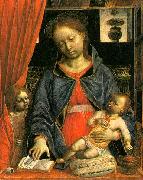
Italian painter. Giving new life to the art of the Lombard school, he exercised a great influence upon northern Italian art until the advent of Leonardo da Vinci. He settled (c.1456) in Pavia. There and in Milan he executed many important frescoes, most of which have been destroyed. He painted religious subjects exclusively, ranging from powerful renditions of the Crucifixion (Bergamo) to poignant depictions of the Madonna (Milan; Johnson Coll., Philadelphia; Davis Coll., Newport, R.I.; National Gall. of Art, Washington, D.C.). His large altarpiece of the Madonna and Child with Saints (Brera, Milan) is a notable example of his technical skill and variety of characterization.
|
|
|
|
 |
Vincenzo Chialli
|
|
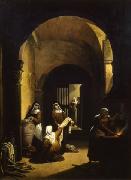
was born at Citte di Castello in 1787. After having learned the rudiments of art in that town, he visited Rome at the age of seventeen years, and became a disciple of Camuccini, whom he afterwards imitated. After leaving Rome he painted religious subjects at Borgo San Sepolcro, Urbino, Pesaro, and Venice, from whence he retraced his steps to Rome; but as the climate did not suit him, he left that city in 1822 and returned to Citta di Castello. He became Director of the School of Painting at Cortona in 1835, and died in 1840.
|
|
 |
Vincenzo Catena
|
|
Italian
c1480-1531
Vincenzo Catena Location
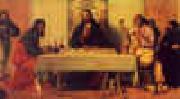
Italian painter. His paintings represent the perpetuation of the style of Giovanni Bellini into the second quarter of the 16th century. He made few concessions to the modern style that was being introduced to Venice by Titian, Palma Vecchio, Pordenone and others in the same period. This archaicizing tendency was shared by several minor Bellinesque painters of the period, including Pietro degli Ingannati, Pietro Duia, Francesco Bissolo, Vittore Belliniano and the Master of the Incredulity of St Thomas. Catena, together with Marco Basaiti, with whose works Catena are sometimes confused, can be considered the most accomplished of these. Despite the fact that he counted several humanists in his circle, the extant repertory of his subjects is limited to religious themes, mainly Marian and including three altarpieces, and to male portraits. The latter, as Vasari observed, include several of his finest works.
|
|
|
|
 |
Vincenzo Campi
|
|
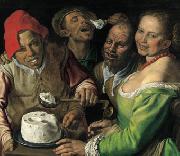
Vincenzo Campi (c. 1536 - 1591) was an Italian painter of the Renaissance from Cremona.
His style merges Lombard with Mannerist styles, however, unlike his siblings, he is known for a series of canvases, mostly painted after 1570s [1], displaying genre scenes and local produce. Many set at a food store front of some sort. At the time, this type of paintings were uncommon in Italy, and more common in Netherlands, as exemplified by the canvases of Joachim Beuckelaer.
In Cremona, his extended family was the main artistic studio of his time. Giulio Campi and Antonio Campi were reportedly half-brothers, while Bernardino Campi was a distant relative. All were active and prominent local painters. In 1586-1589, he and his brother Antonio completed paintings for the church of San Paolo Converso in Milan.
|
|
|
|
 |
Vincent Van Gogh
|
|
Dutch Post-Impressionist Painter, 1853-1890
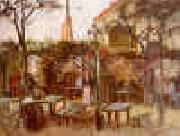
Vincent Willem van Gogh (30 March 1853 ?C 29 July 1890) was a Dutch Post-Impressionist artist. Some of his paintings are now among the world's best known, most popular and expensive works of art.
Van Gogh spent his early adult life working for a firm of art dealers. After a brief spell as a teacher, he became a missionary worker in a very poor mining region. He did not embark upon a career as an artist until 1880. Initially, Van Gogh worked only with sombre colours, until he encountered Impressionism and Neo-Impressionism in Paris. He incorporated their brighter colours and style of painting into a uniquely recognizable style, which was fully developed during the time he spent at Arles, France. He produced more than 2,000 works, including around 900 paintings and 1,100 drawings and sketches, during the last ten years of his life. Most of his best-known works were produced in the final two years of his life, during which time he cut off part of his left ear following a breakdown in his friendship with Paul Gauguin. After this he suffered recurrent bouts of mental illness, which led to his suicide.
The central figure in Van Gogh's life was his brother Theo, who continually and selflessly provided financial support. Their lifelong friendship is documented in numerous letters they exchanged from August 1872 onwards. Van Gogh is a pioneer of what came to be known as Expressionism. He had an enormous influence on 20th century art, especially on the Fauves and German Expressionists.
|
|
 |
Vincent Sellaer
|
|
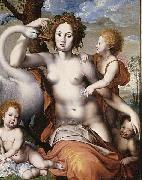
painted Leda with Swan and Children in1st half of 16th century
|
|
|
|
 |
villelm melbye
|
|
Danish, 1824-1882
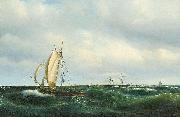
The brother of Anton and Fritz, both Danish artists, Vilhelm Knut Frederik Melbye was born in Denmark and would finish his career as a Professor in the Copenhagen Academy, appointed in 1880. His years between would see him work out of the important venues of Dusseldorf, Venice, Paris and London.
His paintings may almost be used as a travelogue to his career. Working in the Netherlands and paintings scenes of the North and Black Seas through the late 1840s, he exhibited regularly at Charlottenborg in Copenhagen. Melbye lands in London by the early 1850s and ??anglicizes?? his signature to Wilhelm Melby. Paintings by him of Gibraltar and the Italian Mediterranean are in prominent public collections with dates from 1854-62. British subjects reappear in the 1860s, and in 1878, he exhibits at the Parisian Academies. Some later works are signed with initials or his given name once again.
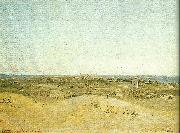
The heart of all his paintings is his obvious attraction to the coastal harbors and marine settings of Europe. They dominate his output, and are compositions full of realistic and dramatic elements emphasizing humanity??s maritime efforts. Cool light, layered shadows and a talent for translating visual depth are noticeable elements in his paintings.
|
|
|
|
 |
Vilhelm Melbye
|
|
(14 May 1824 - 6 October 1882) was a Danish marine artist, the brother of Anton Melbye and Fritz Melbye. He worked in London from 1853 to 1866 and, over the course of his career, painted seascapes, coastal and harbor scenes, sailing vessels and topographical subjects in many parts of Europe, especially in the Mediterranean region.
Knud Frederik Vilhelm Hannibal Melbye was born on 14 May 1824 in Elsinore, Denmark. He first trained to become a merchant but then turned to painting, studying under his older brother Anton, already an established marine painter, and attending the Royal Danish Academy of Fine Arts from 1844 to 1847. He also took private classes in perspective drawing with Carl Dahl.
In 1847, he went on his first journey, to Iceland aboard the corvette Valkyrien, and the following year he traveled to Paris by way of Desseldorf. In Paris he studied with Theodore Gudin (1802 - 1880) before returning to Denmark in 1849.
From 1853 to 1866, he lived in London and it was here he changed his name from Vilhelm to Wilhelm.
He was appointed Professor at the academy in Copenhagen in 1880 but died in 1882 in Roskilde. He is interred at Assistens Cemetery in Copenhagen.
|
|
 |
Vilhelm Kyhm
|
|
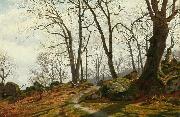
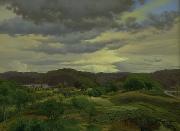
"Jysk skovegn" ("Jutland woodlands"), painted near Silkeborg in 1845 by Vilhelm Kyhn in the very beginning of his career, exhibited at Charlottenborg in 1846. Oil on canvas, 77,5x104 cm.
|
|
 |
Vilhelm Hammershoi
|
|
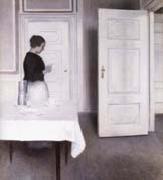
Danish Painter, 1864-1916, was a painter born in Copenhagen, Denmark known for his poetic, low-key portraits and interiors.The son of a well-to-do merchant, Christian Hammershoi and his wife, Frederikke (nee Rentzmann), Vilhelm studied drawing from the age of eight with Neils Christian Kierkegaard and Holger Gronvold, as well as painting with Vilhelm Kyhn, before embarking on studies with Frederik Vermehren and others at the Royal Danish Academy of Fine Arts. From 1883 to 1885, he studied with Peder Severin Kroyer.
|
|
|
|
|
|
 |
Viktor Vasnetsov
|
|
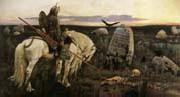
Russian Painter , 1848-1926
Painter, designer and graphic artist. He played a leading role in the evolution of Russian art from 19th-century realism towards Art Nouveau with a national historical slant. The son of a priest, he studied at a theological seminary in Vyatka (1862-7); then, developing a passion for drawing, he entered the drawing school of the Society for the Encouragement of the Arts, St Petersburg, and studied under Ivan Kramskoy in 1867-8. He perfected his skills at the Academy of Arts, St Petersburg, in 1869-75 and joined the WANDERERS in 1878.
|
|
 |
VIGNON, Claude
|
|
French Baroque Era Painter, 1593-1670
French painter, printmaker and illustrator. Born into a prosperous family in Tours, he received his early training in Paris, probably in Jacob Bunel's studio. In 1609-10 he travelled to Rome; although his presence there is recorded only in 1618-20, he was probably based there throughout that decade, becoming a member of the community of young French artists that included Simon Vouet and Valentin de Boullogne. They were all predominantly influenced by the art of Caravaggio and of his most direct follower Bartolomeo Manfredi. Vignon's severe half-length figures (St Paul, Turin, Gal. Sabauda; Four Church Fathers, on loan to Cambridge, Fitzwilliam), executed possibly even earlier than 1615, are in a Caravaggesque style, as are his paintings of singers, musicians and drinkers (e.g. the Young Singer, Paris, Louvre), although the latter group owes more to the style of contemporary genre painting. However, Vignon was already showing an interest in new artistic experiments, the origins of which were northern, Venetian and Mannerist. His sensitivity to the splendid colouring of Venice and to the art of Jacques Bellange, Georges Lallemand and Jacques Callot is manifest in his Martyrdom of St Matthew (1617; Arras, Mus. B.-A.), a work with striking references to Caravaggio's painting of the same subject (Rome, S Luigi dei Francesi), and still more so in his Adoration of the Magi (1619; Dayton, OH, A. Inst.), which also shows clear links with the art of several precursors of Rembrandt, including Adam Elsheimer, Pieter Lastman, Jakob Pynas and particularly Leonard Bramer.
|
|
 |
Vigilius Eriksen
|
|
(b Copenhagen, 2 Sept 1722; d Copenhagen, 23 or 24 May 1783). Danish painter, active also in Russia. He was apprenticed to the portrait painter Johann Salomon Wahl in Copenhagen. In 1755 he competed unsuccessfully for the gold medal at the Royal Academy of Art in Copenhagen with a historical painting, Lot and his Wife (untraced). In a letter he complained that the rules did not allow him to enter a portrait, a genre more suited to his talents. Presumably in 1756 he completed the portraits of the registrar of the royal art collections, Lorenz Spengler and his Wife (Copenhagen, Stat. Mus. Kst).
|
|
|
|
 |
Viggo Johansen
|
|
Danish Realist Painter, 1851-1935
Danish painter. He trained at the Kongelige Akademi for de Skenne Kunster from 1868 to 1875 under Jergen Roed. In 1871 he began to visit the fishing hamlet of Hornbek on the north coast of Zealand, not far from Copenhagen, often with painters such as Peter Severin Kreyer and Kristian Zahrtmann. Here Johansen painted pure landscapes, or alternatively figures from the village traditional population, seen in their homes. A Meal (1877; Copenhagen, Hirschsprungske Saml.) shows an elderly fisherman seated at table eating potatoes, attended by his wife; dull daylight from a window in which a net is drying illumines the frugal interior and worn figures.
|
|
 |
VIGEE-LEBRUN, Elisabeth
|
|
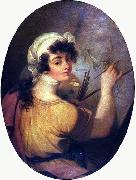
French painter (full name: Marie-Louise-Élisabeth Vigee-Lebrun). Vigee LeBrun's most famous client was Marie Antoinette, France's much maligned queen. When the two met in 1778, Vigee LeBrun's art-dealer husband had gambled away his wife's earnings. Still, she was dauntless and set out to establish her own salon where she would court royal clients. In a November 1982 article for Art in America, Brooks Adams noted that in her memoirs, Vigee LeBrun said that her much sought-after salon was, "a place where art and society mixed, where noblemen and ministers were content to sit on the floor, to avoid the stiff, formal court entertainments at Versailles." In time, her portraits and memoirs alike painted a portrait of Vigee LeBrun as a woman born to contend with anyone. Unfortunate Circumstances Marie Louise Elisabeth Vigee LeBrun was born in 1755 in Paris. Her father was Louis Vigee, a little-known portrait artist who worked in pastels. From the time she was small, he taught his daughter the skills of the trade. She proved to be somewhat of a prodigy. Her parents placed Vigee LeBrun in the convent of La Trinite, directly behind the Bastille. Her earliest memories were of drawing so frantically on the walls of her dormitory that the sisters regularly punished her. When her father died, Vigee LeBrun was only 12. He had been her biggest supporter. For an article in Antiques, magazine in November 1967, Ilse Bischoff quoted Vigee LeBrun's father after he saw a drawing she had done as a small child. It was the head of a bearded man with the light of a lamp falling on his face. She took care to observe light and shade, and showed skill beyond her years. Her father had exclaimed, "You will be a painter if I ever saw one." By the time she was 15, Vigee LeBrun had established a business as a painter that provided major financial support for her family. Her mother was a hairdresser from Luxembourg, who remarried not long after her first husband's death. Her stepfather soon began to squander her earnings. When she was only 21, she married an art dealer named Pierre LeBrun. It was clearly a marriage more of convenience, than of love. They had one daughter, Julie, born in 1780. Vigee LeBrun's marriage helped her gain access to a world normally restricted to men. Although she was denied access to a male apprentice system, and was unable to participate in classes at the major art academies around the city, she gained admission to the lesser salon of the Academie de Saint Luc. However, the Academie Royale was closed to her without proper connections. In those days, being shown in lesser salons kept a painter away from the financial benefits to be gained from wealthier clients who frequented the prestigious Academie Royale. When Vigee LeBrun was finally admitted to the Royale in 1783, her critics were not kind. She was accused of using her husband and the palace, most particularly her friendship with Queen Marie Antoinette. Another unfortunate rumor was that she had a long-standing sexual affair with the finance minister, Calonne. Her accusers contended that he aided her in squandering much of the Royal Treasury. That was never proven. Still, it was clear that she capitalized on her associations with the queen and the rest of the royal family. The aristocracy longed to be seen as simple, especially as unrest grew among the people outside of the palace confines. One portrait of Marie Antoinette was considered so scandalously informal, that it was withdrawn from the salon in the midst of her debut at the Academie Royale. Vigee LeBrun's arch-rival was a woman painter named Madame Labille Guiard. They were admitted to the Academie Royale on the same day. For the rest of the decade, before the French Revolution erupted in 1789, the two women maintained their rivalry. At the time of the academy's biennial exhibitions, the bitterness they felt toward each other had reached the height of its intensity. Vigee LeBrun painted one of her most acclaimed works in 1784. It was the portrait of Marie-Gabrielle de Gramont, Duchess of Caderousse. That was the same year she suffered a miscarriage, and painted only five portraits. Her usual output far exceeded that. The portrait was shown at the Salon of 1785 to much acclaim and became one of the artist's most celebrated works. In her memoirs, written fifty years later, Vigee LeBrun recalled the painting. "As I detested the female style of dress then in fashion, I bent all my efforts upon rendering it a little more picturesque, and was delighted when, after getting the confidence of my models, I was able to drape them according to my fancy. Shawls were not yet worn, but I made an arrangement with broad scarfs lightly intertwined around the body and on the arms, which was an attempt to imitate the beautiful drapings of Raphael and Domenichino I could not endure powder persuaded the Duchess to put none on for her sittings." Thrived in Exile Vigee LeBrun was not immune to the anxious rumbling that became the French Revolution. What had begun on that fateful night of July 14, 1789, erupted further when mobs stormed the palace at Versailles on the following October 6. Vigee LeBrun had been in disfavor for her association with Marie Antoinette for some time and was considered to be a royal sympathizer.
|
|
 |
Vieira Portuense
|
|
(Porto, 13 May 1765 - Funchal, 2 May 1805), who choose the artistic name of Vieira Portuense, was a Portuguese painter, one of the introducers of Neoclassicism in Portuguese painting. He was, in the neoclassical style, one of the two great Portuguese painters of his generation, with Domingos Sequeira.
He first studied in Lisbon, later moving to Rome. He traveled through Italy, Germany, Austria and England, before returning to Portugal, in 1800. He met Swiss painter Angelika Kauffmann, from whom he seems to have received influences. He seems to anticipate some motives of the romantic painting in several of his historical paintings, like "Dona Filipa de Vilhena knighting her sons" (1801).
He contracted tuberculosis, and moved to Madeira, were he died, aged only 39.
He is represented at the National Museum of Ancient Art, in Lisbon, and at the National Museum Soares dos Reis, in Porto.
Not to be confused with another Portuguese painter, Francisco Vieira de Matos, better known as Vieira Lusitano.
|
|
 |
VICTORS, Jan
|
|
1619-1676 . Dutch painter.
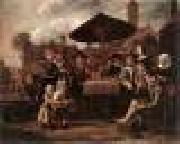
He was half-brother to the bird painter Jacobus Victors (1640-1705) and the noted Delft potter Victor Victors (b 1638). About 150 oil paintings by Jan Victors, comprising portraits, genre scenes and historical subjects on both canvas and panel, have been catalogued. No signed or securely attributable drawing by him is known. Although his training is undocumented, Victors has long been considered a member of the school of Rembrandt in Amsterdam. His paintings of 1640-70 show many formal and thematic interrelationships with Rembrandt and his documented pupils of the 1630s
|
|
|
|
 |
Victor Westerholm
|
|
Finnish, 1860-1919
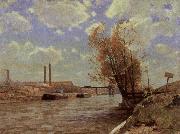
Finnish painter. He studied at the School of Drawing in Turku from 1869 to 1878. In 1878 he travelled to Dosseldorf and enrolled at the Kunstakademie, where he attended classes on landscape painting by Eugen Docker until 1886. He spent his summers in Finland, on the aland Islands, preparing sketches that provided the groundwork for many of the paintings he produced in Dosseldorf. Although Westerholm began working according to the principles of studio painting, his vivid studies are often imbued with the crispness of the plein-air style. In the early 1880s he concentrated on painting autumnal scenes and rapidly became the leading landscape artist of the younger generation with such works as the Mail-packet Jetty at Ecker (1885; Hemeenlinna, A. Mus.).
|
|
 |
Victor Schivert
|
|
(1863-1926?) was a renowned Romanian painter
He painted illustrations of the Thirty Years War.
One of his paintings "Kriegsbeute" was reported stolen in 2005 from Bohemia (Czech Republic).
|
|
|
|
 |
victor pasmore
|
|
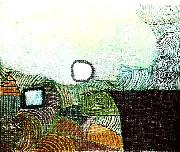
Edwin John Victor Pasmore (3 December 1908 - 23 January 1998) was a British artist and architect. He pioneered the development of abstract art in Britain in the 1940s and 1950s.
Pasmore was born in Chelsham, Surrey. He studied at Harrow but with the death of his father in 1927 he was forced to take an administrative job at the London County Council. He studied painting part-time at the Central School of Art and was associated with the formation of the Euston Road School and the first post-war exhibition of abstract art. After experimenting with abstraction Pasmore worked for a time in a lyrical figurative style, painting views of the Thames from Hammersmith much in the style of Turner and Whistler. Beginning in 1947 he developed a purely abstract style under the influence of Ben Nicholson and other artists associated with Circle, becoming a pioneering figure of the revival of interest in Constructivism in Britain following the War. Pasmore's abstract work, often in collage and construction of reliefs, pioneered the use of new materials and was sometimes on a large architectural scale. Herbert Read described Pasmore's new style as 'The most revolutionary event in post-war British art'.
Pasmore's abstract Mural for the canteen of a bus depot in Kingston upon Thames 1950Pasmore was a leading figure in the promotion of abstract art and reform of the fine art education system. From 1943-1949 he taught at Camberwell School of Art where one of his students was Terry Frost whom he advised not to bother with the School's formal teaching and to instead study the works in the National Gallery. In 1950 he was commissioned to design an abstract mural for a bus depot in Kingston upon Thames and the following year Pasmore contributed a mural to the Festival of Britain that promoted a number of the British Constructivists. From 1952 he was leader of the art course of Kings College, Durham based in Newcastle upon Tyne. There he developed a general art and design course inspired by the 'basic course' of the Bauhaus that became the model for higher arts education across the UK.
Pasmore was a supporter of fellow artist Richard Hamilton, giving him a teaching job in Newcastle and contributing a constructivist structure to the exhibition "This Is Tomorrow" in collaboration with Ernő Goldfinger and Helen Phillips. Pasmore was commissioned to make a mural for the new Newcastle Civic Centre. His interest in the synthesis of art and architecture was given free hand when he was appointed Consulting Director of Architectural Design for Peterlee development corporation in 1955. Pasmore's choices in this area proved controversial; the centerpiece of the town design became an abstract public art structure of his design, the Apollo Pavilion. The structure became the focus for local criticism over the failures of the Development Corporation but Pasmore remained a defender of his work, returning to the town to face critics of the Pavilion at a public meeting in 1982.
Pasmore represented Britain at the 1961 Venice Biennale, was participating artist at the documenta II 1959 in Kassel and was a trustee of the Tate Gallery, donating a number of works to the collection. He gave a lecture on J.M.W.Turner as 'first of the moderns' to the Turner Society, of which he was elected a vice president in 1975.
|
|
 |
Victor Mottez
|
|
Lille 1809-Bievres (Essonne)1897
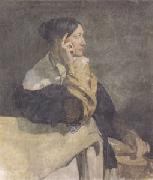
.was a French fresco painter, painter and portraitist. His father was passionate about art and painted himself. Sent to Paris with a pension for some years, Victor was recalled due to the poor state of his father's finances and his studies were cut short. He followed courses at the École de dessin in Lille and worked under the direction of his father and his father's painter friends such as Édouard Lienard, student of Jacques-Louis David. He returned to Paris from 1828 to 1829 to enter the École des Beaux-Arts and at first studied under the direction of François-Édouard Picot, then as a free student of Dominique Ingres. The Mottez family was highly religious and devoted to the House of Bourbon, and so the July Revolution in 1830 came as a catastrophe to them. Victor was again recalled to Lille by his father and married shortly afterwards. From there he made many trips, of which the longest and most notable was that to Italy and he came to consider its old masters as the absolute masters of painting. In Rome he met Ingres again - Ingres liked him very much and often gave him advice. His Christ in the Tomb (now in the glise Sainte-Catherine de Lille) and The Martyrdom of Saint Stephen (now in the glise Saint-Étienne de Lille) date to this era. Also on this trip to Italy he became hugely interested in fresco art - Mottez painted his wife Julie in this medium and, showing Ingres the end result, pulled it off the wall at Ingres' request (it was later given to the Louvre by Mottez's two children). Returning to France in 1838, he set up shop in Paris and exhibited at the Paris Salons, especially turning more and more towards the neglected genre of frescoes, notably religious ones. He also translated the Treatise by the 14th century Florentine painter Cennino Cennini and learned from his techniques. His most remarkable works are those for churches (at Église Saint-Germain-l'Auxerrois in the 1840s, and at the Saint-Severin in the 1850s), which were admired by Ingres and Delacroix. However, the clergy's hostility to them, the materials used, the saltpeter walls and their situation all meant that they were already deteriorated by the end of the 19th century and are now largely lost (except for Saint Martin cutting his cloak in two at St-Germain l'Auxerrois), though Mottez's cartoons for them survive. During the same years he frequented the Bertins' salon, alongside the main writers and artists of the time (a sketch of his for a portrait of Victor Hugo survives). He produced two frescoes for this salon, destroyed in 1854. After the 1848 Revolution Mottez set out for the United Kingdom, where he produced several portraits of British nobles and personalities and the exiled minister François Guizot, which were exhibited at the Royal Academy salons.
|
|
 |
Victor Meirelles
|
|
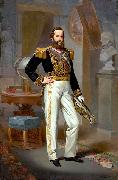
Victor Meirelles de Lima (August 18, 1832 -February 22, 1903) was a 19th century painter. He studied art in Paris but painted most of his works in and about his native Brazil. His religious and military paintings helped him become one of the most popular and celebrated Brazilian painters. His The first Mass in Brazil was the first Brazilian painting to be accepted in the Salons of Paris and is one of the most well known paintings in his native country, being reproduced in every book of History for elementary schools.
|
|
|
|
|
|
|
|
|
|
|
|
 |
Victor C.Anderson
|
|
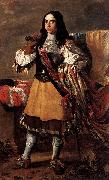
a well known Hudson River School painter,
American , 1882-1937
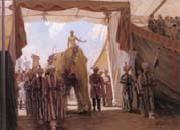
was an American painter and illustrator, primarily known for his rural life scenes and landscapes, whose works were featured in Life and other magazines of the early 20th Century, and who produced a wide range of illustrations for books as well as oil paintings. Like his father, Frank Anderson, Victor was a well-known painter of the Hudson River School. Victor drew and painted from an early age, eventually entering the Pratt Institute in Brooklyn. His favorite subjects were scenes of homespun rural life and landscapes of the late 19th and early 20th Centuries, and were popular nationally. For many years, he lived and had his studio at 195 Battle Avenue, White Plains, New York, where he died in 1937. He exhibited in the National Academy. His daughter, Joan Howe (1915-2005), was a well-known watercolor artist .
|
|
 |
Victor Boucquet
|
|
Victor Boucquet, a Flemish painter, was born at Veurne in 1619. He was the son of Marcus Boucquet, a painter little known. Descamps supposes he must have visited Italy, as his works exhibit a manner that partakes little of the taste of his country. He painted historical subjects, and was also esteemed as a portrait painter. His works are distributed in the different churches of the towns in Flanders. They are well composed, and, like those of most of the artists of his country, are well coloured. In the great church of Nieuport are two altar-pieces by this master, one of which, representing 'The Death of St. Francis,' is particularly admired; and in the town-house there is a large picture by him, considered as his principal work, representing 'The Judgment of Cambyses.' The principal altar-piece in the church at Ostend is by Boucquet: it represents the Taking down from the Cross. He died at Furnes in 1677.
|
|
 |
Victor Borisov-Musatov
|
|
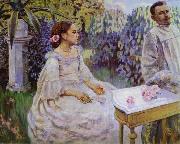
(Russian), (April 14 [O.S. April 2] 1870 - November 8 [O.S. October 26] 1905) was a Russian painter, prominent for his unique Post-Impressionistic style that mixed Symbolism, pure decorative style and realism. Together with Mikhail Vrubel he is often referred as the creator of Russian Symbolism style.
Victor Musatov was born in Saratov, Russia (he added the last name Borisov later). His father was a minor railway official who had been born as a serf. In his childhood he suffered a spinal injury, which made him humpbacked for the rest of his life. In 1884 he entered Saratov real school, where his talents as an artist were discovered by his teachers Fedor Vasiliev and Konovalov.
He was enrolled in the Moscow School of Painting, Sculpture and Architecture in 1890, transferring the next year to the Imperial Academy of Arts in Saint-Petersburg, where he was a pupil of Pavel Chistyakov. The damp climate of Saint-Petersburg was not good for Victor's health and in 1893 he was forced to return to Moscow and re-enroll to the Moscow School of painting, sculpturing and architecture. His earlier works like May flowers, 1894 were labelled decadent by the school administration, who sharply criticised him for making no distinction between the girls and the apple trees in his quest for a decorative effect. The same works however were praised by his peers, who considered him to be the leader of the new art movement.
The Pool. 1902In 1895 Victor once again left Moscow School of painting, sculpturing and architecture and enrolled in Fernand Cormon's school in Paris. He studied there for three years, returning in summer months to Saratov. He was fascinated by the art of his French contemporaries, and especially by the paintings of "the father of French Symbolism" Pierre Puvis de Chavannes and by the work of Berthe Morisot.
In 1898 Borisov-Musatov returned to Russia and almost immediately fell into what it is called "fin de siecle nostalgia". He complained about "the cruel, the truly iron age", "dirt and boredom", "devil's bog", and he had acute money problems that were somewhat alleviated only in the last years of his life when collectors started to buy his paintings. Musatov's response was creating a half-illusory world of the 19th century nobility, their parks and country-seats. This world was partially based on the estate of princes Prozorvky-Galitzines Zubrilovka and partially just on Musatov's imagination. Borisov-Musatov also abandoned oil-paintings for the mixed tempera and watercolor and pastel techniques that he found more suitable for the subtle visual effects he was trying to create.
|
|
|
|
Vicente Palmaroli Gonzalez
|
|
1834-1896
Spanish
Vicente Palmaroli Gonzalez Gallery
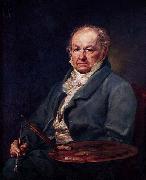
His father was the Italian lithographer, Gaetano Palmaroli and he studied in San Fernando's Royal Academy. He later went to Rome in 1857 to complete his training, and he lived there until 1866. One year later, he went to the Paris World's Fair of 1867. He met Ernest Meissonier, who influenced his later works.
He was academician in San Fernando's Royal Academy, and director in the Spanish Academy in Rome and Prado Museum (1893-1896).
|
|
 |
Vicente Lopez y Portana
|
|
(September 19, 1772, Valencia, Spain CJuly 22, 1850, Madrid, Spain) was a Spanish painter, considered the best portrait painter of his time.
Vicente Lepez y Portaña was born in Valencia on September 19, 1772. His parents were Cristebal Lepez Sanchordi and Manuela Portaña Meer. Vicente Lepez began formally studying painting in Valencia at the age of thirteen, he was a disciple of father Antonio de Villanueva, a Franciscan monk, and he studied at the Academy of San Carlos in his native city. He was seventeen when he won first prize in drawing and coloring receiving a scholarship to study in the prestigious Academia Real de Bellas Artes de San Fernando in Madrid. For the following three years in Madrid, he apprenticed with the Valencian painter, Mariano Salvador Maella. Vicente Lepez returned to Valencia in 1794 and subsequently became vice-director of painting at the Academy where he had studied as a boy. In 1795 he married Maria Piquer, they had two sons: Bernardo Lepez Piquer and Luis (1802-1865), who were also painters, following their father's style but with little accomplishments. In 1801 Lepez was named President of the Academy of San Carlos.
|
|
 |
Vicente Lopez
|
|
1772-1850
Spanish
Vicente Lopez Gallery
was an Argentine writer and politician who acted as interim President of Argentina from July 7, 1827 to August 18, 1827. He also wrote the lyrics of the Argentine National Anthem adopted in May 11, 1813.
Lopez began his primary studies in the San Francisco School, and later studied in the Real Colegio San Carlos, today the Colegio Nacional de Buenos Aires. He obtained a doctorate of laws in the University of Chuquisaca. He served as a captain in the Patriotic Regiment during the English invasions. After the Argentine victory he composed a poem entitled El triunfo argentino (The Argentine Triumph). He participated in the Cabildo Abierto of May 22, 1810 and supported the formation of the Primera Junta. He had good relations with Manuel Belgrano. When the royalist members of the city government of Buenos Aires were expulsed, he was elected mayor of the city; he was an enemy of the party of Cornelio Saavedra and one of the creators of the First Triumvirate, of which he was the Treasurer.
Lopez was a member of the Constituent Assembly of year XIII, representing Buenos Aires. At the request of the Assembly, he wrote the lyrics to a "patriotic march", which eventually became the Argentine National Anthem. It was a military march, whose music was composed by the Catalan Blas Parera; it was approved on March 11, 1813. The first public reading was at a tertulia on May 7 in the house of Mariquita Sanchez de Thompson. It displaced a different march, written by Esteban de Luca, which would have been the hymn if not for the more militaristic Lopez.
|
|
 |
Vicente Carducho
|
|
(in Spanish, sometimes Vicencio or Vicente Carducho; 1568-1638) was an Italian painter.
He was born in Florence, and was trained as a painter by his brother Bartolomeo, whom he followed to Madrid as a boy.
He Initially painted some works at Valladolid and helped his brother in painting at the Escorial for Philip II of Spain. He returned to the court of Philip III in Madrid in 1606 and helped decorate the recently rebuilt Palacio del Pardo. While at work his brother died, and Vicente took his place. He painted there a history of Achilles. When finished, he was employed for four years by the monks of the Chartreuse of el Paular to decorate their monastery with 55 canvases of historical figures the great cloister. 27 represent the live of St. Bruno, 27 of martyrs.
He worked a great deal for the subsequent monarch, Philip IV, and his best pictures are those he executed for him as decorations in the Prado. Examples of his work are preserved at Toledo, Segovia, and several other Spanish cities. For many years he labored in Madrid as a teacher of his art, and among his pupils were Giovanni Ricci, Pedro Obregon, Vela,[disambiguation needed ] Francisco Collantes, and other distinguished representatives of the Spanish school during the 17th century.
He also authored a treatise, De las Excelencias de la Pintura or Dielogos de la pintura, su defensa, origen, essencia, definicien, modos, y differencias, published in 1633. Written in classical tradition as a dialogue between a master and an apprentice. Following strict piety of the Spanish realm,
|
|
|
|
|
|
|
|
|
|
|
|
|
|
|
|
|
| Wholesale China Oil Painting Wholesale Oil Painting China Xiamen Portrait Reproduction on canvas Chinese Oil Painting Wholesale USA Oil Painting |
|
|
|
|
|