| |
|
Xiamen Oil Paintings, Wholesale Direct!
|
|
100% hand painted, 100% cotton canvas, 100% money back if not satisfaction. |
|
|
|
|
ART WORKS INDEX
A
B
C
D
E
F
G
H
I
J
K
L
M
N
O
P
Q
R
S
T
U
V
W
X
Y
Z
|
|
ARTISTS INDEX
A
B
C
D
E
F
G
H
I
J
K
L
M
N
O
P
Q
R
S
T
U
V
W
X
Y
Z
|
|
|
|
 |
Willem van Mieris
|
|
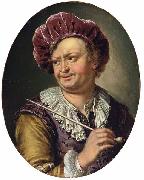
(3 June 1662, Leiden - 26 January 1747, Leiden) was a Dutch painter. He was a son of Frans van Mieris sr. and brother of Jan van Mieris.
His works are extremely numerous, being partly imitations of the paternal subjects, or mythological episodes, which Frans habitually avoided. In no case did he come near the excellence of his sire.
van Mieris has works in the Victoria and Albert Museum as well as Cheltenham and Derby Museum and Art Gallery
|
|
|
|
 |
Willem Van de Velde The Younger
|
|
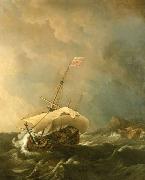
(bapt. 18 December 1633 - 6 April 1707) was a Dutch marine painter.
Willem van de Velde was baptised on 18 December 1633 in Leiden, Holland, Dutch Republic.
A son of Willem van de Velde the Elder, also a painter of sea-pieces, Willem van de Velde, the younger, was instructed by his father, and afterwards by Simon de Vlieger, a marine painter of repute at the time, and had achieved great celebrity by his art before he came to London. In 1673 he moved to England, where he was engaged by Charles II, at a salary of £100, to aid his father in "taking and making draughts of sea-fights", his part of the work being to reproduce in color the drawings of the elder van de Velde. He was also patronized by the Duke of York and by various members of the nobility.
He died on 6 April 1707 in London, England.
|
|
 |
Willem van de Velde the Elder
|
|
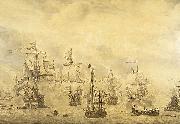
(c. 1611 - 13 December 1693) was a Dutch Golden Age seascape painter.
Willem van de Velde, known as the Elder, a marine draughtsman and painter, was born in Leiden, the son of a Flemish skipper, Willem Willemsz. van de Velde, and is commonly said to have been bred to the sea. In 1706 Bainbrigg Buckeridge noted that he eunderstood navigation very welle. He married Judith Adriaensdochter van Leeuwen in Leiden, the Netherlands, in 1631.
His three known legitimate children were named Magdalena, born 1632; Willem, known as the Younger, also a marine painter, born 1633; and Adriaen, a landscape painter, born 1636.
His marriage was stormy, at least in its later years. David Cordingly relates that Willem the Elder fathered two children out of wedlock in 1653, one eby his maidservant, and the other by her friend. Nine years later the Elder and his wife went through a legal separation, eon account of legal disputes and the most violent quarrelse. The immediate cause of the dispute was his affair with a married woman.e Michael S. Robinson noted that eon 17/27 July 1662, he and his wife agreed to part. A condition of the separation was that the Elder could recover from his son Adriaen etwo royal giftse, presumably gifts from Charles II for work done in England.e Cordinglyes account further relates that the dispute was still continuing after another ten years, since ein the autumn of 1672 Judith complained to the womanes husband.e Robinson adds that by 1674 the couple emust have been reconcilede, for at a chance meeting with Pieter Blaeu in Amsterdam in July the Elder explained that he was only visiting for a few days ein order to fetch his wifee. His son, Adriaen, had died in Amsterdam in 1672, and Willem the Elder was also fetching his grandson, similarly named Adriaen, who was then aged two.
After his move to England, the exact date of which is uncertain, but reportedly at the end of 1672 or beginning of 1673, he is said to have lived with his family in East Lane, Greenwich, and to have used the Queenes House, now part of the National Maritime Museum in Greenwich, as a studio. Following the accession of William and Mary as King and Queen of England, it appears that this facility was no longer provided, and by 1691 he was living in Sackville Street, now close to Piccadilly Circus. He died in London, and was buried in St Jameses Church, at the south end of the street.
|
|
 |
willem van de velde the younger
|
|
(bapt. 18 December 1633 - 6 April 1707) was a Dutch marine painter.
Willem van de Velde was baptised on 18 December 1633 in Leiden, Holland, Dutch Republic.
A son of Willem van de Velde the Elder, also a painter of sea-pieces, Willem van de Velde, the younger, was instructed by his father, and afterwards by Simon de Vlieger, a marine painter of repute at the time, and had achieved great celebrity by his art before he came to London. In 1673 he moved to England, where he was engaged by Charles II, at a salary of £100, to aid his father in "taking and making draughts of sea-fights", his part of the work being to reproduce in color the drawings of the elder van de Velde. He was also patronized by the Duke of York and by various members of the nobility.
He died on 6 April 1707 in London, England.
|
|
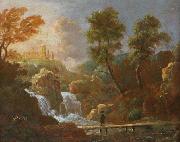 |
Willem van Bemmel
|
|
(Utrecht 10 June 1630 - Nuremberg 20 December 1708), was a Dutch Golden Age painter active in Germany.
Van Bemmel was a student of Herman Saftleven in Utrecht. He made a Grand Tour to Rome, spending first the years 1647-9 in Venice where he became famous for his landscapes. He stayed in Rome for six years and was a member of the Bentvueghels. From Rome he crossed the Alps to Nuremberg, where he became a successful painter of Italianate landscapes.
In 1656 he moved to Kassel. He was the father of the German Von Bemmel painting family.
|
|
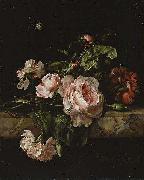 |
Willem van Aelst
|
|
(May 16, 1627 - in or after 1683) was a Dutch artist who specialized in still-life painting with flowers or game.
Van Aelst was born in Delft to a family of prominent city magistrates. He learned to paint from his uncle, the still-life painter Evert van Aelst. On 9 November 1643 he enrolled as a master of the Guild of Saint Luke at Delft.
Between 1645 and 1649 he lived in France. In 1649 Van Aelst travelled to Florence, where he served as court painter to Ferdinando II de' Medici, grand duke of Tuscany. At this time, the grand duke also employed two fellow Dutchmen Matthias Withoos and Otto Marseus van Schrieck, the latter also a still-life painter who probably influenced Van Aelst's style.
In 1656 he returned to the Netherlands to settle permanently in Amsterdam. He became one of the most prominent still-life painters of his generation, which allowed him to live on the Prinsengracht. He must have at Amsterdam died in 1683 or shortly thereafter, as his latest dated work is from that year. Van Aelst taught Rachel Ruysch and several others.
|
|
 |
Willem van
|
|
Dutch Baroque Era Painter, 1627-ca.1683
|
|
|
|
 |
Willem Roelofs
|
|
Dutch Painter, 1822-1897
Dutch painter. He is said to have made his first sketches at the age of four; at fifteen he completed his first landscape painting. Many of these early works are in the print rooms of the Rijksmuseum, Amsterdam, and the Gemeentemuseum, The Hague. In c. 1837-8 he was apprenticed to the amateur painter Abraham Hendrik de Winter (1800-61) in Utrecht, where the Roelofs family had moved in 1826. In 1838 he entered his first paintings in the Exhibition of Living Masters in Amsterdam and Rotterdam. In the late summer of 1840 Roelofs became a pupil of the landscape and animal painter Hendrik van de Sande Bakhuyzen (1795-1860), with whom he made a study trip to Germany in 1841. Roelofs took a special interest in nature: he applied himself energetically both to painting and drawing, almost always selecting landscape subjects. He also studied entomology and accumulated a large collection of insects. After his training he returned to his parents in Utrecht.
|
|
 |
Willem Pieterszoon Buytewech
|
|
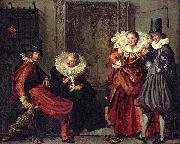
(1591/1592, Rotterdam - September 23, 1624, Rotterdam) was a Dutch painter, draughtsman and etcher of the Golden Age. He is often considered the "inventor" of Dutch genre painting. For his preference of irony, his contemporaries named him Gheestige Willem (Jolly or spiritual William).
Buytewech was the son of Pieter Jacobsz, a cobbler and candlemaker. He learned his trade in Haarlem, where he became a member of the artists' guild (Haarlem Guild of St. Luke) in 1612, together with Hercules Segers and Esaias van de Velde.[1] Frans Hals, who was a member of this guild since 1610, had much influence on Buytenwech's work, as shown by the many drawings that the latter made after Hals's paintings. After his marriage on November 10, 1613 with Aeltje van Amerongen, of a patrician family, he returned to Rotterdam. There Hendrik Martenszoon Sorgh was one of his pupils.
Buytewech was primarily a graphic artist, mostly of landscapes and genre pieces, but occasionally also of biblical and allegorical themes. Of his paintings only eight have survived to this date, all genre pieces, most depicting merry companies.
Willem Buytewech's Merry CompanyHe died at the age of only 32 or 33 of unrecorded causes. His son Willem Willemsz Buytewech (1625-1670), born after his death, would become a painter as well.
|
|
 |
Willem Pietersz. Buytewech
|
|
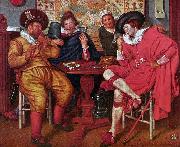
Willem Pieterszoon Buytewech (1591/1592 - September 23, 1624) was a Dutch painter, draughtsman and etcher of the Golden Age. He is often considered the "inventor" of Dutch genre painting. For his preference of irony, his contemporaries named him eGheestige Willeme (Jolly or spiritual William).
|
|
 |
Willem Maris
|
|
Dutch Painter, 1844-1910
Brother of Jacob Maris. He received his training as a painter from his brothers, Jacob Maris and Matthijs Maris. Although he briefly attended evening classes at the Academie in The Hague and was advised by the animal painter Pieter Stortenbeker (1828-98), he was basically self-taught; he was the only self-made man in the circle of Hague school artists. In 1862 he visited Oosterbeek where he met Anton Mauve, with whom he established a long friendship. In the same year he first entered a painting, Cows on the Heath (untraced), in the Tentoonstellung van Levende Meesters in Rotterdam. The themes of cows at pasture and ducks by the side of a ditch, which characterized the Dutch polder landscape in summer, became his hallmark. In the following year he exhibited Cows by a Pool (The Hague, Gemeentemus) in The Hague; it received discouraging reviews, as did the picture entered by his brother Matthijs. Painted in 1863, this work already employs Willem main motif and shows his attention to the handling of light (with effects of haze and backlighting).
|
|
 |
Willem Kalf
|
|
1619-1693
Dutch
Willem Kalf Galleries
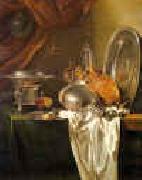
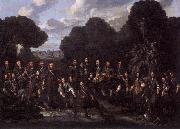
Willem Kalf was born in Rotterdam, in 1619. He was previously thought to have been born in 1622, but H. E. van Gelder??s important archival research has established the painter??s correct place and date of birth. Kalf was born into a prosperous patrician family in Rotterdam, where his father, a cloth merchant, held municipal posts as well. In the late 1630s, Willem Kalf travelled to Paris and spent time in the circle of the Flemish artists in Saint-Germain-des-Pr??s, Paris. In Paris he painted mainly small-scale rustic interiors and still-lifes. Kalf??s rustic interiors are typically dominated by groups of vegetables, buckets, pots and pans, which he arranged as a still-life in the foreground (e.g. Kitchen Still-life, Dresden, Gemäldegal; Alte Meister). Figures usually appeared only in the blurred obscurity of the background. Though painted in Paris, those pictures belong to a pictorial tradition practised primarily in Flanders in the early 17th century, by such artists as David Teniers the Younger. The only indication of the French origin of the paintings are a few objects that Flemish exponents of the same genre would not have pictured in their works. Kalf??s rustic interiors had a large influence on French art in the circle of the Le Nain brothers. The semi-monochrome still-lifes which Kalf created in Paris form a link to the banketjes or 'little banquet pieces' painted by such Dutch artists as Pieter Claesz, Willem Claeszoon Heda and others in the 1630s. During the 1640s, Kalf further developed the banketje into a novel form of sumptuous and ornate still-life (known as pronkstilleven), depicting rich groupings of gold and silver vessels. Like other still-lifes of this period, these paintings were usually expressing vanitas allegories.
|
|
 |
Willem Eversdijck
|
|
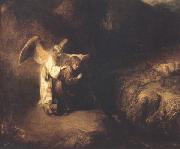
the son of Cornelis Eversdijck, flourished at Goes about the year 1660. He was a portrait painter, and several of his portraits were engraved by Houbraken. A picture of Officers and Members of the Company of Archers, called " Edele Voetboog," at Goes, by him, is in the Rotterdam Museum.
Cornelis Willemsz Eversdijck, his father, was also a portrait painter of Goes, who died there in 1649. In the Rotterdam Museum are three pictures by him, representing Officers and Members of the Company of Archers, called "Edele Voetboog," at Goes; two of which are dated 1616 and 1624.
|
|
 |
Willem Drost
|
|
Dutch Baroque Era Painter, ca.1630-1680
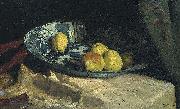
Dutch painter, draughtsman and printmaker, possibly of German origin. According to Houbraken, he was a pupil of Rembrandt, possibly in or shortly before 1650. An early etching signed w drost 1652 is probably a self-portrait, in which Drost portrayed himself as a young man drawing. His earliest dated paintings are two pendants of 1653: the Portrait of a Man (New York, Met.) and the Portrait of a Woman .
|
|
 |
Willem de Zwart
|
|
(16 May 1862 The Hague - 11 December 1931 The Hague) was a Dutch painter, engraver, watercolorist, with many connections to the Hague School.
Willem De Zwart was born in The Hague on 16 May 1862, the eldest of eight children. His youngest brother, Pieter, would also become a painter. His father painted carriages for a living, and in 1875 the fourteen-year-old Willem was apprenticed to a carriage maker to learn the same trade. In his spare time, he copied prints he found in magazines, and a year later he enrolled in the evening class at the Royal Academy of Visual Art in The Hague. The following year, he was admitted at the studio of Jacob Maris. In the three years that he remained here, it is probable that he got to know many of the leading lights of the Hague School. Maris also sent De Zwart on a journey to the coast, without drawing materials, and had him work out his impressions directly on canvas when he returned to the studio.
De Zwart made several copies of works by 16th and 17th century masters in the Mauritshuis. He was most interested in the works of Johannes Vermeer, Paulus Potter, and Rembrandt, but studied paintings by German and Italian masters, as well. Sometimes he produced copies on commission. In this period, he also made detailed studies of animals, concentrating particularly on their legs, heads and snouts. De Zwart developed a fastidious painting style with a sober, predominantly brown palette.
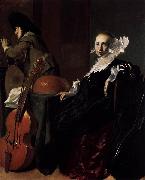
Willem de Zwart lived and worked until 1894 in The Hague and from 1900 to 1905 in Amsterdam. His work has a wide range of subjects: landscapes, cityscapes, portraits and still life, rendered in a naturalistic or impressionist style. His work shows affinity with the people and city-oriented Amsterdam Impressionism. In his choice of subjects belonged to the Hague School and in his style and his exuberant use of color to the school of Amsterdam Impressionism. He is also known as the "Hague Breitner" because of the similarity of his work to that of George Hendrik Breitner. He painted his landscapes, figure paintings and still lifes with smooth, bold brushstrokes. De Zwart applied the paint thickly, sometimes straight from the tube, with bright colors, exuberant reds, yellows and blues, giving his paintings special vibrancy.
|
|
 |
Willem Cornelisz. Duyster
|
|
(1599-1635) was a Dutch Golden Age painter from Amsterdam.
According to the RKD, his name was taken from his house on the Amsterdam Koningstraat, which was called "De Duystere Werelt", the dim world. He was a pupil of Pieter Codde. He married the sister of the painter Simon Kick (1603-1652), who himself married Willem's sister.
|
|
 |
Willem Cornelisz Duyster
|
|
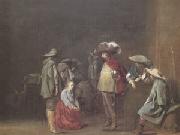
Willem Cornelisz Duyster (1599 ?C 1635) was a Dutch painter from Amsterdam.
Duyster paintings generally depicted genre scenes and portraits, quite often of soldiers. He exhibited a strong ability to paint textiles, accurately characterize his subjects, and to depict relationships between his figures. Duyster career was cut short when he succumbed to the plague in 1635.
|
|
|
|
 |
Willem Claesz Heda
|
|
1594-1682
Dutch
Willem Claesz Heda Galleries
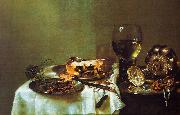
Dutch painter. He was a still-life painter, who, like Pieter Claesz., is noted for his monochrome breakfast-pieces, which are, however, more opulent than those of Claesz. Heda earliest dated work is a Vanitas (1621; The Hague, Mus. Bredius), which shows a still-life from a high viewpoint, composed of various objects bearing vanitas associations (e.g. a bowl of glowing embers, smoker requisites, an overturned glass and a skull); the colouring is in brownish-grey tones and represents one of the earliest examples of a Dutch monochrome still-life (monochrome refers to the range of tones, rather than of colours). Even in this early work Heda skill at painting textures is evident. A more balanced composition is achieved in another Still-life (1629; The Hague, Mauritshuis) and in the Breakfast Table (1631; Dresden, Gemeldegal. Alte Meister), in both of which the objects, set against a neutral background, are linked by a strong diagonal. The Mauritshuis still-life also gives an early indication of Heda interest in painting the effects of light. In 1631 he became a member of the Haarlem Guild of St Luke (of which he served as deacon on several occasions after 1637).
|
|
 |
Willem Buytewech
|
|
1591-1624
Dutch Willem Buytewech Locations
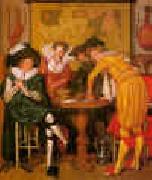
Dutch painter, draughtsman and etcher. Although he was born and died in Rotterdam, stylistically he belongs to the generation of young artists working in Haarlem at the beginning of the 17th century. He was nicknamed Geestige Willem (Dut.: inventive, or witty, Willem) by his contemporaries, and during his short career he made an important and highly personal contribution to the new approach to realism in Dutch art. He was one of the first to paint interiors with merry companies (see CONVERSATION PIECE) and is primarily known for his lively and spontaneous drawings and etchings on a wide range of subjects.
|
|
|
|
 |
Willem Bastiaan Tholen
|
|
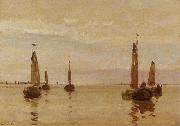
was a Dutch painter, draftsman and printmaker, born in Amsterdam, 13 Feb 1860, died in The Hague, 5 Dec 1931. He came from an artistic family, who lived in Kampen from 1864. There he developed at an early age a lasting love of the Zuiderzee. In Kampen he became friendly with the young Jan Voerman; they entered the Amsterdam academy together in 1876, where Tholen studied under August Allebe. Subsequently he learned technical drawing at the Polytechnische School in Delft until 1878. Thereafter he spent three months in the studio of Paul Gabriël in Brussels, from whom he received his first real instruction in painting. In the following years Gabriël's advice was of particular importance for Tholen, as they worked together en plein air for many summers near Kampen and Giethoorn, among other places. In Gouda (1878-9) and Kampen (1880-85) he taught draftsmanship in order to support himself but after 1885 concentrated entirely on his own work. From 1887 he lived in The Hague, where he became friendly with the painters of The Hague school. He took an active part in the artistic life of The Hague and was a member of the Pulchri Studio.
|
|
 |
Willem Drost
|
|
Dutch Baroque Era Painter, ca.1630-1680
Dutch painter, draughtsman and printmaker, possibly of German origin. According to Houbraken, he was a pupil of Rembrandt, possibly in or shortly before 1650. An early etching signed w drost 1652 is probably a self-portrait, in which Drost portrayed himself as a young man drawing. His earliest dated paintings are two pendants of 1653: the Portrait of a Man (New York, Met.) and the Portrait of a Woman (The Hague, Mus. Bredius). The man portrait is signed Wilhelmus Drost F. Amsterdam 1653; the form of the first name implies that he was of German descent.
|
|
|
|
 |
Wille Pierre Alexandre
|
|
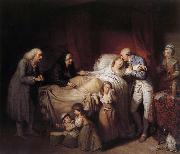
French Painter , 1748--Paris 1821
Painter, son of Jean-Georges Wille. Between 1761 and 1763 he trained under Jean-Baptiste Greuze, who was a friend of his father, and later under Joseph-Marie Vien. Approved by the Acad?mie Royale in 1774, he devoted himself to painting sentimental genre scenes, such as the Last Moments of a Beloved Wife (1784; Cambrai, Mus. Mun.), in Greuze's manner. He also executed paintings for his father to engrave, including French Patriotism (1781) and the Double Reward of Merit (1785; both Bl?rancourt, Cheteau, Mus. N. Coop. Fr.-Amer.).
|
|
 |
Willard Metcalf
|
|
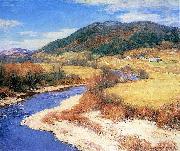
Willard Leroy Metcalf (July 1, 1858 - March 9, 1925) was an American artist born in Lowell, Massachusetts. He studied at the School of the Museum of Fine Arts, Boston, and later attended Academie Julian, Paris. After early figure-painting and illustration, he became prominent as a landscape painter. He was one of the Ten American Painters who in 1897 seceded from the Society of American Artists. For some years he was an instructor in the Womans Art School, Cooper Union, New York, and in the Art Students League, New York. In 1893 he became a member of the American Watercolor Society, New York. Generally associated with American Impressionism, he is also remembered for his New England landscapes and involvement with the artists' colony at Old Lyme, Connecticut.
Born into a working-class family, Metcalf began painting in 1874. In 1876 he opened a studio in Boston, and received a scholarship at the Boston Museum school, where he studied until 1878. In 1882 he held an exhibition at the J. Eastman Chase Gallery in Boston, the sales from which financed a study trip abroad.[1]
Metcalf left for Europe in September 1883, and did not return to the United States until late 1888. During that time he traveled and painted, studying first in Paris with Gustave Boulanger and Jules-Joseph Lefebvre, subsequently going to England and Pont-Aven, Brittany. In the winter of 1884 he apparently met John Twachtman in Paris, and painted at Grez-sur-Loing alongside other American artists, including Theodore Robinson. His landscapes at this time were traditional renditions of peasant scenes, in the manner of Jean Millet.[2] By 1886 Metcalf was painting in Giverny, evidently the first American painter to visit there.[2] Soon thereafter he traveled to Algeria and Tunisia, returning to Giverny in the summers of 1887 and 1888, in the company of other American painters.
|
|
 |
Willard Leroy Metcalf
|
|
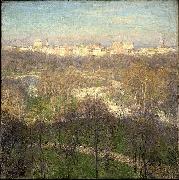
(July 1, 1858 - March 9, 1925) was an American artist born in Lowell, Massachusetts. He studied at the School of the Museum of Fine Arts, Boston, and later attended Academie Julian, Paris. After early figure-painting and illustration, he became prominent as a landscape painter. He was one of the Ten American Painters who in 1897 seceded from the Society of American Artists. For some years he was an instructor in the Womans Art School, Cooper Union, New York, and in the Art Students League, New York. In 1893 he became a member of the American Watercolor Society,
|
|
|
|
|
|
|
|
 |
WILLAERTS, Adam
|
|
Dutch painter (b. 1577, Antwerpen, d. 1664, Utrecht)
During his early years in Antwerp he was impressed with the colourful paintings of the Fleming Jan Breughel the elder, but the subject and style of his earliest known picture, Dutch East Indiamen off the West African Coast (1608; Amsterdam, Hist. Mus.), presumably painted after the artist's arrival in Holland, shows the influence of the Dutch marine painter Hendrick Cornelisz. Vroom. In this painting Willaerts adopted Vroom's austere compositional scheme of an uninterrupted horizontal expanse of water with no framing devices,
|
|
|
|
|
|
 |
Wilhelmina Lagerholm
|
|
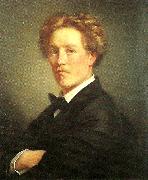
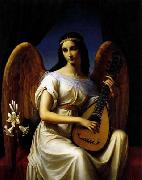
1826-1917 Konstakademien Lagerholm studerade samtidigt med Malmström såväl vid konstakademien i stockholm som för couture i paris.
|
|
 |
Wilhelm von Schadow
|
|
German Romantic Painter, 1788-1862,Painter, teacher and writer, son of Johann Gottfried Schadow. He studied at the Berlin Akademie from 1805 and in 1806 showed paintings at the annual Akademie exhibition. Under his teacher, Friedrich Georg Weitsch, he quickly became a skilled portrait painter, and by 1810 he was commissioned to paint portraits of members of the Prussian royal family and of the Empress of Austria. Influenced by the English artist John Flaxman, Schadow developed an emphasis on outline. In 1810 Schadow went with his brother Ridolfo Schadow to Rome, where in 1813 he became a member of the Lukasbreder and, in 1814, a Catholic. In 1815-17 he took part, with Peter von Cornelius, Friedrich Overbeck and Philipp Veit, in the commission for frescoes of the Story of Joseph for a room in the Casa Bartholdy (now Berlin, Alte N.G.). In his continuing interest in portraits, Schadow differed from his colleagues. Following the example of Gottlieb Schick and similarly inspired by Raphael, Schadow developed a poetic style of portraiture. In 1819 he returned to Berlin in order to help Karl Friedrich Schinkel with the decoration of the Schauspielhaus. He took over the running of a studio and won a high degree of respect as a painter and teacher.
|
|
 |
Wilhelm von Kobell
|
|
1766-1853
German
Wilhelm von Kobell Gallery
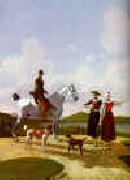
Kobell was born in Mannheim, the son of Ferdinand Kobell, a landscape painter who cited Claude Lorrain as his influence. Wilhelm's initial lessons were supplied by his father and his uncle, Franz Kobell. He received further training under Franz Anton, von Leydendorf and Egid Verhelst in the art of engraving at the Zeichnungsakademie in Mannheim. During this time he practiced various styles, including 17th-century Dutch painting and 18th-century English art. He was supported by Charles Theodore who compensated him an annual sum of 500 florins from 1792 until Theodore's death in 1799. Throughout his life Kobell traveled to England, France and Italy but ultimately based his style on Dutch art.
|
|
 |
Wilhelm von Kaulbach
|
|
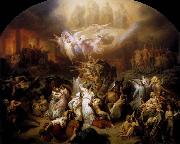
German Painter, ca.1804-1874,Painter and illustrator. After initial instruction from his father, Kaulbach received his principal education, from 1822 to 1826, at the Kunstakademie, Desseldorf, under Peter Cornelius. Six months after Ludwig I, King of Bavaria, had summoned Cornelius to Munich, Kaulbach followed his tutor to the Bavarian capital, where he worked on various collaborative ventures with other pupils of Cornelius, and completed his practical training on such projects as the decoration of the Odeon (destr.) in 1826, and of the Hofgartenarkaden, from 1826 to 1829 (now painted over). More independent work followed with 16 frescoes on the theme of Cupid and Psyche for the Festsaal of the Herzog-Max-Palais (1829-35; now Munich, Neue Pin.),
|
|
 |
wilhelm von gegerfelt
|
|
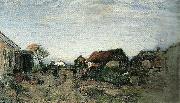
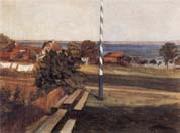
född 9 november 1844 i Göteborg, död 1920, målare, son till arkitekten Victor von Gegerfelt.
von Gegerfelt studerade 1861-63 vid konstakademien i Köpenhamn, 1864-67 vid akademien i Stockholm och 1867-72 i D??sseldorf, varefter han överflyttade till Paris. Där arbetade han sig till en helt ny teknik och blev jämte Alfred Wahlberg den förste svenske representanten för det moderna stämningslandskapet. Han gjorde studieresor till Frankrikes nordkust, till hemlandet och till Italien, målade skymning över Venedigs kajer, månsken över lagunerna, kritklippor vid Engelska kanalen i gråstämning, svenska sommarnätter, allt med elegant pensel, smekande färg och livligt föredrag. Gegerfelt är representerad på Nationalmuseum av Stormen (akvarell, motiv från Dalarna, inköpt 1886) och Strand på Hallands Väderö (i olja, 1893) samt på Göteborgs konstmuseum av Strandgata i Venezia (1884), oljemålningen Vinterafton på Hallands Väderö (1893) samt akvarellen Fjällbacka.
|
|
 |
Wilhelm Trubner
|
|
German, 1851-1917
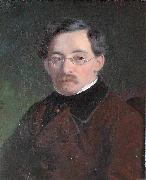
was a German realist painter of the circle of Wilhelm Leibl. Trubner was born in Heidelberg and had early training as a goldsmith. In 1867 he met classicist painter Anselm Feuerbach who encouraged him to study painting, and he began studies in Karlsruhe under Fedor Dietz. The next year saw him studying at the Kunstacademie in Munich, where he was to be greatly impressed by an international exhibition of paintings by Leibl and Gustave Courbet. Courbet visited Munich in 1869, not only exhibiting his work but demonstrating his alla prima method of working quickly from nature in public performances. This had an immediate impact on many of the city's young artists, who found Courbet's approach an invigorating alternative to the shopworn academic tradition. The early 1870s were a period of discovery for Tr??bner. He travelled to Italy, Holland and Belgium, and in Paris encountered the art of Manet, whose influence can be seen in the spontaneous yet restrained style of Trubner's portraits and landscapes. During this period he also made the acquaintance of Carl Schuch, Albert Lang and Hans Thoma, German painters who, like Trubner, greatly admired the unsentimental realism of Wilhelm Leibl. This group of artists came to be known as the "Leibl circle". He published writings on art theory in 1892 and 1898, which express above all the idea that "beauty must lie in the painting itself, not in the subject". By urging the viewer to discover beauty in a painting's formal values, its colors, proportions, and surface, Trubner advanced a philosophy of "art for art's sake".
|
|
|
|
|
|
 |
Wilhelm Marstrand
|
|
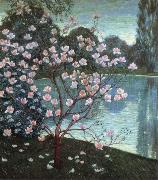
(24 December 1810 - 25 March 1873), painter and illustrator, was born in Copenhagen, Denmark to Nicolai Jacob Marstrand, instrument maker and inventor, and Petra Othilia Smith. Marstrand is one of the most renowned artists belonging to the Golden Age of Danish Painting.
Marstrand studied at Copenhagen's Metropolitan School (Metropolitanskolen), but had little interest in books, and left around 16 years of age. Christoffer Wilhelm Eckersberg, painter and professor at the Royal Danish Academy of Art (Det Kongelige Danske Kunstakademi) in Copenhagen, was a close friend of Wilhelm's father, and it was to all appearance Eckersberg who recommended an artistic career for young Wilhelm. Wilhelm had already shown artistic talent, tackling difficult subjects such as group scenes with many figures and complicated composition.
At 16 years of age Marstrand thus began his studies at the Academy under Eckersberg, attending the school from 1826 to 1833. Although his interests had a firm hold in genre themes - depiction of the daily life he observed around him in Copenhagen's streets, especially middle class society - he would soon reach for the pinnacle of Academic acceptability: the history painting.
History painting displayed what was grand - classical themes from mythology and history, rather than daily life. The traditions, and the taste of traditional art critics, strongly favored it. It was therefore something to strive for, in spite of Marstrand's equal skill at depicting more modest themes, and of the enjoyment he had in portraying the crowds, the diversions of the city, and the humor and story behind the hustle and bustle. Marstrand's creative production would, through many paintings and illustrations made not only during the 1830s but throughout his life, never abandon this inclination toward displaying the simple life of his times.
At the same time Christian Waagepetersen, wine merchant to the Danish court and supporter of the arts, also became an important patron for Marstrand during this early period. His painting "A musical evening party" (Et musikalsk aftenselskab) (1834), depicts such an occasion at the home of Waagepetersen, and was an important transition painting for Marstrand.
Despite an unmistakably growing recognition, Marstrand never received the Academy's gold medal. This medal was coveted not only for its great prestige, but also because it came with a travel stipend for furthering the laureate's artistic training. Marstrand's attempts at winning the medal were unsuccessful both in 1833 with his neoclassical "Flight to Egypt" (Flugten til Ægypten) and in 1835 with "Odysseus and Nausikaa". This was a disappointment, as he had won both available silver medals in 1833.
|
|
 |
wilhelm list
|
|
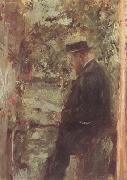
Siegmund Wilhelm List (May 14, 1880 ?C August 17, 1971), was a German field marshal during World War II, and at the start of the war was based in Slovakia in command of the Fourteenth Army.
List was born in Oberkirchberg near Ulm, Weerttemberg, Germany in 1880 and entered the Bavarian Army in 1898 as a cadet. In 1900 he was promoted to Lieutenant and in 1913 he joined the general staff as a Hauptmann. He served as a staff officer in World War I.
After the war List stayed in the Reichswehr and most of his assignments were as an administrator. In 1927 he was promoted to Oberst, in 1930 he was promoted to General-Major and in 1932 he was promoted to General-Leutnant. In 1938 after the Anschluss of Austria he was made responsible for integrating the Bundesheer into the Wehrmacht.
During 1939 List commanded the German 14th Army in the invasion of Poland. From 1939 to 1941 he commanded the German 12th Army in France and Greece. During 1941 he was Commander-in-Chief South-East. In July 1942 he was Commander-in-Chief of Army Group A on the Eastern Front in the Soviet Union.
|
|
 |
Wilhelm Leibl
|
|
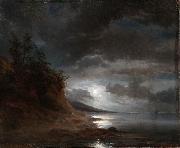
German Realist Painter, 1844-1900
German painter, draughtsman and etcher. In 1861 he abandoned his apprenticeship as a locksmith in order to train as a precision instrument maker, though a month or so later he decided to train as an artist, at first under the Cologne history painter and writer Hermann Becker (1817-85). In 1863 he moved to Munich; he studied there from March 1864, at the Akademie der Bildenden K?nste, initially under Philipp von Foltz and Alexander Straehuber, drawing from plaster casts, and later in Hermann Ansch?tz's painting class. Here, Arthur von Ramberg (1819-75) stimulated Leibl's sensitivity to colour; and Karl Theodor von Piloty encouraged him to observe reality and incorporate its lessons boldly into compositions on historical themes. From the start, however, Leibl tended to think of his pictures in terms of form rather than content. While at the Akademie he first reached a standard of excellence with his draughtmanship, which is notable for its directness and objectivity. As an artist, Leibl's early works were not especially promising. However, as occurred throughout his career, a long period of mediocrity was crowned by an unexpected masterpiece, such as his portrait drawing of Aunt Josepha (c. 1864; Cologne, Wallraf-Richartz-Mus.). This is particularly striking for Leibl's use of the hands to add to the expression of the sitter's character and mood, a device he was to use frequently in later work. In Munich, Leibl supplemented the teaching of the Akademie by studying the works of the Old Masters in the Alte Pinakothek: he paid particular attention to painters of the Baroque period such as van Dyck, Cornelis de Vos and Rubens, and also to other great masters of portraiture such as Frans Hals and Vel?zquez. The presentation of the subject found in such works is reflected in Leibl's portrait of Frau Gedon (1869; Munich, Neue Pin.). When the work was shown at the Grossen Internationale Kunstausstellung in Munich in 1869 it was singled out as the best oil painting of the exhibition by Gustave Courbet and, as a result, Leibl was honoured with an invitation to Paris, where he arrived on 13 November 1869.
|
|
 |
Wilhelm Krause
|
|
Wilhelm Krause (July 12, 1833 - February 4, 1910) was a German anatomist born in Hanover. In 1854 he earned his medical doctorate, and later (1860) became an associate professor at the University of Göttingen. In 1892 he was appointed head of the Anatomical Institute Laboratory in Berlin. He was the son of anatomist Karl Friedrich Theodor Krause (1797-1868).
Krause is remembered for the discovery and description of mechanoreceptors that were to become known as Krause's corpuscles, sometimes called "Krause's end-bulbs". His name is also associated with "Krause's membranes", which are isotropic bands in striated muscle fiber that consist of disks of sarcoplasm and connect the individual fibrils. In addition he performed pioneer research in the field of embryology. One of his well-known students at Göttingen was bacteriologist Robert Koch (1843-1910).
|
|
 |
Wilhelm Hammershoi
|
|
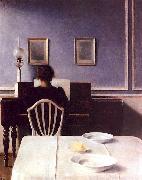
Danish 1864-1916
The son of a well-to-do merchant, Christian Hammershøi and his wife, Frederikke (n??e Rentzmann), Vilhelm studied drawing from the age of eight with Neils Christian Kierkegaard and Holger Grønvold, as well as painting with Vilhelm Kyhn, before embarking on studies with Frederik Vermehren and others at the Royal Danish Academy of Fine Arts. From 1883 to 1885, he studied with Peder Severin Krøyer at the Independent Study Schools, then debuted in the Charlottenborg Exhibition in the spring of 1885 with Portrait of a Young Girl (his sister, Anna; Pierre Auguste Renoir is reported to have admired this painting). Hammershøi married Ida Ilsted in 1891.
|
|
|
|
 |
Wilhelm Ferdinand Bendz
|
|
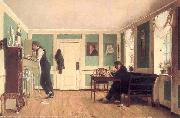
(March 20, 1804 - November 14, 1832), Danish genre and portrait painter, is one of the main personages associated with the Golden Age of Danish Painting. He was educated at the Royal Danish Academy of Art (Det Kongelige Danske Kunstakademi) in Copenhagen from 1820 to 1825, winning both silver medals but never the gold prize. He studied under professor Christoffer Wilhelm Eckersberg, but may at the same time have acquired some knowledge of contemporary German painting.
Today he is mainly remembered for his many technically accomplished portraits, though his ambition most of all ran towards a refined fusion of portrait, genre scene and allegorical history painting. His technical virtuosity is particularly visible in his depictions of the play of light cast from an obscured source and the resulting shadows. During his travel to Italy - which also brought him a one-year stay in Munich - he caught a sickness to the lungs and died at the age of 28 in 1832.
|
|
|
|
|
|
|
|
|
| Wholesale China Oil Painting Wholesale Oil Painting China Xiamen Portrait Reproduction on canvas Chinese Oil Painting Wholesale USA Oil Painting |
|
|
|
|
|