| |
|
Xiamen Oil Paintings, Wholesale Direct!
|
|
100% hand painted, 100% cotton canvas, 100% money back if not satisfaction. |
|
|
|
|
ART WORKS INDEX
A
B
C
D
E
F
G
H
I
J
K
L
M
N
O
P
Q
R
S
T
U
V
W
X
Y
Z
|
|
ARTISTS INDEX
A
B
C
D
E
F
G
H
I
J
K
L
M
N
O
P
Q
R
S
T
U
V
W
X
Y
Z
|
|
|
|
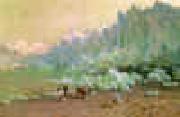 |
Thomas Hill
|
|
1829-1908
Thomas Hill was born in England on September 11, 1829. At the age of 15, he emigrated to the United States with his family. They settled in Taunton, Massachusetts. In 1851, he married Charlotte Elizabeth Hawkins. They had nine children.
At the age of 24, Hill attended evening classes at the Pennsylvania Academy of the Fine Arts (PAFA) and studied under American painter Peter Frederick Rothermel (1812-1895). During his years as a student, Hill traveled to the White Mountains in New Hampshire as early as 1854 and sketched alongside members of the Hudson River School, such as Benjamin Champney. In 1856, Hill and his family moved to San Francisco, California.
With painter Virgil Williams and photographer Carleton Watkins, Hill made his first trip to the Yosemite Valley in 1865. The next year, Hill traveled to the East Coast and Europe. He established his family on the East Coast but continued to take sketching trips to the West Coast and to attend meetings of the San Francisco Art Association. He moved his family back to San Francisco in 1873.
Hill made yearly sketching trips to Yosemite, Mount Shasta, and, back east, to the White Mountains. Hill ran an art gallery and art supply store. He briefly acted as the interim director for the SFAA School of Design and went to Alaska on a commission for environmentalist John Muir. He lived on his stock market investments as well as his art proceeds. His marriage ended in the 1880s.
Toward the end of his life, he maintained a studio at Yosemite??s Wawona Hotel. After suffering a stroke, Hill left Yosemite and traveled up and down the California coast, including stops in Coronado, San Diego and Santa Barbara. He died in Raymond, California, on June 30, 1908, and is buried at Mountain View Cemetery in Oakland, California.
|
|
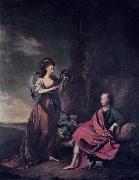 |
Thomas Hickey
|
|
was an Irish painter.
Born in Dublin, Hickey was the son of Noah, a confectioner in Capel Street, and Anne Hickey. A younger brother was John Hickey, the sculptor. He was trained at the Royal Dublin Society schools under Robert West.
Hickey painted primarily portraits and genre scenes. He traveled widely, working in India, Portugal, Italy and England, residing in Bath between 1776 and 1780. On his voyage to India, the vessel in which he was travelling was captured by French and Spanish fleets which led him to Lisbon, where, after receiving a number of commissions, he remained for several years. He eventually reached Bengal and stayed there until 1791 when he returned to England. He then traveled as far as Peking, China with George Macartney, 1st Earl Macartney as the expedition's official portrait painter.
He returned to Ireland shortly after the death of his brother John in January 1796. In 1797, he was commissioned by Dr. Robert Emmet, State Physician for Ireland, to paint a portrait of the doctor's son, Robert, and daughter, Mary. By 1798 he had returned to India where he landed just in time for the start of the Fourth Mysore War, which kept him engaged in painting. He resided in Madras until his death in 1824.
In addition to his artistic talents, he is reputed to have been a sparkling conversationalist who rarely failed to charm his sitters. The Courtauld Institute of Art (London), the Honolulu Academy of Arts, the National Gallery of Ireland, the Tate and the Victoria Art Gallery (Bath, England) are among the public collections having paintings by Thomas Hickey.
|
|
 |
Thomas Hearne
|
|
British Painter, 1744-1817
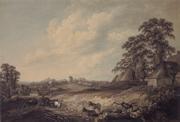
English painter and engraver. From 1765 to 1771 Hearne studied printmaking as apprentice to the landscape engraver William Woollett, exhibiting watercolours meanwhile at the Free Society of Artists and the Society of Artists. In 1771 he abandoned engraving and accompanied Sir Ralph Payne to the Leeward Islands (where Payne had just been appointed Governor), returning in 1775; several of his fastidious watercolours of Antigua survive, for example the Court House and Guard House in the Town of St John's in the Island of Antigua (n.d.; London, V&A). From then on British topography was his main concern. He travelled widely in England, Scotland and Wales with Sir George Beaumont and from these excursions was able to provide 84 drawings which, engraved by William Byrne, were published as The Antiquities of Great Britain (1778-81). This series set new standards in the pictorial recording of medieval architecture. Hearne also provided drawings for etchings of landscapes and 'rural sports'.
|
|
 |
Thomas Heaphy
|
|
English Painter, 1775-1835
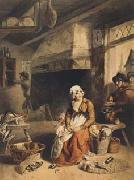
He trained at John Boyne's drawing school in Gloucester Street, Bloomsbury, London, and exhibited portraits at the Royal Academy from 1797. Following the success of a portrait of the Russian ambassador, Count Woronzow, he was appointed portrait painter to the Princess of Wales. Thomas Lawrence observed Heaphy's success and bought some of his pictures but had little cause to envy Heaphy's style, which owed much to the vocabulary of civic portraiture popularized by Joshua Reynolds (e.g. Portrait of a Naval Officer; London, V&A). Heaphy's largest project, The Duke of Wellington in Consultation with his Officers Previous to a General Engagement (Newcastle upon Tyne, Laing A.G.), was begun in Spain in 1813 during the Peninsular War and was finished in 1816. The engraving, which was intended to ensure Heaphy's fortune, was not released until 1822, by which time interest in the war had waned. Heaphy failed to finish his Battle of Waterloo (1816; untraced), another panoramic multiple portrait. Heaphy's other speciality, paintings of ports, markets, tradespeople and labourers, brought him great popularity between 1807 and 1811.
|
|
|
|
|
|
 |
Thomas Girtin
|
|
English Romantic Painter, 1775-1802
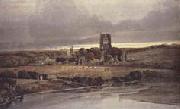
English painter, draughtsman and printmaker. With his rival, J. M. W. Turner, he extended the technical possibilities of watercolour and in doing so demonstrated that watercolours could have the visual impact and emotional range of oils. Although close in style throughout the 1790s, by 1800 Turner and Girtin were beginning to diverge: whereas the former dissolved forms to express his idea of Nature in a state of flux, the latter sought out a landscape's underlying patterns to convey his awe of Nature's permanence as well as its grandeur. Girtin's reduction of landscape to simple and monumental forms
|
|
 |
Thomas Gainsborough
|
|
1727-1788
British
Thomas Gainsborough Locations
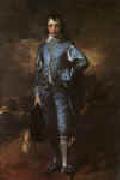
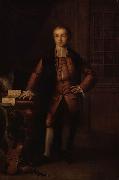
English painter, draughtsman and printmaker. He was the contemporary and rival of Joshua Reynolds, who honoured him on 10 December 1788 with a valedictory Discourse (pubd London, 1789), in which he stated: If ever this nation should produce genius sufficient to acquire to us the honourable distinction of an English School, the name of Gainsborough will be transmitted to posterity, in the history of Art, among the very first of that rising name. He went on to consider Gainsborough portraits, landscapes and fancy pictures within the Old Master tradition, against which, in his view, modern painting had always to match itself. Reynolds was acknowledging a general opinion that Gainsborough was one of the most significant painters of their generation. Less ambitious than Reynolds in his portraits, he nevertheless painted with elegance and virtuosity. He founded his landscape manner largely on the study of northern European artists and developed a very beautiful and often poignant imagery of the British countryside. By the mid-1760s he was making formal allusions to a wide range of previous art, from Rubens and Watteau to, eventually, Claude and Titian. He was as various in his drawings and was among the first to take up the new printmaking techniques of aquatint and soft-ground etching. Because his friend, the musician and painter William Jackson (1730-1803), claimed that Gainsborough detested reading, there has been a tendency to deny him any literacy. He was, nevertheless, as his surviving letters show, verbally adept, extremely witty and highly cultured. He loved music and performed well. He was a person of rapidly changing moods, humorous, brilliant and witty. At the time of his death he was expanding the range of his art, having lived through one of the more complex and creative phases in the history of British painting. He painted with unmatched skill and bravura; while giving the impression of a kind of holy innocence, he was among the most artistically learned and sophisticated painters of his generation. It has been usual to consider his career in terms of the rivalry with Reynolds that was acknowledged by their contemporaries; while Reynolds maintained an intellectual and academic ideal of art, Gainsborough grounded his imagery on contemporary life, maintaining an aesthetic outlook previously given its most powerful expression by William Hogarth. His portraits, landscapes and subject pictures are only now coming to be studied in all their complexity; having previously been viewed as being isolated from the social, philosophical and ideological currents of their time, they have yet to be fully related to them. It is clear, however, that his landscapes and rural pieces, and some of his portraits, were as significant as Reynolds acknowledged them to be in 1788.
|
|
 |
Thomas Frye
|
|
The Anglo-Irish painter Thomas Frye (c. 1710 - 3 April 1762 best known for his portraits in oil and pastel, including some miniatures and his early mezzotint engravings, was also the patentee of the Bow porcelain factory, London, and claimed in his epitaph to be "the inventor and first manufacturer of porcelain in England," though his rivals at the Chelsea porcelain factory seem to have preceded him in bringing wares to market. The Bow porcelain works did not long survive Frye's death; their final auctions took place in May 1764.
Thomas Frye was born at Edenderry, County Offaly, Ireland, in 1710; in his youth he went to London to practice as an artist. His earliest work are a pair of pastel portraits of boys, one dated 1734 (Earl of Iveagh). For the Worshipful Company of Saddlers he painted a full-length portrait of Frederick, Prince of Wales (1736, destroyed 1940), which he engraved in mezzotint and published in 1741. With his silent partner, a London merchant Edward Heylyn, he took out a patent on kaolin to be imported from the English colony of Virginia in November 1745, and became manager of the Bow factory from its obscure beginnings in the 1740s. He retired to Wales in 1759 for the sake of his lungs, but soon returned to London and resumed his occupation as an engraver, publishing the series of life-size fancy portraits in mezzotint, by which he is most remembered. He died of consumption on 2 April 1762.
Frye had five children; his two daughters assisted him in painting porcelain at Bow until their marriages. One of them, who married a Mr. Willcox, was employed by Josiah Wedgwood at the Wedgwood Etruria works in painting figure-subjects from 1759 to 1776, the year of her death.
|
|
|
|
|
|
 |
Thomas Fearnley
|
|
Norwegian Painter, 1802-1842
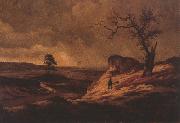
Norwegian painter. He was descended from a Yorkshire merchant who had settled in Norway in 1753. In 1819 he went into business but at the same time entered the Kongelige Tegneskole in Christiania (now Oslo) and received further training at the art colleges in Copenhagen (1821-3) and Stockholm (1823-7), where Karl XIV commissioned work from him. Fearnley spent much of his life travelling. In Norway in the summer of 1826 he met J. C. Dahl, with whom he later studied in Dresden (1829-30), learning especially to observe nature. After two years in Munich (1830-32),
|
|
 |
Thomas Faed
|
|
Scottish Painter,
1826-1900
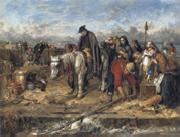
was a Scottish painter born in Gatehouse of Fleet, Kirkcudbrightshire, and was the brother of John Faed. He received his art education in the school of design, Edinburgh and was elected an associate of the Royal Scottish Academy in 1849. He came to London three years later, was elected an associate of the Royal Academy in 1861, and academician in 1864, and retired in 1893. He had much success as a painter of domestic genre, and had considerable executive capacity. Three of his pictures, The Silken Gown, Faults on Both Sides, and The Highland Mother are in the Tate Gallery and a further two, Highland Mary and The Reaper hang in the Aberdeen Art Gallery. The Last of the Clan, completed in 1865.
|
|
 |
Thomas Ender
|
|
(3 November 1793 Vienna - 28 September 1875 Vienna) was an Austrian painter.
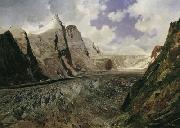
He was twin brother of Johann Ender. He also studied at the Vienna Academy, becoming a noted landscape painter. He won the grand prize at the Vienna Academy in 1816. Going to Brazil in 1817, he brought back nearly a thousand drawings and water colors. He visited Italy, Palestine, Greece and Paris. In 1836, he became corrector and later professor at the Vienna Academy, filling that chair until 1849.
|
|
 |
Thomas Eakins
|
|
American Realist Painter, 1844-1916.
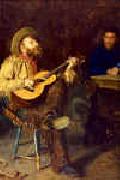
Thomas Cowperthwait Eakins (July 25, 1844 ?C June 25, 1916) was a realist painter, photographer, sculptor, and fine arts educator. He is widely acknowledged to be one of the most important artists in American art history.
For the length of his professional career, from the early 1870s until his health began to fail some forty years later, Eakins worked exactingly from life, choosing as his subject the people of his hometown of Philadelphia. He painted several hundred portraits, usually of friends, family members, or prominent people in the arts, sciences, medicine, and clergy. Taken en masse, the portraits offer an overview of the intellectual life of Philadelphia in the late 19th and early 20th centuries; individually, they are incisive depictions of thinking persons. As well, Eakins produced a number of large paintings which brought the portrait out of the drawing room and into the offices, streets, parks, rivers, arenas, and surgical amphitheaters of his city. These active outdoor venues allowed him to paint the subject which most inspired him: the nude or lightly clad figure in motion. In the process he could model the forms of the body in full sunlight, and create images of deep space utilizing his studies in perspective.
No less important in Eakins' life was his work as a teacher. As an instructor he was a highly influential presence in American art. The difficulties which beset him as an artist seeking to paint the portrait and figure realistically were paralleled and even amplified in his career as an educator, where behavioral and sexual scandals truncated his success and damaged his reputation.
Eakins also took a keen interest in the new technologies of motion photography, a field in which he is now seen as an innovator. Eakins was a controversial figure whose work received little by way of official recognition during his lifetime. Since his death, he has been celebrated by American art historians as "the strongest, most profound realist in nineteenth-and early-twentieth-century American art".
|
|
 |
Thomas Doughty
|
|
1793-1856
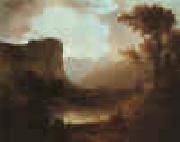
Thomas Doughty (July 19, 1793 ?C July 22, 1856) was an American artist of the Hudson River School.
"Gilpin's Mill on the Brandywine" attributed to Thomas Doughty circa 1827Born in Philadelphia, Thomas Doughty was the first American artist to work exclusively as a landscapist and was successful both for his skill and the fact that Americans were turning their interest to landscape. He was known for his quiet, often atmospheric landscapes of the rivers and mountains of Pennsylvania, New York, New England, and especially the Hudson River Valley. He taught himself how to paint while aprenticing for a leather manufacturer.
|
|
 |
Thomas Dewing
|
|
(May 4, 1851 C November 5, 1938) was an American painter working at the turn of the 20th century. He was born in Newton Lower Falls, Massachusetts. He studied at the Acad??mie Julian in Paris, and later settled into a studio in New York City. He married Maria Oakey Dewing, an accomplished painter with extensive formal art training and familial links with the art world.
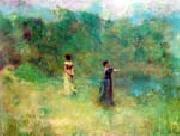
He is best known for his tonalist paintings, a sub-genre of American art that was rooted in English Aestheticism. Dewing's preferred vehicle of artistic expression is the female figure. Often seated playing instruments, writing letters, or engaged in other impassive actions and situated in gauzy, dreamy interiors, the figures remain remote and distant to the viewer. These scenes are infused with a color that pervades the entire picture, setting tone and mood. The ethereal delicacy and subtle color harmonies of Dewing's paintings have not met with universal approval: some feminist critics have lambasted Dewing's work as being misogynistic; he rarely painted anything other than the female figure, vacant of expression, languishing in sumptuous clothing.
Tonalism quickly came to be considered outdated with the advent of modernism and abstraction in art, though Dewing was successful in his own day. His art was considered extremely elegant, and has undergone a subtle revival in the last 10 years or so.
Dewing was a member of the Ten American Painters, a group of American Impressionists who seceded from the Society of American Artists in 1897.
|
|
 |
Thomas De Keyser
|
|
1586-1667
Dutch
Thomas De Keyser Gallery
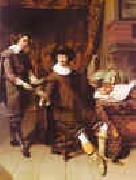
De Keyser excelled as a portrait painter, and was the most in-demand portrait painter in the Netherlands until the 1630s, when Rembrandt eclipsed him in popularity. Rembrandt was influenced by his work, and many of de Keyser's paintings were later falsely attributed to Rembrandt.
His portraiture is full of character and masterly in handling, and often distinguished by a rich golden glow of color and Rembrandtesque chiaroscuro. Some of his portraits are life-size, but the artist generally preferred to keep them on a considerably smaller scale, like the famous Four Amsterdam burgomasters assembled to receive Marie de Medici in 1638, now on display at the Mauritshuis museum in The Hague.
In addition to portraits, he also executed some historical and mythological pictures, such as the Theseus and Ariadne in the Amsterdam town hall, now the Royal Palace. De Keyser also worked as an architect. From 1662 until his death in 1667 he oversaw construction of the new Amsterdam town hall, now Royal Palace.
De Keyser was a son of the architect and sculptor Hendrik de Keyser. We have no definite knowledge of his training, and but scant information as to the course of his life. Aert Pietersz, Cornelis vander Voort, Werner van Valckert and Nicolas Elias are accredited by different authorities with having developed his talent.
In the 1640s, de Keyser received very few painting commissions, and was forced to seek income elsewhere. He owned a basalt business from 1640 until 1654, when he returned to painting.
The Rijksmuseum in Amsterdam has the largest collection of paintings by de Keyser. His work can also be seen at the Louvre in Paris, the Metropolitan Museum of Art in New York City, the Hermitage in Saint Petersburg and the National Gallery in London, among others.
The Stedelijk Museum modern art museum in Amsterdam carries a statue of de Keyser on its facade. A street in Enschede is named for him.
A contemporary namesake of the painter was Thomas de Keyser (Utrecht, 1597-1651), an actor and nephew of Hendrick de Keyser.
|
|
 |
Thomas Daniell
|
|
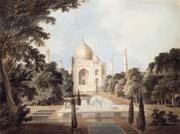
1749-1840,was an English landscape painter. He was born at the Chertsey inn, kept by his father, in 1749, and apprenticed to an heraldic painter. Daniell, however, was animated with a love of the romantic and beautiful in architecture and nature. Up to 1784 he painted topographical subjects and flower pieces. By this time his two nephews had come under his influence, the younger, Samuel, being apprenticed to Medland the landscape engraver, and the elder, William, being under his own care. In this year (1784) he embarked for India accompanied by William Daniell, and found at Calcutta ample encouragement. Here he remained ten years, and on returning to London he published his largest work, Oriental Scenery, in six large volumes, not completed till 1808. From 1795 until 1828 he continued to exhibit Eastern subjects, temples, jungle hunts, &c., and at the same time continued the publication of illustrated works. These are Views of Calcutta; Oriental Scenery, 144 plates; Views in Egypt; Excavations at Ellora; Picturesque Voyage to China. These were for the most part executed in aquatint.
|
|
 |
Thomas Danby
|
|
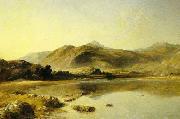
(c. 1818 - 25 March 1886) was an English landscape painter.
Danby was born, it is thought, in Bristol in south-west England, the younger son of Francis Danby (1793-1861). He had an elder brother, James Francis Danby (1816-75) who also became a landscape painter. Thomas went with his father to Europe in 1829, living for a time in Paris where he was able to earn a living by copying pictures at the Louvre in Paris. He thus became an earnest admireer and "student" of Claude Lorrain, whose aerial effects he sought to imitate.
Returning to England about the same time as his father, he first exhibited at the British Institution in 1841, and afterwards frequently at the Royal Academy from 1843. He was a friend of Paul Falconer Poole, with whom he shared a house in Hampstead in 1843, and imbibed not a little of his romantic feeling for nature. From 1855 to his death, Danby resided in or near Hampstead in north London..
The subjects of his landscapes were usually taken from Welsh scenery, especially the old county of Merioneth; his pictures for the most part were not ideal compositions (unlike his father's work) but actual scenes pervaded with a true romantic spirit. "He was always trying" says the writer of his obituary in The Times newspaper, "to render his inner heart's feeling of a beautiful view rather than the local facts received on the retina."
He came, it is said, within one vote of election as an Associate of the Royal Academy (ARA) but, failing eventually to attain Academy honours, he devoted himself in his latter years chiefly to watercolour painting. He became a member of the Royal Hibernian Academy in 1860, an associate of the Society of Painters in Watercolours in 1867, and a full member of the latter in 1870; until his death his contributions were prominent amongst the works at the society's exhibitions.
Danby died of a chest complaint, terminating in dropsy on 25 March 1886. He had been twice married, and had 2 daughters and a son from the second marriage.
|
|
 |
thomas creswick
|
|
Thomas Creswick (5 February 1811 - 28 December 1869) was an English landscape painter and illustrator, born in Sheffield, son of Thomas Creswick and Mary Epworth and educated at Hazelwood, near Birmingham.
At Birmingham he first began to paint. His earliest appearance as an exhibitor was in 1827, at the Society of British Artists in London; in the ensuing year he sent to the Royal Academy the two pictures named Llyn Gwynant, Morning, and Carnarvon Castle. About the same time he settled in London; and in 1836 he took a house in Bayswater. He soon attracted some attention as a landscape painter, and had a career of uniform and encouraging, though not signal success. In 1842 he was elected an associate, and in 1850 a full member of the Royal Academy, which, for several years before his death, numbered hardly any other full members representing this branch of art.
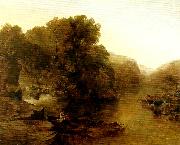
In his early practice he set an example, then too much needed, of diligent study of nature out of doors, painting on the spot all the substantial part of several of his pictures. English and Welsh streams may be said to have formed his favourite subjects, and generally British rural scenery, mostly under its cheerful, calm and pleasurable aspects, in open daylight. This he rendered with elegant and equable skill, color rather grey in tint, especially in his later years, and more than average technical accomplishment; his works have little to excite, but would, in most conditions of public taste, retain their power to attract.
Creswick was industrious and extremely prolific; he produced, besides a steady outpouring of paintings, numerous illustrations for books. He was personally genial, a dark, bulky man, somewhat heavy and graceless in aspect in his later years. He died at his house in Bayswater, Linden Grove, after a few years of declining health. Among his principal works may be named England (1847); Home by the Sands, and a Squally Day (1848); Passing Showers (1849); The Wind on Shore, a First Glimpse of the Sea, and Old Trees (1850); A Mountain Lake, Moonrise (1852); Changeable Weather (1865); also the London Road, a Hundred Years ago; The Weald of Kent; the Valley Mill (a Cornish subject); a Shady Glen; the Windings of a River; the Shade of the Beech Trees; the Course of the Greta; the Wharfe; Glendalough, and other Irish subjects, 1836 to 1840; the Forest Farm Frith for figures, and Ansdell for animals, occasionally worked in collaboration with Creswick.
|
|
|
|
 |
Thomas Couture
|
|
1815-1879
French
Thomas Couture Location
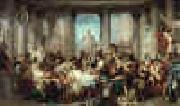
French painter and teacher. A student of Antoine-Jean Gros in 1830-38 and Paul Delaroche in 1838-9, he demonstrated precocious ability in drawing and was expected to win the Prix de Rome. He tried at least six times between 1834 and 1839, but achieved only second prize in 1837 (entry untraced). Disgusted with the politics of the academic system, Couture withdrew and took an independent path. He later attacked the stultified curriculum of the Ecole des Beaux-Arts and discouraged his own students from entering this institution. He first attained public notoriety at the Paris Salon with Young Venetians after an Orgy (1840; Montrouge, priv. col., see Boime, p. 85), the Prodigal Son (1841; Le Havre, Mus. B.-A.) and the Love of Gold (1844; Toulouse, Mus. Augustins). These early canvases are treated in a moralizing and anecdotal mode; the forms and compositional structures, like the debauched and corrupt protagonists, are sluggish and dull. Yet what made his work seem fresh to the Salon audience was his use of bright colour and surface texture derived from such painters as Alexandre-Gabriel Decamps and Eugene Delacroix, while his literary bent and methodical drawing demonstrated his mastery of academic tradition. The critics Thophile Gautier and Paul Mantz (1821-95) proclaimed him as the leader of a new school that mediated between the old and the new, and looked to him for a revitalization of Salon painting. The air of compromise his works projected made him appear a cultural representative of the juste milieu policies of Louis-Philippe.
|
|
 |
Thomas Cooper Gotch
|
|
1854-1931
English
Thomas Cooper Gotch Gallery
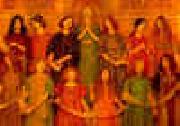
In Newlyn he worked first at painting local scenes in the then-fashionable realist manner. But even these often had a romantic edge, such as The Wizard or an obvious love of surface colour.
In 1891 a visit to Florence, Italy, opened his eyes to the work of the romantic European symbolists. He took the brave step of changing his style, to make romantic decorative paintings, when the prevailing fashion was against him. His first work in this new style was My Crown and Sceptre (1892), which was the progenitor to his most well-known work The Child Enthroned (1894). The latter, on original exhibition, was hailed by The Times newspaper as the star of that year's Royal Academy show. Until that time, his new style of work had drawn much critical scorn.
He painted religious Christian scenes, history painting, portraits, and a few landscapes. His best-known paintings, which form the bulk of his work, usually portray girl-children in ornate classical or medievalist dress. The appearance of the girls in his paintings is often noted as being very modern. Gotch was a close and lifelong friend of Henry Scott Tuke, whose work featured a parallel focus on the boy-child. Gotch's lifelong adoration of the beautiful girl-child was shared by other Victorian giants such as John Ruskin and Lewis Carroll.
His emotionally-charged work was immensely popular and critically acclaimed for most of his life, although interest in neo-romanticism waned after the First World War and he turned to watercolours of flowers. He also illustrated books, such as Round About Wiltshire, The Land of Pardons (an early study of Breton folklore & Celtic Christianity), and contributed illustrations to school readers such as Highroads of Literature.
A retrospective show was held in Newcastle in 1910, and a memorial exhibition in Kettering in 1931.
|
|
 |
Thomas Cole
|
|
1801-1848
Thomas Cole Galleries
Thomas Cole (February 1, 1801 - February 11, 1848) was a 19th century American artist. He is regarded as the founder of the Hudson River School, an American art movement that flourished in the mid-19th century. Cole's Hudson River School, as well as his own work, was known for its realistic and detailed portrayal of American landscape and wilderness, which feature themes of romanticism and naturalism.
In New York he sold three paintings to George W. Bruen, who financed a summer trip to the Hudson Valley where he visited the Catskill Mountain House and painted the ruins of Fort Putnam. Returning to New York he displayed three landscapes in the window of a bookstore; according to the New York Evening Post, this garnered Cole the attention of John Trumbull, Asher B. Durand, and William Dunlap. Among the paintings was a landscape called "View of Fort Ticonderoga from Gelyna". Trumbull was especially impressed with the work of the young artist and sought him out, bought one of his paintings, and put him into contact with a number of his wealthy friends including Robert Gilmor of Baltimore and Daniel Wadsworth of Hartford, who became important patrons of the artist.
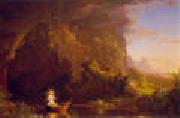
Cole was primarily a painter of landscapes, but he also painted allegorical works. The most famous of these are the five-part series, The Course of Empire, now in the collection of the New York Historical Society and the four-part The Voyage of Life. There are two versions of the latter, one at the National Gallery in Washington, D.C., the other at the Munson-Williams-Proctor Arts Institute in Utica, New York.
Cole influenced his artistic peers, especially Asher B. Durand and Frederic Edwin Church, who studied with Cole from 1844 to 1846. Cole spent the years 1829 to 1832 and 1841-1842 abroad, mainly in England and Italy; in Florence he lived with the sculptor Horatio Greenough.
|
|
|
|
|
|
|
|
 |
Thomas Buttersworth
|
|
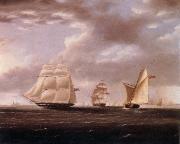
English Painter, 1768-1828, He was a seaman of the Napoleonic wars period who became a maritime painter producing works to commission, and was little exhibited during his lifetime. He was born on the Isle of Wight, England. He enlisted in the Royal Navy in London in 1795, and served on HMS Caroline during the wars with France, then was invalided home from Minorca in 1800. The National Maritime Museum in London has 27 watercolours by him, several of which are mounted on sheets from 18th century printed signal and muster books.
|
|
|
|
 |
Thomas Buchanan Read
|
|
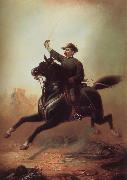
American Painter, 1822-1872,was an American poet and portrait painter born in Chester County, Pennsylvania. Read wrote a prose romance, The Pilgrims of the Great St. Bernard, and several books of poetry, including The New Pastoral, The House by the Sea, Sylvia, and A Summer Story. Some of the shorter pieces included in these, e.g., "Sheridan's Ride," "Drifting,""The Angler", "The Oath," and "The Closing Scene," have great merit. Read was briefly associated with the Pre-Raphaelite Brotherhood. His greatest artistic popularity took place in Florence. Among portraits he painted were Abraham Lincoln, Henry Longfellow, Alfred Tennyson, Elizabeth Barrett Browning, Robert Browning and William Henry Harrison. Read died from injuries sustained in a carriage accident, which weakened him and led him to contract pneumonia while on shipboard returning to America.
|
|
|
|
|
|
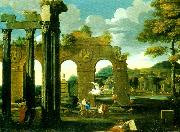 |
Thomas Blanchet
|
|
Thomas Blanchet (1614, possibly in Paris - 21 June 1689, Lyon) was a French painter, draughtsman, architect, sculptor and printmaker.
During his training in Paris Blanchet met Jacques Sarazin, and on his advice moved from studying sculpture to painting. During this time he familiarised himself with the Baroque and the School of Fontainebleau's Mannerism, new imports into Paris at this time. Among his probably co-students was Simon Vouet. He stayed in Rome from c.1645 to 1653 and worked with artists in Nicolas Poussin's circle, as well as visiting the studios of Andrea Sacchi and Pietro da Cortona. He was highly praised by Gianlorenzo Bernini, who he also visited. Blanchet produced paintings for Niccolo Guido di Bagno (1584 -1663), made engravings of ancient tombs and views or prospettive and a mausoleum for Rene de Voyer d'Argenson, French ambassador to Venice in San Giobbe, Venice (1654).
|
|
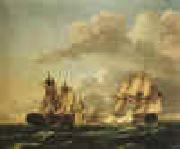 |
Thomas Birch
|
|
1779-1851
Thomas Birch Gallery
American painter of English birth. He was one of the most important American landscape and marine painters of the early 19th century. He moved to America in 1794 with his father William Birch (1755-1834), a painter and engraver from whom he received his artistic training. The family settled in Philadelphia, where William, armed with letters of introduction from Benjamin West to leading citizens of that city, became a drawing-master. Early in their American careers both Birches executed cityscapes, several of which were engraved. Thomas contributed a number of compositions to The City of Philadelphia in the State of Pennsylvania, North America, as it Appeared in the Year 1800 (1800), a series of views conceived by the elder Birch in obvious imitation of comparable British productions. An English sensibility is also apparent in the many paintings of country estates executed by father and son in the early 19th century (e.g. Eaglesfield, 1808; priv. col.). These compositions, along with such portrayals of important public edifices in and near Philadelphia as Fairmount Waterworks (1821; Philadelphia, PA Acad. F.A.), emphasize the cultural progress and commercial prosperity of the young United States as well as its almost Edenic natural beauty. Birch is also known for his representations of winter landscapes.
|
|
|
|
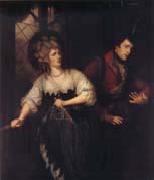 |
Thomas Beach
|
|
British Painter, 1738-1806,English painter. He studied with Joshua Reynolds from 1760 until early in 1762, during which time he was also a student at the St Martin's Lane Academy, London. He probably settled in Bath; his recorded portraits of the 1760s are all of sitters from Dorset or Somerset, and he sent two portraits from an address in Bath to the Society of Artists exhibition of 1772. He exhibited with the Society until 1783, becoming its vice-president (1782) and president (1783) he also exhibited at the Royal Academy (1785-90, 1797). He probably divided his mature practice between London and Bath. His early reliance on Reynolds's ideas of propriety gave way to a more direct approach, seen at its best in such group portraits as The Stapleton Family (1789; U. Bath, Holburne of Menstrie Mus.). In this work, the four children are shown in costume, as a fortune-teller and her customers. The theatrical element in Beach's work, reflecting his interest in the stage, is seen most strikingly in Sarah Siddons and John Philip Kemble in 'Macbeth' Act 2, Scene ii (1786; London, Garrick Club). Beach's diary for 1798, the only one to have survived, chronicles what appears to have been an annual tour of the west country; that year he completed 31 portraits between June and December. Beach was able to capture a strong likeness and this, despite a certain naivety and awkwardness in composition, was enough to establish his reputation in moderately fashionable provincial circles. His last recorded work is a Self-portrait
|
|
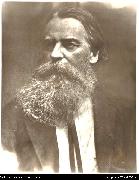 |
Thomas Baines
|
|
(27 November 1820 ?C 8 May 1875) was an English artist and explorer of British colonial southern Africa and Australia. Born in King's Lynn, Norfolk, Baines was apprenticed to a coach painter at an early age. When he was 22 he left England for South Africa aboard the "Olivia" (captained by a family friend William Roome) and worked for a while in Cape Town as a scenic and portrait artist, and as official war artist during the so-called Eighth Frontier War for the British Army.
In 1855 Baines joined Augustus Gregory??s 1855?C1857 Royal Geographical Society sponsored expedition across northern Australia as official artist and storekeeper. The expedition??s purpose was to explore the Victoria River district in the north-west and to evaluate the entire northern area of Australia in terms of its suitability for colonial settlement.
|
|
 |
Thomas Anshutz
|
|
American Realist Painter,
1851-1912
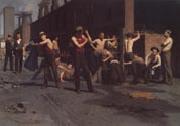
was an American painter and teacher. He studied art in Paris at the Academie Julian, and at the Pennsylvania Academy of the Fine Arts under Thomas Eakins. His most famous painting, The Ironworkers' Noontime (1880), depicts several workers on their break in the yard of a foundry. Painted near Wheeling, West Virginia, it is conceived in a naturalistic style similar to that of Eakins, although Eakins never painted industrial subjects.
|
|
 |
Thomas Allom
|
|
1804-1872
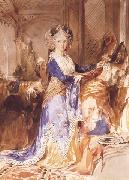
was an English artist, topographical illustrator and architect, and one of the founder members of what eventually became the Royal Institute of British Architects (RIBA).He was born in Lambeth, south London, the son of a coachman from Suffolk. In 1819, he was apprenticed to architect Francis Goodwin for whom he worked until 1826. He then studied at the Royal Academy School. His designs for churches shown at exhibitions in 1824 and 1827 aroused considerable interest, and he later designed many buildings in London (including a workhouse in Marloes Road, Kensington (1847), the Church of Christ in Highbury in 1850, the Church of St Peter's in Notting Hill in 1856, and the elegant Ladbroke Estate in west London). Further afield his works included workhouses at Calne, Wiltshire (1847) and in Liverpool, design of the William Brown Library also in Liverpool, (1857-1860), and the tower of St. Leodegarius Church, Basford near Nottingham (1860).
|
|
|
|
 |
Therese Schwartze
|
|
(December 20, 1852, Amsterdam - December 23, 1918, Amsterdam) was a Dutch portrait painter.
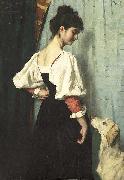
Therese was the daughter of Johan Georg Schwartze (1814 - 1874), from whom she received her first training, before studying for a year under Gabriel Max and Franz von Lenbach in Munich. In 1879 she went to Paris to continue her studies under Jean-Jacques Henner. Her portraits are remarkable for excellent character drawing, breadth and vigour of handling and rich quality of pigment.
She was one of the few women painters who had been honoured by an invitation to contribute their portraits to the hall of painters at the Uffizi Gallery in Florence. Some of her best pictures, notably a portrait of Piet J Joubert, and Three Inmates of the Orphanage at Amsterdam, are at the Rijksmuseum, and one entitled The Orphan at the Boyman Museum in Rotterdam.
|
|
 |
theophile-alexandre steinlen
|
|
Swiss-born French Art Nouveau Painter and Printmaker, 1859-1923
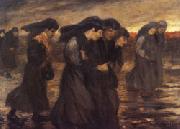
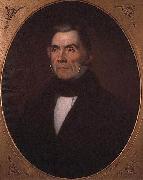
was a Swiss-born French Art Nouveau painter and printmaker. Born in Lausanne, Steinlen studied at the University of Lausanne before taking a job as a designer trainee at a textile mill in Mulhouse in eastern France. In his early twenties he was still developing his skills as a painter when he and his new wife were encouraged by the painter Francois Bocion to move to the artistic community in the Montmartre Quarter of Paris. Once there, Steinlen was befriended by the painter Adolphe Willette who introduced him the artistic crowd at Le Chat Noir that led to his commissions to do poster art for the cabaret owner/entertainer, Aristide Bruant and other commercial enterprises. La tournee du Chat Noir avec Rodolphe Salis (1896)In the early 1890s, Steinlen's paintings of rural landscapes, flowers, and nudes were being shown at the Salon des Independants. His 1895 lithograph titled Les Chanteurs des Rues was the frontispiece to a work entitled Chansons de Montmartre published by Editions Flammarion with sixteen original lithographs that illustrated the Belle Epoque songs of Paul Delmet. His permanent home, Montmartre and its environs was a favorite subject throughout Steinlen's life and he often painted scenes of some of the harsher aspects of life in the area. In addition to paintings and drawings, he also did sculpture on a limited basis, most notably figures of cats that he had great affection for as seen in many of his paintings. Steinlen became a regular contributor to Le Rire and Gil Blas magazines plus numerous other publications including L'Assiette au Beurre and Les Humouristes, a short-lived magazine he and a dozen other artists jointly founded in 1911.
|
|
 |
Theophile Hamel
|
|
(8 November 1817 - 23 December 1870) was a Canadian artist who painted mainly portraits and religious images in 19th-century Quebec.
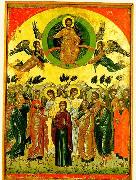
Hamel was born in 1817 in Sainte-Foy (that was a suburb of Quebec City), the son of a successful farmer. Hamel's paternal ancestry can be traced to French immigrant Jean Hamel, who arrived in New France from Avremesnil (Normandy) in 1656. In 1834 Theophile was already taking art lessons from Antoine Plamondon. His early portraits show a mixture of European romanticism and Canadian simplicity. His style gradually changed to match the taste of his clients for simple, honest, even prim portraits
|
|
|
|
 |
Theophanes the Cretan
|
|
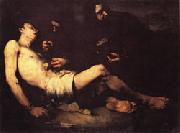
active 1527-1559,was a leading icon painter of the Cretan school in the first half of the sixteenth century, and in particular the most important figure in Greek wall-painting of the period.
He was born in Heraklion (date unknown), and no doubt trained there, but all his known work was done in mainland Greece. Frescoes bearing his signature survive in the Greek monasteries of Mt. Athos, especially Stavronikita monastery and Lavra, and Meteora which has his earliest dated work, from 1527. He also did many panel icons, either for iconostases or small portable works. Theophanes was active from about 1527-48, and trained his sons and several pupils, often themselves Cretan. By 1535 both he and his two sons had become monks in the Lavra monastery of Mount Athos, where many of his best works remain. Theophanes returned to Crete before his death in 1559.
Two detached wallpaintings attributed to Theophanes are in the Hermitage Museum in Saint Petersburg. Like most Cretan painters of this date, his work shows some influence from Western painting, but less in his case than with many artists. Some faces are personalised or looking out to the viewer, and his figures are modelled to convey volume. His work is more conscious of visual perspective than older Byzantine artists, but he does not use the geometrical perspective schemes by then standard in the West. He uses traditional Byzantine compositions, in a rather austere and powerful manner.
He should not be confused with Theophanes the Greek (Feofan Grek), an icon painter who worked in Muscovite Russia in the late fourteenth century.
|
|
 |
Theodule Ribot
|
|
Saint-Nicolas-d'Attez, 1823-Colombes 1891.
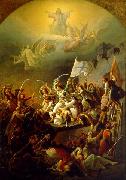
was a French realist painter. He was born in Saint-Nicolas-d'Attez, and studied at the École des Arts et Metiers de Chalons before moving to Paris in 1845. There he found work decorating gilded frames for a mirror manufacturer; he also studied in the studio of Auguste-Barth??l??my Glaize. After a trip to Algeria around 1848, he returned in 1851 to Paris, where he continued to make his living as an artisan. In the late 1850s, working at night by lamplight, he began to paint seriously, depicting everyday subjects in a realistic style. He made his Salon debut in 1861 with several paintings of kitchen subjects. Collectors purchased the works, and his paintings in the Salons of 1864 and 1865 were awarded medals. Ribot painted domestic genre works, still-lifes, portraits, and religious scenes. His preference was for painting directly from nature, emphasizing the contrasts of light and dark. His use of chiaroscuro to suggest psychological states grew from his admiration for Spanish and Dutch baroque masters such as Ribera and Rembrandt, an enthusiasm shared by his contemporaries Courbet and Bonvin. Members of Ribot's family are the likely models for many of his figure compositions, in which the subjects engage in humble activities, such as preparing meals or gathering in groups to read to each other. The light draws attention to faces and hands, which emerge sharply from dimly lit surroundings. Although the realism of Ribot's work aligns him with the most progressive artists of the generation preceding the Impressionists, he was no revolutionary,
|
|
 |
Theodoros Vryzakis
|
|
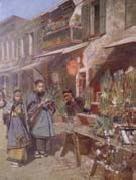
Thebes 19 October 1814 - Munich 6 December 1878) was a major Greek painter of the 19th century.
Vryzakis's father died in the Greek War of Independence. He is the first Greek painter who studied in Munich and the main representative of the type of historical painting that was popular in Greece in the 18th century.
He is considered the first painter of modern Greece, a recorder of the Greek War of Independence, which he viewed in a romantic and nostalgic way. His paintings' characters are pompous, theatrical and detached figures. His interest in the traditional costumes and the decoration and the absence of any individual facial expression is according to art critics the result of the eye of a "foreign" artist, who looks for the conventional element in another land. The monumental size of his pictures, the ceremonial and theatrical compositions, and the meticulous style of academic idealistic romanticism make his style unique for among Greek Artists. Today, many of his works are exhibited at the National Gallery of Athens and the Benaki Museum in Athens.
|
|
 |
Theodore Wores
|
|
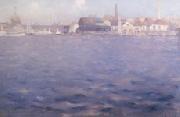
American Painter, ca.1859-1939,was an American painter born in San Francisco. Wores began his art training at age twelve in the studio of Joseph Harrington, who taught him color, composition, drawing and perspective. When the San Francisco School of Design opened in 1874, Wores was one of the first pupils to enroll. After one year at that school under the landscape painter Virgil Macey Williams, he continued his art education at the Royal Academy in Munich where he spent six years. He also painted with William Merritt Chase and Frank Duveneck. Wores returned to San Francisco in 1881. He went to Japan for two extended visits and had successful exhibitions of his Japanese paintings in New York and London, where he became friends with James Abbott McNeill Whistler and Oscar Wilde. He visited Hawaii and Samoa in 1901-1902 and established a home in San Francisco about 1906. He visited Hawaii for a second time in 1910?C1911. For the remainder of his career, Wores painted the coast on the western edge of San Francisco. He died in San Francisco in 1939. His most famous work is The Lei Maker, which is on permanent display at the Honolulu Academy of Arts.
|
|
 |
Theodore Roussel
|
|
English Painter, 1847-1926
English painter and etcher of French birth. He was born and educated in France and settled in England in 1878, when he quickly established a reputation. Largely self-taught, his few extant early paintings show an eclectic style that combines the techniques of the Old Masters, which he studied in detail, with the subject-matter of modern urban life. In 1885 he was introduced to James McNeill Whistler, his neighbour in Chelsea, London, and in consequence a lifelong friendship was formed. As Roussel was a member of Whistler's London circle his work in watercolour and oil was influenced by the latter in style and choice of subject-matter. His oft-quoted remark that he was a 'pupil of Whistler' is, however, belied by his frequently distinct style, as seen in such paintings as the Reading Girl (1886-7; London, Tate). In 1888 Whistler introduced him to the techniques of etching and drypoint, resulting in such etchings as the Sign of the 'White Horse', Parson's Green (c. 1893-4; see Rutter, pl. xxx). For the remainder of his life he relentlessly pursued the medium, even, like Whistler, designing his own special frames. Always fascinated by the theoretical and practical nature of colour science, he constantly experimented and was an early pioneer of the technique of colour etching in England, producing such works as Dawn.
|
|
|
|
|
|
|
|
|
| Wholesale China Oil Painting Wholesale Oil Painting China Xiamen Portrait Reproduction on canvas Chinese Oil Painting Wholesale USA Oil Painting |
|
|
|
|
|