| |
|
Xiamen Oil Paintings, Wholesale Direct!
|
|
100% hand painted, 100% cotton canvas, 100% money back if not satisfaction. |
|
|
|
|
ART WORKS INDEX
A
B
C
D
E
F
G
H
I
J
K
L
M
N
O
P
Q
R
S
T
U
V
W
X
Y
Z
|
|
ARTISTS INDEX
A
B
C
D
E
F
G
H
I
J
K
L
M
N
O
P
Q
R
S
T
U
V
W
X
Y
Z
|
|
|
|
 |
ZUCCARO Taddeo
|
|
Italian Mannerist Painter, 1529-1566
Painter and draughtsman. Taught to draw by his father, at the age of 14 he went alone to Rome where, according to Vasari, he was employed in various workshops and studied independently, particularly the works of Raphael. Through assisting Daniele de Porri (1500-77), who had trained in Parma, he learnt of the work of Correggio and Parmigianino. He first became known for his paintings on fa?ades, notably scenes from the Story of Furius Camillus on the palazzo of a Roman nobleman Jacopo Matteo, executed in 1548. Vasari claimed that Taddeo's fa?ade decorations equalled those of Polidoro da Caravaggio; none survives, although some are documented in drawings (e.g. London, BM; Paris, Louvre) and show his assimilation of Polidoro's style. Taddeo's earliest extant works date from 1553 when he collaborated with Prospero Fontana on the decoration (part destr.) of the villa of Pope Julius III outside the Porta del Popolo in Rome; Taddeo's contributions included scenes of The Seasons in the loggia of the nymphaeum. In these, clarity of form and space, natural proportions and idealization of human form demonstrate his affinity with the classicism of the High Renaissance. He also assimilated the sculptural sensibility of Mannerism, derived from Michelangelo.
|
|
 |
Wouter Johannes van Troostwijk
|
|
1782-1810
Dutch
Wouter Johannes van Troostwijk Gallery
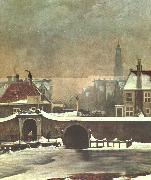
Dutch painter, draughtsman and etcher. In 1803 he was admitted to the Amsterdam Tekenacademie where he was a pupil of the director, Jurriaan Andriessen. Despite a highly successful student career that culminated in a gold medal from the Felix Meritis Society in 1807, he was unable to establish himself as a professional artist during the remainder of his very short working life in Amsterdam. Andriessen's studies from nature seem to have been an important influence; van Troostwijk was one of the earliest artists to paint en plein air. Although he looked back to 17th-century Dutch landscape art and to the work of his contemporaries, in such paintings as Landscape in Gelderland (c. 1808; Amsterdam, Rijksmus.; see NETHERLANDS, THE, fig. 21) he achieved a totally new lyricism in the rendering of atmospheric effects. The Raampoortje (1809; Amsterdam, Rijksmus.) displays a fresh colouristic touch rare in Dutch painting of this period. His Self-portrait (c. 1810; Amsterdam, Rijksmus.) is equally original in composition and colour. He also produced animal paintings in the manner of Paulus Potter, drawings and a few etchings towards the end of his life. Van Troostwijk died before his considerable talents could be recognized, and, although he has come to be seen as an important precursor of much late 19th-century Dutch painting, he had little influence on his immediate successors.
|
|
 |
Woolner, Thomas
|
|
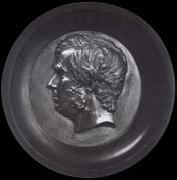
1825 - 1892,English sculptor and poet. He ranks with John Henry Foley as the leading sculptor of mid-Victorian England. He trained with William Behnes and in 1842 enrolled as a student at the Royal Academy, London. In 1844 he exhibited at Westminster Hall, London, a life-size plaster group, the Death of Boadicea (destr.), in an unsuccessful attempt to obtain sculptural commissions for the Houses of Parliament. His earliest important surviving work is the statuette of Puck (plaster, 1845-7; C. G. Woolner priv. col.), which was admired by William Holman Hunt and helped to secure Woolner's admission in 1848 to the Pre-Raphaelite Brotherhood. The work's Shakespearean theme and lifelike execution, stressing Puck's humorous malice rather than traditional ideal beauty, made it highly appealing. Although eclipsed by Hunt, John Everett Millais and Dante Gabriel Rossetti, Woolner was an important figure in the Brotherhood. He contributed poetry to its journal, The Germ (1850), and his work was committed to truthfulness to nature more consistently than that of any other Pre-Raphaelite, except for Hunt. This is evident in Woolner's monument to William Wordsworth (marble, 1851; St Oswald, Grasmere, Cumbria).
|
|
|
|
 |
William Turner of Oxford
|
|
British, 1789-1862
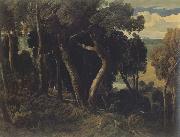
He probably received his earliest training from William Delamotte, in Oxford. In 1804 he went to London and became a pupil of John Varley, possibly being formally apprenticed. He first exhibited at the Royal Academy in 1807; in January 1808 he was elected an associate of the Society of Painters in Water-Colours, and in November of that year became its youngest full member. He exhibited there annually from 1808 until his death, sending 455 works in all. His passionate, technically complex youthful work was highly acclaimed, yet its promise remained unfulfilled; around 1811 he returned to Oxfordshire and soon established himself as a drawing-master in Oxford.
|
|
 |
William Turner
|
|
English Romantic Painter, 1775-1851
British painter and printmaker. He dominated British landscape painting throughout the first half of the 19th century. He established a reputation in the Royal Academy, London, first as a topographical watercolourist and then within a few years as a painter of Sublime and historical landscapes.
|
|
 |
William Trost Richards
|
|
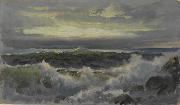
(June 3, 1833 - April 17, 1905) was an American landscape artist associated with both the Hudson River School and the American Pre-Raphaelite movement.
William Trost Richards was born on 3 June 1833 in Philadelphia. In 1846 and 1847 he attended the local Central High School. Between 1850 and 1855 he studied part-time with the German artist Paul Weber while working as designer and illustrator of ornamental metalwork. Richards first public showing was part of an exhibition in New Bedford, Massachusetts, organized by artist Albert Bierstadt in 1858. In 1862 he was elected honorary member of the National Academy of Design and Academician in 1871. In 1863, he became a member of the Association of the Advanced of Truth in Art, an American Pre-Raphaelite group. In 1866, he departed for Europe for one year. Upon his return and for the following six years he spent the summers on the East Coast. In the 1870s, he produced many acclaimed watercolor views of the White Mountains, several of which are now in the collection of the Metropolitan Museum of Art. Richards exhibited at the National Academy of Design from 1861 to 1899 and at the Brooklyn Art Association from 1863 to 1885. He was elected a full member of the National Academy in 1871.
Richards rejected the romanticized and stylized approach of other Hudson River painters and instead insisted on meticulous factual renderings. His views of the White Mountains are almost photographic in their realism. In later years, Richards painted almost exclusively marine watercolors.
His works are featured today in many important American museums, including the National Gallery, the Smithsonian American Art Museum, the Wadsworth Atheneum, the Philadelphia Museum of Art, the Yale University Art Gallery, the High Museum of Art, the Museum of Fine Arts, Boston, the Fogg Art Museum, the Brooklyn Museum of Art and the Thyssen-Bornemisza Museum.
|
|
|
|
|
|
|
|
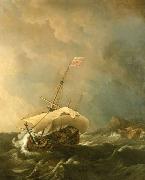 |
Willem Van de Velde The Younger
|
|
(bapt. 18 December 1633 - 6 April 1707) was a Dutch marine painter.
Willem van de Velde was baptised on 18 December 1633 in Leiden, Holland, Dutch Republic.
A son of Willem van de Velde the Elder, also a painter of sea-pieces, Willem van de Velde, the younger, was instructed by his father, and afterwards by Simon de Vlieger, a marine painter of repute at the time, and had achieved great celebrity by his art before he came to London. In 1673 he moved to England, where he was engaged by Charles II, at a salary of £100, to aid his father in "taking and making draughts of sea-fights", his part of the work being to reproduce in color the drawings of the elder van de Velde. He was also patronized by the Duke of York and by various members of the nobility.
He died on 6 April 1707 in London, England.
|
|
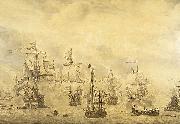 |
Willem van de Velde the Elder
|
|
(c. 1611 - 13 December 1693) was a Dutch Golden Age seascape painter.
Willem van de Velde, known as the Elder, a marine draughtsman and painter, was born in Leiden, the son of a Flemish skipper, Willem Willemsz. van de Velde, and is commonly said to have been bred to the sea. In 1706 Bainbrigg Buckeridge noted that he eunderstood navigation very welle. He married Judith Adriaensdochter van Leeuwen in Leiden, the Netherlands, in 1631.
His three known legitimate children were named Magdalena, born 1632; Willem, known as the Younger, also a marine painter, born 1633; and Adriaen, a landscape painter, born 1636.
His marriage was stormy, at least in its later years. David Cordingly relates that Willem the Elder fathered two children out of wedlock in 1653, one eby his maidservant, and the other by her friend. Nine years later the Elder and his wife went through a legal separation, eon account of legal disputes and the most violent quarrelse. The immediate cause of the dispute was his affair with a married woman.e Michael S. Robinson noted that eon 17/27 July 1662, he and his wife agreed to part. A condition of the separation was that the Elder could recover from his son Adriaen etwo royal giftse, presumably gifts from Charles II for work done in England.e Cordinglyes account further relates that the dispute was still continuing after another ten years, since ein the autumn of 1672 Judith complained to the womanes husband.e Robinson adds that by 1674 the couple emust have been reconcilede, for at a chance meeting with Pieter Blaeu in Amsterdam in July the Elder explained that he was only visiting for a few days ein order to fetch his wifee. His son, Adriaen, had died in Amsterdam in 1672, and Willem the Elder was also fetching his grandson, similarly named Adriaen, who was then aged two.
After his move to England, the exact date of which is uncertain, but reportedly at the end of 1672 or beginning of 1673, he is said to have lived with his family in East Lane, Greenwich, and to have used the Queenes House, now part of the National Maritime Museum in Greenwich, as a studio. Following the accession of William and Mary as King and Queen of England, it appears that this facility was no longer provided, and by 1691 he was living in Sackville Street, now close to Piccadilly Circus. He died in London, and was buried in St Jameses Church, at the south end of the street.
|
|
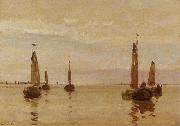 |
Willem Bastiaan Tholen
|
|
was a Dutch painter, draftsman and printmaker, born in Amsterdam, 13 Feb 1860, died in The Hague, 5 Dec 1931. He came from an artistic family, who lived in Kampen from 1864. There he developed at an early age a lasting love of the Zuiderzee. In Kampen he became friendly with the young Jan Voerman; they entered the Amsterdam academy together in 1876, where Tholen studied under August Allebe. Subsequently he learned technical drawing at the Polytechnische School in Delft until 1878. Thereafter he spent three months in the studio of Paul Gabriël in Brussels, from whom he received his first real instruction in painting. In the following years Gabriël's advice was of particular importance for Tholen, as they worked together en plein air for many summers near Kampen and Giethoorn, among other places. In Gouda (1878-9) and Kampen (1880-85) he taught draftsmanship in order to support himself but after 1885 concentrated entirely on his own work. From 1887 he lived in The Hague, where he became friendly with the painters of The Hague school. He took an active part in the artistic life of The Hague and was a member of the Pulchri Studio.
|
|
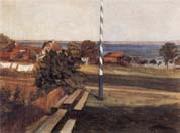 |
Wilhelm Trubner
|
|
German, 1851-1917
was a German realist painter of the circle of Wilhelm Leibl. Trubner was born in Heidelberg and had early training as a goldsmith. In 1867 he met classicist painter Anselm Feuerbach who encouraged him to study painting, and he began studies in Karlsruhe under Fedor Dietz. The next year saw him studying at the Kunstacademie in Munich, where he was to be greatly impressed by an international exhibition of paintings by Leibl and Gustave Courbet. Courbet visited Munich in 1869, not only exhibiting his work but demonstrating his alla prima method of working quickly from nature in public performances. This had an immediate impact on many of the city's young artists, who found Courbet's approach an invigorating alternative to the shopworn academic tradition. The early 1870s were a period of discovery for Tr??bner. He travelled to Italy, Holland and Belgium, and in Paris encountered the art of Manet, whose influence can be seen in the spontaneous yet restrained style of Trubner's portraits and landscapes. During this period he also made the acquaintance of Carl Schuch, Albert Lang and Hans Thoma, German painters who, like Trubner, greatly admired the unsentimental realism of Wilhelm Leibl. This group of artists came to be known as the "Leibl circle". He published writings on art theory in 1892 and 1898, which express above all the idea that "beauty must lie in the painting itself, not in the subject". By urging the viewer to discover beauty in a painting's formal values, its colors, proportions, and surface, Trubner advanced a philosophy of "art for art's sake".
|
|
|
|
|
|
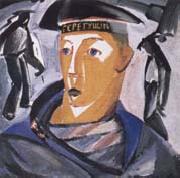 |
Vladimir Tatlin
|
|
1885-1953,Ukrainian sculptor and painter. After a visit to Paris (1914), he became the leader of a group of Moscow artists who sought to apply engineering techniques to sculpture construction, a movement that developed into Constructivism. He pioneered the use of iron, glass, wood, and wire in nonrepresentational constructions. His Monument to the Third International, commissioned by the Soviet government, was one of the first buildings conceived entirely in abstract terms and was intended to be, at more than 1,300 ft (400 m), the world's tallest structure. A model was exhibited at the 1920 Soviet Congress, but the government disapproved of nonfigurative art and it was never built. After 1933 Tatlin worked largely as a stage designer.
|
|
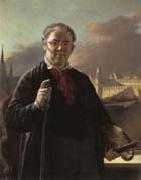 |
Vasily Tropinin
|
|
1776-1857
Russian painter. He was born a serf and in 1790 was apprenticed to a pastrycook in St Petersburg. From 1793 he attended classes at the Academy of Art there, in 1799 becoming a pupil of the portrait painter Stepan Shchukin (1762-1828). In 1804 he was sent to work as a pastrycook and manservant on an estate in the Ukraine owned by his master, General Morkov. Tropinin's Ukrainian period (1804-21) was interrupted by frequent, often protracted, visits to Moscow. During these years he copied a great deal, drew landscapes from nature and also painted religious subjects. His early style is painterly and distinguished by freedom of execution and skill in the use of colour, but the compositions are derivative and the drawing weak: The Spinner (1820s), The Lacemaker (1823), Wedding in the Village of Kukavka, Podolsky Province and Girl with a Bird (all Moscow, Tret'yakov Gal.). Portraiture, however, began to take on a more important place in his work; the best of this period is the Portrait of Arseny, the Artist's Son (1818; Moscow, Tret'yakov Gal.), especially notable for its use of colour. Tropinin captured perfectly the child's spontaneous vision of the world, his sensitive spirit and openness. While in Moscow from 1813 to 1818, he portrayed a series of important cultural figures that brought him great popularity. He was freed from serfdom on 8 May 1823 and shortly thereafter he became a nominee to the Academy for his paintings The Lacemaker
|
|
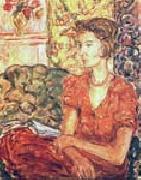 |
Tytus Czyzewski
|
|
(1880-1945) was a Polish painter, art theoretician, Futurist poet, playwright, member of the Polish Formists, and Colorist.
In 1902 he studied at the Academy of Fine Arts in Krakow in the painting studios of Jezef Mehoffer and Leon Wycz??łkowski. Czyżewski travelled to Paris and learned from the artistic trends there. He began exhibiting in 1906. Czyżewski painting style was highly influenced by Cezanne and El Greco, whose work he admired until his death.
In 1917, with the brothers Zbigniew Pronaszko and Andrzej Pronaszko, he organized in Krakew an exhibition of Polish Expressionist works. The group later became known as the Polish Formists. Until the break-up of the Formists in 1922, he was the primary artist and theoretician behind the movement as well as the joint editor of the periodical Formiści.
|
|
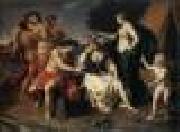 |
TURCHI, Alessandro
|
|
Italian Baroque Era Painter, 1578-1649
Italian painter. He first studied in Verona with Felice Brusasorci in whose studio he was recorded in 1597 (Brenzoni). Dal Pozzo reported that Turchi completed Brusasorci's Fall of the Manna (Verona, S Giorgio) after his master's death in 1605; his early Veronese paintings, such as the Adoration of the Shepherds (1608; Verona, S Fermo), are ambitious, with many figures and elaborate backgrounds, echoing the local tradition of which Paolo Veronese was the most distinguished exponent. Turchi may have gone to Venice with his fellow pupil, Marcantonio Bassetti, before moving to Rome c. 1614-15. He was paid for work in the Sala Regia of the Palazzo del Quirinale in 1616-17 (Briganti), where he collaborated with a team of artists, among them Giovanni Lanfranco and Carlo Saraceni. His part was to paint an oval medallion with the Gathering of the Manna (in situ) in a style that suggests Lanfranco's influence. He soon found patrons for altarpieces and cabinet paintings, among them Cardinal Scipione Borghese. By 1619 he had settled permanently in Rome and was a member of the Accademia di S Luca,
|
|
 |
Tudor St George Tucker
|
|
1862 - 1906,was the son of Captain Charlton Nassau Tucker, a cavalry officer in the East India Company's service. He came to Melbourne in 1881. He studied at the national gallery school and afterwards at Paris. He returned to Melbourne and about the year 1893 was associated with E. Phillips Fox in the conduct of the Melbourne art school. He was back in London in 1899 working in a studio at Chelsea, and had two paintings in the 1900 Royal Academy exhibition, two in 1901 and one in 1902. He died in London in 1906. He suffered much from ill health and his work is comparatively little known.
|
|
 |
Trophime Bigot
|
|
Trophime Bigot (1579-1649/50), also known as Theophile Bigot, Teofili Trufemondi, Candlelight Master, Maître e la Chandelle, was a French painter of the Baroque era, active in Rome and his native Provence.
Bigot was born in Arles in 1579, where he began his artistic career. Between 1620 and 1634, Bigot was in Italy, including Rome. He is known to have been in Arles in 1634, where he painted the altarpiece Saint Laurent condamne au supplice (Saint Laurence Condemned to Torture) and Assomption de la Vierge (Assumption of the Virgin) for local churches.
Between 1638 and 1642, he lived in Aix-en-Provence, where he painted another Assumption of the Virgin. He returned to Arles in 1642, and divided his activities between this city and Avignon, where he died around 1650.
|
|
 |
TROOST, Cornelis
|
|
Dutch painter (b. 1697, Amsterdam, d. 1750, Amsterdam).
Dutch painter, draughtsman and printmaker. He was the most important Dutch artist of the 18th century; he received many commissions (the catalogue by Niemeijer contains 925 numbers). Although he generally looked back to the genre scenes of the Dutch 17th-century masters, his satirical paintings earned him the nickname 'the Dutch Hogarth' after his English contemporary.
|
|
|
|
 |
TRAVERSI, Gaspare
|
|
Italian Painter, ca.1722-1770
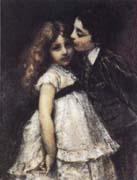
Italian painter. He was apprenticed to the elderly Francesco Solimena, whose late style, a reinterpretation of the Baroque art of Mattia Preti, influenced his earliest works. At the same time he studied the naturalist painters of the 17th century: Preti himself, Giovanni Battista Caracciolo, Jusepe de Ribera, Filippo Vitale and Francesco Fracanzano. Classical art also attracted him, and in the 1740s he began to make journeys to Rome to study the influential works of Bolognese and Roman classicism: paintings by Guido Reni, Guercino and the Carracci family, and by Carlo Maratti. During one of these visits he copied two pictures by Maratti, then in S Isidoro, Rome: the Flagellation and a Crucifixion . In the following year he was in Naples; three canvases of scenes from the Life of the Virgin (Naples, S Maria dell'Aiuto), one of which is signed and dated 1749
|
|
 |
Tranquillo Cremona
|
|
Italian Painter , 1837-1878
Italian painter. The son of an Austrian government official, Cremona began his artistic education in 1849 at the art school in Pavia, where he encountered three Lombard artists who were an important influence on his early studies: Giacomo Tr?court (1812-82), head of the school; Giovanni Carnevali, Tr?court's friend and a frequent visitor to Pavia; and Federico Faruffini, also a student at Pavia. All three were interpreters of the curiously soft and subtle form of Romanticism, derived from Andrea Appiani, that was to be found in this specific form only in Italy. In 1852 Cremona moved to Venice, where he enrolled at the Accademia. His teachers, who included Ludovico Lipparini (1800-56), Michelangelo Grigoletti (1801-70) and Antonio Zona (1814-92), were well versed in the more academic form of Romanticism expressed by Francesco Hayez, although in Zona the rather rigid, academic linearity was attenuated by a softer sense of form and colour. The Venetian Old Masters were a greater influence on Cremona's ultimate use of colour than was his academy training. In 1859, to avoid military service with the Austrian Army, Cremona moved to Piedmont.
|
|
|
|
 |
toulouse-lautrec
|
|
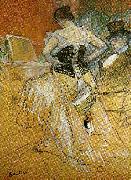
Fils d'Alphonse, comte Alphonse de Toulouse-Lautrec-Monfa (1838-1913) et d'Adele Tapie de Celeyran (1841-1930), il grandit entre Albi, le chateau du Bosc (demeure de ses grands-parents) et le chateau de Celeyran.
Henri de Toulouse-Lautrec est ne dans l'une des plus vieilles familles de France, descendant en effet en droite ligne des comtes de Toulouse, qui furent jusqu'au XIIIe si??cle parmi les plus puissants feodaux du royaume. Cependant, cette branche cadette, malgre son nom illustre, ne vit que comme une famille aisee de l'aristocratie de province.
|
|
 |
TORRENTIUS, Johannes
|
|
Dutch painter (b. 1589, Amsterdam, d. 1644, Amsterdam).
Dutch painter. He was active in Amsterdam, Leiden and Haarlem. In Haarlem in 1627 he was condemned, after severe torture, to 20 years of imprisonment for impiety, blasphemy and his membership of the outlawed Society of Rosicrucians. After having been notified by Sir Dudley Carleton, the British ambassador in The Hague, Charles I of England intervened and brought about Torrentius's release in 1629. Torrentius was subsequently active from 1629 to 1632 in London, which he nevertheless had to leave, again on account of his purportedly immoral mode of life; he returned to Amsterdam. There he was again involved in a trial and died after suffering torture in 1644. His erotic pictures, some of which depicted masterful nudes in mythological settings and are now known only through literary sources, were publicly burnt. A few still-lifes (e.g. Emblematic Still-life, 1614; Amsterdam, Rijksmus.) have survived. These carefully composed works, mostly set before a dark background, recall the work of Jan van de Velde II and the circle of Willem Claesz. Heda.
|
|
 |
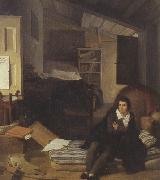
Tommaso Ruiz
|
|
Active in Naples during the second half of the 18th Century
|
|
 |
Tommaso Minardi
|
|
1787-1871
Italian painter, draughtsman, teacher and theorist. He studied drawing with the engraver Giuseppe Zauli (1763-1822) who imbued Minardi with his enthusiasm for 15th-century Italian art and introduced him to his large collection of engravings after the work of Flemish artists such as Adriaen van Ostade. However, Minardi was strongly influenced by the Neo-classical painter Felice Giani, who ran a large workshop in Faenza, and whose frescoes of mythological scenes (1804-5) at the Palazzo Milzetti he saw being painted. In 1803 he went to Rome on an annual stipend provided by Count Virgilio Cavina of Faenza (1731-1808), and he received (1803-8) additional financial assistance from the Congregazione di S Gregorio. He was given the use of Giani's studio and through him met Vincenzo Camuccini who, with Canova, dominated the artistic establishment in Rome at that time. Although Minardi learnt the precepts of Neo-classicism from Camuccini, he did not share his interest in heroic art. His first works done in Rome show his interest in the theme of master and acolyte. In Socrates and Alcibiades (1807; Faenza, Pin. Com.), for example, he has included himself among a group of elderly philosophers and young students who are placed on either side of a portrait bust of Zauli. He sent this drawing to his patrons, the Congregazione di S Gregorio, no doubt to reassure them of his aptitude and moral correctness. Supper at Emmaus (c. 1807; Faenza, Pin. Com.) was another painting destined for the same patrons. The confined pictorial space, with a single source of light entering through a small window, and the casual poses of the figures are reminiscent of Flemish art and of the works of the northern Caravaggisti, familiar to the artist through engravings.
|
|
|
|
 |
Tom Thomson
|
|
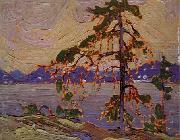
(August 5, 1877 - July 8, 1917), also known as Tom Thomson, was an influential Canadian artist of the early 20th century. He directly influenced a group of Canadian painters that would come to be known as the Group of Seven, and though he died before they formally formed, he is sometimes incorrectly credited as being a member of the group itself. Thomson died under mysterious circumstances, which added to his mystique.
|
|
 |
Tom roberts
|
|
British-born Australian Painter, 1856-1931
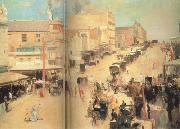
Australian painter of English birth. A leader of the HEIDELBERG SCHOOL and pioneer of plein-air Impressionism in Australia, he has been described as 'the father of Australian landscape painting'. Having moved to Melbourne in 1869, he studied at the East Collingwood and Carlton Schools of Design and the National Gallery of Victoria's School of Art (1874-81) while working as a photographic assistant. He led sketching expeditions with Frederick McCubbin and initiated student requests for reforms at the school. Returning to England, he enrolled in the Royal Academy Schools, London, on 6 December 1881, officially recommended by Edwin Long. In the summer of 1883 he toured Spain with the painter John Peter Russell. He learnt something of French Impressionism from Spanish art students Ramon Casas and Loreano Barrau (b 1864), and then followed the latter's advice to visit the Academie Julian in Paris. He returned to Melbourne in 1885 and the following year established the first summer camp at Box Hill with McCubbin and Louis Abrahams (1852-1903), portrayed in his painting the Artists' Camp (c. 1886; Melbourne, N.G. Victoria). According to the painter Arthur Streeton, it was Roberts's 'quick perception and expression of the principles of Impressionism in the year 1886,
|
|
|
|
 |
Tobias Verhaeght
|
|
1561-1631
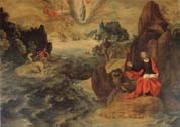
was a painter and draughtsman active in Antwerp, Florence and Rome. Primarily a landscape painter, his style is indebted to mannerist world landscapes of artists like Joachim Patinir with high viewpoints, fantastic distant perspectives and three-colour scheme. Before Verhaecht entered Antwerp's guild of St. Luke in 1590?C91, he had already spent time in Italy, first in Florence, and then as a fresco painter in Rome. Peter Paul Rubens, who was a relative by marriage, studied with him around 1592, and another student was his own son, Willem van Haecht.
|
|
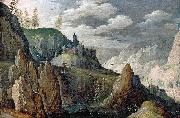 |
Tobias Verhaecht
|
|
(Antwerp, 1561 - 1631) was a painter and draughtsman active in Antwerp, Florence and Rome. Primarily a landscape painter, his style is indebted to mannerist world landscapes of artists like Joachim Patinir with high viewpoints, fantastic distant perspectives and three-colour scheme. Before Verhaecht entered Antwerp's guild of St. Luke in 1590-91, he had already spent time in Italy, first in Florence, and then as a fresco painter in Rome. Peter Paul Rubens, who was a relative by marriage, studied with him around 1592, and another student was his own son, Willem van Haecht. Verhaecht is also known for his designs for prints.
|
|
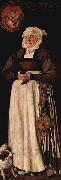 |
Tobias Stimmer
|
|
(7 April 1539 - 4 January 1584) was a Swiss painter and illustrator. His most famous work is the paintings on the Strasbourg astronomical clock. He died in Strasbourg.
He was born in Schaffhausen, and was active in Schaffhausen, Strasbourg and Baden-Baden as a wall and portrait painter. He made a great number of drawings for woodcuts (Bible scenes, allegories, etc.) which were published by the printer Sigmund Feyerabend in Frankfurt am Main, and Bernhart Jobin in Strasbourg.
Stimmer followed Hans Holbein the Younger, but developed his own mannerism. Among his wall paintings remain the "House zum Ritter" in Schaffhausen, although this was actually much restored and changed.
|
|
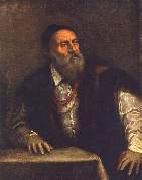 |
TIZIANO Vecellio
|
|
Italian painter, Venetian school (b. 1490, Pieve di Cadore, d.
1576, Venezia).
|
|
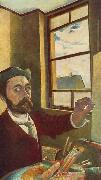 |
Tivadar Kosztka Csontvary
|
|
born 1853 - d. 1919) was a Hungarian painter. He was one of the first Hungarian painters to become well known in Europe.
Csontvery was born on 5 July 1853 in Kisszeben, Seros County, Kingdom of Hungary (today Sabinov, Slovakia), and died 20 June 1919 in Budapest. His ancestors were Poles who settled down in Hungary. Although Csontvery was obsessed with his Magyar roots, he himself grew up speaking Slovak mixed with German. He was a pharmacist until his twenties. On a hot sunny afternoon, 13 October 1880, e when he was 27 years old e he experienced a mystic vision. He heard a voice saying "you will be the greatest sunway painter, greater than Raphael!" He took journeys around Europe, visited the galleries of the Vatican, then went home to collect money for his journeys working as an apothecary. From 1890 onwards he traveled around the world. He visited Paris, the Mediterraneum (Dalmatia, Italy, Greece), North Africa and the Middle East (Lebanon, Palestine, Egypt, Syria) and painted pictures. He painted his major works between 1903 and 1909. He had some exhibitions in Paris (1907) and Western Europe. Most of the critics in Western Europe recognized his abilities, art and congeniality, but in the Kingdom of Hungary during his life he was considered to be an eccentric crank for several reasons, e. g. for his vegetarianism, anti-alcoholism, anti-nicotinism, pacifism, his latent, but more and more apparent schizophrenia and his cloudy, prophetic writings and pamphlets about his life (Curriculum), genius (The Authority, The Genius) and religious philosophy (The Positivum). Even though later he was acclaimed, during his lifetime Csontvery's visionary, expressionistic style found little understanding. A loner by nature, the master's mental balance was upset by his efailuree impairing his creative power. Little did he know that some years after his death, an entire museum in Paris, Hungary, would be devoted to his paintings, and that worldwide appreciation of his works would be in constant ascendancy. Many painters, e.g. Picasso added a stone to Csontvery's cairn.
|
|
|
|
|
|
 |
Titian
|
|
Italian High Renaissance Painter, ca.1485-1576
Italian painter active in Venice. As a young man he was taught by the Bellini family and worked closely with Giorgione. His early works are so similar in style to Giorgione's as to be indistinguishable, but soon after Giorgione's early death Titian established himself as the leading painter of the Republic of Venice. Among his most important religious paintings is the revolutionary and monumental Assumption (1516 ?C 18) for Santa Maria dei Frari, in which the Virgin ascends to heaven in a blaze of colour accompanied by a semicircle of angels. Titian was also interested in mythological themes, and his many depictions of Venus display his work's sheer beauty and inherent eroticism. Bacchus and Ariadne (1520 ?C 23), with its pagan abandon, is one of the greatest works of Renaissance art. Titian was sought after for his psychologically penetrating portraits, which include portrayals of leading Italian aristocrats, religious figures, and Emperor Charles V. He reached the height of his powers in The Rape of Europa (c. 1559 ?C 62), one of several paintings done for Philip II of Spain. He was recognized as supremely gifted in his lifetime, and his reputation has never declined.
|
|
|
|
|
|
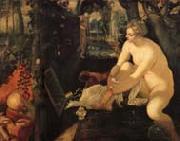 |
Tintoretto
|
|
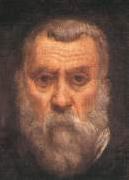
Italian Mannerist Painter, ca.1518-1594
His father was a silk dyer (tintore); hence the nickname Tintoretto ("Little Dyer"). His early influences include Michelangelo and Titian. In Christ and the Adulteress (c. 1545) figures are set in vast spaces in fanciful perspectives, in distinctly Mannerist style. In 1548 he became the centre of attention of artists and literary men in Venice with his St. Mark Freeing the Slave, so rich in structural elements of post-Michelangelo Roman art that it is surprising to learn that he had never visited Rome. By 1555 he was a famous and sought-after painter, with a style marked by quickness of execution, great vivacity of colour, a predilection for variegated perspective, and a dynamic conception of space. In his most important undertaking, the decoration of Venice's Scuola Grande di San Rocco (1564 C 88), he exhibited his passionate style and profound religious faith. His technique and vision were wholly personal and constantly evolving.
|
|
|
|
 |
Tim Verfaillie
|
|
(Brugge, 14 January 1893 - Rochefort, 1934) was Belgian painter who was one of the smaller figures of Flemish expressionism.
In his younger days he travelled through the Scottish Highlands. The atmosphere he witnessed there would remain an important influence in his work.
|
|
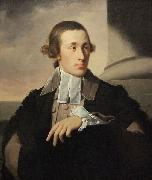 |
Tilly Kettle
|
|
(1735-1786) was a portrait painter and the first English painter to work in India. He was born in London, the son of a coach painter, in a family that had been members of the Brewers' Company of freemen for five generations. He studied drawing with William Shipley in the Strand and first entered professional portraiture in the 1750s.
Kettle's first series of portraits appeared in the 1760s. His first surviving painting is a self-portrait from 1760, with his first exhibit at the Society of Artists in 1761. In 1762, he worked at restoring Robert Streater's ceiling fresco in the Sheldonian Theatre, Oxford, and painted Francis Yarborough, a doctor of Brasenose College, Oxford in 1763. He painted many members of the family of William Legge, 2nd Earl of Dartmouth. In 1764-5, he was active in London and continued exhibiting at the Society of Artists.
In 1768, Kettle sailed to India with the British East India Company, landing at Madras (now Chennai), where he remained for two years. There, he painted Lord Pigot and Muhammad Ali Kahn twice (once alone and once with five of his sons). He also painted non-portraits, including Dancing Girls (Blacks) in 1772 and a suttee scene in 1776 entitled, The ceremony of a gentoo woman taking leave of her relations and distributing her jewels prior to ascending the funeral pyre of her deceased husband. In 1770 Kettle painted a half-length portrait of 'Sir' Levett Hanson, a peripatetic writer on European knighthood and chivalry originally from Yorkshire. (The portrait is now in the collection of the Bury St Edmunds Manor House Museum.)
Kettle moved on to Calcutta (now Kolkata) in 1771 and painted Shuja ud-Daula and Dancing-Girl Holding the Stem of a Hookah. In 1775,he painted George Bogle, Warren Hastings' emissary to Tibet, in Tibetan dress, presenting a ceremonial white scarf to Lobsang Yeshe the 5th Panchen Lama.He also took an Indian mistress and had two daughters by her.
|
|
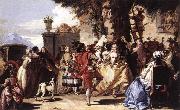 |
TIEPOLO, Giovanni Domenico
|
|
Italian painter, Venetian school (b. 1727, Venezia, d.
1804, Venezia).
Italian painter and printmaker. He was apprenticed to his father, Giovanni Battista Tiepolo, in Venice in the early 1740s and worked with him in Madrid from 1762 until the elder's death in 1770. His most notable early works are the chinoiserie decorations of the Villa Valmarana in Vicenza (1757). Back in Venice, he executed several frescoes and paintings of scenes from the commedia dell'arte. A talented genre painter and caricaturist, he was famous for his many engravings and etchings after his own and his father's designs.
|
|
|
|
|
|
|
|
|
| Wholesale China Oil Painting Wholesale Oil Painting China Xiamen Portrait Reproduction on canvas Chinese Oil Painting Wholesale USA Oil Painting |
|
|
|
|
|