| |
|
Xiamen Oil Paintings, Wholesale Direct!
|
|
100% hand painted, 100% cotton canvas, 100% money back if not satisfaction. |
|
|
|
|
ART WORKS INDEX
A
B
C
D
E
F
G
H
I
J
K
L
M
N
O
P
Q
R
S
T
U
V
W
X
Y
Z
|
|
ARTISTS INDEX
A
B
C
D
E
F
G
H
I
J
K
L
M
N
O
P
Q
R
S
T
U
V
W
X
Y
Z
|
|
|
|
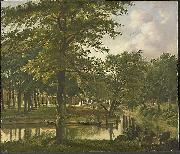 |
Wybrand Hendriks
|
|
(June 24, 1744, Amsterdam - January 28, 1831, Haarlem), was a Dutch painter and the concierge of the Teylers Museum.
According to the RKD he learned to paint while working for the decorative wall paper factory of J. Remmers in Amsterdam. From 1786 to 1819 he was the second concierge ("kastelein") of the Teyler's Stichting in Haarlem, where he lived at the "Fundatiehuis" as curator of the art collection, with his studio in the old drawing room of Teyler's drawing academy, which had itself been moved to the city hall. He assumed the position in 1785 after his predecessor Vincent Jansz van der Vinne had left in disagreement with Martin van Marum, the head of the fossil and instrument collections. As curator, he managed to purchase an important collection of Italian drawings from the collection of Queen Christina of Sweden in 1790.
He is known for portraits, landscapes, and flower still lifes in the manner of Jan van Huysum.
|
|
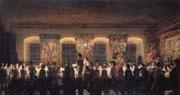 |
Wolfgang Heimbach
|
|
c.1600/1615-after 1678, German painter. The son of a bookkeeper at the corn exchange, he was known because of a disability as 'the Ovelg?nne mute'. An aristocratic sponsor, probably Graf Anton G?nther (1603-67) of Oldenburg, sent him to train in the Netherlands: stylistic considerations would suggest that this was in the 1630s. The Evening Scene (1637; ex-art market, Berlin; G?ttsche, no. 8) shows him adapting the style of Caravaggio as practised in Utrecht to the kind of social gathering depicted by Dirck Hals or Anthonie Palamedesz. He uses an artificial light source to exaggerate the modelling of the figures and the space. This characteristic of his art also shows in the Evening Banquet of 1640
|
|
|
|
 |
Winslow Homer
|
|
1836-1910
Winslow Homer Locations
Winslow Homer (February 24, 1836 ?C September 29, 1910) was an American landscape painter and printmaker, best known for his marine subjects. He is considered one of the foremost painters in 19th century America and a preeminent figure in American art.
Largely self-taught, Homer began his career working as a commercial illustrator. He subsequently took up oil painting and produced major studio works characterized by the weight and density he exploited from the medium. He also worked extensively in watercolor, creating a fluid and prolific oeuvre, primarily chronicling his working vacations.
|
|
|
|
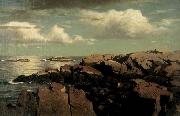 |
William Stanley Haseltine
|
|
(June 11, 1835-February 3, 1900) was an American painter and draftsman who was associated with the Hudson River School and Luminism.
Born in Philadelphia to John Haseltine, a successful businessman, and Elizabeth Shinn Haseltine, an amateur landscape painter, Haseltine studied at the University of Pennsylvania and then at Harvard University, where he received a degree in 1854.
He first exhibited his paintings the following year at the Pennsylvania Academy of Fine Arts, after which he sailed to Europe, first joining a colony of American painters who were studying in Dusseldorf, then traveling up the Rhine into Switzerland and Italy. In late 1857 he settled in Rome, and in the following months made numerous excursions to draw the landscape around Rome and on Capri.
In 1858 Haseltine returned to Philadelphia, and by late 1859 was installed in the Tenth Street Studio Building in New York City, then a central point for American landscape painters; also in the building were Frederic Edwin Church, Albert Bierstadt, and Worthington Whittredge, the latter two having befriended Haseltine in Europe. Though many of his paintings from this time derived from his European sketches, Haseltine also began to paint the oceanside of New England, especially favoring the rockbound coasts of Narragansett, Rhode Island, Nahant, Massachusetts, and Mount Desert Island, Maine. The precision with which he painted these landscapes won critical praise, and Haseltine was elected an Associate of the National Academy of Design in 1860, and a full Academician in 1861.
In 1864 Haseltine's wife died in childbirth. He spent some time training his nephew, Howard Russell Butler, but he moved after he married Helen Marshall in 1866. Initially the family considered settling in Paris, but in 1867 they moved to Rome, which would for most of Haseltine's subsequent years serve as his home and point of departure from which to produce views of the European landscape. While his paintings of Capri and Sicily would prove popular with visiting American tourists, Haseltine also traveled and drew in France, Holland, Belgium, and the Netherlands, summering in Bavaria and the Tyrol in the 1880s and 1890s. In his later years he also returned periodically to the United States, making a final trip to the west in 1899.
Haseltine died of pneumonia in Rome in 1900.
|
|
|
|
 |
William Morris Hunt
|
|
1824- 1879
William Morris Hunt Gallery
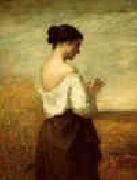
Hunt's father's family were among Vermont's founders and largest landowners; his mother's a family of wealth and prominence in Connecticut. Hunt attended Harvard but withdrew in his junior year.
Following the untimely death of his Congressman father from cholera, Hunt's mother Jane took him and his brothers to Switzerland, the South of France and to Rome, where Hunt studied with Couture in Paris and then came under the influence of Jean-François Millet, from whom he learned the principles of the Barbizon school. The Hunt family remained in Europe for a dozen years.
Afterwards, leaving Paris, he painted and established art schools at Newport, Rhode Island, where he had relatives, Brattleboro, Vermont, Faial Island in the Azores, where he had family connections and finally at Boston, where he painted, taught art and became a popular portrait painter.
The companionship of Millet had a lasting influence on Hunt's character and style, and his work grew in strength, in beauty and in seriousness. He was among the biggest proponents of the Barbizon school in America, and he more than any other turned the rising generation of American painters towards Paris.
On his return in 1855 he painted some of his most handsome canvases, all reminiscent of his life in France and of Millet's influence. Such are The Belated Kid, Girl at the Fountain, Hurdy-Gurdy Boy, and others ?C but the public called for portraits, and it became the fashion to sit for Hunt; among his best paintings of this genre are those of William M. Evarts, Mrs Charles Francis Adams, the Rev. James Freeman Clarke, William H. Gardner, Chief Justice Shaw and Judge Horace Gray.
Sadly, many of Hunt's paintings and sketches, together with five large Millets and other art treasures collected by him in Europe, were destroyed in the Great Boston Fire of 1872.
|
|
 |
William Michael Harnett
|
|
1851-1892
Harnett was born in Clonakilty, County Cork, Ireland during the time of the potato famine. Shortly after his birth his family emigrated to America, settling in Philadelphia. Becoming a United States citizen in 1868, he made a living as a young man by engraving designs on table silver, while also taking night classes at the Pennsylvania Academy of the Fine Arts and later, in New York, at Cooper Union and at the National Academy of Design. His first known oil painting, a still life, dates from 1874.
The style of trompe l'oeil painting that Harnett developed was distinctive and inspired many imitators, but it was not without precedent. A number of 17th century Dutch painters, Pieter Claesz. for instance, had specialized in tabletop still life of astonishing verisimilitude. Raphaelle Peale, working in Philadelphia in the early 19th century, pioneered the form in America. What sets Harnett's work apart, besides his enormous skill, is his interest in depicting objects not usually made the subject of a painting.
Harnett painted musical instruments, hanging game, and tankards, but also painted the unconventional Golden Horseshoe (1886), a single rusted horseshoe shown nailed to a board. He painted a casual jumble of second-hand books set on top of a crate, Job Lot, Cheap (1878), as well as firearms and even paper currency. His works sold well, but they were more likely to be found hanging in a tavern or a business office than in a museum, as they did not conform to contemporary notions of high art.
Harnett spent the years 1880?C1886 in Europe, staying in Munich from 1881 until early 1885. Harnett's best-known paintings, the four versions of After The Hunt, were painted between 1883 and 1885. Each is an imposing composition of hunting equipment and dead game, hanging on a door with ornate hinges at the right and keyhole plate at the left. These paintings, like the horseshoe or currency depictions mentioned earlier, are especially effective as trompe l'oeil because the objects occupy a shallow space, meaning that the illusion is not spoiled by parallax shift if the viewer moves.
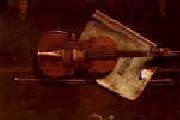
Overall, Harnett's work is most comparable to that of the slightly younger John F. Peto. The two artists knew each other, and a comparison can be made between two paintings featuring violins. Harnett's Music and Good Luck from 1888 shows the violin hanging upright on a door with ornate hinges and with a slightly torn piece of sheet music behind it. The elements are arranged in a stable, deliberate manner. Peto's 1890 painting shows the violin hanging askew, as well as chipped and worn, with one string broken. The sheet music is dog-eared and torn around the edges, and placed haphazardly behind the instrument. The hinges are less ornate, and one is broken. Harnett's objects show signs of use but are well preserved, while Peto's more humble objects are nearly used up.
Crippling rheumatism plagued Harnett in his last years, reducing the number but not the quality of his paintings. He died in New York City in 1892. Other artists who painted similar compositions in Harnett's wake include his contemporary John Haberle and successors such as Otis Kaye and Jefferson David Chalfant.
|
|
|
|
 |
William John Hennessy
|
|
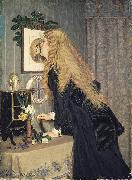
(July 11, 1839 - December 27, 1917) was an Irish artist.
William John Hennessy was born in Thomastown, County Kilkenny in 1839. His father, John Hennessy, was forced to leave Ireland in 1848 as a result of his involvement in the Young Ireland movement. He landed in Canada and settled in New York. William, his mother Catherine, and brother joined their father there in 1849. He gained admittance to the National Academy of Design in 1854 and exhibitioned his first works there.
Hennessy developed a skill in wood engraving and was hired to illustrate the works of renowned poets, including that of Tennyson, Longfellow and Whittier. As an American he became the co-founder of the Artists Fund Society, and an honorary member of the American Society of Painters in Watercolours. In 1870 he moved to London where he became a member of the Royal Institute of Oil Painters in 1902. Between 1879 and 1907 the Royal Hibernian Academy displayed eight of his paintings.
|
|
|
|
|
|
|
|
|
|
 |
william holman hunt,o.m.,r.w.s
|
|
1827-1910
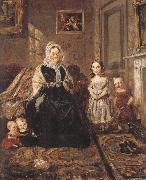
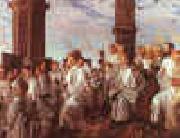
English painter. He worked as an office clerk in London from 1839 to 1843, attending drawing classes at a mechanics' institute in the evenings and taking weekly lessons from the portrait painter Henry Rogers. Holman Hunt overcame parental opposition to his choice of career in 1843, and this determined attitude and dedication to art could be seen throughout his working life. In July 1844, at the third attempt, he entered the Royal Academy Schools. His earliest exhibited works, such as Little Nell and her Grandfather (exh. British Institution, 1846; Sheffield, Graves A.G.), reveal few traces of originality, but the reading of John Ruskin's Modern Painters in 1847 was of crucial importance to Holman Hunt's artistic development. It led him to abandon the ambitious Christ and the Two Marys (Adelaide, A.G. S. Australia) in early 1848, when he realized its traditional iconography would leave his contemporaries unmoved. His next major work, the Flight of Madeline and Porphyro during the Drunkenness Attending the Revelry (1848; London, Guildhall A.G.), from John Keats's 'Eve of St Agnes', though displaced into a medieval setting, dramatized an issue dear to contemporary poets and central to Holman Hunt's art: love and youthful idealism versus loyalty to one's family. His first mature painting, it focuses on a moment of psychological crisis in a cramped and shallow picture space.
|
|
 |
William Holman Hunt
|
|
1827-1910
British
William Holman Hunt Galleries
Hunt's intended middle name was "Hobman", which he disliked intensely. He chose to call himself Holman when he discovered that his middle name had been misspelled this way after a clerical error at his baptism at the church of Saint Mary the Virgin, Ewell.[1] Though his surname is "Hunt", his fame in later life led to the inclusion of his middle name as part of his surname, in the hyphenated form "Holman-Hunt", by which his children were known.
After eventually entering the Royal Academy art schools, having initially been rejected, Hunt rebelled against the influence of its founder Sir Joshua Reynolds. He formed the Pre-Raphaelite movement in 1848, after meeting the poet and artist Dante Gabriel Rossetti. Along with John Everett Millais they sought to revitalise art by emphasising the detailed observation of the natural world in a spirit of quasi-religious devotion to truth. This religious approach was influenced by the spiritual qualities of medieval art, in opposition to the alleged rationalism of the Renaissance embodied by Raphael. He had many pupils including Robert Braithwaite Martineau (best known for his work "Last Days in the Old Home") who was a moderately successful painter although he died young.
The Hireling Shepherd, 1851Hunt's works were not initially successful, and were widely attacked in the art press for their alleged clumsiness and ugliness. He achieved some early note for his intensely naturalistic scenes of modern rural and urban life, such as The Hireling Shepherd and The Awakening Conscience. However, it was with his religious paintings that he became famous, initially The Light of the World (now in the chapel at Keble College, Oxford, with a later copy in St Paul's Cathedral), having toured the world. After travelling to the Holy Land in search of accurate topographical and ethnographical material for further religious works, Hunt painted The Scapegoat, The Finding of the Saviour in the Temple and The Shadow of Death, along with many landscapes of the region. Hunt also painted many works based on poems, such as Isabella and The Lady of Shalott.
All these paintings were notable for their great attention to detail, their hard vivid colour and their elaborate symbolism. These features were influenced by the writings of John Ruskin and Thomas Carlyle, according to whom the world itself should be read as a system of visual signs. For Hunt it was the duty of the artist to reveal the correspondence between sign and fact. Out of all the members of the Pre-Raphaelite Brotherhood Hunt remained most true to their ideals throughout his career. He eventually had to give up painting because failing eyesight meant that he could not get the level of quality that he wanted. His last major work, The Lady of Shalott, was completed with the help of an assistant (Edward Robert Hughes).
Hunt married twice. After a failed engagement to his model Annie Miller, he married Fanny Waugh, who later modelled for the figure of Isabella. When she died in childbirth in Italy he sculpted her tomb up at Fiesole, having it brought down to the English Cemetery, beside the tomb of Elizabeth Barrett Browning. His second wife, Edith, was Fanny's sister. At this time it was illegal in Britain to marry one's deceased wife's sister, so Hunt was forced to travel abroad to marry her. This led to a serious breach with other family members, notably his former Pre-Raphaelite colleague Thomas Woolner, who had married Fanny and Edith's third sister Alice.
Hunt's autobiography Pre-Raphaelitism and the Pre-Raphaelite Brotherhood (1905) was written to correct other literature about the origins of the Brotherhood, which in his view did not adequately recognise his own contribution. Many of his late writings are attempts to control the interpretation of his work.
In 1905, he was appointed to the Order of Merit by King Edward VII. At the end of his life he lived in Sonning-on-Thames.
|
|
|
|
 |
William Hogarth
|
|
British
1697-1764
William Hogarth Galleries
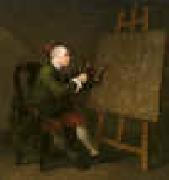
Early satirical works included an Emblematical Print on the South Sea Scheme (c.1721), about the disastrous stock market crash of 1720 known as the South Sea Bubble, in which many English people lost a great deal of money. In the bottom left corner, he shows Protestant, Catholic, and Jewish figures gambling, while in the middle there is a huge machine, like a merry-go-round, which people are boarding. At the top is a goat, written below which is "Who'l Ride" and this shows the stupidity of people in following the crowd in buying stock in The South Sea Company, which spent more time issuing stock than anything else. The people are scattered around the picture with a real sense of disorder, which represented the confusion. The progress of the well dressed people towards the ride in the middle shows how foolish some people could be, which is not entirely their own fault.
Other early works include The Lottery (1724); The Mystery of Masonry brought to Light by the Gormogons (1724); A Just View of the British Stage (1724); some book illustrations; and the small print, Masquerades and Operas (1724). The latter is a satire on contemporary follies, such as the masquerades of the Swiss impresario John James Heidegger, the popular Italian opera singers, John Rich's pantomimes at Lincoln's Inn Fields, and the exaggerated popularity of Lord Burlington's prot??g??, the architect and painter William Kent. He continued that theme in 1727, with the Large Masquerade Ticket. In 1726 Hogarth prepared twelve large engravings for Samuel Butler's Hudibras. These he himself valued highly, and are among his best book illustrations.
In the following years he turned his attention to the production of small "conversation pieces" (i.e., groups in oil of full-length portraits from 12 to 15 in. high). Among his efforts in oil between 1728 and 1732 were The Fountaine Family (c.1730), The Assembly at Wanstead House, The House of Commons examining Bambridge, and several pictures of the chief actors in John Gay's popular The Beggar's Opera.
One of his masterpieces of this period is the depiction of an amateur performance of John Dryden's The Indian Emperor, or The Conquest of Mexico (1732?C1735) at the home of John Conduitt, master of the mint, in St George's Street, Hanover Square.
Hogarth's other works in the 1730s include A Midnight Modern Conversation (1733), Southwark Fair (1733), The Sleeping Congregation (1736), Before and After (1736), Scholars at a Lecture (1736), The Company of Undertakers (Consultation of Quacks) (1736), The Distrest Poet (1736), The Four Times of the Day (1738), and Strolling Actresses Dressing in a Barn (1738). He may also have printed Burlington Gate (1731), evoked by Alexander Pope's Epistle to Lord Burlington, and defending Lord Chandos, who is therein satirized. This print gave great offence, and was suppressed (some modern authorities, however, no longer attribute this to Hogarth).
|
|
 |
William Hodges
|
|
English Painter, 1744-1797
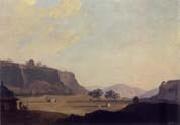
English painter. He first attended classes at William Shipley's Academy in the Strand, London, and from 1758 to 1765 was apprenticed to Richard Wilson (about whom he published a short biographical essay in 1790). Hodges followed Wilson's classical landscape style periodically throughout his career.
|
|
 |
William Hoare
|
|
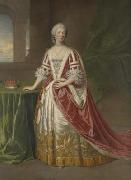
William Hoare of Bath RA (c. 1707 - 12 December 1792) was an English painter and printmaker, co-founder of the Royal Academy noted for his pastels.
Born near Eye, Suffolk, Hoare received a gentlemanes education in Faringdon. He showed a marked aptitude for drawing and was sent to London to study under Giuseppe Grisoni, who had left Florence for London in 1715. When Grisoni returned to Italy in 1728, Hoare went with him, travelling to Rome and continuing his studies under the direction of Francesco Imperiali. He remained in Rome for nine years, returning to London in 1737/8.
Failing to establish himself in London, Hoare settled in Bath, an expanding spa town popular with the wealthier classes. He obtained numerous commissions, the most important being for official portraits of social leaders of the day (including George Frideric Handel) and political men. There are several versions of most of these, suggesting that he had a studio, and they were further publicised by the production of mezzotints by leading engravers of the day. Hoare himself was a delicate etcher and published a number of private plates, mostly of family and friends, including Miss Hoare (probably Mary), Christopher Anstey and the 3rd Duke of Beaufort. His pastels were influenced by Rosalba Carriera.
|
|
|
|
 |
William Herbert Dunton
|
|
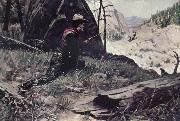
a self-taught artist . American Painter , 1878-1936
was an American artist who was one of the founding members of the Taos Society of Artists and part of the Taos art colony. He first came to Taos, New Mexico, in 1912. Among his proteges in Western art was Harold Dow Bugbee of Clarendon and Canyon in the Texas Panhandle.
|
|
|
|
 |
William Henry Pyne
|
|
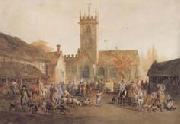
English Painter, 1769-1843
English painter, illustrator and writer. He trained at the drawing academy of Henry Pars (c. 1733-1806) in London and first exhibited at the Royal Academy in 1790. His drawings were almost always pen, ink and colour wash (e.g. Gossip at the Cottage Door, 1794; London, BM). His most characteristic works are the illustrations for the books Microcosm (1803-8) and The Costume of Great Britain (1808) in which he successfully placed groups of well-observed characters in picturesque settings. Pyne had been a founder of the Old Water-Colour Society in 1804 but resigned in 1809 when it refused to increase its membership to greater than 24 artists.
|
|
|
|
|
|
 |
William Henry Knight
|
|
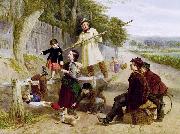
(26 September 1823 - 31 July 1863) was an English portrait and genre painter.
Knight was born in Newbury, Berkshire where his father, John Knight, was a schoolmaster. He was to become a solicitor, but gave up his law studies after two of his paintings were accepted by the annual exhibition of the Society of British Artists. He moved to London in 1855, taking lodgings in Kennington Road, Lambeth, and supporting himself by drawing crayon portraits while studying in the British Museum and in the schools of the Royal Academy.
|
|
 |
William Henry Hunt,OWS
|
|
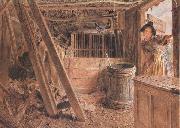
1790-1864
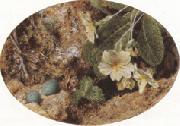
was an English watercolour painter. He was born near Long Acre, London, and was apprenticed in about 1805 to John Varley, the landscape-painter, with whom he remained five or six years. He exhibited three oil pictures at the Royal Academy in 1807. He became connected with the Society of Painters in Water Colours at its beginning, and was elected an associate in 1824 and a full member in 1827. Until the year of his death, he was one of the most prolific contributors to the Society's exhibitions. Many years of Hunt's uneventful but industrious life were spent at Hastings. He died of apoplexy. Hunt was one of the creators of the English school of water-color painting. His subjects, especially those of his later life, are extremely simple; but, by the delicacy, humor and fine power of their treatment, they rank second to works of the highest art only. Considered technically, his works exhibit all the resources of the water-color painter's craft, from the purest transparent tinting to the boldest use of gouache, rough paper and scraping for texture. His sense of color is perhaps as true as that of any English artist. He was, says John Ruskin, all in all, the finest ever painter of still life. Several characteristic examples of Hunt's work, as the "Boy and Goat," "Brown Study and Plums," "Primroses and Birds' Nests" are in the Victoria and Albert Museum.
|
|
 |
william henry hunt,o.w.s
|
|
1790-1864
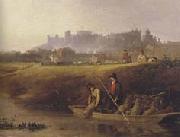
was an English watercolour painter. He was born near Long Acre, London, and was apprenticed in about 1805 to John Varley, the landscape-painter, with whom he remained five or six years. He exhibited three oil pictures at the Royal Academy in 1807. He became connected with the Society of Painters in Water Colours at its beginning, and was elected an associate in 1824 and a full member in 1827. Until the year of his death, he was one of the most prolific contributors to the Society's exhibitions. Many years of Hunt's uneventful but industrious life were spent at Hastings. He died of apoplexy. Hunt was one of the creators of the English school of water-color painting. His subjects, especially those of his later life, are extremely simple; but, by the delicacy, humor and fine power of their treatment, they rank second to works of the highest art only. Considered technically, his works exhibit all the resources of the water-color painter's craft, from the purest transparent tinting to the boldest use of gouache, rough paper and scraping for texture. His sense of color is perhaps as true as that of any English artist. He was, says John Ruskin, all in all, the finest ever painter of still life. Several characteristic examples of Hunt's work, as the "Boy and Goat," "Brown Study and Plums," "Primroses and Birds' Nests" are in the Victoria and Albert Museum.
|
|
 |
William henry hunt
|
|
English Painter, 1790-1864
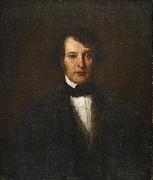
was an English watercolour painter. He was born near Long Acre, London, and was apprenticed in about 1805 to John Varley, the landscape-painter, with whom he remained five or six years. He exhibited three oil pictures at the Royal Academy in 1807. He became connected with the Society of Painters in Water Colours at its beginning, and was elected an associate in 1824 and a full member in 1827. Until the year of his death, he was one of the most prolific contributors to the Society's exhibitions. Many years of Hunt's uneventful but industrious life were spent at Hastings. He died of apoplexy. Hunt was one of the creators of the English school of water-color painting. His subjects, especially those of his later life, are extremely simple; but, by the delicacy, humor and fine power of their treatment, they rank second to works of the highest art only. Considered technically, his works exhibit all the resources of the water-color painter's craft, from the purest transparent tinting to the boldest use of gouache, rough paper and scraping for texture. His sense of color is perhaps as true as that of any English artist. He was, says John Ruskin, all in all, the finest ever painter of still life. Several characteristic examples of Hunt's work, as the "Boy and Goat," "Brown Study and Plums," "Primroses and Birds' Nests" are in the Victoria and Albert Museum.
|
|
 |
William Henry Furness
|
|
(1802-1896) was an American clergyman, theologian, reformer and abolitionist. Following the American Civil War, he raised funds for Black schools in the South, including Morehouse College.
A graduate of the Theological Department of Harvard University, Furness became the Minister of the First Unitarian Church of Philadelphia at the age of 22. A close friend of Ralph Waldo Emerson, Furness presided over a period marked by the growth and increasing prosperity for First Church. A fiery abolitionist, Furness was a supporter of the rights of all segments of society, including African-Americans and Jews. He also lived to see the construction of the current church building in 1885 in the role of Minister Emeritus.
Rev. Furness was the father of painter William Furness, Shakespearean scholar Horace Howard Furness, architect Frank Furness, and author and translator Annis Furness Lee.
|
|
|
|
|
|
 |
William Harnett
|
|
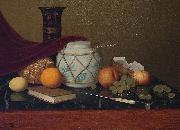
(August 10, 1848 - October 29, 1892) was an Irish-American painter known for his trompe l'oeil still lifes of ordinary objects.
Harnett was born in Clonakilty, County Cork, Ireland during the time of the potato famine. Shortly after his birth his family emigrated to America, settling in Philadelphia. Becoming a United States citizen in 1868, he made a living as a young man by engraving designs on table silver, while also taking night classes at the Pennsylvania Academy of the Fine Arts and later, in New York, at Cooper Union and at the National Academy of Design. His first known oil painting, a still life, dates from 1874.
|
|
 |
William Hamilton
|
|
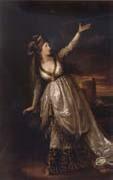
English Painter, 1751-1801, was an English painter and illustrator. Hamiliton was born in Chelsea, London, but travelled and worked in Italy with Antonio Zucchi for several years. He trained first as an architectural draftsman, but soon moved to theatrical portraits and scenes from plays. Hamilton became very well known for his paintings depicting episodes from the plays of Shakespeare and for his illustrations of poems. He was commissioned to create works for John Boydell's Shakespeare Gallery, Macklin's Bible and Bowyer's English History. These were widely reproduced in popular prints. Francesco Bartolozzi engraved a number of Hamilton??s best known works. He also painted modern events, such as the execution of Marie Antoinette, in the manner of epic historical drama. Hamilton's style shows the influence of the cult of sentiment typical of the period, resembling the work of Angelica Kauffmann. He also sometimes adopts aspects of Fuseli's dramatic distortions in composition and figure drawing. He became an associate member of the Royal Academy from 1784, and was made a full member in 1789.
|
|
|
|
 |
Willem Claesz Heda
|
|
1594-1682
Dutch
Willem Claesz Heda Galleries
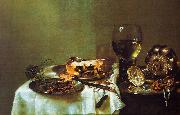
Dutch painter. He was a still-life painter, who, like Pieter Claesz., is noted for his monochrome breakfast-pieces, which are, however, more opulent than those of Claesz. Heda earliest dated work is a Vanitas (1621; The Hague, Mus. Bredius), which shows a still-life from a high viewpoint, composed of various objects bearing vanitas associations (e.g. a bowl of glowing embers, smoker requisites, an overturned glass and a skull); the colouring is in brownish-grey tones and represents one of the earliest examples of a Dutch monochrome still-life (monochrome refers to the range of tones, rather than of colours). Even in this early work Heda skill at painting textures is evident. A more balanced composition is achieved in another Still-life (1629; The Hague, Mauritshuis) and in the Breakfast Table (1631; Dresden, Gemeldegal. Alte Meister), in both of which the objects, set against a neutral background, are linked by a strong diagonal. The Mauritshuis still-life also gives an early indication of Heda interest in painting the effects of light. In 1631 he became a member of the Haarlem Guild of St Luke (of which he served as deacon on several occasions after 1637).
|
|
 |
Wilhelm Hammershoi
|
|
Danish 1864-1916
The son of a well-to-do merchant, Christian Hammershøi and his wife, Frederikke (n??e Rentzmann), Vilhelm studied drawing from the age of eight with Neils Christian Kierkegaard and Holger Grønvold, as well as painting with Vilhelm Kyhn, before embarking on studies with Frederik Vermehren and others at the Royal Danish Academy of Fine Arts. From 1883 to 1885, he studied with Peder Severin Krøyer at the Independent Study Schools, then debuted in the Charlottenborg Exhibition in the spring of 1885 with Portrait of a Young Girl (his sister, Anna; Pierre Auguste Renoir is reported to have admired this painting). Hammershøi married Ida Ilsted in 1891.
|
|
|
|
|
|
|
|
|
|
|
|
 |
VROOM, Hendrick Cornelisz.
|
|
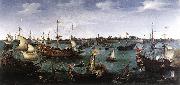
Dutch Baroque Era Painter, ca.1563-1640. He was one of the founders of Dutch marine painting. Painter and draughtsman. By his own account, he received his early training in Delft, home of his mother's family. Van Mander reports that Hendrick's stepfather, like his father a ceramic artist, forced him to work as a decorator of ceramic vessels, which caused the young artist to leave home and embark on extensive travels in Spain and Italy. After working for ecclesiastical patrons in Florence and Rome, he was employed for at least two years (c. 1585-7) by Cardinal Ferdinando de' Medici, who in October 1587 succeeded Francesco I as Grand Duke of Tuscany. Ferdinando's keen interest in ships and the navy seems to have been a determining factor in Vroom's choice of subject-matter. According to Lanzi, he was known in Rome as 'Lo Spagnolo' (since he had arrived there from Spain). Among his earliest works may be a group of marine paintings attributed to him (Rome, Villa Colonna). His friendship in Rome with Paul Bril, mentioned by van Mander, had no effect on Hendrick's painting style, but Bril's influence is discernible in a group of landscape drawings
|
|
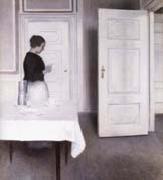 |
Vilhelm Hammershoi
|
|
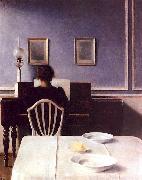
Danish Painter, 1864-1916, was a painter born in Copenhagen, Denmark known for his poetic, low-key portraits and interiors.The son of a well-to-do merchant, Christian Hammershoi and his wife, Frederikke (nee Rentzmann), Vilhelm studied drawing from the age of eight with Neils Christian Kierkegaard and Holger Gronvold, as well as painting with Vilhelm Kyhn, before embarking on studies with Frederik Vermehren and others at the Royal Danish Academy of Fine Arts. From 1883 to 1885, he studied with Peder Severin Kroyer.
|
|
|
|
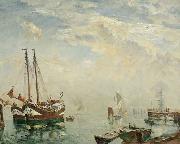 |
Ulrich Hubner
|
|
(17 June 1872 Berlin - 29 April 1932 Neubabelsberg) was a German painter.
He was born into a family of artists, his academic training he received in 1892 in Karlsruhe with Robert Poetzelberger, Gustav Schönleber, and Carlos Grethe. He then studied at the private art school in Munich Friedrich Fehr. In 1899, he was a member of the Berlin Secession, and in 1906 and 1907 was on the board.
In 1899, he won the prize for advertising designs for cooperative advertising by Ludwig and Otto Stollwerck Henkell.
He painted in Berlin, Havel, and in the summers in Hamburg, Lebeck, Rostock and Travemende (where he had his principal residence from 1909 to 1912), and in particular, many harbor scenes.
He showed at Kunstverein in Hamburg in 1910. Some of his works are in the Behnhaus Museum, in Lebeck, and Los Angeles County Museum of Art.
|
|
|
|
|
|
|
|
|
|
|
|
|
| Wholesale China Oil Painting Wholesale Oil Painting China Xiamen Portrait Reproduction on canvas Chinese Oil Painting Wholesale USA Oil Painting |
|
|
|
|
|