| |
|
Xiamen Oil Paintings, Wholesale Direct!
|
|
100% hand painted, 100% cotton canvas, 100% money back if not satisfaction. |
|
|
|
|
ART WORKS INDEX
A
B
C
D
E
F
G
H
I
J
K
L
M
N
O
P
Q
R
S
T
U
V
W
X
Y
Z
|
|
ARTISTS INDEX
A
B
C
D
E
F
G
H
I
J
K
L
M
N
O
P
Q
R
S
T
U
V
W
X
Y
Z
|
|
|
|
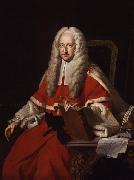 |
Thomas Hudson
|
|
Thomas Hudson (1701 - 1779) was an English portrait painter in the 18th century. He was born in 1701 in the West Country of the United Kingdom. His exact birthplace is unknown. Hudson studied under Jonathan Richardson in London and against his wishes, married Richardson's daughter at some point before 1725.
Hudson was most prolific between 1740 and 1760 and, from 1745 until 1755 was the most successful London portraitist. He lived at Deep Cross, Twickenham.
Many assistants were employed by Hudson, to help with his paintings. Joshua Reynolds and Joseph Wright were students of Hudson. He retired toward the end of the 1750s.
|
|
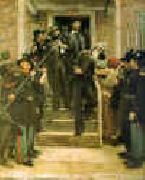 |
Thomas Hovenden
|
|
1840-1895
Thomas Hovenden Gallery
Thomas Hovenden (December 28, 1840 ?C August 14, 1895), was an Irish-American artist and teacher. He painted realistic quiet family scenes, narrative subjects and often depicted African Americans.
Hovenden was born in Dunmanway, Co. Cork, Ireland. His parents died at the time of the potato famine and he was placed in an orphanage at the age of six. Apprenticed to a carver and gilder, he studied at the Cork School of Design.
In 1863, he immigrated to the United States. He studied at the National Academy of Design in New York City. He moved to Baltimore in 1868 and then left for Paris in 1874. He studied at the École des Beaux Arts under Cabanel, but spent most of his time with the American colony at Pont-Aven in Brittany led by Robert Wylie, where he painted many pictures of the peasantry.
Returning to America in 1880, he became a member of the Society of American Artists and an Associate member of the National Academy of Design (elected Academician in 1882). He married Helen Corson in 1881, an artist he had met in Pont-Aven, and settled at her father's homestead in Plymouth Meeting, Pennsylvania, outside of Philadelphia. She came from a family of abolitionists and her home was a stop on the underground railroad. Their barn, later used as Hovenden's studio, was known as Abolitionist Hall due to its use for anti-slavery meetings.
He was commissioned to paint a historical picture of the abolitionist leader John Brown. He finished "The Last Moments of John Brown" (now in the collection of the Fine Arts Museums of San Francisco) in 1884. His "Breaking Home Ties", a picture of American farm life, was engraved with considerable popular success.
In 1886, he was appointed Professor of Painting and Drawing at the Pennsylvania Academy of the Fine Arts, replacing Thomas Eakins who was dismissed due to his use of nude models. Among Hovenden's students were the sculptor Alexander Stirling Calder and the leader of the Ashcan School, Robert Henri.
Hovenden was killed at the age of 54, along with a ten-year old girl, by a railroad locomotive at a crossing near his home in Plymouth Meeting. Newspaper accounts reported that his death was the result of a heroic effort to save the girl, while a coroner's inquest determined his death was an accident.
|
|
|
|
 |
Thomas Hill
|
|
1829-1908
Thomas Hill was born in England on September 11, 1829. At the age of 15, he emigrated to the United States with his family. They settled in Taunton, Massachusetts. In 1851, he married Charlotte Elizabeth Hawkins. They had nine children.
At the age of 24, Hill attended evening classes at the Pennsylvania Academy of the Fine Arts (PAFA) and studied under American painter Peter Frederick Rothermel (1812-1895). During his years as a student, Hill traveled to the White Mountains in New Hampshire as early as 1854 and sketched alongside members of the Hudson River School, such as Benjamin Champney. In 1856, Hill and his family moved to San Francisco, California.
With painter Virgil Williams and photographer Carleton Watkins, Hill made his first trip to the Yosemite Valley in 1865. The next year, Hill traveled to the East Coast and Europe. He established his family on the East Coast but continued to take sketching trips to the West Coast and to attend meetings of the San Francisco Art Association. He moved his family back to San Francisco in 1873.
Hill made yearly sketching trips to Yosemite, Mount Shasta, and, back east, to the White Mountains. Hill ran an art gallery and art supply store. He briefly acted as the interim director for the SFAA School of Design and went to Alaska on a commission for environmentalist John Muir. He lived on his stock market investments as well as his art proceeds. His marriage ended in the 1880s.
Toward the end of his life, he maintained a studio at Yosemite??s Wawona Hotel. After suffering a stroke, Hill left Yosemite and traveled up and down the California coast, including stops in Coronado, San Diego and Santa Barbara. He died in Raymond, California, on June 30, 1908, and is buried at Mountain View Cemetery in Oakland, California.
|
|
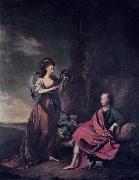 |
Thomas Hickey
|
|
was an Irish painter.
Born in Dublin, Hickey was the son of Noah, a confectioner in Capel Street, and Anne Hickey. A younger brother was John Hickey, the sculptor. He was trained at the Royal Dublin Society schools under Robert West.
Hickey painted primarily portraits and genre scenes. He traveled widely, working in India, Portugal, Italy and England, residing in Bath between 1776 and 1780. On his voyage to India, the vessel in which he was travelling was captured by French and Spanish fleets which led him to Lisbon, where, after receiving a number of commissions, he remained for several years. He eventually reached Bengal and stayed there until 1791 when he returned to England. He then traveled as far as Peking, China with George Macartney, 1st Earl Macartney as the expedition's official portrait painter.
He returned to Ireland shortly after the death of his brother John in January 1796. In 1797, he was commissioned by Dr. Robert Emmet, State Physician for Ireland, to paint a portrait of the doctor's son, Robert, and daughter, Mary. By 1798 he had returned to India where he landed just in time for the start of the Fourth Mysore War, which kept him engaged in painting. He resided in Madras until his death in 1824.
In addition to his artistic talents, he is reputed to have been a sparkling conversationalist who rarely failed to charm his sitters. The Courtauld Institute of Art (London), the Honolulu Academy of Arts, the National Gallery of Ireland, the Tate and the Victoria Art Gallery (Bath, England) are among the public collections having paintings by Thomas Hickey.
|
|
 |
Thomas Hearne
|
|
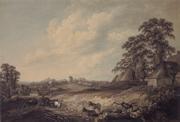
British Painter, 1744-1817
English painter and engraver. From 1765 to 1771 Hearne studied printmaking as apprentice to the landscape engraver William Woollett, exhibiting watercolours meanwhile at the Free Society of Artists and the Society of Artists. In 1771 he abandoned engraving and accompanied Sir Ralph Payne to the Leeward Islands (where Payne had just been appointed Governor), returning in 1775; several of his fastidious watercolours of Antigua survive, for example the Court House and Guard House in the Town of St John's in the Island of Antigua (n.d.; London, V&A). From then on British topography was his main concern. He travelled widely in England, Scotland and Wales with Sir George Beaumont and from these excursions was able to provide 84 drawings which, engraved by William Byrne, were published as The Antiquities of Great Britain (1778-81). This series set new standards in the pictorial recording of medieval architecture. Hearne also provided drawings for etchings of landscapes and 'rural sports'.
|
|
 |
Thomas Heaphy
|
|
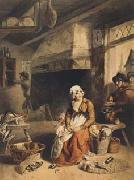
English Painter, 1775-1835
He trained at John Boyne's drawing school in Gloucester Street, Bloomsbury, London, and exhibited portraits at the Royal Academy from 1797. Following the success of a portrait of the Russian ambassador, Count Woronzow, he was appointed portrait painter to the Princess of Wales. Thomas Lawrence observed Heaphy's success and bought some of his pictures but had little cause to envy Heaphy's style, which owed much to the vocabulary of civic portraiture popularized by Joshua Reynolds (e.g. Portrait of a Naval Officer; London, V&A). Heaphy's largest project, The Duke of Wellington in Consultation with his Officers Previous to a General Engagement (Newcastle upon Tyne, Laing A.G.), was begun in Spain in 1813 during the Peninsular War and was finished in 1816. The engraving, which was intended to ensure Heaphy's fortune, was not released until 1822, by which time interest in the war had waned. Heaphy failed to finish his Battle of Waterloo (1816; untraced), another panoramic multiple portrait. Heaphy's other speciality, paintings of ports, markets, tradespeople and labourers, brought him great popularity between 1807 and 1811.
|
|
 |
Theophile Hamel
|
|
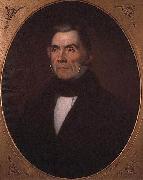
(8 November 1817 - 23 December 1870) was a Canadian artist who painted mainly portraits and religious images in 19th-century Quebec.
Hamel was born in 1817 in Sainte-Foy (that was a suburb of Quebec City), the son of a successful farmer. Hamel's paternal ancestry can be traced to French immigrant Jean Hamel, who arrived in New France from Avremesnil (Normandy) in 1656. In 1834 Theophile was already taking art lessons from Antoine Plamondon. His early portraits show a mixture of European romanticism and Canadian simplicity. His style gradually changed to match the taste of his clients for simple, honest, even prim portraits
|
|
 |
Theodore Heuck
|
|
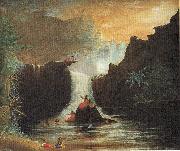
(1830 - 1877) was an architect, a merchant, and a painter. He designed The Queen's Medical Center (dedicated to Queen Emma), the Royal Mausoleum of Hawaii in 1865, and ʻIolani Barracks in 1871.
He was born in Hamburg, Germany and grew up as an only child. Traveling from Australia, Heuck arrived in Hawaii January 20, 1850 and advertised as the first professional architect. Finding no business, he became a partner with Herman Von Halt in a retail store, "General Commission Merchants". He became a citizen of the Kingdom of Hawaii and married Mahiki on March 22, 1852
|
|
|
|
 |
Theodor Hosemann
|
|
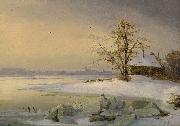
painted Blick uber die Havel auf das winterliche Brandenburg in 1838
|
|
|
|
|
|
 |
th. hildebrandt
|
|
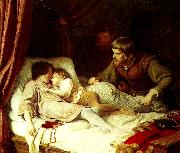
Ferdinand Theodor Hildebrandt, född 2 juli 1804 i Stettin, död 29 september 1874 i Dusseldorf, var en tysk målare.
Hildebrandt började sina konstnärliga studier i Berlin under Wilhelm Schadow, vilken han 1826 följde till Dusseldorf, och blev en av den där grundade skolans mest framstående lärjungar. 1825 framträdde han med Faust, 1826 med Cordelia och kung Lear och 1828 med Tankred döpande Klorinda. Ännu större popularitet vann han 1835 för Mordet på kung Edvards söner. Bland hans genrebilder har i synnerhet Krigaren och hans son (1832, Berlins nationalgalleri) blivit känd. Hildebrandt, som för övrigt utförde illustrationer och porträtt, kallades på sin tid realist, men han var knappast fri från den melodramatiska ton och den sentimentala inställning, som tillhörde skolan.
|
|
 |
Testelin,Henri
|
|
French , 1616-1695
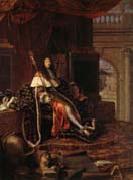
Painter, printmaker and writer, brother of Louis Testelin. As a member of the circle of Charles Le Brun, he endorsed his connection with the Academie Royale by submitting an allegorical portrait of Louis XIV in Childhood as Patron of the Arts as his morceau de reception. He was secretary of the Acad?mie from 1650 and a professor from 1656. He produced several tapestry cartoons based on designs by Le Brun for the Gobelins, including the Wedding of Louis XIV and Maria-Theresa on 9 June 1660 (before 1665) and the Founding of the Academie des Sciences and the Observatory in 1666. He was active also as a court portrait painter, exhibiting portraits of Louis XIV as Patron of the Academie Royale de Peinture et de Sculpture (exh. Salon 1673; Versailles, Cheteau) and of Maria-Theresa, Queen of France . Also at the Salon of 1673 he showed a history painting,
|
|
 |
TERBRUGGHEN, Hendrick
|
|
Dutch Baroque Era Painter, ca.1588-1629
Dutch painter, a leading member of the Utrecht school. He was a pupil of the history painter Bloemaert before living (c.1604?C14) in Italy. Crowning of Thorns (1620; Copenhagen) is his first known dated work. Like his contemporaries Honthorst and Baburen, he was largely influenced by Caravaggio, although an awareness of D??rer and Lucas van Leyden recurs throughout his work. His intimate and restrained genre compositions foreshadow in coloring the work of Vermeer. Many of Terbrugghen's paintings are nighttime genre scenes. His work is represented in the major European museums. Typical examples are his St. Sebastian (Allen Mus., Oberlin, Ohio), Old Man Writing
|
|
 |
SWANEVELT, Herman van
|
|
Dutch Baroque Era Painter, ca.1600-1655
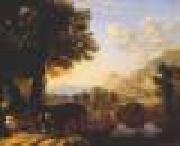
Dutch painter, draughtsman and etcher, active in France and Italy. His first signed and dated works are two views of Paris dated 1623 (Brunswick, Herzog Anton Ulrich-Mus.). He was in Rome from 1629 to 1641. His earliest dated painting there is an Old Testament Scene (1630; The Hague, Mus. Bredius; see fig.), a compositional formula that he often used, with some variations, in Rome. A flat, low foreground is closed on the left by a house and a tree; on the right is a distant hilly scene; and groups of figures are disposed horizontally. This design, derived from Cornelis van Poelenburch, is well suited to van Swanevelt's many landscapes with biblical and mythological subjects. The large tree extending beyond the frame gives a monumental touch to the composition.
|
|
|
|
 |
STRIGEL, Hans II
|
|
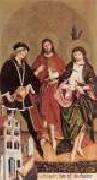
German painter, Swabian school (active 1450-1480 in Memmingen). Painter. The panels of the Montfort-Werdenberg Altarpiece and a Deposition mural (1477), fragment of a series in the church at Tiefenbach, Allgäu, are documented as his. They show an artist in the tradition of Hans Multscher, using strongly foreshortened perspectives for an emphatic relaying of realities. In the 1470s he attempted to tone down the contrasts, to organize his figures after the manner of the Master of Sterzing: a change of style shown in the panels of the Mickhausener altar (Budapest, Mus. F.A.) and the Saints and Passion scenes in the Oberhaus-Museum
|
|
 |
Steven van Herwijck
|
|
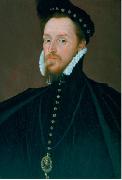
(Utrecht c. 1530-London 1565/67), was a Netherlandish sculptor and gem engraver famous for his portrait medallions and medals. It has recently been suggested that he is the "famous paynter Steven" mentioned in an inventory of 1590, who has traditionally been identified as Steven van der Meulen.
Van Herwijck worked in Italy in 1557 and returned to Utrecht in 1558, when he was made a Master of the artists' Guild of St. Luke. His earliest surviving medals, of George van Egmond, Bishop of Utrecht, and Engelken Tols, date from this year. In 1559 he relocated to Antwerp. Nine medals survive of his work there, including a portrait of Jacobus Fabius. Fleeing religious persecution, he went to Poland in 1561 where he made medallions of King Sigismund II and other members of the Polish royal family.
|
|
 |
Solon H. Borglum
|
|
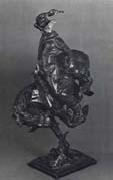
American Sculptor, 1868-1922,was an American sculptor. Born in Ogden, Utah, he was the younger brother of Gutzon Borglum and uncle of Lincoln Borglum of Mount Rushmore fame. The son of Danish immigrants who settled on the great plains, Solon Borglum spent his early years as a rancher in western Nebraska. Though he later lived in Paris and New York and achieved a reputation as one of America's best sculptors, it was his depiction of frontier life, and especially his experience with cowboys and native American peoples, on which his reputation was founded. Borglum studied under Louis Rebisso in Cleveland and in Paris. He specialized in depicting people and scenes of the American West. He moved to the Silvermine neighborhood of New Canaan, Connecticut, where he helped found the "Knockers Club" of artists. His brother, Gutzon, lived in nearby Stamford,
|
|
|
|
|
|
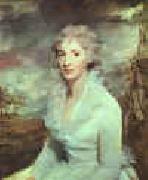 |
Sir Henry Raeburn
|
|
1756-1823
Scottish Sir Henry Raeburn Galleries
He was born the son of a manufacturer in Stockbridge, a former village now within the city of Edinburgh. Orphaned, he was supported by his older brother and placed in Heriot's Hospital, where he received an education. At the age of fifteen he was apprenticed to a goldsmith, and various pieces of jewellery, mourning rings and the like, adorned with minute drawings on ivory by his hand, still exist. Soon he took to the production of carefully finished portrait miniatures; meeting with success and patronage, he extended his practice to oil painting, at which he was self-taught. The goldsmith watched the progress of his pupil with interest, and introduced him to David Martin, who bad been the favourite assistant of Allan Ramsay the Latter, and was now the leading portrait painter in Edinburgh. Raeburn was especially aided by the loan of portraits to copy. Soon he had gained sufficient skill to make him decide to devote himself exclusively to painting.
In his early twenties, he was asked to paint the portrait of a young lady whom he had previously observed and admired when he was sketching from nature in the fields. She was the daughter of Peter Edgar of Bridgelands, and widow of Count Leslie. Fascinated by the handsome and intellectual young artist, she became his wife within a month, bringing him an ample fortune. The acquisition of wealth did not affect his enthusiasm or his industry, but spurred him on to acquire a thorough knowledge of his craft. It was usual for artists to visit Italy, and Raeburn set off with his wife. In London he was kindly received by Sir Joshua Reynolds, who advised him on what to study in Rome, especially recommending the works of Michelangelo. Raeburn carried with him to Italy many valuable introductions from the president of the Royal Academy. In Rome he met Gavin Hamilton, Pompeo Girolamo Batoni and Byers, an antique dealer whose advice proved particularly useful, especially the recommendation that "he should never copy an object from memory, but, from the principal figure to the minutest accessory, have it placed before him." After two years of study in Italy he returned to Edinburgh in 1787, and began a successful career as a portrait painter. In that year he executed a seated portrait of the second Lord President Dundas.
Raeburn's portrait of Sir Walter Scott (1822)Examples of his earlier portraiture include a bust of Mrs Johnstone of Baldovie and a three-quarter-length of Dr James Hutton, works which, if somewhat timid and tentative in handling and not as confident as his later work, nevertheless have delicacy and character. The portraits of John Clerk, Lord Eldin, and of Principal Hill of St Andrews belong to a later period. Raeburn was fortunate in the time in which he practised portraiture. Sir Walter Scott, Hugh Blair, Henry Mackenzie, Lord Woodhouselee, William Robertson, John Home, Robert Fergusson, and Dugald Stewart were resident in Edinburgh, and were all painted by Raeburn. Mature works include his own portrait and that of the Rev. Sir Henry Moncrieff Wellwood, the bust of Dr Wardrop of Torbane Hill, the two full-lengths of Adam Rolland]] of Gask, the remarkable paintings of Lord Newton and Dr Alexander Adam in the National Gallery of Scotland, and that of William Macdonald of St Martin's.
It was commonly believed that Raeburn was less successful in painting female portraits, but the exquisite full-length of his wife, the smaller likeness of Mrs R. Scott Moncrieff in the National Gallery of Scotland, and that of Mrs Robert Bell, and others, argue against this. Raeburn spent his life in Edinburgh, rarely visiting London, and then only for brief periods, thus preserving his individuality. Although he, personally, may have lost advantages resulting from closer association with the leaders of English art, and from contact with a wider public, Scottish art gained much from his disinclination to leave his native land. He became the acknowledged chief of the school which was growing up in Scotland during the earlier years of the 19th century, and his example and influence at a critical period were of major importance. So varied were his other interests that sitters used to say of him, "You would never take him for a painter till he seizes the brush and palette."
In 1812 he was elected president of the Society of Artists in Edinburgh, in 1814 associate, and in the following year full member of the Royal Scottish Academy. In 1822 he was knighted by George IV and appointed His Majesty's limner for Scotland. He died at Edinburgh.
The Reverend Robert Walker Skating on Duddingston Loch, better known as The Skating Minister (1790s)Raeburn had all the essential qualities of a popular and successful portrait painter. He was able to produce a telling and forcible likeness; his work is distinguished by powerful characterisation, stark realism, dramatic and unusual lighting effects, and swift and broad handling of the most resolute sort. David Wilkie recorded that, while travelling in Spain and studying the works of Diego Vel??zquez, the brushwork reminded him constantly of the "square touch" of Raeburn.
Raeburn was unusual amongst many of his contemporaries, such as Reynolds, in the extent of his philosophy of painting everything directly from life. This attitude partly explains the often coarse modelling and clashing colour combinations he employed, in contrast to the more refined style of Thomas Gainsborough and Reynolds. However these qualities and those mentioned above anticipate many of the later developments in painting of the nineteenth century from romanticism to Impressionism.
Sir Henry Raeburn died in St Bernard's House, Stockbridge, Edinburgh.
|
|
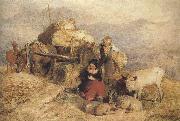 |
Sir edwin henry landseer,R.A.
|
|
1802-1873
Painter, draughtsman, sculptor and etcher, brother of (3) Charles Landseer. He became the best-known member of the family and was one of the most highly respected and popular British painters of the 19th century. He was first trained by his father, who taught him etching, and he then studied with Benjamin Robert Haydon and at the Royal Academy Schools in London. Precociously gifted, he drew competently from childhood and in 1813 he won the Silver Palette for draughtsmanship at the Society of Arts. In 1815 he exhibited at the Royal Academy for the first time, showing some drawings of a mule and of the heads of dogs. From an early age he was a frequent visitor to the menagerie in Exeter Change in the Strand, London,
|
|
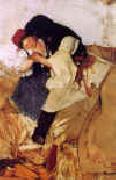 |
Simon Hollosy
|
|
1857-1918
Hungarian Simon Hollosy Gallery
Simon Hollosy (Romanian: Simion Corbu); (2 February 1857, Maramarossziget, now Sighetu Marmatiei - 8 May 1918, Tecso, now Tiachiv) was a Hungarian painter. He was considered one of the greatest Hungarian representatives of 19th century Naturalism and Realism.
Holl??sy came from an Armenian family who settled in Maramarossziget (present-day Sighetu Marmaţiei, Romania). He frequently worked abroad.
He criticized training at the Academy and founded a private school in 1886 where he gathered young talents around him who were interested in realistic protrayal. He opened the way to new styles by relying on his personality and by pointing out the merits of French pictures (Courbet) exhibited in Munich. He abandoned the academic style in order to follow new trends in French painting.
Encouraged by Istvan Reti and Janos Thorma, his pupils and friends, he spent the summer of 1896 in Nagyb??nya (present-day Baia Mare, Romania) with his school, which played an important role in Hungarian painting as the cradle of the Nagybanya school. He soon settled down in Nagybanya. With its style (sunny landscapes), his school determined Hungarian painting for decades. Leaving the Nagyb??nya colony in 1901, he spent the summers in Tecso with his students from 1902. During winters he was in Munich to run his school there.
He was not productive as an artist: he was in search of atmospheres and his productivity was confined to teaching. His large scale plan of "Rakoczi March" with a lot of figures got as far sketches because he kept on changing his mind. The landscapes painted in Tecso include "Landscape in T??cső", "Landscape with Stacks and Sunset with Stacks", where he applied elements of plein air and impressionism.
His self-portrait (1916) is one of his most harrowing pictures.
|
|
 |
Sigrid Hjerten
|
|
Swedish, 1885-1948,
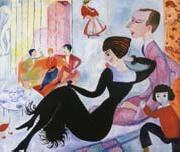
was a Swedish modernist painter. Hjerten is considered a crucial figure in Swedish modernism. Periodically she was highly productive and she participated in a large number of exhibitions. She worked as an artist for 30 years before succumbing to complications from treatment for a psychiatric disorder. Sigrid Hjerten was born in Sundsvall in 1885. She studied at the College of Crafts and Design in Stockholm and graduated as a drawing teacher. At a studio party in 1909, Herten met her future husband, twenty-year old Isaac Grenewald, who had already studied one year with Henri Matisse in Paris. Grenewald convinced her that she would do herself more justice as a painter. Later that year she went to Matisse's art school as well. 1910s As she studied under Henri Matisse in Paris, she was impressed by the way he and Paul Cezanne dealt with colour. This shows in her painting in contrasting colour fields and simplified contours, her way of achieving the greatest possible expressiveness. Her aesthetic intentions had primarily to do with colour, and in her later works from the 1930s she spoke of colours in terms such as cold yellow. Hjerten strove to find forms and colours that could convey her emotions. In that respect her work is more closely related to the German Expressionists, such as Ernst Ludwig Kirchner, than to the French painters, with their graceful play of lines. After a year and a half she returned to Sweden. In 1912 Sigrid Hjerten participated in a group show in Stockholm. In the following ten years she took part in several exhibitions both in Sweden and abroad, among other places in Berlin in 1915, where she was well received. Sigrid Hjerten was also represented at the Expressionist Exhibition at the Liljevalch's konsthall in Stockholm in 1918, together with two other artists. However, most of the critics then were writing scathing reviews about her art. In Hjerten's art, where she greatly exposes herself, one notices different stages of development. The influence of Matisse is perhaps mostly discernible in the 1910s. During this decade, Hjerten created many paintings with indoor pictures and views from her home, first at Kornhamnstorg Square and later at Katarinavägen Street, in Stockholm. Her husband Isaac Grenewald and her son Iven, as well as Sigrid herself, are often depicted in scenes that embrace various sorts of conflicts. At this time Sigrid Hjerten got acquainted with and inspired by the art made by Ernst Josephson during his illness. Ateljeinteriör (Studio interior) from 1916 shows how radical Hjerten was for her time. The painting describes the roles she played as artist, woman, and mother: different identities in different worlds. Hjerten sits on the sofa between two artists - her husband, Isaac Grenewald, and Einar Jolin - who talk to each other over her head. Her large blue eyes stare into the distance. In the foreground a woman dressed in black-a sophisticated alter ego-leans against the artist Nils von Dardel. Her son Iven crawls out of the right-hand corner. In the background we glimpse one of Hjerten's paintings of the period, Zigenarkvinna (Gypsy woman). Studio Interior and Den röda rullgardinen (The red blind) from 1916, are daring paintings that have given rise in recent years to new interpretations based on contemporary gender studies and revealing information about the artist's life. For long periods Sigrid Hjerten lived alone with her son and a sister of her husband. Sigrid and Isaac seem to have been very attached to one another, but their marriage met with great problems. Sigrid apparently had difficulties with her identity as a woman and in combining her different roles as a mother, a wife and an artist. The conflicts of her life made a mark in her painting. 1920s Between 1920 and 1932, Sigrid Hjerten lived in Paris, and made many excursions to the French countryside and the Italian Riviera for painting. This was a relatively harmonious era in Hjerten's art, but her exhibits were very limited in this period. Her husband, Isaac, mostly lived in Stockholm where he had a brilliant career. In the late twenties Hjerten increasingly suffered from various psychosomatic ailments, and she complained of loneliness. As time passed, an increasing tension can be seen in her art that successively rises and reaches its height immediately before the disease forces Sigrid Hjerten to cease as an artist. In the late twenties, while she was very isolated in France, colder and darker colours began to show. Recurring diagonal strokes helped to give the paintings a tense impression. During the thirties Hjerten painted innovative paintings which are characterized by menacing tones, growing storm clouds, and feelings of abandonment. 1930s In 1932, Sigrid Hjerten decided to return to Stockholm. But during packing she collapsed. She got to Sweden and was temporarily taken to the psychiatric hospital of Beckomberga with symptoms of schizophrenia. She recovered periodically and in the two following years (1932 C1934) Hjerten's artistry culminated in a crescendo, where, like one possessed, she made pictures that expressed strongly loaded feelings. One gets the impression that she tried to master a threatening inner chaos with her creative work. She devoted herself to intensive painting, creating one picture a day, the picture-book of her life, according to an interview in the Swedish art magazine Paletten. Some paintings radiate horror while others give a warm and harmonious impression. During 1934, she traveled with her family in the south of Europe, where she painted. Sigrid Hjerten eventually made her name as an artist among the critics in 1935, when she exhibited with Isaac and Ivan in Gothenburg. Yet, most contemporary critics had a negative and even scornful attitude towards Sigrid Hjerten's works of art, and many of them wrote deeply offensive reviews. Among other things her paintings were called idiocy, humbug, horrors and products of handicap. She won public recognition only in 1936, when she had a well received solo exhibition at the Royal Swedish Academy of Arts in Stockholm. Isaac, who had many mistresses over the years, divorced Sigrid and remarried. (Both Isaac and his new wife later died in a flying accident in 1946). At that time, Sigrid suffered from escalating mental illness, diagnosed with schizophrenia, and was permanently hospitalised at Beckomberga Psychiatric Hospital in Stockholm, where she remained for the rest of her life. After 1938 her artistic output dwindled. Following a botched lobotomy, she died in Stockholm in 1948.
|
|
 |
Sharp Joseph Henry
|
|
American Painter, 1859-1953
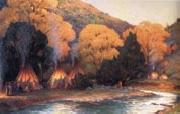
was a painter credited with influencing the creation of the Taos, New Mexico Society of Artists. Sharp may have been the first artist to discover Taos when he visited in 1883. He painted American Indian portraits and cultural life, and Western landscapes. As a youth he permanently damaged his hearing in a near-drowning accident, and gradually become totally deaf. His formal art training included Mckmicken School of Design (Cincinnati) and Antwerp (Belgium) Academy. He traveled and worked in Europe also. Harpers Magazine commissioned his illustrations of Taos Indian life. Some portraits were purchased by the Smithsonian Institution. President Theodore Roosevelt took an interest in him and had a cabin built for him at Little Big Horn to paint Indian life there.
|
|
 |
SEGHERS, Hercules
|
|
Dutch Baroque Era Painter and Printmaker, ca.1590-1638
Dutch landscape painter and etcher. Seghers's work greatly influenced early 17th-century Dutch landscape painting. He studied with the painter Coninxloo (1544C1607) and may have traveled to Italy and in the Alps. Some of the frenzy of his personal life can be seen in his rare paintings and his more numerous, masterly etchings. His landscapes consist of vast, often desolate, panoramas and powerful, smaller scenes rendered with drama and pathos. Rembrandt owned eight paintings by him, and his own landscape style was influenced by Seghers.
|
|
|
|
|
|
 |
SCHAUFELEIN, Hans Leonhard
|
|
German Northern Renaissance Painter, ca.1480-1540
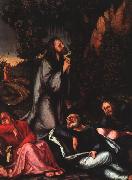
was a German painter, designer, and wood engraver. He was born in Nuremberg, probably studied under Wohlgemut, and then became the assistant of D??rer, whom he imitated. In 1512 he went to Augsburg and in 1515 removed to Nordlingen. He is a graceful narrator, and his types, though rarely accurately drawn, are attractive, but he lacks power and depth. Characteristic early paintings are the altarpiece at Ober Sankt Veit[1], near Vienna (1502), "Scenes from the Life of Christ" (Dresden Gallery), and "St. Jerome" (Germanic Museum, Nuremberg). To his Nordlingen period belong his masterpiece, the so-called "Ziegler Altar" for St. George's Church (1521), part of which is still in the church, part in the museum; "Scenes from the Story of Judith," in the town hall; and the illuminated Psalter for Count von Ottingen, now in the Berlin print room. His most important woodcuts are those for the Theuerdank of Emperor Maximilian.
|
|
 |
Samuel van hoogstraten
|
|
Dutch Baroque Era Painter, 1627-1678
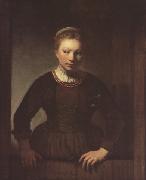
Dutch portrait painter and etcher, studied with his father, Dirk van Hoogstraten (1596?C1640), and with Rembrandt. His best works, such as The Old Jew (Vienna), reflect the influence of Rembrandt. He was director of the Academy in Dordrecht and author of a treatise (1678) in which he analyzed the theory and practice of the art of Rembrandt and other artists of the period.
|
|
 |
Samuel Howitt
|
|
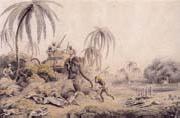
English, 1756-1822,was an artist from England. Samuel Howitt was born into a wealthy Quaker family in Nottinghamshire, England. He began painting as a hobby and to amuse his friends. Hunting and racing were his hobbies and he mimicked this interest in his work. Howitt's family experienced financial difficulties, so Howitt decided to move to London. In London, Howitt made a career out of his talent, flourishing as a professional artist. He was published often in The Sporting Magazine and went on to illustrate various books. Howitt is best known for his lively and exotic sporting scenes. His superior watercolors and aquatints depict dramatic racing and hunting scenes as well as an array of conventional and exotic animals. Howitt's work is included in the Mellon Collection, which possesses no fewer than 160 of his watercolors, and many of his aquatints. Howitt exhibited at the Royal Academy and illustrated several books, including his own entitled The British Sportsman c.1812 and British Preserve c.1824. Samuel Howitt, "genius, artist, sportsman", concentrated his considerable artistic talents on picturing scenes of horse-racing and hunting in all its aspects. Born in Nottinghamshire, England, Howitt was largely self-taught ,"although he must have been helped by his companions George Morland, Rowlandson and John Raphael Smith. Howitt's watercolours of hunting, shooting and racing have delightful spontaneity.
|
|
 |
Samuel Hieronymous Grimm
|
|
Swiss Painter, 1733-1794
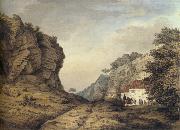
Swiss painter and draughtsman, active in England. He studied in Berne under Johann Ludwig Aberli and became established as a painter of topographical views in oil and watercolour. His early surviving works (e.g. River Landscape and Landscape with Chasseurs; Basle, priv. col.) are principally tinted drawings of landscapes and alpine scenery, with scenes of rustic life in the foreground; they display his characteristically charming and informal style. He also produced many decorative book illustrations: the frontispiece and plates to Friedrich von Hagedorn's Poetische Werke (1769-72) are among his finest. By 1764 Grimm had abandoned oils and was painting only in watercolour. From 1765 to 1768 he travelled and painted in France; he then moved to England,
|
|
|
|
 |
Rufus Hathaway
|
|
American country painter , 1770-1822
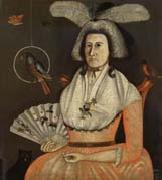
American painter and physician. He may have been apprenticed to ship-carvers and decorators, but he was not trained in fine art. His earliest known portrait, Lady with her Pets (1790; New York, Met.), demonstrates his unsophisticated, decorative style. Between 1790 and 1796 he seems to have worked as an itinerant artist; only portraits of relatives and friends survive. During his life he painted at least 25 portraits as well as miniatures, views and decorative overmantels. He also painted a genre subject, the Welch Curate, c. 1800
|
|
 |
ROBERT, Hubert
|
|
French Rococo Era Painter, 1733-1808
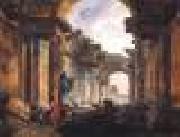
French painter, draughtsman, etcher and landscape designer. He was one of the most prolific and engaging landscape painters in 18th-century France. He specialized in architectural scenes in which topographical elements derived from the buildings and monuments of ancient and modern Italy and of France are combined in often fantastic settings or fictitious juxtapositions. The fluid touch and rich impasto employed in his paintings
|
|
|
|
 |
Robert Hills
|
|
British Painter, 1769-1844
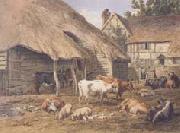
English painter and etcher. After taking drawing-lessons from John Alexander Gresse (1740-94), he enrolled at the Royal Academy Schools, London, in 1788. Village and rural scenes, and in particular studies of animals, occupied him throughout his working life; his favourite subjects were cattle, sheep, donkeys, pigs and above all deer, which he stalked for the purpose of sketching. As well as making plein-air drawings, Hills carried out careful anatomical studies of animal bones and joints. Between 1798 and 1815 he issued an extensive series of Etchings of Quadrupeds; the British Museum holds the artist's collection of his own etchings
|
|
 |
robert herrick
|
|
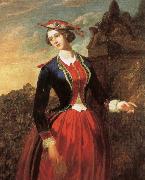
The English poet and Anglican parson Robert Herrick (1591-1674) invented a fanciful world compounded of pagan Rome and Christian England, of reality and fantasy, which he ruled as his poetic domain.
|
|
 |
Robert Henri
|
|
1865-1929
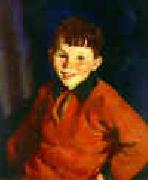
Robert Henri was born Robert Henry Cozad in Miami, Florida to Theresa Gatewood Cozad of Malden, Virginia and John Jackson Cozad, a gambler and real estate developer. Henri had a brother, Johnny, and was a distant cousin of the noted American painter Mary Cassatt. In 1871, Henri's father founded the town of Cozaddale, Ohio. In 1873, the family moved west to Nebraska, where they founded the town of Cozad.
In October 1882, Henri's father became embroiled in a dispute with a rancher, Alfred Pearson, over the right to pasture cattle on land claimed by the family. When the dispute turned physical, Cozad shot Pearson fatally with a pistol. Cozad was eventually cleared of wrongdoing, but the mood of the town turned against him. He fled to Denver, Colorado, and the rest of the family followed shortly. In order to disassociate themselves from the scandal, family members changed their names. The father became known as Richard Henry Lee, and his sons posed as adopted children under the names Frank Southern and Robert Earl Henri (pronounced "hen rye").
In 1883, the family moved to New York City, then to Atlantic City, New Jersey, where the young artist completed his first paintings.
|
|
 |
Robert Havell Jr Prints
|
|
1793-1878
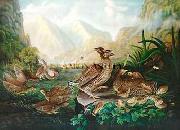
Engraver and painter, cousin of William Havell. He learnt the art of aquatint engraving from his father, Robert Havell I. He worked first in the family engraving business and then c. 1825-7 with Colnaghi in London. In 1827 he undertook the execution in aquatint of the plates for John James Audubon Birds of America, published in parts in London between 1827 and 1838. Havell engraved 425 of the plates and reworked the ten that had been engraved by William Home Lizars in Edinburgh. Havell father printed and coloured some of the double elephant folio sheets in 1827-8 after which Havell took on those tasks himself, establishing himself as a master of aquatint. Among his other important works in the medium are the plates for Mrs E. Bury Selection of Hexandrian Plants (London, 1831-4). In 1839, at Audubon invitation, Havell moved with his family to New York and embarked on a new career as a landscape painter in the style of the Hudson River school, while also working as an engraver. He settled in the Hudson River villages of Ossining (1841) and Tarrytown (1857) but painted throughout north-eastern America. View of Deerfield, Massachusetts (1847; Hist. Deerfield, MA) is characteristic of his quietly romantic idealization of his subjects. Niagara Falls from the Chinese Pagoda (1845; New York, Pub. Lib.), engraved by Havell after one of his paintings, is among the best known of his American aquatints. Though his reputation rests largely on his work for Audubon, his original subjects gave him greater opportunities to display the full range of his aquatint technique.
Part of the Havell family
|
|
 |
Robert Alexander Hillingford
|
|
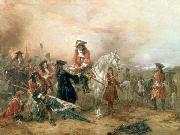
(1825-1904) was an English painter. He specialized in historical pictures, often battle scenes.
Contents
He was born in London on January 28, 1828, and studied in Desseldorf in 1841 for five years and before traveling to Munich, Rome, Florence and Naples, where he married and worked for several years, producing paintings of Italian life. One painting from this period entitled The Last Evening of the Carnival was exhibited at St. Petersburg in 1859. He returned to London in 1864, and first exhibited at the Royal Academy in 1866; it was at this time that he began to work on historical subjects, especially of the Napoleonic Wars. He was a regular exhibitor at the Royal Academy, British Institution and at other galleries. While he was attracted to costume pieces such as An incident in the early life of Louis XIV and During the wanderings of Charles Edward Stuart', he also included some contemporary military scenes including his 1901 RA painting South Africa, 1901 - The Dawn of Peace.
Wellington at Waterloo
Lord Hill invites the last remnants of the French Imperial Guard to surrenderThe original paintings often come up at auction, and, with a large amount of the collection dispersed in 1998, the original paintings are widely scattered.
|
|
 |
RIGAUD, Hyacinthe
|
|
French Baroque Era Painter, 1659-1743
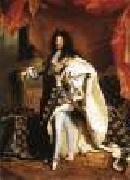
.was a French baroque painter of Catalan origin whose career was based in Paris. He is renowned for his portrait paintings of Louis XIV, the royalty and nobility of Europe, and members of their courts. Rigaud was born Jacint Rigau i Ros -- though in many encyclopaedias is "re-christened" with the name of H??acint Francesc Honrat Mathias Pere Martyr Andreu Joan Rigau -- in Perpignan, which became part of France by the Treaty of the Pyrenees (7 November 1659) shortly after his birth. In 1682, he was awarded the Prix de Rome. He was the most important portrait painter during the reign of King Louis XIV. His instinct for impressive poses and grand presentations precisely suited the tastes of the royal personages, ambassadors, clerics, courtiers, and financiers who sat for him. Because Rigaud's paintings captured very exact likenesses along with the subject's costumes and background details, his paintings are considered precise records of contemporary fashions. Rigaud was a master of the Baroque style of art. Rigaud's best-known work is his 1701 painting of Louis XIV which today hangs in the Louvre in Paris, as well as the second copy also requested by Louis XIV that now hangs at the Palace of Versailles. In 1709, he was made a noble by his hometown of Perpignan. In 1727 he was made a knight of the Order of Saint Michael. Rigaud died in Paris in 1743 at the age of 84.
|
|
 |
RICHTER, Johan
|
|
Swedish painter, Venetian school (b. 1665, Tukholma, d. 1745, Venezia).was a Baroque painter, born in Sweden, but painting mainly landscapes or veduta of Venice. Richter was born in Stockholm and died in Venice. He was known to be active in Venice by 1717. He was influenced by Luca Carlevarijs.
|
|
 |
Rene-Antoine Houasse
|
|
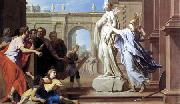
(c. 1645 - 1710) was a decorative French painter.
He was a pupil of Charles Le Brun, under whose direction he worked at the Manufacture des Gobelins, and with whom he worked on the decoration of the Château de Versailles. He was the director of the French Academy in Rome from 1699 to 1704. His son was Michel-Ange Houasse, a painter of genre scenes.
|
|
 |
Rene Herisson
|
|
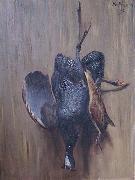
Rene Herisson (ne a Cognac (Charente) le 24 mai 1857 - decede le 4 janvier 1940) est un poete et peintre animalier francais
|
|
 |
REMBRANDT Harmenszoon van Rijn
|
|
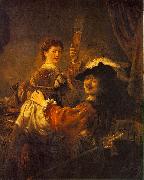
Born 1606, Died 1669.One of the great Dutch painters and printmakers of the 17th century, Rembrandt van Rijn is best known for his expressive use of light and shadow (also called chiaroscuro) in his many portraits. Raised in Leiden, he studied with Pieter Lastman (1583-1633) in Amsterdam, then returned to Leiden around 1625 and set up shop as a teacher and portrait artist. Sometime between 1630 and 1632 Rembrandt relocated to Amsterdam, where he spent the rest of his career. Though he had his detractors (some of whom considered him coarse and "low born"), Rembrandt was successful and famous during his lifetime, though he fell on financial hard times in his later years. He was a master printer and produced hundreds of group portraits and historical paintings, including The Anatomy Lesson of Dr. Tulp (1632), The Military Company of Captain Frans Banning Cocq (1642) and Aristotle with a Bust of Homer (1653). His portraits -- including a lifelong trail of intriguing and rather frank self-portraits -- reveal his interest in psychological study and continue to be admired as landmarks in Western art. The Military Company of Captain Frans Banning Cocq is also known as "The Night Watch" because it was thought the painting depicted a nighttime scene. When the painting was cleaned in the 1940s it became obvious that it depicted a daytime scene... He married Saskia van Ulenburgh (also Uylenburgh) in 1634.
|
|
 |
Rembrandt Harmensz Van Rijn
|
|
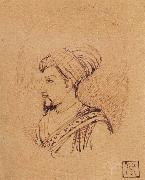
b. 1606 Leiden, The Netherlands, d. 1669 Amsterdam,Dutch painter, draughtsman and etcher. From 1632 onwards he signed his works with only the forename Rembrandt; in documents, however, he continued to sign Rembrandt van Rijn (occasionally van Rhyn), initially with the addition of the patronymic 'Harmensz.'. This was no doubt in imitation of the great Italians such as Leonardo, Michelangelo, Raphael and Titian, on whom he modelled himself, sometimes literally. He certainly equalled them in fame, and not only in his own country. His name still symbolizes a whole period of art history rightfully known as 'Holland's Golden Age'. In 1970-71 a great exhibition in Paris was devoted to it under the eloquent title Le Si?cle de Rembrandt. A century before, a popular work of cultural history by C. Busken Huet referred to the Netherlands as 'the land of Rembrandt'. His fame is partly due to his multi-faceted talent. Frans Hals was perhaps at times a greater virtuoso with the brush but remained 'only' a portrait painter. Vermeer may have excelled Rembrandt in the art of illusion but was less prolific. Rembrandt was not only a gifted painter but also an inspired graphic artist: he has probably never been surpassed as an etcher, and he often seems inimitable as a draughtsman. His subjects reflect his manifold talent and interests. He painted, drew and etched portraits, landscapes, figures and animals, but, above all, scenes of biblical and secular history and mythology.
|
|
|
|
|
|
|
|
|
| Wholesale China Oil Painting Wholesale Oil Painting China Xiamen Portrait Reproduction on canvas Chinese Oil Painting Wholesale USA Oil Painting |
|
|
|
|
|