| |
|
Xiamen Oil Paintings, Wholesale Direct!
|
|
100% hand painted, 100% cotton canvas, 100% money back if not satisfaction. |
|
|
|
|
ART WORKS INDEX
A
B
C
D
E
F
G
H
I
J
K
L
M
N
O
P
Q
R
S
T
U
V
W
X
Y
Z
|
|
ARTISTS INDEX
A
B
C
D
E
F
G
H
I
J
K
L
M
N
O
P
Q
R
S
T
U
V
W
X
Y
Z
|
|
|
|
|
|
|
|
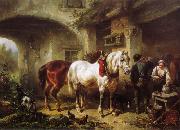 |
Wouterus Verschuur
|
|
(11 June 1812 - 4 July 1874) was a Dutch painter of animal subjects - mainly horses - and of landscapes. He is one of the later representatives of Romanticism in Dutch art.
Born to an Amsterdam jeweller, Verschuur received his training from the landscape and cattle painters Pieter Gerardus van Os and Cornelis Steffelaar. As part of this education Verschuur had to copy works by the 17th century painter Philips Wouwerman, like Wouwerman Verschuures subjects consist mostly of stable scenes, landscapes with horses and coastal landscapes.
Showing talent from an early age, at 15 Verschuur had a painting exhibited at the eExhibition of Living Masterse at Amsterdam in 1828. In 1832 and 1833 he won the gold medal at the annual exhibition at Felix Meritis. In 1833 he was appointed a member of the Royal Academy in Amsterdam. In 1839 he joined the artistse society, Arti et Amicitiae. His reputation was also considerable abroad. He was often featured in the annual exhibitions which travelled the large European cities at that time. In 1855 Napoleon III purchased one of his paintings at the Exposition Universelle in Paris.
The popularity of his paintings provided him with sufficient funds to travel widely. He made frequent trips to Gelderland and Brabant and abroad to Switzerland and Germany. In 1874, on one of his trips to Gelderland, he died on July 4 in the town of Vorden. He left behind an oevre of about 400 paintings and over 2000 drawings. Amongst his students were his son, Wouterus Verschuur Jr. and Anton Mauve.
|
|
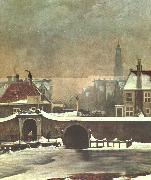 |
Wouter Johannes van Troostwijk
|
|
1782-1810
Dutch
Wouter Johannes van Troostwijk Gallery
Dutch painter, draughtsman and etcher. In 1803 he was admitted to the Amsterdam Tekenacademie where he was a pupil of the director, Jurriaan Andriessen. Despite a highly successful student career that culminated in a gold medal from the Felix Meritis Society in 1807, he was unable to establish himself as a professional artist during the remainder of his very short working life in Amsterdam. Andriessen's studies from nature seem to have been an important influence; van Troostwijk was one of the earliest artists to paint en plein air. Although he looked back to 17th-century Dutch landscape art and to the work of his contemporaries, in such paintings as Landscape in Gelderland (c. 1808; Amsterdam, Rijksmus.; see NETHERLANDS, THE, fig. 21) he achieved a totally new lyricism in the rendering of atmospheric effects. The Raampoortje (1809; Amsterdam, Rijksmus.) displays a fresh colouristic touch rare in Dutch painting of this period. His Self-portrait (c. 1810; Amsterdam, Rijksmus.) is equally original in composition and colour. He also produced animal paintings in the manner of Paulus Potter, drawings and a few etchings towards the end of his life. Van Troostwijk died before his considerable talents could be recognized, and, although he has come to be seen as an important precursor of much late 19th-century Dutch painting, he had little influence on his immediate successors.
|
|
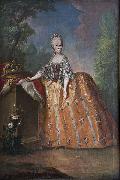 |
Workshop of Anton von Maron
|
|
Anton von Maron (January 8, 1733 - March 3, 1808) was an Austrian painter, active in Rome.
Von Maron was born in Vienna, but moved at a young age to Rome. There, he studied under Anton Raphael Mengs, and became an accomplished portrait painter. He married a sister of Mengs, Therese Maron, who was a painter in her own right. He lived the rest of his life in Rome, and died there in 1808.
|
|
|
|
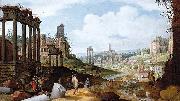 |
Willem van Nieulandt
|
|
(1584-1635) was a Dutch Golden Age painter and engraver from Antwerp.
His father Adrien van Nieulandt the elder was born to a family of artists of Flemish origin from Antwerp. He probably moved with his family to Amsterdam in 1589 after the Siege of Antwerp, because they were Protestants. His three sons Willem van Nieulandt II (named for his uncle, also a painter), Adriaen van Nieulandt the younger, and Jacob van Nieulandt all became painters.
According to Houbraken, Willem was a pupil of Roelant Savery in Amsterdam, and he left him to travel to Rome, where he became a student of Paulus Bril. He specialized in painting artistic ruins of monuments, arches, and temples, many of which he then engraved himself. He returned to Amsterdam (via Antwerp) in 1607, and became a respected poet there as well as Italianate painter.
|
|
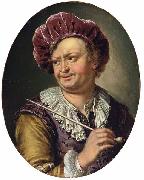 |
Willem van Mieris
|
|
(3 June 1662, Leiden - 26 January 1747, Leiden) was a Dutch painter. He was a son of Frans van Mieris sr. and brother of Jan van Mieris.
His works are extremely numerous, being partly imitations of the paternal subjects, or mythological episodes, which Frans habitually avoided. In no case did he come near the excellence of his sire.
van Mieris has works in the Victoria and Albert Museum as well as Cheltenham and Derby Museum and Art Gallery
|
|
|
|
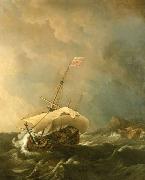 |
Willem Van de Velde The Younger
|
|
(bapt. 18 December 1633 - 6 April 1707) was a Dutch marine painter.
Willem van de Velde was baptised on 18 December 1633 in Leiden, Holland, Dutch Republic.
A son of Willem van de Velde the Elder, also a painter of sea-pieces, Willem van de Velde, the younger, was instructed by his father, and afterwards by Simon de Vlieger, a marine painter of repute at the time, and had achieved great celebrity by his art before he came to London. In 1673 he moved to England, where he was engaged by Charles II, at a salary of £100, to aid his father in "taking and making draughts of sea-fights", his part of the work being to reproduce in color the drawings of the elder van de Velde. He was also patronized by the Duke of York and by various members of the nobility.
He died on 6 April 1707 in London, England.
|
|
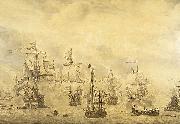 |
Willem van de Velde the Elder
|
|
(c. 1611 - 13 December 1693) was a Dutch Golden Age seascape painter.
Willem van de Velde, known as the Elder, a marine draughtsman and painter, was born in Leiden, the son of a Flemish skipper, Willem Willemsz. van de Velde, and is commonly said to have been bred to the sea. In 1706 Bainbrigg Buckeridge noted that he eunderstood navigation very welle. He married Judith Adriaensdochter van Leeuwen in Leiden, the Netherlands, in 1631.
His three known legitimate children were named Magdalena, born 1632; Willem, known as the Younger, also a marine painter, born 1633; and Adriaen, a landscape painter, born 1636.
His marriage was stormy, at least in its later years. David Cordingly relates that Willem the Elder fathered two children out of wedlock in 1653, one eby his maidservant, and the other by her friend. Nine years later the Elder and his wife went through a legal separation, eon account of legal disputes and the most violent quarrelse. The immediate cause of the dispute was his affair with a married woman.e Michael S. Robinson noted that eon 17/27 July 1662, he and his wife agreed to part. A condition of the separation was that the Elder could recover from his son Adriaen etwo royal giftse, presumably gifts from Charles II for work done in England.e Cordinglyes account further relates that the dispute was still continuing after another ten years, since ein the autumn of 1672 Judith complained to the womanes husband.e Robinson adds that by 1674 the couple emust have been reconcilede, for at a chance meeting with Pieter Blaeu in Amsterdam in July the Elder explained that he was only visiting for a few days ein order to fetch his wifee. His son, Adriaen, had died in Amsterdam in 1672, and Willem the Elder was also fetching his grandson, similarly named Adriaen, who was then aged two.
After his move to England, the exact date of which is uncertain, but reportedly at the end of 1672 or beginning of 1673, he is said to have lived with his family in East Lane, Greenwich, and to have used the Queenes House, now part of the National Maritime Museum in Greenwich, as a studio. Following the accession of William and Mary as King and Queen of England, it appears that this facility was no longer provided, and by 1691 he was living in Sackville Street, now close to Piccadilly Circus. He died in London, and was buried in St Jameses Church, at the south end of the street.
|
|
 |
willem van de velde the younger
|
|
(bapt. 18 December 1633 - 6 April 1707) was a Dutch marine painter.
Willem van de Velde was baptised on 18 December 1633 in Leiden, Holland, Dutch Republic.
A son of Willem van de Velde the Elder, also a painter of sea-pieces, Willem van de Velde, the younger, was instructed by his father, and afterwards by Simon de Vlieger, a marine painter of repute at the time, and had achieved great celebrity by his art before he came to London. In 1673 he moved to England, where he was engaged by Charles II, at a salary of £100, to aid his father in "taking and making draughts of sea-fights", his part of the work being to reproduce in color the drawings of the elder van de Velde. He was also patronized by the Duke of York and by various members of the nobility.
He died on 6 April 1707 in London, England.
|
|
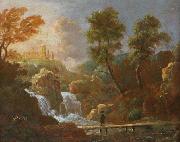 |
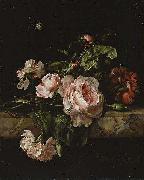
Willem van Bemmel
|
|
(Utrecht 10 June 1630 - Nuremberg 20 December 1708), was a Dutch Golden Age painter active in Germany.
Van Bemmel was a student of Herman Saftleven in Utrecht. He made a Grand Tour to Rome, spending first the years 1647-9 in Venice where he became famous for his landscapes. He stayed in Rome for six years and was a member of the Bentvueghels. From Rome he crossed the Alps to Nuremberg, where he became a successful painter of Italianate landscapes.
In 1656 he moved to Kassel. He was the father of the German Von Bemmel painting family.
|
|
 |
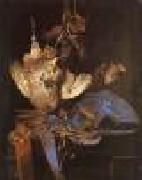
Willem van Aelst
|
|
(May 16, 1627 - in or after 1683) was a Dutch artist who specialized in still-life painting with flowers or game.
Van Aelst was born in Delft to a family of prominent city magistrates. He learned to paint from his uncle, the still-life painter Evert van Aelst. On 9 November 1643 he enrolled as a master of the Guild of Saint Luke at Delft.
Between 1645 and 1649 he lived in France. In 1649 Van Aelst travelled to Florence, where he served as court painter to Ferdinando II de' Medici, grand duke of Tuscany. At this time, the grand duke also employed two fellow Dutchmen Matthias Withoos and Otto Marseus van Schrieck, the latter also a still-life painter who probably influenced Van Aelst's style.
In 1656 he returned to the Netherlands to settle permanently in Amsterdam. He became one of the most prominent still-life painters of his generation, which allowed him to live on the Prinsengracht. He must have at Amsterdam died in 1683 or shortly thereafter, as his latest dated work is from that year. Van Aelst taught Rachel Ruysch and several others.
|
|
 |
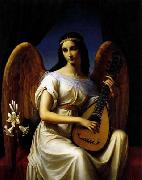
Willem van
|
|
Dutch Baroque Era Painter, 1627-ca.1683
|
|
 |
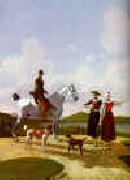
Wilhelm von Schadow
|
|
German Romantic Painter, 1788-1862,Painter, teacher and writer, son of Johann Gottfried Schadow. He studied at the Berlin Akademie from 1805 and in 1806 showed paintings at the annual Akademie exhibition. Under his teacher, Friedrich Georg Weitsch, he quickly became a skilled portrait painter, and by 1810 he was commissioned to paint portraits of members of the Prussian royal family and of the Empress of Austria. Influenced by the English artist John Flaxman, Schadow developed an emphasis on outline. In 1810 Schadow went with his brother Ridolfo Schadow to Rome, where in 1813 he became a member of the Lukasbreder and, in 1814, a Catholic. In 1815-17 he took part, with Peter von Cornelius, Friedrich Overbeck and Philipp Veit, in the commission for frescoes of the Story of Joseph for a room in the Casa Bartholdy (now Berlin, Alte N.G.). In his continuing interest in portraits, Schadow differed from his colleagues. Following the example of Gottlieb Schick and similarly inspired by Raphael, Schadow developed a poetic style of portraiture. In 1819 he returned to Berlin in order to help Karl Friedrich Schinkel with the decoration of the Schauspielhaus. He took over the running of a studio and won a high degree of respect as a painter and teacher.
|
|
 |
Wilhelm von Kobell
|
|
1766-1853
German
Wilhelm von Kobell Gallery
Kobell was born in Mannheim, the son of Ferdinand Kobell, a landscape painter who cited Claude Lorrain as his influence. Wilhelm's initial lessons were supplied by his father and his uncle, Franz Kobell. He received further training under Franz Anton, von Leydendorf and Egid Verhelst in the art of engraving at the Zeichnungsakademie in Mannheim. During this time he practiced various styles, including 17th-century Dutch painting and 18th-century English art. He was supported by Charles Theodore who compensated him an annual sum of 500 florins from 1792 until Theodore's death in 1799. Throughout his life Kobell traveled to England, France and Italy but ultimately based his style on Dutch art.
|
|
 |
Wilhelm von Kaulbach
|
|
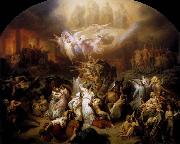
German Painter, ca.1804-1874,Painter and illustrator. After initial instruction from his father, Kaulbach received his principal education, from 1822 to 1826, at the Kunstakademie, Desseldorf, under Peter Cornelius. Six months after Ludwig I, King of Bavaria, had summoned Cornelius to Munich, Kaulbach followed his tutor to the Bavarian capital, where he worked on various collaborative ventures with other pupils of Cornelius, and completed his practical training on such projects as the decoration of the Odeon (destr.) in 1826, and of the Hofgartenarkaden, from 1826 to 1829 (now painted over). More independent work followed with 16 frescoes on the theme of Cupid and Psyche for the Festsaal of the Herzog-Max-Palais (1829-35; now Munich, Neue Pin.),
|
|
 |
wilhelm von gegerfelt
|
|
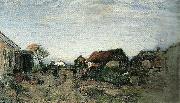
född 9 november 1844 i Göteborg, död 1920, målare, son till arkitekten Victor von Gegerfelt.
von Gegerfelt studerade 1861-63 vid konstakademien i Köpenhamn, 1864-67 vid akademien i Stockholm och 1867-72 i D??sseldorf, varefter han överflyttade till Paris. Där arbetade han sig till en helt ny teknik och blev jämte Alfred Wahlberg den förste svenske representanten för det moderna stämningslandskapet. Han gjorde studieresor till Frankrikes nordkust, till hemlandet och till Italien, målade skymning över Venedigs kajer, månsken över lagunerna, kritklippor vid Engelska kanalen i gråstämning, svenska sommarnätter, allt med elegant pensel, smekande färg och livligt föredrag. Gegerfelt är representerad på Nationalmuseum av Stormen (akvarell, motiv från Dalarna, inköpt 1886) och Strand på Hallands Väderö (i olja, 1893) samt på Göteborgs konstmuseum av Strandgata i Venezia (1884), oljemålningen Vinterafton på Hallands Väderö (1893) samt akvarellen Fjällbacka.
|
|
|
|
|
|
 |
Werner van den Valckert
|
|
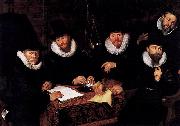
Though he was born in Amsterdam, he became a member of the Guild of St. Luke in the Hague between 1600 - 1605. By 1614 he had moved to Amsterdam, because his daughter was baptized there. His earliest dated etchings are from 1612. His surviving paintings are historical allegories and portraits. He also made a prestigious schutterstuk, which features the Amsterdam burgermeester Albert Burgh.
According to Houbraken, he was a student of Hendrik Goltzius. He painted a series of 4 paintings showing a doctor as angel, Christ, a man, and the devil; these were all based on engravings by Goltzius. These paintings are now in the possession of the Boerhaave Museum, which has other similar series on display.
|
|
 |
Wallerant Vaillant
|
|
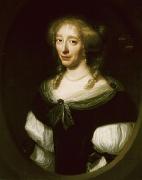
Wallerant Vaillant, (Lille 30 May 1623 - Amsterdam 28 August 1677), was a painter of the Dutch Golden Age and one of the first artists to use the mezzotint technique, which he probably helped to develop.
Wallerant Vaillant was the oldest of five brothers, who all became successful painters.
Jacques (1625 - 1691) traveled to Italy where he joined the Bentvueghels in Rome with the nickname Leeuwrik, and settled later in Berlin.
Jan (1627 - 1668+) was an engraver considered to be a member of the school of Frankenthal and later became a merchant in Frankfurt.
Bernard (1632 - 1698) accompanied Wallerant on all of his travels, and settled later in Rotterdam, where he became deacon of the Wallonian Church.
Andreas (1655 - 1693), the youngest, became an engraver in Paris, and died in Berlin visiting his brother Jacques.
It is said Wallerant was a student of Erasmus Quellinus II (1607 - 1678) in Antwerp. He moved with his parents in 1643 to Amsterdam. In 1647 he lived in Middelburg, but in 1649 he was back in Amsterdam. In 1658 he traveled with his brother to Frankfurt and Heidelberg. He helped invent the Mezzotint technique (schraapkunst, or zwartekunst) with Prince Rupert of the Rhine when he was his tutor performing experiments in etching techniques. In 1659 he went to Paris with Philibert de Gramont where he stayed five years.
|
|
 |
w. von schadow
|
|
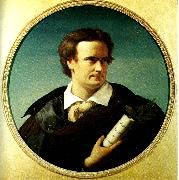
Friedrich Wilhelm Schadow (7 September 1789 - 19 March 1862) was a German Romantic painter.
He was born in Berlin and was the second son of the sculptor Johann Gottfried Schadow.
In 1806-1807 Friedrich served as a soldier. In 1810 he traveled with his elder brother Rudolph to Rome where he became one of the leaders among painters of the Nazarene movement. Following the example of Johann Friedrich Overbeck and others, he joined the Roman Catholic Church, and held that an artist must believe and live out the truths he essays to paint. The sequel showed that Schadow was qualified to shine more as a teacher and mentor than as a painter. As an author, he is best known for his lecture, Ueber den Einfluss des Christentums auf die bildende Kunst (About The Influence of Christianity On The Visual Arts) (Dusseldorf, 1843), and the biographical sketches, Der moderne Vasari (Berlin, 1854).
In Rome, Schadow was given one of his first major commissions when the Prussian Consul-General, General Jakob Salomon Bartholdy, befriended the young painter, and asked him and three young compatriots (Cornelius, Overbeck and Veit) to decorate in fresco a room in his house on the Pincian Hill. The overall theme selected was the story of Joseph and his brethren, and two scenes, the Bloody Coat and Joseph in Prison, were conferred on Schadow. In 1819, Schadow was appointed professor in the prestigious Berlin Academy of the Arts, and his ability and thorough training gained many devoted disciples.
It was during this period that Schadow developed his paintings for churches. In 1826, Professor Schadow was made director of the Dusseldorf Academy of the Arts, which he reoriented towards the production of Christian art, though he began a major dispute with one of its professors, Heinrich Christoph Kolbe, ending in the latter leaving the Academy in 1832. In 1837, Schadow selected, at request, those of his students best qualified to decorate the chapel of St Apollinaris on the Rhine with frescoes. When finished, they were acclaimed as the fullest and purest manifestation of the spiritual side of the D??sseldorf school. One of his famous students, Heinrich Mucke, carried on the liturgical art with emphasis both in painting and frescoes. The painting of the Wise and Foolish Virgins. considered one of his masterworks, was commissioned in 1842. Now in the Städel Museum, this large and important picture, while carefully considered and rendered, it however lacks power of some of his other works.
Schadow's fame rests less on his own artistic creations than on the school he formed. In D??sseldorf a reaction set in against the spiritual and sacerdotal style he had established and, in 1859, the party of naturalism, after a severe struggle, drove Director Schadow from his chair. Friedrich Wilhelm Schadow died at Dusseldorf in 1862, and a monument was erected in the square which bears his name at a jubilee held to commemorate his directorate.
The D??sseldorf School that Schadow directed became internationally renowned, attracting such American painters as George Caleb Bingham, Eastman Johnson, Worthington Whittredge, Richard Caton Woodville, William Stanley Haseltine, James M. Hart, and William Morris Hunt and producing the German emigre Emmanuel Leutze.
|
|
 |
Vyacheslav Schwarz
|
|
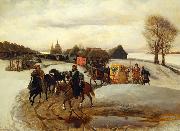
painted The Spring Pilgrimage of the Tsarina, under Tsar Aleksy Mihailovich in 1868
|
|
 |
VROOM, Hendrick Cornelisz.
|
|
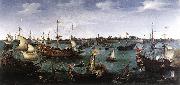
Dutch Baroque Era Painter, ca.1563-1640. He was one of the founders of Dutch marine painting. Painter and draughtsman. By his own account, he received his early training in Delft, home of his mother's family. Van Mander reports that Hendrick's stepfather, like his father a ceramic artist, forced him to work as a decorator of ceramic vessels, which caused the young artist to leave home and embark on extensive travels in Spain and Italy. After working for ecclesiastical patrons in Florence and Rome, he was employed for at least two years (c. 1585-7) by Cardinal Ferdinando de' Medici, who in October 1587 succeeded Francesco I as Grand Duke of Tuscany. Ferdinando's keen interest in ships and the navy seems to have been a determining factor in Vroom's choice of subject-matter. According to Lanzi, he was known in Rome as 'Lo Spagnolo' (since he had arrived there from Spain). Among his earliest works may be a group of marine paintings attributed to him (Rome, Villa Colonna). His friendship in Rome with Paul Bril, mentioned by van Mander, had no effect on Hendrick's painting style, but Bril's influence is discernible in a group of landscape drawings
|
|
|
|
 |
VOUET, Simon
|
|
French Baroque Era Painter, 1590-1649
French painter and draughtsman. Although at the time regarded as one of the leading French painters of the first half of the 17th century, he is now known more for his influence on French painting than for his actual oeuvre. He made his reputation in Italy, where he executed numerous portraits for aristocratic patrons and was commissioned for religious subjects. Although the early Italian works show the influence of Caravaggio, his work was subsequently modified by the Baroque style of such painters as Lanfranco and the influence of the Venetian use of light and colour. When he was summoned back to France by Louis XIII in 1627 he thus brought with him an Italian idiom hitherto unknown in France that revitalized French painting
|
|
 |
VOS, Paul de
|
|
Flemish Baroque Era Painter, ca.1591-1678
was a Flemish Baroque painter. De Vos was born in Hulst near Antwerp, now in the Dutch province of Zeeland. Like his older brother Cornelis and younger brother Jan, he studied under the little-known painter David Remeeus (1559?C1626). He specialized in monumental animal scenes, especially hunts for aristocratic patrons, that are heavily influenced by Frans Snyders (to whom his sister Margaretha was married). De Vos became a master and joined the guild of St. Luke in 1620. As was frequent amongst artists in Antwerp, De Vos frequently collaborated with other painters. He painted animals in hunting scenes and armor in mythologies by Peter Paul Rubens and his studio.
|
|
 |
VOS, Marten de
|
|
Flemish painter (b. 1532, Antwerpen, d. 1603, Antwerpen).
Flemish painter and draughtsman. Together with the brothers Ambrosius Francken I and Frans Francken I, he ranks among the most important painters of altarpieces in Antwerp during the 1590s. Due, in part, to the Counter-Reformation, there was a renewed demand for altarpieces to replace those lost during iconoclastic riots in 1566 or the reformist movement of 1581. De Vos produced works for, among others, the Old Crossbowmen, the Brabant Coiners, the Antonites, the wine merchants and the Guild of St Luke. The importance of these works would seem to suggest that, after the deaths of Pieter Bruegel I in 1569 and Frans Floris in 1570, de Vos was considered, with some justification, the most important figure painter in Antwerp before Rubens. He was also a prolific draughtsman, especially during the first half of the 1580s, when the Calvinists were in power in Antwerp. During this period he provided numerous designs for print publishers, such as Peeter Baltens, Frans van Beusecom, the widow of Hieronymus Cock, Adriaen Collaert, Phillip Galle, Willem van Haecht, Eduard van Hoeswinkel, Gerard de Jode, Hans van Luyck and Johannes Baptista Vrints. This increased activity is probably indicative of the economic recession and a dwindling market for paintings (especially of religious themes). A total of some 1600 prints were produced after designs by de Vos, an output three times that of Maarten van Heemskerck. De Vos's drawings have been praised (see Mielke) for their lively,
|
|
 |
VOS, Cornelis de
|
|
Flemish painter (b. 1584/85, Hulst, d. 1651, Antwerpen)
Flemish portrait and figure painter. He was a contemporary of Rubens, who sent many sitters to him. Although of the school of Rubens, Vos developed an individual style of portraiture in which cool grays predominate. His representations of children were particularly successful. An example of his many portraits is that of Abraham Grapheus (Antwerp). His brother, Paulus de Vos, c.1596 C1678, was an excellent painter of animals and hunting scenes. His paintings show the influence of his brother-in-law, Frans Snyders.
|
|
 |
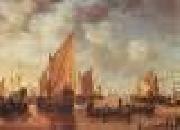
Volterrano
|
|
Italian Baroque Era Painter, 1611-ca.1690
|
|
 |
VLIEGER, Simon de
|
|
b. 1601, Rotterdam, d. 1653, Weesp..Dutch painter, draughtsman, etcher and stained-glass designer. He was one of the leading marine and landscape artists of the Dutch school and decisively influenced the direction of Dutch marine art during the 1630s and 1640s. His late works anticipated the shift from the monochrome or tonal phase of Dutch marine art to the more classical style of Jan van de Cappelle and Willem van de Velde the younger
|
|
|
|
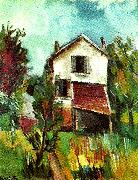 |
vlaminck
|
|
Maurice de Vlaminck (4 April 1876 ?C 11 October 1958) was a French painter. Along with Andre Derain and Henri Matisse he is considered one of the principal figures in the Fauve movement, a group of modern artists who from 1904 to 1908 were united in their use of intense color.
|
|
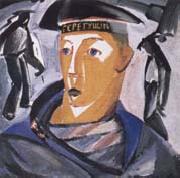 |
Vladimir Tatlin
|
|
1885-1953,Ukrainian sculptor and painter. After a visit to Paris (1914), he became the leader of a group of Moscow artists who sought to apply engineering techniques to sculpture construction, a movement that developed into Constructivism. He pioneered the use of iron, glass, wood, and wire in nonrepresentational constructions. His Monument to the Third International, commissioned by the Soviet government, was one of the first buildings conceived entirely in abstract terms and was intended to be, at more than 1,300 ft (400 m), the world's tallest structure. A model was exhibited at the 1920 Soviet Congress, but the government disapproved of nonfigurative art and it was never built. After 1933 Tatlin worked largely as a stage designer.
|
|
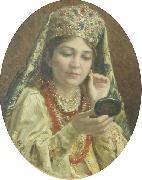 |
Vladimir Makovsky
|
|
(Russian: 26 January (greg.: 7 February) 1846, Moscow - 21 February 1920, Petrograd) was a Russian painter, art collector, and teacher.
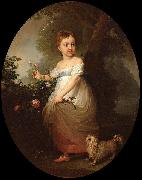
Portrait by Vladimir Makovsky of Empress Maria Fyodorovna. Gatchina Palace, 1885Makovsky was the son of collector, Yegor Ivanovich Makovsky, who was one of the founders of the Moscow Art School. Vladimir had two brothers, Nikolai Makovsky and Konstantin Makovsky, and one sister, Alexandra Makovsky, all of whom were famous painters. Vladimir studied at the Moscow School of Painting, Sculpture, and Architecture. He finished his studies in 1869 and the following year became one of the founding members of the Association of Travelling Art Exhibitions, where his many years of prolific work brought him to a leading position
Makovsky's work was defined by a perpetual humor as well as blatant irony and scorn. During the seventies his paintings dealt primarily with small-town folk. His pictures, "The Grape-juice Seller" (1879), "Fruit-Preserving" (1876) and "The Congratulator" (1878) depict various scenes where the mood is finely conceived and almost laughter-inducing. Other works of his, such as "The Benefactor" (1874) and "The Convict" (1878) are profoundly socially-conscious. In them, Makovsky either criticizes the false sympathy of the aristocracy towards the poor, or draws attention to the oppression and persecution by the tsarist gendarmerie. In 1878, he became an academician.
In the eighties, during the time of Russian "democratic" painting, Makovsky produced some of his most valued works. In 1882, he was made professor at the Moscow Art School after the death of Vasili Perov. Some of Makovsky's greatest works of this period include "In the Ante-room of the Court of Conciliation" (1880), "The Released Prisoner" (1882), and "The Collapse of the Bank" (1881). From the end of the 1880s, Makovsky began to produce more gloomy works. Quintessential works of this period include "You Shall Not Go" (1892), and "On the Boulevard" (1888).
In 1894, Makovsky became Rector of the Preparatory school of the Academy of Art. After the First Russian Revolution, he painted "January 9, 1905, on Vasilyev Island" in which he depicts the armed police firing at defenseless people. In another painting "The Sacrifices on the Khodyn Field" in which a thousand people lost their lives during the coronation ceremony in 1896 of Nicholas II, he again stood uncompromisingly on the side of the oppressed people. After the 1917 October Revolution, Makovsky helped carry over the realist traditions to the early stages of Socialist Realism.
|
|
 |
Vladimir Lukich Borovikovsky
|
|
(Russian: July 24 O.S. 1757 - April 6 O.S. 1825) was a Ukrainian-born painter who dominated Russian portraiture at the turn of the 19th century.
ladimir Borovikovsky was born dymyr Borovyk in Myrhorod (now Ukraine) on July 24, 1757. His father, Luka Borovyk was a Ukrainian Cossack and an amateur icon painter. According to the family tradition, all four of Borovyk's sons served in Myrhorod regiment, but Volodymyr retired early at the rank of poruchik and devoted his life to art mostly icon painting for local churches.
Borovikovsky may have lived the remainder his life as an amateur painter in a provincial town if not for an unexpected event. His friend Vasyl Kapnist was preparing an accommodation for Empress Catherine II in Kremenchuk during her travel to newly conquered Crimea. Kapnist asked Borovikovsky to paint two allegoric paintings (Peter I of Russia and Catherine II as peasants sowing seeds and Catherine II as a Minerva) for her rooms. The paintings so pleased the Empress that she requested that the painter move to Saint Petersburg.
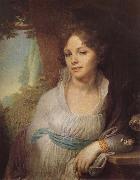
Portrait of Maria Lopukhina, 1797After September 1788 Borovikovsky lived in Saint Petersburg where he changed his surname from the Cossack "Borovyk" to the more aristocratic-sounding "Borovikovsky". For his first ten years in Saint Petersburg, he lived in the house of the poet, architect, musician and art theorist, Prince Nikolay Lvov, whose ideas strongly influenced Borovikovsky's art. At 30-years-old, he was too old to attend Imperial Academy of Arts, so he took private lessons from Dmitry Levitzky and later from Austrian painter Johann Baptist Lampi.
|
|
 |
Vladimir Borovikovsky
|
|
1757-1825,Russian painter of Ukrainian birth. Along with Fyodor Rokotov and Dmitry Levitsky, Borovikovsky is one of the three great Russian portrait painters of the second half of the 18th century. He was trained by his father and brothers, who were icon painters. His early works were also icons, such as the Mother of God (1784; Kiev, Mus. Ukrain. A.) and King David (1785; St Petersburg, Rus. Mus.); they are archaic in style and resemble portraits produced by Ukrainian folk artists. At the end of the 1780s Borovikovsky moved to St Petersburg and took up portrait painting. He was aided by advice from Levitsky and took lessons from Johann Baptist Lampi (i). He soon became established, gaining a reputation as a brilliant colourist, and he received many commissions. Throughout his career, however, he continued to paint icons from time to time. In 1795 he became a member of the St Petersburg Academy of Arts; he was also closely connected with many of the chief exponents of Russian culture in the city. The number of his surviving works is large (at least 400 portraits). He had his own workshop, and he would often rely on assistants to paint the less important parts of a portrait. His sitters included members of the imperial family, courtiers, generals, many aristocrats and figures from the Russian artistic and literary worlds. Most of his portraits are intimate in style. A particularly touching example is the portrait of Ol ga Filippova, the wife of a close friend (c. 1790; St Petersburg, Rus. Mus.), who is seen in a white peignoir with a park in the background. The portrait is painted in a flowing style; the combination of light, subdued tones, typical of Borovikovsky, gives an impression of tender femininity and quiet contemplation.
|
|
 |
Vladimir Baranov-Rossine
|
|
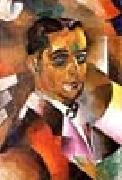
(1888?C1944) was a Russian-Ukrainian painter, avant-garde artist (Cubo-Futurist), and inventor of Jewish ethnicity
Vladimir Baranov-Rossine was born in Kherson, Ukraine, to parents of Jewish ethnicity.
In 1902 he studied at the School of the Society for the Furthering of the Arts in St. Petersburg. From 1903 to 1907 he attended the Imperial Academy of Arts in St. Petersburg.
In 1908 he exhibited with the group Zveno ("The Link") in Kiev organized by the artist David Burliuk and his brother Wladimir Burliuk.
In 1910 he moved to Paris, wher until 1914 he was a resident in the artist's colony La Ruche together with Alexander Archipenko, Sonia Delaunay-Terk, Nathan Altman and others. He exhibited regularly in Paris after 1911.
He returned to Russia in 1914. In 1916 he had a solo exhibition in Oslo. In 1918 he had exhibits with the union of artists Mir Iskusstva ("World of Art") in Petrograd (St.Petersburg). In the same year he had an exhibition with the group Jewish Society for the Furthering of the Arts in Moscow, together with Nathan Altman, El Lissitzky and David Shterenberg. He participated at the First State Free Art Exhibition in Petrograd in 1919.
In 1922 Baranov-Rossine was the teacher at the Higher Artistic-Technical Workshops (VKhUTEMAS) in Moscow.
In 1924 he had the first presentation of his optophonic piano during a performance at the Bolshoi Theatre in Moscow - a synaesthetic instrument that was capable of creating sounds and coloured lights, patterns and textures simultaneously.
|
|
 |
VIVIEN, Joseph
|
|
French painter (b. 1657, Lyon, d. 1734, Bonn)
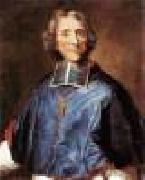
French painter and pastellist, active in Germany. He trained in Paris in 1672 with the painter Fran?ois Bonnemers (1638-89), also attending the Acad?mie Royale, where his oil painting the Punishment of Adam and Eve (untraced) won a second prize in 1678. Only in 1698 was he received (re?u) at the Acad?mie, as a pastellist, on presentation of portraits of the sculptor Fran?ois Girardon and of the architect Robert de Cotte (both Paris, Louvre; see PASTEL, fig. 1). Having been commissioned to execute a pastel Self-portrait (Florence, Uffizi) by Maximilian II Emanuel, Elector of Bavaria, in 1699, the following year he was appointed the Elector's principal court painter (see WITTELSBACH). He henceforth divided his time between Paris, the Elector's courts at Brussels and Munich,
|
|
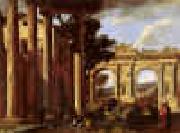 |
Viviano Codazzi
|
|
1604-1670
Italian
Viviano Codazzi Location
1670). Italian painter. He arrived in Naples about 1634, having almost certainly trained in Rome. He was a specialist in the realistic architectural VEDUTA, and his interest in this theme may have been stimulated in Rome by the quadratura frescoes of Agostino Tassi and by the urban views of Claude Lorrain and Herman van Swan.
|
|
|
|
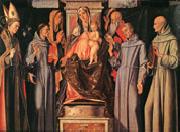 |
VIVARINI, Alvise
|
|
Italian Early Renaissance Painter ,
b. 1445/46, Venezia, d. 1503/5, Venezia
|
|
|
|
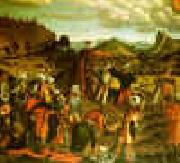 |
Vittore Carpaccio
|
|
Italian
1455-1526
Vittore Carpaccio Locations
His name is associated with the cycles of lively and festive narrative paintings that he executed for several of the Venetian scuole, or devotional confraternities. He also seems to have enjoyed a considerable reputation as a portrait painter. While evidently owing much in both these fields to his older contemporaries, Gentile and Giovanni Bellini, Carpaccio quickly evolved a readily recognizable style of his own which is marked by a taste for decorative splendour and picturesque anecdote. His altarpieces and smaller devotional works are generally less successful, particularly after about 1510, when he seems to have suffered a crisis of confidence in the face of the radical innovations of younger artists such as Giorgione and Titian.
|
|
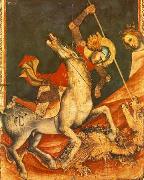 |
VITALE DA BOLOGNA
|
|
Italian Gothic Era Painter ,
b. 1289/1309, Bologna, d. 1359/69, Bologna
|
|
|
|
|
|
 |
VINCKBOONS, David
|
|
Flemish Baroque Era Painter, 1576-ca.1632
was a Dutch painter of Flemish origin. Vinckboons was one of the most prolific and popular painters and print designers in the Netherlands. Himself influenced by Pieter Bruegel the Elder, he was instrumental ?? together with Hans Bol and Roelant Savery ?? in the development of genre painting in the northern Netherlands. The family moved to Antwerp around 1580, and then to Middelburg after the Spanish occupation of Antwerp in 1585. It is not likely they moved for religious reasons to Amsterdam. His father became a citizen in 1591, but none of his grandchildren were baptized in a Calvinist church. In 1602 David married in Leeuwarden to Agneta van Loon, the daughter of a notary. Then he lived in Sint Antoniesbreestraat like many other artists and painters. According to Karel van Mander he did not have any teacher other than his father Phillipe, a painter on canvas with watercolors, an art form practised mainly in his birthplace of Mechelen. David specialized in elegant figures in park-like landscapes (Outdoor Merry Company, 1610; Vienna, Akademie der Bildenden K??nste) as well as Kermis and other village festivals. His landscapes reflect his contact with Gillis van Coninxloo. Vinckboons attracted a number of students; among them were Gillis d'Hondecoeter, Claes Janszoon Visscher and probably Esaias van de Velde. Vingboons, as his name is often spelled,
|
|
|
|
|
|
|
|
|
| Wholesale China Oil Painting Wholesale Oil Painting China Xiamen Portrait Reproduction on canvas Chinese Oil Painting Wholesale USA Oil Painting |
|
|
|
|
|