| |
|
Xiamen Oil Paintings, Wholesale Direct!
|
|
100% hand painted, 100% cotton canvas, 100% money back if not satisfaction. |
|
|
|
|
ART WORKS INDEX
A
B
C
D
E
F
G
H
I
J
K
L
M
N
O
P
Q
R
S
T
U
V
W
X
Y
Z
|
|
ARTISTS INDEX
A
B
C
D
E
F
G
H
I
J
K
L
M
N
O
P
Q
R
S
T
U
V
W
X
Y
Z
|
|
|
|
 |
ZURBARAN Francisco de
|
|
Spanish Baroque Era Painter, 1598-1664
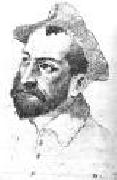
Spanish painter. He was apprenticed in 1614 to a painter in Sevilla (Seville), where he lived until 1658 when he moved to Madrid. He had a few royal commissions but remained throughout his life a provincial painter of religious pictures. His apostles, saints, and monks are painted with almost sculptural modeling, and his emphasis on the minutiae of their dress lends verisimilitude to their miracles, visions, and ecstasies. This distinctive combination of naturalism with religious sensibility conforms to the guidelines for Counter-Reformation artists outlined by the Council of Trent. He had numerous commissions from monasteries and churches throughout southern Spain, and many of his works were sent to Lima, Peru.
|
|
 |
ZUCCARO Federico
|
|
Italian Mannerist Painter, ca.1542-1609
..Painter, draughtsman and writer, brother of (1) Taddeo Zuccaro. Having been invited to Rome by his brother, between 1555 and 1563 he worked with Taddeo on various projects including the Villa Farnese at Caprarola and the Pucci Chapel in Trinit? dei Monti, Rome. Many of Federico's drawings for both commissions show Taddeo's influence. According to Vasari, Taddeo supervised his brother's early work, which created friction between them. In 1558, for example, when they collaborated on painting the fa?ade of the house of Tizio da Spoleto with scenes from the Life of St Eustace, Taddeo retouched some of his brother's paintings, so offending Federico. Already at 18 Federico was commissioned to paint many works at the Vatican: the Transfiguration, the Marriage at Cana and other scenes from the Life of Christ for the decorations (part destr.) of the Casino of Pius IV;
|
|
 |
ZUCCARELLI Francesco
|
|
Italian painter, Venetian school (b. Pitigliano, 1702, d. 1788, Firenze)
Florentine landscape painter and decorator. He twice visited London, where he decorated the Opera House and was well known through popular engravings of his scenes on the Thames. He was a charter member of the Royal Academy. His facile paintings of landscapes with ruins and small figures are best seen in Windsor Castle and in the Academy, Venice.
|
|
|
|
 |
William Powell Frith
|
|
English Painter, 1819-1909
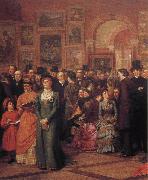
His parents were in domestic employment before taking a hotel in Harrogate in 1826. They encouraged him to become an artist, despite his own desire to be an auctioneer. While at school in Dover, Frith sketched caricatures and copies of Dutch genre scenes (Dover Mus.) that betray his disposition to narratives. His taste did not accord with the academic training he received at Henry Sass's Academy in London (1835-7) and at the Royal Academy Schools (1837). Frith began his career as a portrait painter, using members of his family as models. He first exhibited at the British Institution in 1838, and during the 1840s he established himself with his entertaining historical and literary subjects in the popular tradition of C. R. Leslie, William Mulready and Sir David Wilkie. He was a member of THE CLIQUE, which included Richard Dadd, Augustus Egg, Henry O'Neil and John Phillip.
|
|
 |
William Powell Frith
|
|
1819-1909 English painter. His parents were in domestic employment before taking a hotel in Harrogate in 1826. They encouraged him to become an artist, despite his own desire to be an auctioneer. While at school in Dover, Frith sketched caricatures and copies of Dutch genre scenes (Dover Mus.) that betray his disposition to narratives. His taste did not accord with the academic training he received at Henry Sass Academy in London (1835-7) and at the Royal Academy Schools (1837). Frith began his career as a portrait painter, using members of his family as models. He first exhibited at the British Institution in 1838, and during the 1840s he established himself with his entertaining historical and literary subjects in the popular tradition of C. R. Leslie, William Mulready and Sir David Wilkie. He was a member of THE CLIQUE, which included Richard Dadd, Augustus Egg, Henry O Neil and John Phillip. His friendship with Charles Dickens began with commissions for paintings of Dolly Varden (London, V&A) and Kate Nickleby (untraced) in 1842.
|
|
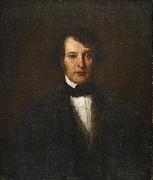 |
William Henry Furness
|
|
(1802-1896) was an American clergyman, theologian, reformer and abolitionist. Following the American Civil War, he raised funds for Black schools in the South, including Morehouse College.
A graduate of the Theological Department of Harvard University, Furness became the Minister of the First Unitarian Church of Philadelphia at the age of 22. A close friend of Ralph Waldo Emerson, Furness presided over a period marked by the growth and increasing prosperity for First Church. A fiery abolitionist, Furness was a supporter of the rights of all segments of society, including African-Americans and Jews. He also lived to see the construction of the current church building in 1885 in the role of Minister Emeritus.
Rev. Furness was the father of painter William Furness, Shakespearean scholar Horace Howard Furness, architect Frank Furness, and author and translator Annis Furness Lee.
|
|
 |
William Frederick Yeames,RA
|
|
1835-1918
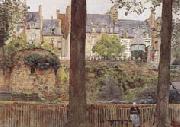
English painter. The son of a British consul in Russia, Yeames was sent to school in Dresden after the death of his father in 1842. He also studied painting there. The collapse of the Yeames family fortune resulted in a move to London in 1848, where Yeames learnt anatomy and composition from George Scharf (1788-1860). He later took lessons from F. A. Westmacott. In 1852 he continued his artistic education in Florence under Enrico Pollastrini and Raphael Buonajuto, from whom he learnt the methods of the Old Masters. He drew from frescoes by Ghirlandaio, Gozzoli and Andrea del Sarto and painted in the Life School at the Grand Ducal Academy. He then went to Rome and made landscape studies and copied Old Masters, including Raphael's frescoes in the Vatican. His extensive study of Italian art gave him a precision and facility that assisted his artistic success upon his return to London in 1859. There he set up a studio in Park Place and became involved with the ST JOHN'S WOOD CLIQUE. He exhibited at the Royal Academy and the British Institution from 1859 and became an ARA in 1866.
|
|
 |
William Frederick Wells
|
|
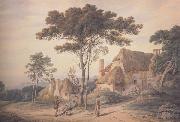
A landscape painter in watercolor, Wells was the true founder of the Society of Painters in Watercolors in 1804 and its president in 1806-07. He studied under J. J. Barralet and exhibited at the Royal Academy from 1795 to 1804 and at the Watercolor Society to 1813, when he resigned.
|
|
|
|
|
|
|
|
|
|
 |
William Edward frost R.A.
|
|
1810-1877
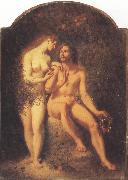
was an English painter of the Victorian era. Virtually alone among English artists in the middle Victorian period, he devoted his practice to the portrayal of the female nude. Frost was educated in the schools of the Royal Academy, beginning in 1829; he established a reputation as a portrait painter before branching into historical and mythological subjects, including the sub-genre of fairy painting that was characteristic of Victorian art. In 1839 he won the Royal Academy's gold medal for his "Prometheus Bound," and in 1843 he won a prize in the Westminster Hall competition for his "Una Alarmed by Fauns" (a subject from Spenser's The Faerie Queen). He was elected an associate member of the Royal Academy in 1846, and a full member in 1870. Frost is widely recognized as a follower of William Etty, who preceded him as the primary British painter of nudes in the second quarter of the nineteenth century.
|
|
|
|
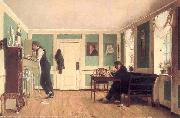 |
Wilhelm Ferdinand Bendz
|
|
(March 20, 1804 - November 14, 1832), Danish genre and portrait painter, is one of the main personages associated with the Golden Age of Danish Painting. He was educated at the Royal Danish Academy of Art (Det Kongelige Danske Kunstakademi) in Copenhagen from 1820 to 1825, winning both silver medals but never the gold prize. He studied under professor Christoffer Wilhelm Eckersberg, but may at the same time have acquired some knowledge of contemporary German painting.
Today he is mainly remembered for his many technically accomplished portraits, though his ambition most of all ran towards a refined fusion of portrait, genre scene and allegorical history painting. His technical virtuosity is particularly visible in his depictions of the play of light cast from an obscured source and the resulting shadows. During his travel to Italy - which also brought him a one-year stay in Munich - he caught a sickness to the lungs and died at the age of 28 in 1832.
|
|
|
|
|
|
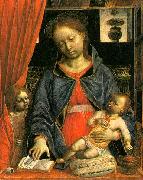 |
Vincenzo Foppa
|
|
1427-1516
Italian
Vincenzo Foppa Locations
Italian painter. Giving new life to the art of the Lombard school, he exercised a great influence upon northern Italian art until the advent of Leonardo da Vinci. He settled (c.1456) in Pavia. There and in Milan he executed many important frescoes, most of which have been destroyed. He painted religious subjects exclusively, ranging from powerful renditions of the Crucifixion (Bergamo) to poignant depictions of the Madonna (Milan; Johnson Coll., Philadelphia; Davis Coll., Newport, R.I.; National Gall. of Art, Washington, D.C.). His large altarpiece of the Madonna and Child with Saints (Brera, Milan) is a notable example of his technical skill and variety of characterization.
|
|
|
|
|
|
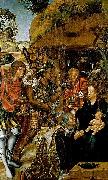 |
Vasco Fernandes
|
|
Vasco Fernandes (c.1475-c.1542), better known as Grão Vasco, was one of the main Portuguese Renaissance painters.
Vasco Fernandes was probably born in Viseu, in Northern Portugal, where he began his career in the team of painters executing the main altarpiece of Viseu Cathedral (1501-1506). Between 1506 and 1511 he painted the main altarpiece of Lamego Cathedral. After working in the Santa Cruz Monastery of Coimbra, Vasco Fernandes returned to Viseu and executed a series of altarpieces for Viseu Cathedral, considered his main works.
Most of his paintings hang nowadays in the Grão Vasco Museum, in Viseu.
|
|
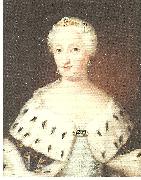 |
ulrica fredrica pasch
|
|
Ulrika Fredrika Pasch, född 10 juli 1735 i Stockholm, död 2 april 1796, var en svensk konstnär. Hon var dotter till konstnären Lorens Pasch d.ä. och Anna Helena Beckamn, syster till konstnären Lorens Pasch d.y. och brorsdotter till konstnären Johan Pasch.
Ulrika Pasch började måla 1756 men hade tidigt tillsammans med sin bror fått undervisning av fadern. Hon blev hushållerska åt en släkting, men målade på fritiden. Under en tioårsperiod försörjde hon sin pappa och syster som professionell porträttmålare i Stockholm innan hennes bror återvände från sina studier utomlands 1766, då de började arbeta tillsammans. Deras samarbete beskrivs som harmoniskt och de valdes båda in i konstakademien 1773. Hon var inte den första kvinnan som valdes in i akademin, men hon var den första kvinnliga yrkeskonstnären som blev vald. Hon ska ha målat detaljerna på broderns tavlor, som klädesdetaljer och liknande. Ulrika hade en framgångsrik karriär och målade ofta porträtt av kungafamiljen och hovet. Hon ansökte dock upprepade gånger förgäves för en pension. Systern Helena Lovisa (1744-96) hushållade åt sina syskon.
Trots att det sägs att hon själv var en ödmjuk person som aldrig framhävde sitt arbete, så är hon en av få kända självförsörjande kvinnliga yrkeskonstnärer i Skandinavien före artonhundratalet.
|
|
|
|
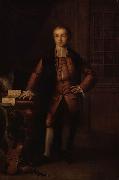 |
Thomas Frye
|
|
The Anglo-Irish painter Thomas Frye (c. 1710 - 3 April 1762 best known for his portraits in oil and pastel, including some miniatures and his early mezzotint engravings, was also the patentee of the Bow porcelain factory, London, and claimed in his epitaph to be "the inventor and first manufacturer of porcelain in England," though his rivals at the Chelsea porcelain factory seem to have preceded him in bringing wares to market. The Bow porcelain works did not long survive Frye's death; their final auctions took place in May 1764.
Thomas Frye was born at Edenderry, County Offaly, Ireland, in 1710; in his youth he went to London to practice as an artist. His earliest work are a pair of pastel portraits of boys, one dated 1734 (Earl of Iveagh). For the Worshipful Company of Saddlers he painted a full-length portrait of Frederick, Prince of Wales (1736, destroyed 1940), which he engraved in mezzotint and published in 1741. With his silent partner, a London merchant Edward Heylyn, he took out a patent on kaolin to be imported from the English colony of Virginia in November 1745, and became manager of the Bow factory from its obscure beginnings in the 1740s. He retired to Wales in 1759 for the sake of his lungs, but soon returned to London and resumed his occupation as an engraver, publishing the series of life-size fancy portraits in mezzotint, by which he is most remembered. He died of consumption on 2 April 1762.
Frye had five children; his two daughters assisted him in painting porcelain at Bow until their marriages. One of them, who married a Mr. Willcox, was employed by Josiah Wedgwood at the Wedgwood Etruria works in painting figure-subjects from 1759 to 1776, the year of her death.
|
|
|
|
|
|
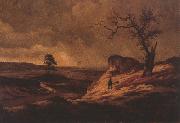 |
Thomas Fearnley
|
|
Norwegian Painter, 1802-1842
Norwegian painter. He was descended from a Yorkshire merchant who had settled in Norway in 1753. In 1819 he went into business but at the same time entered the Kongelige Tegneskole in Christiania (now Oslo) and received further training at the art colleges in Copenhagen (1821-3) and Stockholm (1823-7), where Karl XIV commissioned work from him. Fearnley spent much of his life travelling. In Norway in the summer of 1826 he met J. C. Dahl, with whom he later studied in Dresden (1829-30), learning especially to observe nature. After two years in Munich (1830-32),
|
|
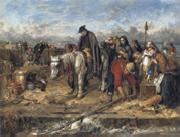 |
Thomas Faed
|
|
Scottish Painter,
1826-1900
was a Scottish painter born in Gatehouse of Fleet, Kirkcudbrightshire, and was the brother of John Faed. He received his art education in the school of design, Edinburgh and was elected an associate of the Royal Scottish Academy in 1849. He came to London three years later, was elected an associate of the Royal Academy in 1861, and academician in 1864, and retired in 1893. He had much success as a painter of domestic genre, and had considerable executive capacity. Three of his pictures, The Silken Gown, Faults on Both Sides, and The Highland Mother are in the Tate Gallery and a further two, Highland Mary and The Reaper hang in the Aberdeen Art Gallery. The Last of the Clan, completed in 1865.
|
|
|
|
|
|
|
|
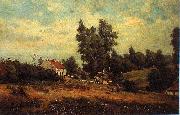 |
Theodore Fourmois
|
|
(14 October 1814 in Presles - October 1871 in Ixelles) was a Belgian landscape painter and printmaker.
Theodore Fourmois learned drawing in the lithographic's workshop of Antoine Dewasme-Pletinckx in Brussels. He first exposed his works in this city in 1836. He began painting landscapes of Ardennes and Campine, several studies and panoramic views while traveling in Dauphine and Switzerland.
|
|
|
|
|
|
 |
Tait Arthur Fitzwilliam
|
|
English-born American Painter, 1819-1905
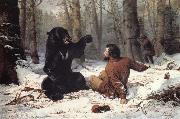
American painter and lithographer of English birth. He spent the first three decades of his life in England and arrived in New York in 1850. Steeped in admiration for the subjects of Edwin Landseer and the style of the Pre-Raphaelites, he established himself as a realistic painter of animals and sporting scenes. For his images of Western hunters and trappers, he used as sources the works of George Catlin and William Ranney, artists who, unlike himself, had travelled extensively. He established a summer studio at a camp in the Adirondack Mountains, where he painted sporting scenes. These wilderness scenes, often composed around an anecdote, appealed to a wide popular audience, and from 1852 Currier & Ives as well as Louis Prang published a number of lithographs and chromolithographs of his work. Tait also composed still-lifes of game birds and, in his later career, barnyard scenes of sheep and chickens. His painting A Tight Fix: Bear Hunting in Early Winter
|
|
|
|
 |
Stettheimer Florine
|
|
American Painter, 1871-1944
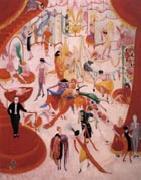
was an American artist. She has been described as "a Deco-influenced early Modernist who??s never really gotten her due". Stettheimer was born in Rochester, New York to a wealthy family. She spent much of her early life traveling, studying art in Italy, Spain, France, Germany, and Switzerland. She studied for three years in the mid-1890s at the Art Students League in New York, but came into her own artistically upon her permanent return to New York after the start of World War I. In October 1916, the only one-person exhibition of her work during her lifetime took place at New York's Knoedler & Company. She exhibited 12 "high-keyed, decorative paintings", none of which were sold. Cushioned by family resources, Stettheimer refrained from self-promotion and considered her painting "an entirely private pursuit". She intended to have her works destroyed after her death, a wish defied by her sister Henrietta, her executor. Stettheimer's privileged position pervades her work. As one critic has written, "money she regarded as a birthright, decidedly not something to be flaunted in the shape of a dozen yachts, but rather to be used as a palliative against the more unpleasant aspects of the world outside
|
|
 |
Stanislav Feikl
|
|
(November 12, 1883-January 7, 1933) was a Czech painter.
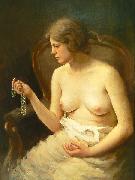
He studied at the School of Applied Arts and at the Prague Academy of Fine Arts. For inspiration, he toured Russia, Turkey, Dalmatia and northern Italy. He is known for his pictures of old Prague, rural areas and portraits of women, including naked. He painted impressionist paintings.
|
|
|
|
|
|
 |
SNYDERS, Frans
|
|
Flemish Baroque Era Painter, 1579-1657
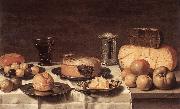
Flemish painter and draughtsman, active also in Italy. He was the progenitor of Flemish Baroque still-life and animal painting. He worked intensively for about 50 years, producing an enormous body of works, of which more than 300 paintings survive , along with some oil sketches and about 100 drawings.
|
|
|
|
 |
Sir Frank Dicksee
|
|
1853-1928
English
Sir Frank Dicksee Location
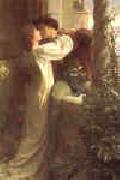
English painter and illustrator. He studied in the studio of his father, Thomas Francis Dicksee (1819-95), who painted portraits and historical genre scenes; he then entered the Royal Academy Schools, London, where he was granted a studentship in 1871. He won a silver medal for drawing from the Antique in 1872 and a gold medal in 1875 for his painting Elijah confronting Ahab and Jezebel in Naboth Vineyard (untraced), with which he made his debut at the Royal Academy in 1876. He also began to work as an illustrator during the 1870s, contributing to Cassell Magazine, Cornhill Magazine, The Graphic and other periodicals. During the 1880s he was commissioned by Cassell & Co. to illustrate their editions of Longfellow Evangeline (1882), Shakespeare Othello (1890) and Romeo and Juliet (1884).
|
|
 |
Sir Francis Drake
|
|
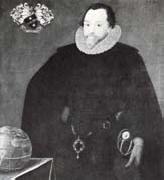
1540-1596,English admiral, the most renowned seaman of the Elizabethan Age. Brought up by his wealthy Hawkins relatives (see John Hawkins) in Plymouth, Drake went to sea at about age 18. He gained a reputation as an outstanding navigator and became wealthy by raiding and plundering Spanish colonies. In 1577 he set sail with five ships, but ultimately only his flagship, the Golden Hind, made its way through the Strait of Magellan into the Pacific and up the coast of South and North America. He sailed at least as far north as what is now San Francisco, claiming the area for Elizabeth, and continued westward to the Philippines and around the Cape of Good Hope. Having circumnavigated the globe, he returned to Plymouth, Eng., in 1580 laden with treasure, the first captain ever to sail his own ship around the world. In 1581 he was knighted. Appointed vice admiral (1588), he destroyed ships and supplies destined for the Spanish Armada and delayed the Spanish attack for a year. But he is not known to have played any part in the battle that eventually occurred. In his lifetime, his reputation at home was equivocal, yet his legend grew. On his last voyage he succumbed to fever and was buried at sea.
|
|
 |
Sigmund Freudenberger
|
|
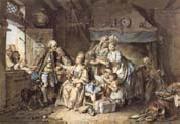
Swiss, 1745-1801,Swiss painter, draughtsman and engraver. In 1761 he went to work for the portrait painter Emanuel Handmann in Basle, where he stayed for three years. In 1765, with Adrian Zingg (1734-86), he left for Paris, where he trained with Jakob Schmutzer (1733-1811) and frequented the studio of Jean Georges Wille, the celebrated engraver. He worked as a book illustrator during this period. The work of Boucher, whom he met, and of Greuze and Fragonard had a significant influence on his artistic development. Freudenberger returned in 1773 to Berne, where he undertook several portraits. He became friendly with Johann Ludwig Aberli, with whom he travelled the countryside, which he recorded in numerous drawings, watercolours and engravings. He specialized in genre scenes, rustic still-lifes and portrayals of Bernese peasant life, which became very popular. In some works, such as a red chalk drawing of A Woman Playing the Harp (1778; Zurich, Schweizer. Landesmus.), he continued the gallant style he had learnt from Boucher. His watercolours were frequently engraved, either individually or in series, and hand-coloured. His style is characterized by detailed and careful execution and by an intimate, narrative approach, although he tended to idealize his rustic subject-matter. His work was significant in introducing genre subjects in Switzerland, where artists had tended to concentrate on pure landscape. He ran a large studio where Daniel Lafond (1763-1831), Niklaus Kenig and Georg Mind (1768-1814) were pupils. The French Revolution was disastrous for his art and his business and clouded the last years of his life.
|
|
 |
Semyon Fyodorovich Shchedrin
|
|
(1745-1804) was a Russian landscape painter, the uncle and mentor of Sylvester Shchedrin.
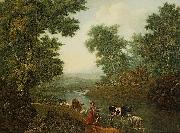
He was born in St. Petersburg into the family of a life guard. In 1759, he entered the Academy of Arts in St. Petersburg, and in 1765 graduated with a gold medal and grants to study abroad. Shchedrin ventured to Paris, then to Rome. In Paris he studied the works of old and contemporary painters. Under the influence of Rousseau's idea that beauty exists not only in classic patterns of arts but also in everyday life and nature, Shchedrin worked much en plein-air, otherwise known as painting in outdoor environments. In Rome, however, he fell under the influence of classicism, the idea that art should reflect the works of antiquity and thus prolong their successes.
Shchedrin returned to St. Petersburg in 1776 and became a professor of landscape painting in the Academy of Arts. He was assigned to draw views of the palaces and parks of Catherine the Great, which brought into existence such works as View of the Large Pond Island in the Tsarskoselsky Gardens (1777), View of the Large Pond in the Tsarskoselsky Gardens (1777), View of the Farmyard in the Tsarskoye Selo (1777). After 1780, Shchedrin also participated in the restoration of pictures in the Hermitage, and in 1799 he headed a new class of landscape graphics.
The pinnacle of his art career came in the 1790s. The most famous of his works of the period are views of parks and palaces in Pavlovsk, Gatchina, and Petergof: The Mill and the Peel Tower at Pavlovsk (1792), View of the Gatchina Palace from the Silver Lake (1798), View of the Gatchina Palace from Long Island (1798), The Stone Bridge at Gatchina (1799-1801), View of the Kamennoostrovsky Palace through Bolshaya Nevka from the Stroganov Seashore (1803).
|
|
|
|
|
|
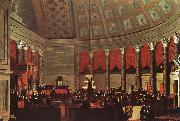 |
Samuel Finley Breese Morse
|
|
1791-1872
Samuel F.B. Morse was born on April 27, 1791 in Charlestown, Massachusetts, the first child of geographer and Pastor Jedidiah Morse (1761-1826) and Elizabeth Ann Breese (1766-1828). Jedidiah was a great preacher of the Calvinist faith and supporter of the American Federalist party. He not only saw it as a great preserver of Puritan traditions (strict observance of the Sabbath), but believed in its idea of an alliance with English in regards to a strong central government. Jedidiah strongly believed in education within a Federalist framework alongside the instillation of Calvinist virtues, morals and prayers for his son. After attending Phillips Academy in Andover, Massachusetts, Samuel Morse went on to Yale College to receive instruction in the subjects of religious philosophy, mathematics and science of horses. While at Yale, he attended lectures on electricity from Benjamin Silliman and Jeremiah Day. He earned money by painting. In 1810, he graduated from Yale.
Morse's Calvinist beliefs are evident in his painting the Landing of the Pilgrims, through the depiction of simplistic clothing as well as the austere facial features. This image captured the psychology of the Federalists; Calvinists from England brought to the United States ideas of religion and government thus forever linking the two countries. More importantly, this particular work attracted the attention of the famous artist, Washington Allston. Allston wanted Morse to accompany him to England to meet the artist Benjamin West. An agreement for a three- year stay was made with Jedidah, and young Morse set sail with Allston aboard the Lydia on July 15, 1811 (1).
Upon his arrival in England, Morse diligently worked at perfecting painting techniques under the watchful eye of Allston; by the end of 1811, he gained admittance to the Royal Academy. At the Academy, he fell in love with the Neo-classical art of the Renaissance and paid close attention to Michelangelo and Raphael. After observing and practicing life drawing and absorbing its anatomical demands, the young artist successfully produced his masterpiece, the Dying Hercules.
To some, the Dying Hercules seemed to represent a political statement against the British and also the American Federalists. The muscles apparently symbolized the strength of the young and vibrant United States versus the British and British-American supporters. During Morse??s time in Britain the Americans and English were engaged in the War of 1812 and division existed within United States society over loyalties. Anti-Federalists Americans aligned themselves with the French, abhorred the British, and believed a strong central government to be inherently dangerous to democracy.(3) As the war raged on, his letters to his parents became more anti-Federalist in their tones. In one such letter Morse said, "I assert that the Federalists in the Northern States have done more injury to their country by their violent opposition measures than a French alliance could. Their proceedings are copied into the English papers, read before Parliament, and circulated through their country, and what do they say of them... they call them (Federalists) cowards, a base set, say they are traitors to their country and ought to be hanged like traitors."
|
|
|
|
|
|
|
|
|
| Wholesale China Oil Painting Wholesale Oil Painting China Xiamen Portrait Reproduction on canvas Chinese Oil Painting Wholesale USA Oil Painting |
|
|
|
|
|