| |
|
Xiamen Oil Paintings, Wholesale Direct!
|
|
100% hand painted, 100% cotton canvas, 100% money back if not satisfaction. |
|
|
|
|
ART WORKS INDEX
A
B
C
D
E
F
G
H
I
J
K
L
M
N
O
P
Q
R
S
T
U
V
W
X
Y
Z
|
|
ARTISTS INDEX
A
B
C
D
E
F
G
H
I
J
K
L
M
N
O
P
Q
R
S
T
U
V
W
X
Y
Z
|
|
|
|
|
|
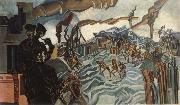 |
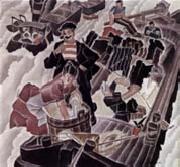
wyndham lewis
|
|
British painter and writer. He attended Rugby School and then studied painting at the Slade School of Art, London (1898-1901), where he earned a reputation both as a draughtsman and as a poet. His early artistic and intellectual mentors were Augustus John and Thomas Sturge Moore. From 1902 to 1908 Lewis travelled widely in Europe and studied in many of the major museums. He was one of the first British artists to be aware of, and interested in, Cubism and Expressionism, though little of his work before 1909 survives as evidence of his early development. In late 1908 Lewis settled in London and as well as painting began to publish satirical short stories that take a mechanistic view of human social behaviour, evident in the deliberately clumsy and grotesque figures in his art of the period 1909 to 1912. By 1910 he was including Cubist elements in his watercolour drawings (his preferred medium), and by 1912 he had developed his own linear vocabulary of forms, indebted to Cubist, Futurist and Expressionist forms, which gives an often ironic visual dimension to the themes of his fiction. Another important influence on his art was that of Japanese woodblock prints, as seen in the watercolour drawing later called The Vorticist (1912; Southampton, C.A.G.). By 1913 he was popularly seen as the leading British avant-garde artist.
|
|
|
|
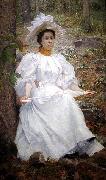 |
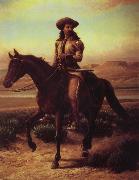
William Robinson Leigh
|
|
(September 23, 1866 - March 11, 1955) is a noted American artist, who specialized in Western scenes.
He was born at Maidstone Manor Farm, Berkeley County, West Virginia. He entered the Maryland Institute at age 14, then attended the Royal Academy in Munich. He returned to the United States and worked painting cycloramas and as a magazine illustrator. He married and fathered William Colston Leigh, Sr. (1901-1992).
In 1906, Leigh traveled to the American West and maintained a studio in New York City. In 1933, he wrote and illustrated The Western Pony. He also traveled to Africa and published a book Frontiers of Enchantment (1938). Hs adventures were chronicled in a number of popular magazines including Life, the Saturday Evening Post, and Colliers.He is known for painting the Grand Canyon and Yellowstone National Forest, but his primary interest were the Hopi and Navajo Indians
|
|
|
|
|
|
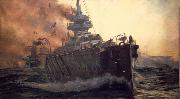 |
William Lionel Wyllie
|
|
(often simply W L Wyllie) (5 July 1851 - 6 April 1931) was a prolific English painter of maritime themes in both oils and watercolours.
Wyllie was born on 5 July 1851 at 67 Albany Street, Camden, London, the elder son of William Morison Wyllie (d. 1895), a prosperous minor-genre painter living in London and Wimereux, France. His mother was a singer, Katherine Smythe Wyllie (d. 1872).
Most of his early summers were spent in France with his parents. He began to draw from an early age, and his natural talent was encouraged by his father and by Lionel Smythe, his step brother. He was given a thorough artistic education; first at the Heatherley School of Fine Art, and then in 1866, aged 15, at the Royal Academy Schools. At the Royal Academy he studied under Edwin Henry Landseer, John Everett Millais and Frederic Leighton, among others.[2] He further demonstrated his precocious talent when he won the Turner Gold Medal in 1869 at the age of eighteen with Dawn after a Storm.
|
|
 |
William Lees Judson
|
|
1842-1928
William Lees Judson was born in 1842 in Manchester, England, and moved to the United States with his parents when he was ten years old. After serving four years with the Illinois volunteers during the American Civil War, Judson studied art in New York and Paris. He settled in London, Ontario, where he became a successful portrait painter and art teacher. He moved to Chicago in 1890 but, suffering from failing health, he moved to Los Angeles in 1893. He settled on the banks of the Arroyo Seco in the Garvanza section of Los Angeles. A 1937 radio program noted that it was ??love at first sight?? when Judson saw the Arroyo Seco, and the area became his home for the rest of his life. Soon after his arrival, Judson was at the forefront of the Arroyo Guild of Craftsmen, an influential group of artists, sculptors and architects who fueled Southern California??s Arts and Crafts Movement. The beauty of the area stirred Judson to switch from portrait painting to landscapes, and his work attracted such favorable attention that in 1896 he was offered a professorship in drawing and painting at the University of Southern California. In the late 1890s, he founded the Los Angeles College of Fine Arts at his home in Garvanza (the present location of Judson Studios). In 1901, Judson's art college became USC??s College of Fine Arts, with Judson serving as dean from 1901 until his retirement in 1922. He died at his home in the studio building in October 1928.
|
|
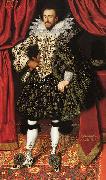 |
William Larkin
|
|
(early 1580s - 1619) was an English painter active from 1609 until his death in 1619, known for his iconic portraits of members of the court of James I of England which capture in brilliant detail the opulent layering of textiles, embroidery, lace, and jewellery characteristic of fashion in the Jacobean era, as well as representing numerous fine examples of oriental carpets in Renaissance painting.Larkin was born in London in the early 1580s, and lived in the parishes of St Sepulchre-without-Newgate, Holborn, and St Anne Blackfriars. He became a freeman of the Worshipful Company of Painter-Stainers on 7 July 1606 under the patronage of Lady Arbella Stuart and Edward Seymour, 1st Earl of Hertford. Married before 1612, he buried a stillborn son in that year; a son, William, in 1613; and a daughter, Mary, in January 1614/15, all at St Anne Blackfriars. Another daughter called Mary was alive at the time of his death. He died sometime between the witnessing of his will on 10 April 1619 and its proving on 14 May. The date of his burial is unknown because the parish records were destroyed in the Great Fire of London in 1666
|
|
 |
William de Leftwich Dodge
|
|
(1867-1935) was an American artist best known for his murals, which were commissioned for both public and private buildings.
Dodge was born at Liberty, Virginia in the Piedmont near Lynchburg. In 1879, his mother, Mary de Leftwich Dodge, an aspiring artist, moved her family to Europe. After living initially in Munich they moved to Paris, where she worked on art. Dodge later followed her example and became an artist. He spent most of his childhood years in France, where his mother was working on art. He studied at the École des Beaux Arts and took first place in the examinations in 1881. He also studied under Jean-Leon Gerôme and with Raphaël Collin at the Academie Colarossi,[1] and traveled to Munich for studies there.
|
|
|
|
|
|
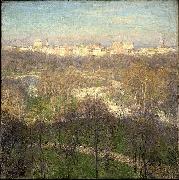 |
Willard Leroy Metcalf
|
|
(July 1, 1858 - March 9, 1925) was an American artist born in Lowell, Massachusetts. He studied at the School of the Museum of Fine Arts, Boston, and later attended Academie Julian, Paris. After early figure-painting and illustration, he became prominent as a landscape painter. He was one of the Ten American Painters who in 1897 seceded from the Society of American Artists. For some years he was an instructor in the Womans Art School, Cooper Union, New York, and in the Art Students League, New York. In 1893 he became a member of the American Watercolor Society,
|
|
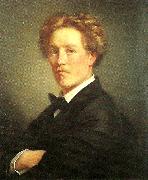 |
Wilhelmina Lagerholm
|
|
1826-1917 Konstakademien Lagerholm studerade samtidigt med Malmström såväl vid konstakademien i stockholm som för couture i paris.
|
|
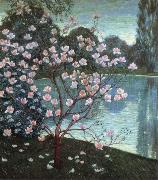 |
wilhelm list
|
|
Siegmund Wilhelm List (May 14, 1880 ?C August 17, 1971), was a German field marshal during World War II, and at the start of the war was based in Slovakia in command of the Fourteenth Army.
List was born in Oberkirchberg near Ulm, Weerttemberg, Germany in 1880 and entered the Bavarian Army in 1898 as a cadet. In 1900 he was promoted to Lieutenant and in 1913 he joined the general staff as a Hauptmann. He served as a staff officer in World War I.
After the war List stayed in the Reichswehr and most of his assignments were as an administrator. In 1927 he was promoted to Oberst, in 1930 he was promoted to General-Major and in 1932 he was promoted to General-Leutnant. In 1938 after the Anschluss of Austria he was made responsible for integrating the Bundesheer into the Wehrmacht.
During 1939 List commanded the German 14th Army in the invasion of Poland. From 1939 to 1941 he commanded the German 12th Army in France and Greece. During 1941 he was Commander-in-Chief South-East. In July 1942 he was Commander-in-Chief of Army Group A on the Eastern Front in the Soviet Union.
|
|
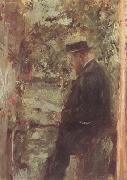 |
Wilhelm Leibl
|
|
German Realist Painter, 1844-1900
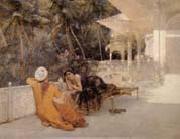
German painter, draughtsman and etcher. In 1861 he abandoned his apprenticeship as a locksmith in order to train as a precision instrument maker, though a month or so later he decided to train as an artist, at first under the Cologne history painter and writer Hermann Becker (1817-85). In 1863 he moved to Munich; he studied there from March 1864, at the Akademie der Bildenden K?nste, initially under Philipp von Foltz and Alexander Straehuber, drawing from plaster casts, and later in Hermann Ansch?tz's painting class. Here, Arthur von Ramberg (1819-75) stimulated Leibl's sensitivity to colour; and Karl Theodor von Piloty encouraged him to observe reality and incorporate its lessons boldly into compositions on historical themes. From the start, however, Leibl tended to think of his pictures in terms of form rather than content. While at the Akademie he first reached a standard of excellence with his draughtmanship, which is notable for its directness and objectivity. As an artist, Leibl's early works were not especially promising. However, as occurred throughout his career, a long period of mediocrity was crowned by an unexpected masterpiece, such as his portrait drawing of Aunt Josepha (c. 1864; Cologne, Wallraf-Richartz-Mus.). This is particularly striking for Leibl's use of the hands to add to the expression of the sitter's character and mood, a device he was to use frequently in later work. In Munich, Leibl supplemented the teaching of the Akademie by studying the works of the Old Masters in the Alte Pinakothek: he paid particular attention to painters of the Baroque period such as van Dyck, Cornelis de Vos and Rubens, and also to other great masters of portraiture such as Frans Hals and Vel?zquez. The presentation of the subject found in such works is reflected in Leibl's portrait of Frau Gedon (1869; Munich, Neue Pin.). When the work was shown at the Grossen Internationale Kunstausstellung in Munich in 1869 it was singled out as the best oil painting of the exhibition by Gustave Courbet and, as a result, Leibl was honoured with an invitation to Paris, where he arrived on 13 November 1869.
|
|
 |
Weeks Lord-Edwin
|
|
189-1903
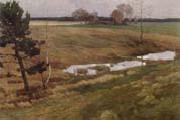
American artist, was born at Boston, Massachusetts, in 1849. He was a pupil of Leon Bonnat and of Jean-Leon Gerome, at Paris. He made many voyages to the East, and was distinguished as a painter of oriental scenes. In 1895 he wrote and illustrated a book of travels, From the Black Sea through Persia and India, and two years later he published Episodes of Mountaineering. He died in November 1903. He was a member of the Legion d'honneur, France, an officer of the Order of St. Michael, Germany, and a member of the Secession, Munich.
|
|
 |
Walter Leistikow
|
|
1865-1908,German painter, decorative artist, etcher, exhibition organizer and writer. He studied painting briefly in 1883, at the Akademie in Berlin, but he was dismissed after six months as 'untalented'. From 1883 to 1885 he trained with the painter Hermann Eschke (1823-1900) and from 1885 to 1887 with the Norwegian painter Hans Fredrik Gude. Gude had a decisive influence on the style of Leistikow's early works, as is especially clear in Leistikow's light coastal landscapes with figures. His most significant work from this period, however, is Brickworks near Eckernferde (1887; ex-Gem?ldegal. Neue Meister, Dresden). Leistikow's dismissal from the Akademie concentrated his attention on issues of artistic policy. When the German government decided not to send works for exhibition in the Exposition Universelle in Paris in 1889, Leistikow himself organized the dispatch of works to Paris. In 1892,
|
|
|
|
|
|
|
|
 |
Vladimir Lukich Borovikovsky
|
|
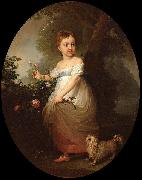
(Russian: July 24 O.S. 1757 - April 6 O.S. 1825) was a Ukrainian-born painter who dominated Russian portraiture at the turn of the 19th century.
ladimir Borovikovsky was born dymyr Borovyk in Myrhorod (now Ukraine) on July 24, 1757. His father, Luka Borovyk was a Ukrainian Cossack and an amateur icon painter. According to the family tradition, all four of Borovyk's sons served in Myrhorod regiment, but Volodymyr retired early at the rank of poruchik and devoted his life to art mostly icon painting for local churches.
Borovikovsky may have lived the remainder his life as an amateur painter in a provincial town if not for an unexpected event. His friend Vasyl Kapnist was preparing an accommodation for Empress Catherine II in Kremenchuk during her travel to newly conquered Crimea. Kapnist asked Borovikovsky to paint two allegoric paintings (Peter I of Russia and Catherine II as peasants sowing seeds and Catherine II as a Minerva) for her rooms. The paintings so pleased the Empress that she requested that the painter move to Saint Petersburg.
Portrait of Maria Lopukhina, 1797After September 1788 Borovikovsky lived in Saint Petersburg where he changed his surname from the Cossack "Borovyk" to the more aristocratic-sounding "Borovikovsky". For his first ten years in Saint Petersburg, he lived in the house of the poet, architect, musician and art theorist, Prince Nikolay Lvov, whose ideas strongly influenced Borovikovsky's art. At 30-years-old, he was too old to attend Imperial Academy of Arts, so he took private lessons from Dmitry Levitzky and later from Austrian painter Johann Baptist Lampi.
|
|
|
|
 |
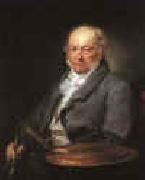
Vicente Lopez y Portana
|
|
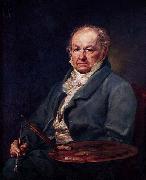
(September 19, 1772, Valencia, Spain CJuly 22, 1850, Madrid, Spain) was a Spanish painter, considered the best portrait painter of his time.
Vicente Lepez y Portaña was born in Valencia on September 19, 1772. His parents were Cristebal Lepez Sanchordi and Manuela Portaña Meer. Vicente Lepez began formally studying painting in Valencia at the age of thirteen, he was a disciple of father Antonio de Villanueva, a Franciscan monk, and he studied at the Academy of San Carlos in his native city. He was seventeen when he won first prize in drawing and coloring receiving a scholarship to study in the prestigious Academia Real de Bellas Artes de San Fernando in Madrid. For the following three years in Madrid, he apprenticed with the Valencian painter, Mariano Salvador Maella. Vicente Lepez returned to Valencia in 1794 and subsequently became vice-director of painting at the Academy where he had studied as a boy. In 1795 he married Maria Piquer, they had two sons: Bernardo Lepez Piquer and Luis (1802-1865), who were also painters, following their father's style but with little accomplishments. In 1801 Lepez was named President of the Academy of San Carlos.
|
|
 |
Vicente Lopez
|
|
1772-1850
Spanish
Vicente Lopez Gallery
was an Argentine writer and politician who acted as interim President of Argentina from July 7, 1827 to August 18, 1827. He also wrote the lyrics of the Argentine National Anthem adopted in May 11, 1813.
Lopez began his primary studies in the San Francisco School, and later studied in the Real Colegio San Carlos, today the Colegio Nacional de Buenos Aires. He obtained a doctorate of laws in the University of Chuquisaca. He served as a captain in the Patriotic Regiment during the English invasions. After the Argentine victory he composed a poem entitled El triunfo argentino (The Argentine Triumph). He participated in the Cabildo Abierto of May 22, 1810 and supported the formation of the Primera Junta. He had good relations with Manuel Belgrano. When the royalist members of the city government of Buenos Aires were expulsed, he was elected mayor of the city; he was an enemy of the party of Cornelio Saavedra and one of the creators of the First Triumvirate, of which he was the Treasurer.
Lopez was a member of the Constituent Assembly of year XIII, representing Buenos Aires. At the request of the Assembly, he wrote the lyrics to a "patriotic march", which eventually became the Argentine National Anthem. It was a military march, whose music was composed by the Catalan Blas Parera; it was approved on March 11, 1813. The first public reading was at a tertulia on May 7 in the house of Mariquita Sanchez de Thompson. It displaced a different march, written by Esteban de Luca, which would have been the hymn if not for the more militaristic Lopez.
|
|
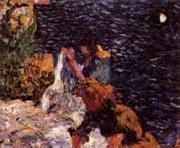 |
Valtat Louis
|
|
Dieppe 1869-Choisel 1952
French painter, printmaker and stage designer. He spent much of his youth in Versailles, moving in 1887 to Paris, where he studied under Gustave Moreau at the Ecole des Beaux-Arts and under Jules Dupre at the Acad?mie Julian. There he met Maurice Denis, Pierre Bonnard, Edouard Vuillard and Albert Andre. With a keen interest in both artistic precedents and contemporary trends, he absorbed in the mid-1890s the chief tenets of Impressionism, van Gogh's work and Pointillism before slowly developing his own style.
|
|
|
|
 |
VADDER, Lodewijk de
|
|
Flemish painter (b. 1605, Bruxelles, d. 1655, Bruxelles)
Flemish painter, draughtsman, engraver and tapestry designer. He was received as a master in the Brussels Guild of St Luke on 15 May 1628, probably, like his brother Hubert de Vadder, after an apprenticeship to his elder brother, Philippe de Vadder (Coeckelberghs). Lodewijk is best known as a landscape painter, although he also executed landscape engravings and drawings. He was granted a privilege to make tapestry cartoons by the Brussels city magistrate in 1644. In this capacity he worked mainly for weavers such as Jean Courdijn and Baudouin van Beveren. The latter referred to him as the best landscape painter in the country
|
|
|
|
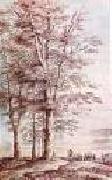 |
UDEN, Lucas van
|
|
Flemish painter (b. 1595, Antwerpen, d. 1672, Antwerpen).
Flemish painter, draughtsman and engraver. He was the son of Artus van Uden (b 1544), town painter of Antwerp, and grandson of Pieter van Uden (i) ( fl 1553), founder of a noted tapestry and silk factory in the city. Lucas was probably trained by his father and in 1626-7 was enrolled in the Antwerp Guild of St Luke as a 'master's son'. On 14 February 1627 he married Anna van Woelput (d 1667). On 31 December 1649 he was registered as no longer living in the city,
|
|
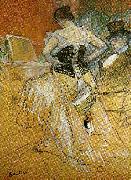 |
toulouse-lautrec
|
|
Fils d'Alphonse, comte Alphonse de Toulouse-Lautrec-Monfa (1838-1913) et d'Adele Tapie de Celeyran (1841-1930), il grandit entre Albi, le chateau du Bosc (demeure de ses grands-parents) et le chateau de Celeyran.
Henri de Toulouse-Lautrec est ne dans l'une des plus vieilles familles de France, descendant en effet en droite ligne des comtes de Toulouse, qui furent jusqu'au XIIIe si??cle parmi les plus puissants feodaux du royaume. Cependant, cette branche cadette, malgre son nom illustre, ne vit que comme une famille aisee de l'aristocratie de province.
|
|
|
|
|
|
 |
Thomas Luny
|
|
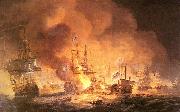
(1759-1837), born in Cornwall, probably at St Ewe, was an English artist and painter, mostly of seascapes and other marine-based works. At the age of eleven, Luny left Cornwall to live in London. There he became the apprentice of Francis Holman, a marine painter who would have a great and long lasting artistic influence on Luny: Luny remained until 1780 in Holman's London studio, which, was first situated in Broad Street, St. George, and later relocated to Old Gravel Lane.
In September 1777, Luny left Holman's studio for a while, to journey to France. During this particular expedition, Luny almost certainly strayed from France itself; his first exhibited picture in London, seen at the Society of Artists that same year, was given the title A distant view of the island of Madeira and Porto Santo, suggesting that an engraving had inspired his choice of subject. Similarly, it is unlikely that Luny was on hand for the Battle of the Nile, 1798, and the bombardment of Algiers, 1816, both of which he illustrated with dramatic atmosphere and credible realism.
After leaving Holman's studio in 1780, Luny moved to Leadenhall Street during 1783. It was around this time that Luny was frequently exhibiting at the Royal Academy, in a total of twenty-nine exhibitions between 1780 and 1802. In Leadenhall Street, Luny became acquainted with a "Mr. Merle", a dealer and framer of paintings who promoted Luny's paintings for over twenty years, to great success. Luny also found a wealthy source of business in Leadenhall Street, where the British East India Company had their headquarters; their officers commissioned many paintings and portraits from Luny. This relationship between the Company and Luny also had several non-monetary benefits for Luny; it seems probable that, considering the great detail and realistic look of many of his sketches of locations such as Naples, Gibraltar, and Charleston, South Carolina, Luny was occasionally invited as a guest on the Company's ships on special occasions and voyages.
|
|
|
|
|
|
|
|
|
|
|
|
|
|
 |
Stefan Luchian
|
|
Romanian Painter, 1868-1916
Romanian painter. He studied at the School of Fine Arts in Bucharest, graduating in 1889 and continuing his studies at the Akademie der Bildenden Kenste in Munich and in Paris at the Academie Julian, where he was a student of William-Adolphe Bouguereau. He rejected the rigidity of academic painting early in his career, however. The Last Autumn Race (1892; Bucharest, Mus. A.), one of the few paintings known from this period, clearly illustrates the influence of Manet and Impressionism on his early work. On his return to Romania in 1892 Luchian, unwilling to restrict his work to merely copying the French artists, struggled to create an original style. In 1900 he was left partially paralysed by a spinal disease, but he continued to work, and it is during the next years that he created his most accomplished works. His self-portraits (e.g. 1907; Bucharest, Mus. A.) are clear evidence of his determination to overcome this personal tragedy; far from inspiring pity, these paintings emphasize the depth and the strength of his inner life. It is in landscapes such as Willows at Chiajna (c. 1907; Cluj-Napoca, Mus. A.), however, that his commitment becomes even more apparent, with joyful rhythms created by means of broad brushstrokes and contrasts of bright colours next to delicate tones. Towards the end of his life Luchian became completely immobilized. During this time flowers were his favourite subject (e.g. Safta, the Flower Girl; Bucharest, N. Mus. A.; see also ROMANIA, fig. 9), and they became a metaphorical bridge between the artist and the outside world. The colours are still bright in these last paintings, and the loss of pastel tones makes the contrast more dramatic.
|
|
 |
Stefan Lochner
|
|
German painter (b. ca. 1400, Meersburg am Bodensee, d. 1451, Köln
was a German late Gothic painter.
His style, famous for its clean appearance, combined Gothic attention towards long flowing lines with brilliant colours with a Flemish influenced realism and attention to detail.
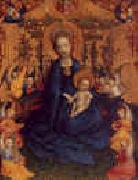
He worked mainly in Cologne, Germany, and his principal work is the triptych of the Altar of the City Patrons (done in the 1440s, which is in the Cologne Cathedral), which represents the city in homage to the infant Jesus. The epitome of his style is Madonna of the Rose Bower (c. 1450, housed in the Wallraf-Richartz Museum in Cologne), showing the Virgin and Child reposing in a blooming rose arbor and attended by Lochner's characteristic child Angels.
|
|
|
|
 |
SPADA, Lionello
|
|
Italian Baroque Era Painter, 1576-1622
Italian painter, active mainly in Emilia. His signature was an L placed across a sword [Ital. spada=sword]. His work shows influence of the grand manner of the Carracci, as in The Burning of Heretical Books (San Domenico, Bologna), and of Caravaggio's naturalism, seen in dramatic religious and genre scenes such as The Way to Calvary (Parma). In his late works his manner became softer and warmer under Correggio's influence. An example is The Marriage of St. Catherine (Parma).
|
|
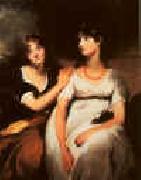 |
Sir Thomas Lawrence
|
|
1769-1830
British
Sir Thomas Lawrence Galleries
was a notable English painter, mostly of portraits.
He was born in Bristol. His father was an innkeeper, first at Bristol and afterwards at Devizes, and at the age of six Lawrence was already being shown off to the guests of the Bear as an infant prodigy who could sketch their likenesses and declaim speeches from Milton. In 1779 the elder Lawrence had to leave Devizes, having failed in business and Thomas's precocious talent began to be the main source of the family's income; he had gained a reputation along the Bath road. His debut as a crayon portrait painter was made at Oxford, where he was well patronized, and in 1782 the family settled in Bath, where the young artist soon found himself fully employed in taking crayon likenesses of fashionable people at a guinea or a guinea and a half a head. In 1784 he gained the prize and silver-gilt palette of the Society of Arts for a crayon drawing after Raphael's "Transfiguration," and presently beginning to paint in oil.
|
|
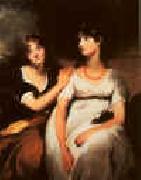 |
Sir Thomas Lawrence
|
|
1769-1830
British
Sir Thomas Lawrence Galleries
was a notable English painter, mostly of portraits.
He was born in Bristol. His father was an innkeeper, first at Bristol and afterwards at Devizes, and at the age of six Lawrence was already being shown off to the guests of the Bear as an infant prodigy who could sketch their likenesses and declaim speeches from Milton. In 1779 the elder Lawrence had to leave Devizes, having failed in business and Thomas's precocious talent began to be the main source of the family's income; he had gained a reputation along the Bath road. His debut as a crayon portrait painter was made at Oxford, where he was well patronized, and in 1782 the family settled in Bath, where the young artist soon found himself fully employed in taking crayon likenesses of fashionable people at a guinea or a guinea and a half a head. In 1784 he gained the prize and silver-gilt palette of the Society of Arts for a crayon drawing after Raphael's "Transfiguration," and presently beginning to paint in oil.
|
|
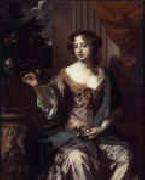 |
Sir Peter Lely
|
|
1618-1680
Dutch (Resident In UK)
Sir Peter Lely Art Locations
Sir Peter Lely (14 September 1618 - 30 November 1680) was a painter of Dutch origin. He was the most popular portrait artist in England from soon after he arrived in the country in the 1640s to his death. He also owned a major collection of art, especially drawings by other artists.
Lely was born Pieter van der Faes to Dutch parents in Soest in Westphalia,[1] where his father was an officer serving in the armed forces of the Elector of Brandenburg. Lely studied painting in Haarlem, where he may have been apprenticed to Pieter de Grebber. He become a master of the Guild of Saint Luke in Haarlem in 1637. He is reputed to have adopted the surname "Lely" (also occasionally spelled Lilly) from a heraldic lily on the gable of the house where his father was born in The Hague.
He arrived in London in around 1641. His early English paintings, mainly mythological or religious scenes, or portraits set in a pastoral landscape, show influences from Anthony van Dyck and the Dutch baroque. Lely's portraits were well received, and he succeeded Anthony van Dyck as the most fashionable portrait artist in England. He became a freeman of the Painter-Stainers' Company in 1647 and was portrait artist to Charles I, but his talent ensured that his career was uninterrupted by Charles's execution, and he served Oliver Cromwell, whom he painted "warts and all", and Richard Cromwell. In the years around 1650 the poet Sir Richard Lovelace wrote two poems about Lely ?? Peinture and "See what a clouded majesty...."
Two ladies from the Lake family, 1650. Held by the Tate Gallery.[1]After the English Restoration in 1660, Lely was appointed as Charles II's Principal Painter in Ordinary in 1661, with a stipend of £200 per year, as Van Dyck had enjoyed in the previous Stuart reign. Lely became a naturalised British subject in 1662.
Demand was high, and Lely and his school were prolific. After Lely painted a sitter's head, Lely's pupils would often complete the portrait in one of a series of numbered poses. As a result Lely is the first English painter who has left "an enormous mass of work." Among his most famous paintings are a series of 10 portraits of ladies from the Royal court, known as the "Windsor Beauties", formerly at Windsor Castle but now at Hampton Court Palace; a similar series for Althorp; a series of 12 of the admirals and captains who fought in the Second Anglo-Dutch War, known as the "Flagmen of Lowestoft", now mostly owned by the National Maritime Museum in Greenwich; and his Susannah and the Elders at Burghley House. His most famous non-portrait work is probably Nymphs by a fountain in Dulwich Picture Gallery.
Lely played a significant role in introducing the mezzotint to Britain, as he realized its possibilities for publicising his portraits. He encouraged Dutch mezzotinters to come to Britain to copy his work, laying the foundations for the English mezzotint tradition.
Lely was knighted in 1680. He died soon afterwards at his easel in Covent Garden, while painting a portrait of the Duchess of Somerset. He was buried at St Paul's Church, Covent Garden. He collected Old Masters during his life, with examples by Veronese, Titian, Claude Lorrain and Rubens, and a fabulous collection of drawings. His collection was broken up and sold after his death, raising the immense sum of £26,000. Some items in it which had been acquired by Lely from the Commonwealth dispersal of Charles I's art collections, such as the Lely Venus, were re-acquired by the royal collection.
|
|
|
|
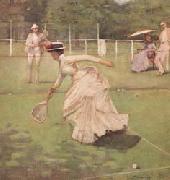 |
Sir John Lavery,RA
|
|
1856-1941
The artist John Lavery was born in Belfast, and studied in Scotland at the Glasgow School of Art from about 1874. He was in London from 1879-81 (he studied at Heatherley's School of Art for six months), and later in Paris, where he was influenced by Bastien-Lepage. He then returned to Glasgow, becoming a leading member of informal group of painters known as the Glasgow School (James Guthrie was another member), with work characterised by lack of a storyline, but great energy. Lavery achieved his pinnacle in the 1880s, with exhibitions in Europe and America, and as a leading portraitist, he was chosen to paint the State visit of Queen Victoria to the International Exhibition in Glasgow, 1888 - there were some 250 portraits in that picture. From 1890 he visited Morocco frequently, and he changed his British base to London in 1896, where he used a studio belonging to Alfred East. He was elected ARA in 1911,
|
|
 |
Sir John Lavery
|
|
Irish Painter, 1856-1941
Irish painter. The son of an unsuccessful publican, he was orphaned at the age of three and was brought up by relatives, initially in the north of Ireland and then in Ayrshire. He became an apprentice retoucher to a Glasgow photographer and attended the Haldane Academy, Glasgow, in the 1870s. After spending a winter term at Heatherley's School of Art, London, he moved in 1881 to Paris where he studied at the Acad?mie Julian. At this time he was influenced by Jules Bastien-Lepage and painted in a plein-air naturalist style
|
|
|
|
|
|
|
|
|
| Wholesale China Oil Painting Wholesale Oil Painting China Xiamen Portrait Reproduction on canvas Chinese Oil Painting Wholesale USA Oil Painting |
|
|
|
|
|