| |
|
Xiamen Oil Paintings, Wholesale Direct!
|
|
100% hand painted, 100% cotton canvas, 100% money back if not satisfaction. |
|
|
|
|
ART WORKS INDEX
A
B
C
D
E
F
G
H
I
J
K
L
M
N
O
P
Q
R
S
T
U
V
W
X
Y
Z
|
|
ARTISTS INDEX
A
B
C
D
E
F
G
H
I
J
K
L
M
N
O
P
Q
R
S
T
U
V
W
X
Y
Z
|
|
|
|
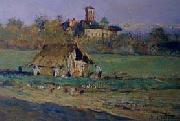 |
Lorenzo Delleani
|
|
(Pollone (Biella), 1840 - Turin, 1908) was an Italian painter.
A pupil of Cesare Gamba and Carlo Arienti at the Albertina Academy in Turin, Delleani worked initially in the field of history painting and received various marks of official recognition. He exhibited work at the Paris Salon of 1874 and gradually modernised his means of expression and range of subjects at the end of the decade with a new focus on landscape and painting from life. The early 1880s saw an exclusive focus on painting en plein air, capturing light in thick strokes of colour. His most frequent subjects were views of the Piedmontese and Lombard countryside in changing conditions of light and season. The artistes presentation of some 40 works at the Venice Biennale in 1905 and participation in the International Exhibition in Munich of the same year set the seal on his international success.
|
|
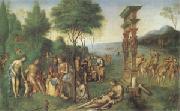 |
Lorenzo Costa
|
|
Bologna 1460-Mantua 1535
was an Italian painter of the Renaissance. He was born at Ferrara, but moved to Bologna by the his early twenties, and would be more influential to the Bolognese school of painting. However, many artists worked in both nearby cities, and thus others consider him a product of the School of Ferrara. There are claims that he trained with Cosimo Tura. In 1483 he painted his famous Madonna and Child with the Bentivoglio family, and other frescoes, on the walls of the Bentivoglio chapel in San Giacomo Maggiore, and he followed this with many other works. He was a great friend of Francesco Francia, who was much influenced by him. In 1509 he went to Mantua, where his patron was the Marquis Francesco Gonzaga, and he eventually died there. His Madonna and Child enthroned is in the National Gallery, London, but his chief works are at Bologna. His sons, Ippolito and Girolamo, were also painters, and so was Girolamo's son, Lorenzo the younger (1537-1583).
|
|
 |
Lorenzo Costa
|
|
1460-1535
Italian
Lorenzo Costa Locations
Italian painter of the Ferrarese and Bolognese schools. Trained in the manner of such painters as Tura and Cossa, he modified the strident Ferrarese style when he became a partner of Francia. Among his paintings are the Madonna and Child with the Bentivoglio Family and the Triumphs of Petrarch in San Giacomo Maggiore, the Madonna with Saints in San Petronio, and the Madonna in San Giovanni in Monte, all in Bologna. His Three Saints is in the Metropolitan Museum.
|
|
|
|
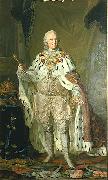 |
Lorens Pasch the Younger
|
|
(1733-1805) was a Swedish painter
He grew up in an artistic family (he was the brother of Ulrika Pasch, alongside whom he was elected to the Art Academy in 1773), but his father Lorens Pasch the Elder wanted him to become a priest. He was thus sent to study in Uppsala aged 10. However, he decided on an artistic career after all and began an apprenticeship in his father's studio before going to Copenhagen, with introductions from his wealthy and influential uncle Johan Pasch. There he studied painting for three years in the studio of Carl Gustaf Pilo. Despite good offers of studio-apprenticeships and commissions from Sweden, he then set off for Paris in 1758 to complete his artistic education. There he specialised in history painting in the studios of Eustache Le Sueur and François Boucher (though for financial reasons he also continued his training in portraiture) and became friends with fellow-Swede Alexander Roslin.
In 1764 he left Paris and got back to Sweden in 1766. He fully completed his training in the studio of the French painter Guillaume Taraval, who in 1735 founded the Royal Swedish Academy of Arts in Stockholm. Soon after his arrival back in Sweden Pasch's gained a great reputation as a portraitist, gaining favour and commissions from the royal court and gaining the esteem of Adolf Frederick, King of Sweden and his queen Louisa Ulrika - one of his most notable works is his Portrait of Louisa Ulrika of Prussia. He served as a professor at the Academy of Arts from 1773 to his death, becoming its director on Pilo's death in 1793. At the end of his life he concentrated more on training young artists and managing the Academy than on painting. He died unmarried in 1805 and due to his powerful portraits remains one of the most respected painters of the Gustavian era in Sweden.
|
|
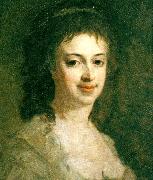 |
lorens pasch d.y
|
|
Lorens Pasch d.y., född 1733, död 1805, konstnär; professor vid Konstakademien från 1773. Son till Lorens Pasch d.ä., bror till Ulrika Pasch, brorsson till Johan Pasch. Invald tillsammans med sin syster i Konstakademien 1773.
|
|
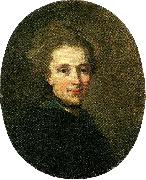 |
lorens pasch d. y
|
|
Lorens Pasch d.y., född 1733, död 1805, konstnär; professor vid Konstakademien från 1773. Son till Lorens Pasch d.ä., bror till Ulrika Pasch, brorsson till Johan Pasch. Invald tillsammans med sin syster i Konstakademien 1773.
|
|
|
|
|
|
|
|
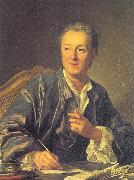 |
Loo, Louis-Michel van
|
|
Flemish active in France, 1707-1771
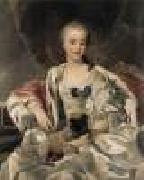
Painter, son of Jean-Baptiste van Loo. He trained with his father in Turin and Rome, later attending the courses of the Acad?mie Royale in Paris. He received the institution's first prize for painting in 1726, and in 1728, accompanied by his brother, Fran?ois, and his uncle, Carle, returned to Rome where he was associated with Francois Boucher. On his way back to France, he stayed for a time in Turin, painting portraits of the royal family of Sardinia, the Duke and Duchess of Savoy. In Paris he was admitted to membership of the Acad?mie Royale and in 1735 was appointed assistant teacher at the Academie, becoming renowned as a specialist in portrait painting. Most of his portraits from this period are half-length, combining ideas from Hyacinthe Rigaud's later work with other more natural and innovative ones. On the death of Jean Ranc, Philip V of Spain asked Rigaud to suggest a substitute, and van Loo was proposed. He arrived in Madrid in 1737 and remained there as Pintor de la Corte until 1752, responding with modern aesthetic ideas to the demands of the Spanish monarchs for pomp and splendour. He carried out court commissions but devoted part of his time to teaching, his pupils often becoming studio assistants. He also took an active part in meetings held over a number of years to establish the Real Academia de Bellas Artes de S Fernando, for which he produced the canvas, the Education of Cupid by Venus and Mercury
|
|
 |
LOO, Louis Michel van
|
|
French painter (b. 1707, Toulon, d. 1771, Paris).
Painter, son of Jean-Baptiste van Loo. He trained with his father in Turin and Rome, later attending the courses of the Academie Royale in Paris. He received the institution's first prize for painting in 1726, and in 1728, accompanied by his brother, Francois, and his uncle, Carle, returned to Rome where he was associated with Francois Boucher. On his way back to France, he stayed for a time in Turin, painting portraits of the royal family of Sardinia, the Duke and Duchess of Savoy. In Paris he was admitted to membership of the Academie Royale and in 1735 was appointed assistant teacher at the Academie, becoming renowned as a specialist in portrait painting. Most of his portraits from this period are half-length, combining ideas from Hyacinthe Rigaud's later work with other more natural and innovative ones. On the death of Jean Ranc, Philip V of Spain asked Rigaud to suggest a substitute, and van Loo was proposed. He arrived in Madrid in 1737 and remained there as Pintor de la Corte until 1752, responding with modern aesthetic ideas to the demands of the Spanish monarchs for pomp and splendour. He carried out court commissions but devoted part of his time to teaching, his pupils often becoming studio assistants. He also took an active part in meetings held over a number of years to establish the Real Academia de Bellas Artes de S Fernando, for which he produced the canvas, the Education of Cupid by Venus and Mercury
|
|
 |
Loo, Jacob van
|
|
Flemish Baroque Era Painter, 1614-1670
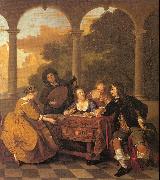
was a Dutch painter and popularized around 1650 a close-focus concert on a loggia or terrace. So Van Loo became known for his conversation groupings with a subtle color palette, and according to Arnold Houbraken famous for his nudes. He was the founder of the Van Loo family of painters. Van Loo was born in Zeeland in the Dutch Republic. His father might have been a notary, but most time he is regarded as the son of a painter, Jan van Loo, who trained him. (As part of the city archives in Sluis have been destroyed during World War II it is impossible now to make out what is true). His early influences include Thomas de Keyser and Jacob Adriaensz Backer. In 1642, Jacob moved to Amsterdam, where his contemporaries included Rembrandt, Frans Hals, and Bartholomeus van der Helst. In 1643 he married the sister of the painter Martinus Lengele and had six children. They lived on Rozengracht, in the Jordaan and Eglon van der Neer became one of his pupils. In 1660, Van Loo fled the city after having fatally stabbed someone in his belly, during a fight in an inn. He was sentenced to death in absentia and was forever banned from the state of Holland. Van Loo settled in Paris, where he was admitted to the Acad??mie de peinture et de sculpture and where he died in 1670. Van Loo's work was done in the Baroque style, which had begun in Rome and which was becoming a Europe-wide phenomenon in this period. He was a major influence on Johannes Vermeer, when painting Diana and Her Companions. He painted portraits of Johan Huydecoper van Maarssenveen, his wife, his sister Leonara Huydecoper, married to Jan J.
|
|
|
|
 |
Longpre, Paul De
|
|
French, practiced mainly in America, 1855-1911
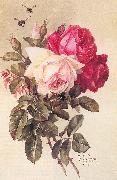
was a French flower painter, actively chiefly in the United States. He was born in Lyons, France, and was entirely self-taught. From his twelfth year he practiced successfully in Paris as a painter of fans. At 21 he first exhibited at the Salon. Having lost his money by the failure of a Paris bank, he moved in 1890 to New York and in 1896 held an exhibition of flower pieces which secured him instant recognition. In 1899 he moved to California and two years later built a beautiful house at Hollywood, which became celebrated for its magnificent flower gardens. De Longpre painted only perfect specimens of flowers; with delicacy of touch and feeling for bosoms he united scientific knowledge, and he also knew how to give expression to the subtle essence of the flowers.
|
|
 |
LONGHI, Pietro
|
|
Italian Rococo Era Painter, ca.1702-1785
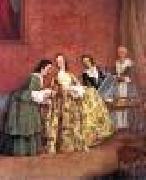
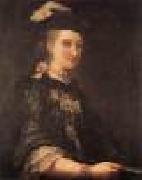
Painter and draughtsman. His father, Alessandro Falca, encouraged his natural talent for drawing, and he studied under Antonio Balestra for 'several years', according to his son, Alessandro Longhi. Balestra probably took Pietro to Bologna and recommended him to Giuseppe Maria Crespi. No documents exist on Longhi until 1732, the year he married, and some doubt has been expressed about his study with Crespi. There is no trace of Crespi's influence in Longhi's altarpiece for the parish church of S Pellegrino in Bologna, St Pellegrino Condemned to Death, installed in 1732; Crespi's style is an intimate one, however, and would have been inappropriate for such a large altarpiece. One of Longhi's first independent works, the St Pellegrino altarpiece recalls his Venetian origins and training in its broken brushwork and colour glazes. In another early work, the Adoration of the Magi (Venice, Scuola Grande S Giovanni Evangelista), documented in 1733 as at S Maria Materdomini, Venice, the subject-matter lends itself to a more domestic treatment, and Crespi's influence is evident. Both these works contain passages anticipating Longhi's subsequent development as a genre painter; in each picture a boy or young man, perhaps a self-portrait, gazes out at the spectator, unconcerned with events in the painting.
|
|
 |
LONGHI, Alessandro
|
|
Italian painter, Venetian school (b. 1733, Venezia, d. 1813, Venezia).
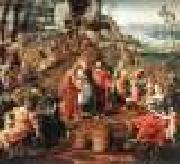
Painter, engraver and writer, son of (1) Pietro Longhi. He must have received his first artistic training from his father, although the only evidence of this is the similarity of their styles. He was apprenticed to Giuseppe Nogari, one of the better Venetian portrait painters of the first half of the eighteenth century, and his earliest works are bust-length, mostly life-size portraits in Nogari's style. He first exhibited in 1757 and by 1758 must have been considered a reasonably established artist,
|
|
 |
LOMBARD, Lambert
|
|
Flemish Northern Renaissance Painter, 1505-1566
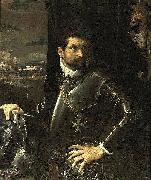
Flemish painter, draughtsman, architect, humanist and numismatist. He belonged to the generation of artists who sought to revive Flemish painting by turning to the art of antiquity and the Italian Renaissance. However, because of his northern training, he assimilated his models with difficulty and produced a hesitant form of art, one that was academic and cold. He was nonetheless an important innovator in the Low Countries through his investigation of the forms and compositions of Classical art.
|
|
|
|
 |
Lodovico Carracci
|
|
(21 April 1555 - 13 November 1619) was an Italian, early-Baroque painter, etcher, and printmaker born in Bologna.
Ludovico himself apprenticed under Prospero Fontana in Bologna and traveled to Florence, Parma, and Venice, before returning to his hometown. Along with his cousins Annibale and Agostino Carracci, Ludovico in 1585 was a founder and director (caposindaco) of the so-called Eclectic Academy of painting (also called the Accademia degli Incamminati), which in reality was a studio with apprenticed assistants. This studio however propelled a number of Emilian artists to pre-eminence in Rome and elsewhere, and singularly helped encourage the so-called Bolognese School) of the late 16th century, which included Albani, Guercino, Sacchi, Reni, Lanfranco and Domenichino. The Carracci had their apprentice draw studies focused on observation of nature and natural poses, and use a bold scale in drawing figures. Ludovico specifically helped train Giacomo Cavedone. The Carracci are credited with reinvigorating Italian art, especially fresco art, which was subsumed with formalistic Mannerism.
Carracci's own works are characterized by a strong mood invoked by broad gestures and flickering light that create spiritual emotion.
Ludovico Carracci died in Bologna in 1619.
|
|
|
|
 |
Lodewijk Toeput
|
|
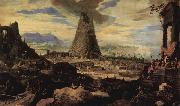
(ca.1550, Antwerp - 1605, Treviso), was a Mannerist landscape painter active in Italy.
According to Karel van Mander who listed him as one of two painters from Northern Europe who he met in Venice, he was a good poet (rederijker) as well as a painter, who he thought came from Mechelen. Van Mander listed him with Dirck de Vries, a painter of kitchen pieces and fruit markets from Friesland. According to the RKD he was from Antwerp and spent most of his life in Treviso, Italy. He painted several historical allegories from the Bible and mythological themes from Metamorphoses.
|
|
 |
Lodewijk de Vadder
|
|
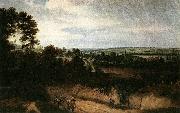
Lodewijk de Vadder (1605, Grimbergen - 1655, Brussels) was a Flemish Baroque landscape painter and engraver.
He became a master of Antwerp's Guild of St. Luke in 1628, and learned painting from his father and brothers. He specialized in landscapes with woods, in the manner of his contemporary Jacques d'Arthois and his pupil Lucas Achtschellinck[1]. They are usually referred to collectively as "The Sonian Forest Painters".
|
|
|
|
|
|
|
|
 |
Lo Scheggia
|
|
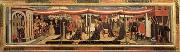
Italian Early Renaissance Painter, 1406-1486
|
|
|
|
 |
Ljubov Popova
|
|
Russian Constructivist Painter and Designer, 1889-1924
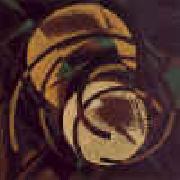
Through a synthesis of styles Popova worked towards what she termed painterly architectonics. Exploring firstly Impressionism, by 1913, in Composition with Figures, she was experimenting with the particularly Russian development of Cubo-Futurism: a fusion of two equal influences from France and Italy.
Portrait of a Philosopher (Artists's brother, Pavel Sergeyevich Popov), 1915From 1914-1915 her Moscow home became the meeting-place for artists and writers. In 1914-1916 Popova together with other avant-garde artists (Aleksandra Ekster, Nadezhda Udaltsova, Olga Rozanova) contributed to the two Jack of Diamonds exhibitions, then in Petrograd Tramway V and the 0.10, The Store in Moscow.
In 1916 she joined the Supremus group with Kazimir Malevich, the founder of Suprematism, Aleksandra Ekster, Ivan Kliun, Nadezhda Udaltsova, Olga Rozanova, Ivan Puni, Nina Genke, Ksenia Boguslavskaya and others who at this time worked in Verbovka Village Folk Centre. However there was a tension between those who like Malevich saw art as a spiritual quest and others who responded to the need for the artist to create a new physical world. Popova embraced both of these ideals but eventually identified herself entirely with the early aims of the Revolution working in poster, book design, fabric and theatre design, as well as teaching.
Her painting The Violin of 1914 reveals the development from cubism towards the "painterly architectonics" of 1917- 1918. Before joining the Supremus group her paintings, the architectonic series defined her artistic trajectory, quite distinct from that of Malevich, Rozanova, Tatlin and Mondrian, in abstract form. The canvas surface is an energy field of overlapping and intersecting angular planes in a constant state of potential release. At the same time the elements are held in a balanced and proportioned whole as if linking the compositions of the classical past to the future. By 1918 colour is used as the iconic focus; the strong primary colour at the centre drawing the outer shapes together.
In 1918 Popova married von Eding, and gave birth to a son, but von Eding died the following year of typhoid fever. She worked on Agitprop designs, and in 1919 she contributed to Tenth State Exhibition: Non Objective Creativity and Suprematism. She painted more advanced abstract works in 1919-21. In 1921 she exhibited in the 5 x 5 Exhibition.
From 1921-24 Popova became active in Constructivist projects, sometimes in collaboration with the architect Alexander Vesnin. She was active in stage designs: Vsevolod Meyerhold's production of Fernand Crommeldynck's The Magnanamous Cuckold, 1922; and in teaching: Spatial Force Constructions were used as the basis of an art teaching theory. She designed typography of books, production art and textiles, and contributed designs for dresses to LEF.
Popova died in Moscow. A large exhibition of her work opened in Moscow on 21 December 1924.
|
|
 |
Livio Mehus
|
|
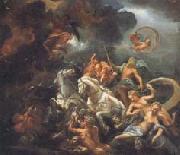
The Flemish artist (1627-1691) eclectic painter, author of landscapes, sacred objects, genre paintings and portraits embodies
|
|
|
|
|
|
|
|
 |
LIPPI, Fra Filippo
|
|
Italian Early Renaissance Painter, ca.1406-1469
Filippo Lippi was born in Florence. He took his vows in 1421 in the monastery S. Maria del Carmine, where Masaccio frescoed the Brancacci Chapel in the church (1426-1427). By 1430 Lippi is mentioned in church documents as "painter." Masaccio's influence, as well as Donatello's, can be seen in Lippi's early works, such as the Tarquinia Madonna of 1437 (National Gallery, Rome) and the Annunciation (S. Lorenzo, Florence) and Barbadori Altar (Louvre, Paris), both begun in 1437/1438. However, the severity of Masaccio and Donatello was mitigated by Lippi, who was instrumental in salvaging from the Gothic past the lyrical expressiveness of a linear mode which Masaccio had all but given up for modeling in chiaroscuro. Toward the middle of the 15th century Lippi's pictures became more finely articulated and his surface design more complex. It is probable that he had a large workshop, and the hand of assistants may be observed in the important fresco decoration started in 1452 in the choir chapel of the Prato Cathedral. After delays and strong protests this commission was finally completed in 1466. The cycle, a highly important monument of Early Renaissance painting, demonstrates Lippi's increasingly more mature style, revealing him to be witty, original, and well versed in all the artistic accomplishments of his time, to which he himself contributed. Through linear perspective Lippi was able to render a convincing illusion of recession and plausible three-dimensional figures. He knew how to express emotions, and he was a keen observer of nature. Lippi painted astonishing portrait likenesses and combined figures and space with an animated surface rhythm, the best example of which can be seen in the Feast of Herod, one of the last scenes in the Prato cycle. During his stay at Prato he was the cause of a scandal (later resolved by papal indulgence): he ran off with a nun, Lucrezia Buti, who bore him two children, one of whom, Filippino Lippi (ca. 1457-1504), was also a painter. In the Prato frescoes as well as in his contemporary panel pictures, such as the Madonna with Two Angels (Uffizi Gallery, Florence), or in the exquisite tondo of the Madonna (Pitti Palace, Florence), Filippo Lippi anticipated later developments in 15th-century painting. In these pictures are to be found the sources of Sandro Botticelli, Lippi's most illustrious pupil. Lippi's innovations extended also to iconography. In his quest for realism he introduced the "bourgeoise" Madonna: the type of contemporary Florentine lady elegantly dressed in the fashion of the time with the hair on her forehead plucked to stress the height of it. He also introduced the subject of the Madonna adoring the Child in the woods (Museum of Berlin, and Uffizi, Florence).
|
|
 |
LIPPI, Filippino
|
|
Italian Early Renaissance Painter, ca.1457-1504
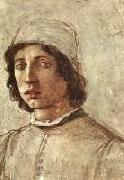
Son of Filippo Lippi. He was a painter of altarpieces, cassone panels and frescoes and also an exceptional draughtsman. His success lay in his ability to absorb, without slavishly following, the most popular trends in contemporary painting. He worked in Florence and Rome at a time when patrons were beginning to intermingle personal, religious, social and political ideals in their ambitions for palaces and chapels: with the support of wealthy and erudite patrons, such as Lorenzo de' Medici and Filippo Strozzi, he won important civic and private commissions.
|
|
|
|
 |
Lionel Walden
|
|
(1861-1933) was born in Norwich, Connecticut in 1861. He first became interested in art in Minnesota, where the family moved when his father became rector of an Episcopal Church there. As a young man, Walden moved to Paris where he studied painting with Carolus-Duran. In around 1893-97, Walden was in England, living in Falmouth. Paintings of Cardiff in Wales are in museums in Cardiff and Paris. Walden received medals from the Paris Salon and was made a Knight of the French Legion of Honor. He visited to Hawaii in 1911 and several times thereafter. Walden died in Chantilly, France in 1933.
According to David H. Forbes, author of Encounters with Paradise: Views of Hawaii and its People, 1778-1941, Lionel Walden "was the finest seascape painter to work in Hawaii". The Brooklyn Museum, the Henry Art Gallery (University of Washington, Seattle), the Honolulu Academy of Arts, the Isaacs Art Center (Waimea, Hawaii), and the Musee d'Orsay are among the public collections holding works by Lionel Walden.
|
|
|
|
 |
LINGELBACH, Johannes
|
|
Dutch Baroque Era Painter, 1622-1674
German painter, active in the Netherlands and Italy. By 1634 his family had settled in Amsterdam, where presumably Lingelbach trained as a painter. According to Houbraken, he visited France in 1642 and arrived in Italy two years later. However, he is not mentioned in any document of 1644, although he is recorded in Rome from 1647 to 1649. The artist left Rome in 1650 and by 1653 was back in Amsterdam, where he remained until his death. Lingelbach is perhaps the only one of the Dutch Italianates with a catalogue of numerous signed and dated works to document his artistic development. The first two signed works are The Blacksmith (1650; Rome, Melmeluzzi priv. col., see Briganti, Trezzani and Laureati, fig. 10.1) and Self-portrait with Violin (1650; Zurich, Ksthaus). Unfortunately no certain works survive from the previous years. Kren (1982) attributed a series of works depicting Roman trades, some formerly ascribed to Pieter van Laer, to Lingelbach's early career. The original group consisted of three small paintings: the Acquavita-seller, the Cake-seller and The Tobacconist (all Rome, Pal. Corsini). While these paintings have some striking points in common with the Melmeluzzi Blacksmith of 1650 and the signed Dentist on Horseback (1651; Amsterdam, Rijksmus.), it is still uncertain whether they belong to Lingelbach's pre-1650 work or are by another hand
|
|
|
|
 |
LINARD, Jacques
|
|
French Baroque Era Painter, ca.1600-1645
French painter. He was in Paris by 1626, and his first securely attributed still-life work is dated the following year. He lived in the Saint-Germain-des-Pr?s district, where a number of French still-life painters such as Louise Moillon and Lubin Baugin worked alongside Flemish artists specializing in this genre. In 1631 he was created Peintre et Valet de Chambre du Roi, a post that guaranteed him a degree of financial independence. Linard's works of 1627-44 were mainly of fruit and flowers; with Louise Moillon, however, he was among the first French artists to combine successfully the female form with still-life elements, as, for example, in Woman with Flowers and Woman with Fruit (both Paris, priv. col., see Far?, 1974, pp. 22-3). A painting such as Basket of Flowers (Paris, Louvre) owes something to Flemish prototypes in the anachronistic grouping of flowers that span several months. Patiently recording the flowers as they bloomed, and working on the picture from a series of drawings and sketches, Linard demonstrated his commitment to working from nature. However
|
|
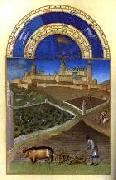 |
LIMBOURG brothers
|
|
Flemish painters (b. 1370-80, Nijmegen, d.
1416, Nijmegen).
family of Franco-Flemish manuscript illuminators. The Limbourg brothers, Pol, Jan, and Herman, were trained as goldsmiths. They succeeded Jacquemart de Hesdin in 1411 as court painters to Jean, duc de Berry. Their masterpiece is the magnificent book of hours known as the Tr??s Riches Heures (c.1415; Mus??e Cond??, Chantilly). This is filled with exquisite illustrations of the daily life of the aristocracy and peasantry, including a series of calendar illuminations that are considered the finest extant examples of the International Gothic style
|
|
 |
lim-johan
|
|
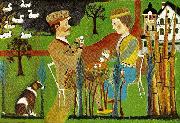
Johan Erik Olsson, född 1865, död 1944, svensk konstnär, autodidakt och naivist, bosatt i Kyan, Hälsingland, där han försörjde sig som dagsverkare, laggkärlstillverkare och fotograf. Hans släkt kom från Lima i Dalarna, därav namnet. Som ung vistades han 8 år på Ulleråkers mentalsjukhus i Uppsala. Fram till 1920-talet målade han natur, djur och andra motiv från hemtrakterna i fantasifull, närmast exotisk gestalt. Lim-Johan uppmärksammades inte under sin levnad, men finns i dag representerad på bland annat på Edsbyns museum i Hälsingland och på Moderna Museet i Stockholm. 1944 avled Lim-Johan på Ovanåkers ålderdomshem efter en tids sjukdom. Han är begravd på Ovanåkers kyrkogård, där det sedan 1994 står "LIM-JOHAN" på gravstenen.
Hans konst upptäcktes av en tillfällighet av fil.dr. Philibert Humbla, länsintendent på Gävle museum, som bad Hans Lidman att försöka finna så många tavlor av Lim-Johan som möjligt. Lim-Johan räknas i dag bland de förnämsta naivisterna i världen.
|
|
 |
Lilly martin spencer
|
|
1822-1902
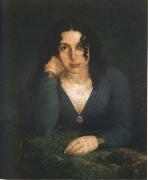
American painter of English birth. At the age of eight, she and her family emigrated to America, and after three years in New York they moved to Marietta, OH. In 1841 her father took her to Cincinnati, where she exhibited and received help from artists such as the animal painter James Henry Beard (1812-93). However, she refused the offer of the city's most important art patron, Nicholas Longworth, to assist in her art studies in Boston and Europe. Instead she stayed in Cincinnati and married an Englishman, Benjamin Spencer, by whom she had thirteen children, seven living to maturity.
|
|
 |
Lilla Cabot Perry
|
|
American Impressionist Painter, 1848-1933
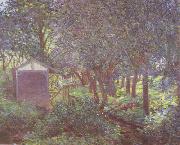
was an American artist who worked in the Impressionist style, rendering portraits and landscapes in the free form manner of her mentor, Claude Monet. Perry was an early advocate of the French Impressionist style and contributed to its reception in the United States. Perry's early work was shaped by her exposure to the Boston school of artists and her travels in Europe and Japan. She was also greatly influenced by Ralph Waldo Emerson's philosophies and her friendship with Camille Pissarro. Although it was not until the age of thirty-six that Perry received formal training, her work with artists of the Impressionist, Realist, Symbolist, and German Social Realist movements greatly affected the style of her oeuvre. Boston native Lilla Cabot Perry was born on January 13, 1848 to Dr. Samuel Cabot, a distinguished surgeon, and Hannah Lowell Jackson Cabot. What is known of her early life reveals a childhood that allowed her the freedom of exploring her interests and creativity. Perry studied literature, language, poetry, and music. There are a few references to Perry having informal sketching sessions with her friends however she had no formal training in the arts before 1884. As a child she additionally enjoyed reading books and playing sports outdoors. Because of her family's prominence in Boston society,
|
|
 |
LIGOZZI, Jacopo
|
|
Italian painter, Florentine school (b. 1547, Verona, d. 1627, Firenze)
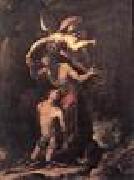
Italian painter, draughtsman, miniaturist and printmaker. He was one of the most productive artists in 17th-century Florence, although in the context of the Florentine Baroque, with its pageantry and decorative form, Ligozzi remained as much a foreigner in terms of his precise drawing, veristic figures and expressive content, as he was by birth. He was the son of the painter Giovanni Ermanno Ligozzi ( fl 1572-88; d before 1605) and came from a Veronese family of painters and designers of armour, tapestries and embroidery on silk. Other members of the family who were painters (Fumagalli in 1986 exh. cat.) were Jacopo's brother Francesco (d before 1635), whose career seems to have been in Verona, his cousin Francesco di Mercurio, who worked for the Medici in Florence in 1590-91
|
|
|
|
 |
LIEVENS, Jan
|
|
Dutch painter (b. 1607, Leiden, d. 1674, Amsterdam)
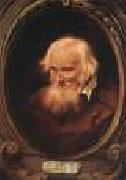
Dutch painter, draughtsman and printmaker. His work has often suffered by comparison with that of Rembrandt, with whom he was closely associated from 1625 to 1631. Yet Lievens's early work is equal to that of Rembrandt, although in later years he turned more towards a somewhat facile rendering of the international Baroque style favoured by his noble patrons, thus never fully realizing his early promise. Nonetheless, he became a renowned portrait painter and draughtsman, and his drawings
|
|
 |
Lieve Verschuier
|
|
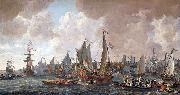
(1627-1686) was a Dutch Golden Age painter of maritime subjects.
He was born in Rotterdam, and is documented in Amsterdam in 1651, where he possibly learned to paint from Simon de Vlieger. He traveled to Rome in 1653 as a young man with Jan Vermeer van Utrecht and became friends with Willem Drost and Johann Carl Loth.. On his return he settled in Rotterdam in 1667 where he remained, painting marine scenes, and Italianate landscapes.
His maritime works are valued today for their historical value illustrating the art of shipbuilding in the 17th century.
|
|
 |
LIEFERINXE, Josse
|
|
French painter, Provençal school (active 1493-1508 in Marseille)
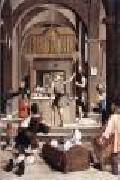
South Netherlandish painter, active in France. A native of Hainaut, in the diocese of Cambrai, he may have come from Lieferinge near Enghien (Claessens). He is documented in Marseille and Aix-en-Provence from 1493 to 1505, often being described as a 'Picard painter'. In 1503 he married Michelle, one of the daughters of Jean Changenet, the most prominent painter of the time in Avignon, with whom he may have trained. The last great representative of the 'School of Avignon',
|
|
|
|
|
|
|
|
|
| Wholesale China Oil Painting Wholesale Oil Painting China Xiamen Portrait Reproduction on canvas Chinese Oil Painting Wholesale USA Oil Painting |
|
|
|
|
|