| |
|
Xiamen Oil Paintings, Wholesale Direct!
|
|
100% hand painted, 100% cotton canvas, 100% money back if not satisfaction. |
|
|
|
|
ART WORKS INDEX
A
B
C
D
E
F
G
H
I
J
K
L
M
N
O
P
Q
R
S
T
U
V
W
X
Y
Z
|
|
ARTISTS INDEX
A
B
C
D
E
F
G
H
I
J
K
L
M
N
O
P
Q
R
S
T
U
V
W
X
Y
Z
|
|
|
|
 |
Lambert Lombard
|
|
Flemish Northern Renaissance Painter, 1505-1566
was a Renaissance painter, architect and theorist for the Prince-Bishopric of Liege. During his career he worked for Jan Gossaert in Middelburg and trained Frans Floris. In 1532 he became court painter and architect in Liege. A few paintings and many drawings have been preserved. In 1537 he was sent to Rome by Erard de la Marck, prince-bishop of Liege, to buy works of art, and he discovered the wonders of the Italian Renaissance. On his return he brought not only works of art, but also the new ideas concerning art and the position of the artist, to Liege.
|
|
 |
Lambert Jacobsz
|
|
1598-1636
Dutch
Lambert Jacobsz Gallery
Dutch painter. He was the son of a well-to-do Mennonite cloth merchant in Amsterdam. He served his apprenticeship there among the artists now called the Pre-Rembrandtists. After his marriage in 1620, commemorated by the poet Joost van den Vondel (1587-1639), he settled in Leeuwarden, his wife's native city, where he became a preacher in the Mennonite community and worked primarily as a painter. He was also active as an art dealer, as is known from his estate inventory, which records transactions in Amsterdam with the Mennonite art dealer and patron of Rembrandt, Hendrick van Uylenburgh. Two of Jacobsz.'s pupils were Govaert Flinck and Jacob Backer. His son, the painter ABRAHAM VAN DEN TEMPEL probably also studied with him before becoming Backer's pupil c. 1642-6.
|
|
 |
Lambdin, George Cochran
|
|
American Painter, 1830-1896
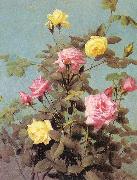
American painter. He was a son of the portrait and landscape painter James R. Lambdin (1807-89), who had founded a museum in Pittsburgh in 1828 and directed the Pennsylvania Academy of the Fine Arts in Philadelphia from 1845 to 1864. George Lambdin studied with his father and began exhibiting at the Pennsylvania Academy in 1848 and at the National Academy of Design, New York, in 1856. In the mid-1850s he travelled, probably to Munich, Paris and Rome. His early works were sentimental genre paintings, the best known of which are Our Sweetest Songs (1857; New York, N. Acad. Des.) and the Dead Wife (The Last Sleep) (exh. 1858; Raleigh, NC Mus. A.). The latter was shown at the Exposition Universelle in Paris in 1867 together with one of his depictions of a Civil War subject, Consecration, 1861 (1865; Indianapolis, IN, Mus. A.). In 1868-9 he was at the Tenth Street Studio Building, New York, where he continued to exhibit anecdotal genre, especially childhood subjects, as in The Pruner (1868; Boston, MA, Mus. F.A.). He was elected an Academician by the Pennsylvania Academy in 1863 and by the National Academy of Design in 1868. In Germantown, after a short trip abroad in 1870, Lambdin turned to floral studies, especially of roses from his own garden. Some of his floral still-life subjects were conventional table-top arrangements in glass or ceramic vases, but most were paintings of blooming plants and shrubs as they grow in nature or in garden pots, their foliage and blossoms silhouetted against blue sky or a neutral wall, as in Autumn Sunshine
|
|
|
|
|
|
|
|
 |
Lajos Deak-ebner
|
|
(1850- 1934 ) - Painter
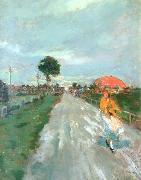
painted On the Road in between 1876(1876) and 1880(1880)
|
|
|
|
|
|
 |
Lady Anne Barnard
|
|
(12 December 1750-6 May 1825), nee Anne Lindsay, eldest daughter of James Lindsay, 5th Earl of Balcarres was born at Balcarres House, Fife, Scotland. She was author of the ballad Auld Robin Gray and an accomplished travel writer, artist and socialite of the period. Her five year residence in Cape Town, South Africa, although brief, had a significant impact on the cultural and social life of the time.
|
|
|
|
 |
Labille-Guiard, Adelaide
|
|
French Neoclassical Painter, 1749-1803
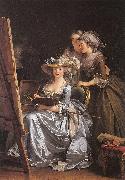
French painter. Labille-Guiard was a painter of the French nobility before the Revolution and survived to paint the citizens of the Directory. Emerging from the 18th-century tradition of powdered wigs and shimmering satins, she captured informal moments in the lives of her subjects, frequently depicting them interrupted from some pastime
|
|
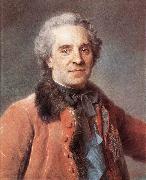 |
LA TOUR, Maurice Quentin de
|
|
French Rococo Era Painter, 1704-1788
French pastellist. He was one of the greatest pastellists of the 18th century, an equal of Jean-Simeon Chardin and Jean-Baptiste Perronneau. Unlike them, however, he painted no works in oils. Reacting against the stately portraits of preceding generations and against the mythological portraits of many of his contemporaries, La Tour returned to a more realistic and sober style of work. The fundamental quality of his art lies in his ability to suggest the temperament and psychology of his subjects by means of their facial expression, and thereby to translate their fugitive emotions on to paper: 'I penetrate into the depths of my subjects without their knowing it, and capture them whole', as he himself put it. His considerable success led to commissions from the royal family, the court, the rich bourgeoisie and from literary, artistic and theatrical circles.
|
|
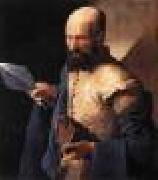 |
LA TOUR, Georges de
|
|
French Baroque Era Painter, 1593-1652
French painter. He was well known in his lifetime, especially for his depictions of candlelit subjects, then was forgotten until the 20th century, when the identification of works previously misattributed established his reputation as a giant of French painting. His early works were painted in a realistic manner and influenced by the dramatic chiaroscuro of Caravaggio. The paintings of La Tour's maturity are marked by a startling geometric simplification of the human form and by the depiction of interior scenes lit only by the glare of candles or torches. His religious paintings done in this manner have a monumental simplicity and a stillness that expresses both contemplative quiet and wonder. Little is known of his life, and only four or five of his paintings are dated.
|
|
|
|
|
|
 |
LA FOSSE, Charles de
|
|
French Baroque Era Painter, 1636-1716
French painter and draughtsman. He was the most important decorative painter in France in the generation after Charles Le Brun and in this capacity contributed to many of the major official and private building projects from the 1670s to the 1710s, including the D?me des Invalides in Paris and the chapel at the ch?teau of Versailles. His colourist's temperament, his early study of the Venetian painters of the 16th century and his interest in the work of Peter Paul Rubens contributed to the triumph of the party that championed colour over line and put him in the vanguard of the new tendency in French painting in the later 17th century. His work, with its rich and changing colours, combines the strength of the 17th century
|
|
|
|
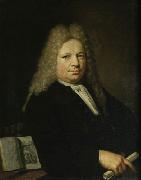 |
Krzysztof Lubieniecki
|
|
(1659-1729) was a Polish Baroque painter and engraver active in Amsterdam during the Dutch Golden Age.
Krzysztof was born in Szczecin. He and his brother Teodor Lubieniecki hailed from an Arian family. They learned to paint from Juriaan Stur in Hamburg. In 1667 they travelled to Amsterdam, where Krzysztof apprenticed with Adriaen Backer, and Teodor with Gerard de Lairesse. In 1682, Teodor moved to Hannover before eventually moving to Poland in 1706, where he died.
Krzysztof remained in Amsterdam, where he painted portraits and genre pieces. He also collaborated on prints for Jacobus Houbraken, Daniel Willink, and Johannes Brandt (son of Gerard Brandt). He died in Amsterdam.
|
|
|
|
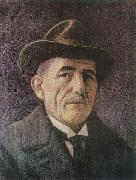 |
Kole Idromeno
|
|
Kolë Idromeno (1860-1939) was an Albanian painter, sculptor, photographer, architect and engineer.
He was born in Shkodër, where he learned the first elements of photography from Pietro Marubi. In 1876 he stayed for some months at the Academy of Fine Arts in Venice (Accademia di Belle Arti di Venezia), and then worked in the studio of an Italian painter. When back in Albania (1878), he engaged himself in a number of different activities, working as an architect, sculptor, photographer, scene-painter, engineer and painter. He was the initiator of the first art exhibition in Shkodër (1923) and was represented in the first national art exhibition in Tirana (1931).
He established a very active photographic studio. Idromeno was the first painter to show motion pictures in Albania in 1912. He had kept up a correspondence with the Lumiere brothers in Paris.
|
|
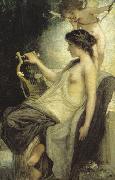 |
Karoly Lotz
|
|
(16 December 1833 - 13 October 1904) was a German-Hungarian painter.
Karl Lotz was born in Bad Homburg vor der Höhe, Germany, the 7th and youngest surviving child of Wilhelm Christian Lotz and Antonia Höfflick (Höfflich). His father was a valet of Prince Gustav zu Hessen-Homburg at the time when the prince was representing Austria at the Congress of Vienna, which among other matters dealt with the House of Hessen-Homburg's rights of sovereignty over Hessen-Darmstadt. The sudden death of the young Baron von Sinclair, charge d'affaires, forced W. C. Lotz temporarily into the rôle. While in Hungary in 1815 he made the acquaintance of the 13-year-old Antonie Hoefflich, whom he married three years later. She gave birth to 8 children, of whom Karl was the youngest.
W. C. Lotz died in 1837 and Antonie moved the family to Pest (now one of the three constituent parts of Budapest; the one on the east bank of the River Danube). Karl attended the Piaristengymnasium, where, although Calvinist, he was awarded a scholarship for his exceptional academic performance. He began his artistic career as a pupil of the Hofkapellmeister Destouches, then in the academy of the Venetian master Jacopo Marastoni (1804-1860). Later he was a pupil of the historical painters Henrik Weber (1818-1866) in Budapest and Carl Rahl (1812-1865) in Vienna.
Together with Rahl he worked on numerous commissions. Later he started on his own original works, first as a romantic landscape artist in scenes of the Alföld (the Hungarian lowland plain), and then as a creator of monumental murals and frescos in the style of the Venetian master Tiepolo.
After various works in Budapest he became active in Vienna. He laid out plans for a grandiose palace, and completed murals commissioned by the Abbot of Tihany for his abbey church on the shore of Lake Balaton. He became known for his portraits and nudes, for which both his wife and his daughters (Katarina in particular) posed. Lotz found married bliss only at the age of 58, when he married the widow Jacoboy, the former wife of his brother Paul Johann Heinrich, who had died in 1828. From then on he signed his works Keroly Jacoboy-Lotz.
In 1882 Lotz was appointed Professor at various art academies in Budapest, and in 1885 he became dean of a newly-established department for women painters. He was an honorary member of the Academy of Pictorial Arts in Vienna.
Tomb of Keroly Lotz by Jenos Pesztor (Kerepesi cemetery in Budapest)Hist last important public commission was the "Apotheosis of the Habsburg Dynasty", a huge ceiling fresco in the Habsburg Room of the newly rebuilt Royal Palace, that he painted in 1903, one year before his death. Lotz was already seriously ill when he worked on the fresco. The "Apotheosis" followed the traditions of Baroque court painting and the work was praised by contemporary critics. The fresco survived the war unscathed, but it was destroyed in the 1950s.
He died in 1904 in Budapest. As a "Prince of Hungarian Artists" he was given a state funeral and interred inside a memorial. His pictures, drawings and sketches were donated to the State of Hungary and are now in the Szepműveszeti Mezeum. Several Hungarian cities have streets named after him, there are Hungarian stamps bearing his likeness, and there is a bust in the National Museum in Budapest.
|
|
|
|
|
|
|
|
|
|
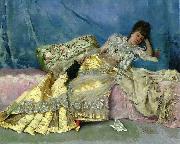 |
Julius LeBlanc Stewart
|
|
(September 6, 1855, Philadelphia, Pennsylvania - January 5, 1919, Paris, France), was an American artist who spent his career in Paris. A contemporary of fellow expatriate painter John Singer Sargent, Stewart was nicknamed "the Parisian from Philadelphia."
His father, the sugar millionaire William Hood Stewart, moved the family to Paris in 1865, and became a distinguished art collector and an early patron of Fortuny and the Barbizon artists. Julius studied under Eduardo Zamacois as a teenager, under Jean-Leo Grôme at the École des Beaux Arts, and later was a pupil of Raymondo de Madrazo.
Stewart's family wealth enabled him to live a lush expatriate life and paint what he pleased, often large-scaled group portraits. The first of these, After the Wedding (1880), showed the artist's brother Charles and his bride Mae, daughter of financier Anthony J. Drexel, leaving for their honeymoon.
|
|
|
|
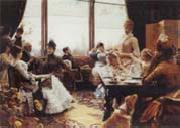 |
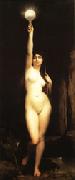
Julius L.Stewart
|
|
American Painter, 1855-1919
American artist, was born in Philadelphia. His father, William Hood Stewart, was a distinguished collector of the fine arts, an early patron of Fortuny and the Barbizon artists, and lived in Paris during the latter part of his life. The son was a pupil of JL Gerome, at the Ecole des Beaux Arts, and of Raymondo de Madrazo. Among his principal paintings are The Hunt Ball, Essex Club, Newark, New Jersey.
|
|
 |
Jules Lefebvre
|
|
Tournan-en-Brie, 1834-Paris 1912.
French Academic Painter.
|
|
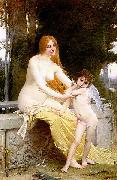 |
Jules Joseph Lefebvre
|
|
(Tournan-en-Brie, Seine-et-Marne, 14 March 1836 - Paris, 24 February 1911) was a French figure painter.
Lefebvre entered the École nationale superieure des Beaux-Arts in 1852 and was a pupil of Leon Cogniet. He won the prestigious Prix de Rome in 1861. Between 1855 and 1898, he exhibited 72 portraits in the Paris Salon. In 1891, he became a member of the French Academie des Beaux-Arts.
He was an instructor at the Academie Julian in Paris. He is chiefly important as an excellent and sympathetic teacher who numbered many Americans among his 1500 or more pupils. Some of his famous students were the Scottish-born landscape painter William Hart, as long as Georges Rochegrosse, Felix Vallotton, and many more. He was long a professor at the École des Beaux-Arts.
Many of his paintings are single figures of beautiful women.
Among his best portraits were those of M. L. Reynaud and the Prince Imperial (1874). Among his many decorations were a first-class medal at the Paris Exhibition of 1878 and the medal of honor in 1886. He was a Commander of the Legion of Honor and a member of the Institut de France.
|
|
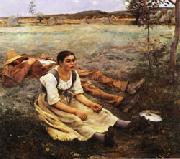 |
Jules Bastien-Lepage
|
|
French Realist Painter, 1848-1884
French painter. Bastien-Lepage grew up on a farm. Although his earliest efforts in drawing were encouraged, his parents violently objected when he decided to become a professional artist. To mollify them he worked for a time as a postal clerk in Paris while studying at the Ecole des Beaux-Arts. In 1868 he left the civil service and was accepted into Alexandre Cabanel's atelier. During this apprenticeship, Bastien-Lepage won two prizes in drawing, and in 1870 he made his d?but at the Salon with a Portrait of a Young Man (untraced). In the Franco-Prussian War (1870-71) he joined a regiment of sharpshooters and was severely wounded in the chest. When he recovered he attempted unsuccessfully to find work as an illustrator.
|
|
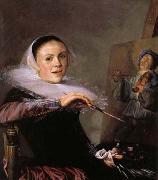 |
Judith leyster
|
|
1609-60
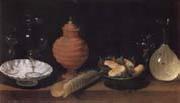
Dutch painter. She painted genre scenes, portraits and still-lifes, and she may also have made small etchings; no drawings by her are known. She specialized in small intimate genre scenes, usually with women seated by candlelight, and single half-length figures set against a neutral background.
|
|
 |
Juan van der Hamen y Leon
|
|
Spanish Baroque Era Painter, 1596-1631, was a Spanish painter, a master of the still life paintings, also called bodegones. During his lifetime, he was prolific and versatile, painting allegories, landscapes, and large-scale works for churches and convents. However, today he is remembered mostly for his still lifes. In the 1620s, He popularized still life painting in Madrid.Juan van der Hamen y (Gemez de) Leen was born in Madrid in 1596 but he was baptized late on April 8, 1596 in Madrid, therefore, he must had been born there just days before that date. He was the son of Jehan van der Hamen, a Flemish courtier, who had moved to Madrid from Brussels before 1586, and Dorotea Whitman Gemez de Leen, a half-Flemish mother of noble Toledan ancestry [1]. Van der Hamen and his two brothers Pedro and Lorenzo (both of whom were writers) emphasized their Spanish roots by using all or part of their maternal grandmother's family name, Gemez de Leen.. The painter's father, Jan van der Hamen, had come to Spain, as an archer, to the court of Philip II were he settled, married, and his children were born. According to 18th-century sources, the artist's father had also been a painter, but there is no evidence for this. Juan van der Hamen inherited his father's honorary positions at court and also served as unsalaried painter of the king. Van der Hamen's artistic activity in the service of the crown is first recorded on 10 September 1619, when he was paid for painting a still-life for the country palace of El Pardo, to the north of Madrid.
|
|
 |
Juan Pantoja de la Cruz
|
|
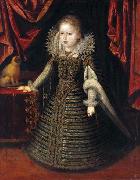
(Valladolid, 1553 - 26 October 1608, Madrid) Spanish painter, one of the best representatives of the Spanish school of court painters. He worked for Philip II and Philip III. The Museo del Prado contains examples of his severe portraiture style.
Juan Pantoja de La Cruz was, born 1553 in Valladolid. Very little is known of his formative years as a painter. He was a pupil of the court painter Alonso Senchez Coello in Madrid and he must have assisted his master in complying with his duties as painter of the Spanish King, Philip II. Pantoja probably continued to work in his master studio after completing his training. He married in 1585 beginning to paint for the court around that time. After Sanchez Coello's death in 1588, Pantoja took over his master workshop and became court painter to Philip II of Spain.
Pantoja kept working for the court and the nobility, painting portraits of Prince Philip, the future Philip III, in 1592 and 1594. Among his most well known works is the portrait of Philip II wearing a cape and hat all in black, painted around 1594 for the Escorial. This portrait is one of the best representations of the idea of Spanish majesty, based on the remoteness of the monarch. On Philip II's death in 1598, Philip III confirmed Pantoja's status as court painter. When the court settled in Valladolid in 1601, Pantoja moved to the new capital, remaining in this city, several years.
|
|
 |
Juan Luna
|
|
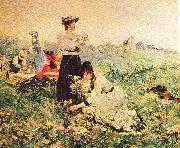
Juan Luna y Novicio (October 23, 1857 - December 7, 1899) was an Ilocano Filipino painter, sculptor and a political activist of the Philippine Revolution during the late 19th century. He became one of the first recognized Philippine artists.
His winning the gold medal in the 1884 Madrid Exposition of Fine Arts, along with the silver win of fellow Filipino painter Felix Resurreccien Hidalgo, prompted a celebration which was a major highlight in the memoirs of members of the Propaganda Movement, with the fellow Ilustrados toasting to the two painters' good health and citing their win as evidence that Filipinos and Spaniards were equals.
Regarded for work done in the manner of the Spanish and French academies of his time, Luna painted literary and historical scenes, some with an underscore of political commentary.
|
|
|
|
 |
Jozef Israels
|
|
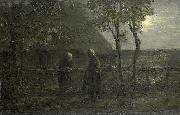
(27 January 1824, Groningen - 12 August 1911, Scheveningen) was a Dutch painter, and "the most respected Dutch artist of the second half of the nineteenth century".
|
|
 |
Josse Lieferinxe
|
|
active in Provence 1493-1505/08
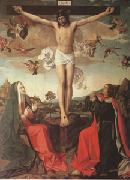
was a South Netherlandish painter, formerly known by the pseudonym the Master of St. Sebastian. Originating in the diocese of Cambrai in Hainaut, then part of the territories ruled by the Dukes of Burgundy. Josse Lieferinxe was documented as a "Picard" in the regions of Avignon and Marseille at the end of the fifteenth and in the early sixteenth centuries. He was first mentioned in Provence in 1493. Thus he figures among the painters of the Provençal school, whose most prominent members in an earlier generation had also been from the far north of the French-speaking world Barth lemy d'Eyck and Enguerrand Quarton. In 1503 he married Michelle, a daughter of Jean Changenet, the most prominent painter of Avignon, in whose atelier Lieferinxe may have matured his style. He was last mentioned living in 1505, and in 1508 as deceased. Before he was identified by Charles Sterling who linked his work with a document, his artistic personality was recognized, as the "Master of St. Sebastian", through a former retable of eight scenes depicting the acts and miracles of Saint Sebastian and Saint Roch, protectors against the plague, which was commissioned in 1497 for the church of Nôtre Dame des Accoul's in Marseille. Bernardino Sismondi, who originally received the commission, died, however, before he could finish the work.
|
|
|
|
|
|
|
|
 |
joseph lange
|
|
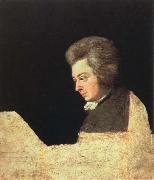
Joseph Lange (1 April 1751 W??rzburg - 17 September 1831 Vienna) was an actor and amateur painter of the 18th century. Through his marriage to Aloysia Weber, he was the brother-in-law of Wolfgang Amadeus Mozart.
|
|
 |
Jose Legarda
|
|
painted Portrait of Manuel de Alday, bishop of Santiago de Chile in 1772
|
|
|
|
 |
Jonas Lie
|
|
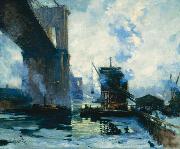
Jonas Lauritz Idemil Lie (6 November 1833 - 5 June 1908) was a Norwegian novelist, poet, and playwright who is considered to have been one of the Four Greats of 19th century Norwegian literature, together with Henrik Ibsen, Bjornstjerne Bjørnson and Alexander Kielland.
|
|
 |
John Seymour Lucas
|
|
(21 December 1849 - 8 May 1923) was a Victorian English historical and portrait painter as well as an accomplished theatrical costume designer. He was born into an artistic London family, and originally trained as a woodcarver, but turned his attention to portrait painting and entered first the St. Martin's Lane Art School and later the Royal Academy Schools. Here he met his French wife, fellow artist Marie Cornelissen, whom he married in 1877. Lucase artistic education included extensive travels around Europe, particularly Holland and Spain, where he studied the Flemish and Spanish Masters. He first started exhibiting in 1872, was elected an associate member of the Royal Academy in 1876 and a full Royal Academician in 1898.
John Seymour Lucas was first and foremost a historical genre painter with a particular talent for realism in the depiction of costumes and interiors. Inspired by van Dyck and particularly Diego Velezquez, he excelled in depicting scenes from the English 16th to 18th century Tudor and Stuart periods, including in particular the Spanish Armada, Preparing for the Voyage, the English Civil War and the Jacobite rebellions.
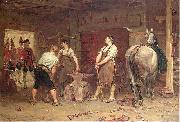
His first major work to achieve widespread public acclaim was Rebel Hunting after Culloden, executed in 1884. It was praised not only for the obvious tension between the muscular blacksmiths and the redcoated forces of law and order (or repression) but for the extraordinary realism in the depiction of the rough smithy and glowing horsehoe on the anvil. In 1885 his next major work whas "Preparing for the Voyage".
As his reputation grew, Lucas increasingly mixed in society circles, and became firm friends with the famous society portrait painter John Singer Sargent who was his almost exact contemporary. A portrait of Lucas executed by John Singer Sargent is displayed in Tate Britain. Towards the 1890s John Seymour Lucas executed a number of major works for prestigious public buildings or royal clients. These include: The Flight of the Five Members (Houses of Parliament), The Granting of the Charter of the City of London (Royal Exchange), Reception by HM King Edward VII of the Moorish Ambassador (Royal Collection), HRH the Prince of Wales in German Uniform (Royal Collection)
Apart from executing over 100 major oil paintings and a host of drawings, Lucas was renowned as a set and costume designer for the historical dramas popular on the late Victorian and early Edwardian stages. One of his more unusual commissions was the "Duke of Normandy" costume for the ill-fated prince Alfred of Saxe Coburg-Gotha for the Devonshire House Ball in 1897. Lucas was also a prolific watercolour painter and was elected a member of the Institute of Painters in Water Colours in 1877.
During most of his artistic career, John Seymour Lucas lived in a purpose-built studio in South Hampstead, London, designed for him by his friend and fellow artist, architect Sydney Williams-Lee.
He retired from painting towards the end of World War I, and moved to Blythburgh, Suffolk, where re-designed a house next to the church known as 'The Priory'. Lucas died in 1923 and is interred in Blythburgh church yard. His son, Sydney Seymour Lucas, was also an artist, and illustrator.
|
|
|
|
|
|
|
|
|
|
|
|
|
|
|
| Wholesale China Oil Painting Wholesale Oil Painting China Xiamen Portrait Reproduction on canvas Chinese Oil Painting Wholesale USA Oil Painting |
|
|
|
|
|