| |
|
Xiamen Oil Paintings, Wholesale Direct!
|
|
100% hand painted, 100% cotton canvas, 100% money back if not satisfaction. |
|
|
|
|
ART WORKS INDEX
A
B
C
D
E
F
G
H
I
J
K
L
M
N
O
P
Q
R
S
T
U
V
W
X
Y
Z
|
|
ARTISTS INDEX
A
B
C
D
E
F
G
H
I
J
K
L
M
N
O
P
Q
R
S
T
U
V
W
X
Y
Z
|
|
|
|
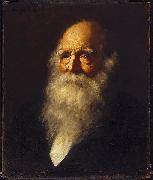 |
Wyatt Eaton
|
|
(May 6, 1849 - June 7, 1896) was an Canadian/American portrait and figure painter, remembered as one of the founders of the Society of American Artists.
Born in Philipsburg, Quebec, Lower Canada, Eaton was a student of the National Academy of Design, New York. In 1872, he moved to Paris and studied at the École des Beaux-Arts under Jean-Leon Gerôme. During this time, he made the acquaintance of Jean-François Millet at Barbizon, and was also influenced by his friend Jules Bastien-Lepage.
After his return to the United States in 1877, he became a teacher in the Cooper Institute, and opened a studio in New York City. He became one of the founders of the Society of American Artists, in which he was the first secretary. Eaton died from tuberculosis at Newport, Rhode Island on June 7, 1896.
|
|
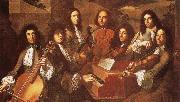 |
william wordsworth
|
|
Born: 7 April 1770
Birthplace: Cockermouth, England
Died: 23 April 1850
Best Known As: The author of the poem "Tintern Abbey"
|
|
 |
William Maw Egley
|
|
English painter , (1826-1916)
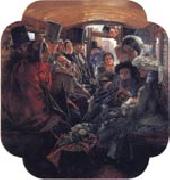
was a British artist of the Victorian era. The son of the miniaturist William Egley, he studied under his father. His early works were illustrations of literary subjects typical of the period, such as Prospero and Miranda from The Tempest. These were similar to the work of The Clique. William Powell Frith, one of The Clique, hired Egley to add backgrounds to his own work. Egley soon developed a style influenced by Frith, including domestic and childhood subjects. Most of his paintings were humorous or "feelgood" genre scenes of urban and rural life, depicting such subjects as harvest festivals and contemporary fashions. His best known painting, Omnibus Life in London (Tate Gallery) is a comic scene of people squashed together in the busy, cramped public transport of the era. Egley always showed great interest in specifics of costume, to which he paid detailed attention, but his paintings were often criticised for their hard, clumsy style. In the 1860s Egley adopted the fashion for romanticised 18th century subjects.
|
|
 |
William Etty
|
|
1787-1849
English
William Etty Location
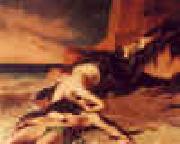
English painter. Born into a Methodist family, he was the seventh child of a miller and baker in Feasegate, York, and in 1798 he was apprenticed as a printer to Robert Peck, publisher of the Hull Packet. Financial support from his uncle, a banker, allowed him to go to London in 1805, where he entered the Royal Academy Schools in 1806. For a year, in 1807-8, he was a pupil of Thomas Lawrence, who greatly influenced him. Following the death of his uncle in 1809 he became financially secure. From 1811 he exhibited regularly at the Royal Academy and the British Institution and in 1816 worked in the studio of Jean-Baptiste Regnault in Paris.
|
|
 |
William Ellery Channing
|
|
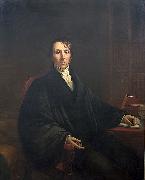
(April 7, 1780 - October 2, 1842) was the foremost Unitarian preacher in the United States in the early nineteenth century and, along with Andrews Norton, one of Unitarianism's leading theologians. He was known for his articulate and impassioned sermons and public speeches, and as a prominent thinker in the liberal theology of the day.
|
|
 |
William Edward frost R.A.
|
|
1810-1877
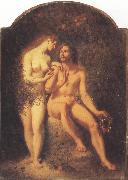
was an English painter of the Victorian era. Virtually alone among English artists in the middle Victorian period, he devoted his practice to the portrayal of the female nude. Frost was educated in the schools of the Royal Academy, beginning in 1829; he established a reputation as a portrait painter before branching into historical and mythological subjects, including the sub-genre of fairy painting that was characteristic of Victorian art. In 1839 he won the Royal Academy's gold medal for his "Prometheus Bound," and in 1843 he won a prize in the Westminster Hall competition for his "Una Alarmed by Fauns" (a subject from Spenser's The Faerie Queen). He was elected an associate member of the Royal Academy in 1846, and a full member in 1870. Frost is widely recognized as a follower of William Etty, who preceded him as the primary British painter of nudes in the second quarter of the nineteenth century.
|
|
|
|
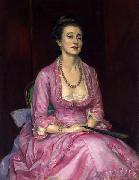 |
William Bruce Ellis Ranken
|
|
United Kingdom (1881- 1941 ) - Watercolours
painted Souvenir of the seventies. Signed with monogram and dated 1923
|
|
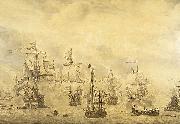 |
Willem van de Velde the Elder
|
|
(c. 1611 - 13 December 1693) was a Dutch Golden Age seascape painter.
Willem van de Velde, known as the Elder, a marine draughtsman and painter, was born in Leiden, the son of a Flemish skipper, Willem Willemsz. van de Velde, and is commonly said to have been bred to the sea. In 1706 Bainbrigg Buckeridge noted that he eunderstood navigation very welle. He married Judith Adriaensdochter van Leeuwen in Leiden, the Netherlands, in 1631.
His three known legitimate children were named Magdalena, born 1632; Willem, known as the Younger, also a marine painter, born 1633; and Adriaen, a landscape painter, born 1636.
His marriage was stormy, at least in its later years. David Cordingly relates that Willem the Elder fathered two children out of wedlock in 1653, one eby his maidservant, and the other by her friend. Nine years later the Elder and his wife went through a legal separation, eon account of legal disputes and the most violent quarrelse. The immediate cause of the dispute was his affair with a married woman.e Michael S. Robinson noted that eon 17/27 July 1662, he and his wife agreed to part. A condition of the separation was that the Elder could recover from his son Adriaen etwo royal giftse, presumably gifts from Charles II for work done in England.e Cordinglyes account further relates that the dispute was still continuing after another ten years, since ein the autumn of 1672 Judith complained to the womanes husband.e Robinson adds that by 1674 the couple emust have been reconcilede, for at a chance meeting with Pieter Blaeu in Amsterdam in July the Elder explained that he was only visiting for a few days ein order to fetch his wifee. His son, Adriaen, had died in Amsterdam in 1672, and Willem the Elder was also fetching his grandson, similarly named Adriaen, who was then aged two.
After his move to England, the exact date of which is uncertain, but reportedly at the end of 1672 or beginning of 1673, he is said to have lived with his family in East Lane, Greenwich, and to have used the Queenes House, now part of the National Maritime Museum in Greenwich, as a studio. Following the accession of William and Mary as King and Queen of England, it appears that this facility was no longer provided, and by 1691 he was living in Sackville Street, now close to Piccadilly Circus. He died in London, and was buried in St Jameses Church, at the south end of the street.
|
|
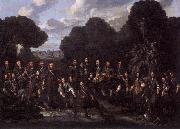 |
Willem Eversdijck
|
|
the son of Cornelis Eversdijck, flourished at Goes about the year 1660. He was a portrait painter, and several of his portraits were engraved by Houbraken. A picture of Officers and Members of the Company of Archers, called " Edele Voetboog," at Goes, by him, is in the Rotterdam Museum.
Cornelis Willemsz Eversdijck, his father, was also a portrait painter of Goes, who died there in 1649. In the Rotterdam Museum are three pictures by him, representing Officers and Members of the Company of Archers, called "Edele Voetboog," at Goes; two of which are dated 1616 and 1624.
|
|
|
|
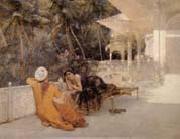 |
Weeks Lord-Edwin
|
|
189-1903
American artist, was born at Boston, Massachusetts, in 1849. He was a pupil of Leon Bonnat and of Jean-Leon Gerome, at Paris. He made many voyages to the East, and was distinguished as a painter of oriental scenes. In 1895 he wrote and illustrated a book of travels, From the Black Sea through Persia and India, and two years later he published Episodes of Mountaineering. He died in November 1903. He was a member of the Legion d'honneur, France, an officer of the Order of St. Michael, Germany, and a member of the Secession, Munich.
|
|
|
|
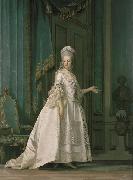 |
Vigilius Eriksen
|
|
(b Copenhagen, 2 Sept 1722; d Copenhagen, 23 or 24 May 1783). Danish painter, active also in Russia. He was apprenticed to the portrait painter Johann Salomon Wahl in Copenhagen. In 1755 he competed unsuccessfully for the gold medal at the Royal Academy of Art in Copenhagen with a historical painting, Lot and his Wife (untraced). In a letter he complained that the rules did not allow him to enter a portrait, a genre more suited to his talents. Presumably in 1756 he completed the portraits of the registrar of the royal art collections, Lorenz Spengler and his Wife (Copenhagen, Stat. Mus. Kst).
|
|
|
|
 |
VIGEE-LEBRUN, Elisabeth
|
|
French painter (full name: Marie-Louise-Élisabeth Vigee-Lebrun). Vigee LeBrun's most famous client was Marie Antoinette, France's much maligned queen. When the two met in 1778, Vigee LeBrun's art-dealer husband had gambled away his wife's earnings. Still, she was dauntless and set out to establish her own salon where she would court royal clients. In a November 1982 article for Art in America, Brooks Adams noted that in her memoirs, Vigee LeBrun said that her much sought-after salon was, "a place where art and society mixed, where noblemen and ministers were content to sit on the floor, to avoid the stiff, formal court entertainments at Versailles." In time, her portraits and memoirs alike painted a portrait of Vigee LeBrun as a woman born to contend with anyone. Unfortunate Circumstances Marie Louise Elisabeth Vigee LeBrun was born in 1755 in Paris. Her father was Louis Vigee, a little-known portrait artist who worked in pastels. From the time she was small, he taught his daughter the skills of the trade. She proved to be somewhat of a prodigy. Her parents placed Vigee LeBrun in the convent of La Trinite, directly behind the Bastille. Her earliest memories were of drawing so frantically on the walls of her dormitory that the sisters regularly punished her. When her father died, Vigee LeBrun was only 12. He had been her biggest supporter. For an article in Antiques, magazine in November 1967, Ilse Bischoff quoted Vigee LeBrun's father after he saw a drawing she had done as a small child. It was the head of a bearded man with the light of a lamp falling on his face. She took care to observe light and shade, and showed skill beyond her years. Her father had exclaimed, "You will be a painter if I ever saw one." By the time she was 15, Vigee LeBrun had established a business as a painter that provided major financial support for her family. Her mother was a hairdresser from Luxembourg, who remarried not long after her first husband's death. Her stepfather soon began to squander her earnings. When she was only 21, she married an art dealer named Pierre LeBrun. It was clearly a marriage more of convenience, than of love. They had one daughter, Julie, born in 1780. Vigee LeBrun's marriage helped her gain access to a world normally restricted to men. Although she was denied access to a male apprentice system, and was unable to participate in classes at the major art academies around the city, she gained admission to the lesser salon of the Academie de Saint Luc. However, the Academie Royale was closed to her without proper connections. In those days, being shown in lesser salons kept a painter away from the financial benefits to be gained from wealthier clients who frequented the prestigious Academie Royale. When Vigee LeBrun was finally admitted to the Royale in 1783, her critics were not kind. She was accused of using her husband and the palace, most particularly her friendship with Queen Marie Antoinette. Another unfortunate rumor was that she had a long-standing sexual affair with the finance minister, Calonne. Her accusers contended that he aided her in squandering much of the Royal Treasury. That was never proven. Still, it was clear that she capitalized on her associations with the queen and the rest of the royal family. The aristocracy longed to be seen as simple, especially as unrest grew among the people outside of the palace confines. One portrait of Marie Antoinette was considered so scandalously informal, that it was withdrawn from the salon in the midst of her debut at the Academie Royale. Vigee LeBrun's arch-rival was a woman painter named Madame Labille Guiard. They were admitted to the Academie Royale on the same day. For the rest of the decade, before the French Revolution erupted in 1789, the two women maintained their rivalry. At the time of the academy's biennial exhibitions, the bitterness they felt toward each other had reached the height of its intensity. Vigee LeBrun painted one of her most acclaimed works in 1784. It was the portrait of Marie-Gabrielle de Gramont, Duchess of Caderousse. That was the same year she suffered a miscarriage, and painted only five portraits. Her usual output far exceeded that. The portrait was shown at the Salon of 1785 to much acclaim and became one of the artist's most celebrated works. In her memoirs, written fifty years later, Vigee LeBrun recalled the painting. "As I detested the female style of dress then in fashion, I bent all my efforts upon rendering it a little more picturesque, and was delighted when, after getting the confidence of my models, I was able to drape them according to my fancy. Shawls were not yet worn, but I made an arrangement with broad scarfs lightly intertwined around the body and on the arms, which was an attempt to imitate the beautiful drapings of Raphael and Domenichino I could not endure powder persuaded the Duchess to put none on for her sittings." Thrived in Exile Vigee LeBrun was not immune to the anxious rumbling that became the French Revolution. What had begun on that fateful night of July 14, 1789, erupted further when mobs stormed the palace at Versailles on the following October 6. Vigee LeBrun had been in disfavor for her association with Marie Antoinette for some time and was considered to be a royal sympathizer.
|
|
|
|
|
|
|
|
 |
ulrika eleonora
|
|
Ulrika Eleonora d.y., född 23 januari 1688, död 24 november 1741, var regerande drottning av Sverige 1719-1720, dotter till Karl XI och Ulrika Eleonora av Danmark, syster till Karl XII samt kusin till August den starke, Fredrik IV av Danmark och Fredrik IV av Holstein-Gottorp.
Hon gifte sig 24 mars 1715 med Fredrik av Hessen, den blivande Fredrik I, men förblev barnlös.
Ulrika Eleonora föddes den 23 januari 1688 på Stockholms slott som dotter till kung Karl XI och Ulrika Eleonora d.ä. Under barndomen förbisågs hon av alla för sin äldre, livligare och mera begåvade syster Hedvig Sofia.
Så snart hon blivit giftasvuxen fick hon många friare, bland andra blivande Georg II av Storbritannien och arvprins Fredrik av Hessen-Kassel. Redan 1710 begärde denne hennes hand, men deras trolovning tillkännagavs inte förrän den 23 januari 1714. Bilägret firades den 24 mars 1715.
Under Karl XII:s vistelse utomlands var hon, efter Hedvig Sofias död (1708), den enda myndiga medlemmen av kungahuset inom riket om man borträknar hennes åldriga farmor (Hedvig Eleonora).
I slutet av 1712 eller början av 1713 hade Karl XII tankar om att göra sin syster Ulrika Eleonora till regent, men fullföljde inte denna plan. Det kungliga rådet däremot övertalade henne att bevista dess sammanträden för att i henne erhålla ett stöd. Första gången hon infann sig i rådet, 2 november 1713, beslöts också om sammankallande av en riksdag. Det s.k. rörelsepartiet vid denna riksdag ville att prinsessan i kungens frånvaro skulle göras till riksföreståndarinna "såsom närmaste arvinge till kronan och regementet". Detta förslag motarbetades av Arvid Horn och rådet, som fruktade att svårigheterna för en ändring av regeringssättet därigenom skulle ökas. Prinsessan visade emellertid ständerna stort intresse för landets angelägenheter. I sina brev till kungen uppmanade hon honom att återvända hem och varnade honom för möjliga följder av hans frånvaro. Med hans samtycke undertecknade hon under den följande tiden alla rådets skrivelser, utom dem som var ställda till honom, för i sin egenskap av vice regent var hon ett med kungen enligt dennes uppfattning. Mera sällan deltog hon i rådets förhandlingar.
|
|
|
|
|
|
|
|
 |
Thomas Ender
|
|
(3 November 1793 Vienna - 28 September 1875 Vienna) was an Austrian painter.
He was twin brother of Johann Ender. He also studied at the Vienna Academy, becoming a noted landscape painter. He won the grand prize at the Vienna Academy in 1816. Going to Brazil in 1817, he brought back nearly a thousand drawings and water colors. He visited Italy, Palestine, Greece and Paris. In 1836, he became corrector and later professor at the Vienna Academy, filling that chair until 1849.
|
|
 |
Thomas Eakins
|
|
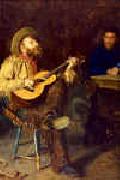
American Realist Painter, 1844-1916.
Thomas Cowperthwait Eakins (July 25, 1844 ?C June 25, 1916) was a realist painter, photographer, sculptor, and fine arts educator. He is widely acknowledged to be one of the most important artists in American art history.
For the length of his professional career, from the early 1870s until his health began to fail some forty years later, Eakins worked exactingly from life, choosing as his subject the people of his hometown of Philadelphia. He painted several hundred portraits, usually of friends, family members, or prominent people in the arts, sciences, medicine, and clergy. Taken en masse, the portraits offer an overview of the intellectual life of Philadelphia in the late 19th and early 20th centuries; individually, they are incisive depictions of thinking persons. As well, Eakins produced a number of large paintings which brought the portrait out of the drawing room and into the offices, streets, parks, rivers, arenas, and surgical amphitheaters of his city. These active outdoor venues allowed him to paint the subject which most inspired him: the nude or lightly clad figure in motion. In the process he could model the forms of the body in full sunlight, and create images of deep space utilizing his studies in perspective.
No less important in Eakins' life was his work as a teacher. As an instructor he was a highly influential presence in American art. The difficulties which beset him as an artist seeking to paint the portrait and figure realistically were paralleled and even amplified in his career as an educator, where behavioral and sexual scandals truncated his success and damaged his reputation.
Eakins also took a keen interest in the new technologies of motion photography, a field in which he is now seen as an innovator. Eakins was a controversial figure whose work received little by way of official recognition during his lifetime. Since his death, he has been celebrated by American art historians as "the strongest, most profound realist in nineteenth-and early-twentieth-century American art".
|
|
 |
Theodor Esbern Philipsen
|
|
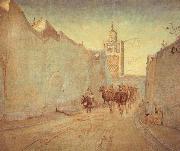
1840-1920
Danish painter, sculptor and draughtsman. He studied at the Kongelige Akademi for de Skenne Kunster, Copenhagen, in 1862-3 and 1865-9, and in Paris under Leon Bonnat in 1875-6. He was an important figure in the development and renewal of Danish naturalism, linking the Danish Golden Age tradition with new French ideas. Conscious of the importance of plein-air painting, he was first a great admirer of the Barbizon school; later he was influenced by the Impressionists, becoming the only truly Danish Impressionist. Frequent visits abroad helped him develop his outlook; he eagerly studied the Old Masters, and the strong light of the south
|
|
|
|
|
|
|
|
 |
solomon eccles
|
|
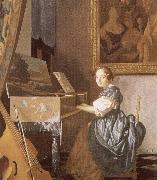
also known as Solomon Eagle (1618 - 1683) was an English composer.
Little if any of his works are extant since, when he became a Quaker, he burned all his books and compositions so as to distance himself from church music. His repugnance for the organised church showed in his name for them: "steeple-houses".
|
|
 |
SIRANI, Elisabetta
|
|
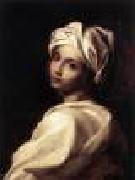
Italian Baroque Era Painter, 1638-1665
Italian painter. She was the daughter of Giovanni Andrea Sirani (1610-70), who had been Guido Reni's principal assistant. Encouraged by Carlo Malvasia, her mentor and eventual biographer, she was painting professionally by the age of 17. Her prolific talent, as well as her reputed beauty and modesty, soon brought her European renown. The details of her training are unclear, but as a woman she would not have had access to an academy and (like many other professional women painters prior to the 20th century) she was probably taught by her father. Her sisters Anna Maria (1645-1715) and Barbara (alive in 1678) were also practising artists and Elisabetta herself is known to have had female students. As women, they could not undertake any formal study of the male nude, and Sirani's weakness in depicting male anatomy is sometimes clearly detectable in her work Sirani's drawings employ a highly individual pen-and-wash method, eschewing outline and employing quick, blunt strokes of barely dilute ink to create striking chiaroscuro effects
|
|
 |
Sir John Everett Millais
|
|
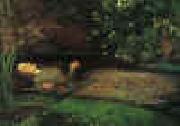
British 1829-1896 Sir John Everett Millais Galleries After his marriage, Millais began to paint in a broader style, which was condemned by Ruskin as "a catastrophe". It has been argued that this change of style resulted from Millais' need to increase his output to support his growing family. Unsympathetic critics such as William Morris accused him of "selling out" to achieve popularity and wealth. His admirers, in contrast, pointed to the artist's connections with Whistler and Albert Moore, and influence on John Singer Sargent. Millais himself argued that as he grew more confident as an artist, he could paint with greater boldness. In his article "Thoughts on our art of Today" (1888) he recommended Vel??zquez and Rembrandt as models for artists to follow. The Two Princes Edward and Richard in the Tower (1878) The Boyhood of Raleigh (1871)Paintings such as The Eve of St. Agnes and The Somnambulist clearly show an ongoing dialogue between the artist and Whistler, whose work Millais strongly supported. Other paintings of the late 1850s and 1860s can be interpreted as anticipating aspects of the Aesthetic Movement. Many deploy broad blocks of harmoniously arranged colour and are symbolic rather than narratival. Later works, from the 1870s onwards demonstrate Millais' reverence for old masters such as Joshua Reynolds and Vel??zquez. Many of these paintings were of an historical theme and were further examples of Millais' talent. Notable among these are The Two Princes Edward and Richard in the Tower (1878) depicting the Princes in the Tower, The Northwest Passage (1874) and the Boyhood of Raleigh (1871). Such paintings indicate Millais' interest in subjects connected to Britain's history and expanding empire. His last project was to be a painting depicting a white hunter lying dead in the African veldt, his body contemplated by two indifferent Africans. This fascination with wild and bleak locations is also evident in his many landscape paintings of this period, which usually depict difficult or dangerous terrain. The first of these, Chill October (1870) was painted in Perth, near his wife's family home. Many others were painted elsewhere in Perthshire, near Dunkeld and Birnam, where Millais rented grand houses each autumn in order to hunt and fish. Millais also achieved great popularity with his paintings of children, notably Bubbles (1886) ?C famous, or perhaps notorious, for being used in the advertising of Pears soap ?C and Cherry Ripe.
|
|
|
|
 |
Sir edwin landseer,ra
|
|
1802-1873
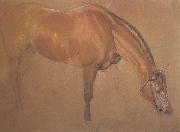
Painter, draughtsman, sculptor and etcher, brother of (3) Charles Landseer. He became the best-known member of the family and was one of the most highly respected and popular British painters of the 19th century. He was first trained by his father, who taught him etching, and he then studied with Benjamin Robert Haydon and at the Royal Academy Schools in London. Precociously gifted, he drew competently from childhood and in 1813 he won the Silver Palette for draughtsmanship at the Society of Arts. In 1815 he exhibited at the Royal Academy for the first time, showing some drawings of a mule and of the heads of dogs. From an early age he was a frequent visitor to the menagerie in Exeter Change in the Strand, London, where he drew lions, monkeys and other animals.
|
|
 |
Sir edwin henry landseer,R.A.
|
|
1802-1873
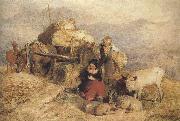
Painter, draughtsman, sculptor and etcher, brother of (3) Charles Landseer. He became the best-known member of the family and was one of the most highly respected and popular British painters of the 19th century. He was first trained by his father, who taught him etching, and he then studied with Benjamin Robert Haydon and at the Royal Academy Schools in London. Precociously gifted, he drew competently from childhood and in 1813 he won the Silver Palette for draughtsmanship at the Society of Arts. In 1815 he exhibited at the Royal Academy for the first time, showing some drawings of a mule and of the heads of dogs. From an early age he was a frequent visitor to the menagerie in Exeter Change in the Strand, London,
|
|
 |
Sir Edward john poynter,bt.,P.R.A
|
|
1836-1919
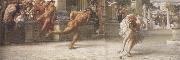
English painter, draughtsman, decorative designer and museum official. He came from an artistic family: his great-grandfather was Thomas Banks the sculptor, and Ambrose Poynter, his father, was an architect and watercolour painter. Edward began studying art in 1852 under Thomas Shotter Boys, a friend of his father. In 1853-4 Poynter visited Rome, where he was greatly impressed by the large-scale academic painting of Frederic Leighton. Returning to London, he studied at Leigh's Academy and the studio of William Dobson (1817-1898). Poynter entered the Royal Academy Schools in 1855 but his admiration for French painting led him to Charles Gleyre's studio in Paris the following year. He remained there until 1859, with fellow students George Du Maurier, Thomas Armstrong and Whistler; their activities are described in Du Maurier's novel Trilby (1894). At this time Poynter received his first commissions for decorative work. He began designing stained glass and painting furniture and, after his return to England, he was employed by his friend the architect William Burges to decorate the ceiling of Waltham Abbey, Essex, in 1860.
|
|
|
|
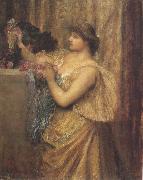 |
Sir edward coley burne-jones,Bt.,A.R.A.,R.W.S
|
|
1833-1898
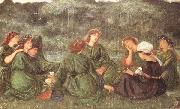
English painter and decorative artist. He was the leading figure in the second phase of the Pre-Raphaelite movement. His paintings of subjects from medieval legend and Classical mythology and his designs for stained glass, tapestry and many other media played an important part in the Aesthetic Movement and the history of international Symbolism.
|
|
|
|
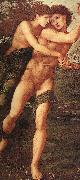 |
Sir Edward Coley Burne-Jones
|
|
British Pre-Raphaelite Painter, 1833-1898
English painter and decorative artist. He was the leading figure in the second phase of the Pre-Raphaelite movement. His paintings of subjects from medieval legend and Classical mythology and his designs for stained glass, tapestry and many other media played an important part in the Aesthetic Movement and the history of international Symbolism.
|
|
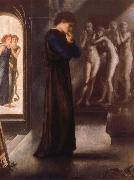 |
Sir Edward Burne-Jones
|
|
Britain 1833-1898
English painter and decorative artist. He was the leading figure in the second phase of the Pre-Raphaelite movement. His paintings of subjects from medieval legend and Classical mythology and his designs for stained glass, tapestry and many other media played an important part in the Aesthetic Movement and the history of international Symbolism.
|
|
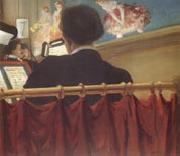 |
Shinn Everett
|
|
American Ashcan School Painter, 1876-1953
American painter, illustrator, designer, playwright and film director. He studied industrial design at the Spring Garden School in Philadelphia from 1888 to 1890. In 1893 he became an illustrator at the Philadelphia Press. Simultaneously he attended the Pennsylvania Academy of Fine Arts, Philadelphia, where he met Robert Henri, John Sloan, William J. Glackens and George Luks. Their style of urban realism prompted him to depict the bleak aspects of city life. In 1897 Shinn moved to New York and produced illustrations for several newspapers and magazines
|
|
|
|
|
|
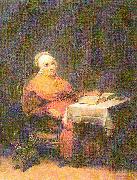 |
Robert Wilhelm Ekman
|
|
(August 13, 1808 - February 19, 1873), aka R. W. Ekman, was a significant teacher and painter of the Finnish romantic portraits and early national romanticism.
Robert Ekman was born in Uusikaupunki, Finland to an upper class family. His father was Karl Kristoffer Ekman, a medical doctor and a mayor. Mother was Sara Elisabet (maiden name Gadolin). Robert Ekman's both parents died when he was about 10 years old. They left behind five orphans who were placed in foster homes. Schooling was incomplete and there was no chance of academic education.
Robert Ekman first studied in Finland under the guidance of Gustaf Wilhelm Finnberg, but in 1824, with his brother Fredrubjm begun studies in Kungliga Akademien för de Fria Konsterna (The royal academy for free arts) in Stockholm. Already as a student Ekman specialized in portraying the life of the common people, instead of Classicism of the academic arts. Ekman graduated in 1836, and was granted a generous traveling scholarship for excelling in his studies. That supported him working in Holland, France and Italy between years 1837-1844. As the scholarship was not plausible otherwise, Ekman took the Swedish citizenship.
|
|
|
|
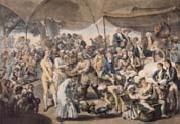 |
Richard Earlom
|
|
English Printmaker, 1743-1822,English printmaker. Taught by Giovanni Battista Cipriani, he worked in mezzotint, etching and occasionally stipple. His mezzotints of flowers and still-lifes, such as Roses for the Temple of Flora (1805) by Robert John Thornton (?1768-1837) or the Fruit Piece (see Wessely, no. 145) after Jan van Huysum, are also found printed in colours or coloured by hand. Earlom's most influential prints were a set of outline etchings combined with mezzotint of the volume, then belonging to the Dukes of Devonshire, of Claude's drawings of his own landscape paintings
|
|
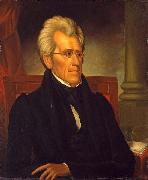 |
Ralph Eleaser Whiteside Earl
|
|
(1785-8 - Nashville, Tennessee, September 16, 1838), also known as Ralph E. W. Earl or Ralph Eleazer Whiteside Earl, was an American painter known as the "court painter" to President Andrew Jackson.
Earl was the son of portrait painter Ralph Earl and his second wife Ann Whiteside. He was born c. 1785-88, probably in New York City, and likely received his early training in portraiture from his father, whose naive style is reflected in the younger Earl's earliest works. He traveled to London in 1809, where he studied for a year with John Trumbull and was advised by Benjamin West, learning perspective, anatomy, and three-dimensional illusion. He remained in England until 1814, living with his maternal grandfather and uncle in Norwich and executing portrait commissions. He then traveled to Paris before returning to the United States in December 1815 with the intention of creating grand-scale history paintings on the European model.
As preparation for a planned project depicting the Battle of New Orleans, Earl met General Andrew Jackson and visited him at his Tennessee home, The Hermitage, in January 1817. Earl painted portraits of Jackson and his family, and married Mrs. Jackson's niece Jane Caffery on 19 May 1819. She died in childbirth in 1820.
|
|
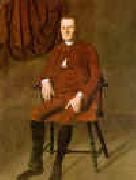 |
Ralph Earl
|
|
1751- 1801
Ralph Earl Galleries
Ralph Earl was born in either Shrewsbury or Leicester, Massachusetts. By 1774, he was working in New Haven, Connecticut as a portrait painter. In the autumn of 1774, Earl returned to Leicester, Massachusetts to marry his cousin, Sarah Gates. A few months later, their daughter was born; however, Earl left them both with Sarah's parents and returned to New Haven.
Like so many of the colonial craftsmen, Earl was self-taught, and for many years was an itinerant painter. In 1775, Earl visited Lexington and Concord, which were the sites of recent battles in the American Revolution. Together with engraver Amos Doolittle, he painted four of his most famous pictures, all battle scenes.
Although his father was a colonel in the Revolutionary army, Ralph Earl himself was a Loyalist. In 1778, he left behind his wife and daughter and escaped to England by disguising himself as the servant of British army captain John Money.
|
|
|
|
|
|
|
|
|
|
|
| Wholesale China Oil Painting Wholesale Oil Painting China Xiamen Portrait Reproduction on canvas Chinese Oil Painting Wholesale USA Oil Painting |
|
|
|
|
|