| |
|
Xiamen Oil Paintings, Wholesale Direct!
|
|
100% hand painted, 100% cotton canvas, 100% money back if not satisfaction. |
|
|
|
|
ART WORKS INDEX
A
B
C
D
E
F
G
H
I
J
K
L
M
N
O
P
Q
R
S
T
U
V
W
X
Y
Z
|
|
ARTISTS INDEX
A
B
C
D
E
F
G
H
I
J
K
L
M
N
O
P
Q
R
S
T
U
V
W
X
Y
Z
|
|
|
|
|
|
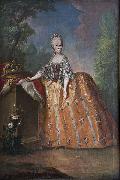 |
Workshop of Anton von Maron
|
|
Anton von Maron (January 8, 1733 - March 3, 1808) was an Austrian painter, active in Rome.
Von Maron was born in Vienna, but moved at a young age to Rome. There, he studied under Anton Raphael Mengs, and became an accomplished portrait painter. He married a sister of Mengs, Therese Maron, who was a painter in her own right. He lived the rest of his life in Rome, and died there in 1808.
|
|
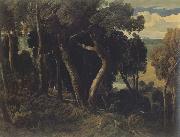 |
William Turner of Oxford
|
|
British, 1789-1862
He probably received his earliest training from William Delamotte, in Oxford. In 1804 he went to London and became a pupil of John Varley, possibly being formally apprenticed. He first exhibited at the Royal Academy in 1807; in January 1808 he was elected an associate of the Society of Painters in Water-Colours, and in November of that year became its youngest full member. He exhibited there annually from 1808 until his death, sending 455 works in all. His passionate, technically complex youthful work was highly acclaimed, yet its promise remained unfulfilled; around 1811 he returned to Oxfordshire and soon established himself as a drawing-master in Oxford.
|
|
 |
William Turner
|
|
English Romantic Painter, 1775-1851
British painter and printmaker. He dominated British landscape painting throughout the first half of the 19th century. He established a reputation in the Royal Academy, London, first as a topographical watercolourist and then within a few years as a painter of Sublime and historical landscapes.
|
|
|
|
|
|
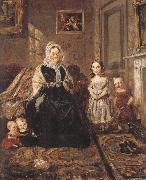 |
william holman hunt,o.m.,r.w.s
|
|
1827-1910
English painter. He worked as an office clerk in London from 1839 to 1843, attending drawing classes at a mechanics' institute in the evenings and taking weekly lessons from the portrait painter Henry Rogers. Holman Hunt overcame parental opposition to his choice of career in 1843, and this determined attitude and dedication to art could be seen throughout his working life. In July 1844, at the third attempt, he entered the Royal Academy Schools. His earliest exhibited works, such as Little Nell and her Grandfather (exh. British Institution, 1846; Sheffield, Graves A.G.), reveal few traces of originality, but the reading of John Ruskin's Modern Painters in 1847 was of crucial importance to Holman Hunt's artistic development. It led him to abandon the ambitious Christ and the Two Marys (Adelaide, A.G. S. Australia) in early 1848, when he realized its traditional iconography would leave his contemporaries unmoved. His next major work, the Flight of Madeline and Porphyro during the Drunkenness Attending the Revelry (1848; London, Guildhall A.G.), from John Keats's 'Eve of St Agnes', though displaced into a medieval setting, dramatized an issue dear to contemporary poets and central to Holman Hunt's art: love and youthful idealism versus loyalty to one's family. His first mature painting, it focuses on a moment of psychological crisis in a cramped and shallow picture space.
|
|
|
|
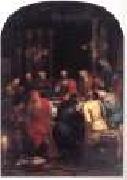 |
VEEN, Otto van
|
|
Flemish painter (b. 1556, Leiden, d. 1629, Bruxelles).
Flemish painter and draughtsman of Dutch birth. Although born in Holland, he is regarded as an artist of the Catholic southern Netherlands, where he spent most of his active life. He seems to have been acquainted with most of the Netherlandish scholars of his time, and his works testify to his broad humanistic learning. This and his prominent role in the early manifestations of the Counter-Reformation in Antwerp may have led Rubens to choose him as a teacher. Van Veen's importance as an artist has often been compared to the career of his famous pupil, for whom he was certainly the most important exemplar of the pictor doctus or learned painter. Van Veen obviously represents the older generation's more classicizing and conservative response to the Counter-Reformation. For him, the return to the spiritual values of the past also implied a recovery of the pictorial style of the High Renaissance, with its deliberate borrowings from the paintings of such artists as Raphael and Correggio.
|
|
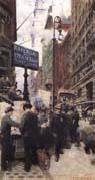 |
Thornton Oakley
|
|
an illustrator,American , 1881-1953
was an American artist and illustrator. Thornton Oakley was born March 27,1881, in Pittsburgh. He studied at the University of Pennsylvania and received B.S. and M.S. degrees in architecture in 1901 and 1902. He first studied with Howard Pyle in 1902 at Chadds Ford in the mill, and described his first day there in a talk given at the Free Library in Philadelphia in 1951: "There we four - my new cronies - Allen Tupper True, George Harding, Gordon McCouch and I - made our first sketches from a model, and our efforts were frightful to behold! Not one of us had had a palette in our hands ever before: I had not the least idea as to procedure. My attempts were terrifying to behold, and when H.P. came to me to criticize my work he paused for a long, long time before speaking, and I know that he must have been appalled." Oakley studied with Pyle for three years. Oakley became an illustrator and writer for periodicals, including Scribner's, Century, Collier's, and Harper's Monthly. In the years 1914-19 and 1921-36 he was in charge of the Department of Illustration at the Philadelphia Museum School of Industrial Art. In 1914-15 he also taught drawing at the University of Pennsylvania, and gave lectures at the Art Institute of Chicago, the Metropolitan Museum of Art, and the Curtis Institute. He was a member of the jury of selection and advisory committee of the Department of Fine Arts at the Panama-Pacific International Exposition in San Francisco in 1915 and the Philadelphia Sesquicentennial Exposition in 1926.
|
|
|
|
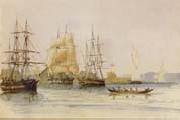 |
Stanley, Owen
|
|
1811 - 1850,was commander of HMS Rattlesnake on a four year exploratory expedition to New Guinea, 1846?C1850. Stanley was the son of Edward Stanley, Bishop of Norwich. He left naval college at the age of fifteen, and served under Phillip Parker King on HMS Adventure and John Franklin in the Mediterranean. In 1836 he sailed to the Arctic as scientific officer on HMS Terror under George Back. In 1838 he was given command of HMS Britomart and sailed to Australia, returning in 1843. In December 1846 Stanley sailed from Portsmouth in charge of HMS Rattlesnake, with the purpose of surveying the seas around the Great Barrier Reef and Torres Strait. The ship called at Madeira, Rio de Janeiro, Simon's Town and Mauritius, arriving in Sydney in July 1847.
|
|
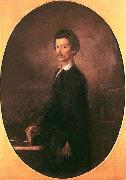 |
Soma Orlai Petrich
|
|
(October 22, 1822, Mezőbereny - June 5, 1880, Budapest) was a Hungarian painter. Petrich was born to a Serbian father and Hungarian mother.
He originally wanted to become a writer. He was a pupil of Jakab Marastoni in 1846 and attended Ferdinand Georg Waldmeller's school in Vienna from 1847. He often painted historical themese and in his lithographs he portrayed experiences during the war of independence. He studied from Kaulbach in Munich from 1850. He painted "The Corpse of Louis II" in 1851, a decade before Bertalan Szekely's painting. He was also a popular portraitist.
|
|
 |
Sir William Orpen
|
|
Irish
1878-1931
Sir William Orpen Location
Irish painter. He attended the Metropolitan School of Art, Dublin (1891-7), and the Slade School of Art, London (1897-9), there winning the composition prize of 1899 with The Play Scene from Hamlet (Houghton Hall, Norfolk). He became a friend of Augustus John and joined the New English Art Club. From very early years he had been an impassioned student of the Old Masters, and he went to Paris with John in 1899 to see Leonardo da Vinci Mona Lisa (Paris, Louvre). In the following years his perception of their works
|
|
|
|
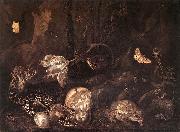 |
SCHRIECK, Otto Marseus van
|
|
Dutch Baroque Era Painter, 1619-1678
Dutch painter. According to Houbraken, he travelled to Italy and stayed in Rome and Florence with the painters Matthias Withoos and Willem van Aelst, the latter his pupil at the time. Among his patrons were Ferdinando II de' Medici, Grand Duke of Tuscany (reg 1621-70). Van Hoogstraten claimed that he met van Schrieck in Rome as late as 1652. In Rome, van Schrieck was a member of the Schildersbent. About 1657 he returned with van Aelst to Amsterdam, where he had a small property and got married on 25 April 1664. An inventory of the contents of his house was made in July 1678, shortly after his death, in which more than 300 paintings are listed. Besides his own paintings, there were works by Cornelis van Poelenburch, Simon de Vlieger, Ludolf Bakhuizen, Jan Wijnants, Lucas van Leyden
|
|
|
|
|
|
|
|
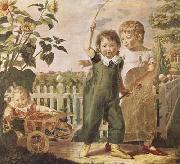 |
Philipp Otto Runge
|
|
German Romantic Painter, 1777-1810
..German painter, draughtsman and theorist. He stands alongside Caspar David Friedrich as a leading figure in German Romantic painting even though his early death restricted his oeuvre to relatively few stages of development. The enduring prominence of philosophical and theoretical concerns suggests that further work would have contributed to the history of ideas as well as to that of art. Runge's greatest influence was on later, largely 20th-century artists and thinkers rather than on his immediate contemporaries. While 19th-century developments certainly bore out Runge's claim for a new, symbolic role for landscape,
|
|
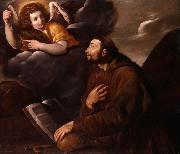 |
Pasquale Ottino
|
|
(Verona, 1578 - Verona, 1630) was an Italian painter.
Born in Verona in 1578, Ottino learned his trade in the workshop of Felice Brusasorci together with Alessandro Turchi, known as Orbetto, with whom he completed the Fall of Manna in the church of San Giorgio in Braida, left unfinished on the masteres death in 1605. His early works attest to the decidedly Mannerist character of the initial phase of his career. The sources indicate fairly constant activity in his hometown, even though there are still some doubts as to the reconstruction of his artistic career, especially incongruities regarding a trip to Rome that may have taken place with his companions Turchi and Bassetti around 1615. He died of plague in Verona in 1630.
|
|
 |
Ozias Humphry
|
|
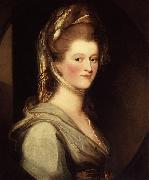
Ozias Humphry (or Humphrey) (8 September 1742 -9 March 1810) was a leading English painter of portrait miniatures, later oils and pastels, of the 18th century. He was elected to the Royal Academy in 1791, and in 1792 he was appointed Portrait Painter in Crayons to the King.
Born and schooled in Honiton, Devon, Humphrey was attracted by the gallery of casts opened by the Duke of Richmond and came to London to study art at Shipley's school. He also studied art in Bath (under Samuel Collins, taking over his practice in 1762); in Bath, he lodged with Thomas Linley. As a young artist, his talent was encouraged by Thomas Gainsborough and Sir Joshua Reynolds, among others. His problems with his sight, which ultimately led to blindness, began in the early 1770s and forced him to paint larger works in oils and pastel.
He travelled to Italy in 1773 with his great friend George Romney, stopping en route at Knole, near Sevenoaks in Kent, where the Duke of Dorset commissioned several works from him. His stay in Italy lasted until 1777.
On his return, his numerous subjects included George Stubbs (1777), fellow academician Dominic Serres, the chemist Joseph Priestley, and a portrait claimed to be of the teenage Jane Austen, from perhaps as early as 1790 (clothing styles suggest a later date), known as the "Rice" portrait after a later owner, though this has always been a controversial attribution of the sitter. This failed to reach its minimum estimate in a Christies auction in April 2007, and was withdrawn from sale. His pupils included John Opie. He compiled a fifty-page manuscript A Memoir of George Stubbs, based on what Stubbs had related to him; it is the only contemporary biography. This was edited and privately published in the 1870s and republished in 2005. He also knew William Blake and commissioned copies of some of his illustrated books. At least one of Blake's letters to him is a significant document for Blake's biographers.
|
|
 |
Ozias Humphrey
|
|
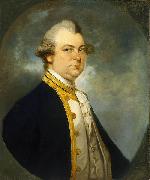
(8 September 1742 - 9 March 1810) was a leading English painter of portrait miniatures, later oils and pastels, of the 18th century. He was elected to the Royal Academy in 1791, and in 1792 he was appointed Portrait Painter in Crayons to the King.
Born and schooled in Honiton, Devon, Humphrey was attracted by the gallery of casts opened by the Duke of Richmond and came to London to study art at Shipley's school. He also studied art in Bath (under Samuel Collins, taking over his practice in 1762); in Bath, he lodged with Thomas Linley. As a young artist, his talent was encouraged by Thomas Gainsborough and Sir Joshua Reynolds, among others. His problems with his sight, which ultimately led to blindness.
|
|
 |
Owen, William
|
|
English, 1769-1825
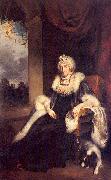
English painter. The son of a bookseller, he was educated at the grammar school in Ludlow and was sent to London in 1786 to study under Charles Catton the elder (1728-98), coach painter to George III and founder-member of the Royal Academy. Owen's copy of a work by Reynolds, made soon after his arrival, attracted the latter's attention. He entered the Royal Academy Schools in 1791 and exhibited at the Royal Academy the following year. From then on he exhibited there every year, apart from 1823 and 1825, and was elected ARA in 1804 and RA in 1806. He painted a number of rural scenes but specialized in portrait painting. Although his reputation was eclipsed by that of Thomas Lawrence, he was sought after by many of the eminent figures of the day, producing portraits of the Archbishop of Canterbury, Dr William Howley (1813), and of the politician and essayist John Wilson Croker (exh. 1812; both London, N.P.G.); other of his sitters were William Pitt the younger and John Soane. In 1810 he was appointed portrait painter to the Prince of Wales (later George IV) and in 1813 principal portrait painter to the Prince when the latter became Prince Regent. The Prince Regent does not seem to have sat to him but nonetheless he offered Owen a knighthood, which the painter refused. From c. 1820 Owen's health deteriorated until a disease of the spine confined him to his room and finally rendered him incapable of painting. He died after accidentally taking a bottle of opium that had been wrongly labelled.
|
|
 |
Overbeck, Johann Friedrich
|
|
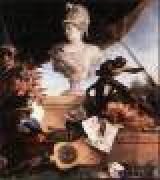
German Painter, 1789-1869
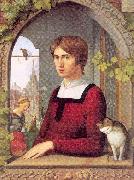
German religious painter. Expelled from the Vienna Academy because of his opposition to its classicism, he went to Rome and with Peter von Cornelius, Veit, Schadow-Godenhaus, and others, formed the group known as the Nazarenes. His first real successes were his frescoes for the Casa Bartholdy (now in Berlin) and for the Villa Massimo. Among his notable paintings are Christ's Entry into Jerusalem and Christ's Agony in the Garden. Overbeck sought to make his art serve religion.
|
|
 |
OUDRY, Jean-Baptiste
|
|
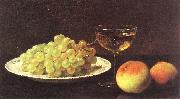
French Baroque Era Painter, 1686-1755
French painter. He was the principal animal painter and one of the foremost decorative painters during the first half of Louis XV's reign. After initial training as a portrait painter, he concentrated on still-lifes; by the 1720s he had also begun to establish himself as a specialist in hunting scenes, game-pieces and portraits of animals. He ran an active workshop, often keeping his best originals for years and selling copies and (more or less autograph) variants. In the 1730s he was most active as a tapestry designer, making numerous designs for the royal tapestry works of Beauvais and the Gobelins, and he continued to produce his brilliantly painted hunts, still-lifes and studies of animals and birds to the end of his career.
|
|
 |
Otto Scholderer
|
|
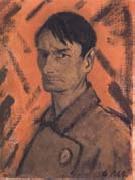
(25 January 1834 - 22 January 1902) was a German painter.
He was born in Frankfurt am Main. On completing his schooling, Scholderer went to the Städel academy of arts in 1849, where he remained until 1851. Among his teachers were the art historian Johann David Passavant and the painter Jakob Becker. Subsequently, Scholderer established himself in Städel as a freelance painter. During this period his friendship with Victor Meller began; Scholderer became his brother-in-law in 1868.
Through Meller, Scholderer became acquainted with the works of Gustave Courbet. Scholderer made several short study trips to Paris between 1857 and 1858, where he became friends with Henri Fantin-Latour and Édouard Manet, whose influence can be seen in his subsequent work. Fantin-Latour depicted Scholderer in his picture Studio aux Batignolles . Starting from 1858, Scholderer worked and lived predominantly in Kronberg in Taunus, where his colleagues included Anton Burger, Peter Burnitz and Louis Eysen; he was close to the Kronberger painter colony.
In 1866, Scholderer established himself in Desseldorf and made friends with Hans Thoma. With Thoma, Scholderer went in 1868 to Paris and returned to Germany only shortly before the outbreak of the French-German War. First Scholderer established himself in Munich, renewing his friendship with Wilhelm Leibl and becoming one of the artists of the Leibl-Kreis (Leibl circle). At the beginning of 1871 he went to London and worked there till the autumn of 1899. After 1899, Scholderer returned to his hometown of Frankfurt, where he died at the age of almost 68 years on 22 January 1902.
Otto Scholderer's art, initially dominated by landscapes, later consisted primarily of portraits and still lifes. The important connection between the romantic period and the Impressionists is evident in his work.
|
|
|
|
|
|
 |
Otto Muller
|
|
1874-1930
was a German painter and printmaker of the Die Br??cke expressionist movement. Otto Mueller was born in Liebau (now Lubawka, Kamienna G??ra County), Kreis Landeshut, German Silesia. Between 1890-1892 he was trained in lithography in Görlitz and Breslau. From 1894 to 1896 he studied at the Academy of Fine Arts in Dresden and continued his study in Munich 1898. He left Munich's academy after Franz von Stuck classified him as untalented. His early works are influenced by impressionism, Jugendstil and symbolism. When he settled to Berlin in 1908, he turned more and more to the expressionism. During this time there were meetings with Wilhelm Lehmbruck, Rainer Maria Rilke and Erich Heckel. In 1910, he joined 'Die Br??cke', a Dresden-based group of Expressionist artists. He was member of the group until it disbanded in 1913 due to artistic differences. At the same time Mueller also had contact with the artists group of the 'Blaue Reiter'. During the World War I he fought as a German soldier in France and Russia. After the war he became professor at the academy of arts (Akademie der Bildenden Kunste) in Breslau where he taught until his death on September 24, 1930. Johnny Friedlaender and Isidor Ascheim were among his pupils there. Altogether his printmaking amounted to 172 prints, in woodcut, etching and lithography. In 1937 the Nazis seized 357 of his works from German museums, since the pictures were considered as degenerate art. Mueller was one of the most lyrical of German expressionist painters. The central topic in Mueller's works is the unity of humans and nature, whereas his paintings are focused on a harmonious simplification of form, colour and contours.
|
|
 |
Otto Mueller
|
|
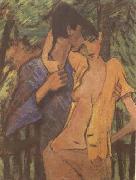
German Painter, 1874-1930
Otto Mueller was born on October 16, 1874, in Liebau, German Silesia. His mother had been adopted as a young girl, giving rise to the story that he was the son of a gypsy - a story he never denied. He was a cousin to the famous German writers and dramatists Gerhart and Carl Hauptmann (the latter's novel "Einhart der Lächler" is an imaginary portrait of the painter). After four years of apprenticeship with a lithographer, Mueller entered the Academy of Fine Arts in Dresden in 1894. He was dissatisfied with the conservative instructions and left after two years. The next several years he lived close to his influential cousins, and for a short while he went to Munich to study with the famous painter Franz von Stuck. Information about his life and work until 1908 - when he settled in Berlin - is sketchy, especially since the artist destroyed many of his earlier works. In Berlin Mueller met the expressionist sculptor Wilhelm Lehmbruck, whose concept of the human form had a decisive influence on his own perception. When in 1910 his entries to the exhibition of the Berlin Secession were rejected he joined the members of the artist group "Die Brecke" (The Bridge) and exhibited with the New Secession and thus met Ernst Ludwig Kirchner, Ernst Heckel, and Karl Schmidt-Rottluff. He became their lifelong friend, and, while only slightly influenced by their woodcut techniques, he contributed in return his experience in lithography and especially his techniques of distemper painting (colors bound by glue or size). This technique permits the quick coverage of large areas of the very rough canvas (burlap) which he preferred and adds a subdued luminosity. Since overpainting in distemper is not possible, the artist has to have a clear conception of his work before he begins. The technical devices strengthened the Brecke painters' desire to "flatten" the image on the canvas - following the examples of Paul Gauguin and even Edvard Munch and rejecting the academic preference for an emphasis on three-dimensionality of the subject. In his graphic works Mueller experimented with mixtures of woodcut and lithography, the rubbing of the printer's ink, frequently adding color in the form of watercolor or colored chalk, until he had the technical means of the Breslau Academy available to make true color lithographs. His "Gypsy-Portfolio" (nine color lithographs in a portfolio of 1927), which used as many as five stones, is one of his great achievements as a graphic artist. From 1916 to 1918 he served as a soldier in World War I, an experience which left no impact on his work. Shortly after his return he was appointed professor at the Breslau Academy of Art, where he taught until his death. Mueller's work shows only three motifs: landscapes, gypsies, and primarily nudes in landscapes. The last motif dominated his work. The earthen color of his mostly young, subtle but angular nude girls forms with the subdued and delicate greens of the landscape backgrounds a vision of a lost past. There is a frequently melancholic nostalgia in his works, presenting a harmony between nature and the human form which is not only opposite to the academic approach but also to that of the other Expressionists.
|
|
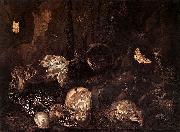 |
Otto Marseus van Schrieck
|
|
(ca. 1619, Nijmegen - buried June 22, 1678, Amsterdam) was a painter in the Dutch Golden Age.
Marseus van Schrieck spent the years 1648-1657 in Rome and Florence with the painters Matthias Withoos and Willem van Aelst, after which he settled in Amsterdam. He is best known for his paintings of forest flora and fauna. In Arnold Houbraken's biography of him, he mentions that he joined the Bentvueghels in Rome and was called the snuffelaer, or "sniffer", because he was always sniffing strange lizards and snakes. He quotes his wife, who apparently survived him by two husbands and was still alive when he wrote the book. He wrote that she said that Otto kept snakes and lizards in a shed at the back of his house, and also on a piece of land outside the city that was walled in for this purpose.
|
|
|
|
|
|
|
|
|
|
|
|
|
|
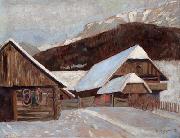 |
Otto Barth
|
|
(18 June 1891 - 3 May 1963) was a highly decorated Generalmajor in the Wehrmacht during World War II who commanded the 30. Infanterie-Division. He was also a recipient of the Knight's Cross of the Iron Cross. The Knight's Cross of the Iron Cross was awarded to recognise extreme battlefield bravery or successful military leadership. Otto Barth was captured by Soviet troops following the fall of the Courland Pocket in 1945. He was held until 1955.
|
|
|
|
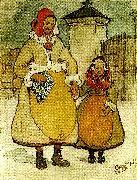 |
ottilia adelborg
|
|
Eva Ottilia Adelborg, född 6 december 1855 i Karlskrona, död 19 mars 1936, var en svensk akvarellkonstnär. Hon var dotter till kommendörkapten Bror Jacob Adelborg och hans hustru Hedvig Catharina af Uhr samt syster till Gertrud Adelborg.
Adelborg var "bilderbokskonstnärinna" enligt äldre benämning. Hon benämns idag barnboksillustratör, men illustrerade även böcker för vuxna, komponerade tapetmönster och skrev böcker och kan därför benämnas författare. Bosatt i Gagnef i Dalarna från juli 1903, då hon startade en skola för knyppling. Museum över hennes liv och verksamhet finns i Gagnefs gamla prostgård. Känd för bland annat affischen "Prinsarnes blomsteralfabet" (1892). Det litterära Ottilia Adelborg-priset instiftades år 2000 av Gagnefs kommun.
|
|
|
|
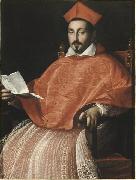 |
Ottavio Leoni
|
|
Ottavio Leoni (1578 - 1630) was an Italian painter and printmaker of the early-Baroque, active mainly in Rome.
He was born in Rome, where he first trained with his father, Lodovico Leoni. He painted altarpieces for churches in Rome such as an Annunciation for Sant'Eustachio and a Virgin and child with St. Giacinto for Santa Maria della Minerva, and a Saints Charles, Francis, & Nicholas for Sante Urbano. He became a member, and later president, of the Accademia di San Luca and a Cavalieri of the Order of Christ, on which occasion he presented the church of the Academy the Martyrdom of St. Martina. He died in Rome. Ottavio Leoni was also the engraver of a set of portraits of painters. His portrait of Michelangelo Merisi Caravaggio is the only documented portrait of the painter by another artist.
His work is exhibited in places such as Fine Arts Museums of San Francisco; Museum of Fine Arts, Boston; National Gallery of Art; Bowes Museum; Courtauld Institute of Art; Los Angeles County Museum of Art; and Palazzo Ruspoli, Rome, Italy.
|
|
|
|
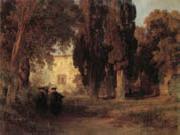 |
Oswald achenbach
|
|
German Painter, 1827-1905
was a German landscape painter. Born in Desseldorf, he received his art education from his brother, Andreas Achenbach. His landscapes generally dwell on the rich and glowing effects of color which drew him to the Bay of Naples and the neighborhood of Rome. From 1863 to 1872 he was Professor of Landscape Painting at the Desseldorf Academy. He died in Desseldorf of an inflammation of the lungs.
|
|
|
|
|
|
|
|
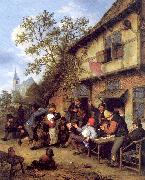 |
Ostade, Adriaen van
|
|
Dutch Baroque Era Painter, 1610-1685
Painter, draughtsman and etcher. According to Houbraken's rather unreliable biography, he was a pupil concurrently with Adriaen Brouwer of Frans Hals in Haarlem. Hals influenced him very little, whereas Brouwer, who was described as 'known far and wide' as early as 1627, had a decisive influence on the evolution of Adriaen van Ostade's always idiosyncratic portrayal of peasant life. The first documentary mention of Adriaen van Ostade as a painter is in 1632 (Schnackenburg, 1970). Most of his paintings are signed and dated, the earliest firmly dated example being the Peasants Playing Cards (1633; St Petersburg, Hermitage).
|
|
|
|
|
|
|
|
|
|
|
| Wholesale China Oil Painting Wholesale Oil Painting China Xiamen Portrait Reproduction on canvas Chinese Oil Painting Wholesale USA Oil Painting |
|
|
|
|
|