| |
|
Xiamen Oil Paintings, Wholesale Direct!
|
|
100% hand painted, 100% cotton canvas, 100% money back if not satisfaction. |
|
|
|
|
ART WORKS INDEX
A
B
C
D
E
F
G
H
I
J
K
L
M
N
O
P
Q
R
S
T
U
V
W
X
Y
Z
|
|
ARTISTS INDEX
A
B
C
D
E
F
G
H
I
J
K
L
M
N
O
P
Q
R
S
T
U
V
W
X
Y
Z
|
|
|
|
 |
Zygmunt Waliszewski
|
|
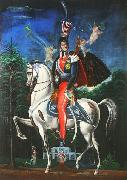
(1897-1936) was a Polish painter, a member of the Kapist movement.
Waliszewski was born in Saint Petersburg to the Polish family of an engineer. In 1907 his parents moved to Tbilisi where Waliszewski spent his childhood. In Tbilisi began his studies at a prestigious art school. In 1908 he had his first exhibition and participated in the life of artistic avant-garde. During World War I he fought with the Russian army, returning to Tbilisi in 1917. He visited Moscow several times and became inspired by the Russian Futurists. He, later, became a member of a Futurist group. In the early 1920s, he departed for Poland, and settled in Krakew. Between 1921 and 1924 he studied at Academy of Fine Arts in Krakew in the studios of Wojciech Weiss and Jezef Pankiewicz. In 1924 he went to Paris with his avante-garde group and continued his studies in painting there under the guidance of Pankiewicz. He was a participant in the Capists' plein-air painting workshops in Cagnes, Valence, Cap Martin, and Avignon. At the Louvre, he painted copies and travesties of the works of old masters like Titian, Veronese, Velezquez, Vermeer, Goya, and Delacroix. He was also fascinated by the art of Cezanne, van Gogh, and Matisse.
In 1931 he returned to Poland, residing in Warsaw, Krzeszowice, and Krakew. During this time Waliszewski designed scenery and posters, created book illustrations, drew and painted caricatures and grotesque scenes. In Krakew he befriended the Polish Formists. Waliszewski painted primarily portraits and figural compositions and landscapes of the rural countryside. He died suddenly in 1936.
|
|
|
|
 |
Wynford Dewhurst
|
|
British, 1864-1941
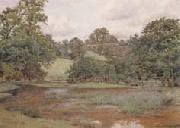
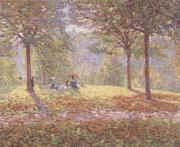
Wynford Dewhurst was born in Manchester in 1864. He was educated at home by a private tutor and later at Mintholme College. Although he originally trained to enter the legal profession, he showed artistic flair and decided to pursue a career as a painter after some of his drawings were published in various journals.
He gained his artistic training in France at the Ecole des Beaux-Arts, in Paris, where he was a pupil of the renowned French painter Jean-L??on Gerome. Despite his teacher Gerome rejection of the radical Impressionist movement in favour of a highly finished academic style (Gerome continued the development and conservation of French Neoclassicism), Dewhurst was heavily influenced by the Impressionists. It is well known that he first encountered Impressionism, to which he was instantly attracted, in the work of Emile Claus in the Maddocks Collection in Bradford. However his most important mentor would become Claude Monet.
It was Monet to whom Dewhurst dedicated his pioneering account of French Impressionism, Impressionist Painting: its genesis and development, in 1904. This was the first important study of the French painters to be published in English. As well as helping to reintroduce British artists to this style of painting, Dewhurst book called attention to the French Impressionists debt to the British artists John Constable and J. M. W. Turner, claiming that the Impressionists simply developed their existing painterly techniques. According to Dewhurst, artists who, like himself, painted in an impressionist manner, were often sneered at for imitating a foreign style, and he was keen to justify their position. French artists simply developed a style which was British in its conception, he wrote, a view that was dismissed by some French painters - such as Pissarro - who revealed his national bias when he acknowledged Constable and Turner but identified instead French influences like Nicolas Poussin, Claude Lorrain, Jean-Baptiste-Sim??on Chardin and Jean-Baptiste-Camille Corot. The thesis that Dewhurst put forward in Impressionist Painting was controversial for it dealt with the debated question of whether Impressionism was French or British in origin. However, it found much support in Britain: Kevin McConkey informs us that Dewhurst theme was taken up by others as various as Clausen, John Rothenstein and Kenneth Clark Nevertheless, Dewhurst detailed biographical notices of the most prominent artists associated with the rise of impressionism in France...leave little to be desired from the historical point of view. It is worth noting that Impressionist Painting also included an entire chapter on female artists, since modernity is the note of Impressionism, and that movement was the very first artistic revolt in which women took part. Indeed, Dewhurst thanks the celebrated female painter Mary Cassatt (who worked within the Impressionist circle) for her assistance in the preface of his book.
|
|
 |
wyndham lewis
|
|
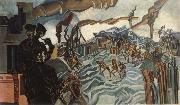
British painter and writer. He attended Rugby School and then studied painting at the Slade School of Art, London (1898-1901), where he earned a reputation both as a draughtsman and as a poet. His early artistic and intellectual mentors were Augustus John and Thomas Sturge Moore. From 1902 to 1908 Lewis travelled widely in Europe and studied in many of the major museums. He was one of the first British artists to be aware of, and interested in, Cubism and Expressionism, though little of his work before 1909 survives as evidence of his early development. In late 1908 Lewis settled in London and as well as painting began to publish satirical short stories that take a mechanistic view of human social behaviour, evident in the deliberately clumsy and grotesque figures in his art of the period 1909 to 1912. By 1910 he was including Cubist elements in his watercolour drawings (his preferred medium), and by 1912 he had developed his own linear vocabulary of forms, indebted to Cubist, Futurist and Expressionist forms, which gives an often ironic visual dimension to the themes of his fiction. Another important influence on his art was that of Japanese woodblock prints, as seen in the watercolour drawing later called The Vorticist (1912; Southampton, C.A.G.). By 1913 he was popularly seen as the leading British avant-garde artist.
|
|
|
|
 |
Wyke Bayliss
|
|
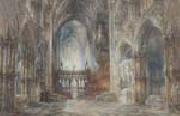
(October 21, 1835, Madeley, Shropshire - April 5, 1906, London) was a British painter, author and poet. He almost exclusively painted interiors of British and European churches and cathedrals, and was known in the late Victorian era as an academic authority on art. From the start of his career Bayliss' main interest was in depicting architecture, finding "infinite charm" in the "infinite variety of the aspect of a Cathedral interior".
His unusual first name was his mother Anne's maiden surname. His brother William Wyke Bayliss became a vicar and sister Elizabeth Anne Bayliss married a vicar, whilst a second sister Mary died as a teenager. Bayliss' wider family consisted of a number of luminaries. His great uncle was Thomas Turner, founder of the Caughley porcelain factory, a major leader in the development of the Willow pattern. Bayliss owned a portrait of Turner by Sir Joshua Reynolds as well as a number of further family portraits by Lemuel Francis Abbott . His second cousin was Sir William Maddock Bayliss.
Cologne Cathedral, pen and watercolourHis father, Rev. John Cox Bayliss was a railway engineer who taught military and mathematical drawing, and was also an artist known for his work "Views of Shropshire" published in 1839 . He gave his younger son training after he showed drawing aptitude at an early age. The family moved from Madeley to London following a job offer too good to refuse, giving Bayliss the opportunity to immerse himself in the emerging art scene of the early Victorian period. As a young student at the Royal Academy and the School of Design he became affiliated with the Pre-Raphaelites, and he counted amongst his friends John Millais, Frederic Leighton, William Holman Hunt and Edward Burne-Jones While distant from the Pre-Raphaelites in subject and technique, his paintings often reflect the juxtaposition of detail and colour that characterise much of Millais' and Leighton's work. Frederick Wedmore states in the foreword to Bayliss' autobiography "On reflection it will be seen that Wyke Bayliss had his speciality pretty well to himself. He was the inventor of his own genre - as well as his own method" . Bayliss paintings are held in many smaller UK and European collections, including the Atkinson Art Gallery in Southport (Evening: Amiens Cathedral) and the Welsh national collection.
|
|
 |
Wybrand Hendriks
|
|
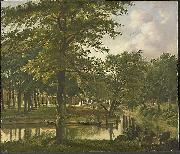
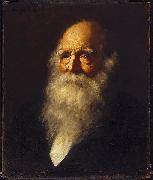
(June 24, 1744, Amsterdam - January 28, 1831, Haarlem), was a Dutch painter and the concierge of the Teylers Museum.
According to the RKD he learned to paint while working for the decorative wall paper factory of J. Remmers in Amsterdam. From 1786 to 1819 he was the second concierge ("kastelein") of the Teyler's Stichting in Haarlem, where he lived at the "Fundatiehuis" as curator of the art collection, with his studio in the old drawing room of Teyler's drawing academy, which had itself been moved to the city hall. He assumed the position in 1785 after his predecessor Vincent Jansz van der Vinne had left in disagreement with Martin van Marum, the head of the fossil and instrument collections. As curator, he managed to purchase an important collection of Italian drawings from the collection of Queen Christina of Sweden in 1790.
He is known for portraits, landscapes, and flower still lifes in the manner of Jan van Huysum.
|
|
 |
Wyatt Eaton
|
|
(May 6, 1849 - June 7, 1896) was an Canadian/American portrait and figure painter, remembered as one of the founders of the Society of American Artists.
Born in Philipsburg, Quebec, Lower Canada, Eaton was a student of the National Academy of Design, New York. In 1872, he moved to Paris and studied at the École des Beaux-Arts under Jean-Leon Gerôme. During this time, he made the acquaintance of Jean-François Millet at Barbizon, and was also influenced by his friend Jules Bastien-Lepage.
After his return to the United States in 1877, he became a teacher in the Cooper Institute, and opened a studio in New York City. He became one of the founders of the Society of American Artists, in which he was the first secretary. Eaton died from tuberculosis at Newport, Rhode Island on June 7, 1896.
|
|
 |
WTEWAEL, Joachim
|
|
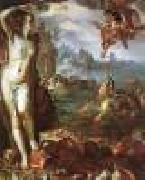
Dutch painter (b. 1566, Utrecht, d. 1638, Utrecht).
Dutch painter and draughtsman. He was one of the last exponents of MANNERISM. From c. 1590 until 1628, the year of his latest known dated paintings, he employed such typical Mannerist formal devices as brilliant decorative colour, contrived spatial design and contorted poses. He sometimes combined such artifice with naturalism, and this amalgam represents the two approaches Dutch 16th- and 17th-century theorists discussed as uyt den geest ('from the imagination') and naer 't leven ('after life'). Wtewael's activity reflects the transition from Mannerism to a more naturalistic style in Dutch art. Slightly over 100 of his paintings and about 80 drawings are known. Subjects from the Bible and mythology predominate;
|
|
 |
WRIGHT, Joseph
|
|
English painter (b. 1734, Derby, d. 1797, Derby).
Painter, known as Wright of Derby, where he was born and spent most of his life. He earned a living as a portrait painter, while he experimented with the effects of light and industrial and scientific subjects, reflecting the interests of his day. Two of his best-known works come from this period, A Philosopher Lecturing on the Orrery (1766, Derby) and An Experiment on a Bird in the Air Pump (1768, Tate).
|
|
|
|
 |
WOUWERMAN, Philips
|
|
Dutch Baroque Era Painter, 1619-1668. Dutch painters from Haarlem. Dutch painter and draughtsman. He was the eldest son of the painter Paulus [Pauwels] Joostens Wouwerman of Alkmaar (d 28 Sept 1642), whose two other sons, Pieter Wouwerman (1623-82) and Johannes Wouwerman (1629-66), also became painters. Philips probably received his first painting lessons from his father, none of whose work has been identified. According to Cornelis de Bie, Wouwerman was next apprenticed to Frans Hals, although no trace of Hals's influence is discernible in Wouwerman's work. Wouwerman is also reputed to have spent several weeks in 1638 or 1639 working in Hamburg in the studio of the German history painter Evert Decker (d 1647). While in Hamburg, he married Annetje Pietersz. van Broeckhof. On 4 September 1640 Wouwerman joined the Guild of St Luke in Haarlem, in which in 1646 he held the office of vinder (agent or 'finder'). Given the many southern elements in his landscapes, it has repeatedly been suggested that Wouwerman must have travelled to France or Italy, but there is no documentary evidence that he left his native Haarlem for more than short periods. During his lifetime he must have attained a certain degree of prosperity, as demonstrated by the relatively large sums inherited by each of his seven children after his wife's death in 1670.
|
|
 |
Wouterus Verschuur
|
|
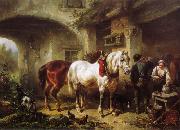
(11 June 1812 - 4 July 1874) was a Dutch painter of animal subjects - mainly horses - and of landscapes. He is one of the later representatives of Romanticism in Dutch art.
Born to an Amsterdam jeweller, Verschuur received his training from the landscape and cattle painters Pieter Gerardus van Os and Cornelis Steffelaar. As part of this education Verschuur had to copy works by the 17th century painter Philips Wouwerman, like Wouwerman Verschuures subjects consist mostly of stable scenes, landscapes with horses and coastal landscapes.
Showing talent from an early age, at 15 Verschuur had a painting exhibited at the eExhibition of Living Masterse at Amsterdam in 1828. In 1832 and 1833 he won the gold medal at the annual exhibition at Felix Meritis. In 1833 he was appointed a member of the Royal Academy in Amsterdam. In 1839 he joined the artistse society, Arti et Amicitiae. His reputation was also considerable abroad. He was often featured in the annual exhibitions which travelled the large European cities at that time. In 1855 Napoleon III purchased one of his paintings at the Exposition Universelle in Paris.
The popularity of his paintings provided him with sufficient funds to travel widely. He made frequent trips to Gelderland and Brabant and abroad to Switzerland and Germany. In 1874, on one of his trips to Gelderland, he died on July 4 in the town of Vorden. He left behind an oevre of about 400 paintings and over 2000 drawings. Amongst his students were his son, Wouterus Verschuur Jr. and Anton Mauve.
|
|
 |
Wouter Johannes van Troostwijk
|
|
1782-1810
Dutch
Wouter Johannes van Troostwijk Gallery
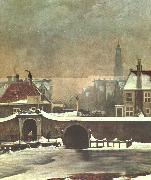
Dutch painter, draughtsman and etcher. In 1803 he was admitted to the Amsterdam Tekenacademie where he was a pupil of the director, Jurriaan Andriessen. Despite a highly successful student career that culminated in a gold medal from the Felix Meritis Society in 1807, he was unable to establish himself as a professional artist during the remainder of his very short working life in Amsterdam. Andriessen's studies from nature seem to have been an important influence; van Troostwijk was one of the earliest artists to paint en plein air. Although he looked back to 17th-century Dutch landscape art and to the work of his contemporaries, in such paintings as Landscape in Gelderland (c. 1808; Amsterdam, Rijksmus.; see NETHERLANDS, THE, fig. 21) he achieved a totally new lyricism in the rendering of atmospheric effects. The Raampoortje (1809; Amsterdam, Rijksmus.) displays a fresh colouristic touch rare in Dutch painting of this period. His Self-portrait (c. 1810; Amsterdam, Rijksmus.) is equally original in composition and colour. He also produced animal paintings in the manner of Paulus Potter, drawings and a few etchings towards the end of his life. Van Troostwijk died before his considerable talents could be recognized, and, although he has come to be seen as an important precursor of much late 19th-century Dutch painting, he had little influence on his immediate successors.
|
|
 |
Worthington Whittredge
|
|
1820-1910
Thomas Worthington Whittredge (May 22, 1820 - February 25, 1910) was an American artist of the Hudson River School. Whittredge was a highly regarded artist of his time, and was friends with several leading Hudson River School artists including Albert Bierstadt and Sanford Robinson Gifford. He traveled widely and excelled at landscape painting, many examples of which are now in major museums. He served as president of the National Academy of Design from 1874 to 1875 and was a member of the selection committees for the 1876 Philadelphia Centennial Exposition and the 1878 Paris Exposition, both important venues for artists of the day.
Whittredge was born in a log cabin near Springfield, Ohio in 1820. He painted landscapes and portraits as a young man in Cincinnati before traveling to Europe in 1849 to further his artistic training. Arriving in Germany he settled at the Dusseldorf Academy, a major art school of the period, and studied with Emanuel Leutze. At Dusseldorf, Whittredge befriended Bierstadt and posed for Leutze as both George Washington and a steersman in Leutze??s famous painting ??Washington Crossing the Delaware??, now in the collection of the Metropolitan Museum of Art in New York City.
Whittredge spent nearly ten years in Europe, meeting and travelling with other important artists including Sanford Gifford. He returned to the United States in 1859 and settled in New York City where he launched his career as a landscape artist painting in the Hudson River School style.
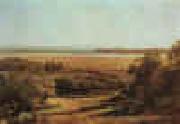
Whittredge journeyed across the Great Plains to the Rocky Mountains in 1865 with Sanford Gifford and John Frederick Kensett. The trip resulted in some of Whittredge??s most important works??unusually oblong, spare landscapes that captured the stark beauty and linear horizon of the Plains. Whittredge later wrote in his autobiography, ??I had never seen the plains or anything like them. They impressed me deeply. I cared more for them than for the mountains... Whoever crossed the plains at that period, not withstanding its herds of buffalo and flocks of antelope, its wild horses, deer and fleet rabbits, could hardly fail to be impressed with its vastness and silence and the appearance everywhere of an innocent, primitive existence."
Whittredge moved to Summit, New Jersey, in 1880 where he continued to paint for the rest of his life. He died in 1910 at the age of 89 and is buried in the Springfield, New Jersey cemetery. Whittredge's paintings are now in the collections of numerous museums, including the Metropolitan Museum of Art in New York City and the Smithsonian American Art Museum in Washington, DC.
|
|
|
|
|
|
 |
Workshop of Anton von Maron
|
|
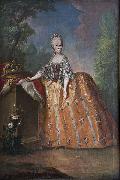
Anton von Maron (January 8, 1733 - March 3, 1808) was an Austrian painter, active in Rome.
Von Maron was born in Vienna, but moved at a young age to Rome. There, he studied under Anton Raphael Mengs, and became an accomplished portrait painter. He married a sister of Mengs, Therese Maron, who was a painter in her own right. He lived the rest of his life in Rome, and died there in 1808.
|
|
 |
Woolner, Thomas
|
|
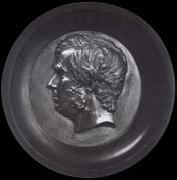
1825 - 1892,English sculptor and poet. He ranks with John Henry Foley as the leading sculptor of mid-Victorian England. He trained with William Behnes and in 1842 enrolled as a student at the Royal Academy, London. In 1844 he exhibited at Westminster Hall, London, a life-size plaster group, the Death of Boadicea (destr.), in an unsuccessful attempt to obtain sculptural commissions for the Houses of Parliament. His earliest important surviving work is the statuette of Puck (plaster, 1845-7; C. G. Woolner priv. col.), which was admired by William Holman Hunt and helped to secure Woolner's admission in 1848 to the Pre-Raphaelite Brotherhood. The work's Shakespearean theme and lifelike execution, stressing Puck's humorous malice rather than traditional ideal beauty, made it highly appealing. Although eclipsed by Hunt, John Everett Millais and Dante Gabriel Rossetti, Woolner was an important figure in the Brotherhood. He contributed poetry to its journal, The Germ (1850), and his work was committed to truthfulness to nature more consistently than that of any other Pre-Raphaelite, except for Hunt. This is evident in Woolner's monument to William Wordsworth (marble, 1851; St Oswald, Grasmere, Cumbria).
|
|
|
|
|
|
|
|
 |
Wolfgang Heimbach
|
|
c.1600/1615-after 1678, German painter. The son of a bookkeeper at the corn exchange, he was known because of a disability as 'the Ovelg?nne mute'. An aristocratic sponsor, probably Graf Anton G?nther (1603-67) of Oldenburg, sent him to train in the Netherlands: stylistic considerations would suggest that this was in the 1630s. The Evening Scene (1637; ex-art market, Berlin; G?ttsche, no. 8) shows him adapting the style of Caravaggio as practised in Utrecht to the kind of social gathering depicted by Dirck Hals or Anthonie Palamedesz. He uses an artificial light source to exaggerate the modelling of the figures and the space. This characteristic of his art also shows in the Evening Banquet of 1640
|
|
 |
wolfgang amadeus mozart
|
|
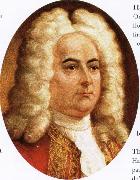
Born: 27 January 1756
Birthplace: Salzburg, Austria
Died: 5 December 1791 (fever)
Best Known As: Composer of Eine kleine Nachtmusik
|
|
|
|
 |
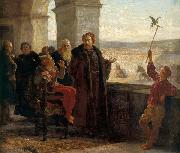
Wojciech Stattler
|
|
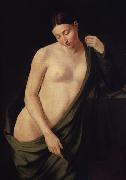
(1800, Krakew - 1875) was a Polish painter of Swiss aristocratic ancestry and a long-standing professor of the School of Fine Arts in Krakew.
|
|
 |
Wojciech Gerson
|
|
(1831 - 1901) was a Polish painter and professor.
Born in Warsaw, Gerson enrolled at the Warsaw Fine Arts Academy and graduated with honorable mention and a scholarship to St. Petersburg Academy of Arts where he studied historical painting under A. T. Markov. He graduated from St. Petersburg with a silver medal and returned to Warsaw. He left for Paris in 1850 and studied under Leon Cogniet.
He travelled back to Warsaw in 1858, where he would live for the rest of his life. Gerson began to teach art in his own workshop in 1865. He trained many future Polish artists such as J??zef Chełmo??ski, Leon Wycz??łkowski, Władysław Podkowi??ski, and J??zef Pankiewicz. He was made a professor for the St. Petersburg Fine Arts Academy in 1878.
Gerson also worked as an architect and art critic. He is known for his paintings of patriotism, country life, and mountain landscapes. Gerson died in Warsaw, aged 70.
|
|
|
|
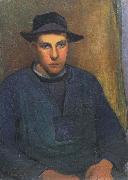 |
Wladyslaw slewinski
|
|
(1854-1918) was a Polish painter. He was a student of Gauguin's and a leading artist of the Young Poland movement.
Władysław Ślewiski was a Polish painter. He administered his estate in Poland before traveling to Paris in 1888. Once there he studied at the Academie Colarossi where he met Gauguin. The impression this encounter made on him and Gauguin's encouragement prompted Slewinski to dedicate himself to art. He submitted to Gauguin's artistic and personal influence, spending time with him in Paris and, from 1889, in Pont-Aven and Le Pouldu in Brittany.
Seascapes painted during this period include Cliffs in Brittany. In 1891 Gauguin painted a portrait of Slewinski and presented it to him. During this period Slewinski exhibited in Paris, with some success, both at the Salon des Independents in 1895 and 1896 and the Galerie Georges Thomas in 1897 and 1898.
|
|
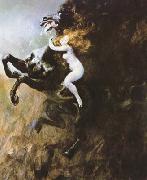 |
Wladyslaw Podkowinski
|
|
Polish Painter, 1866-1895
Polish painter and illustrator. In 1880-84 he studied in Warsaw at Wojciech Gerson's Drawing School. From 1884 he regularly contributed illustrations to leading Warsaw journals such as Tygodnik Ilustrowany and Wedrowiec. In 1885, accompanied by his fellow artist J?zef Pankiewicz, he went to St Petersburg and studied (1885-6) at the Academy of Fine Arts. Disappointed with the conservative teaching system and short of money, he returned to Warsaw in 1886 and in 1887 continued working regularly for Tygodnik Ilustrowany, becoming one of its most popular illustrators. He produced his first watercolours and oil paintings, much under the influence of Aleksander Gierymski, but continued to regard these as secondary activities until a stay in Paris in 1889, again in the company of Pankiewicz. Here, the experience of new French painting, especially that of Claude Monet shown at the Galerie Georges Petit, encouraged Podkowinski to attempt paintings in an Impressionist manner.
|
|
|
|
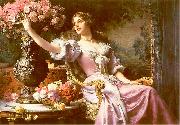 |
Wladyslaw Czachorski
|
|
(1850-1911) was a Polish artist.
In 1866 Czachorski went to the Warsaw Drawing School and had Rafał Hadziewicz as a peer. Then he spent one year at the Dresden Academy and from there went to Munich Academy (1869-1873) some of his classmates were: Hermann Anschetz, Karl von Piloty, and Alexander Wagner. He received Magna Cum Laude (the Grand Silver Medal) from Munich, and proceeded to travel to France, Italy and Poland after his graduation. He held membership to Berlin academy and has also organizer and jurist of international exhibitions even though he had his home in Munich. He was awarded the Bavarian Order of Saint Michael in 1893. He had many art exhibitions in Poland. Some took place in Krakew, Warsaw, Łedź, and Lwew. After his death in 1911, a posthumous showing was held at the Warsaw "Zachęta" Society of Fine Arts.
Some of Czachorski's noted works were: still lifes, painted portraits, and Shakespearean scenes. Some of these that he painted were: Julliette's Funeral (1873), Hamlet (1873), and, most notably, Hamlet Receiving the Players (1875); widely recognized as his greatest works.
His paintings can be found in all the more famous and sizable museums of Poland. His works also make appearances in private collections in many countries including: Germany, Poland, England and the United States. They can also be found in foreign museums such as Lwew, Bremen and the Academia de San Carlos in Mexico City.
|
|
|
|
|
|
 |
WITZ, Konrad
|
|
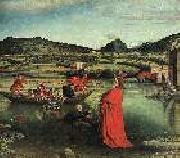
b. cca 1400, Rottweil, d. ca. 1445, Basel. German-born painter from Rottweil in Swabia, active in Switzerland. German painter. One of the great innovators in northern European painting, he turned away from the lyricism of the preceding generation of German painters. His sturdy, monumental figures give a strong impression of their physical presence, gestures are dignified and the colours strong and simple. Even scenes with several figures are strangely undramatic and static. The surface appearance of materials, especially metals and stone, is intensely observed and recorded with an almost naive precision. Powerful cast shadows help to define the spatial relationships between objects. His fresh approach to the natural world reflects that of the Netherlandish painters: the Master of Fl?malle and the van Eycks. He need not, however, have trained in the Netherlands or in Burgundy as knowledge of their style could have been gained in Basle. He remained, however, untouched by the anecdotal quality present in their art,
|
|
|
|
 |
WITTE, Emanuel de
|
|
Dutch Baroque Era Painter, ca.1617-1691
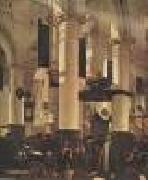
Dutch painter. He was one of the last and, with Pieter Saenredam, one of the most accomplished 17th-century artists who specialized in representing church interiors. He trained with Evert van Aelst (1602-57) in Delft and in 1636 joined the Guild of St Luke at Alkmaar, but he was recorded in Rotterdam in the summers of 1639 and 1640. In October 1641 his daughter was baptized in Delft, where he entered the Guild of St Luke in June 1642 and lived for a decade, moving to Amsterdam c. 1652. He began his long career as an unpromising figure painter, as can be seen in the Vertumnus and Pomona (1644) and two small pendant portraits (1648; all Rotterdam, Mus. Boymans-van Beuningen). Jupiter and Mercury in the House of Philemon and Baucis (1647) and a Rembrandtesque Holy Family
|
|
 |
Witold Pruszkowski
|
|
Polish Painter, 1846-1896
Polish painter and draughtsman. He spent his early years in Odessa and Kiev, subsequently living in France, in particular in Paris, where he studied under the Polish portrait painter Tadeusz Gorecki (1825-68), continuing (1868-71) at the Akademie der Kenste in Munich. In 1871 he moved to Krakew where he studied until 1875 under Jan Matejko at the School of Fine Arts. During ten years in Krakew he produced many striking portraits. In the portrait of Mrs Fedorowicz (1878; Krakew, N. Mus.) he achieved subtle effects of modelling by means of carefully differentiated tones and meticulously distributed light. The Realism of these portraits is subsumed into an advanced proto-Impressionist technique, on occasion using both small patches of distinct colour and broadly applied areas of impasto. Alongside such works, Pruszkowski produced paintings based on fantastic legends, fables and folk-tales. In these works one can trace influences going back to the artist's Munich period; but Pruszkowski's essentially Romantic vision translated his subjects into an entirely Polish context, as in Midsummer's Night (1875; Warsaw, N. Mus.) and Water Nymphs (1877; Krakew, N. Mus.). In 1882 Pruszkowski moved to the village of Mnikow outside Krakew, where he worked in the isolation he believed essential for creative activity. Contact with the country people, however, provided him with themes for his work; alongside his fantastic and legendary subjects he painted genre scenes of peasant life. He brought to his subjects a diversity of means of formal depiction, from the realistic to the near visionary. However, there are notable recurrent motifs, for example the image of the native willow, the symbolic haunt of spirits, as in Willow on Marshland (1892; Ledz, Mus. A.). The visionary element achieved its apogee in the pastel compositions from the last years of his life. In works such as Death of Ellenai (1892; Wroclaw, N. Mus.) the evanescent nature of forms is expressed through restrained colour schemes, generally tending towards silvery greyish azure or shades of pink.
|
|
|
|
 |
WIT, Jacob de
|
|
Dutch Rococo Era Painter, 1695-1754
Dutch painter, draughtsman, etcher and writer. He was the leading 18th-century Dutch decorative painter, specializing in Rococo ceiling and room decorations and groups of putti painted naturalistically in colour or as imitation reliefs in grisaille. His preparatory drawings for ceiling decorations were collected during his own lifetime, but he also executed independent finished drawings specifically for collectors
|
|
|
|
 |
Winslow Homer
|
|
1836-1910
Winslow Homer Locations
Winslow Homer (February 24, 1836 ?C September 29, 1910) was an American landscape painter and printmaker, best known for his marine subjects. He is considered one of the foremost painters in 19th century America and a preeminent figure in American art.
Largely self-taught, Homer began his career working as a commercial illustrator. He subsequently took up oil painting and produced major studio works characterized by the weight and density he exploited from the medium. He also worked extensively in watercolor, creating a fluid and prolific oeuvre, primarily chronicling his working vacations.
|
|
 |
WILSON, Richard
|
|
Welsh Romantic Painter, ca.1713-1782
British landscape painter, b. Wales. He studied in London and achieved success as a portrait painter, but after a visit to Italy (c.1750?C1756) he devoted himself to landscape in the classical tradition of Claude Lorrain. The exhibition of Wilson's Niobe in 1760 won him acclaim, and he was made a member and later librarian of the Royal Academy. His work did not become generally popular until after his death. Although his Italian landscapes did not depart from the classical tradition of picturesque Roman ruins and recumbent nymphs, his work shows considerable originality and breadth of treatment, especially in his many fine paintings of English country houses. He exerted a strong influence on subsequent landscape painting in England. On Hounslow Heath (National Gall., London) and Afternoon and Lake Nemi
|
|
 |
Wilson Irvine
|
|
1869-1936
Wilson Henry Irvine Galleries
Wilson Henry Irvine (28 February 1869-1936) was a master American Impressionist landscape painter. Although most closely associated with the Old Lyme, Connecticut art colony headed by Florence Griswold, Irvine spent his early career near Chicago, a product of the School of the Art Institute of Chicago. Irvine also painted across Western Europe ?? where he produced outstanding American Impressionist versions of the local countryside.
Today, Wilson Irvine's paintings grace the collection of Chicago's Art Institute, as well as other notable collections strong in American Impressionism, including: Old Lyme's Florence Griswold Museum; Washington, D.C.'s Smithsonian Institution National Portrait Gallery and Corcoran Gallery of Art; and Chicago's Union League Club.
Irvine is best known for his mastery of light and texture ?? a 1998 exhibit of his work was called Wilson Henry Irvine and the Poetry of Light. To capture subtle effects of light, Irvine often painted en plein air ?? wearing his trademark cap, knickers, and goatee, with his easel and his paints set up in the field.
Sometimes Irvine's obsession with light led him to paint rather pedestrian subjects ?? landscapes depicting little more than some trees, or a road or fence. But a number of Irvine masterpieces depict well-composed scenes including houses, boats, bridges ?? even a handful of portraits, including at least one self-portrait and a nude.
Wilson Henry Irvine, born near Byron, Illinois, was a descendant of early Illinois settlers and farmers. Wilson channeled his family's agrarian interests into a painter's eye for landscape.
From the beginning, Irvine's interest in painterly subjects was equalled by a parallel focus on artistic technology. While still in his 20s, Irvine was a pioneer of the airbrush as artistic medium ?? a medium which had just been developed and marketed by Liberty Walkup, Irvine's Illinois neighbor, mentor, and teacher.
Having mastered the airbrush, in 1888 Irvine moved to Chicago to make his reputation. Irvine's "day job" during this period was as an illustrator/graphic designer, often employing the still-novel airbrush. But simultaneously, Irvine built a career as a serious painter. He worked his way up Chicago art society ?? he led the Palette and Chisel Club and Cliff Dwellers Club, along with sculptor Loredo Taft.
During these years, Irvine gravitated to the night school of the famed Art Institute of Chicago, where he studied for over seven years. Indeed, the Art Institute was to remain a loyal patron. By the turn of the century, the Institute often showed Irvine's work, and gave him a prestigious solo show over the 1916-1917 Christmas season. To this day, the Art Institute maintains a number of Wilson Irvine paintings in its permanent collection.
|
|
|
|
|
|
|
|
|
|
 |
William-Adolphe Bouguereau
|
|
(November 30, 1825 - August 19, 1905) was a French academic painter. William Bouguereau was a traditionalist whose realistic genre paintings and mythological themes were modern interpretations of Classical subjects with a heavy emphasis on the female human body.
William-Adolphe Bouguereau was born in La Rochelle, France on November 30, 1825, into a family of wine and olive oil merchants. He seemed destined to join the family business but for the intervention of his uncle Eugene, a Roman Catholic priest, who taught him classical and Biblical subjects, and arranged for Bouguereau to go to high school. Bouguereau showed artistic talent early on and his father was convinced by a client to send him to the École des Beaux-Arts in Bordeaux, where he won first prize in figure painting for a depiction of Saint Roch. To earn extra money, he designed labels for jams and preserves
|
|
 |
William Yates
|
|
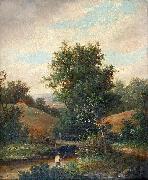
painted Fisherman on the River Bank in 19th Century
|
|
|
|
|
|
|
|
|
| Wholesale China Oil Painting Wholesale Oil Painting China Xiamen Portrait Reproduction on canvas Chinese Oil Painting Wholesale USA Oil Painting |
|
|
|
|
|