| |
|
Xiamen Oil Paintings, Wholesale Direct!
|
|
100% hand painted, 100% cotton canvas, 100% money back if not satisfaction. |
|
|
|
|
ART WORKS INDEX
A
B
C
D
E
F
G
H
I
J
K
L
M
N
O
P
Q
R
S
T
U
V
W
X
Y
Z
|
|
ARTISTS INDEX
A
B
C
D
E
F
G
H
I
J
K
L
M
N
O
P
Q
R
S
T
U
V
W
X
Y
Z
|
|
|
|
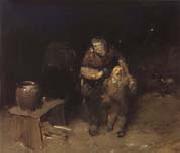 |
Wilhelm Busch
|
|
1832 Wiedensahl/Hannover-1908,was a German caricaturist, painter and poet who is known for his satirical picture stories. After studying first mechanical engineering and then art in Dusseldorf, Antwerpen and Munich, he turned to drawing caricatures. One of his first picture stories, Max and Moritz (published in 1865), was a huge success. Max and Moritz as well as many of his other picture stories are regarded as one of the main precursors of the modern comic strip. Max and Moritz, for instance, has been an inspiration for the Katzenjammer Kids. Wilhelm Busch also wrote a number of poems in a similar style to his picture stories. Besides that he produced more than 1,000 oil paintings that weren't sold before his death in 1908. He was also active as a sculptor.
|
|
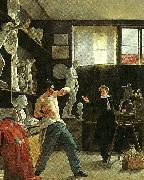 |
wilhelm bendz
|
|
(March 20, 1804 ?C November 14, 1832), Danish genre and portrait painter, is one of the main personages associated with the Golden
|
|
|
|
 |
WILDENS, Jan
|
|
Flemish Baroque Era Painter, 1586-1653
Flemish painter and draughtsman, active also in Italy. He was an important and proficient landscape painter who worked with Rubens and other masters in Antwerp.
|
|
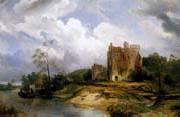 |
Wijnand Nuyen
|
|
Dutch Painter, 1813-1839, Dutch painter and printmaker who specialised in landscapes, and was greatly influenced by the French Romantics. Born to a baker father who recognised his son's talent, Nuijen was apprenticed at age twelve to Andreas Schelfhout in Den Haag. Between 1825 and 1829 he studied at the Den Haag Tekenacademie, under Bartholomeus Johannes van Hove. In his short lifespan Nuijen turned into a prolific painter of rural and marine landscapes, spending much time on the Normandy and northern French coasts. Here he fell under the spell of painters who were working in France, such as Richard Parkes Bonington (1802-1828) and Eugene Isabey (1803-1886), both of whom painted picturesque villages, Normandy harbours and seascapes, with a spontaneity Nuijen admired and adopted. His preoccupation with ruins is typically Romantic and his use of colour and texture is reminiscent of the watercolours of Turner. The Felix Meritis society of Amsterdam awarded him a medal in 1829 for his watercolour of a forest landscape. On completion of his tuition he travelled to Belgium, France and Germany, at times with his painting companion Antonie Waldorp [1803-1866]. Nuijen became a member of the Koninklijke Akademie in Amsterdam in 1836, and just before his death he married the daughter of Schelfhout, his former tutor. Nuijen was unusual among Dutch painters of the period, his theatricality and liberal style contrasting with the near photographic depiction that was then the norm. King William II greatly admired Nuijen's work and bought the "Shipwreck" in 1843,
|
|
 |
WIERINGEN, Cornelis Claesz van
|
|
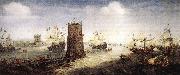
Dutch painter (b. ca. 1580, Haarlem, d. 1633, Haarlem)
Dutch draughtsman, painter, etcher and navigator. His name first appears in the Haarlem records in 1597. It is generally assumed that he was a pupil of Hendrick Vroom, whose work strongly influenced his own. Documentary sources confirm that he maintained close friendships with both Hendrick Goltzius, who made woodcuts after his drawings (see fig.), and Cornelis Cornelisz. van Haarlem. Van Wieringen was more than once governor of the Haarlem Guild of St Luke, a position in which he was responsible for updating the guild's outmoded organization. He specialized in seascapes and received commissions from the city of Haarlem, the Dutch Admiralty in Amsterdam and others. His interest lies primarily in his influence on Dutch marine painters of the 17th century.
|
|
 |
WEYDEN, Rogier van der
|
|
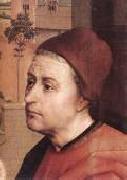
Netherlandish Northern Renaissance Painter, ca.1400-1464
major early Flemish master, known also as Roger de la Pasture. He is believed to have studied with Robert Campin. His early works also show the influence of Jan van Eyck. Van Eyck, however, had been a master at objective rendering of detail, whereas Roger in his work portrayed emotions with an assurance that has not been surpassed. His ability to depict piety is reflected in the early masterpiece Descent from the Cross (c.1435; Prado); he depicted with significant restraint the profound grief of the mourners grouped around the tragic figure of Jesus. His composition strongly affected later representations of the theme. Roger became City Painter in Brussels in 1436. He then produced a series of undated altarpieces including the Last Judgment (hospital, Beaune), the Braque Triptych (Louvre), Crucifixion with Donors (Vienna), and Adoration of the Magi (Berlin), which vary in execution from a stress on sumptuous details to a more sculptural rendering of the figures. Roger is believed to have made a pilgrimage to Italy in the holy year 1450. Whether this supposed excursion had any effect on his style is much debated. It has been shown that his Entombment (Uffizi) bears an affinity to the Tuscan treatment of the subject, particularly by Fra Angelico, and that Roger's Virgin and Child with Saints (Frankfurt) has a strong resemblance to the Italian religious art of the day. His style is, however, highly individual. His religious paintings and his portraits are characterized by a straightforward monumentality. The portraits, such as that of a young lady (National Gall. of Art, Washington, D.C.) and of Francesco d'Este (Metropolitan Mus.) exhibit a simple clarity of contour and psychological penetration. Other notable works are his St. Luke Painting the Virgin, of which a version or replica is in the Museum of Fine Arts, Boston, the Crucifixion
|
|
|
|
 |
WET, Gerrit de
|
|
Dutch painter, Amsterdam school (c. 1616 - 1674, Leyden)
|
|
 |
WEST, Benjamin
|
|
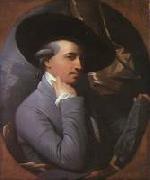
American Neoclassical Painter, 1738-1820
American historical painter who worked in England. He was born in Springfield, Pa., in a house that is now a memorial museum at Swarthmore College. After some instruction from a local artist named William Williams, he set up as a portrait painter in Philadelphia at 18, subsequently moving to New York City. In 1760 he went to Europe, where he remained for the rest of his life. For three years he studied in Italy. Working under the tutelage of Anton Mengs, he was also inspired by the classical research of Johann Winckelmann. He then settled in London, becoming a leader of the neoclassical movement. Under the patronage of George III, commissions came to him in great numbers, and in 1772 he was appointed historical painter to the king. A founder of the Royal Academy, he succeeded Sir Joshua Reynolds as its president in 1792. West executed more than 400 canvases, chiefly historical, mythological, and religious subjects painted on a heroic scale. He had many pupils and was a generous friend and adviser to younger artists, particularly American painters studying in England, among whom were Washington Allston, Samuel Morse, Charles Willson Peale, Gilbert Stuart, and John Singleton Copley. His influence on American painting of the period was predominant. Among West's best-known works are Death of General Wolfe (Grosvenor Gall., London) and Penn's Treaty with the Indians (Pa. Acad. of the Fine Arts). In these paintings he created a new departure in historical painting by clothing his figures in the costume of their period instead of the traditional classical garb.
|
|
 |
WERTINGER, Hans
|
|
German painter (b. 1465, Landshut, d. 1533, Landshut)
German painter and woodcutter. An artist as ambitious as Lucas Cranach I, he became one of Germany's first accredited court painters, working for the Dukes of Landshut in the triangular area defined by Ingolstadt, Straubing and Munich. The son of a functionary working for the Dukes, he was probably first taught by a certain Sigmund Gleism?ller (c. 1449-1511). Hans Mair (Mair von Landshut), who had come from Augsburg and had settled in Landshut, seems to have prompted him to work as a journeyman in Augsburg. His acquisition of citizen's rights in Landshut in 1491 suggests he was a master by that date. Mair seemingly procured him a series of commissions between 1497 and 1499 from Prince Bishop Philipp of Freising (1480-1541). The only work to survive from this period, however, is the large panel of the Life of St Sigismund (1498) in Freising Cathedral. It retains the deep tones associated with Augsburg painting, and its shape, with a pointed arch at the top, must also have been developed in Augsburg. As in Mair's work, several scenes are assembled in the arch and the side sections, creating a cramped Late Gothic framing architecture,
|
|
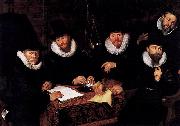 |
Werner van den Valckert
|
|
Though he was born in Amsterdam, he became a member of the Guild of St. Luke in the Hague between 1600 - 1605. By 1614 he had moved to Amsterdam, because his daughter was baptized there. His earliest dated etchings are from 1612. His surviving paintings are historical allegories and portraits. He also made a prestigious schutterstuk, which features the Amsterdam burgermeester Albert Burgh.
According to Houbraken, he was a student of Hendrik Goltzius. He painted a series of 4 paintings showing a doctor as angel, Christ, a man, and the devil; these were all based on engravings by Goltzius. These paintings are now in the possession of the Boerhaave Museum, which has other similar series on display.
|
|
|
|
 |
WERFF, Adriaen van der
|
|
Dutch Baroque Era Painter, 1659-1722
Dutch painter and draughtsman. He was apprenticed to the portrait painter Cornelis Picolet (1626-79) from 1668 to 1670 and then from c.1671 to 1676 to Eglon van der Neer in Rotterdam. From 1676 van der Werff produced small portraits and genre paintings as an independent master; the Cook and Hunter at a Window (1678; New York, priv. col.; see Gaethgens, no. 2) and Man and Woman Seated at a Table (1678; St Petersburg, Hermitage) perpetuate the thematic and stylistic traditions of Gerrit Dou, Gabriel Metsu, Frans van Mieris and Gerard ter Borch (ii) but are distinguished by their greater elegance and richness of costume and interior. Van der Werff's portraits date mainly from the years 1680-95 (e.g. Two Children with a Guinea-pig and a Kitten (1681; London, Buckingham Pal., Royal Col.)). The motif of children with animals recalls van der Neer, while the careful depiction of fabrics recalls the Leiden school of 'Fine' painters. His Portrait of a Man in a Quilted Gown (1685; London, N.G.) resembles compositions by Caspar Netscher and Nicolaes Maes: a figure leaning against a balustrade, before a landscape. Van der Werff's work is, however, more elegant, in part because of the depiction of fabrics, but also because of the inclusion for the first time of Classical sculpture, in this case the Farnese Flora
|
|
|
|
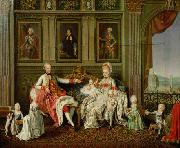 |
Wenceslaus Werlin
|
|
Wenceslaus Werlin (died 1780) was an Austrian painter.
Werlin specialized in portraits. He died in Florence in 1780.
|
|
|
|
 |
WEENIX, Jan Baptist
|
|
Dutch Baroque Era Painter, 1621-ca.1663
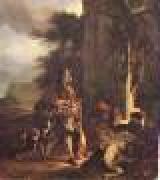
Painter and draughtsman, son of Jan Baptist Weenix. Jan probably received his first instruction as a painter from his father, and it is possible that he helped finish certain of his father's works. He probably remained in Utrecht after his father's death. By 1664 he had become a member of the Guild of St Luke in Utrecht without, however, having submitted the required entrance painting, which he provided by 1668. There are several documented references to Jan in the late 1660s. He inherited a legacy along with his uncle, the painter Barent Micker, and other family members in 1667, at which time Gillis, his younger brother, apparently still required a guardian. He received another legacy in 1668, the year of his marriage, and in 1669 served as a witness for the inventory of the painter Jacob de Hennin (1629-c. 1688) in The Hague.
|
|
 |
WEENIX, Jan
|
|
Dutch painter (b. 1642, Amsterdam, d. 1719, Amsterdam).
|
|
 |
Weeks Lord-Edwin
|
|
189-1903
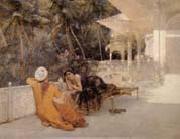
American artist, was born at Boston, Massachusetts, in 1849. He was a pupil of Leon Bonnat and of Jean-Leon Gerome, at Paris. He made many voyages to the East, and was distinguished as a painter of oriental scenes. In 1895 he wrote and illustrated a book of travels, From the Black Sea through Persia and India, and two years later he published Episodes of Mountaineering. He died in November 1903. He was a member of the Legion d'honneur, France, an officer of the Order of St. Michael, Germany, and a member of the Secession, Munich.
|
|
|
|
 |
WATTEAU, Louis-Joseph
|
|
French Painter, 1731-1798
Nephew of Antoine Watteau. He trained in Paris with Jacques Dumont, and at the Academie Royale, where in 1751 he was awarded first prize for painting. In 1755 he settled in Lille; there he became assistant teacher at the school of drawing, but was dismissed, because of what was considered a scandalous innovation, the introduction of study of the nude, as in Paris. He then returned to Valenciennes for some 15 years; around 1770 he became assistant teacher to Louis-Jean Gueret, director of the school of drawing in Lille, whom he succeeded in the post in 1778. On Watteau's initiative, an annual Salon, at which he himself exhibited regularly, was established in Lille in 1773.
|
|
 |
WATTEAU, Antoine
|
|
(1684?C1721).
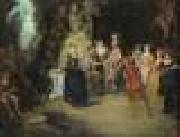
French painter of Flemish descent, b. Valenciennes. Until 1704 poverty forced him to work in the shops of mediocre artists, where he produced genre and devotional subjects. In 1704?C8 he studied in the studio of Claude Gillot, an adept painter of scenes of theatrical life, which later became the subject of some of Watteau's finest paintings, such as Love in the Italian Theatre and Love in the French Theatre (both: Berlin). In 1708?C9 Watteau worked with the decorator Claude Audran. Watteau attracted the attention of eminent patrons in his last years, including the comte de Caylus, his biographer, and in 1717 he was made a full member of the Acad??mie royale. The Embarkation for Cythera (1717; Louvre) is characteristic of his art; it is a delicate, courtly fantasy, represented in warm and shimmering pastel tones that place him among the great colorists of all time. A lyric, Giorgionesque quality pervades his airy, gay, and sensuous scenes, which have a poignancy that none of his followers attained. Out of the most fleeting aspects of life he created an enduring and individual art. His exquisite paintings influenced fashion and garden design in the 18th cent. Other outstanding works include Gilles (Louvre), Perspective (Mus. of Fine Arts, Boston), Mezzetin (Metropolitan Mus.), and Gersaint's Shop Sign (1719; Berlin).
|
|
|
|
 |
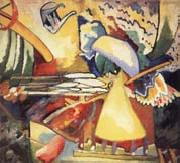
Wassily Kandinsky
|
|
1866-1944
Wassily Kandinsky Galleries
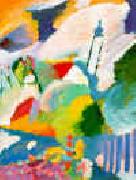
was a Russian painter, printmaker and art theorist. One of the most famous 20th-century artists, he is credited with painting the first modern abstract works.
Born in Moscow, Kandinsky spent his childhood in Odessa. He enrolled at the University of Moscow and chose to study law and economics. Quite successful in his profession??he was offered a professorship (chair of Roman Law) at the University of Dorpat??he started painting studies (life-drawing, sketching and anatomy) at the age of 30.
In 1896 he settled in Munich and studied first in the private school of Anton Azbe and then at the Academy of Fine Arts, Munich. He went back to Moscow in 1914 after World War I started. He was unsympathetic to the official theories on art in Moscow and returned to Germany in 1921. There he taught at the Bauhaus school of art and architecture from 1922 until the Nazis closed it in 1933. He then moved to France where he lived the rest of his life, and became a French citizen in 1939. He died at Neuilly-sur-Seine in 1944.
|
|
 |
Wassilij Grigorjewitsch Perow
|
|
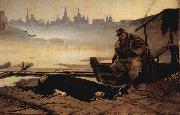
Vasily Grigorevich Perov (Russian; real name Vasily Grigorevich Kridener ; 2 January 1834 (21 December 1833 Old Style) - 10 June (29 May Old Style) 1882) was a Russian painter and one of the founding members of Peredvizhniki, a group of Russian realist painters.
Vasily Perov was born 2 January 1834 (21 December 1833 Old Style) in Tobolsk, being the illegitimate son of procurator, baron Grigory Karlovich Kridener. After completing a course at Arzamas uezd school, he was transferred to the Alexander Stupin art school also located in Arzamas. In 1853 he was admitted to the Moscow School of Painting, Sculpture and Architecture, where he learned from several renowned artists.
In 1856 he was awarded with a minor silver medal for his sketch of a boy's head, presented to the Imperial Academy of Arts. Later the Academy gave him many other awards: in 1857 a major silver medal for Commissary of Rural Police Investigating, a minor golden medal for the Scene on a Grave and the Son of a Dyak Promoted to First Rank, and in 1861 a major golden medal for Sermon in a Village.
After receiving the right to a state-paid trip abroad together with a golden medal, in 1862 Perov went to Western Europe, visiting several German cities, and then Paris. During this time he created paintings depicting scenes from European street life, such as the Vendor of statuettes, the Savoyard, the Organ-Grinder in Paris, the Musicians and the Bystanders, and the Paris Ragpickers.
Returning to Moscow early, from 1865 to 1871 Perov created his masterpieces The Queue at The Fountain, A Meal in the Monastery, Last Journey, Troika, the Lent Monday, Arrival of a New Governess in a Merchant House, the Drawing Teacher, A Scene at the Railroad, the Last Tavern at Town Gate, the Birdcatcher, the Fisherman, and the Hunters at Rest.
|
|
|
|
 |
Washington Allston
|
|
1779-1843
Washington Allston Gallery Allston was born on a plantation on the Waccamaw River near Georgetown, South Carolina. His mother Rachel Moore had married Captain William Allston in 1775, though her husband died in 1781, shortly after the Battle of Cowpens. Moore remarried to Dr. Henry C. Flagg, the son of a wealthy shipping merchant from Newport, Rhode Island.
Allston graduated from Harvard College in 1800 and moved to Charleston, South Carolina for a short time before sailing to England in May 1801. He was admitted to the Royal Academy in London in September, when painter Benjamin West was then the president.
From 1803 to 1808 he visited the great museums of Paris and then for several years those of Italy, where he met Washington Irving in Rome, and Coleridge, his lifelong friend. In 1809 Allston married Ann Channing, sister of William Ellery Channing. Samuel F. B. Morse was one of Allston's art pupils and accompanied Allston to Europe in 1811. After traveling throughout western Europe, Allston finally settled in London, where he won fame and prizes for his pictures.
Allston was also a published writer. In London in 1813, he published The Sylphs of the Seasons, with Other Poems, republished in Boston, Massachusetts later that year. His wife died in February 1815, leaving him saddened, lonely, and homesick for America.
In 1818 he returned to the United States and lived in Cambridge, Massachusetts for 25 years. He was the uncle of the artists George Whiting Flagg and Jared Bradley Flagg, both of whom studied painting under him.
In 1841 he published Monaldi, a romance illustrating Italian life, and in 1850, a volume of his Lectures on Art, and Poems.
Allston died on July 9, 1843, at age 64. Allston is buried in Harvard Square, in "the Old Burying Ground" between the First Parish Church and Christ Church.
|
|
|
|
 |
Walter Withers
|
|
English-born Australian Painter,
1854-1914
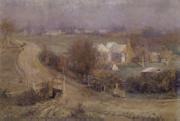
was an Australian landscape artist and a member of the Heidelberg School of Australian impressionists. Withers was born at Handsworth, Staffordshire, the son of Edwin Withers. He showed an early desire to paint, but objection was made to this by his father. It is not known what occupation he followed in England, but in 1882 he arrived in Australia with the intention of going on the land. After working for about 18 months on a farm, Withers removed to Melbourne and obtained a position as draughtsman in a firm of printers. He then took up his painting again, and began to exhibit with the Victorian Academy of Arts afterwards merged in the Victorian Artists' Society. In 1887 Withers went to Europe. There he was married to Miss F. Flinn and studied for some months at the Academie Julian, Paris. He returned to Australia with his wife in June 1888 having been commissioned to do black and white work for Messrs Fergusson and Mitchell of Melbourne. His most important work in this way will be found in the illustrations to Edmund Finn's, The Chronicles of Early Melbourne. Withers settled down at first at Kew, a suburb of Melbourne, and then near Heidelberg on the other side of the river Yarra. He became friendly with Arthur Streeton, Charles Conder, Tom Roberts, Frederick McCubbin and other leading artists of the period. He began to sell a few pictures, but the collapse of the land boom put an end to his illustrative work. He obtained some work as a drawing and painting master in schools, and in 1891 opened a studio in Collins-street west, where he held his first private exhibition.
|
|
 |
Walter Ufer
|
|
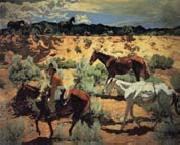
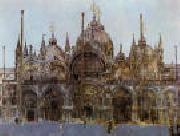
American Painter, 1876-1936,was an American artist based in Taos, New Mexico. His most notable work focuses on scenes of Native American life, particularly of the Pueblo Indians. Walter was born of German immigrant parents and raised in Kentucky. After an apprenticeship as a lithographer, he went to Europe where he was a traveling journeyman. When he returned to America, he worked as a printer in Chicago and taught school, and later took classes in fine arts. After a brief time in Chicago, he returned to Europe for further study as an artist.
|
|
 |
Walter Sickert
|
|
German
1860-1942
Walter Sickert Gallery
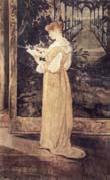
Walter Richard Sickert (May 31, 1860 in Munich, Germany ?C January 22, 1942 in Bath, England) was a German-born English Impressionist painter. Sickert was a cosmopolitan and eccentric who favoured ordinary people and urban scenes as his subjects
He developed a personal version of Impressionism, favouring sombre colouration. Following Degas' advice, Sickert painted in the studio, working from drawings and memory as an escape from "the tyranny of nature".[3] Sickert's earliest major works were portrayals of scenes in London music halls, often depicted from complex and ambiguous points of view, so that the spatial relationship between the audience, performer and orchestra becomes confused, as figures gesture into space and others are reflected in mirrors. The isolated rhetorical gestures of singers and actors seem to reach out to no-one in particular, and audience members are portrayed stretching and peering to see things that lie beyond the visible space. This theme of confused or failed communication between people appears frequently in his art.
By emphasising the patterns of wallpaper and architectural decorations, Sickert created abstract decorative arabesques and flattened the three-dimensional space. His music hall pictures, like Degas' paintings of dancers and caf??-concert entertainers, connect the artificiality of art itself to the conventions of theatrical performance and painted backdrops. Many of these works were exhibited at the New English Art Club, a group of French-influenced realist artists with which Sickert was associated. At this period Sickert spent much of his time in France, especially in Dieppe where his mistress, and possibly his illegitimate son, lived
|
|
 |
Walter Shirlaw
|
|
Scottish-American artist , 1838-1909
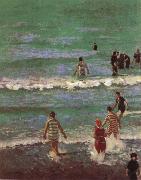
was a Scottish-American artist. Shirlaw was born in Paisley, Scotland, and moved to the United States with his parents in 1840. He worked as a bank-note engraver, and his work was first exhibited at the National Academy in 1861. He was elected an academician of the Chicago Academy of Design in 1868. Among his pupils there was Frederick Stuart Church. From 1870 to 1877 he studied in Munich, under George Raab, Richard Wagner, Arthur George von Ramberg, and Wilhelm Lindenschmidt. His first work of importance was the Toning of the Bell (1874), which was followed by Sheep-shearing in the Bavarian Highlands (1876). The latter, which is probably the best of his works, received honorable mention at the Paris exposition in 1878. Other notable works from his easel are Good Morning (1878), in the Buffalo Academy; Indian Girl and Very Old (1880); Gossip (1884); and Jealousy (1886), owned by the Academy of Design, New York. His largest work is the frieze for the dining-room in the house of Darius O. Mills in New York. Shirlaw has also earned an excellent reputation as an illustrator. He was one of the founders of the Society of American Artists, and was its first president. On his return from Europe he took charge of the Art Students League of New York, and for several years taught in the composition class.
|
|
 |
Walter Richard Sickert
|
|
British Camden Town Group Painter, 1860-1942
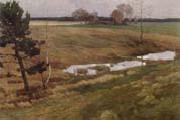
British painter, printmaker, teacher and writer of German birth. Sickert was one of the most influential British artists of this century. He is often called a painter painter, appealing primarily to artists working in the figurative tradition; there are few British figurative painters of the 20th century whose development can be adequately discussed without reference to Sickert subject-matter or innovative techniques. He had a direct influence on the Camden Town Group and the Euston Road School, while his effect on Frank Auerbach, Howard Hodgkin and Francis Bacon was less tangible. Sickert active career as an artist lasted for nearly 60 years. His output was vast. He may be judged equally as the last of the Victorian painters and as a major precursor of significant international developments in later 20th-century art, especially in his photo-based paintings.
|
|
|
|
 |
Walter Leistikow
|
|
1865-1908,German painter, decorative artist, etcher, exhibition organizer and writer. He studied painting briefly in 1883, at the Akademie in Berlin, but he was dismissed after six months as 'untalented'. From 1883 to 1885 he trained with the painter Hermann Eschke (1823-1900) and from 1885 to 1887 with the Norwegian painter Hans Fredrik Gude. Gude had a decisive influence on the style of Leistikow's early works, as is especially clear in Leistikow's light coastal landscapes with figures. His most significant work from this period, however, is Brickworks near Eckernferde (1887; ex-Gem?ldegal. Neue Meister, Dresden). Leistikow's dismissal from the Akademie concentrated his attention on issues of artistic policy. When the German government decided not to send works for exhibition in the Exposition Universelle in Paris in 1889, Leistikow himself organized the dispatch of works to Paris. In 1892,
|
|
|
|
|
|
|
|
 |
Walter I Cox
|
1866-1930
English
Can you freeze blue apron meals
Are you a busy parent or an overwhelmed office worker who just doesn??t have the time for cooking? You know what it feels like to be tired and famished but lack the energy to cook, right? If so, then Blue Apron meals might just sound like a lifesaver! Though they provide scrumptious home-cooked meals in minutes, do you ever find yourself with more meal options than you can eat that week? Well have we got good news for you - yes, indeed you *can* freeze Blue Apron Meals! Keep reading to find out exactly how.
Exploring freezing blue apron meals - what recipes can you freeze, and for how long
Exploring freezing Blue Apron meals can be a fun and flavorful way to enjoy later in the month. Whether you've just received your delivery or need to preserve leftovers, most of Blue Apron's recipes can be frozen for up to three months. Many seafood dishes, such as recipes involving white fish, salmon and shellfish, do not freeze well and should be consumed within 1-2 days. Other dishes, such as stir-fries, braises, stews, soups and pastas lend themselves particularly well for freezing. When making these dishes at home from a Blue Apron kit or Hellofresh kit hellofreshvsblueapron, simply portion out individual servings in airtight containers before freezing. Once you're ready to reheat the meal again, simply place the container back in the fridge overnight before cooking!
How to choose the best meals from blue apron to freeze
Freezing meals from Blue Apron is a great way to make sure you're always prepared for mealtimes. Depending on your tastes and preferences, there are a few tips and tricks you should bear in mind when selecting meals to freeze. Firstly, if you're aiming for the best possible quality upon defrosting, look for recipes with minimal dairy content. Dairy does not survive freezing well and can lead to a gritty texture after thawing. Secondly, consider recipes containing more neutral ingredients like vegetables or fish, as these will retain their flavors better than more robust options such as steak or pork chops. Lastly, be mindful of highly-seasoned ingredients as these tend to lose flavor faster than basic ones when frozen. Doing these things will ensure that by taking the time to freeze a meal now, you'll be able to enjoy it later at its peak flavor level!
Tips for prepping and packaging blue apron meals before freezing them
Prepping and packaging blue apron meals before freezing them is a simple but effective way to save time when cooking during the week. For best results, it??s important to properly season the un-prepped pre-measured ingredients prior to combining them. This will make sure that the flavors of the meal are properly distributed. Once seasoned, combine the ingredients in one large bowl or dish, this will make packaging easier and result in less waste. Transferring prepped meals into storage bags or containers should be done quickly in order to properly seal out air, this will keep your meal fresher for longer. Finally, don??t forget to label each bag with the name of dish and date you prepped it. Following these simple tips for prepping and packaging blue apron meals before freezing them will ensure you have delicious home cooked meals ready throughout the week without spending hours putting dishes together from scratch!
What effects does freezing have on the nutritional content of blue apron meals
Flash freezing is incredibly beneficial to blue apron meals as it preserves the nutritional content of the food. When produce is picked off the vine, nutrient levels are at their peak and will decay over time. Thankfully, flash freezing locks in the flavor and nutrition contained in blue apron??s fresh ingredients so that you can be sure you are enjoying healthy, delicious meals. This method also significantly decreases spoilage so that your food won??t go bad nearly as quickly, allowing for fewer trips to the grocery store and more time spent enjoying your meals with friends and family.
|
|
|
|
|
|
 |
Walter Griffin
|
|
1861-1935
Walter Burley Griffin November 24, 1876?CFebruary 11, 1937) was a US architect and landscape architect, who is best known for his role in designing Canberra, Australia's capital city. He has also been credited with the development of the L-shaped floor plan, the carport and the first use of reinforced concrete.
Influenced by the Chicago-based Prairie School, Griffin went on to develop a unique modern style. For much of his career Griffin worked in partnership with his wife Marion Mahony Griffin. In the 28 years of their architectural partnership, the Griffins designed over 350 building, landscape and urban-design projects as well as designing construction materials, interiors, furniture and other household items.
|
|
|
|
 |
Walter Gramatte
|
|
Walter Gramatte (8 January 1897 in Berlin - 9 February 1929 in Hamburg) was a German expressionist painter who specialized in magic realism. He often painted with a mystical view of nature.
Walter Gramatte died on 9 February 1929 of Intestinal Tuberculosis.
His second wife Sonia married again, was then named Sophie Carmen Eckhardt-Gramatte and lived in Canada as a renowned musician. To remember her and her former husband Walter Gramatte „The Eckhardt-Gramatte-Foundatione was established in Winnipeg, Canada.
Walter Gramatte's written posthumous works are preserved in the German National Museum.
A special exhibition of his paintings, titled Rediscovered: Walter Gramatte 1897-1929, took place in Hamburg Ernst Barlach Haus from October 26, 2008 to February 1, 2009. This exhibition was organized by Kirchner Museum in Davos, Switzerland and the Ernst Barlach Haus in Hamburg, Germany.
|
|
 |
Walter Gay
|
|
1856-1937. He was an American painter born at Hingham, Massachusetts. He married heiress Matilda E. Travers, the daughter of prominent New York City investor and co-founder of Saratoga Race Course, William R. Travers. In 1876 the couple moved to Paris, France where Walter Gay became a pupil of Leon Bonnat. They lived in an apartment on the Left Bank and in 1907 purchased Chateau Le Breau on a three-hundred-acre walled park near the Forest of Fontainebleau. Walter Gay received an honorable mention in the Paris Salon of 1885; a gold medal in 1888, and similar awards at Vienna (1894), Antwerp (1895), Berlin (1896) and Munich (1897). He became an Officer of the Legion of Honor and a member of the Society of Secession, Munich.
|
|
|
|
 |
Walter Crane,RWS
|
|
1845-1915
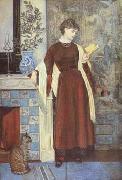
English painter, illustrator, designer, writer and teacher. He showed artistic inclinations as a boy and was encouraged to draw by his father, the portrait painter and miniaturist Thomas Crane (1808-59). A series of illustrations to Tennyson's The Lady of Shalott (Cambridge, MA, Harvard U., Houghton Lib.) was shown first to Ruskin, who praised the use of colour, and then to the engraver William James Linton, to whom Crane was apprenticed in 1859. From 1859 to 1862 Crane learnt a technique of exact and economical draughtsmanship on woodblocks. His early illustrative works included vignette wood-engravings for John R. Capel Wise's The New Forest: Its History and its Scenery (1862).
|
|
 |
Walter Crane
|
|
English Golden Age Illustrator, 1845-1915
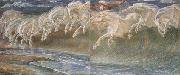
English painter, illustrator, designer, writer and teacher. He showed artistic inclinations as a boy and was encouraged to draw by his father, the portrait painter and miniaturist Thomas Crane (1808-59). A series of illustrations to Tennyson's The Lady of Shalott (Cambridge, MA, Harvard U., Houghton Lib.) was shown first to Ruskin, who praised the use of colour, and then to the engraver William James Linton, to whom Crane was apprenticed in 1859. From 1859 to 1862 Crane learnt a technique of exact and economical draughtsmanship on woodblocks.
|
|
|
|
|
|
|
|
|
|
|
| Wholesale China Oil Painting Wholesale Oil Painting China Xiamen Portrait Reproduction on canvas Chinese Oil Painting Wholesale USA Oil Painting |
|
|
|
|
|