| |
|
Xiamen Oil Paintings, Wholesale Direct!
|
|
100% hand painted, 100% cotton canvas, 100% money back if not satisfaction. |
|
|
|
|
ART WORKS INDEX
A
B
C
D
E
F
G
H
I
J
K
L
M
N
O
P
Q
R
S
T
U
V
W
X
Y
Z
|
|
ARTISTS INDEX
A
B
C
D
E
F
G
H
I
J
K
L
M
N
O
P
Q
R
S
T
U
V
W
X
Y
Z
|
|
|
|
|
|
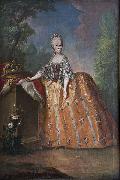 |
Workshop of Anton von Maron
|
|
Anton von Maron (January 8, 1733 - March 3, 1808) was an Austrian painter, active in Rome.
Von Maron was born in Vienna, but moved at a young age to Rome. There, he studied under Anton Raphael Mengs, and became an accomplished portrait painter. He married a sister of Mengs, Therese Maron, who was a painter in her own right. He lived the rest of his life in Rome, and died there in 1808.
|
|
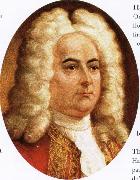 |
wolfgang amadeus mozart
|
|
Born: 27 January 1756
Birthplace: Salzburg, Austria
Died: 5 December 1791 (fever)
Best Known As: Composer of Eine kleine Nachtmusik
|
|
|
|
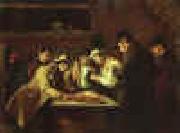 |
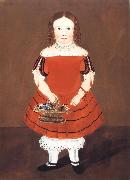
William Sidney Mount
|
|
1807-1868
William Sidney Mount Galleries
William Sidney Mount (November 26, 1807 ?C November 19, 1868) born in Setauket, New York was a renowned genre painter and contemporary of the Hudson River School. Mount trained at the National Academy of Design in New York. Two of his more famous paintings are Eel Spearing at Setauket (1845, New York State Historical Association, Cooperstown) and Bargaining for a Horse (1835, New-York Historical Society, New York City). Beginning as a history painter, Mount moved to depicting scenes from everyday life. The largest collection of his works is located in The Long Island Museum of American Art, History, and Carriages
His home and studio, the William Sidney Mount House, is a National Historic Landmark. One of the local elementary schools in The Three Village Central School District is named in his honor, as is PS 174 elementary school in Rego Park, Queens. A residential building is named after him on the Stony Brook University campus.
|
|
 |
William Mulready
|
|
(1 April 1786 - 7 July 1863) was an Irish genre painter living in London. He is best known for his romanticizing depictions of rural scenes, and for creating Mulready stationery letter sheets, issued at the same time as the Penny Black postage stamp.
William Mulready was born in Ennis, County Clare. Early in his life, in 1792, the family moved to London, where he was able to get an education and was taught painting well enough so that he was accepted at the Royal Academy School at the age of fourteen.
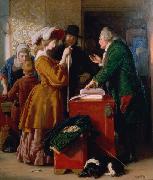
Choosing the Wedding Gown
illustrating ch 1 of Vicar of Wakefield by Oliver GoldsmithIn 1802, he married Elizabeth Varley (1784-1864), a landscape painter. Their three children, Paul Augustus (1805-1864), William (1805-1878), and Michael (1807-1889) also became artists. His relationship with his wife however deteriorated gradually over the years, which is detailed in papers stored at the library of the Victoria and Albert Museum. His strong Catholic beliefs prevented any chance of a divorce but they separated. He accused her of "bad conduct" but shied from providing details. In a letter to him in 1827 she blamed him entirely for the collapse of their marriage, suggesting cruelty, pederastic activities and adultery were the reasons.
His son, William Mulready Junior (1805-1878), lived in London and maintained a career of a portrait painter and picture restorer. He had five children (Ellen, Mary, Augustus Edwin, Henry William, and John).They also were trained as artists, but not all of them pursued the artistic career: Henry William and John described themselves as 'house painters'. Augustus Edwin Mulready (1844-1904) was the most successful of them and became known as a member of the Cranbrook Colony of artists.
|
|
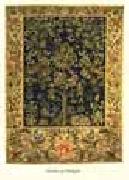 |
William Morris Prints
|
|
English Pre-Raphaelite Writer and Designer, 1834-1896
was an English architect, furniture and textile designer, artist, writer, and socialist associated with the Pre-Raphaelite Brotherhood and the English Arts and Crafts Movement.
Born in Walthamstow in north London, Morris was educated at Marlborough and Oxford. In 1856, Morris became an apprentice to Gothic revival architect G. E. Street. That same year he founded the Oxford and Cambridge Magazine, an outlet for his poetry and a forum for development of his theories of hand-craftsmanship in the decorative arts. In 1861, Morris founded a design firm in partnership with the artist Edward Burne-Jones, and the poet and artist Dante Gabriel Rossetti which had a profound impact on the decoration of churches and houses into the early 20th century. Morris's chief contribution was as a designer of repeating patterns for wallpapers and textiles, many based on a close observation of nature. Morris was also a major contributor to the resurgence of traditional textile arts and methods of production.
Morris wrote and published poetry, fiction, and translations of ancient and medieval texts throughout his life. His best-known works include The Defence of Guenevere and Other Poems (1858), The Earthly Paradise (1868?C1870), A Dream of John Ball and the utopian News from Nowhere.
Morris was an important figure in the emergence of socialism in Great Britain, founding the Socialist League in 1884, but breaking with the movement over goals and methods by the end of that decade. Morris devoted much of the rest of his life to the Kelmscott Press which he founded in 1891. The 1896 Kelmscott edition of the Works of Geoffrey Chaucer is considered a masterpiece of book design.
|
|
 |
William Morris Hunt
|
|
1824- 1879
William Morris Hunt Gallery
Hunt's father's family were among Vermont's founders and largest landowners; his mother's a family of wealth and prominence in Connecticut. Hunt attended Harvard but withdrew in his junior year.
Following the untimely death of his Congressman father from cholera, Hunt's mother Jane took him and his brothers to Switzerland, the South of France and to Rome, where Hunt studied with Couture in Paris and then came under the influence of Jean-François Millet, from whom he learned the principles of the Barbizon school. The Hunt family remained in Europe for a dozen years.
Afterwards, leaving Paris, he painted and established art schools at Newport, Rhode Island, where he had relatives, Brattleboro, Vermont, Faial Island in the Azores, where he had family connections and finally at Boston, where he painted, taught art and became a popular portrait painter.
The companionship of Millet had a lasting influence on Hunt's character and style, and his work grew in strength, in beauty and in seriousness. He was among the biggest proponents of the Barbizon school in America, and he more than any other turned the rising generation of American painters towards Paris.
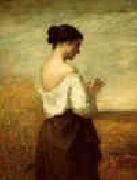
On his return in 1855 he painted some of his most handsome canvases, all reminiscent of his life in France and of Millet's influence. Such are The Belated Kid, Girl at the Fountain, Hurdy-Gurdy Boy, and others ?C but the public called for portraits, and it became the fashion to sit for Hunt; among his best paintings of this genre are those of William M. Evarts, Mrs Charles Francis Adams, the Rev. James Freeman Clarke, William H. Gardner, Chief Justice Shaw and Judge Horace Gray.
Sadly, many of Hunt's paintings and sketches, together with five large Millets and other art treasures collected by him in Europe, were destroyed in the Great Boston Fire of 1872.
|
|
 |
William Morris Davis
|
|
February 12, 1850 - February 5, 1934,Davis, who was born in Philadelphia, Pennsylvania, was educated at Harvard. He returned to teach there in 1877 after a period as a meteorologist in Argentina and as an assistant with the North Pacific Survey. He became professor of physical geography in 1890 and of geology in 1898. Davis is acknowledged as the founder of geomorphology, the study of landforms. In his The Rivers and Valleys of Pennsylvania (1889) he first introduced what later became known as the Davisian systems of landscape analysis. His aim was to provide an explanatory description of how landforms change in an ideal situation and his most important contribution to this was his introduction of the cycle of erosion into geographical thought. He proposed a complete cycle of youth, maturity, and old age to describe the evolution of a landscape. In youth rivers occupy steep V-shaped valleys while in old age the valleys are broad. The end product would be a flat featureless plain he called a epeneplaine. This was an ideal cycle but in practice the cycle would invariably be interrupted by Earth movements. It was, nevertheless, strongly attacked by German geographers who objected to it on the grounds that it neglected such vital factors as weathering and climate in transforming the landscape. They also believed him to be undermining their argument that landforms could only be discovered by local fieldwork and the production of regional monographs. Davis also produced an influential work,
|
|
 |
William Michael Harnett
|
|
1851-1892
Harnett was born in Clonakilty, County Cork, Ireland during the time of the potato famine. Shortly after his birth his family emigrated to America, settling in Philadelphia. Becoming a United States citizen in 1868, he made a living as a young man by engraving designs on table silver, while also taking night classes at the Pennsylvania Academy of the Fine Arts and later, in New York, at Cooper Union and at the National Academy of Design. His first known oil painting, a still life, dates from 1874.
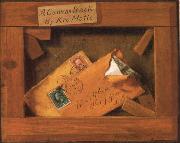
The style of trompe l'oeil painting that Harnett developed was distinctive and inspired many imitators, but it was not without precedent. A number of 17th century Dutch painters, Pieter Claesz. for instance, had specialized in tabletop still life of astonishing verisimilitude. Raphaelle Peale, working in Philadelphia in the early 19th century, pioneered the form in America. What sets Harnett's work apart, besides his enormous skill, is his interest in depicting objects not usually made the subject of a painting.
Harnett painted musical instruments, hanging game, and tankards, but also painted the unconventional Golden Horseshoe (1886), a single rusted horseshoe shown nailed to a board. He painted a casual jumble of second-hand books set on top of a crate, Job Lot, Cheap (1878), as well as firearms and even paper currency. His works sold well, but they were more likely to be found hanging in a tavern or a business office than in a museum, as they did not conform to contemporary notions of high art.
Harnett spent the years 1880?C1886 in Europe, staying in Munich from 1881 until early 1885. Harnett's best-known paintings, the four versions of After The Hunt, were painted between 1883 and 1885. Each is an imposing composition of hunting equipment and dead game, hanging on a door with ornate hinges at the right and keyhole plate at the left. These paintings, like the horseshoe or currency depictions mentioned earlier, are especially effective as trompe l'oeil because the objects occupy a shallow space, meaning that the illusion is not spoiled by parallax shift if the viewer moves.
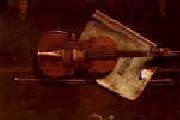
Overall, Harnett's work is most comparable to that of the slightly younger John F. Peto. The two artists knew each other, and a comparison can be made between two paintings featuring violins. Harnett's Music and Good Luck from 1888 shows the violin hanging upright on a door with ornate hinges and with a slightly torn piece of sheet music behind it. The elements are arranged in a stable, deliberate manner. Peto's 1890 painting shows the violin hanging askew, as well as chipped and worn, with one string broken. The sheet music is dog-eared and torn around the edges, and placed haphazardly behind the instrument. The hinges are less ornate, and one is broken. Harnett's objects show signs of use but are well preserved, while Peto's more humble objects are nearly used up.
Crippling rheumatism plagued Harnett in his last years, reducing the number but not the quality of his paintings. He died in New York City in 1892. Other artists who painted similar compositions in Harnett's wake include his contemporary John Haberle and successors such as Otis Kaye and Jefferson David Chalfant.
|
|
 |
William Merritt Chase
|
|
American Impressionist Painter, 1849-1916
American painter and printmaker. He received his early training in Indianapolis from the portrait painter Barton S. Hays (1826-75). In 1869 he went to New York to study at the National Academy of Design where he exhibited in 1871. That year he joined his family in St Louis, where John Mulvaney (1844-1906) encouraged him to study in Munich. With the support of several local patrons, enabling him to live abroad for the next six years, Chase entered the Kenigliche Akademie in Munich in 1872. Among his teachers were Alexander von Wagner (1838-1919), Karl Theodor von Piloty and Wilhelm von Diez (1839-1907). Chase also admired the work of Wilhelm Leibl. The school emphasized bravura brushwork, a technique that became integral to Chase's style, favoured a dark palette and encouraged the study of Old Master painters, particularly Diego Velezquez and Frans Hals. Among Chase's friends in Munich were the American artists Walter Shirlaw, J. Frank Currier and Frederick Dielman (1847-1935)
|
|
|
|
|
|
|
|
 |
William Mctaggart
|
|
Scottish Painter,
1835-1910
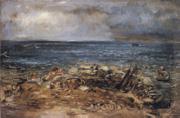
was a Scottish landscape painter who was influenced by Impressionism. The son of a crofter, William McTaggart was born in the small village of Aros in Kintyre. He moved to Edinburgh at the age of 16 and studied at the Trustees' Academy under Robert Scott Lauder. He won several prizes as a student and exhibited his work in the Royal Scottish Academy, becoming a full member of the Academy in 1870. His early works were mainly figure paintings, often of children, but he later turned to land and seascape painting, inspired by his childhood love of the sea and the rugged, Atlantic-lashed west coast of his birth. The Storm, 1890, National Gallery of Scotland, Edinburgh.McTaggart was fascinated with nature and man??s relationship with it, and he strove to capture aspects such as the transient effects of light on water. He adopted the Impressionist practice of painting out of doors, and his use of colour and bold brushwork resemble qualities found in paintings by Constable and Turner, both artists whom he admired. McTaggart was skilled in the use of both oil and watercolour and, in addition to Kintyre seascapes, he also painted landscapes and seascapes in Midlothian and East Lothian. Many of his later works depict the Moorfoot Hills which could be seen from his house near Lasswade, which he moved to in 1889.
|
|
 |
William McGregor Paxton
|
|
1869-1941
William McGregor Paxton Gallery
William McGregor Paxton (June 22, 1869 ?C 1941) was an American Impressionist painter.
Born in Baltimore, the Paxton family came to Newton Corner in the mid-1870s, where William's father James established himself as a caterer. At 18, William won a scholarship to attend the Cowles Art School, where he began his art studies with Dennis Miller Bunker. Later he studied with Jean-L??on G??rôme in Paris and, on his return to Boston, with Joseph DeCamp at Cowles. There he met his future wife Elizabeth Okie, who also was studying with DeCamp. After their marriage, William and Elizabeth lived with his parents at 43 Elmwood Street, and later bought a house at 19 Montvale Road in Newton Centre.
Paxton, who is best known as a portrait painter, taught at the Museum School from 1906 to 1913. Along with other well known artists of the era, including Edmund Charles Tarbell and Frank Benson, he is identified with the Boston School.
Paxton was working on his last painting, a view of his living room at 19 Montvale Road, with his wife posing for him, when he was stricken with a heart attack and died at the age of 72.
|
|
 |
William Maw Egley
|
|
English painter , (1826-1916)
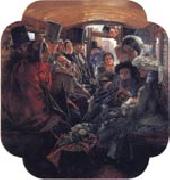
was a British artist of the Victorian era. The son of the miniaturist William Egley, he studied under his father. His early works were illustrations of literary subjects typical of the period, such as Prospero and Miranda from The Tempest. These were similar to the work of The Clique. William Powell Frith, one of The Clique, hired Egley to add backgrounds to his own work. Egley soon developed a style influenced by Frith, including domestic and childhood subjects. Most of his paintings were humorous or "feelgood" genre scenes of urban and rural life, depicting such subjects as harvest festivals and contemporary fashions. His best known painting, Omnibus Life in London (Tate Gallery) is a comic scene of people squashed together in the busy, cramped public transport of the era. Egley always showed great interest in specifics of costume, to which he paid detailed attention, but his paintings were often criticised for their hard, clumsy style. In the 1860s Egley adopted the fashion for romanticised 18th century subjects.
|
|
|
|
 |
William Marlow
|
|
(1740 - 14 January 1813) was a British landscape and marine painter and etcher.
Marlow was born in Southwark in London, and studied for 5 years under the marine painter Samuel Scott, and also at the St. Martin's Lane Academy, London.
He became a member of the Incorporated Society of Artists, and from 1762 to 1764 contributed to their exhibitions in Spring Gardens. He was employed in painting views of country houses.
From 1765 to 1768, on the advice of the Duchess of Northumberland, he travelled in France and Italy. On his return to Britain he renewed his contributions to the Society of Artists, and took up residence in Leicester Square, London - he was made a Fellow of the Society in 1771.
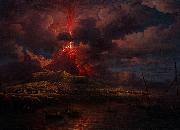
In 1788 he moved to Twickenham, and started to exhibit at the Royal Academy, showing works regularly until 1796, and again, for the last time, in 1807, when he exhibited Twickenham Ferry by Moonlight.
Marlow died in Twickenham on 14 January 1813.
|
|
|
|
 |
William James Muller
|
|
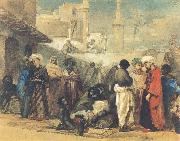
British Painter, 1812-1845, English landscape and figure painter, was born at Bristol, his father, a Prussian, being curator of the museum. He first studied painting under JB Pyne. His early subjects deal mainly with the scenery of Gloucestershire and Wales, and he learned much from his study of Claude, Ruysdael, and earlier landscape-painters. In 1833 he figured for the first time in the Royal Academy with his "Destruction of Old London Bridge--Morning," and next year he made a tour through France, Switzerland and Italy. Four years later he visited Athens, extending his travels to Egypt, and in the sketches executed during this period and the paintings produced from them his power and individuality are apparent. Shortly after his return he left Bristol and settled in London, where he exhibited regularly. In 1840 he again visited France, where he executed a series of sketches of Renaissance architecture, twenty-five of which were lithographed and published in 1841, in a folio entitled "The Age of Francis I. of France." In 1843 he accompanied,
|
|
 |
William J. McCloskey
|
|
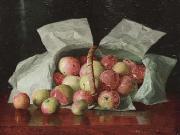
painted Lady Apples in Overturned Basket. Signed W.J. McCloskey in 1941
United States (1859- 1941 ) - Painter
|
|
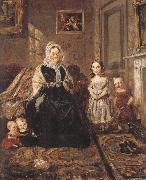 |
william holman hunt,o.m.,r.w.s
|
|
1827-1910
English painter. He worked as an office clerk in London from 1839 to 1843, attending drawing classes at a mechanics' institute in the evenings and taking weekly lessons from the portrait painter Henry Rogers. Holman Hunt overcame parental opposition to his choice of career in 1843, and this determined attitude and dedication to art could be seen throughout his working life. In July 1844, at the third attempt, he entered the Royal Academy Schools. His earliest exhibited works, such as Little Nell and her Grandfather (exh. British Institution, 1846; Sheffield, Graves A.G.), reveal few traces of originality, but the reading of John Ruskin's Modern Painters in 1847 was of crucial importance to Holman Hunt's artistic development. It led him to abandon the ambitious Christ and the Two Marys (Adelaide, A.G. S. Australia) in early 1848, when he realized its traditional iconography would leave his contemporaries unmoved. His next major work, the Flight of Madeline and Porphyro during the Drunkenness Attending the Revelry (1848; London, Guildhall A.G.), from John Keats's 'Eve of St Agnes', though displaced into a medieval setting, dramatized an issue dear to contemporary poets and central to Holman Hunt's art: love and youthful idealism versus loyalty to one's family. His first mature painting, it focuses on a moment of psychological crisis in a cramped and shallow picture space.
|
|
|
|
|
|
|
|
|
|
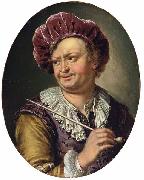 |
Willem van Mieris
|
|
(3 June 1662, Leiden - 26 January 1747, Leiden) was a Dutch painter. He was a son of Frans van Mieris sr. and brother of Jan van Mieris.
His works are extremely numerous, being partly imitations of the paternal subjects, or mythological episodes, which Frans habitually avoided. In no case did he come near the excellence of his sire.
van Mieris has works in the Victoria and Albert Museum as well as Cheltenham and Derby Museum and Art Gallery
|
|
 |
Willem Maris
|
|
Dutch Painter, 1844-1910
Brother of Jacob Maris. He received his training as a painter from his brothers, Jacob Maris and Matthijs Maris. Although he briefly attended evening classes at the Academie in The Hague and was advised by the animal painter Pieter Stortenbeker (1828-98), he was basically self-taught; he was the only self-made man in the circle of Hague school artists. In 1862 he visited Oosterbeek where he met Anton Mauve, with whom he established a long friendship. In the same year he first entered a painting, Cows on the Heath (untraced), in the Tentoonstellung van Levende Meesters in Rotterdam. The themes of cows at pasture and ducks by the side of a ditch, which characterized the Dutch polder landscape in summer, became his hallmark. In the following year he exhibited Cows by a Pool (The Hague, Gemeentemus) in The Hague; it received discouraging reviews, as did the picture entered by his brother Matthijs. Painted in 1863, this work already employs Willem main motif and shows his attention to the handling of light (with effects of haze and backlighting).
|
|
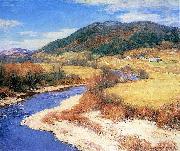 |
Willard Metcalf
|
|
Willard Leroy Metcalf (July 1, 1858 - March 9, 1925) was an American artist born in Lowell, Massachusetts. He studied at the School of the Museum of Fine Arts, Boston, and later attended Academie Julian, Paris. After early figure-painting and illustration, he became prominent as a landscape painter. He was one of the Ten American Painters who in 1897 seceded from the Society of American Artists. For some years he was an instructor in the Womans Art School, Cooper Union, New York, and in the Art Students League, New York. In 1893 he became a member of the American Watercolor Society, New York. Generally associated with American Impressionism, he is also remembered for his New England landscapes and involvement with the artists' colony at Old Lyme, Connecticut.
Born into a working-class family, Metcalf began painting in 1874. In 1876 he opened a studio in Boston, and received a scholarship at the Boston Museum school, where he studied until 1878. In 1882 he held an exhibition at the J. Eastman Chase Gallery in Boston, the sales from which financed a study trip abroad.[1]
Metcalf left for Europe in September 1883, and did not return to the United States until late 1888. During that time he traveled and painted, studying first in Paris with Gustave Boulanger and Jules-Joseph Lefebvre, subsequently going to England and Pont-Aven, Brittany. In the winter of 1884 he apparently met John Twachtman in Paris, and painted at Grez-sur-Loing alongside other American artists, including Theodore Robinson. His landscapes at this time were traditional renditions of peasant scenes, in the manner of Jean Millet.[2] By 1886 Metcalf was painting in Giverny, evidently the first American painter to visit there.[2] Soon thereafter he traveled to Algeria and Tunisia, returning to Giverny in the summers of 1887 and 1888, in the company of other American painters.
|
|
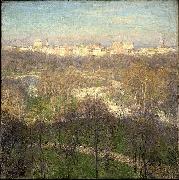 |
Willard Leroy Metcalf
|
|
(July 1, 1858 - March 9, 1925) was an American artist born in Lowell, Massachusetts. He studied at the School of the Museum of Fine Arts, Boston, and later attended Academie Julian, Paris. After early figure-painting and illustration, he became prominent as a landscape painter. He was one of the Ten American Painters who in 1897 seceded from the Society of American Artists. For some years he was an instructor in the Womans Art School, Cooper Union, New York, and in the Art Students League, New York. In 1893 he became a member of the American Watercolor Society,
|
|
|
|
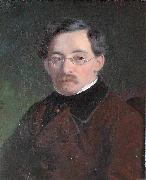 |
Wilhelm Marstrand
|
|
(24 December 1810 - 25 March 1873), painter and illustrator, was born in Copenhagen, Denmark to Nicolai Jacob Marstrand, instrument maker and inventor, and Petra Othilia Smith. Marstrand is one of the most renowned artists belonging to the Golden Age of Danish Painting.
Marstrand studied at Copenhagen's Metropolitan School (Metropolitanskolen), but had little interest in books, and left around 16 years of age. Christoffer Wilhelm Eckersberg, painter and professor at the Royal Danish Academy of Art (Det Kongelige Danske Kunstakademi) in Copenhagen, was a close friend of Wilhelm's father, and it was to all appearance Eckersberg who recommended an artistic career for young Wilhelm. Wilhelm had already shown artistic talent, tackling difficult subjects such as group scenes with many figures and complicated composition.
At 16 years of age Marstrand thus began his studies at the Academy under Eckersberg, attending the school from 1826 to 1833. Although his interests had a firm hold in genre themes - depiction of the daily life he observed around him in Copenhagen's streets, especially middle class society - he would soon reach for the pinnacle of Academic acceptability: the history painting.
History painting displayed what was grand - classical themes from mythology and history, rather than daily life. The traditions, and the taste of traditional art critics, strongly favored it. It was therefore something to strive for, in spite of Marstrand's equal skill at depicting more modest themes, and of the enjoyment he had in portraying the crowds, the diversions of the city, and the humor and story behind the hustle and bustle. Marstrand's creative production would, through many paintings and illustrations made not only during the 1830s but throughout his life, never abandon this inclination toward displaying the simple life of his times.
At the same time Christian Waagepetersen, wine merchant to the Danish court and supporter of the arts, also became an important patron for Marstrand during this early period. His painting "A musical evening party" (Et musikalsk aftenselskab) (1834), depicts such an occasion at the home of Waagepetersen, and was an important transition painting for Marstrand.
Despite an unmistakably growing recognition, Marstrand never received the Academy's gold medal. This medal was coveted not only for its great prestige, but also because it came with a travel stipend for furthering the laureate's artistic training. Marstrand's attempts at winning the medal were unsuccessful both in 1833 with his neoclassical "Flight to Egypt" (Flugten til Ægypten) and in 1835 with "Odysseus and Nausikaa". This was a disappointment, as he had won both available silver medals in 1833.
|
|
|
|
|
|
|
|
 |
VOS, Marten de
|
|
Flemish painter (b. 1532, Antwerpen, d. 1603, Antwerpen).
Flemish painter and draughtsman. Together with the brothers Ambrosius Francken I and Frans Francken I, he ranks among the most important painters of altarpieces in Antwerp during the 1590s. Due, in part, to the Counter-Reformation, there was a renewed demand for altarpieces to replace those lost during iconoclastic riots in 1566 or the reformist movement of 1581. De Vos produced works for, among others, the Old Crossbowmen, the Brabant Coiners, the Antonites, the wine merchants and the Guild of St Luke. The importance of these works would seem to suggest that, after the deaths of Pieter Bruegel I in 1569 and Frans Floris in 1570, de Vos was considered, with some justification, the most important figure painter in Antwerp before Rubens. He was also a prolific draughtsman, especially during the first half of the 1580s, when the Calvinists were in power in Antwerp. During this period he provided numerous designs for print publishers, such as Peeter Baltens, Frans van Beusecom, the widow of Hieronymus Cock, Adriaen Collaert, Phillip Galle, Willem van Haecht, Eduard van Hoeswinkel, Gerard de Jode, Hans van Luyck and Johannes Baptista Vrints. This increased activity is probably indicative of the economic recession and a dwindling market for paintings (especially of religious themes). A total of some 1600 prints were produced after designs by de Vos, an output three times that of Maarten van Heemskerck. De Vos's drawings have been praised (see Mielke) for their lively,
|
|
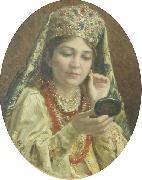 |
Vladimir Makovsky
|
|
(Russian: 26 January (greg.: 7 February) 1846, Moscow - 21 February 1920, Petrograd) was a Russian painter, art collector, and teacher.
Portrait by Vladimir Makovsky of Empress Maria Fyodorovna. Gatchina Palace, 1885Makovsky was the son of collector, Yegor Ivanovich Makovsky, who was one of the founders of the Moscow Art School. Vladimir had two brothers, Nikolai Makovsky and Konstantin Makovsky, and one sister, Alexandra Makovsky, all of whom were famous painters. Vladimir studied at the Moscow School of Painting, Sculpture, and Architecture. He finished his studies in 1869 and the following year became one of the founding members of the Association of Travelling Art Exhibitions, where his many years of prolific work brought him to a leading position
Makovsky's work was defined by a perpetual humor as well as blatant irony and scorn. During the seventies his paintings dealt primarily with small-town folk. His pictures, "The Grape-juice Seller" (1879), "Fruit-Preserving" (1876) and "The Congratulator" (1878) depict various scenes where the mood is finely conceived and almost laughter-inducing. Other works of his, such as "The Benefactor" (1874) and "The Convict" (1878) are profoundly socially-conscious. In them, Makovsky either criticizes the false sympathy of the aristocracy towards the poor, or draws attention to the oppression and persecution by the tsarist gendarmerie. In 1878, he became an academician.
In the eighties, during the time of Russian "democratic" painting, Makovsky produced some of his most valued works. In 1882, he was made professor at the Moscow Art School after the death of Vasili Perov. Some of Makovsky's greatest works of this period include "In the Ante-room of the Court of Conciliation" (1880), "The Released Prisoner" (1882), and "The Collapse of the Bank" (1881). From the end of the 1880s, Makovsky began to produce more gloomy works. Quintessential works of this period include "You Shall Not Go" (1892), and "On the Boulevard" (1888).
In 1894, Makovsky became Rector of the Preparatory school of the Academy of Art. After the First Russian Revolution, he painted "January 9, 1905, on Vasilyev Island" in which he depicts the armed police firing at defenseless people. In another painting "The Sacrifices on the Khodyn Field" in which a thousand people lost their lives during the coronation ceremony in 1896 of Nicholas II, he again stood uncompromisingly on the side of the oppressed people. After the 1917 October Revolution, Makovsky helped carry over the realist traditions to the early stages of Socialist Realism.
|
|
|
|
|
|
 |
villelm melbye
|
|
Danish, 1824-1882
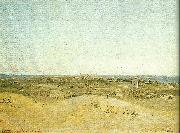
The brother of Anton and Fritz, both Danish artists, Vilhelm Knut Frederik Melbye was born in Denmark and would finish his career as a Professor in the Copenhagen Academy, appointed in 1880. His years between would see him work out of the important venues of Dusseldorf, Venice, Paris and London.
His paintings may almost be used as a travelogue to his career. Working in the Netherlands and paintings scenes of the North and Black Seas through the late 1840s, he exhibited regularly at Charlottenborg in Copenhagen. Melbye lands in London by the early 1850s and ??anglicizes?? his signature to Wilhelm Melby. Paintings by him of Gibraltar and the Italian Mediterranean are in prominent public collections with dates from 1854-62. British subjects reappear in the 1860s, and in 1878, he exhibits at the Parisian Academies. Some later works are signed with initials or his given name once again.
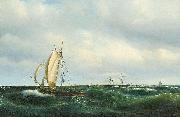
The heart of all his paintings is his obvious attraction to the coastal harbors and marine settings of Europe. They dominate his output, and are compositions full of realistic and dramatic elements emphasizing humanity??s maritime efforts. Cool light, layered shadows and a talent for translating visual depth are noticeable elements in his paintings.
|
|
 |
Vilhelm Melbye
|
|
(14 May 1824 - 6 October 1882) was a Danish marine artist, the brother of Anton Melbye and Fritz Melbye. He worked in London from 1853 to 1866 and, over the course of his career, painted seascapes, coastal and harbor scenes, sailing vessels and topographical subjects in many parts of Europe, especially in the Mediterranean region.
Knud Frederik Vilhelm Hannibal Melbye was born on 14 May 1824 in Elsinore, Denmark. He first trained to become a merchant but then turned to painting, studying under his older brother Anton, already an established marine painter, and attending the Royal Danish Academy of Fine Arts from 1844 to 1847. He also took private classes in perspective drawing with Carl Dahl.
In 1847, he went on his first journey, to Iceland aboard the corvette Valkyrien, and the following year he traveled to Paris by way of Desseldorf. In Paris he studied with Theodore Gudin (1802 - 1880) before returning to Denmark in 1849.
From 1853 to 1866, he lived in London and it was here he changed his name from Vilhelm to Wilhelm.
He was appointed Professor at the academy in Copenhagen in 1880 but died in 1882 in Roskilde. He is interred at Assistens Cemetery in Copenhagen.
|
|
|
|
 |
Victor Mottez
|
|
Lille 1809-Bievres (Essonne)1897
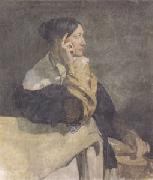
.was a French fresco painter, painter and portraitist. His father was passionate about art and painted himself. Sent to Paris with a pension for some years, Victor was recalled due to the poor state of his father's finances and his studies were cut short. He followed courses at the École de dessin in Lille and worked under the direction of his father and his father's painter friends such as Édouard Lienard, student of Jacques-Louis David. He returned to Paris from 1828 to 1829 to enter the École des Beaux-Arts and at first studied under the direction of François-Édouard Picot, then as a free student of Dominique Ingres. The Mottez family was highly religious and devoted to the House of Bourbon, and so the July Revolution in 1830 came as a catastrophe to them. Victor was again recalled to Lille by his father and married shortly afterwards. From there he made many trips, of which the longest and most notable was that to Italy and he came to consider its old masters as the absolute masters of painting. In Rome he met Ingres again - Ingres liked him very much and often gave him advice. His Christ in the Tomb (now in the glise Sainte-Catherine de Lille) and The Martyrdom of Saint Stephen (now in the glise Saint-Étienne de Lille) date to this era. Also on this trip to Italy he became hugely interested in fresco art - Mottez painted his wife Julie in this medium and, showing Ingres the end result, pulled it off the wall at Ingres' request (it was later given to the Louvre by Mottez's two children). Returning to France in 1838, he set up shop in Paris and exhibited at the Paris Salons, especially turning more and more towards the neglected genre of frescoes, notably religious ones. He also translated the Treatise by the 14th century Florentine painter Cennino Cennini and learned from his techniques. His most remarkable works are those for churches (at Église Saint-Germain-l'Auxerrois in the 1840s, and at the Saint-Severin in the 1850s), which were admired by Ingres and Delacroix. However, the clergy's hostility to them, the materials used, the saltpeter walls and their situation all meant that they were already deteriorated by the end of the 19th century and are now largely lost (except for Saint Martin cutting his cloak in two at St-Germain l'Auxerrois), though Mottez's cartoons for them survive. During the same years he frequented the Bertins' salon, alongside the main writers and artists of the time (a sketch of his for a portrait of Victor Hugo survives). He produced two frescoes for this salon, destroyed in 1854. After the 1848 Revolution Mottez set out for the United Kingdom, where he produced several portraits of British nobles and personalities and the exiled minister François Guizot, which were exhibited at the Royal Academy salons.
|
|
 |
Victor Meirelles
|
|
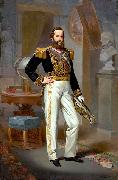
Victor Meirelles de Lima (August 18, 1832 -February 22, 1903) was a 19th century painter. He studied art in Paris but painted most of his works in and about his native Brazil. His religious and military paintings helped him become one of the most popular and celebrated Brazilian painters. His The first Mass in Brazil was the first Brazilian painting to be accepted in the Salons of Paris and is one of the most well known paintings in his native country, being reproduced in every book of History for elementary schools.
|
|
 |
Victor Borisov-Musatov
|
|
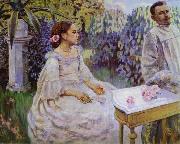
(Russian), (April 14 [O.S. April 2] 1870 - November 8 [O.S. October 26] 1905) was a Russian painter, prominent for his unique Post-Impressionistic style that mixed Symbolism, pure decorative style and realism. Together with Mikhail Vrubel he is often referred as the creator of Russian Symbolism style.
Victor Musatov was born in Saratov, Russia (he added the last name Borisov later). His father was a minor railway official who had been born as a serf. In his childhood he suffered a spinal injury, which made him humpbacked for the rest of his life. In 1884 he entered Saratov real school, where his talents as an artist were discovered by his teachers Fedor Vasiliev and Konovalov.
He was enrolled in the Moscow School of Painting, Sculpture and Architecture in 1890, transferring the next year to the Imperial Academy of Arts in Saint-Petersburg, where he was a pupil of Pavel Chistyakov. The damp climate of Saint-Petersburg was not good for Victor's health and in 1893 he was forced to return to Moscow and re-enroll to the Moscow School of painting, sculpturing and architecture. His earlier works like May flowers, 1894 were labelled decadent by the school administration, who sharply criticised him for making no distinction between the girls and the apple trees in his quest for a decorative effect. The same works however were praised by his peers, who considered him to be the leader of the new art movement.
The Pool. 1902In 1895 Victor once again left Moscow School of painting, sculpturing and architecture and enrolled in Fernand Cormon's school in Paris. He studied there for three years, returning in summer months to Saratov. He was fascinated by the art of his French contemporaries, and especially by the paintings of "the father of French Symbolism" Pierre Puvis de Chavannes and by the work of Berthe Morisot.
In 1898 Borisov-Musatov returned to Russia and almost immediately fell into what it is called "fin de siecle nostalgia". He complained about "the cruel, the truly iron age", "dirt and boredom", "devil's bog", and he had acute money problems that were somewhat alleviated only in the last years of his life when collectors started to buy his paintings. Musatov's response was creating a half-illusory world of the 19th century nobility, their parks and country-seats. This world was partially based on the estate of princes Prozorvky-Galitzines Zubrilovka and partially just on Musatov's imagination. Borisov-Musatov also abandoned oil-paintings for the mixed tempera and watercolor and pastel techniques that he found more suitable for the subtle visual effects he was trying to create.
|
|
 |
Verner Moore White
|
|
Verner Moore White (October 5, 1863 - August 30, 1923), born Thomas Verner Moore White but informally known as Verner White, was an American landscape and portrait painter. White painted works for many of the business and political leaders of his time including commissions for three United States Presidents.
|
|
 |
Vassily Maximov
|
|
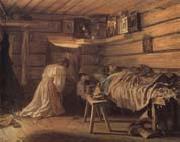
Russian 1844-1911,was a Russian painter, a prominent member of the Peredvizhniki group. Maximov was born to a peasant family in the village of Lopino near Novaya Ladoga. He became an orphan early and worked for an Iconpainting shop, where he first learned to paint. In 1863 he entered the Imperial Academy of Arts and in 1864 he became a member of an Artel of Artists created by P.N. Krestonovtsev by the example of Ivan Kramskoi. The artel existed only one year and was then disbanded. Maximov painted the Sick Child (1864) at that time, when received a Gold Medal of the Academia. He completed all the courses of the Academy in three years. In 1865 he (like the group of fourteen led by Ivan Kramskoi had done earlier) refused to take part in the competitions for the Major Gold Medal by Academia. He argued that he did not need to study abroad (that was a part of the prize) but rather would study the Russian village. Indeed, after graduation from the Academia he moved to the village of Shubino, in the gubernia of Tver, where he painted the peasant life, earning money as a painting teacher of the Princes Golenischev Kutuzov (descendants of Mikhail Illarionovich Kutuzov). His painting Grandmother tales (1867) was shown at a Peredvizhniki exhibition, where it won a prize and was bought by Pavel Tretyakov. In 1872 he was admitted to the Peredvizhniki group, and soon became one of its most prominent and rigorous members. Ilya Yefimovich Repin described Maximov as the most uncrushable stone in the foundation of peredvizhnechestvo. Maximov painted many paintings of the peasant life. In the last twenty years of his life, realism paintings fell out of fashion. Maximov still painted almost exclusively scenes of the peasant lives that had almost no buyers. The artist lived a life full of poverty and illnesses. He died in Saint Petersburg.
|
|
|
|
 |
ulrika melin
|
|
Ulrika Drufva, född 1767, död 1834, var en svensk textilkonstnär, ledamot av Fria konsternas Akademi.
Ulrika Melin var dotter till major Lars Melin, syster till generalmajor Henrik Georg Melin och från 1788 gift med ståthållaren på Västerås slott Peter Thure Gerhard Drufva. Melin var konstnär och "egde en ovanlig skicklighet uti att sy landskap". Hon invaldes i akademin år 1784 för ett arbete i vit satin, inspirerad av Claude Lorrain.
|
|
|
|
|
|
|
|
|
| Wholesale China Oil Painting Wholesale Oil Painting China Xiamen Portrait Reproduction on canvas Chinese Oil Painting Wholesale USA Oil Painting |
|
|
|
|
|