| |
|
Xiamen Oil Paintings, Wholesale Direct!
|
|
100% hand painted, 100% cotton canvas, 100% money back if not satisfaction. |
|
|
|
|
ART WORKS INDEX
A
B
C
D
E
F
G
H
I
J
K
L
M
N
O
P
Q
R
S
T
U
V
W
X
Y
Z
|
|
ARTISTS INDEX
A
B
C
D
E
F
G
H
I
J
K
L
M
N
O
P
Q
R
S
T
U
V
W
X
Y
Z
|
|
|
|
|
|
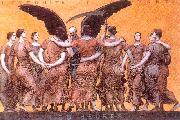 |
Mellery, Xavier
|
|
Belgian Symbolist Painter, 1845-1921
Belgian painter, decorative artist and draughtsman. A gardener's son, he was brought up in a quiet suburb of Brussels, bordering the Parc Royal. He studied under the decorative artist Charles Albert (1821-89) and then, between 1860 and 1867, took a course in decorative design at the Brussels Acad?mie. In 1864 he joined the studio of Jean-Fran?ois Portaels to learn the techniques of modelling, painting from life and history painting. Having won the Belgian Prix de Rome in 1870, he travelled to Italy, where he was inspired by the work of Mantegna. His early work treated the working lives of the Belgian poor in a social realist manner influenced by Charles de Groux
|
|
|
|
|
|
|
|
|
|
 |
Melchior de Hondecoeter
|
|
1635-1695
Dutch
Melchior de Hondecoeter Gallery
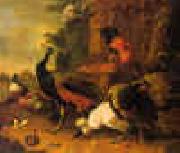
Melchior d'Hondecoeter (c. 1636 ?C April 3, 1695), Dutch animalier painter, was born at Utrecht, and died in Amsterdam. After the start of his career, he painted virtually exclusively bird subjects, usually exotic or game, in a park-like landscapes.
Being the grandson of Gillis d'Hondecoeter and son of Gijsbert d'Hondecoeter, as well as nephew of Jan Baptist Weenix, he was brought up by the last to the profession of painting, when his father died. Of Weenix we know that he married Gilles daughter Josina in 1638. Melchior was, therefore, also related to Jan Weenix. The latter told Arnold Houbraken, in his youth Melchior was extremely religious, praying very loud, so his mother and uncle doubted if they would have him trained as a painter.
In 1659 he was working in the Hague and became a member of the painters' academy at the Hague. In 1663 Hondecoeter married Susanne Tradel in Amsterdam. While she was captious and having her sisters living in their house, Hondecoeter spent much time in his garden or drinking in the tavern in the Jordaan. On the Lauriergracht, where he used to live, he was surrounded by art dealers and various painters. Later he moved to a house on Prinsengracht. In 1686 he bought a small countryhouse in Vreeland. Hondecoeter died in the house of his daughter Isabel in Warmoesstraat but was buried in Westerkerk near his house. His inventory lists a small gallow, to keep birds in the right position, and several paintings of Frans Snyders.
Melchior began his career with a different speciality from that by which he is usually known. Mr de Stuers affirms that he produced sea-pieces. One of his earliest works is a "Tub with Fish," dated 1655, in the gallery of Brunswick. But Melchior soon abandoned fish for fowl. He acquired celebrity as a painter of birds only, which he represented not exclusively, like Johannes Fyt, as the gamekeeper's perquisite after a day's shooting, or stock of a poulterer's shop, but as living beings with passions, joys, fears and quarrels, to which naturalists will tell us that birds are subject. Without the brilliant tone and high finish of Fyt, his Dutch rival's birds are full of action; and, as Burger truly says, "Hondecoeter displays the maternity of the hen with as much tenderness and feeling as Raphael the maternity of Madonnas."
|
|
|
|
|
|
 |
Meindert Hobbema
|
|
1638-1709
Dutch
Meindert Hobbema Galleries
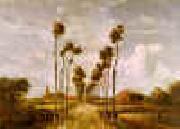
In the exercise of his craft Hobbema was patient beyond all conception. It is doubtful whether any one ever so completely mastered as he did the still life of woods and hedges, or mills and pools. Nor can we believe that he obtained this mastery otherwise than by constantly dwelling in the same neighbourhood, say in Guelders or on the Dutch Westphalian border, where day after day he might study the branching and foliage of trees and underwood embowering cottages and mills, under every variety of light, in every shade of transparency, in all changes produced by the seasons. Though his landscapes are severely and moderately toned, generally in an olive key, and often attuned to a puritanical grey or russet, they surprise us, not only by the variety of their leafage, but by the finish of their detail as well as the boldness of their touch. With astonishing subtlety light is shown penetrating cloud, and illuminating, sometimes transiently, sometimes steadily, different portions of the ground, shining through leaves upon other leaves, and multiplying in an endless way the transparency of the picture. If the chance be given him he mirrors all these things in the still pool near a cottage, the reaches of a sluggish river, or the swirl of the stream that feeds a busy mill. The same spot will furnish him with several pictures. One mill gives him repeated opportunities of charming our eye; and this wonderful artist, who is only second to Ruisdael because he had not Ruisdael's versatility and did not extend his study equally to downs and rocky eminences, or torrents and estuaries - this is the man who lived penuriously, died poor, and left no trace in the artistic annals of his country. It has been said that Hobbema did not paint his own figures, but transferred that duty to Adriaen van de Velde, Lingelbach, Barendt Gael, and Abraham Storck. As to this much is conjecture.
|
|
 |
MEI, Bernardino
|
|
Italian painter, Roman school (b. 1612, Siena, d. 1676, Roma)
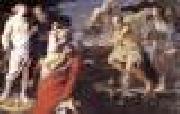
Italian painter, draughtsman and printmaker. His early art drew on a variety of sources, which included the naturalism of Rutilio Manetti and Francesco Rustici, the descriptive realism of the engraver Giuliano Periccioli (d 1646) and the Baroque of Raffaelle Vanni. Mei's interests even embraced 16th-century Sienese art. This stylistic variety is evident in his first known works, such as a bier (Casole d'Elsa, Collegiata), three signed miniatures in the Libro dei leoni (1634; Siena, Pal. Piccolomini, Archv Stato) and frescoes of scenes from the Life of St Bernard (1639; Siena, oratory of S Bernardino). His experimental approach is also displayed in such works as the Annunciation (Siena, Mus. Semin. Montarioso), which may be dated between the mid-1630s and the early 1640s. Mei's early maturity is marked by a conscious return to the naturalism of Manetti, enriched with a Baroque pathos and soft, fluid brushwork, as in the St Peter in Prison Awoken by the Angel and St Peter Freed by the Angel (both Siena; Conservatori Femminili Riuniti). His interest in both naturalism and the Baroque made him responsive to the art of Mattia Preti, possibly seen in Rome, as in the Beheading of St John the Baptist (1647; Siena, oratory of S Giovannino in Pantaneto) and the frescoes of scenes from the Life of St Roch and Life of St Job (1648; Siena, S Rocco),
|
|
 |
Mehoffer, Jozef
|
|
Polish, 1869-1946
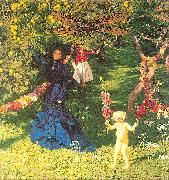
was a Polish painter and decorative artist, one of the leading artists of the Young Poland movement and one of the most revered Polish artists of his time. Mehoffer studied painting at the Academy of Fine Arts in Krakew under Władysław Łuszczkiewicz, and later at the Academy of Fine Arts in Vienna as well as in Paris at the Academie Colarossi among others. There Mehoffer began painting portraits often of people of historical significance. He later expanded his work to include different techniques, such as graphic art, stained glass, textiles, chalk drawings, etchings and book illustrations. He produced set designs for theatre and stylized furniture designs. Mehoffer received international acclaim for his stained glass windows in the Gothic St Nicholas Collegiate Church in Fribourg, Switzerland produced in 1895-1936. His other stained glass designs include the Radziwill Chapel in Balice (1892), Grauer Chapel in Opava (1901), church in Jutrosini (1902), Holy Cross Chapel at Wawel (1904), sepulchral chapel in Goluchoew (1906), Orgelmeister Chapel in Vienna (1910), cathedral in Wloclawek (1935-40), cathedral in Przemysl (1940) and church in Debniki near Krakow (1943).There are stained glass designed by Mehoffer in Jesus Holliest Heart in Turek (East Greater Poland - central Poland) in the same church there are also mural paintings made by Mehoffer. Mehoffer explored various media further throughout his career to include a range of applied arts in his projects. He manufactured a multiplicity of book covers, ornaments and posters.
|
|
 |
Mednyanszky, Laszlo
|
|
Hungarian, 1852-1919
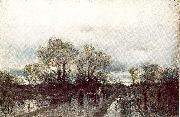
Ladislaus Josephus Balthasar Eustachius Mednyenszky was a Hungarian painter in the Impressionist tradition. Despite an aristocratic background, he spent most of his life moving around Europe working as an artist. Mednyenszky spent considerable periods in seclusion but mingled with people across society - in the aristocracy, art world, peasantry and army - many of whom became the subjects of his paintings. His most important works depict scenes of nature and poor, working people, particularly from his home region in Upper Hungary. Medny nszky was born in Beck, the Kingdom of Hungary (now Beckov in Slovakia), to Eduard Mednyenszky and Maria Anna Mednyenszky, (nee Szirmay) both from landowning families. Mednyenszky's family moved in 1861 to the chateau of his grandfather, Baltazer Szirmay, at Nagyőr (Strežky), near Szepesbela (Spišsk Bele) in north-eastern Hungary. This was to be the setting for many of his works. Medny nszky met the Austrian artist Thomas Ender in 1863 when Ender visited the chateau at Nagyőr. Ender took an interest in Mednyenszky's early efforts at drawing, lending his assistance to improve Mednyenszky's skills. Mednyenszky attended a grammar school in K??smerk (Kežmarok), near his home, then attended the Akademie der Bildenden Kenste (Academy of Fine Arts) in Munich in 1872 - 1873. Dissatisfied in Munich, he moved to Paris to attend the École des Beaux-Arts. After the death of his professor, Isidore-Alexandre Augustin Pils, in 1875, Mednyenszky left the École and began practicing independently from Montmartre. Mednyenszky returned to Nagyőr after 1877 to continue painting, and subsequently travelled widely in Europe, between his childhood homes in Upper Hungary and Budapest, Vienna, Paris and beyond. Mednyenszky visited the Szolnok artists' colony in the autumn of 1877 and Italy in 1878. His mother died in 1883, after which he lived in seclusion in Nagyőr. He returned to Nagyőr in 1887 to help deal with an outbreak of cholera but soon fell ill himself, with pneumonia. He spent much of 1889-1892 in Paris and returned regularly to Nagyőr until 1900.
|
|
 |
Medardo Rosso
|
|
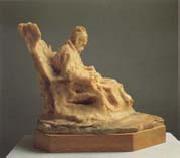
1858 Turin-1928 Milan,was an Italian sculptor. He is thought to have developed the Post Impressionism style in sculpture along with Auguste Rodin. Medardo Rosso was born in Turin, Italy, in 1858, the son of the city stationmaster. Later his family mover to Milano (Milan). As a child Rosso played hooky from school to visit a monument mason who taught him to handle a chisel and hammer. This distressed and angered his parents. At the age of 23, after a period of military service as unsatisfactory as his home life, he enrolled at the Berea Academy in Milano, where he learned to draw classical statues and copy them in gesso. But academic art appeared to him entirely artificial, unrelated to the world around him. Before long he helped to organize the Berea students into demanding life models for the drawing classes. As a result of his revolutionary behavior he was expelled from the school. He moved to Rome, where he lived in great poverty, sleeping among the ruins of the Colosseum. To the end of his life Rosso battled unremittingly against the academicians. What absorbed, even obsessed, him was the problem of interpreting life itself. In 1882, some time before he saw any Impressionist paintings, he produced his fully impressionistic sculptures, The Street Singer and Lovers under the Lamplight. In 1884 some friends arranged an exhibition for him in Paris, where he lived for a time in a cheap boarding-house.
|
|
|
|
|
|
 |
MAZZOLINO, Ludovico
|
|
Italian Painter, 1480-1528
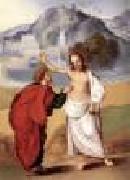
.Italian painter. He may have served an apprenticeship with Ercole de' Roberti (Morelli) before he left Ferrara to study in Bologna with Lorenzo Costa (i). The earliest surviving documentation is from 20 May 1504, when he received a first payment for frescoes (destr. 1604) in eight chapels in S Maria degli Angeli, Ferrara, commissioned by Ercole I d'Este, Duke of Ferrara and Modena. Between 1505 and 1507 he was paid for works, presumably decorative, in the Este guardaroba and the camerini of the Duchessa Lucrezia Borgia in Ferrara Castle (untraced). His first surviving dated painting is the triptych of the Virgin and Child with SS Anthony and Mary Magdalene
|
|
|
|
|
|
|
|
 |
Maynard, George Willoughby
|
|
American, 1843-1923
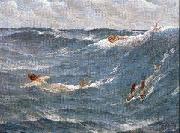
American figure, marine, and mural painter, b. Washington, D.C., studied at the National Academy of Design and in Florence and Antwerp. Maynard created decorations for the Library of Congress and the old Metropolitan Opera House, New York City.
|
|
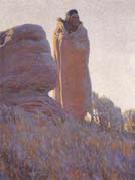 |
Maynard Dixon
|
|
American Painter, 1875-1946,was a noted 20th century American artist, whose oeuvre focused on the American West. He was married for a time to famed American photographer Dorothea Lange.
|
|
|
|
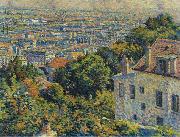 |
Maximilien Luce
|
|
Maximilien Luce (March 13, 1858 - February 6, 1941) was a French Neo-impressionist artist. A printmaker, painter, and anarchist, Luce is best known for his pointillist canvases. He grew up in the working class Montparnasse, and became a painter of landscapes and urban scenes which frequently emphasize the activities of people at work. He was a member of the Groupe de Lagny with Leo Gausson, Émile-Gustave Cavallo-Peduzzi and Lucien Pissarro.
|
|
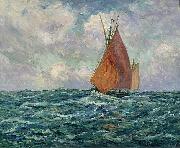 |
Maxime Maufra
|
|
was a French landscape and marine painter, etcher and lithographer.
Maufra first began painting at 18. He was encouraged to do so by two artists from Nantes: the brothers Leduc. However, he didnet fully embrace his painting career right away. Being a businessman, he only painted on his spare time from 1884 to 1890. During this time, Maufra discovered the work of the Impressionists and was able to display his works at the Paris Salon of 1886. In 1890, Maufra decided to give up commerce and to become a full-time painter. He left Nantes for Brittany, where he was able to meet Paul Gauguin and Paul Serusier. Maufra had his first solo exhibition in Paris in 1894, at Le Barc de Toutteville. Returning from Brittany, Maufra was the first painter to take up residence in The Bateau-Lavoir, a famous Parisian residence for artists.
In his paintings, Maufra sometimes quoted the pointillisit technique of Pissarro or Sisley, and also took from the strong colors and powerful drawing of the Pont Aven school. However, Maufra stayed an independent artist his all life through, and dedicated his art to recording the beauty of nature.
|
|
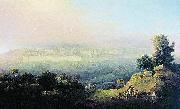 |
Maxim Nikiforovich Vorobiev
|
|
(1787-1855) was a Russian Romantic landscape painter.
Vorobiev was born into the family of a soldier, who on retirement became a guard in the Academy of Arts in St. Petersburg. There, Maxim was admitted in 1798 where he initially studied architecture but graduated as a landscape painter in 1809.
|
|
 |
Max, Gabriel Cornelius von
|
|
Czechoslovakian, 1840-1915
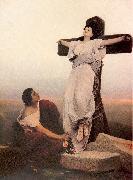
Painter, illustrator and teacher, nephew of (1) Emanuel Max. He studied at the Academy of Fine Arts, Prague (1855-8), and the Akademie der Bildenden K?nste, Vienna (1858-61), and under Karl Theodor von Piloty at the Akademie der Bildenden K?nste, Munich (1863/4-7). He settled in Munich, where he opened a private school of painting in 1869. His paintings and book illustrations of the second half of the 1860s show an affinity with the late Romanticist movement. He illustrated works of German literature by Wieland, Lenau and Schiller, as well as producing illustrations for Goethe's Faust (1867-8; Prague, N.G., Kinsky Palace). As well as literary and even musical sources, religious themes frequently occur in his work, including his first great success, the Crucifixion of St Julie (1867; ex-Sotheby's, London, 1976). In numerous female figures and portraits Max explored the tension between the inner state and the charm of the physical appearance or surroundings of his subjects. His interest in the artistic perception of relationships between physical reality and the spiritual world led him to a study of anthropology and contemporary occultism and mysticism, as in his portraits of the Seer of Prevorst
|
|
 |
Max Uth
|
|
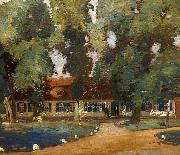
painted Landsitz in der Mark in 1900
|
|
 |
Max Slevogt
|
|
German Impressionist Painter, 1868-1932
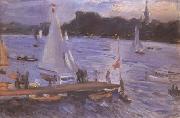
German painter, printmaker and illustrator. His father, adjutant and friend of the future Prince Regent, Luitpold (1821-1912), died when Slevogt was just two years old. His mother moved to Werzburg, where he spent his schooldays. Even in his childhood and adolescence, family connections brought Slevogt to Pfalz, to an aunt in Landau and to the Finkler family in Neukastel. Initially he had planned to become a musician, but he began to study painting at the Akademie der Bildenden Kenste in Munich in 1885. His fellow students included Gabriel von Hackl (1843-1926), Karl Raupp (1837-1918), Ludwig Herterich (1856-1932) and Wilhelm von Diez (1839-1907). In 1889 he spent a term at the Academie Julian in Paris. At that time Impressionism had very little effect on him. Following a trip to Italy in 1890 with the painter Robert Breyer (1866-1941) who had befriended him at the Akademie, he began to work independently as a painter in Munich. In 1893 he participated in the first exhibition of the newly founded Munich Secession, exhibiting Wrestling School (1893; Edenkoben, Schloss Villa Ludwigshehe); the judges wanted to refuse this painting as immoral since its entwined and naked men caused offence. In the following years his paintings often appeared harsh and non-academic to conservative Munich circles. At this time Slevogt also made contributions to the journals Jugend and Simplizissimus, which were significant in the development of his graphic work.
|
|
 |
Max Pechstein
|
|
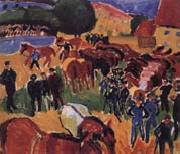
German Expressionist Painter, 1881-1955,German painter and printmaker. He was apprenticed as a decorator in Zwickau from 1896 to 1900, when he moved to Dresden to enrol at the Kunstgewerbeschule, where he met the architect Wilhelm Kreis and the painter Otto Gussmann (1869-1926) and obtained decorative commissions. He continued his studies from 1902 until 1906 as Gussmann's pupil at the Dresden Kunstakademie. Through Kreis, Pechstein was introduced to Erich Heckel in 1906 and was invited by him to join DIE BRECKE, a group founded in the previous year that was quickly to become a major force in the rise of German Expressionism.
|
|
 |
Max Liebermann
|
|
German Impressionist Painter, 1847-1935
Max Liebermann (July 20 1847 ?C February 8 1935) was a German painter and printmaker in etching and lithography.
The son of a Jewish businessman from Berlin, Liebermann first studied law and philosophy at the University of Berlin, but later studied painting and drawing in Weimar in 1869, in Paris in 1872, and in the Netherlands in 1876-77. During the Franco-Prussian War (1870?C71), Liebermann served as a medic with the Order of St. John near Metz. After living and working for some time in Munich, he finally returned to Berlin in 1884, where he remained for the rest of his life. He was married in 1884 to Martha Liebermann (1857-1943, see portrait by Anders Zorn).
Together with Lovis Corinth and Max Slevogt, Liebermann became an exponent of German Impressionism. He used his own inherited wealth to assemble an impressive collection of French Impressionist works. He later chose scenes of the bourgeoisie, as well as aspects of his garden near Lake Wannsee, as motifs for his paintings. In Berlin, he became a famous painter of portraits; his work is especially close in spirit to Édouard Manet.
"Boys Bathing" Neue PinakothekFrom 1899 to 1911 he led the premier avant-garde formation in Germany, the Berliner Secession. Beginning in 1920 he was president of the Prussian Academy of Arts. In 1933 he resigned when the academy decided to no longer exhibit works by Jewish artists. While watching the Nazis celebrate their victory by marching through the Brandenburg Gate, Liebermann was reported to have commented: "Ich kann gar nicht so viel fressen, wie ich kotzen möchte" ("I could not eat as much as I would like to vomit.")
On 30 April 2006, the Max Liebermann Society opened a permanent museum in the Liebermann family's villa in Berlin-Wannsee. The artist's wife, Martha Liebermann, was forced to sell the building in 1940. In 1943 she committed suicide in the family home, Haus Liebermann, hours before police came to deport her to Theresienstadt concentration camp.
|
|
 |
Max Kurzweil
|
|
Maximilian Franz Viktor Zdenko Marie Kurzweil (12 (13?) October 1867 Bisenz - 9 May 1916 Vienna) was an Austrian painter and printmaker. He moved near Vienna in 1879.
|
|
 |
Max Koch
|
|
(born July 17, 1854 - April 1, 1925) was a German-born Australian botanical collector.
Born in Berlin, Koch was apprenticed to a merchant's office, but, not liking the work, joined the crew of a Glasgow-based sailing ship at Bremerhaven. He left it at Port Augusta, South Australia in April 1878, taking work at a wheat farm. Later he moved to Mount Lyndhurst sheep station, where he remained for many years. Around 1896 he began serious botanical collecting.
Koch visited Germany around 1902-1903, then returned to Australia, and in 1904 moved to the extreme south-west of Western Australia, where he spent the next 17 years working in the timber industry. By that time he had a large family, and he supplemented his income by plant specimens, and, in his later years, seed. He died at Pemberton, Western Australia in 1925
|
|
 |
Max Klinger
|
|
German Symbolist Painter and Sculptor, 1857-1920
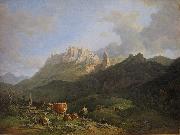
German painter, printmaker, sculptor and writer. He was one of the most versatile German artistic personalities of the turn of the 20th century and was especially celebrated for his cycles of prints, which were influential.
|
|
 |
Max Joseph Wagenbauer
|
|
Maximilian Joseph Wagenbauer (1775 Grafing - 1829 Munich), was a Bavarian artist.
After finishing school, Wagenbauer attended drawing classes in Munich, under Johann Jakob Dorner the Elder (1741-1813). At the turn of the 19th century he was producing mostly Neo-Classical watercolour landscapes. He served in the military from 1797 to 1801, receiving a royal artist's annuity after his service through the influence of Johann Christian von Mannlich (1741-1822), architect and general building director of the dukes of Zweibre-ken. A condition of the royal stipend was that he produce paintings. He was appointed artist to the court and cabinet in 1802 and Inspector of the Royal Paintings Gallery in 1815. Wagenbauer focused increasingly on oil painting after 1810 and enjoyed the patronage of Maximilian I Joseph of Bavaria, who in 1811 commissioned him, Cantius Dillis (1779-1856) and Johann Jakob Dorner the Younger (1775-1852) to decorate the banquet hall at Schloss Nymphenburg with large paintings of Bavarian lakes.
|
|
 |
max ernst
|
|
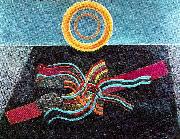
Max Ernst (2 April 1891 ?C 1 April 1976) was a German painter, sculptor, graphic artist, and poet. A prolific artist, Ernst is considered to be one of the primary pioneers of the Dada movement and Surrealism.
|
|
 |
Max Buri
|
|
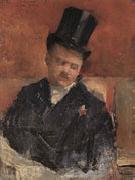
1868-1915,Swiss painter. While still at school he was given drawing lessons by Paul Volmar (1832-1906) in Berne. From 1883 he was a pupil of Fritz Schider (1846-1907) in Basle, where he became acquainted with the works of Hans Holbein the younger and Arnold B?cklin. In 1886 he went to the Akademie der Bildenden K?nste in Munich, transferring in 1887 to Simon Holl?sy painting school. After seeing the works of the French Impressionists exhibited in Munich, he moved to the Acad?mie Julian in Paris in 1889. He made several journeys to Algeria, Holland, Belgium and England, and in 1893 he returned to Munich to study under Albert von Keller. In 1898 he settled in Switzerland, living first at Lucerne, then from 1903 in Brienz, near Interlaken. About 1900, influenced by the paintings of Ferdinand Hodler, Buri moved on from his early genre pictures, which were in mawkish shades of pink in the style of Keller and H?llosy, to achieve an individual style that brought him great popularity. He established his reputation with Village Politicians (1904; Basle, Kstmus.). He painted mainly the landscape and people of the Bernese Oberland, often depicting single figures and groups in front of bare indoor walls in realistic everyday scenes. The expressiveness of the compositions is achieved by clear contours and powerful clearly differentiated surfaces in local colours. Buri works are essentially populist rather than intellectual and avoid Hodler strict parallelism and Symbolist content.
|
|
 |
Max Beckmann
|
|
1884-1950
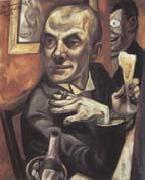
was a German painter, draftsman, printmaker, sculptor, and writer. Although he is usually classified as an Expressionist artist, he rejected both the term and the movement. In the 1920s he was associated with the New Objectivity (Neue Sachlichkeit), an outgrowth of Expressionism that opposed its introverted emotionalism. He was born into a middle-class family in Leipzig, Saxony. From his youth he pitted himself against the old masters. His traumatic experiences of World War I, in which he served as a medic, coincided with a dramatic transformation of his style from academically correct depictions to a distortion of both figure and space, reflecting his altered vision of himself and humanity.He is known for the self-portraits he painted throughout his life, their number and intensity rivalled only by Rembrandt and Picasso. Well-read in philosophy and literature, he also contemplated mysticism and theosophy in search of the "Self". As a true painter-thinker, he strove to find the hidden spiritual dimension in his subjects. (Beckmann's 1948 "Letters to a Woman Painter" provides a statement of his approach to art.) In the Weimar Republic of the Twenties, Beckmann enjoyed great success and official honors. In 1927 he received the Honorary Empire Prize for German Art and the Gold Medal of the City of D??sseldorf; the National Gallery in Berlin acquired his painting The Bark and, in 1928, purchased his Self-Portrait in Tuxedo.In 1925 he was selected to teach a master class at the Städelschule Academy of Fine Art in Frankfurt. Some of his most famous students included Theo Garve, Leo Maillet and Marie-Louise Von Motesiczky. His fortunes changed with the rise to power of Adolf Hitler, whose dislike of Modern Art quickly led to its suppression by the state. In 1933, the Nazi government bizarrely called Beckmann a "cultural Bolshevik"and dismissed him from his teaching position at the Art School in Frankfurt. In 1937 more than 500 of his works were confiscated from German museums, and several of these works were put on display in the notorious Degenerate Art exhibition in Munich.For ten years, Beckmann lived in poverty in self-imposed exile in Amsterdam, failing in his desperate attempts to obtain a visa for the US. In 1944 the Germans attempted to draft him into the army, despite the fact that the sixty-year-old artist had suffered a heart attack. The works completed in his Amsterdam studio were even more powerful and intense than the ones of his master years in Frankfurt, and included several large triptychs, which stand as a summation of Beckmann's art. After the war, Beckmann moved to the United States, and during the last three years of his life, he taught at the art schools of Washington University in St. Louis (with the German-American painter and printmaker Werner Drewes) and the Brooklyn Museum. He suffered from angina pectoris and died after Christmas 1950, struck down by a heart attack in Manhattan.Many of his late paintings are now displayed in American museums.
|
|
|
|
 |
mauzaise
|
|
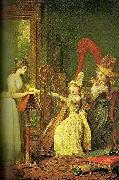
princess adelaide dorleans taking aharp lesson with mme de genlis,c.
1789
versailles, museum
|
|
 |
Mauve, Anton
|
|
Dutch, 1838-1888
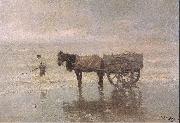
Dutch painter. He came from a large family of clergymen in the province of North Holland. At the age of 16 he was apprenticed to the animal painter Pieter Frederik van Os (1808-92): animals (especially sheep, but also cows and horses) became Mauve's preferred theme. He then trained for a few months with Wouterus Verschuur, who gave him his love of horses, in the style, at least, of Paulus Potter and Philips Wouwerman.
|
|
 |
Maurycy Gottlieb
|
|
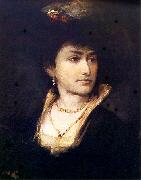
Drohobytsch, February 21/28, 1856 - Krakew, July 17, 1879) was a Jewish painter, of Polish-speaking Galician Jews from the western part of Ukraine. He was born in Drohobych (at that time Austria-Hungary), Galicia, modern Lviv region, western Ukraine.
Maurycy was one of Isaac and Fanya Tigerman Gottlieb's eleven children. At fifteen, he was enrolled at the Vienna Fine Arts Academy. Later, he would study under Jan Matejko in Krakew. However, he experienced anti-semitism from his fellow students, and left Matejko's studio after less than a year, he then traveled to Norway settling in Molde. After several years he returned to Vienna to pursue his Jewish roots.
At twenty, he won a gold medal from a Munich art competition for Shylock and Jessica (at right), showing a scene from Shakespeare's The Merchant of Venice. He based Jessica's face on that of Laura Rosenfeld, to whom he had proposed marriage. However, Rosenfeld rejected his proposal, and wed a Berlin banker. Gottlieb then planned to marry Lola Rosengarten, but when he heard about Rosenfeld's marriage he committed suicide by exposure to the elements, dying of complications from a cold.
Despite his early death, more than three hundred of his works survive, though not all are finished. After the fall of the Iron Curtain, many Polish collections unknown in the West were discovered, and his reputation grew greatly.
His brother, painter Leopold Gottlieb, was born five years after his death.
|
|
 |
Mauritz Lindstrom
|
|
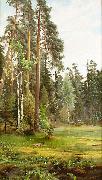
(26 April 1849 - 11 December 1923) was a Swedish painter. He was born in Västmanland and studied at the Royal Swedish Academy of Arts in Stockholm, in 1869 - 72. He went to Munchen and Paris to continue his studies, and lived in England from early 1880s to 1889. Lindström is best known today for his landscapes.
|
|
|
|
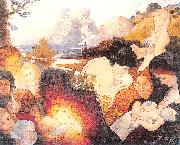 |
Maurin, Charles
|
|
French, 1856-1914
was a French painter who practised a variety of styles. A notable symbolist work of his being Maternity, a study of motherhood. He was a friend of the painter Felix Vallotton.
|
|
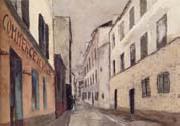 |
Maurice Utrillo
|
|
French Painter, 1883-1955,French painter, son of SUZANNE VALADON. He was entrusted to his grandmother while his mother posed as a model for such painters as Renoir and Puvis de Chavannes before discovering her own talent for drawing and painting. His father, the Spanish painter Miguel Utrillo (1862-1934), only admitted paternity eight years after Maurice's birth. Maurice Utrillo had no predisposition for art, but when he was 19 his mother took medical advice and urged him to adopt drawing and painting as a distraction from his need for alcohol. In search of a suitable subject, he went to the countryside around Montmagny, a village to the north of Paris, where, between the autumn of 1903 and the winter of 1904, he completed almost 150 paintings, sombre, heavily impasted landscapes, such as the Roofs of Montmagny (Paris, Pompidou). By 1906 the doctor felt that Utrillo could return to Montmartre. His pictures of the streets and suburbs were painted with a less heavy impasto and with lighter tones.
|
|
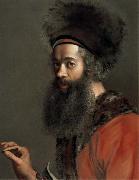 |
Maurice quentin de la tour
|
|
1704-88
French pastellist. He was one of the greatest pastellists of the 18th century, an equal of Jean-Sim?on Chardin and Jean-Baptiste Perronneau. Unlike them, however, he painted no works in oils. Reacting against the stately portraits of preceding generations and against the mythological portraits of many of his contemporaries, La Tour returned to a more realistic and sober style of work. The fundamental quality of his art lies in his ability to suggest the temperament and psychology of his subjects by means of their facial expression, and thereby to translate their fugitive emotions on to paper: 'I penetrate into the depths of my subjects without their knowing it, and capture them whole', as he himself put it. His considerable success led to commissions from the royal family, the court, the rich bourgeoisie and from literary, artistic and theatrical circles.
|
|
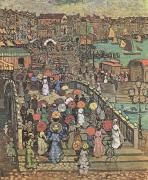 |
Maurice Prendergast
|
|
Canadian-born American Impressionist Painter, 1858-1924
American painter, printmaker, illustrator and designer of Canadian birth. He moved with his family to Boston in 1868 and was working as a commercial artist by 1886, lettering showcards, but his early attempts at watercolour foretold little of the talent that emerged after he travelled to Paris in January 1891. He studied for three years at the Atelier Colarossi under Gustave Courtois (1853-1923), and later at the Acad?mie Julian under Benjamin Constant, Joseph Blanc and Jean-Paul Laurens.
|
|
 |
Maurice Galbraith Cullen
|
|
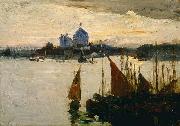
Maurice Galbraith Cullen (1866-1934) was a Canadian artist.
Cullen was born June 6, 1866 in St. John's, Newfoundland.
Beginning in January 1918, Cullen served with Canadian forces in the First World War. He came to the attention of Lord Beaverbrook, who arranged for him to be commissioned as an "official war artist" along with Frederick Varley, J.W. Beatty and C. W. Simpson.
|
|
 |
Maurice Denis
|
|
1870-1943
French
Maurice Denis Locations
French painter, designer, printmaker and theorist. Although born in Normandy, Denis lived throughout his life in Saint-Germain-en-Laye, just west of Paris. He attended the Lycee Condorcet, Paris, where he met many of his future artistic contemporaries, then studied art simultaneously at the Ecole des Beaux-Arts and at the Academie Julian (1888-90). Through fellow student Paul Serusier, in 1888 he learnt of the innovative stylistic discoveries made that summer in Pont-Aven by Paul Gauguin and Emile Bernard. With Serusier and a number of like-minded contemporaries at the Academie Julian
|
|
|
|
|
|
|
|
|
| Wholesale China Oil Painting Wholesale Oil Painting China Xiamen Portrait Reproduction on canvas Chinese Oil Painting Wholesale USA Oil Painting |
|
|
|
|
|