| |
|
Xiamen Oil Paintings, Wholesale Direct!
|
|
100% hand painted, 100% cotton canvas, 100% money back if not satisfaction. |
|
|
|
|
ART WORKS INDEX
A
B
C
D
E
F
G
H
I
J
K
L
M
N
O
P
Q
R
S
T
U
V
W
X
Y
Z
|
|
ARTISTS INDEX
A
B
C
D
E
F
G
H
I
J
K
L
M
N
O
P
Q
R
S
T
U
V
W
X
Y
Z
|
|
|
|
|
|
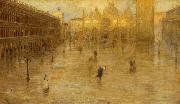 |
Pietro Fragiacomo
|
|
(Pirano deIstria (Trieste), 1856 - Venice, 1922) was an Italian painter.
Born at Pirano deIstria near Trieste, Fragiacomo moved with his family to Venice, where he enrolled at the Academy of Fine Arts in 1878 after a period as a worker in Treviso. He then abandoned his studies barely one year later to devote himself more freely to painting from life, often in the company of his friend the painter Giacomo Favretto. He won a bronze medal at the Universal Exhibition of 1889 in Paris and took part in the Munich International Exhibition of the same year, as well as later editions. Drawing inspiration from the Venetian lagoon and always characterised by a crepuscular sense of nature, his landscapes took on Symbolist overtones at the end of the century. He won the Prince Umberto Prize at the Milan Triennale of 1891 and was a regular participant from 1895 to 1922 at the Venice Biennale, which held a solo show of his work in 1910 and a posthumous retrospective in 1924.
|
|
|
|
 |
Pieter Bruegel the Elder
|
|
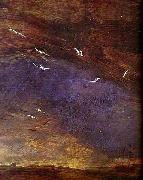
(Dutch pronunciation:c. 1525 - 9 September 1569) was a Flemish Renaissance painter and printmaker known for his landscapes and peasant scenes (Genre Painting). He is sometimes referred to as "Peasant Bruegel" to distinguish him from other members of the Brueghel dynasty, but is also the one generally meant when the context does not make clear which "Bruegel" is being referred to. From 1559 he dropped the 'h' from his name and started signing his paintings as Bruegel.
There are records that he was born in Breda, Netherlands, but it is uncertain whether the Dutch town of Breda or the Belgian town of Bree, called Breda in Latin, is meant. He was an apprentice of Pieter Coecke van Aelst, whose daughter Mayken he later married. He spent some time in France and Italy, and then went to Antwerp, where in 1551 he was accepted as a master in the painter's guild. He traveled to Italy soon after, and then returned to Antwerp before settling in Brussels permanently 10 years later. He received the nickname 'Peasant Bruegel' or 'Bruegel the Peasant' for his alleged practice of dressing up like a peasant in order to mingle at weddings and other celebrations, thereby gaining inspiration and authentic details for his genre paintings. He died in Brussels on 9 September 1569 and was buried in the Kapellekerk. He was the father of Pieter Brueghel the Younger and Jan Brueghel the Elder. Both became painters, but as they were very young children when their father died, it is believed neither received any training from him.
|
|
 |
Pierre-edouard Frere
|
|
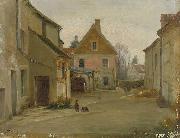
(1819 - 1886), French painter, studied under Hippolyte Delaroche, entered the e - ole des Beaux-Arts in 1836 and exhibited first at the Salon in 1843. The marked sentimental tendency of his art makes us wonder at John Ruskin's enthusiastic eulogy which finds in Frere's work the depth of William Wordsworth, the grace of Joshua Reynolds, and the holiness of Fra Angelico. What we can admire in his work is his accomplished craftsmanship and the intimacy and tender homeliness of his conception. Among his chief works are the two paintings, Going to School and Coming from School, The Little Glutton (his first exhibited picture) and L'Exercice (in the 19th century this work was in John Jacob Astor's collection). A journey to Egypt in 1860 resulted in a small series of Orientalist subjects, but the majority of Frere's paintings deal with the life of the kitchen, the workshop, the dwellings of the humble, and mainly with the pleasures and little troubles of the young, which the artist brings before us with humor and sympathy. He was one of the most popular painters of domestic genre in the middle of the 19th century.
|
|
|
|
|
|
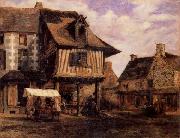 |
Pierre etienne theodore rousseau
|
|
Paris 1812-Barbizon 1867
French painter of the Barbizon school, was born in Paris, of a bourgeois family which included one or two artists.At first he received a business training, but soon displayed aptitude for painting. Although his father regretted the decision at first, he became reconciled to his son leaving business, and throughout the artist's career (for he survived his son) was a sympathizer with him in all his conflicts with the Paris Salon authorities. Theodore Rousseau shared the difficulties of the romantic painters of 1830 in securing for their pictures a place in the annual Paris exhibition. The whole influence of the classically trained artists was against them, and not until 1848 was Rousseau adequately presented to the public. He had exhibited one or two unimportant works in the Salon of 1831 and 1834, but in 1836 his great work "La descente des vaches" was rejected by the vote of the classic painters; and from then until after the revolution of 1848 he was persistently refused. He was not without champions in the press, and under the title of "le grand refus" he became known through the writings of Thor, the critic who afterwards resided in England and wrote under the name of Burger. During these years of artistic exile Rousseau produced some of his finest pictures: "The Chestnut Avenue", "The Marsh in the Landes" (now in the Louvre), "Hoar-Frost" (now in America); and in 1851, after the reorganization of the Salon in 1848, he exhibited his masterpiece, "The Edge of the Forest" (also in the Louvre), a picture similar in treatment to, but slightly varied in subject from, the composition called "A Glade in the Forest of Fontainebleau", in the Wallace Collection at Hertford House, London. Up to this period Rousseau had lived only occasionally at Barbizon, but in 1848 he took up his residence in the forest village, and spent most of his remaining days in the vicinity. He was now at the height of his artistic power, and was able to obtain fair sums for his pictures (but only about one-tenth of their value thirty years after his death), and his circle of admirers increased. He was still ignored by the authorities, for while Narcisse Virgilio Diaz was made Chevalier of the Legion of Honour in 1851, Rousseau was left undecorated at this time, but was nominated shortly afterwards. At the Exposition Universelle of 1853, where all Rousseau's rejected pictures of the previous twenty years were gathered together, his works were acknowledged to form one of the finest of the many splendid groups there exhibited. But during his lifetime Rousseau never really conquered French taste, and after an unsuccessful sale of his works by auction in 1861,
|
|
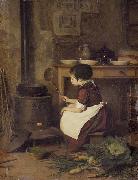 |
Pierre Edouard Frere
|
|
(1819-1886), French painter, studied under Hippolyte Delaroche, entered the cole des Beaux-Arts in 1836 and exhibited first at the Salon in 1843. The marked sentimental tendency of his art makes us wonder at John Ruskin's enthusiastic eulogy which finds in Frere's work the depth of William Wordsworth, the grace of Joshua Reynolds, and the holiness of Fra Angelico. What we can admire in his work is his accomplished craftsmanship and the intimacy and tender homeliness of his conception. Among his chief works are the two paintings, Going to School and Coming from School, The Little Glutton (his first exhibited picture) and L'Exercice (in the 19th century this work was in John Jacob Astor's collection). A journey to Egypt in 1860 resulted in a small series of Orientalist subjects, but the majority of Frere's paintings deal with the life of the kitchen, the workshop, the dwellings of the humble, and mainly with the pleasures and little troubles of the young, which the artist brings before us with humor and sympathy. He was one of the most popular painters of domestic genre in the middle of the 19th century.
|
|
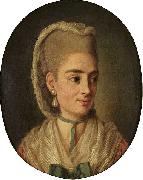 |
Per Krafft the Elder
|
|
(16 January 1724, Arboga - 7 November 1793, Stockholm) was a Swedish portraitist. He was the father of the artists Per Krafft the Younger and Wilhelmina Krafft.
|
|
|
|
|
|
|
|
|
|
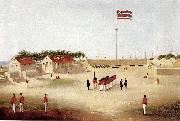 |
Paul Emmert
|
|
Paul Emmert (1826-1867) , who is also known as Paul Emert, was an artist born near Berne, Switzerland in 1826. By 1845, he had become an established artist in New York. He joined the gold rush to California in 1849. The following year he exhibited in Brooklyn a panorama of the gold mining activities before making his second trip to California late in 1850. While in California, he operated the Bear Hotel in Sacramento and exhibited the panorama in San Francisco and other communities. In 1853 he moved to Hawaii where he resided until his death in 1867 in Honolulu.
|
|
|
|
|
|
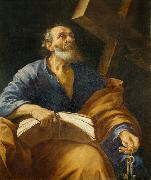 |
Paolo Emilio Besenzi
|
|
(1608-1656) was an Italian painter of the 17th century, born and active in Reggio. He trained with Francesco Albani. Friend and companion of Lionello Spada, he painted for the church of San Pietro. He was also known as sculptor and architect.
|
|
|
|
|
|
|
|
|
|
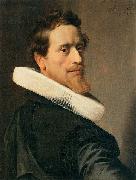 |
Nicolaes Eliaszoon Pickenoy
|
|
(10 January 1588 - 1653/1656) was a Dutch painter of Flemish origin. Pickenoy was possibly a pupil of Cornelis van der Voort and presumably Bartholomeus van der Helst was his own pupil.
He was the son of the Antwerp monumental mason Elias Claeszoon Pickenoy (1565-1640) and Heijltje Laurens s'Jonge (1562-1638), who emigrated to Amsterdam before Nicolaes Pickenoy was born. In 1621, living near the Oude Kerk, he married Levijntje Bouwens (1599-na 1656), an orphan of 21 years. They had ten children: Sara and Elias died young.
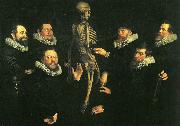
Pickenoy painted large Schuttersstukken, group portraits of the regents of the orphanage, and individual portraits of local or national celebrities like Nicolaes Tulp, Cornelis de Graeff, Maarten Harpertszoon Tromp and Jochem Hendrickszoon Swartenhont, Elisabeth Bas's husband. The earliest picture ascribed to the artist is "Dr. Sebastiaen Egbertz de Vrij's Osteological Presentation" of 1619, now in Amsterdam Historisch Museum. His heyday was ca. 1630-1637, a period marked by a high artistic level and numerous commissions from prominent patrons. After 1637 he painted little, save for a number of prestigiouseand lucrativeegroup portraits. Besides portraits, he also painted a small number of biblical subjects, one of which can be seen in the Museum Catharijneconvent. The Rijksmuseum Amsterdam and Amsterdams Historisch Museum holds many of his best works, not least the Schutterstukken or militia paintings.
In 1637 he bought from Adriaen Pauw the house on the corner of Sint Anthoniessluis and Jodenbreestraat, a fashionable area with many painters, art dealers, jewellers and so on. The house had previously been owned by his supposed master, Cornelis van der Voort, and later by Hendrick van Uylenburgh. During the years 1631-1634 the latter was collaborating with Rembrandt van Rijn, who painted numerous portraits for Van Uylenburgh's art business. Thus the house Pickenoy purchased had been a centre of Amsterdam portraiture for decades. In 1639 Rembrandt returned to the neighbourhood as he bought the house next to Pickenoys, the present day Rembrandthuis. Rembrandt could leave his house via an exit onto the Zwanenburgwal under the house of his neighbor Pickenoy. He brought out Night Watchepainted in his courtyarderolled up through the tunnel. Like Rembrandt, Pickenoy was not able to bring up the loan and so after eight years he sold the house.
The work of Pickenoy is difficult to distinguish from that of some of his contemporaries. Typical of Pickenoy are the fiercely invading light that makes the heads stand out sharply, the somewhat exaggerated gestures, the large greenish brown shadows and the odd-shaped eyes.
|
|
|
|
|
|
 |
NEUREUTHER, Eugen
|
|
German painter b. 1806, Mnchen, d. 1882, Menchen,German lithographer, illustrator, decorative artist and painter. He was the son of the painter and printmaker Ludwig Neureuther (d 1832), and began his studies in Munich in 1823. His tutors included Peter von Cornelius, who enlisted him and several other young painters to help decorate the Glyptothek, and Wilhelm von Kobell. In 1830, fired with enthusiasm for the July Revolution in France, Neureuther went to Paris. He produced numerous studies from life (Munich, Staatl. Graph. Samml.), which are among his best works. From 1836-7 he was in Rome. From 1848 to 1856 he ran the Nymphenburg Porzellanmanufaktur, and for ten years from 1868 he taught decorative mural painting at the Munich Kunstgewerbeschule. Neureuther's principal importance lay in the field of book illustration. His reputation was established with the Vignettes for Goethe's Ballads and Romances (Randzeichnungen zu Goethes Balladen und Romanzen), published by J. G. Cotta in five booklets of 46 lithographic contour drawings in Munich, Stuttgart and Tebingen between 1829 and 1839. Goethe, to whom Cornelius had mentioned Neureuther, repeatedly spoke of these works in public, realizing their similarity to the prayer book of the Emperor Maximilian illustrated by Albrecht Derer, Lukas Cranach the elder, Hans Baldung, Albrecht Altdorfer and others. A new edition of this work, with lithographs by August Strixner (b 1820) had appeared in 1808. Neureuther later illustrated many other texts, but his approach became increasingly naturalistic and picturesque, and there was a notable decline in the artistic standard of the work.
|
|
 |
NEER, Eglon van der
|
|
Dutch Baroque Era Painter, ca.1634-1703
Son of Aert van der Neer. His birth date is based on Houbraken's statement that the artist was 70 years old when he died. He apparently studied first with his father and then with the genre and history painter Jacob van Loo. According to Houbraken, van der Neer was in France c. 1654, where he served as painter to the Counts of Dona, Dutch governors of the principality of Orange. He returned to Holland by 1659 and is recorded as a resident of Amsterdam at the time of his marriage to Maria van Wagensvelt in Rotterdam on 20 February 1659.
|
|
|
|
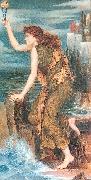 |
Morgan, Evelyn De
|
|
English, 1855-1919
Painter, wife of William De Morgan. She was a pupil of her uncle, the painter Roddam Spencer Stanhope. In 1873-5 she attended the Slade School of Art, London. While there, she was awarded a Slade scholarship entitling her to financial assistance for three years. The scholarship required that she draw in charcoal from the nude, but she eventually declined it because she did not wish to continue working in this technique, although she excelled in it. She was influenced by the work of the Pre-Raphaelite artists and became a follower of Burne-Jones. In 1877 she first exhibited at the Grosvenor Gallery, London, and continued to show there thereafter. From 1875 she spent several winters in Florence working and studying; some of her work is reminiscent of Botticelli, possibly because of her visits to Florence. She often depicted women in unfamiliar ways though in a manner more in tune with a female perspective.
|
|
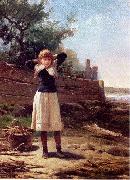 |
Moran, Edward
|
|
English-born American, 1829-1901
American painter of marine and historical subjects, b. England. He came to the United States with his family in 1844. In 1899 he completed a series of 13 paintings illustrating epochs in the maritime history of America from the landing of Leif Ericsson to the return of Admiral Dewey's fleet from the Philippines in 1899 (Pennsylvania Mus. of the Fine Arts, Philadelphia). His brother Thomas Moran, 1837?C1926, was an American landscape painter, illustrator, and etcher. He accompanied the exploring expeditions of Professor F. V. Hayden to the Yellowstone River (1871) and of Major J. W. Powell down the Colorado River (1873). Subsequently, he made the illustrations on wood for both expeditions' reports and the sketches from which he painted the two large canvases now in the Capitol at Washington, D.C., The Grand Canyon of the Yellowstone and Chasm of the Colorado. In 1884 he became a member of the National Academy of Design. As a painter Moran was strongly influenced by the art of Turner. Other examples of his painting are Bringing Home the Cattle (Buffalo, N.Y., Mus.); The Grand Canal, Venice; The Dream of the Orient; and Tower of Cortez, in Mexico, a watercolor. He also produced many etchings and magazine illustrations on wood.
|
|
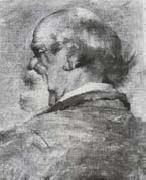 |
Miles Evergood
|
|
Australian Painter, 1871-1939, was an Australian artist. Evergood was born Myer Blashki in Melbourne, eleventh child of Philip Blashki, jeweller, and his wife Anna, nee Imergud. He studied for a while at the national gallery school under Bernard Hall between 1893 and 1895. He exhibited at the Victorian Artists Society, and the Royal Art Society, Sydney, before leaving for the United States in 1898. He worked principally in New York, with frequent visits to Europe, for about 30 years, establishing a good reputation as a painter. He changed his name to Miles Evergood while in the United States. Evergood returned to Australia about the end of 1931 and worked for a year in Queensland and became a member of the Royal Queensland Art Society. He then went to Sydney and Melbourne holding exhibitions of his work, and died of cancer in Melbourne on 3 January 1939. Evergood was a capable artist, who mostly painted landscapes in oil with affinities to the post impressionists.
|
|
|
|
|
|
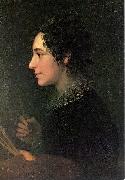 |
Marie Ellenrieder
|
|
Anna Marie Ellenrieder (March 20, 1791 - June 5, 1863, Konstanz) was a German painter.
She was born in Konstanz, Germany, the daughter of Konrad and Anna Maria Herrmann, and the granddaughter of Franz Ludwig Herrmann.
She studied under the miniature painter Joseph Einsle. Her portraits, similar in style to the ones of Angelica Kauffmann, made her the first woman to enter the Academy of Fine Arts Munich.
She spent the time between 1822 and 1824 in Rome, where she became a disciple of Friedrich Johann Overbeck. After this journey, she started painting religious topics such as "Christ Blessing Little Children" and "Mary and the Infant Jesus." Her two paintings "Der 12 jährige Jesus im Tempel / The 12 year old Jesus in the Temple", 1849 (oil on canvas, 203,2 x 139,7 cm) and "Hl Felicitas und ihre sieben Söhne / Holy Felicitas and her Seven Sons", 1847 (oil on canvas, 127 x 177,8 cm) were acquired by Queen Victoria who had been introduced to her work by the Prince Consort, who in turn had encountered the artist on his travels to Rome. They are now part of the Royal Collection in Osborne House.
She died in her home town of Konstanz.
|
|
|
|
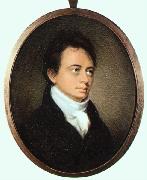 |
Malbone, Edward Greene
|
|
American Miniaturist, 1777-1807
.American miniature painter. Like his boyhood friend Washington Allston, he was encouraged in his artistic pursuits by Samuel King, who lent him engravings to study. In autumn 1794 Malbone set himself up as a miniature painter in Providence, RI, where he worked for two years, achieving almost immediate success. His earliest miniatures, such as that supposedly of Nicholas Brown (1794; New York, NY Hist. Soc.), although somewhat primitive, demonstrate his precosity. The sitters' faces are modelled with a stippling technique and chiselled planes; their outlines are distinct and crisp. These first compositions all include a conventional portrait background, usually a red curtain pulled back to reveal a blue sky. Despite the laboured technique, they are lively, direct and sensitive. During the second half of the 1790s Malbone travelled the eastern USA in search of commissions. He renewed his friendship with Allston in Boston and later visited New York and Philadelphia. In 1801 he was in Charleston, SC, where he befriended the miniature painter Charles Fraser, on whose work he had a strong influence. He developed a brilliant technique of delicate, barely perceptible crosshatching, using interwoven lines of pale colours to create graceful forms.
|
|
|
|
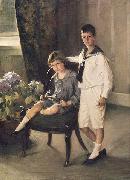 |
Lydia Field Emmet
|
|
(January 23, 1866 - August 16, 1952) was an American artist best known for her work as a portraitist. She studied with, among others, prominent artists such as William Merritt Chase, Henry Siddons Mowbray, Kenyon Cox and Tony Robert-Fleury. Emmet exhibited widely during her career, and her paintings can now be found hanging in the White House, and many prestigious art galleries, including the Metropolitan Museum of Art.
Emmet was born on January 23, 1866, at New Rochelle, New York, the seventh of ten children born to merchant William Jenkins Emmet and illustrator Julia Colt Pierson.
|
|
|
|
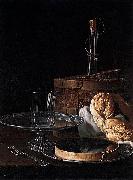 |
Luis Eugenio Melendez
|
|
(Naples, 1716-Madrid, 1780) was a Spanish painter. Although he received little acclaim during his lifetime and died in poverty, Melendez is recognized today as the greatest Spanish still-life painter of the 18th century. His mastery of composition and light, and his remarkable ability to convey the volume and texture of individual objects enabled him to transform the most mundane of kitchen fare into powerful images.
Luis Egidio Melendez de Rivera Durazo y Santo Padre was born in Naples in 1716. His father, Francisco Melendez de Rivera Diaz (1682- after 1758), was a miniaturist painter from Oviedo who had moved to Madrid with his older brother, the portrait painter Miguel Jacinto Melendez (1679-1734) in pursuit of artistic instruction. Whereas Miguel remained in Madrid to study and became a painter in the court of Philip V, Francisco left for Italy in 1699 to seek greater artistic exposure. Francisco took a special interest in visiting the Italian academies and settled in Naples where he married Maria Josefa Durazo y Santo Padre Barrille. Luis was a year old when his father, who had been a soldier in a Spanish garrison and lived abroad for almost two decades, returned to Madrid with the family. Luis Egidio, his brother Jose Agusten, and Ana, one of his sisters, began their careers under the tutelage of their father, who was appointed the King's Painter of Miniatures in 1725. After several years, in his words: painting royal portraits in jewels and bracelets to serve as gifts for envoys and ambassadors, he entered the workshop of Louis Michel van Loo (1707-1771), a Frenchman who had been made royal painter of Philip V of Spain.
|
|
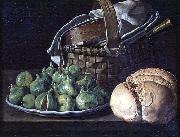 |
Luis Egidio Melendez
|
|
(Naples, 1716-Madrid, 1780) was a Spanish painter. Although he received little acclaim during his lifetime and died in poverty, Melendez is recognized today as the greatest Spanish still-life painter of the 18th century. His mastery of composition and light, and his remarkable ability to convey the volume and texture of individual objects enabled him to transform the most mundane of kitchen fare into powerful images.
Luis Egidio Melendez de Rivera Durazo y Santo Padre was born in Naples in 1716. His father, Francisco Melendez de Rivera Diaz (1682- after 1758), was a miniaturist painter from Oviedo who had moved to Madrid with his older brother, the portrait painter Miguel Jacinto Melendez (1679-1734) in pursuit of artistic instruction. Whereas Miguel remained in Madrid to study and became a painter in the court of Philip V, Francisco left for Italy in 1699 to seek greater artistic exposure. Francisco took a special interest in visiting the Italian academies and settled in Naples where he married Maria Josefa Durazo y Santo Padre Barrille.Luis was a year old when his father, who had been a soldier in a Spanish garrison and lived abroad for almost two decades, returned to Madrid with the family. Luis Egidio, his brother Jose Agusten, and Ana, one of his sisters, began their careers under the tutelage of their father, who was appointed the King's Painter of Miniatures in 1725.After several years, in his words: painting royal portraits in jewels and bracelets to serve as gifts for envoys and ambassadors, he entered the workshop of Louis Michel van Loo (1707-1771), a Frenchman who had been made royal painter of Philip V of Spain. Between 1737 to 1742, Melendez worked as a part of a team of artist dedicated to copying van Loo's prototypes of royal portraits for the domestic and overseas market, but at least he had a foothold in the palace. He had his artistic sights on a distinguished career as a court painter.
|
|
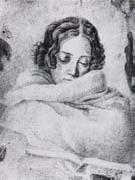 |
Ludwig Emil Grimm
|
|
1790-1863,German draughtsman, engraver and painter. He was a brother of the philologists and fairy-tale collectors Jakob Grimm (1785-1863) and Wilhelm Grimm (1786-1859). He attended the Kunstakademie in Kassel from 1805 to 1807. He then moved to Munich to study with the engraver Carl Ernst Hess (1755-1828), and he became a student at the Akademie der Bildenden Kenste there. He revealed a talent for portraiture in numerous sketches of his family and friends. In 1814 he served with the Prussian army in the military campaign against France, then completed his studies in Munich. In 1816 he visited Italy,
|
|
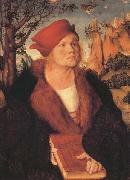 |
Lucas Cranach the Elder
|
|
b. 1472, Kronach, d. 1553, Weimar. German painter and printmaker. He took his name from the town of his birth. Little is known about his early life or training. In Vienna (c. 1501 ?C 04) he painted some notable portraits and landscapes characteristic of the Danube school. From 1505 to 1550 he was court painter in Wittenberg, where he achieved great success and wealth painting portraits, mythological subjects, and altarpieces for Protestant and Catholic churches. He attracted so many young artists to Wittenberg that the town became an art centre. A friend of Martin Luther, Cranach became known as the chief pictorial propagandist of the Protestant cause in Germany. He produced numerous engravings and more than 100 woodcuts, notably for the first German edition of the New Testament (1522). After his death, his style was perpetuated by his son, Lucas the Younger (1515 C 86).
|
|
|
|
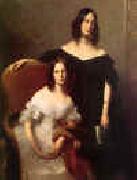 |
Louis-Edouard Dubufe
|
|
1819-1883 French
Son of Claude-Marie Dubufe. He was trained by his father and then by Paul Delaroche. He first appeared at the Salon in 1839 with the Annunciation, a Huntress and a portrait, winning a third class medal. He followed this in 1840 with an episode in the life of St Elisabeth of Hungary, which won him a second class medal; in 1844 he won a first class medal with Bathsheba and a genre scene set in the 15th century (all untraced).
|
|
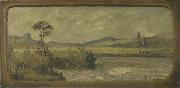 |
Louis Michel Eilshemius
|
|
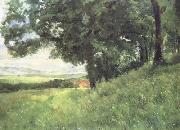
(February 4, 1864 - December 29, 1941) was an American painter, primarily of landscapes and nudes. Although he was academically trained, much of his work has the unself-aware character of naive art. Eilshemius was a grandson of Swiss painter Louis-Leopold Robert.
Born near Newark, New Jersey into a wealthy family, his earliest education was in Europe, after which he spent two years at Cornell University before his art studies began at the Art Students League of New York. He subsequently studied under Bouguereau at the Academie Julian in Paris, and traveled widely in Europe, Africa and the South Seas, returning to the family brownstone in New York City where he was to live for the rest of his life.
|
|
|
|
 |
Louis Eysen
|
|
1843 - 1899
German painter and engraver. His family, which had moved to England in the 1840s, returned to Frankfurt am Main in 1850. He studied wood engraving with Alexander Stix (1819-93) at the St?delsches Kunstinstitut in Frankfurt and later achieved considerable success in this medium (e.g. Glade, 1868; see Zimmermann, p. 9). He was taught painting by Karl Hausmann (1825-86) and was influenced chiefly by contemporary French art. He first worked mainly in Berlin and then in Munich, where he met Otto Scholderer and Wilhelm Leibl, who painted his portrait (c. 1870; Frankfurt am Main, Stedel. Kstinst.). He studied with Leon Bonnat in Paris from 1869 to 1870. In 1873 he settled at Kronberg,
|
|
|
|
 |
Louis Eilshemius
|
|
1864-1941
Louis Eilshemius Gallery
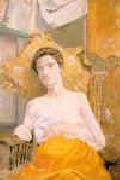
Born near Newark, New Jersey into a wealthy family, his earliest education was in Europe, after which he spent two years at Cornell University before his art studies began at the Art Students League of New York. He subsequently studied under Bouguereau at the Acad??mie Julian in Paris, and traveled widely in Europe, Africa and the South Seas, returning to the family brownstone in New York City where he was to live for the rest of his life.
His early landscapes, which show the influence of the Barbizon school and of Corot, George Inness and Albert Pinkham Ryder, gained him little recognition from critics or from the public. Around 1910, the element of fantasy in his work became more pronounced and his technique became coarser; henceforth, he often painted on cardboard instead of canvas. As his works became more idiosyncratic, so did his behavior, and he developed an unsettling habit of visiting galleries and loudly condemning the works on display.
His later, visionary works depicting moonlit landscapes populated with voluptuous nymphs caused his contemporaries particular consternation, due to their crudely rendered and often extravagantly smiling nudes. These are shown frolicking in forests or waterfalls, either alone or in groups, sometimes defying gravity by floating through the air. His paintings of New York rooftops are as lyrical as his pastoral scenes, and like them are often bounded by sinuous "frames" he painted onto his pictures.
Eilshemius also wrote verse and prose, composed music, painted, philosophized and became notorious for his numerous, often vitriolic, letters-to-the-editor of various New York City publications. His lack of public acclaim led him to desperate measures: suspecting that the length of his name was responsible for his neglect, in about 1890 he began signing his paintings "Elshemus" (he reverted back to the original spelling in 1913). On letterheads and in hyperbolic, self-published flyers he would proclaim his accomplishments: "Educator, Ex-actor, Amateur All-around Doctor, Mesmerist-Prophet and Mystic, Reader of Hands and Faces, Linguist of 5 languages", as well as world-class athlete and marksman, "Spirit-Painter Supreme", and musician whose improvisations rivalled the compositions of Chopin. All of this only reinforced the impression, already suggested by the peculiar imagery in many of his paintings, that he was either mad or a charlatan.
He was not without supporters, however. He was championed by Marcel Duchamp, who "discovered" Eilshemius in 1917 and invited him to exhibit with him in Paris that year. His work was generally well received by French viewers and critics; his admirers included Matisse. Duchamp subsequently helped to arrange Eilshemius's first solo exhibition in 1920, at the Soci??t?? Anonyme in New York City. The hostile critical reception to this exhibition, however, finally drove him to give up painting entirely in 1921, although there is a single known painting dated 1937. The remainder of his life was dedicated to self-promotion, and in 1931 he took to referring to himself as "Mahatma".
Injured in an automobile accident in 1932, he became increasingly reclusive. His health in decline and his family fortune spent, he died in 1941.
Since his death, Eilshemius's work has found a wider audience. One of the artist's few consistent patrons, Roy Neuberger, donated a large body of Eilshemius' work to the Neuberger Museum of Art located at SUNY Purchase College in New York State.
|
|
|
|
|
|
|
|
|
| Wholesale China Oil Painting Wholesale Oil Painting China Xiamen Portrait Reproduction on canvas Chinese Oil Painting Wholesale USA Oil Painting |
|
|
|
|
|