| |
|
Xiamen Oil Paintings, Wholesale Direct!
|
|
100% hand painted, 100% cotton canvas, 100% money back if not satisfaction. |
|
|
|
|
ART WORKS INDEX
A
B
C
D
E
F
G
H
I
J
K
L
M
N
O
P
Q
R
S
T
U
V
W
X
Y
Z
|
|
ARTISTS INDEX
A
B
C
D
E
F
G
H
I
J
K
L
M
N
O
P
Q
R
S
T
U
V
W
X
Y
Z
|
|
|
|
|
|
|
|
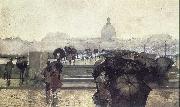 |
Lungren, Fernand Harvey
|
|
American Painter, ca.1857-1932
American painter and illustrator. Of Swedish descent, the family moved to Toledo, OH, when Lungren was four years old. He showed an early talent for drawing but was intended by his father for a professional career and in 1874 entered the University of Michigan, Ann Arbor, to study mining engineering. He left in 1876, however, determined to become an artist. After a protracted dispute with his father, he was allowed briefly to attend the Pennsylvania Academy in Philadelphia, where he studied under Thomas Eakins and had Robert Frederick Blum, Alfred Laurens Brennan (1853-1921) and Joseph Pennell as fellow students. In the winter of 1877 he moved to New York, where he worked as an illustrator for Scribner's Monthly (renamed Century in 1881) during the period known as 'the Golden Age of American illustration'. His first illustration appeared in 1879 and he continued to contribute to the magazine until 1903. He was also an illustrator for the children's magazine St Nicholas from 1879 to 1904 and later for Harper's Bazaar, McClure's and The Outlook.
|
|
 |
Lundbye, Johan Thomas
|
|
Danish Painter, 1818-1848
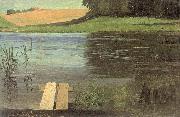
Danish painter. He studied at the Kongelige Akademi for de Sk?nne Kunster, Copenhagen, under Johan Ludvig Lund (1777-1867) and the animal painter Christian Holm (1804-46) between 1832 and 1842. Early on he was influenced by the ideas of the art historian N. L. H?yen, especially his concept of a truly national school of landscape painting. Kalundborg Church (1837; Copenhagen, Stat. Mus. Kst) depicts a historical monument familiar to all Danes, and one that had a particular nostalgic attraction for a painter born in Kalundborg. The picture is both sharply naturalistic and emphatically painterly. In Landscape Near Arres? (1838; Copenhagen, Thorvaldsens Mus.) Lundbye was more occupied with the representation of light and space. There is no anecdotal element; the lake, the open sky, the low hills, the ancient cairn, the cattle and the playing children sum up a typical Danish summer landscape. His larger canvases emphasize openness; flat expanses of land terminate in low tree-fringed horizons below vast skies. They have little of Constable's temperament or the broadness of Corot but are close to the elegiac mood of Caspar David Friedrich and Johan Christian Dahl. Danish landscape painting during the mid-1830s was greatly influenced by Romanticism
|
|
|
|
 |
Luke Fildes
|
|
1844-1927
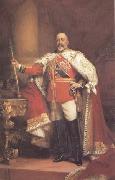
English painter and illustrator. He first studied art at the Mechanics Institute in Liverpool and at the nearby Warrington School of Art. In 1863 he won a scholarship that enabled him to study at the South Kensington Art School in London and subsequently at the Royal Academy Schools.
|
|
 |
Luke Clennell
|
|
Born, 1781, Back. Died, 1840, Country, England
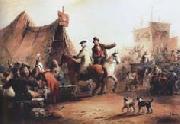
was an English engraver and painter. Born in Morpeth, Northumberland, the son of a farmer, he was apprenticed to the engraver Thomas Bewick in 1797. Between 1799 and 1803 he acted as Bewick's principal assistant on the second volume of the History of British Birds. After completing his seven-year apprenticeship with Bewick he moved to London, where he married a daughter of the copper-engraver Charles Turner Warren (1762-1823). Through his marriage he became acquainted with such book illustrators as William Finden and Abraham Raimbach. He gained a reputation as an engraver and in May 1806 he was awarded the gold palette of the Society of Arts for a wood-engraving of a battle scene. He subsequently gave up engraving for painting. In 1814 he received from the Earl of Bridgewater a commission for a large picture to commemorate the banquet given to the Allied Sovereigns at the Guildhall, London. He experienced great difficulty in getting the distinguished guests to sit for their portraits, and suffered a mental breakdown. After a spell in an asylum, he recovered and returned home.
|
|
|
|
|
|
 |
Luis Ricardo Falero
|
|
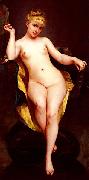
Luis Ricardo Falero (1851 - December 7, 1896) was a Spanish painter. He specialized in female nudes and mythological and fantasy settings. Most of his paintings contained at least one female nude or topless nude. His most common medium was oil on canvas.
|
|
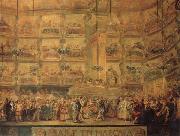 |
Luis Paret y alcazar
|
|
Spanish Rococo Era Painter, 1746-1799
was a Spanish painter of the late-Baroque or Rococo period. He was born in Madrid he first trained with Antonio Gonz??lez Velazquez and attended the Academia Real de San Fernando in Madrid, where he won a second prize in a painting contest in 1760, and first prize in 1766. He entered the studio of the French painter Charles de la Traverse, who worked for the Marchese of Ossun, the ambassador of France in Spain. Unfortunately upon returning to Madrid, despite becoming a teacher in the Academia de San Fernando at age 33 years, he mainly received royal commissions to paint and engrave vistas of ports, the Spanish equivalent of vedute, and also of planned works of construction. For some years, he was banished to Puerto Rico, where he trained the painter Jose Campeche.
|
|
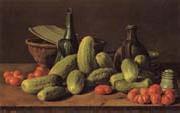 |
Luis Menendez
|
|
1716-1780. a Spanish painter
was a Spanish painter. Although he received little acclaim during his lifetime and died in poverty, Melendez is recognized today as the greatest Spanish still-life painter of the eighteenth century. His mastery of composition and light, and his remarkable ability to convey the volume and texture of individual objects enabled him to transform the most mundane of kitchen fare into powerful images. Luis Egidio Melendez de Rivera Durazo y Santo Padre was born in Naples in 1716. His father, Francisco Melendez de Rivera Diaz (1682- after 1758), was a miniaturist painter from Oviedowho had moved to Madrid with his older brother, the portrait painter Miguel Jacinto Melendez (1679-1734) in pursuit of artistic instruction.Whereas Miguel remained in Madrid to study and became a painter in the court of Philip V, Francisco left for Italy in 1699 to seek greater artistic exposure. Francisco took a special interest in visiting the Italian academies and settled in Naples where he married Maria Josefa Durazo y Santo Padre Barrille.Luis was a year old when his father, who had been a soldier in a Spanish garrison and lived abroad for almost two decades, returned to Madrid with the family. Luis Egidio, his brother Jos' Agusten, and Ana, one of his sisters, began their careers under the tutelage of their father, who was appointed the King's Painter of Miniatures in 1725.After several years, in his words: painting royal portraits in jewels and bracelets to serve as gifts for envoys and ambassadors, he entered the workshop of Louis Michel van Loo (1707-1771), a Frenchman who had been made royal painter of Philip V of Spain. Between 1737 to 1742, Melendez worked as a part of a team of artist dedicated to copying van Loo's prototypes of royal portraits for the domestic and overseas market, but at least he had a foothold in the palace. He had his artistic sights on a distinguished career as a court painter. When the Real Academia de Bellas Artes de San Fernando was provisionally inaugurated in 1744, his father, Francisco, was made an honorary director of painting and Luis was among the first students to be admitted, he achieved outstanding results in drawing. The Academy was progressive in that it not only tolerated but also encouraged the 'lesser' genres, including still life. At this time, he was already an accomplished painter as proved by his superb self-portrait at the Louvre signed in 1747. However, this opportunity was marred by a petty quarrel; Luis' father, Francisco, openly attacked the director of the Academy and claimed for himself the honor of being the founder. He had his son Luis personally delivered the inflammatory material to the Academy. Francisco was relieved of his teaching position and Luis was formally expelled from the Academy on June 15, 1748. Unlike his father, Luis professional status was precarious.
|
|
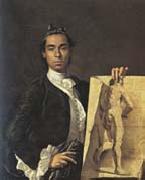 |
Luis Melendez
|
|
1716-80
He assisted his father, artist Francisco Melendez, until 1737, when he began studying with Lewis-Michel Vanloo, the court painter to Philip V of France. Although accepted (1745) into the Spanish Royal Academy of Fine Arts, he was expelled after his father denounced the academy in a dispute over a royal competition. After traveling throughout Italy, he returned to work for his father as an illustrator of choirbooks.
|
|
|
|
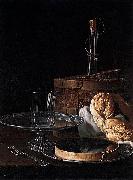 |
Luis Eugenio Melendez
|
|
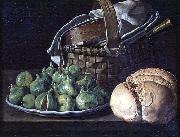
(Naples, 1716-Madrid, 1780) was a Spanish painter. Although he received little acclaim during his lifetime and died in poverty, Melendez is recognized today as the greatest Spanish still-life painter of the 18th century. His mastery of composition and light, and his remarkable ability to convey the volume and texture of individual objects enabled him to transform the most mundane of kitchen fare into powerful images.
Luis Egidio Melendez de Rivera Durazo y Santo Padre was born in Naples in 1716. His father, Francisco Melendez de Rivera Diaz (1682- after 1758), was a miniaturist painter from Oviedo who had moved to Madrid with his older brother, the portrait painter Miguel Jacinto Melendez (1679-1734) in pursuit of artistic instruction. Whereas Miguel remained in Madrid to study and became a painter in the court of Philip V, Francisco left for Italy in 1699 to seek greater artistic exposure. Francisco took a special interest in visiting the Italian academies and settled in Naples where he married Maria Josefa Durazo y Santo Padre Barrille. Luis was a year old when his father, who had been a soldier in a Spanish garrison and lived abroad for almost two decades, returned to Madrid with the family. Luis Egidio, his brother Jose Agusten, and Ana, one of his sisters, began their careers under the tutelage of their father, who was appointed the King's Painter of Miniatures in 1725. After several years, in his words: painting royal portraits in jewels and bracelets to serve as gifts for envoys and ambassadors, he entered the workshop of Louis Michel van Loo (1707-1771), a Frenchman who had been made royal painter of Philip V of Spain.
|
|
 |
Luis Egidio Melendez
|
|
(Naples, 1716-Madrid, 1780) was a Spanish painter. Although he received little acclaim during his lifetime and died in poverty, Melendez is recognized today as the greatest Spanish still-life painter of the 18th century. His mastery of composition and light, and his remarkable ability to convey the volume and texture of individual objects enabled him to transform the most mundane of kitchen fare into powerful images.
Luis Egidio Melendez de Rivera Durazo y Santo Padre was born in Naples in 1716. His father, Francisco Melendez de Rivera Diaz (1682- after 1758), was a miniaturist painter from Oviedo who had moved to Madrid with his older brother, the portrait painter Miguel Jacinto Melendez (1679-1734) in pursuit of artistic instruction. Whereas Miguel remained in Madrid to study and became a painter in the court of Philip V, Francisco left for Italy in 1699 to seek greater artistic exposure. Francisco took a special interest in visiting the Italian academies and settled in Naples where he married Maria Josefa Durazo y Santo Padre Barrille.Luis was a year old when his father, who had been a soldier in a Spanish garrison and lived abroad for almost two decades, returned to Madrid with the family. Luis Egidio, his brother Jose Agusten, and Ana, one of his sisters, began their careers under the tutelage of their father, who was appointed the King's Painter of Miniatures in 1725.After several years, in his words: painting royal portraits in jewels and bracelets to serve as gifts for envoys and ambassadors, he entered the workshop of Louis Michel van Loo (1707-1771), a Frenchman who had been made royal painter of Philip V of Spain. Between 1737 to 1742, Melendez worked as a part of a team of artist dedicated to copying van Loo's prototypes of royal portraits for the domestic and overseas market, but at least he had a foothold in the palace. He had his artistic sights on a distinguished career as a court painter.
|
|
 |
Luis de Morales
|
|
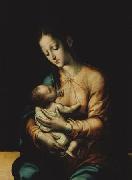
(1510 - 9 May 1586) was a Spanish painter born in Badajoz, Extremadura. Known as "El Divino", most of his work was of religious subjects, including many representations of the Madonna and Child and the Passion.
Influenced, especially in his early work, by Raphael Sanzio and the Lombard school of Leonardo, he was called by his contemporaries "The Divine Morales", because of his skill and the shocking realism of his paintings, and because of the spirituality transmitted by all his work.
His work has been divided by critics into two periods, an early stage under the influence of Florentine artists such as Michelangelo and a more intense, more anatomically correct later period similar to German and Flemish renaissance painters
|
|
|
|
 |
LUINI, Bernardino
|
|
Italian High Renaissance Painter, ca.1480-1532
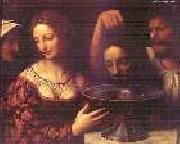
Italian painter and draughtsman. He was one of the generation of Lombard painters active around 1500 who, influenced by Leonardo and Raphael, blended High Renaissance innovations with indigenous Milanese elements to create a Lombard Renaissance style. Luini's paintings were extremely popular with both collectors and critics from c. 1790 to the end of the 19th century. This widespread popularity, however, had unfortunate consequences: many of his frescoes were detached from their original settings, many of the panel paintings were transferred to canvas and other works were heavily restored. As a result few survive in a good state. About 700 works are attributed to Luini, but many of these attributions are over optimistic.
|
|
|
|
 |
Luigi Premazzi
|
|
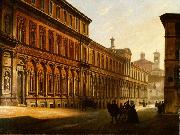
(Milan, 1814 - Istanbul, Turkey, 1891) was an Italian painter.
Premazzi attended the Brera Academy of Fine Arts and then the private school run by Giovanni Migliara. His early watercolours, based on the works of his master, were produced for the lithographic industry. His oeuvre is characterised by a repertoire of urban views produced in accordance with the dictates of perspective painting. While most of these are set in Milan, other Italian cities were also featured in later years. His smooth, precise painting also shows the influence of his contemporary Luigi Bisi in its descriptive focus on architectural detail. He presented work regularly at the exhibitions of the Societe Promotrice di Belle Arti in Turin from 1842 to 1848 as well as those of the Brera Academy. Having moved to Saint Petersburg around 1850, he became a teacher at the Imperial School of Fine Arts there in 1861. Frequent stays in the Caucasus and the Middle East provided new subjects for his paintings, which he continued to send to Italian exhibitions, where they aroused wonder and curiosity.
|
|
|
|
 |
Luigi Loir
|
|
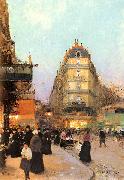
French painter and engraver Luigi Loir (1845-1916).
|
|
 |
Luigi Crosio
|
|
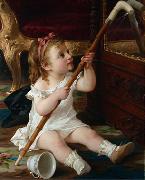
(1835-1915) was an Italian painter who lived and worked in Turin, Italy. He died in Turin and is recorded as having been born in Alba, but the town of Aqua a few miles north of Alba claims Crosio was born there.
He attended the Accademia Albertina di Belle Arte in Turin. His immediate work afterwards tilted towards commercial paintings, but thereafter he specialised in genre painting with romantic 18th century scenes and portraits or period characters or Pompeian scenes. He also liked the opera and depicted several scenes from popular operas. He was also listed as a lithographer and was involved in publishing books and images.
He had several daughters and one of them, Carola Crosio, married the famous mathematician Giuseppe Peano (of Peano axioms fame) in 1887.
In 1898 he painted the famous Refugium Peccatorum Madonna (i.e. Refuge of Sinners Madonna) which was later also called Mother Thrice Admirable Madonna.
|
|
|
|
 |
Ludwig von Hofmann
|
|
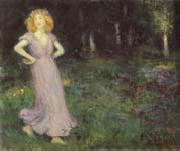
German, 1861-1945,was a German painter. His style was impressionist, and he painted many paintings, like his famous painting "Rain", in a mixture of impressionist and classical.He was also blind in one eye.
|
|
 |
Ludwig Vogel
|
|
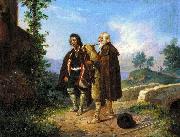
(1788-1879) was a Swiss painter.
This article was initially translated from the German Wikipedia.
|
|
 |
ludwig van beethoven
|
|
Born: December 1770
Birthplace: Bonn, Germany
Died: 26 March 1827 (cirrhosis of the liver, plus dropsy)
Best Known As: The composer of Beethoven's Fifth
|
|
|
|
|
|
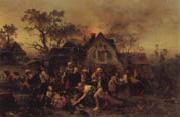 |
Ludwig Knaus
|
|
German Painter, 1829-1910
was a German genre painter of the younger Desseldorf school. He was born at Wiesbaden and studied from 1845 to 1852 under Sohn and Schadow in Desseldorf. His early works, like "The Gamblers," in the Desseldorf Gallery, are in the manner of that school, being dark and heavy in color. This deficiency was remedied by study at Paris, whither he went in 1852 and enrolled as a pupil of Couture. In 1853 his "Morning after the Kermess" received the second gold Medal of the Salon and made him a celebrated painter. Except for a year's study in Italy he remained in Paris until 1860.New International Encyclopedia His chief works of this period include "The Golden Wedding," "The Baptism," and "The Promenade," purchased for the Luxembourg. From 1861 to 1866 he practiced at Berlin, producing such works as "Boys Playing Cards," "Looking for a Bride" (Wiesbaden Museum), and "His Highness on His Travels." The next eight years of his life saw the production of much of his best work, including "The Children's Festival" (Nation Gallery, Berlin), "In Great Distress," and "The Village Prince." From 1874 to 1883 he was professor at the Academy of Berlin, continuing to reside in that city until his death. Among the most importand works of his last period were: "The Holy Family" and "The Road to Ruin," both painted in 1876 and now in the Metropolitan Museum of Art, New York; "Behind the Curtain" (1880), Dresden Gallery; "The Rag Baby" (1880) and "A Village Festival" (1881), both in the Vanderbilt collection, Metropolitan Museum, New York; and "A Duel." During his last period Knaus also painted a series of "Idyls," with nudes in a rather classical style, of which an important example is in the Wiesbaden Museum.
|
|
|
|
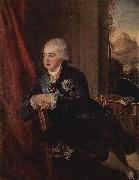 |
Ludwig Guttenbrunn
|
|
Ludwig Guttenbrunn (1750 - 1819) was an artist who worked in the latter part of the 18th century and early 19th century. He specialized in portraiture and history painting.
|
|
|
|
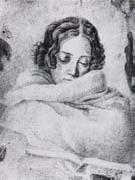 |
Ludwig Emil Grimm
|
|
1790-1863,German draughtsman, engraver and painter. He was a brother of the philologists and fairy-tale collectors Jakob Grimm (1785-1863) and Wilhelm Grimm (1786-1859). He attended the Kunstakademie in Kassel from 1805 to 1807. He then moved to Munich to study with the engraver Carl Ernst Hess (1755-1828), and he became a student at the Akademie der Bildenden Kenste there. He revealed a talent for portraiture in numerous sketches of his family and friends. In 1814 he served with the Prussian army in the military campaign against France, then completed his studies in Munich. In 1816 he visited Italy,
|
|
|
|
 |
ludvig karsten
|
|
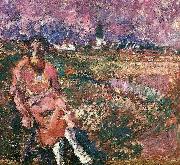
(Ludvig Peter Karsten), född 8 maj 1876 i Oslo, död 19 oktober 1926 i Paris, var en norsk målare. Han räknas som en av de viktigaste efterföljarna till Edvard Munch och räknades som en ledande impressionist.
|
|
 |
Ludovike Simanowiz
|
|
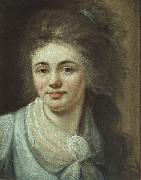
Deutsch: Friedrich Schiller (1759 - 1805), Ölgemälde von Ludovike Simanowiz 1793/94
English: Friedrich Schiller, German poet, philosopher, historian, and dramatist
|
|
 |
Ludovico Mazzolino
|
|
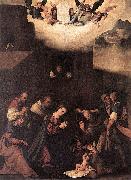
(1480 - c. 1528) - also known as Mazzolini da Ferrara, Lodovico Ferraresa, and Il Ferrarese - was an Italian Renaissance painter active in Ferrara and Bologna.
He was born and died in Ferrara. He appears to have studied under such as Lorenzo Costa, who also trained Dosso Dossi and Cosimo Tura, and came under the influence of Ercole Roberti. In 1521 he married Giovanna, the daughter of Bartolomeo Vacchi, a Venetian painter. Much of his work was commissioned by the duke Ercole I d'Este from Ferrara. Mazzolino was influenced by il Garofalo and Boccaccino. He is known for devotional cabinet pictures, in a style somewhat regressive, or primitive, relative to the modern classicism then emerging. For example, his Massacre canvas has a turbulent and cartoonish crowding.
The exact date, or even year, of his death is not known, but he died during a plague which devastated the area.
|
|
 |
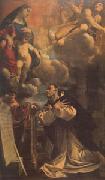
Ludovico Cigoli
|
|
Italian Baroque Era Painter ,
1559-1613
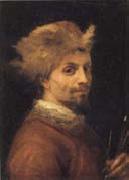
was an Italian painter and architect of the late Mannerist and early Baroque period, trained and active in his early career in Florence, and spending the last nine years of his life in Rome. Lodovico Cardi was born at Villa Castelvecchio di Cigoli, in Tuscany, whence the name by which he is commonly known. Initially, Cigoli trained in Florence under the fervid mannerist Alessandro Allori. Later, influenced by the most prominent of the Contra-Maniera painters, Santi di Tito, as well as by Barocci, Cigoli shed the shackles of mannerism and infused his later paintings with an expressionism often lacking from 16th century Florentine painting. For example, for the Roman patron, Massimo Massimi, he painted an Ecce Homo (now in Palazzo Pitti). Supposedly unbenknownst to any of the painters, two other prominent contemporary painters, Passignano and Caravaggio, had been requested canvases on the same theme. It is unclear if they are completely independent. Cigoli's painting seems to have been made with knowledge of Caravaggio's canvas; however, while Cigoli's work lacks the power of Caravaggio's naturalism, the background shade and sparse foreground shows how much he was moving away from crowded Florentine historical paintings. This work was afterwards taken by Bonaparte to the Louvre, and was restored to Florence in 1815. One of his early paintings was of Cain slaying Abel.
|
|
 |
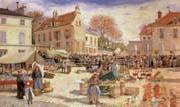
Ludovico Carracci
|
|
(Bologna 1555-1619)
Painter, draughtsman and etcher. His father, Vincenzo Carracci, was a butcher, whose profession may be alluded to in Ludovico's nickname 'il Bue', though this might also be a reference to the artist's own slowness. Ludovico's style was less classical than that of his younger cousins Agostino and Annibale, perhaps because of a mystical turn of mind that gave his figures a sense of other-worldliness. Like his cousins, he espoused the direct study of nature, especially through figure drawing, and was inspired by the paintings of Correggio and the Venetians. However, there survives in his work, more than in that of his cousins, a residue of the Mannerist style that had dominated Bolognese painting for most of the mid-16th century. Ludovico maintained a balance between this Mannerist matrix, his innate religious piety and the naturalism of the work of his cousins. With the exception of some travels during his training and a brief visit to Rome in 1602, Ludovico's career was spent almost entirely in Bologna.
|
|
 |
Ludovic Piette
|
|
French Painter, 1826-1878.French painter. He studied at the Ecole des Beaux-Arts in Paris during the 1850s under Isidore Pils and Thomas Couture. He attended classes at the Acad?mie Suisse and made his Salon d?but in 1857 with The Scorpion Broom (ex-Mus. B.-A., Rouen). His early works were often based on literary sources and include The Phantoms (exh. Salon 1859) and The Witches Appearing to Macbeth (exh. Salon 1861). Piette only exhibited at the Salon on two further occasions (1872 and 1876), preferring instead to sell his work at auction in the H?tel Drouot. In the early 1860s he abandoned literary subjects in favour of working directly from nature, a shift that probably relates to his developing friendship with Camille Pissarro. This association is first documented by Pissarros portrait of Piette in his Studio (1861; Dr and Mrs Jordan H. Trafimow priv. col.) and an important correspondence between the two artists from 1863 to 1877 survives. Piette portrayed Pissarro painting out of doors (c. 1870; priv. col., see Pissarro, exh. cat., ACGB, 1980, no. 322).
|
|
|
|
|
|
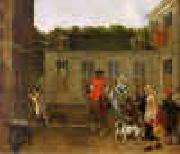 |
Ludolf de Jongh
|
|
1616-1679
Dutch
Ludolf de Jongh Galleries
Dutch painter. He was one of the most versatile Dutch painters of the 17th century, producing portraits, genre paintings of both domestic scenes and soldier life, landscapes with hunting scenes and a few historical subjects. According to Houbraken, he studied with Cornelis Saftleven in Rotterdam, Anthonie Palamedesz. in Delft, and Jan van Bijlert in Utrecht. In 1635 he went to France, where he stayed for seven years. His earliest known paintings are portraits and genre subjects that date from after his return to Rotterdam in about 1642 and strongly reflect the style of Palamedesz.'s work. The genre subjects and numerous hunting scenes (e.g. Riders before an Inn; Geneva, Mus. A. & Hist.) painted shortly before the 1650s show the influence of van Bijlert and other Utrecht painters, especially Jacob Duck and Dirck Stoop.
|
|
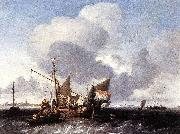 |
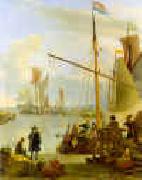
Ludolf Bakhuizen
|
|
(December 28, 1630 - November 17, 1708) was a German-born Dutch Golden Age painter who was the leading Dutch painter of maritime subjects after the two Willem van de Veldes (father and son) left for England in 1672.
He was born in Emden, East Frisia, and came to Amsterdam in about 1650, working as a merchant's clerk and a calligrapher. He discovered so strong a genius for painting that he relinquished the business and devoted himself to art from the late 1650s, initially in pen drawings. He studied first under Allart van Everdingen and then under Hendrik Dubbels, two eminent masters of the time, and soon became celebrated for his sea-pieces, which often had rough seas.
He was an ardent student of nature, and frequently exposed himself on the sea in an open boat in order to study the effects of storms. His compositions, which are numerous, are nearly all variations of one subject, the sea, and in a style peculiarly his own, marked by intense realism or faithful imitation of nature. In his later years Bakhuizen employed his skills in etching; he also painted a few examples each of several other genres of painting, such as portraits, landscapes and genre paintings.
|
|
 |
Ludolf Backhuysen
|
|
b.Dec. 18, 1631, Emden, East Frisia [Germany]
d.Nov. 17, 1708, Amsterdam, Neth.
Dutch
Ludolf Backhuysen Gallery
|
|
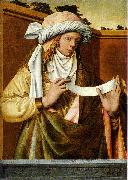 |
Ludger tom Ring the Younger
|
|
(1522-1584) was a German painter and draughtsman.
Ring was born in Menster. His father and brothers were also painters. Ring primarily painted portraits and still lifes. He died in Braunschweig in 1584.
|
|
|
|
|
|
|
|
|
|
|
|
|
| Wholesale China Oil Painting Wholesale Oil Painting China Xiamen Portrait Reproduction on canvas Chinese Oil Painting Wholesale USA Oil Painting |
|
|
|
|
|