| |
|
Xiamen Oil Paintings, Wholesale Direct!
|
|
100% hand painted, 100% cotton canvas, 100% money back if not satisfaction. |
|
|
|
|
ART WORKS INDEX
A
B
C
D
E
F
G
H
I
J
K
L
M
N
O
P
Q
R
S
T
U
V
W
X
Y
Z
|
|
ARTISTS INDEX
A
B
C
D
E
F
G
H
I
J
K
L
M
N
O
P
Q
R
S
T
U
V
W
X
Y
Z
|
|
|
|
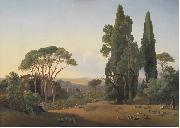 |
Fritz Petzholdt
|
|
(1 January 1805 - 29 August 1838) was a Danish landscape painter of the Copenhagen School, also known as the Golden Age of Danish Painting. He spent most of his artistic life in Italy, where he painted refined landscapes in a light colour palette but died early, most likely by way of suicide.
Fritz Petzholdt was born into a prosperous home on 1 January 1805 in Copenhagen to grocer Johan Jacob Petzholdt and his second wife Josephine Marie Elisabeth Petzholdt. After completing an apprenticeship as a house painter, he attended the Royal Danish Academy of Fine Arts from 1824 where he studied under Christoffer Wilhelm Eckersberg, known as the farther of the Golden Age of Danish Painting spanning the first half of the 19th century. He graduated in 1828 and already the following year sold a painting, En mose ved Høsterkøb med tørvearbejdere (A Bog at Høsterkøb), to the Royal Danish Painting Collection.
Although he never won the Academy's gold medal, the traditional opening for Academy students to go abroad to further their studies since it was accompanied by a travel stipend, his family's wealth allowed him to travel to Harz the same year and then, in May 1830, to set out for Rome. On the way he visited Dresden, Prague, Nuremberg, Munich, Venice and Florence. In Rome he joined the Danish artists colony which had formed in the city with Bertel Thorvaldsen as its centre. He made excursions to the Roman countrysideeto places such as Tivoli, Subiaco and Olevanoeas well as longer trips south to Naples, Sicily and Corfu.
In the winter of 1835/36 he returned to Copenhagen due to his farther's illness and subsequent death. Shortly after the funeral, he returned to Italy with an extended stop in Munich on the way. From Italy he continued to Greece, a destination only Martinus Rørbye had visited before him among the Danish Golden Age painters. On 29 August 1838 he was found dead in his hotel room in Patras with his throat cut. Whether it was a case of suicide or murder was never settled.
|
|
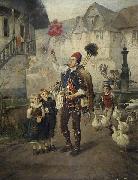 |
Fritz Beinke
|
|
(1842- 1907 ) - Painter
painted The toymaker of Nuremberg in 1882
|
|
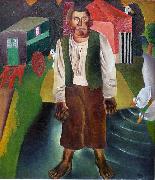 |
Frits Van den Berghe
|
|
(3 April 1883 - 22 September 1939) was a Belgian expressionist painter.
He was born at Ghent. Like his friends Constant Permeke and Gustave De Smet, he first adopted the late-impressionist style of Emile Claus, but converted to expressionism during World War I.
|
|
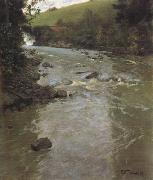 |
Frits Thaulow
|
|
Norwegian Impressionist Painter, 1847-1906
.Norwegian painter and engraver. Originally wanting to become a marine painter he studied at the art academy in Copenhagen (1870-73) as well as with the Danish marine specialist C. F. S?rensen (1818-79). He spent two winters at Karlsruhe (1873-4, 1874-5) as the pupil of Hans Gude and then went to Paris, where he spent much of the period 1875-9. His marines and coastal pictures, some of which were accepted at the Paris Salon, were only moderately successful, but he acquired a fair knowledge of contemporary French Realist art and felt that Norwegian artists should learn from it.
|
|
|
|
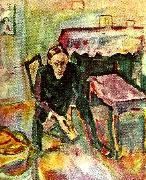 |
friesz
|
|
Achille-Emile Othon Friesz who later called himself just Othon Friesz (6 February 1879 - 10 January 1949), a native of Le Havre, was a French artist of the Fauvist movement.
|
|
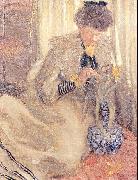 |
Frieseke, Frederick Carl
|
|
American Impressionist Painter, 1874-1939
was an American Impressionist painter. He was born in Owosso, Michigan and studied at the School of the Art Institute of Chicago and the Academie Julian in Paris. Frieseke and his family resided for fourteen years in Giverny, which was also home to Monet. He had a great influence on the Americans at the colony there
|
|
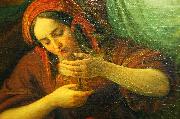 |
Friedrich Wilhelm Schadow
|
|
Friedrich Wilhelm Schadow (7 September 1789 - 19 March 1862) was a German Romantic painter.
He was born in Berlin and was the second son of the sculptor Johann Gottfried Schadow.
In 1806-1807 Friedrich served as a soldier. In 1810 he traveled with his elder brother Rudolph to Rome where he became one of the leaders among painters of the Nazarene movement. Following the example of Johann Friedrich Overbeck and others, he joined the Roman Catholic Church, and held that an artist must believe and live out the truths he essays to paint. The sequel showed that Schadow was qualified to shine more as a teacher and mentor than as a painter. As an author, he is best known for his lecture, Ueber den Einfluss des Christentums auf die bildende Kunst (About The Influence of Christianity On The Visual Arts) (Desseldorf, 1843), and the biographical sketches, Der moderne Vasari (Berlin, 1854).
In Rome, Schadow was given one of his first major commissions when the Prussian Consul-General, General Jakob Salomon Bartholdy, befriended the young painter, and asked him and three young compatriots (Cornelius, Overbeck and Veit) to decorate in fresco a room in his house on the Pincian Hill. The overall theme selected was the story of Joseph and his brethren, and two scenes, the Bloody Coat and Joseph in Prison, were conferred on Schadow. In 1819, Schadow was appointed professor in the prestigious Berlin Academy of the Arts, and his ability and thorough training gained many devoted disciples.
It was during this period that Schadow developed his paintings for churches. In 1826, Professor Schadow was made director of the Desseldorf Academy of the Arts, which he reoriented towards the production of Christian art, though he began a major dispute with one of its professors, Heinrich Christoph Kolbe, ending in the latter leaving the Academy in 1832. In 1837, Schadow selected, at request, those of his students best qualified to decorate the chapel of St Apollinaris on the Rhine with frescoes. When finished, they were acclaimed as the fullest and purest manifestation of the spiritual side of the Desseldorf school. One of his famous students, Heinrich Mucke, carried on the liturgical art with emphasis both in painting and frescoes. The painting of the "Wise and Foolish Virgins," considered one of his masterworks, was commissioned in 1842. Now in the Städel Museum, this large and important picture, while carefully considered and rendered, it however lacks power of some of his other works.
|
|
|
|
 |
Friedrich von Amerling
|
|
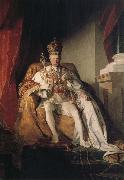
Austrian Academic Painter, 1803-1887,Austrian painter. He came from a family of craftsmen and studied (1815-24) at the Akademie der bildenden Kenste, Vienna, where one of his teachers was the conservative history painter Hubert Maurer (1738-1818). From 1824 to 1826 he attended the Academy in Prague, where he was taught by Josef Bergler. In 1827 and 1828 Amerling stayed in London, and he met the portrait painter Sir Thomas Lawrence, whose work was to be a strong influence on Amerling's painting during the next two decades. Amerling also travelled to Paris and Rome but was recalled to Vienna on an official commission to paint a life-size portrait of the emperor Francis I of Austria (Vienna, Ksthist. Mus.). With this work,
|
|
|
|
|
|
|
|
 |
Friedrich overbeck
|
|
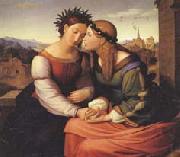
1789-1869
German religious painter. Expelled from the Vienna Academy because of his opposition to its classicism, he went to Rome and with Peter von Cornelius, Veit, Schadow-Godenhaus, and others, formed the group known as the Nazarenes. His first real successes were his frescoes for the Casa Bartholdy (now in Berlin) and for the Villa Massimo. Among his notable paintings are Christ's Entry into Jerusalem and Christ's Agony in the Garden. Overbeck sought to make his art serve religion.
|
|
|
|
 |
friedrich nietzsche
|
|
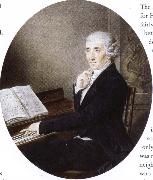
Period: Romantic (1820-1869)
Country: Germany
Born: October 15, 1844 in Röcken
Died: August 25, 1900 in Weimar
|
|
|
|
 |
Friedrich Loos
|
|
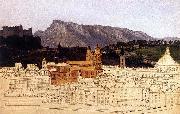
was an Austrian Biedermeier style painter, etcher and lithographer. He was born in Graz on 29 October 1797. He studied at the Vienna Academy with Joseph Mössmer and also went on study tours through the Austrian Alpine regions. From 1835 to 1836 he lived in Vienna, and as of 1846 he sojourned in Rome. He then moved to Kiel, where he worked as a drawing teacher at the university as of 1863 and where he also died on 9 May 1890. In his pictures he emphasized light and color in order to loosen up his painting, as well as to harmonize and unite the details.
|
|
|
|
|
|
 |
Friedrich Herlin
|
|
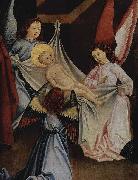
(c. 1425/30 - 1500) was a German painter. His earliest known work, depicting scenes from the Life of the Virgin, is dated 1459. A signature on an altarpiece in Nördlingen, dating it to 1462, identifies him as being from Rothenburg, as do citizenship documents from 1467. Nevertheless, it is possible that he lived there for only a short time, and that his origins lie in Ulm, where a painter named Hans Herlin lived and worked from 1449 until 1468. Stylistically, he borrowed much from Rogier van der Weyden, indicating a great deal of familiarity with the art of the Netherlands and of Cologne. The sculpture attached to the altarpiece of 1462, though officially listed as by the so-called "Master of Nördlingen", has been tentatively ascribed to Nicolaus Gerhaert, which if true would indicate extensive contacts to the highest artistic circles of the era.
Little else is known of Herlin, save that he died in Nördlingen in 1500.
|
|
|
|
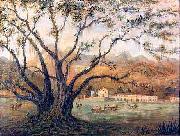 |
Friedrich Hagedorn
|
|
(23 April 1708 - 28 October 1754), German poet, was born at Hamburg, where his father, a man of scientific and literary taste, was Danish minister.
He was educated at the gymnasium of Hamburg, and later (1726) became a student of law at Jena. Returning to Hamburg in 1729, he obtained the appointment of unpaid private secretary to the Danish ambassador in London, where he lived till 1731. Hagedorn's return to Hamburg was followed by a period of great poverty and hardship, but in 1733 he was appointed secretary to the so-called "English Court" (Englischer Hof) in Hamburg, a trading company founded in the 13th century. He shortly afterwards married, and from this time had sufficient leisure to pursue his literary occupations till his death.
Hagedorn is the first German poet who bears unmistakable testimony to the nation's recovery from the devastation wrought by the Thirty Years' War. He is eminently a social poet. His light and graceful love-songs and anacreontics, with their undisguised joie de vivre, introduced a new note into the German lyric; his fables and tales in verse are hardly inferior in form and in delicate persiflage to those of his master La Fontaine, and his moralizing poetry re-echoes the philosophy of Horace. He exerted a dominant influence on the German lyric until late in the 18th century.
The first collection of Hagedorn's poems was published at Hamburg shortly after his return from Jena in 1729, under the title Versuch einiger Gedichte (reprinted by A. Sauer, Heilbronn, 1883). In 1738 appeared Versuch in poetischen Fabeln und Erzählungen; in 1742 a collection of his lyric poems, under the title Sammlung neuer Oden und Lieder; and his Moralische Gedichte in 1750. A collection of his entire works was published at Hamburg in 1757 after his death. The best is J.J. Eschenburg's edition (5 vols., Hamburg, 1800). Selections of his poetry with an excellent introduction in F. Muncker's Anakreontiker und preussisch-patriotische Lyriker (Stuttgart, 1894). See also H. Schuster, F. von Hagedorn und seine Bedeutung fer die deutsche Literatur (Leipzig, 1882); W. Eigenbrodt, Hagedorn und die Erzählung in Reimversen (Berlin, 1884).
|
|
|
|
 |
Friedrich Gauermann
|
|
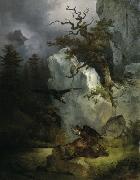
(September 10, 1807 - July 7, 1862), Austrian painter, son of the landscape painter Jacob Gauermann (1773 - 1843), was born at Miesenbach near Gutenstein in Lower Austria.
It was the intention of his father that he should devote himself to agriculture, but the example of an elder brother, who, however, died early, fostered his inclination towards art. Under his father's direction he began studies in landscape, and he also diligently copied the works of the chief masters in animal painting which were contained in the academy and court library of Vienna. In the summer he made art tours in the districts of Styria, Tirol, and Salzburg.
Two animal pieces which he exhibited at the Vienna Exhibition of 1824 were regarded as remarkable productions for his years, and led to his receiving commissions in 1825 and 1826 from Prince Metternich and Caraman, the French ambassador. His reputation was greatly increased by his picture "The Storm," exhibited in 1829, and from that time his works were much sought after and obtained correspondingly high prices. His "Field Labourer" was regarded by many as the most noteworthy picture in the Vienna exhibition of 1834, and his numerous animal pieces have entitled him to a place in the first rank of painters of that class of subjects.
The peculiarity of his pictures is the representation of human and animal figures in connexion with appropriate landscapes and in characteristic situations so as to manifest nature as a living whole, and he particularly excels in depicting the free life of animals in wild mountain scenery. Along with great mastery of the technicalities of his art, his works exhibit patient and keen observation, free and correct handling of details, and bold and clear colouring. He died at Vienna on the 7th of July 1862.
Many of his pictures have been engraved, and after his death a selection of fifty-three of his works was prepared for this purpose by the Austrian Kunstverein (Art Union).
|
|
|
|
 |
Friedrich Carl Groger
|
|
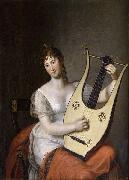
(14 October 1766, Plön - 9 November 1838, Hamburg) was a north-German portrait painter and lithographer. One of the most respected portraitists of his time in northern Germany, his works are to be found in several museums, including the Hamburger Kunsthalle, as well as in north German, Holstein and Danish private collections.
Gröger was the son of a tailor in Plön, where he grew up in modest circumstances. His parents wanted him to become a tailor or wood turner and opposed his early artistic activities. He was largely self taught in painting, though he had some contact in Lebeck with Tischbein and in 1785 was in the city of Lebeck, where he met Heinrich Jacob Aldenrath, his first, loyalest and lifelong friend - the Grögersweg in Hamburg-Barmbek named after him links the Tischbeinstraße with the Aldenrathsweg.
From 1789 he studied at Berlin's Akademie der Kenste. He and Aldenrath then went together to Hamburg, then on a joint study trip to Dresden and Paris, then back to Lebeck, where he worked until 1807. They then alternated between Hamburg, Copenhagen, Kiel and Lebeck, before finally settling in Hamburg in 1814. In 1792 Gröger was made an honorary member of the Gesellschaft zur Beförderung gemeinnetziger Tätigkeit in Lebeck.
Gröger developed from a miniature painter into a portrait painter, who towards the end of his life preferred three quarter bust portraits. Aldenrath took over the miniature painting side of their joint business. After lithography developed in northern Germany, they both worked in this medium individually as well as jointly under the business name Firma Gröger & Aldenrath.
|
|
 |
Friedrich August von Kaulbach
|
|
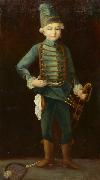
(2 June 1850, Hannover - 26 July 1920, Munich, Germany) was a German portraitist and historical painter. He was the son of Theodor Friedrich Wilhelm Christian Kaulbach (1822 - 1903), the court painter at Hannover, and the great nephew of Wilhelm Kaulbach, another prominent member of the Kaulbach family of artists. He learned to paint from his father, and later was a student of August von Kreling at Nuremberg. He sought to emulate the artist Hans Holbein.
|
|
|
|
 |
Frida Kahlo
|
|
1907-54
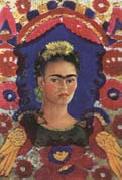
Mexican painter, b. Coyoacen. As a result of an accident at age 15, Kahlo turned her attention from a medical career to painting. Drawing on her personal experiences, her works are often shocking in their stark portrayal of pain and the harsh lives of women. Fifty-five of her 143 paintings are self-portraits incorporating a personal symbolism complete with graphic anatomical references. She was also influenced by indigenous Mexican culture, aspects of which she portrayed in bright colors, with a mixture of realism and symbolism. Her paintings attracted the attention of the artist Diego Rivera, whom she later married. Although Kahlo's work is sometimes classified as surrealist and she did exhibit several times with European surrealists, she herself disputed the label. Her preoccupation with female themes and the figurative candor with which she expressed them made her something of a feminist cult figure in the last decades of the 20th cent.
|
|
|
|
 |
fredrika bremer
|
|
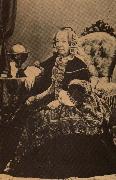
was a Swedish writer and a feminist activist.
Fredrika Bremer was born in Åbo (Turku) in Finland but moved with her family to Stockholm when she was three years old. She grew up in Stockholm and in the manor Årsta outside Stockholm. Her father was described as somewhat of a house tyrant, and her mother was a socialite, and she and her sisters where brought up to marry in to the aristocracy; a trip on the continent 1821-1822 was the finishing touch of her upbringing before her debute.
Bremer was not comfortable with this role, and was inflicted by a crisis, which she overcame by charitable work in the country around Årsta. In 1828, she debuted as a writer, anonomously, with a series of novels published until 1831, and was soon followed by others. Her novels were romantic stories of the time and concentrates on women in the marriage market; either beautiful and superficial, or unattractive with no hope of joining it, and the person telling the story and watching them is often an independent woman. She wanted a new kind of family life, not focused only on the men of the family, that would allow for women to develop their own talents and personality. By the 1840s, she was an acknowledged part of the culture life in Sweden and was translated to many languages. Politically, she was a liberal, but also felt symphaty for the socialism of the English working class movement
|
|
 |
fredrik westin
|
|
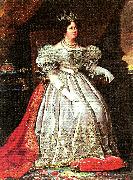
Fredric Westin, född den 22 september 1782 i Stockholm, död 13 maj 1862 i Stockholm, historie- och porträttmålare.
Westin hade varit elev hos Lorens Pasch d.y. och Louis Masreliez på Konstakademien. Sedan han 1808 blivit kallad till akademiens agr?? och förordnad till konduktör vid kungliga museet blev han 1812 invald i Konstakademiens styrelse. Han blev 1815 vice professor och 1816 professor vid Konstakademien. Där var han också 1828-1840 direktör. 1843 utnämndes han till hovintendent.
Till hans tidigare skede och till hans främsta alster hör "Dagens stunder", fyra dörrstycken i Karl Johans sängkammare på Rosersbergs slott med antikiserande figurer: Aurora som strör blommor över jorden, Apollon med sitt fyrspann, Diana följd av Aftonrodnaden samt Natten med sitt stjärnströdda dok (1812-13). På Säfstaholms slott finns "De fyra årstiderna presiderade av jordens gudinna" (1843), på Rosendals slott "Hebe med örnen" (1832) och "Flora bekransande Linn??s byst" (1843) och vid Stockholms universitet "Musiken, föreställd av en grupp unga flickor". Han målade också kompositioner ur den svenska historien ("Olof Skötkonungs dop", "Lutherska lärans antagande").
Westin målade en stor mängd porträtt då han under Karl XIV Johans tid var konstnären på modet. Som porträttmålare var han dock inte enhälligt uppskattad. En kritiker som Silverstolpe beklagade 1809 att en konstnär som "äger så mycken färdighet till stöd för sitt sökande av idealet" sysselsatte sig med en konst av så lågt värde och hoppades att han "måtte återvända från den platta verkliga världen till den poetiska." Hammarsköld menade 1818 att av de svenska konstnärerna var det Westin som hade de ringaste anlagen för porträttmålning. Scholander kallade hans porträtt för "vaxgubbar". Andra hade lovord att fälla över Westins porträtt. Gerss ansåg att Westins porträtt hade likhet och behag i uttrycket, enkelhet i ställning och klädsel, urval av natur i formerna och säkerhet och sanning i utförandet. Wennberg kallade honom "den förste svenske tecknarens Lorenz Paschs så värdige fosterson".
Under Karl XIV Johans tid målade han rad porträtt på kungafamiljen. 1824 målade han en populär allegori över kronprinsessan Josefinas ankomst till Sverige, där Saga i gul och blå dräkt sitter på marken framför en runsten och blickar upp mot skyn där kronprinsessan i röd och vit dräkt svävar ned på en molntapp omgiven av tre amoriner. 1838 målade han Karl XIV Johan till häst på Ladugårdsgärdet hälsande med den trekantiga hatten.
Efter att Sandbergs altartavla för Sankt Jacobs kyrka hade underkänts vände sig de ansvariga till Westin med uppdraget att måla en altartavla. Målningen, "Kristi förklaring" var klar 1828 och resultatet blev både hyllat och kritiserat. Andra altartavlor av Westin finns i Kungsholms kyrka ("Kristi uppståndelse", 1825), Åbo domkyrka ("Kristi förklaring", 1836), Uddevalla kyrka ("Kristus välsignar barnen") samt Carl Gustafs kyrka ("Kristi begravning", 1832).
|
|
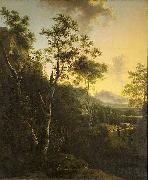 |
Frederik de Moucheron
|
|
(1633-2 January 1686) was a Dutch Golden Age landscape painter.
Frederik de Moucheron was the son of the painter Balthazar de Moucheron and Cornelia van Brouckhoven. His father came from a wealthy family of wine traders and is portrayed as one of the younger sons in the Moucheron Family portrait, 1563. Frederik trained with Jan Asselijn and became a landscape painter. He set off at age 22 for Paris, where he spent 3 years and then after a tour of Antwerp, Paris. and Lyon, he settled in 1659 in Amsterdam. In the same year he married Mariecke de Jouderville there and they had 11 children. He is buried in Amsterdam.
He painted French, Italian, and Dutch landscapes. To finish these scenes, contemporaries specialized in painting figures collaborated with him, such as Adriaen van de Velde in Amsterdam, Theodor Helmbreker in Paris, and at times Johannes Lingelbach, and Nicolaes Pieterszoon Berchem.
|
|
|
|
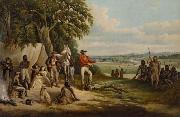 |
Frederick William Woodhouse
|
|
Frederick William Woodhouse
1820-1909
Woodhouse was born in Britain, but is better known as an Australian artist after his move to Australia. He painted images of Bush Life, and made many images from direct observation in sketchbooks and watercolors. He was also Australiaes most important horse racing painter, having painted every Melbourne Cup winner from 1861 until the introduction of the trackside camera. Although horses were his mainstay, Woodhouse also painted dogs, sheep, cattle, landscapes and portraits of persons. Between 1893 and 1894 he made a number of landscapes during a trip to Tasmania.
|
|
|
|
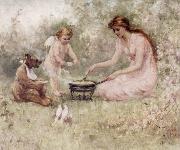 |
Frederick Stuart Church
|
|
Painter , Illustrator and Artist .
American , 1842-1924
was an American artist, working mainly as an illustrator and especially known for his (often allegorical) depiction of animals. He was born in Grand Rapids, Michigan. His father was an important figure in politics as well as a well-known lawyer. At the age of 13 he left school and took a job at the then newly-established American Express Company in Chicago, with his parents intending him to have a business career. Being nineteen at the outbreak of the Civil War he served in the Union Army. After his discharge he returned to Chicago, having decided to devote his life to art, and started studying drawing under Walter Shirlaw at the city's Academy of Design. In 1870 he took the decision to continue his studies in New York City, which became his home for the rest of his life. He enrolled at the National Academy of Design, where he was taught by Lemuel Wilmarth. He joined the Art Students League, headed by his old teacher Walter Shirlaw, in which he remained involved for the rest of his life. Unlike many other Americans of his time who felt themselves to be living in a cultural backwater, Church - while he did think that an artist needed to be formally taught - saw no need to study art in Europe and in fact only crossed the Atlantic late in his life. He often expressed outspoken pride in original American art and declaring that "foreign art" had "little to teach Americans". This might be a reflection of the attitudes taken by the strong nativist movements active during his young age, among other places in Chicago when he lived there.
|
|
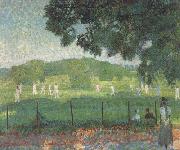 |
Frederick spencer gore
|
|
British. 1878 - 1914.
English painter. He studied at the Slade School of Fine Art, London (1896-9), where he met Harold Gilman, who became a close friend. In 1902 he visited Spain with another Slade contemporary, Wyndham Lewis, and two years later he visited Sickert in Dieppe. From that time on his work was influenced by French art, and Gore learnt much about Degas's paintings through Sickert's teaching. After Sickert's return to London in 1905 Gore frequently accompanied him to music halls and made them the subject of several paintings, for example The Mad Pierrot Ballet, the Alhambra
|
|
|
|
|
|
 |
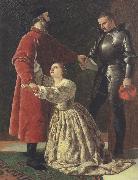
Frederick Sandys
|
|
English Pre-Raphaelite Painter, ca.1829-1904
English painter, illustrator and draughtsman. He was the son of Anthony Sands (1804-83), a minor local artist. He began his artistic education with his father and attended the Norwich School of Design from 1846. His precocious talent was recognized by the award of silver medals by the Society of Arts in 1846 and 1847. He moved to London in 1851, when he first exhibited at the Royal Academy, but he continued to spend time at Norwich until the death of his parents in 1883. After publishing in 1857 A Nightmare, a gentle caricature of John Ruskin and his Pre-Raphaelite proteg's William Holman Hunt, John Everett Millais and Dante Gabriel Rossetti and based on Millais's Sir Isumbras at the Ford
|
|
 |
Frederick richard pickersgill,R.A.
|
|
1820-1900
was an English painter and book illustrator. Born into a family of artists, he was admitted to the Royal Academy Schools in 1840. He did some book illustrations for the works of John Milton and Edgar Allan Poe. Pickersgill's The Burial of Harold was accepted as a decoration for the Houses of Parliament in 1847. He also did some landscapes under the influence of the Pre-Raphaelites. In 1856 Pickersgill was photographed at 'The Photographed Institute' by Robert Howlett, as part of a series of portraits of 'fine artists'.
|
|
 |
Frederick Remington
|
|
1861-1909
Frederic Sackrider Remington (October 4, 1861 - December 26, 1909) was an American painter, illustrator, sculptor, and writer who specialized in depictions of the Old American West, specifically concentrating on the last quarter of the 19th century American West and images of cowboys, American Indians, and the U.S. Cavalry.
Remington was the most successful Western illustrator in the ??Golden Age?? of illustration at the end of the 19th Century and the beginning of the 20th Century, so much so that the other Western artists such as Charles Russell and Charles Schreyvogel were known during Remington??s life as members of the ??School of Remington??. His style was naturalistic, sometimes impressionistic, and usually veered away from the ethnographic realism of earlier Western artists such as George Catlin. His focus was firmly on the people and animals of the West, with landscape usually of secondary importance, unlike the members and descendants of the Hudson River School, such as Frederic Edwin Church, Albert Bierstadt, and Thomas Moran, who glorified the vastness of the West and the dominance of nature over man. He took artistic liberties in his depictions of human action, and for the sake of his readers?? and publishers?? interest. Though always confident in his subject matter, Remington was less sure about his colors, and critics often harped on his palette, but his lack of confidence drove him to experiment and produce a great variety of effects, some very true to nature and some imagined.
His collaboration with Owen Wister on The Evolution of the Cowpuncher, published by Harper??s Monthly in September 1893, was the first statement of the mythical cowboy in American literature, spawning the entire genre of Western fiction, films, and theater that followed. Remington provided the concept of the project, its factual content, and its illustrations and Wister supplied the stories, sometimes altering Remington??s ideas. (Remington??s prototype cowboys were Mexican rancheros but Wister made the American cowboys descendants of Saxons??in truth, they were both partially right, as the first American cowboys were both the ranchers who tended the cattle and horses of the American Revolutionary army on Long Island and the Mexicans who ranched in the Arizona and California territories).
|
|
|
|
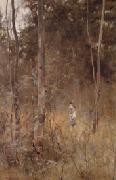 |
Frederick Mccubbin
|
|
Australian Painter, 1855-1917
By the early 1880s, his work began to attract considerable attention and won a number of prizes from the National Gallery, including a 30-pound first prize in 1883 in their annual student exhibition, and by the mid-1880s began to concentrate more on the works of the Australian bush which made him most famous. In 1883, he received first prize in the first annual Gallery students' exhibition, for best studies in colour and drawing. In 1888, he became instructor and master of the School of Design at the National Gallery. In this position he taught a number of students who themselves became prominent Australian artists, including Charles Conder and Arthur Streeton. He continued to paint through the first two decades of the 20th century, though by the beginning of World War I his health began to fail. He travelled to England in 1907 and visited Tasmania, but aside from these relatively short excursions lived most of his life in Melbourne. McCubbin married Annie Moriarty in March, 1889. They had seven children, of whom their son Louis also became an artist. In 1901 McCubbin and his family moved to Mount Macedon, where he was inspired by the surrounding bush and has experimented with the light and its effects on colour in nature. In 1912,
|
|
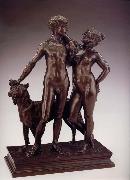 |
Frederick Macmonnies
|
|
American Sculpture 1863-1937,American sculptor and painter. During his apprenticeship in New York (1880-84) with Augustus Saint-Gaudens, who discovered and encouraged his talent, he rose from menial helper to assistant, studying in the evenings at Cooper Union and the National Academy of Design. Through Saint-Gaudens he met two architects who later became invaluable colleagues: Stanford White and Charles F. McKim, who lent him money in 1884 to go to Paris. He studied drawing at Colarossi's then went to Munich, attending drawing and portrait classes at the Akademie (1884-5) and worked for Saint-Gaudens again (1885-6). In Paris he studied sculpture with Alexandre Falguiere at the Ecole des Beaux-Arts,
|
|
|
|
 |
Frederick Leighton
|
|
1830-1896
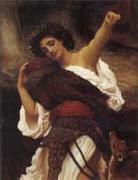
He was an English painter and sculptor. His works depicted historical, biblical and classical subject matter. Leighton was born in Scarborough to a family in the import and export business. He was educated at University College School, London. He then received his artistic training on the European continent, first from Eduard Von Steinle and then from Giovanni Costa. When in Florence, aged 24, where he studied at the Accademia di Belle Arti, he painted the procession of the Cimabue Madonna through the Borgo Allegri. He lived in Paris from 1855 to 1859, where he met Ingres, Delacroix, Corot and Millet. Flaming JuneIn 1860, he moved to London, where he associated with the Pre-Raphaelites. He designed Elizabeth Barrett Browning's tomb for Robert Browning in the English Cemetery, Florence in 1861. In 1864 he became an associate of the Royal Academy and in 1878 he became its President (1878?C96). His 1877 sculpture, Athlete Wrestling with a Python, was considered at its time to inaugurate a renaissance in contemporary British sculpture, referred to as the New Sculpture. His paintings represented Britain at the great 1900 Paris Exhibition. Icarus and DaedalusLeighton was knighted at Windsor in 1878, and was created a baronet eight years later. He was the first painter to be given a peerage, in the New Year Honours List of 1896.
|
|
|
|
|
|
|
|
|
|
|
| Wholesale China Oil Painting Wholesale Oil Painting China Xiamen Portrait Reproduction on canvas Chinese Oil Painting Wholesale USA Oil Painting |
|
|
|
|
|