| |
|
Xiamen Oil Paintings, Wholesale Direct!
|
|
100% hand painted, 100% cotton canvas, 100% money back if not satisfaction. |
|
|
|
|
ART WORKS INDEX
A
B
C
D
E
F
G
H
I
J
K
L
M
N
O
P
Q
R
S
T
U
V
W
X
Y
Z
|
|
ARTISTS INDEX
A
B
C
D
E
F
G
H
I
J
K
L
M
N
O
P
Q
R
S
T
U
V
W
X
Y
Z
|
|
|
|
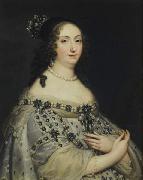 |
Justus van Egmont
|
|
Justus van Egmont (Leiden, 22 September 1601 - Antwerp, 8 January 1674) was a Dutch Golden Age painter and designer of tapestry.
Justus van Egmont moved to Antwerp at age 14 with his family where he became apprenticed to the painter Caspar van den Hoecke (ca. 1585 - ca 1648). In 1618, three years later, he undertook a Grand Tour to Italy in the manner of other artists of his day. This was considered a necessary rite of passage for artists after Karel van Mander published his Schilderboeck in 1604.
|
|
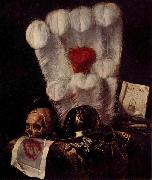 |
Juriaen van Streeck
|
|
(1632 - 1687) was a Dutch Golden Age painter of still lifes.
According to Houbraken, he was good at all sorts of still life subjects, including helmets, books, letters, musical instruments, and skulls or dead animals to indicate the transcience of life.
He was a follower of Willem Kalf and influenced Barend van der Meer.Houbraken also wrote an entry for his son Hendrick van Streeck, who became a student of Emanuel de Witte and painted church interiors.
|
|
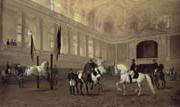 |
Julius von Blaas
|
|
1845-1923,was an Italian painter, the second son of Karl, born at Albano, Italy. He studied under his father, devoted himself principally to equestrian subjects, and went to Rome where he painted genre scenes from the Campagna. His "Race of Intoxicated Slavonic Peasants" (1869) is in the Imperial Museum of Vienna, as is "Antlassritt" (1899). Julius von Blaas was much employed by the Austrian court as a portrait painter and became professor in the Academy of Vienna.
|
|
|
|
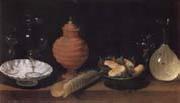 |
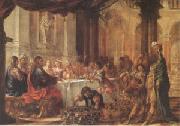
Juan van der Hamen y Leon
|
|
Spanish Baroque Era Painter, 1596-1631, was a Spanish painter, a master of the still life paintings, also called bodegones. During his lifetime, he was prolific and versatile, painting allegories, landscapes, and large-scale works for churches and convents. However, today he is remembered mostly for his still lifes. In the 1620s, He popularized still life painting in Madrid.Juan van der Hamen y (Gemez de) Leen was born in Madrid in 1596 but he was baptized late on April 8, 1596 in Madrid, therefore, he must had been born there just days before that date. He was the son of Jehan van der Hamen, a Flemish courtier, who had moved to Madrid from Brussels before 1586, and Dorotea Whitman Gemez de Leen, a half-Flemish mother of noble Toledan ancestry [1]. Van der Hamen and his two brothers Pedro and Lorenzo (both of whom were writers) emphasized their Spanish roots by using all or part of their maternal grandmother's family name, Gemez de Leen.. The painter's father, Jan van der Hamen, had come to Spain, as an archer, to the court of Philip II were he settled, married, and his children were born. According to 18th-century sources, the artist's father had also been a painter, but there is no evidence for this. Juan van der Hamen inherited his father's honorary positions at court and also served as unsalaried painter of the king. Van der Hamen's artistic activity in the service of the crown is first recorded on 10 September 1619, when he was paid for painting a still-life for the country palace of El Pardo, to the north of Madrid.
|
|
 |
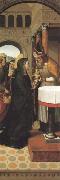
Juan de Valdes Leal
|
|
Seville 1622-1690
was a Spanish painter of the Baroque era. He was born at Seville in 1622, and distinguished himself as a painter, sculptor, and architect. He worked for a time under Antonio del Castillo. Among his works are a History of the Prophet Elias for the church of the Carmelites; a Martyrdom of St. Andrew for the church of San Francesco at Cerdoba; and a Triumph of the Cross for la Caridad at Seville. He was one of the founders of the Seville Academy along with his friend, Bartolome Esteban Murillo. He died at Seville. His wife (daughter of Antonio Palomino), Isabella Carasquilla, was also a painter. She died at Seville as late as 1730. Their children were artists, including Lucas, Juan, Maria, and Laura de Valdes. His daughters specialized in portrait miniatures.
|
|
 |
Juan Correa de Vivar
|
|
Spanish , c.1510-1566
was a Spanish painter,Correa's date of birth has been determined to be around 1510. Records show he grew up wealthy. When Juan was 17 or 18 years old he joined an artist workshop in Burgundy where he met with many other Spanish artists at the time, including Pedro de Cisneros whom he befriended. Juan's brother Eufrasia and Eufrasia's son Rodrigo also grew up to be artists. Rodrigo was apprenticed with his uncle, and continued some of his uncle's works after his death. In Mascaraque, Juan was a substantial landowner with a nice house where he did much of his painting. He took frequent trips but always stayed in the Toledo area. Juan was married and a religious man. It can be seen in his testament: a copy was found in the church files of Mascaraque. When he died, Juan split all his possessions between his nephew Rodrigo and the church of Mascaraque. Juan was a well-regarded painter during his life, but many records were lost. His works and life were brought to light again when the researcher and art historian Ceen Bermudez in 1800 published a dictionary of famous artists and included a brief article about his works and Italian influences. The full reconstruction of its biography has been primarily accomplished in the 20th century. Records show Juan died on April 16, 1566 in San Miguel. Juan's body was taken back to Mascaraque where he was buried, in the same plot where his parents were laid to rest. Many members of the artistic community came to the funeral service,
|
|
 |
Joseph von Fuhrich
|
|
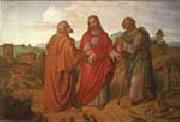
(February 9, 1800 - March 13, 1876), Austrian painter, was born at Kratzau in Bohemia. Also known as Josef Ritter von F??hrich.
Deeply impressed as a boy by rustic pictures adorning the wayside chapels of his native country, his first attempt at composition was a sketch of the Nativity for the festival of Christmas in his father's house. He lived to see the day when, becoming celebrated as a composer of scriptural episodes, his sacred subjects were transferred in numberless repetitions to the roadside churches of the Austrian state, where humble peasants thus learnt to admire modern art reviving the models of earlier ages.
Fehrich has been fairly described as a Nazarene, a romantic religious artist whose pencil did more than any other to restore the old spirit of D??rer and give new shape to countless incidents of the gospel and scriptural legends. Without the power of Cornelius or the grace of Overbeck, he composed with great skill, especially in outline. His mastery of distribution, form, movement and expression was considerable. In its peculiar way his drapery was perfectly cast.
|
|
 |
Joseph Vivien
|
|
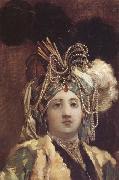
(1657 - 5 December 1735) was a French painter of Lyon.
He left his native Lyon for Paris at the age of twenty and found employment in the large atelier of Charles Le Brun, the equivalent of an academy. He made his reputation by his portraits in pastels, to which he gave a sparkle and immediacy hitherto unreached in that medium.
He was received in the Academie royale de peinture et de sculpture in 1701, under the designation peintre en pastel. He was appointed counsellor to the Academy and provided lodging under royal auspices at the royal manufactory of the Gobelins.
From Paris he visited Brussels. Vivien was taken up by the francophil Elector of Cologne and worked at Munich, as first painter to the Elector's brother, Maximilian Emmanuel, Elector of Bavaria.
|
|
|
|
|
|
 |
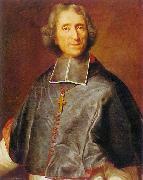
Joseph Marie Vien
|
|
French Neoclassical Painter, 1716-1809
French painter, draughtsman and engraver. He was one of the earliest French painters to work in the Neo-classical style, and although his own work veered uncertainly between that style and the Baroque, Vien was a decisive influence on some of the foremost artists of the heroic phase of Neo-classicism, notably Jacques-Louis David, Jean-Fran?ois-Pierre Peyron, Joseph-Benost Suve and Jean-Baptiste Regnault, all of whom he taught. Both his wife, Marie-Therese Reboul (1738-1805), and Joseph-Marie Vien fils (1762-1848) were artists: Marie-Therese exhibited at the Salon in 1757-67
|
|
|
|
|
|
 |
Joris van Son
|
|
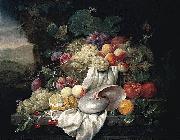
1623-1667) was a highly popular Flemish Baroque painter of fruit and flowers, in banquet style on a plank, but also in garland form.
He seems to have been influenced by Jan Davidszoon de Heem, since his subjects follow his style quite closely. According to Houbraken his paintings were prized for preserving summer plenty in the middle of winter. In a poem by Cornelis de Bie, it is written that his fruits would tempt a pregnant woman. His paintings hang in many european museums, and the Dutch RKD has over 70 known works by him on record. He signed his works JORIS VAN SON. His students were Frans van Everbroeck, Jan Pauwel Gillemans II, and Norbert Montalie.
|
|
 |
Joris van der Haagen
|
|
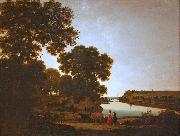
(ca. 1615 - The Hague, 23 May 1669 (buried)) was a Dutch Golden Age painter specialized in landscapes.
Contents
It is unclear where Joris van der Haagen was born, either in Arnhem or Dordrecht, but archival evidence shows that he started his drawing career in Arnhem. He probably learned to paint from his father, the painter Abraham van der Haagen. When his father died he moved in 1639 to the Hague, where he joined the Guild of St. Luke in 1643. A year later he became honorary citizen of The Hague. In 1656 he was one of the founding members of the Confrerie Pictura, which was located on the Princessegracht in the Hague. The painting he made of the Princessegracht at this time probably shows the original building, which has since been renovated beyond recognition.
|
|
 |
Joos van Winghe
|
|
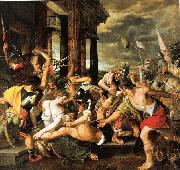
(1544, Brussels - 1603, Frankfurt), was a Flemish Renaissance painter.
According to Karel van Mander he was born in Brussels in 1544 and travelled to Rome where he lived with a Cardinal for four years. When he returned to Brussels he became court painter to the Prince of Parma until he left the country in 1584 as a consequence of the Fall of Antwerp. He settled in Frankfurt and his place at Parma's court was taken by Otto van Veen. He died in 1603, aged 61. Van Mander mentions several pieces by his hand in Brussels, Frankfurt, and Amsterdam.
According to the RKD who spent four years travelling in Rome, Parma, and Paris before returning to Brussels in 1568. In 1585 he moved to Frankfurt, where he became a citizen (burgher) in 1588 and stayed. He was the father of the painter Jeremias van Winghe, and is known for portraits and genre works, as well as book title pages.
|
|
 |
Joos van Ghent
|
|
Netherlandish Northern Renaissance Painter, active ca.1460-1480
|
|
 |
Joos van Craesbeeck
|
|
(c. 1605/06- c. 1660) was a Flemish painter who specialized in tavern interiors, tronies, and other works similar to his teacher Adriaen Brouwer. Born in Neerlinter (Flemish Brabant), he became a master in Antwerp's guild of St. Luke in 1633?C1634, and like his contemporaries David Teniers the Elder and David Rijckaert III he developed rustic genre scenes. He subsequently moved to Brussels, where he joined that city's painters' guild in 1651.
Paintings such as Death is Violent and Fast are typical of his small, theatrical images of peasants brawling crowded with violent expressive figures. Unlike Teniers, whose style became more elegant, Craesbeeck continued to paint bawdy figures later in his career.
|
|
|
|
|
|
|
|
 |
John Vanderlyn
|
|
1775-1852
John Vanderlyn (October 18, 1775 ?C September 23, 1852) was a American neoclassicist painter, was born at Kingston, New York.
He was employed by a print-seller in New York, and was first instructed in art by Archibald Robinson (1765-1835), a Scotsman who was afterwards one of the directors of the American Academy. He went to Philadelphia, where he spent time in the studio of Gilbert Stuart and copied some of Stuart's portraits, including one of Aaron Burr, who placed him under Gilbert Stuart as a pupil.
He was a proteg?? of Aaron Burr who in 1796 sent Vanderlyn to Paris, where he studied for five years. He returned to the United States in 1801 and lived in the home of Burr, then the Vice President, where he painted the well-known likeness of Burr and his daughter. In 1802 he painted two views of Niagara Falls, which were engraved and published in London in 1804. He returned to Paris in 1803, also visiting England in 1805, where he painted the Death of Miss McCrea for Joel Barlow. Vanderlyn then went to Rome, where he painted his picture of Marius amid the Ruins of Carthage, which was shown in Paris, and obtained the Napoleon gold medal there. This success caused him to remain in Paris for seven years, during which time he prospered greatly. In 1812 he showed a nude Ariadne (engraved by Durand, and now in the Pennsylvania Academy), which increased his fame. When Aaron Burr fled to Paris, Vanderlyn was for a time his only support.
Vanderlyn returned to the United States in 1815, and painted portraits of various eminent men, including Washington (for the U.S. House of Representatives), James Monroe, John C. Calhoun, Governor Joseph C. Yates, Governor George Clinton, Andrew Jackson, and Zachary Taylor. He also exhibited panoramas and had a "Rotunda" built in New York City which displayed panoramas of Paris, Athens, Mexico, Versailles (by himself), and some battle-pieces; but neither his portraits nor the panoramas brought him financial success, partly because he worked very slowly.
In 1842, through friendly influences, he was commissioned by Congress to paint The Landing of Columbus. Going to Paris, he hired a French artist, who, it is said, did most of the work. It was engraved for the United States five-dollar banknotes. He died in poverty at Kingston, New York, on 23 September 1852.
Vanderlyn was the first American to study in France instead of in England, and to acquire accurate draughtsmanship. He was more academic than his fellows; but, though faithfully and capably executed, his work was rather devoid of charm, according to the 1911 Encyclopaedia Britannica. His Landing of Columbus has been called (by Appleton's Cyclopedia) "hardly more than respectable."
His other works include portraits of Monroe, and Robert R Livingston (New York Historical Society).
|
|
 |
John Vanderbank
|
|
John Vanderbank (9 September 1694 - 23 December 1739) was an English portrait painter and book illustrator, who enjoyed a high reputation for a short while during the reign of King George I, but who died relatively young due to an intemperate and extravagant lifestyle.
Vanderbank was born in London, the eldest son of John Vanderbank Snr. His father was a Huguenot tapestry weaver, born in Paris, but who was forced to flee to Holland before coming to England where he became head of a Soho tapestry weaving factory.
Vanderbank studied under Sir Godfrey Kneller at James Thornhill's art academy in Great Queen Street from 1711 until 1720, when he joined with Louis Cheron to found his own academy in St. Martin's Lane. The venture proved a failure, and in 1729 he went to France to avoid his creditors. On his return he entered "the liberties of the Fleet" - mansion houses near Fleet prison, London, in which certain privileged prisoners could serve out their sentences in return for payment.
It was noted by George Vertue that "only intemperance prevented Vanderbank from being the greatest portraitist of his generation." He died of Tuberculosis in Holies Street, Cavendish Square, London, on 23 Dec. 1739, aged about 45, and was buried in Marylebone church.
|
|
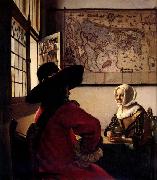 |
Johannes Vermeer
|
|
One of the most talented painters in the Dutch Golden Age , 1632-1675
was a Dutch Baroque painter who specialized in exquisite, domestic interior scenes of ordinary life. Vermeer was a moderately successful provincial genre painter in his lifetime. He seems never to have been particularly wealthy, perhaps because he produced relatively few paintings, leaving his wife and children in debt at his death. Vermeer worked slowly and with great care, using bright colours, sometimes expensive pigments, with a preference for cornflower blue. He is particularly renowned for his masterly treatment and use of light in his work. What strikes in most of his paintings is a certain love, which easily could be called a love sickness, for the people and the objects in his paintings. He created a world more perfect than any he had witnessed. After having been virtually forgotten for nearly one hundred years,
|
|
 |
Johannes van Wijckersloot
|
|
Johan Hendriksz Van Wijckersloot (1557- 1602)
Born in Utrecht, Utrecht, Netherlands on 20 Oct 1557 to Hendrick Roelofsz Van Wijckersloot and Antonia Gosina Van Benthem. He passed away on 27 Jul 1602 in Utrecht, Utrecht, Netherlands
|
|
 |
Johannes Cornelisz Verspronck
|
|
(between 1600 and 1603, Haarlem - buried June 30, 1662, Haarlem) was a gifted Dutch Golden Age portraitist.
He was the son of the painter Cornelis Engelsz from Gouda, who taught him to paint portraits. In 1632 he became a member of the Haarlem Guild of St. Luke and started a successful career as a portraitist of mostly Catholic sitters in Haarlem. He may have been a Frans Hals pupil, and was strongly influenced by him, especially in his natural expressions and relaxed poses. He is best known for his exactness in painting details such as jewelry and lace, which made him quite popular with female sitters. Most notably, he won a lucrative commission in 1642 for a group portrait of the regentesses of the St. Elisabeth Gasthuis, at the time the wealthiest charity institution in Haarlem. This was won at the expense of Frans Hals himself, who had painted the regents of the St. Elisabeth Gasthuis in 1641 and fully expected to win the commission for the women.
|
|
 |
Johann Wolfgang von Goethe
|
|
Frankfurt 1749-1832 Weimar,was a German writer and according to George Eliot, "Germany's greatest man of letters and the last true polymath to walk the earth." Goethe's works span the fields of poetry, drama, literature, theology, humanism and science. Goethe's magnum opus, lauded as one of the peaks of world literature, is the two-part drama Faust. Goethe's other well-known literary works include his numerous poems, the Bildungsroman Wilhelm Meister's Apprenticeship and the epistolary novel The Sorrows of Young Werther. Goethe was one of the key figures of German literature and the movement of Weimar Classicism in the late 18th and early 19th centuries; this movement coincides with Enlightenment, Sentimentality (Empfindsamkeit), Sturm und Drang and Romanticism. The author of the scientific text Theory of Colours, he influenced Darwin with his focus on plant morphology. He also served at length as the Privy Councilor ("Geheimrat") of the duchy of Weimar. Goethe is the originator of the concept of Weltliteratur ("world literature"), having taken great interest in the literatures of England, France, Italy, classical Greece, Persia, Arabic literature, amongst others. His influence on German philosophy is virtually immeasurable, having major effect especially on the generation of Hegel and Schelling, although Goethe himself expressly and decidedly refrained from practicing philosophy in the rarefied sense. Goethe's influence spread across Europe, and for the next century his works were a major source of inspiration in music, drama, poetry and philosophy. Goethe is considered by many to be the most important writer in the German language and one of the most important thinkers in Western culture as well.
|
|
|
|
 |
Johann Georg von Dillis
|
|
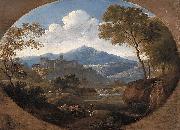
(born Gmain, December 26, 1759 - died Munich, September 28, 1841) was a German painter. Son of a gamekeeper and forester, he was educated in Munich with support from the prince-elector of Bavaria. Initially he was trained for the priesthood, but by 1786 his real interest, art, was beginning to be developed, and he taught drawing both at court and to private families. In 1790 he was appointed inspector of the Hofgarten Galerie, the princely collection. He continued in a curatorial role for the Bavarian court for much of the rest of his career; this allowed him some freedom to travel and expand his knowledge of European art. In 1792 he traveled to Dresden, Prague, and Vienna, and in 1794 he made his first trip to Italy, where he made watercolor studies from nature. A further trip to Italy followed in 1805, and brought him to Rome, where he met Pierre-Henri de Valenciennes, who introduced him to the idea of painting in open air. He studied the work of Simon Denis and Joseph Mallaord William Turner, and encountered Washington Allston. The next year, in Paris, he saw oil sketches by Jean-Joseph-Xavier Bidauld, and with Ludwig, the crown prince visited the Musee Napoleon; he would later advise the prince on collecting and other matters artistic, remaining in this capacity for the rest of his life. He also made several trips to Italy to purchase art for the royal collection. In 1816 he was made responsible for packing and returning to Munich from Paris art stolen from Bavaria by Napoleon. In the fall of 1817 he and Ludwig traveled to Sicily before spending four months in Rome. Dillis helped to shape the collections of the Alte Pinakothek, which opened in 1836. He died in Munich in 1841.
|
|
|
|
 |
Jochem de Vries
|
|
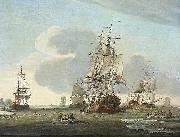
painted The Zaandam shipping company Claes Tan en Zns Greenland farer Zaandam whaling in 1772
|
|
 |
Joachim von Sandrart
|
|
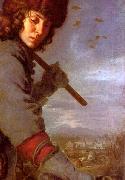
(12 May 1606 - 14 October 1688) was a German Baroque art-historian and painter, active in Amsterdam during the Dutch Golden Age.
Sandrart was born in Frankfurt, but the family originated from Mons. According to Houbraken (who used his Teutsche Akademie as a primary source), he learned to read and write from the son of Theodor de Bry, Johann Theodoor de Brie and his associate Matthäus Merian, but at age 15 was so eager to learn more of the art of engraving, that he walked from Frankfurt to Prague to become a pupil of Gillis Sadelaar (also known as Aegidius Sadeler of the Sadeler family). Sadelaar in turn urged him to paint, whereupon he travelled to Utrecht in 1625 to become a pupil of Gerrit van Honthorst, and through him he met Rubens when he brought a visit to Honthorst in 1627, to recruit him for collaboration on part of his Marie de' Medici cycle. Honthorst took Sandrart along with him when he travelled to London. There he worked with Honthorst and spent time making copies of Holbein portraits for the portrait gallery of Henry Howard, 22nd Earl of Arundel.
Making all of those copies only served to arouse more curiosity in the young adventurer, and in 1627 Sandrart booked a passage on a ship from London to Venice, where he was welcomed by Jan Lis (whose Bentvueghels bent name was "Pan"), and Nicolaas Ringnerus. He then set out for Bologna, where he was met by his cousin on his father's side Michael le Blond, a celebrated engraver. With him, he crossed the mountains to Florence, and from there on to Rome, where they met Pieter van Laer (whose bent name was "Bamboccio"). Sandrart became famous as a portrait-painter. After a few years he undertook a tour of Italy, traveling to Naples, where he drew studies of Mount Vesuvius, believed to be the entrance to the Elysian fields described by Virgil. From there he traveled to Malta and beyond, searching for literary sights to see and paint, and wherever he went he paid his way by selling portraits. Only when he was done traveling did he finally return to Frankfurt, where he married Johanna de Milkau.
Afraid of political unrest and plague, he moved to Amsterdam with his wife in 1637.
|
|
 |
Jeronymus van Diest
|
|
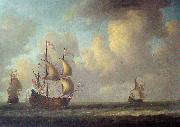
(1631, The Hague - ca.1687, The Hague), was a Dutch Golden Age seascape painter.
According to Houbraken, a Jeronymus van Diest was good with grisailles and was the teacher of Adriaen van de Venne.[1] This grisaille painter Jeronymus Diest (I) may possibly have been a grandfather of the younger Jeronymus Diest (II); since they are both from the Hague.
According to the RKD this younger Jeronymus Diest (II) was the son of the painter Willem van Diest and the father of the painter Adriaen van Diest who was a follower of Jan van Goyen and Hendrik Dubbels.His known works are all seascapes with various ships at sail.
|
|
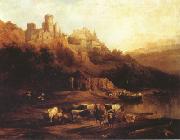 |
Jenaro Perez Villaamil
|
|
1807-1854
was born in Ferrol, Galicia. He was a remarkable painter and prime example of the Galician Romantic Movement. In his work, particularly in his landscapes, he shows an unmistakable taste for the English painters of the same period. Most of his paintings are exhibited at Museo del Prado in Madrid, the city where he died.
|
|
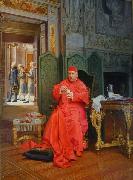 |
Jehan Georges Vibert
|
|
Jehan Georges Vibert (30 September 1840 - 28 July 1902) was a French academic painter.
He was born in Paris. He began his artistic training at a young age under the instruction of his maternal grandfather, engraver Jean-Pierre-Marie Jazet. Vibert was more interested in painting than engraving and entered the studio of Felix-Joseph Barrias and eventually the École des Beaux-Arts when he was sixteen. He remained at the École for six years under the instruction of historic painter François-Edouard Picot.
Vibert debuted at the Salon of 1863 with La Sieste (The Siesta) and Repentir (Repentance).
During the Franco-Prussian War, Vibert became a sharpshooter and was wounded at the battle of Malmaison in October 1870. He was awarded the Legion deHonneur and became a Chevalier de la Legion deHonneur in recognition of his sacrifice. He became an Officer of the Legion deHonneur in 1882.
|
|
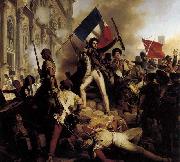 |
Jean-Victor Schnetz
|
|
1787-1870,was a French academic painter well-regarded for his historical and genre paintings. Schnez studied in Paris under Jacques-Louis David. His works can be found at the Louvre and the Petit Palais in Paris, the Hermitage in St. Petersburg, and the Museum of Fine Arts in San Francisco. In 1837 Schnetz was elected to the Academie des Beaux-Arts, and he was twice the Director of the French Academy in Rome, from 1841-1846 then again in 1853-1866
|
|
|
|
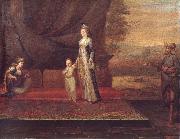 |
Jean-Baptiste Van Mour
|
|
17th Century Painters of the Bosporus,was a Flemish-French painter, remembered for his detailed portrayal of life in the Ottoman Empire during the Tulip Era and the rule of Sultan Ahmed III. Van Mour was a native of Valenciennes, a Flemish town that at he time of his birth belonged to the Spanish Netherlands, but since 1678 to France. He studied art in the studio of Jacques-Albert Gerin, and his work attracted the attention of an aristocrat and statesman of the time, Marquis Charles de Ferriol. Van Mour was invited to go to Istanbul when De Ferriol was appointed there as the French Ambassador in 1699. De Ferriol commissioned van Mour to do one hundred portraits of the local people. In 1711 De Ferriol returned to France and van Mour worked for a variety of other diplomats. In the meantime De Ferriol published a series of one hundred engravings (after the paintings) in Recueil de cent estampes representant differentes nations du Levant. The book had a great influence in Western Europe and was published in at least five languages. Painting audiences with the Sultan became van Mour's speciality; he only had to change the setting and a few faces. Van Mour worked with assistants to fulfill all his obligations. In 1725 he was granted the extraordinary title of Peintre Ordinaire du Roy en Levant in recognition of both his and the Levant's importance to the French government. In 1727 the Dutch ambassador Cornelis Calkoen asked Van Mour to record his audience with Sultan Ahmed III on canvas. Van Mour was allowed to enter the palace during these ceremonies accompanying the ambassador and his retinue; therefore, he was familiar with the special protocol that prevailed in the Ottoman court for ambassador's receptions. Calkoen took many paintings of Jean-Baptiste van Mour with him, when he was appointed as ambassador in Dresden for the Dutch Republic. In his will of 1762 the bachelor Calkoen forbade his heirs to sell the paintings, which are now part of the Rijksmuseum collection.
|
|
|
|
 |
Jean Joseph Vaudechamp
|
|
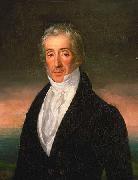
(1790 - 1866) was a French painter born in Rambervillers, Vosges. He was a pupil of Anne-Louis Girodet de Roussy-Trioson. The market in Paris was competitive, so in the winter of 1831 - 32, he went to try his fortunes in New Orleans, Louisiana. The Louisiana Creole people identified with French culture and selected Vaudechamp to paint portraits for them. Over the next ten years he spent winters in New Orleans, and was a leading portrait painter in the region. He died at Neuilly-sur-Seine in 1866.
|
|
 |
Jean Baptiste van Loo
|
|
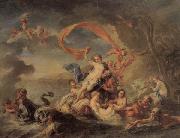
Flemish Painter, 1684-1745
was a French subject and portrait painter. He was born in Aix-en-Provence, and was instructed in art by his father Louis-Abraham van Loo, son of Jacob van Loo. Having at an early age executed several pictures for the decoration of the church and public buildings at Aix, he was employed on similar work at Toulon, which he was obliged to leave during the siege of 1707. He was patronized by the prince of Carignan, who sent him to Rome, where he studied under Benedetto Luti. Here he was much employed on church pictures, and in particular executed a greatly praised Scourging of Christ for St Maria in Monticelli. At Turin he painted Charles Emmanuel II, Duke of Savoy and several members of his court. Then, moving to Paris, where he was elected a member of the Acad??mie Royale de Peinture et de Sculpture, he executed various altar-pieces and restored the works of Francesco Primaticcio at Fontainebleau. In 1737 he went to England, where he attracted attention by his portrait of Colley Cibber and of Owen McSwiny, the theatrical manager; the latter, like many other of van Loo's works, was engraved in mezzotint by John Faber Junior. He also painted Sir Robert Walpole, whose portrait by van Loo in his robes as chancellor of the exchequer is in the National Portrait Gallery, London, and the prince and princess of Wales. He did not, however, practise long in England, for his health failing he retired to Paris in 1742, and afterwards to Aix, where he died on 19 December 1745.
|
|
 |
JanVermeer
|
|
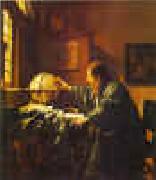
1632-1675
Johannes (or Jan) Vermeer is now recognized as one of the great Dutch painters, but while he was alive he could barely make ends meet, and his artistic achievement was almost entirely ignored for 200 years after his death. Little is known about his personal life, other than he died poor and young and left behind a wife and eleven children. Vermeer is admired for his realistic style, his subtle use of color and light and his unusual and inventive brush technique, but fewer than forty of his paintings exist. His most famous works include domestic scenes such as Girl With a Peal Earring (1665) and The Music Lesson (1662-65), and tranquil landscapes such as The Little Street (1657-58) and View of Delft (1659-60).
Although his actual birth and death dates are unknown, Vermeer was baptized 31 October 1632 and buried 15 December 1675... During his career he used the names Johannes van der Meer, Johannes Vermeer and Jan Vermeer... He was played by actor Colin Firth in the 2003 film Girl With A Pearl Earring, which also starred Scarlett Johansson as the girl.
|
|
 |
Janssens van Ceulen
|
|
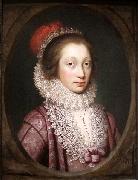
Cornelis Janssens van Ceulen (also Cornelius Jonson van Ceulen, Cornelius Johnson, Cornelis Jansz. van Ceulen and many other variants) (bapt. October 14, 1593, London - bur. August 5, 1661, Utrecht) was an English painter of portraits of Dutch or Flemish parentage. He has been described as "one of the most gifted and prolific portrait painters practising in England during the 1620s and 1630s".
|
|
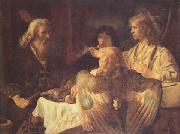 |
Jan victors
|
|
Dutch Baroque Era Painter, ca.1619-1676
was a Dutch Baroque painter that focused mainly on painting subject from the Bible. He was a student of Rembrandt van Rijn.
|
|
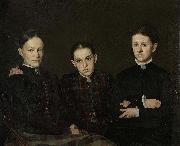 |
Jan Veth
|
|
(18 May 1864 Dordrecht - 1 July 1925 Amsterdam), was a Dutch painter, poet, art critic and university lecturer.
Jan Veth was the son of Gerradus Huibert Veth, a Dordrecht iron merchant and liberal politician, and Anna Cornelia Giltay. On his mother's side he descended from the Dordrecht painter family of Van Strij (his mother was a granddaughter of Jacob van Strij). He married Anna Dorothea Dirks on 10 August 1888, from which marriage came five children.
Veth received his art education at the Rijksakademie voor Beeldende Kunsten in Amsterdam. With several of his fellow students he founded the St. Luke group. From 1885 he worked with the painter Anton Mauve in Laren. After his marriage in 1888 he settled in Bussum.
Jan Veth is especially noted as a portrait painter. Amongst his sitters were Max Liebermann, Lambertus Zijl, Frank van der Goes, Antoon Derkinderen and other contemporaries including various fellow painters.
In addition he was a well-known poet, belonging to the Eighties movement and publishing work in the De Nieuwe Gids. He designed the cover for "De Kleine Johannes", a book written by his friend, Frederik van Eeden, contributing to the development of book-art in Holland.
As Professor Extraordinary in History of Art and Aesthetics, he was associated with the Rijksakademie voor Beeldende Kunsten in Amsterdam.
|
|
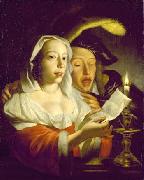 |
Jan Vermeer van Utrecht
|
|
(bapt. 16 February 1630, Schipluiden - c. 1696, Vreeswijk), was a Dutch Golden Age painter. Though he was born near Delft, there is no known relation between this painter and Johannes Vermeer.
His father died when he was 10 and he was raised by his step-grandfather in Rotterdam. According to Houbraken he travelled to Italy with Lieve Verschuier and became friends with Willem Drost and Johann Carl Loth.
He returned North in 1662, where he became member of the Utrecht Guild of St. Luke in 1663 and became deacon of the guild 1664-1666.Houbraken tells a curious story about Vermeer van Utrecht in his biography of Jan Davidsz de Heem. In this story, on his return from Italy, Vermeer marries a widow who owns a white lead factory. He is wealthy and has a carefree life until his wife dies and then his factory is burned by French soldiers. He manages to save a garland painting by De Heem that he once paid 2000 guilders for. This was an enormous sum of money, but Houbraken mentions that his grandfather had been a wealthy man, and until his factory was destroyed, Vermeer van Utrecht had been painting for pleasure, rather than professionally. The amount is meant as an indication of the fame and esteem of De Heem, rather than the wealth of Vermeer van Utrecht. Vermeer van Utrecht then applies to his benefactor, Frederick Nassau de Zuylestein, to give him a government post in return for this painting, which he offers to paint with the likeness of the young prince Willem III in the middle of the garland. The lord of Zuylestein was the governor of the young prince from 1659 to 1666, so this deal must have been done sometime between 1662 (Vermeer van Utrecht's return from Italy), and 1672 (the death of the lord of Zuylestein). Apparently, the deal is done, and several years pass, in which Vermeer van Utrecht did become an appointed member of the Utrecht regency (Vroedschap), but where he felt like a fifth wheel. In 1672 the Utrecht council takes pity on him, and gave him the post of Toll-collector and controller of the river lock at Vreeswijk, where he later remarried.
|
|
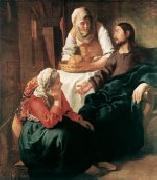 |
Jan Vermeer
|
|
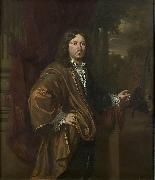
Dutch Baroque Era Painter, 1632-1675
Johannes (or Jan) Vermeer is now recognized as one of the great Dutch painters, but while he was alive he could barely make ends meet, and his artistic achievement was almost entirely ignored for 200 years after his death. Little is known about his personal life, other than he died poor and young and left behind a wife and eleven children. Vermeer is admired for his realistic style, his subtle use of color and light and his unusual and inventive brush technique, but fewer than forty of his paintings exist. His most famous works include domestic scenes such as Girl With a Peal Earring (1665) and The Music Lesson (1662-65), and tranquil landscapes such as The Little Street (1657-58) and View of Delft (1659-60). Although his actual birth and death dates are unknown, Vermeer was baptized 31 October 1632 and buried 15 December 1675... During his career he used the names Johannes van der Meer, Johannes Vermeer and Jan Vermeer
|
|
 |
Jan Verkolje
|
|
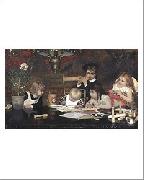
(Amsterdam, baptized on 27 February 1650 - Delft, 8 May 1693) was a Dutch Golden Age painter and engraver, often called Jan I to distinguish him from his son Jan II. He is known for his portraits and genre pieces.
|
|
 |
Jan Verhas
|
|
(9 January 1834-31 October 1896) was a genre painter and is considered the founder of the School of Dendermonde, best known for his paintings of children of the Belgian bourgeoisie, in a classical style but with a natural feeling to them. Born in Dendermonde as the younger brother of painter Frans Verhas, he studied at the Academy of Dendermonde and the Academy in Antwerp, finishing with the Belgian Prix de Rome in 1860. The Belgian government commissioned him to travel to Venice where he made the painting "Velleda et la Bataille de Callao" in 1862. The next four years, he lived in Binche, where he married. He then moved to Brussels. Verhas was a regular of the Salons of the time, winning a second class medal in the Paris Salon Exposition of 1881, and a gold medal at the 1889 Exposition Universelle. He was made a Chevalier in the Legion of Honor in 1881. Jan Verhas died in Schaarbeek in 1896.
Paintings by Jan Verhas can be seen at the Museum of Fine Arts in Ghent, the Royal Museum of Fine Arts, Antwerp and the City Hall of Dendermonde.
|
|
|
|
|
|
|
|
|
| Wholesale China Oil Painting Wholesale Oil Painting China Xiamen Portrait Reproduction on canvas Chinese Oil Painting Wholesale USA Oil Painting |
|
|
|
|
|