| |
|
Xiamen Oil Paintings, Wholesale Direct!
|
|
100% hand painted, 100% cotton canvas, 100% money back if not satisfaction. |
|
|
|
|
ART WORKS INDEX
A
B
C
D
E
F
G
H
I
J
K
L
M
N
O
P
Q
R
S
T
U
V
W
X
Y
Z
|
|
ARTISTS INDEX
A
B
C
D
E
F
G
H
I
J
K
L
M
N
O
P
Q
R
S
T
U
V
W
X
Y
Z
|
|
|
|
|
|
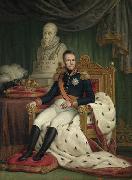 |
Mattheus Ignatius van Bree
|
|
was a Belgian painter, sculptor and architect.
He was born at Antwerp in 1773, was instructed by Regemorter; he afterwards went to Paris, and after having obtained by a 'Cato in Utica' the second prize for Rome, he went to that city in 1797e returning to his native country in 1804.[1] He painted numerous historical pictures, some of which are of large dimensions, and obtained a high reputation in Flanders. His conceptions are frequently poetical, and his compositions graceful, delineated with a light, free, and spirited pencil ; but his colouring is rather too florid in some instances.
He was first professor at the Academy of Fine Arts at Antwerp, and in 1827 its director. Member of several other scientific institutions like the academies of Amsterdam, Rome, Munich and New York. Among his most important works are 'The Patriotism of the Burgomaster Van der Werft,' in the Town-Hall at Leyden, and 'The Death of Rubens,' in the Museum at Antwerp. He brought forward some of the most eminent of the later Flemish painters, among whom are Wappers, De Keyser, F. de Braekeleer, and others of whom their country is justly proud. Van Bree died at Antwerp in 1839.
|
|
|
|
|
|
|
|
|
|
|
|
|
|
|
|
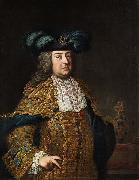 |
Martin van Meytens
|
|
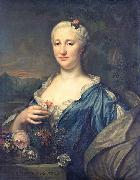
(June 24, 1695 - March 23, 1770) was a Swedish-Austrian painter who painted members of the royal Court of Austria such as Marie Antoinette, Maria Theresa of Austria, Francis I, Holy Roman Emperor, the Emperor's family and others. His painting style has inspired many other painters to paint in a similar format.
|
|
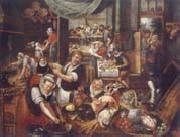 |
Marten van Cleve
|
|
Flemish, 1527-1581,Brother of Hendrik van Cleve III. His presumed date of birth is derived from a document of 2 April 1567 in which he declared his age to be 40. In 1551-2 he became a master in the Antwerp Guild of St Luke and, according to van Mander, followed his brother into the studio of Frans Floris. If this is correct, it was probably c. 1553-5, for motifs drawn from Floris's work appear in Marten van Cleve's paintings executed during these years. Marten married Maria de Greve on 7 January 1556, apparently setting up his own studio at about the same time. Apprentices are regularly recorded from 1558 onwards, and it is probable that his own sons, Gillis II, Marten the younger, Joris and Nicolaas, also worked in the studio. Throughout the 1560s and 1570s Marten van Cleve's workshop was very productive, but the majority of works painted consisted of copies of his own originals. Van Mander's statement that the artist collaborated with a number of landscape painters, including his brother Hendrik III, Gillis van Coninxloo III, Gillis Mostaert and Jacob Grimmer, is confirmed by 17th-century inventories.
|
|
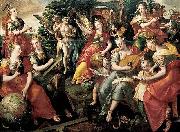 |
Marten de Vos
|
|
(1532-1603), also Maarten, was a leading Antwerp painter and draughtsman in the late sixteenth century.
|
|
|
|
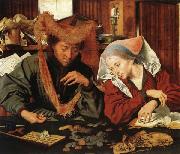 |
Marinus van Reymerswaele
|
|
Flemish Northern Renaissance Painter, ca.1490-1567
South Netherlandish painter. He has been identified with Marino di Sirissea and with Marinus de Seeu, painter of Romerswaelen, mentioned respectively by Guicciardini and van Mander. He could quite possibly have been Moryn Claessone, native of Zeeland, who enrolled as a pupil of 'Simon the glassmaker' in the Antwerp Guild of St Luke in 1509. In that case he would have been born c. 1490-95. Claes van Ziericsee, an artist who became master of the Guild in 1475, is assumed to have been his father though this cannot be proved conclusively. Van Reymerswaele's work corresponds closely with Antwerp painting of the beginning of the 16th century
|
|
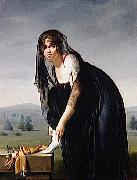 |
Marie-Denise Villers
|
|
(1774 - August 19, 1821) was a French painter, who specialized in portraits. She was born Marie-Denise Lemoine in Paris. She came from an artistic family, and her sisters Marie-Victoire Lemoine and Marie-Élisabeth Gabiou were also accomplished artists. In 1794, Marie-Denise married an architecture student, Michel-Jean-Maximilien Villers.
Villers was a student of the French painter Anne-Louis Girodet de Roussy-Trioson. She was first exhibited at the Paris Salon of the Year VII (1799). Villers' most famous painting, Young Woman Drawing,
|
|
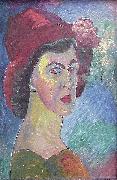 |
Marianne von Werefkin
|
|
Marianne von Werefkin (Russian, 10 September 1860, Tula, Russia - 6 February 1938, Ascona, Switzerland), born Marianna Wladimirowna Werewkina (transliteration Marianna Vladimirovna Verevkina), was a Russian-Swiss Expressionist painter.
Marianne von Werefkin was born the daughter of the commander of the Ekaterinaburg Regiment. In 1880, she became a student of Ilya Repin, the most important painter of Russian Realism. Her progress was dealt a setback by a hunting accident in 1888 in which she shot her right hand, the one with which she painted.
In 1892 she met Alexej von Jawlensky, who desired to be her protege, and in 1896 she, Jawlensky, and their servant moved to Munich. For the sake of Jawlensky's painting, Werefkin interrupted her painting for almost ten years.
She created her first expressionist works in 1907. In these she followed Paul Gauguin's and Louis Anquetin's style of "surface painting", while also showing the influence of Edvard Munch. In 1909, the Neue Kenstlervereinigung Menchen (New Association of Artists in Munich, NKVM) was founded. It became a forum of exhibitions and programming.
At the outbreak of the First World War, they immigrated to Switzerland, near Geneva. They later moved to Zurich. By 1918, they had separated, and Werefkin moved alone to Ascona, on Lago Maggiore. In 1924 she founded the artist group "Grober Bar" (i.e., Big Bear, Ursa Major).
|
|
 |
Maria Vos
|
|
painted Stilleven met kan van steengoed in 1878
|
|
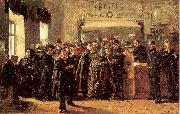 |
Makovsky, Vladimir
|
|
Russian, 1846-1920
Painter, brother of Konstantin Makovsky. He studied at the Moscow School of Painting, Sculpture and Architecture from 1861 to 1866 under Sergey Zaryanko and other artists. From 1872 Makovsky was a member of the WANDERERS (Peredvizhniki). In his early pictures, Makovsky usually portrayed contemporary manners and morals in a spirit of gentle irony, as in the Lovers of Nightingales (1872-3; Moscow, Tret'yakov Gal.). Such works reveal Makovsky's skill in defining precisely and carefully the role of each figure in the scene. In the mid-1870s Makovksy began to concentrate on the central theme of most of his subsequent work: the glaring social contrasts of Russian life.
|
|
|
|
 |
Maerten van heemskerck
|
|
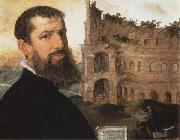
Dutch Northern Renaissance Painter, 1498-1574
Dutch painter, draughtsman and print designer. He was among the second generation of Netherlandish artists to travel to Italy, where he was profoundly affected by the work of contemporary artists in Rome and by the examples of Classical sculpture to be seen in the city (see ROMANISM). On his return to the north, van Heemskerck had a long and successful career. His extensive oeuvre (over 100 paintings) comprises large altarpieces, portraits and smaller works (with both religious and mythological subjects). He also produced a vast number of drawings for prints. He helped spread the influence of Michelangelo and Giulio Romano in the northern Netherlands, through his strong, monumental style, with much emphasis on anatomical detail. He was thus an important figure in the dissemination of late Mannerism in northern Europe
|
|
|
|
 |
Maarten van Heemskerck
|
|
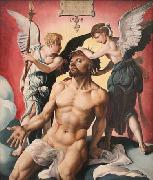
(1498 - 1 October 1574) was a Dutch portrait and religious painter, known for his depictions of the Seven Wonders of the World.
He was born at Heemskerk, North Holland, halfway between Alkmaar and Haarlem.
His father was a small farmer, Jacob Willemsz. van Veen (whose portrait he painted). According to his biography, written by Karel van Mander, he was apprenticed to Cornelis Willemsz in Haarlem. Recalled after a time to the paternal homestead and put to the plough or the milking of cows, young Heemskerk took the first opportunity that offered to run away, and demonstrated his wish to leave home for ever by walking in a single day the 80 km which separate his native hamlet from the town of Delft. There he studied under Jan Lucasz whom he soon deserted for his contemporary Jan van Scorel of Haarlem. Even today, many of Heemskerck's paintings are mistaken for work by van Scorel. He boarded at the home of the wealthy Pieter Jan Foppesz (the van Mander spelling is Pieter Ian Fopsen), curate of the Sint-Bavokerk. He knew him because he owned a lot of land in Heemskerck. This is the same man whom he painted in a now famous family portrait, considered the first of its kind in a long line of Dutch family paintings.
|
|
 |
Ludwig Vogel
|
|
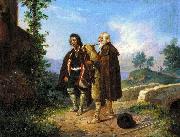
(1788-1879) was a Swiss painter.
This article was initially translated from the German Wikipedia.
|
|
 |
ludwig van beethoven
|
|
Born: December 1770
Birthplace: Bonn, Germany
Died: 26 March 1827 (cirrhosis of the liver, plus dropsy)
Best Known As: The composer of Beethoven's Fifth
|
|
|
|
|
|
|
|
 |
lucas van valchenborch
|
|
Lucas van Valkenborch (also "Valckenborch," "Valkenborgh") (c. 1535, Leuven - February 2, 1597, Frankfurt am Main), was a member of a family of Flemish landscape and genre painters.
|
|
 |
Lucas van Uden
|
|
(18 October 1595 - 4 November 1672) was a Flemish Baroque painter specializing in landscapes.
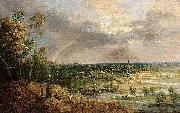
Lucas van Uden was born in Antwerp, where he entered the guild of St. Luke in 1626-27. Although he was never part of Peter Paul Rubens's studio, his works are partly indebted to that master. Van Uden even made copies of Rubens's works on several occasions. His technique, however, owes as much to earlier painters like Joos de Momper and Jan Brueghel the Elder. General characteristics are a tonally-green recessive view punctuated by slender trees and populated by incidental pastoral and peasant figures. Many of Van Uden's figures were either copied from Rubens or painted by David Teniers the Younger. He is often associated with fellow landscape painter Jan Wildens.
|
|
 |
Lucas van Leyden
|
|
1489-1533 Dutch Lucas van Leyden Galleries Lucas van Leyden (Leiden, 1494 ?C August 8, 1533 in Leiden), also named either Lucas Hugensz or Lucas Jacobsz, was a Dutch engraver and painter, born and mainly active in Leiden, who was among the first Dutch exponents of genre painting and is generally regarded as one of the finest engravers in the history of art. He was the pupil of his father, from whose hand no works are known, and of Cornelis Engelbrechtsz, but both of these were painters whereas Lucas himself was principally an engraver. Where he learnt engraving is unknown, but he was highly skilled in that art at a very early age: the earliest known print by him (Mohammed and the Murdered Monk) dates from 1508, when he was perhaps only 14, yet reveals no trace of immaturity in inspiration or technique. Lot and his daughters (ca. 1509)In 1514 he entered the Painters' Guild at Leiden. He seems to have travelled a certain amount, and visits are recorded to Antwerp in 1521, the year of D??rer's Netherlandish journey, and to Middelburg in 1527, when he met Jan Mabuse. An unbroken series of dated engravings makes it possible to follow his career as a print-maker and to date many of his paintings, but no clear pattern of stylistic development emerges. D??rer was the single greatest influence on him, but Lucas was less intellectual in his approach, tending to concentrate on the anecdotal features of the subject and to take delight in caricatures and genre motifs. Carel van Mander characterizes Lucas as a pleasure-loving dilettante, who sometimes worked in bed, but he left a large oeuvre, in spite of his fairly early death, and must have been a prodigious worker. Lucas had a great reputation in his day (Vasari even rated him above D??rer) and is universally regarded as one of the greatest figures in the history of graphic art (he made etchings and woodcuts as well as engravings and was a prolific draughtsman). His status as a painter is less elevated, but he was undoubtedly one of the outstanding Netherlandish painters of his period. He was a pioneer of the Netherlandish genre tradition, as witness his Chess Players (Gemäldegalerie, Berlin) which actually represents a variant game called 'courier' - and his Card Players (National Gallery of Art, Washington), while his celebrated Last Judgement triptych (Lakenhal Museum, Leiden, 1526-27) shows the heights to which he could rise as a religious painter. It eloquently displays his vivid imaginative powers, his marvellous skill as a colourist and his deft and fluid brushwork.
|
|
|
|
|
|
 |
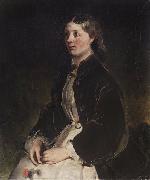
Louis Michel van Loo
|
|
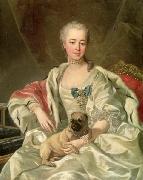
Louis-Michel van Loo (2 March 1707-20 March 1771) was a French painter.
He studied under his father, the painter Jean-Baptiste van Loo, at Turin and Rome, and he won a prize at the Academie Royale de Peinture et de Sculpture in Paris in 1725. With his uncle, the painter Charles-Andre van Loo, he went to Rome in 1727 - 1732, and in 1736 he became court painter to Philip V of Spain at Madrid, where he was a founder-member of the Academy in 1752. He returned to Paris in 1753, and painted many portraits of Louis XV of France. In 1765 he succeeded Charles-Andre as director of the special school of the French academy known as the Ecole Royale des Eleves Proteges. In 1766 he made the portrait of the Portuguese statesman Sebastiao de Melo, Marquis of Pombal.
Among his brothers were the painters Francois van Loo (1708 - 1732) and Charles-Amedee-Philippe van Loo (1719 - 1795).
|
|
 |
Louis Ferdinand von Rayski
|
|
Ferdinand von Rayski (1806 - 1890) was a German painter noted for his portraits.
Rayski was born in 1806 in Pegau. From 1816 to 1821 he studied drawing under Traugott Faber at the Freimaurerinstitut in Dresden and from 1823 to 1825 studied at Kunstakademie in Desseldorf. He began his career as a professional artist in 1829, painting portraits of his noble relatives in Hannover and Silesia. From 1831 to 1834 he lived in Dresden, where he received numerous portrait commissions. He traveled to Paris in 1834-35, and was influenced by the works of Delacroix, Gericault and Gros. Rayski gained a reputation as a distinguished portrait painter, but also produced animal and hunting scenes, as well as, yet less frequently, military, historical and mythological paintings. He lived in Dresden from 1840 until his death in 1890.
|
|
|
|
|
|
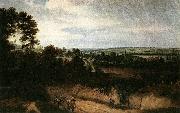 |
Lodewijk de Vadder
|
|
Lodewijk de Vadder (1605, Grimbergen - 1655, Brussels) was a Flemish Baroque landscape painter and engraver.
He became a master of Antwerp's Guild of St. Luke in 1628, and learned painting from his father and brothers. He specialized in landscapes with woods, in the manner of his contemporary Jacques d'Arthois and his pupil Lucas Achtschellinck[1]. They are usually referred to collectively as "The Sonian Forest Painters".
|
|
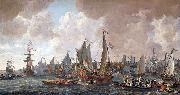 |
Lieve Verschuier
|
|
(1627-1686) was a Dutch Golden Age painter of maritime subjects.
He was born in Rotterdam, and is documented in Amsterdam in 1651, where he possibly learned to paint from Simon de Vlieger. He traveled to Rome in 1653 as a young man with Jan Vermeer van Utrecht and became friends with Willem Drost and Johann Carl Loth.. On his return he settled in Rotterdam in 1667 where he remained, painting marine scenes, and Italianate landscapes.
His maritime works are valued today for their historical value illustrating the art of shipbuilding in the 17th century.
|
|
|
|
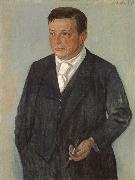 |
Leopold Graf Von Kalckreuth
|
|
1855-1928,German painter and etcher. The son of the late Romantic landscape painter Eduard Stanislaus, Graf von Kalckreuth (1820-94), he studied from 1875 to 1878 under Ferdinand Schauss (1832-1916), Willem Linnig (1819-85) and Alexander Struys (1852-1941) at the Kunstschule in Weimar founded by his father. In 1879, after military service, he enrolled at the Akademie in Munich, where he attended Gyula Benczer's drawing classes and continued his study of painting under Karl Theodor von Piloty and Wilhelm von Diez (1839-1907). In 1883 he travelled to the Netherlands and then to Italy and France. In 1885 he accepted a teaching appointment at the Kunstschule in Weimar, but in 1890 he resigned and returned to Munich. During the next five years he worked at Heckricht in Silesia (now Jedrzychowice, Poland), perfecting his oil technique. In 1892 he was a founder-member of the Munich Secession. Kalckreuth's work from this period reflects the influence of several contemporaries; the portrait of the Artist's Wife of 1888 (Leipzig, Mus. Gesch.) recalls the portraits of Franz von Lenbach and Max Liebermann, while the visionary element brought to the genre scene Rainbow (1894-6; Munich, Neue Pin.) is close to the work of Fritz von Uhde.
|
|
 |
Leonardo Da Vinci
|
|
Italian High Renaissance Painter and Inventor, 1452-1519
Florentine Renaissance man, genius, artist in all media, architect, military engineer. Possibly the most brilliantly creative man in European history, he advertised himself, first of all, as a military engineer. In a famous letter dated about 1481 to Ludovico Sforza, of which a copy survives in the Codice Atlantico in Milan, Leonardo asks for employment in that capacity. He had plans for bridges, very light and strong, and plans for destroying those of the enemy. He knew how to cut off water to besieged fortifications, and how to construct bridges, mantlets, scaling ladders, and other instruments. He designed cannon, very convenient and easy of transport, designed to fire small stones, almost in the manner of hail??grape- or case-shot (see ammunition, artillery). He offered cannon of very beautiful and useful shapes, quite different from those in common use and, where it is not possible to employ cannon ?? catapults, mangonels and trabocchi and other engines of wonderful efficacy not in general use. And he said he made armoured cars, safe and unassailable, which will enter the serried ranks of the enemy with their artillery ?? and behind them the infantry will be able to follow quite unharmed, and without any opposition. He also offered to design ships which can resist the fire of all the heaviest cannon, and powder and smoke.
The large number of surviving drawings and notes on military art show that Leonardo claims were not without foundation, although most date from after the Sforza letter. Most of the drawings, including giant crossbows (see bows), appear to be improvements on existing machines rather than new inventions. One exception is the drawing of a tank dating from 1485-8 now in the British Museum??a flattened cone, propelled from inside by crankshafts, firing guns. Another design in the British Museum, for a machine with scythes revolving in the horizontal plane, dismembering bodies as it goes, is gruesomely fanciful.
Most of the other drawings are in the Codice Atlantico in Milan but some are in the Royal Libraries at Windsor and Turin, in Venice, or the Louvre and the École des Beaux Arts in Paris. Two ingenious machines for continuously firing arrows, machine-gun style, powered by a treadmill are shown in the Codice Atlantico. A number of other sketches of bridges, water pumps, and canals could be for military or civil purposes: dual use technology.
Leonardo lived at a time when the first artillery fortifications were appearing and the Codice Atlantico contains sketches of ingenious fortifications combining bastions, round towers, and truncated cones. Models constructed from the drawings and photographed in Calvi works reveal forts which would have looked strikingly modern in the 19th century, and might even feature in science fiction films today. On 18 August 1502 Cesare Borgia appointed Leonardo as his Military Engineer General, although no known building by Leonardo exists.
Leonardo was also fascinated by flight. Thirteen pages with drawings for man-powered aeroplanes survive and there is one design for a helicoidal helicopter. Leonardo later realized the inadequacy of the power a man could generate and turned his attention to aerofoils. Had his enormous abilities been concentrated on one thing, he might have invented the modern glider.
|
|
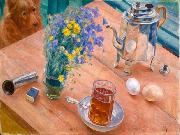 |
Kuzma Sergeevich Petrov-Vodkin
|
|
(1878, Khvalynsk, now Saratov OblasteFebruary 15, 1939, Leningrad) was an important Russian and Soviet painter and writer.
Kuzma Petrov-Vodkin was born in Khvalynsk (Saratov Oblast) into the family of a local shoemaker. His first exposure to art was in his early childhood, when he took some lessons from a couple of icon painters and a signmaker. Still, Petrov-Vodkin didn't quite see himself in art at that time; after graduating from middle school, he took a summer job at a small shipyard with plans to get into railroad college in Samara. After failing his exam, he turned to "Art Classes of Fedor Burov" in 1893.
In April 1895, Burov died and for some time Petrov-Vodkin took different painting jobs in the vicinity of Saratov. By chance, his mother's employer invited a well-known architect, R. Meltzer. Petrov-Vodkin was introduced to the guest and impressed him enough to get an invitation to study art at Saint Petersburg. The education was financed by a charitable subscription among local merchants. He also met at this time Borisov-Musatov, an important painter resident in Saratov, who encouraged Petrov-Vodkin to continue his studies.
Petrov-Vodkin stayed in Saint Petersburg from 1895 to 1897 studying at the Baron Stieglits School, before moving to the Moscow School of Painting, Sculpture and Architecture. There Petrov-Vodkin was a student of Valentin Serov, Isaak Levitan and especially Konstantin Korovin. In 1901 he travelled to Munich to take classes with Anton Ažbe.
He graduated in 1904.
|
|
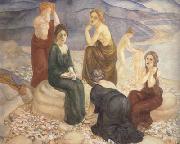 |
Kuzma Petrov-Vodkin
|
|
Russian Painter, 1878-1939
Russian painter. He began his studies in the drawing and painting classes of F. Burov (1843-95) in Samara (1893-5), and he attended Baron Stieglitz's school in St Petersburg from 1895 to 1897. He studied under Abram Arkhipov, Nikolay Kasatkin and Valentin Serov at the Moscow School of Painting, Sculpture and Architecture from 1897 to 1905 and at Anton Azb?'s school in Munich (1901). After working in various private studios in Paris between 1905 and 1908, he travelled to Constantinople (now Istanbul), Greece and Italy in 1905 and to Algiers in 1906. On his return to Russia, he held an exhibition in the editorial offices of the magazine Apollon in St Petersburg (1909). From 1911 to 1924 he exhibited with the WORLD OF ART group and from 1925 to 1928 with the FOUR ARTS SOCIETY OF ARTISTS. From the early 1910s Petrov-Vodkin's work was influential in the artistic life of St Petersburg. He attempted to reconcile classical and modern trends. His style was formed under a wide range of influences, often seemingly incompatible: 19th-century Russian painters such as Aleksey Venetsianov,
|
|
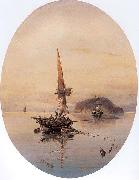 |
Konstantinos Volanakis
|
|
(Greek, b. Heraklion, Crete, 1837- d. 29 June 1907) was a Greek painter, considered one of the best of the 19th century. Born to a wealthy family, he went to Trieste, Italy, in 1856 where he took up painting. He studied in the Munich Academy. He is one of the foremost representatives of the Munich School, a Greek artistic movement of the 19th century. Michalis Oikonomou, another Greek painter, was one of his pupils.
He died in 1907. His works are today exhibited in major museums in Greece and abroad.
|
|
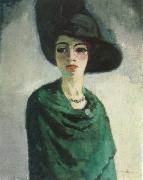 |
kees van dongen
|
|
kees van dongen,(1877 to 1968),French painter and printmaker of Dutch birth. He took evening classes in geometric drawing from 1892 to 1897 at the Akademie voor Beeldende Kunsten in Rotterdam. In 1895 he began working intermittently for the newspaper Rotterdamsche Nieuwsblad, for which he made, among other things, a series of bright watercolour drawings of Rotterdams red-light district and illustrations of Queen Wilhelminas coronation. Van Dongen first paintings used dark tones in imitation of Rembrandt, who remained the most important model for his work; his later book on Rembrandt was, in fact, a projection of his own life. By the mid-1890s he was using more vivid contrasts of black and white, for example in Spotted Chimera (1895; priv. col., see Chaumeil, pl. 1), his palette soon becoming brighter and his line more animated. In Le Muet Windmill (1896; priv. col., see Chaumeil, pl. 7), a red ochre monochrome painting, he successfully enlivened the colour by means of broad, energetic brushstrokes.
|
|
 |
Karl von Piloty
|
|
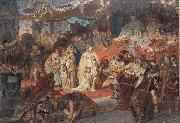
Karl Theodor von Piloty (1 October 1826 - 21 July 1886) was a German painter.
Von Piloty was born in Munich. His father, Ferdinand Piloty (d. 1844), enjoyed a great reputation as a lithographer. In 1840, Karl was admitted as a student of the Munich Academy, under the artists Karl Schorn and Julius Schnorr von Karolsfeld. After a journey to Belgium, France and England, he commenced work as a painter of genre pictures, and in 1853 produced a work, Die Amme (The Wet Nurse), which, on account of its originality of style, caused a considerable sensation in Germany at the time.
But he soon forsook this branch of painting in favour of historical subjects, and produced in 1854 for King Maximilian II The Accession of Maximilian I to the Catholic League in 1609. It was succeeded by Seni at the Dead Body of Wallenstein (1855), which gained for the young painter the membership of the Munich Academy, where he succeeded Schorn (his brother-in-law) as professor.
Among other well-known works by Piloty are the Battle of the White Mountain near Prague, Nero Dancing upon the Ruins of Rome (1861), Godfrey of Bouillon on a Pilgrimage to the Holy Land (1861), Galileo in Prison (1864) and The Death of Alexander the Great (unfinished), his last great work. He also executed a number of mural paintings for the royal palace in Munich.
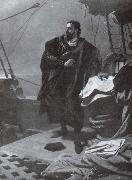
For Baron von Schach, he painted the famous Discovery of America. In 1874, he was appointed keeper of the Munich Academy, being afterwards ennobled by the king of Bavaria. Piloty was the foremost representative of the realistic school in Germany. He was a successful teacher, and among his more famous pupils were Hans Makart, Franz von Lenbach, Franz Defregger, Gabriel von Max, Georgios Jakobides and Eduard von Gretzner.
|
|
 |
Karl Theodor von Piloty
|
|
German, 1826-1886,German painter. He received his first training from his father, the lithographer Ferdinand Piloty (1786-1844). In 1838 Piloty entered the Munich Akademie der Bildenden Kenste and from 1840 became a pupil of Julius Schnorr von Carolsfeld. Piloty had to manage the family business after his father's death in 1844, but in 1846 he returned to the Akademie as a pupil of Karl Schorn (1801-50). His artistic development was influenced by the work of the Antwerp artist Louis Gallait (1810-87), the heightened colour and multi-figure compositions in whose history paintings especially impressed him. Besides his study of Old Masters, especially Veronese and Rubens, he was influenced by French history painters like Paul Delaroche and Horace Vernet. His history painting Seni by the Body of Wallenstein (1855; Munich, Neue Pin.) was an enormous success, allowing him to take a leading role in the art life of Munich. In 1860 he was ennobled.
|
|
|
|
 |
Karel van Mander
|
|
Dutch Mannerist Writer and Painter, 1548-1606
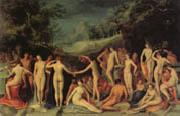
was a Flemish-born Dutch painter and poet, who is mainly remembered as a biographer of Netherlandish artists. As an artist he played an important role in Northern Mannerism in the Netherlands. He was born of a noble family at Meulebeke in modern West Flanders. He studied under Lucas de Heere at Ghent, and in 1568-1569 under Pieter Vlerick at Kortrijk. The next five years he devoted to the writing of religious plays for which he also painted the scenery. Then followed three years in Rome (1574-1577), where he is said to have been the first to discover the catacombs. On his return journey he passed through Vienna, where, together with the sculptor Hans Mont, he made the triumphal arch for the royal entry of the emperor Rudolph. In 1583 he settled in Haarlem where he lived and worked for 20 years on a commission by the city fathers to inventory "their" art collection; work that he later published in his "Schilder-boeck" (see below). While in Haarlem he continued to paint, concentrating his energy on his favorite genre: historical allegories. In 1603 he retired to the castle of Sevenbergen in Heemskerk to proofread his book that was published in 1604.
|
|
 |
Justus van Gent
|
|
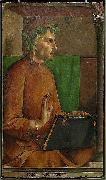
(or Joos van Wassenhove), Justus or Jodocus of Ghent, or Giusto da Guanto (c. 1410 - c. 1480) was an Early Netherlandish painter who later worked in Italy.
The public records of the city of Ghent have been diligently searched, but in vain, for a clue to the history of Justus or Jodocus, whom Vasari and Guicciardini called Giusto da Guanto. Flemish annalists of the 16th century have enlarged upon the scanty, unsourced statements of Vasari, and described Jodocus as a pupil of Hubert van Eyck. The registers of the Guild of St Luke at Ghent comprise six masters of the name of Joos or Jodocus who practised at Ghent in the 15th century. But none of the works of these masters has been preserved, and it is impossible to compare their style with that of Giusto.
Federico da Montefeltro and His Son, GuidobaldoBetween 1465 and 1474, this artist executed the Communion of the Apostles which Vasari described, and which is now in the Galleria Nazionale delle Marche in Urbino. It was painted for the brotherhood of Corpus Christi at the bidding of Frederick of Montefeltro, who was introduced into the picture as the companion of Caterino Zeno, a Persian envoy at that time on a mission to the court of Urbino. From this curious production it may be seen that Giusto, far from being a pupil of the putative Hubert Van Eyck, must have been studied with a later master, possibly Dieric Bouts.
As a composer and draughtsman Giusto compares unfavourably with the better-known painters of Flanders; though his portraits are good, his ideal figures are not remarkable for subtlety of character and expression. Technically, he compares on a level with that of Geertgen tot Sint Jans, whose most famous pictures are preserved in the Kunsthistorisches Museum at Vienna. Vespasian, a Florentine bookseller who contributed much to form the antiquarian taste of Frederick of Montefeltro, states that this duke sent to the Netherlands for a capable artist to paint a series of ancient worthies for a library recently erected in the palace of Urbino. It has been conjectured that the author of these 28 portraits of "Famous Men," which are still in existence at the Louvre and in the Galleria Nazionale delle Marche at Urbino, was Justus van Gent.
Seven (?) Liberal Arts: a young man (Constanzo Sforza?) before Music (National Gallery, London). Another painting from this cycle, with Federigo da Montefeltro before Rhetoric was destroyed in Berlin in 1945Yet there are notable divergences between these pictures and the Communion of the Apostles. Still, it is possible that Giusto should have been able, after a certain time, to temper his Flemish style by studying the masterpieces of Santi and Melozzo, and so to acquire the mixed manner of the Flemings and Italians which these portraits of worthies display. Such an assimilation, if it really took place, might justify the Flemings in the indulgence of a certain pride, considering that Raphael not only admired these worthies, but copied them in the sketch-book which is now the ornament of the Venetian Academy. There is no ground for presuming that Giusto da Guanto is identical with Justus d'Allamagna who painted the Annunciation (1451) in the cloisters of Santa Maria di Castello at Genoa. The drawing and coloring of this wall painting shows that Justus d'Allamagna was as surely a native of south Germany as his homonym at Urbino was a born Netherlander.
|
|
|
|
|
|
|
|
|
| Wholesale China Oil Painting Wholesale Oil Painting China Xiamen Portrait Reproduction on canvas Chinese Oil Painting Wholesale USA Oil Painting |
|
|
|
|
|