| |
|
Xiamen Oil Paintings, Wholesale Direct!
|
|
100% hand painted, 100% cotton canvas, 100% money back if not satisfaction. |
|
|
|
|
ART WORKS INDEX
A
B
C
D
E
F
G
H
I
J
K
L
M
N
O
P
Q
R
S
T
U
V
W
X
Y
Z
|
|
ARTISTS INDEX
A
B
C
D
E
F
G
H
I
J
K
L
M
N
O
P
Q
R
S
T
U
V
W
X
Y
Z
|
|
|
|
 |
Jan van Huysum
|
|
1682-1749
Dutch
Jan Van Huysum Galleries
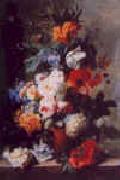
He was the brother of Jacob van Huysum, and the son of Justus van Huysum, who is said to have been expeditious in decorating doorways, screens and vases. A picture by Justus is preserved in the gallery of Brunswick, representing "Orpheus and the Beasts in a wooded landscape", and here we have some explanation of his son's fondness for landscapes of a conventional and Arcadian kind; for Jan van Huysum, though skilled as a painter of still life, believed himself to possess the genius of a landscape painter.
Half his pictures in public galleries are landscapes, views of imaginary lakes and harbours with impossible ruins and classic edifices, and woods of tall and motionless trees-the whole very glossy and smooth, and entirely lifeless. The earliest dated work of this kind is that of 1717, in the Louvre, a grove with maidens culling flowers near a tomb, ruins of a portico, and a distant palace on the shores of a lake bounded by mountains.
Some of the finest of van Huysum's fruit and flower pieces have been in English private collections: those of 1723 in the earl of Ellesmere's gallery, others of 1730-1732 in the collections of Hope and Ashburton. One of the best examples is now in the National Gallery, London (1736-1737). No public museum has finer and more numerous specimens than the Louvre, which boasts of four landscapes and six panels with still life; then come Berlin and Amsterdam with four fruit and flower pieces; then St Petersburg, Munich, Hanover, Dresden, the Hague, Brunswick, Vienna, Carlsruhe, Boston and Copenhagen.
|
|
 |
Jan van Huijsum
|
|
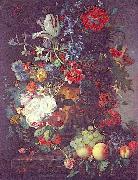
also spelled Huijsum, (April 15, 1682, Amsterdam - February 8, 1749, Amsterdam) was a Dutch painter.
He was the brother of Jacob van Huysum, the son of the flower painter Justus van Huysum, and the grandson of Jan van Huysum I, who is said to have been expeditious in decorating doorways, screens and vases. A picture by Justus is preserved in the gallery of Brunswick, representing "Orpheus and the Beasts in a wooded landscape", and here we have some explanation of his son's fondness for landscapes of a conventional and Arcadian kind; for Jan van Huysum, though skilled as a painter of still life, believed himself to possess the genius of a landscape painter.
Half his pictures in public galleries are landscapes, views of imaginary lakes and harbours with impossible ruins and classic edifices, and woods of tall and motionless trees-the whole very glossy and smooth, and entirely lifeless. The earliest dated work of this kind is that of 1717, in the Louvre, a grove with maidens culling flowers near a tomb, ruins of a portico, and a distant palace on the shores of a lake bounded by mountains.
Some of the finest of van Huysum's fruit and flower pieces have been in English private collections: those of 1723 in the earl of Ellesmere's gallery, others of 1730-1732 in the collections of Hope and Ashburton. One of the best examples is now in the National Gallery, London (1736-1737). No public museum has finer and more numerous specimens than the Louvre, which boasts of four landscapes and six panels with still life; then come Berlin and Amsterdam with four fruit and flower pieces; then St Petersburg, Munich, Hanover, Dresden, the Hague, Brunswick, Vienna, Carlsruhe, Boston and Copenhagen.
|
|
 |
Jan van Hemessen
|
|
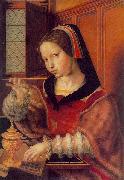
(c. 1500 - c. 1566) was a Flemish Northern Renaissance painter. He was born in Hemiksem, then called Hemessen or Heymissen. Following studies in Italy, in 1524 he settled in Antwerp. A mannerist, his images focused on human failings such as greed and vanity. Like his daughter, Catarina van Hemessen,he specialised in painted portraits.
Jan Sanders van Hemessen was a Flemish Northern Renaissance painter who was part of the mannerist movement. He was born in Hemessen in the Netherlands but settled in Antwerp in 1524 after studying in Italy. Hemessen specialized in scenes of human character flaws such as vanity and greed.
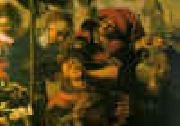
His pictures are often religious, while his style helped found the Flemish traditions of genre painting. Hemessen was also a portrait painter, which influenced his daughter to become a Flemish Northern Renaissance painter as well. The Surgeon of 1555 is an oil painting by Jan Sanders Van Hemessen currently in the Museo del Prado in Madrid, Spain. The scene likely represents a stonecutter at a fair. The surgeon, who is clearly happy that his operations have been successful, painstakingly moves his knife towards the stone, which is already visible. Behind him hang stones which have been successfully cut out of the head of other patients as a sign of his skill. Next to the quack stands a man who is wringing his hands in desperation, clearly going to be the next patient under the scalpel.
|
|
 |
Jan van Haensbergen
|
|
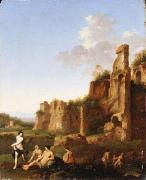
(1642-1705) was a Dutch Golden Age painter.
He was registered in the Utrecht Guild of St. Luke in 1668 and in 1669 he was registered in the Confrerie Pictura in The Hague, where he worked until he died.According to Houbraken he was a student of Cornelius van Poelenburgh, and though he was quite successful in imitating his master's style, he switched to portraits since he could make a comfortable living that way.Though he is considered by some to have been born in Utrecht, he signed his name 'Joh. Haensbergh Gorco fecit', which leads historians to conclude he was from Gorinchem. His portraits show the influence of Caspar Netscher.
|
|
 |
Jan van der Heyden
|
|
1637-1712
Dutch
Jan Van Der Heyden Gallery
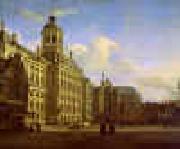
Van der Heyden grew up in Gorcum, but the family moved to Amsterdam around 1650. They lived on Dam Square. As a young guy he witnessed the fire in the old townhall which made a deep impression on him. He later would describe or draw 80 fires in almost any neighborhood of Amsterdam. When he married in 1661 the family was living on Herengracht, the most fashionable canal in Amsterdam. In 1668 Cosimo II de' Medici bought one of his paintings, a view of the townhall with a manipulated perspective. Van der Heyden often painted country estates, like Goudestein, owned by Joan Huydecoper II. He was not good in drawing figures and used for his paintings a metal plate for bricks, a sponge or moss for the leaves. Johannes Lingelbach, Adriaen van de Velde und Eglon van der Neer assisted him drawing the figures. Jan van der Heyden also introduced the lamp post and in 1672 impoved the design of the fire engine. He died in wealth as the superintendent of the lighting and director of the (voluntary) firemen's guild at Amsterdam.
Van der Heyden was a contemporary of the landscape painters Hobbema and Jacob van Ruisdael, with the advantage, which they lacked, of a certain professional versatility; for, whilst they painted admirable pictures and starved, he varied the practice of art with the study of mechanics. Until 1672 he painted in partnership with Adriaen van de Velde. After Adrian's death, and probably because of the loss which that event entailed upon him, he accepted the offices to which allusion has just been made. At no period of artistic activity had the system of division of labour been more fully or more constantly applied to art than it was in Holland towards the close of the 17th century.
Van der Heyden, who was perfect as an architectural draughtsman insofar as he painted the outside of buildings and thoroughly mastered linear perspective, seldom turned his hand to the delineation of anything but brick houses and churches in streets and squares, or rows along canals, or "moated granges," common in his native country.
He was a travelled man, had seen The Hague, Ghent and Brussels, and had ascended the Rhine past Xanten to Cologne, where he copied over and over again the tower and crane of the great cathedral. But he cared nothing for hill or vale, or stream or wood. He could reproduce the rows of bricks in a square of Dutch houses sparkling in the sun, or stunted trees and lines of dwellings varied by steeples, all in light or thrown into passing shadow by moving cloud.
He had the art of painting microscopically without loss of breadth or keeping. But he could draw neither man nor beast, nor ships nor carts; and this was his disadvantage. His good genius under these circumstances was Adrian van der Velde, who enlivened his compositions with spirited figures; and the joint labour of both is a delicate, minute, transparent work, radiant with glow and atmosphere.
|
|
 |
Jan Van Den Hoecke
|
|
Flemish Baroque Era Painter, 1611-1651
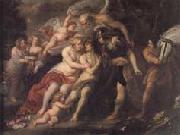
was a Flemish Baroque painter and draughtsman. He was born and died in Antwerp. He first apprenticed with his father, the painter Gaspar van den Hoecke (1595?C1648); then worked in the studio of Peter Paul Rubens. Jan's brother Robert van den Hoecke (1622?C1668) was also a painter. The artist and his father were well known for their 1635 execution of decorations for the Arch dedicated to the Emperor Ferdinand III in Antwerp. In this collaboration, Jan painted monumental representations, as seen in his piece, Triumphal Entrance of Cardinal Prince Ferdinand of Spain, (Uffizi Gallery). Hoecke then traveled to Austria under the commission of the Emperor Ferdinand III after 1637, staying for about ten years. He also painted for Ferdinand's brother, Archduke Leopold Wilhelm of Austria (1614-C1662), including a Madonna and Child and a number of allegorical pieces. Before this he traveled to Italy and worked in Rome, which may have influenced his style some. Another piece by Hoecke is his, Hercules between Vice and Virtue, (Uffizi Gallery), which shows an influence from both Rubens, and another pupil of the master Baroque painter, Anthony van Dyck.
|
|
 |
Jan van den Hecke
|
|
(1620-1684) was a Flemish Baroque painter.
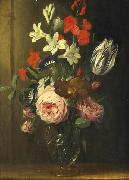
According to Houbraken he painted landscapes, which he populated with animals and other figures himself. He also made flower and fruit still lifes and could paint gold, silver, crystal, and porcelain quite well. He spent a long period travelling and working in Italy, which is noticeable in his landscapes.
According to the RKD he was registered in the Antwerp Guild of Saint Luke as an apprentice in 1636 and learned to paint from Abraham Hack, who also taught his contemporary, the flower painter Hieronymus Galle. In 1641 Van den Hecke was registered as a master of the guild. From 1653-1658 he was in Italy, but somewhere in the mid-50's he went back and forth to Belgium, since he is also registered in Brussels during that period. He died the same year as his wife Maria Adriana Heijens; when they died they left three children; Jan (II), aged 24, Maria, aged 21, and Peeter, aged 20. Van den Hecke's pupil Peeter de Clerc eventually became a master painter in the guild. Van den Hecke's son Jan van den Hecke II became a popular flower painter.
|
|
 |
Jan Sanders van Hemessen
|
|
1500-1566
Dutch
Jan Sanders Van Hemessen Gallery
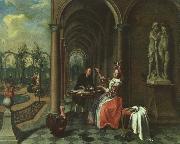
was a Flemish Northern Renaissance painter. He was born in Hemiksem, then called Hemessen or Heymissen. Following studies in Italy, in 1524 he settled in Antwerp. A mannerist, his images focused on human failings such as greed and vanity. Like his daughter, Catarina van Hemessen, he also painted portraits.
|
|
 |
Jan Josef Horemans the Elder
|
|
1682-1759
Dutch
Jan Josef Horemans Galleries
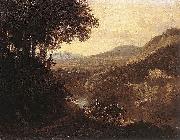
He was a pupil of the sculptor Michiel van der Voort I and then of the Dutch painter Jan van Pee (before 1640-1710), who was active in Antwerp. Horemans joined the Guild of St Luke in 1706-7. He appears to have followed in the footsteps of the 17th-century Flemish genre painters, executing a few portraits and a large number of small anecdotal pictures that were highly prized on the market. In paintings such as the Village School and the Cobbler's Shop (both 1712; Vienna, Ksthist. Mus.), the Musical Company (1715; Brunswick, Herzog Anton Ulrich-Mus.) and the Card-players (Florence, Uffizi) he represented scenes from contemporary everyday life that combine observation with a certain degree of stiffness. Most of his paintings are signed. In 1746, together with his son Jan Josef Horemans II, he painted the Abbot of St Michel Visiting the Order of the Fencing Oath (Antwerp, Kon. Mus. S. Kst.).
|
|
|
|
 |
Jan Hackaert
|
|
(1628-1685) was a Dutch Golden Age painter.
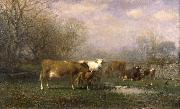
He travelled in Germany and Switzerland, and painted and sketched mostly landscapes.He would sketch miners at work in the mountains, and on more than one occasion this caused him trouble because the workers couldn't understand what he was doing. They felt he was either a spy or hexing them and made a complaint. Because Italianate landscapes were so fashionable, his Lake Zurich was mistaken for an Italian lake for years.
He painted the landscape backgrounds for other painters, such as Nicolas Berchem and Adriaen van de Velde.
|
|
|
|
|
|
 |
James McDougal Hart
|
|
(May 10, 1828 - October 24, 1901), was a Scottish-born American landscape and cattle painter of the Hudson River School. His older brother, William Hart, was also a Hudson River School artist, and the two painted similar subjects.
Hart was born in Kilmarnock, Scotland, and was taken to America with his family in early youth. In Albany, New York he trained with a sign and carriage maker possibly the same employer that had taken on his brother in his early career. Unlike his brother, however, James returned to Europe for serious artistic training. He studied in Munich, and was a pupil of Friedrich Wilhelm Schirmer in Dusseldorf.
Hart returned to America in 1853. He exhibited his first work at the National Academy of Design in 1848, became an associate in 1857 and a full member in 1859. James Hart was particularly devoted to the National Academy, exhibiting there over a period of more than forty years, and serving as vice president late in his life from 1895 to 1899. Like his brother, James also exhibited at the Brooklyn Art Association (he lived for a time in Brooklyn) and at major exhibitions around the country.
Along with most of the major landscape artists of the time, Hart based his operations in New York City and adopted the style of the Hudson River School. While James Hart and his brother William often painted similar landscape subjects, James may have been more inclined to paint exceptionally large works. An example is The Old Homestead (1862), 42 x 68 inches, in the collection of the High Museum of Art in Atlanta, Georgia. James may have been exposed to large paintings while studying in D??sseldorf, a center of realist art pedagogy that also shaped the practices of Albert Bierstadt and Worthington Whittredge. William Hart, who did not seek academic European training, seems to have been more comfortable painting small and mid-sized works.
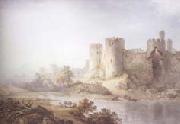
Like his brother William, James excelled at painting cattle. Kevin J. Avery writes, "the bovine subjects that once distinguished [his works] now seem the embodiment of Hart's artistic complacency." In contrast with the complacency of some of his cattle scenes, his major landscape paintings are considered important works of the Hudson River School.
|
|
|
|
 |
James Holworthy
|
|
(d. 1841)
was a British watercolour artist. Some of Holworthy's art can be seen in the Tate Gallery. Holworthy exhibited at the Royal Academy in 1803 and 1804. In the latter year he was one of the foundation members of the Society of Painters in Water-colours, now known as the Royal Watercolour Society,and he contributed constantly to their exhibitions till 1813. His subjects being drawn from Wales, the Lake district, and Yorkshire. He practised in London till 1822. In 1900, there were two drawings by him at the South Kensington Museum. In 1821, Holworthy was living in Barton in the Beans, Leicestershire. In either 1821[2] or 1824 he married Anne Wright,[3] a niece of John Wright in Derby, and retired to the Brookfield estate, near Hathersage in Derbyshire, which he had purchased. He died in London in 1841
|
|
 |
James holland,r.w.s
|
|
1799-1870
English painter. As a boy he was employed for seven years to paint flowers on pottery in the factory of John Davenport ( fl 1793; d 1848) of Longport. In 1819 Holland moved to London, where he continued at first to work as a pottery painter but also undertook watercolours of flowers and natural history subjects, exhibiting his works at the Royal Academy from 1824. After 1828 oil paintings predominated over watercolours in the many pictures that he exhibited at the Royal Academy, the Society of Painters in Water-Colours (of which he was made an associate in 1835), the British Institution and the Society of British Artists. He travelled to Paris in 1831 and subsequently made repeated tours of the Continent. Buildings in European cities now became his favourite subject, and above all, scenes of Venice, which he first visited in 1835; his Venetian views have sometimes been confused with those by Richard Parkes Bonington. In 1837 he was commissioned by the Landscape Annual to make drawings in Portugal, which were engraved in the issue for 1839. He travelled again to Venice in 1845, 1851 and 1857, making sketches en route of the Low Countries, France, Switzerland and Austria.
|
|
 |
James Holland
|
|
1799-1870
British
English painter. As a boy he was employed for seven years to paint flowers on pottery in the factory of John Davenport ( fl 1793; d 1848) of Longport. In 1819 Holland moved to London, where he continued at first to work as a pottery painter but also undertook watercolours of flowers and natural history subjects, exhibiting his works at the Royal Academy from 1824. After 1828 oil paintings predominated over watercolours in the many pictures that he exhibited at the Royal Academy, the Society of Painters in Water-Colours (of which he was made an associate in 1835), the British Institution and the Society of British Artists. He travelled to Paris in 1831 and subsequently made repeated tours of the Continent. Buildings in European cities now became his favourite subject, and above all, scenes of Venice, which he first visited in 1835; his Venetian views have sometimes been confused with those by Richard Parkes Bonington. In 1837 he was commissioned by the Landscape Annual to make drawings in Portugal, which were engraved in the issue for 1839. He travelled again to Venice in 1845, 1851 and 1857, making sketches en route of the Low Countries, France, Switzerland and Austria. Other subjects favoured by Holland were Blackheath and Greenwich (both London), where he lived from 1830 to 1845. He was renowned for his fluent draughtsmanship and for his brilliant colouring in both oils and watercolours, making liberal use of gouache in the latter. The contents of his studio were auctioned at Christie's, London, on 26 May 1870.
|
|
|
|
 |
James Hamilton
|
|
Irish-born American Painter, 1819-1878, American painter of Irish birth. He emigrated to the USA and at the age of 15 arrived in Philadelphia, where he was encouraged to study art by the engraver John Sartain (1808-97). Hamilton had drawing lessons with local teachers and studied from English artists' manuals including that on oil painting by Samuel Prout; he was also influenced by the English watercolour technique of broad transparent washes. With these stylistic interests and his innate sensitivity to nature,
|
|
|
|
 |
James Duffield Harding
|
|
English Painter, ca.1797-1863
English painter, engraver and writer. He received his first lessons in painting from his father, J. Harding (d 1846), who was a pupil of Paul Sandby. By 1807 the family had moved to Greenwich where Harding spent much of his time drawing and painting in Greenwich Park. In 1811 at the age of 14 he exhibited for the first time at the Royal Academy. He had lessons in watercolour painting from Samuel Prout and in 1816 he won the Society of Arts silver medal for landscape painting.
|
|
|
|
James clarke hook,r.a
|
|
1819-1907
English painter. He studied with the portrait painter John Jackson and entered the Royal Academy Schools, London, in 1836, winning medals for drawing and historical painting. His Academy d?but was in 1839 with The Hard Task (untraced). In 1844 Hook was awarded a gold medal in the Houses of Parliament competition. In 1846 he won a Royal Academy travelling scholarship, enabling him to spend two years in Italy, where he was strongly influenced by the colouring of the Venetian painters. On his return his work included a series of subjects from Venetian history, including The Rescue of the Brides of Venice
|
|
|
|
|
|
|
|
 |
Jacquemart de Hesdin
|
|
French Gothic Era Miniaturist, ca.1350-1410
Jacquemart's whole career developed at Bourges (the capital of the Province of Berry) at the court of John, Duke of Berry. He was active in the Duke's service from 1384 until 1414 and made a significant contribution to the Duke's famous illuminated books, in particular the Tr??s Belles Heures du Duc de Berry, the Grandes Heures, the Petites Heures, and a Psalter, often working with the Limbourg brothers and the painter known as the Boucicaut Master.
On 28 November 1384, Jacquemart was paid for the first time by the steward of John, Duke of Berry, to cover expenses he and his wife had incurred in Bourges, and he was also paid for his clothes for the coming winter. After 1384, he was paid a regular salary.
In 1398, while Jacquemart was working for Berry in the castle at Poitiers, he was accused with his assistant Godefroy and with his brother-in-law Jean Petit of the theft of colours and patterns from Jean de Hollande, another painter who worked for Berry. Jacquemart is recorded as staying in Bourges in 1399.
The Tr??s Belles Heures du Duc de Berry (also sometimes called the Brussels Hours, from the city where it has long been kept) is chiefly the work of Jacquemart. The book is described in an inventory of Berry's library dated 1402:
?? Unes tr??s belles heures richement enlumin??es et ystori??es de la main Jacquemart de Odin. ??
The Tr??s Belles Heures disappeared for several hundred years, but the scholarly consensus is that the manuscript in the Biblioth??que Royale at Brussels is the one described in the 1402 inventory.
The Petites Heures is believed to date from before 1388, apart from a miniature of the Duke of Berry himself added later by the Limbourg brothers. Millard Meiss suggests that at least five painters worked on the book's illuminations, Jacquemart and four unidentified artists. One of these four is commonly referred to as the Pseudo-Jacquemart.
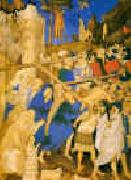
Jacquemart's small painting The Carrying of the Cross (vellum mounted on canvas, 38 cm by 28 cm, dated before 1409) is in the Mus??e du Louvre.
|
|
|
|
 |
Jacob Philipp Hackert
|
|
(September 15, 1737 - April 28, 1807) was a landscape painter from Brandenburg, who did most of his work in Italy.
Hackert was born in 1737 in Prenzlau in the Margraviate of Brandenburg (now in Germany). He trained with his father Philipp (a portraitist and painter of animals) and his uncle, before going to the Akademie der Kenste in Berlin in 1758. Later he traveled to Swedish Pomerania and Stockholm, where he painted murals.
He spent from 1765 to 1768 in Paris, with the Swiss Artist, Balthasar Anton Dunker, where he focused on painting in gouache. He met and was inspired by Claude Joseph Vernet, who was already famous as a painter of landscapes and seascapes, and the German engraver Johann Georg Wille.
In 1768 Hackert left Paris with his brother Georg, and went to Italy, basing himself mainly in Rome and Naples, where he produced many works for Sir William Hamilton. He travelled all over Italy, gaining a reputation as a talented landscape painter.
In 1786 he went to work for Ferdinand I of the Two Sicilies in Naples. He advised on the creation of a painting restoration laboratory at the Museo di Capodimonte, and supervised the transfer of the Farnese collections from Rome to Naples. By this time he had an international reputation, and won commissions from empress Catherine II of Russia, king Louis XVI of France and others. When Goethe visited Naples in 1786, he and Hackert became friends.
|
|
 |
Jacob Huysmans
|
|
1633-1696
Flemish
Jacob Huysmans Gallery
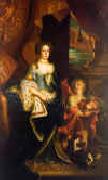
Jacob Huysmans (c.1633?C1696), was a Flemish portrait painter. He moved to England during the reign of Charles II where he became one of the fashionable painters of the court. His chief portraits are those of Izaak Walton and Catherine of Braganza, Charles II's wife (both displayed on the National Gallery, London).
He was a pupil of Gilles Backereel and Frans Wouters and came over to England from - presumably - Antwerp. His first works were pastiches of work from Anthony van Dyck. As a Roman Catholic he was favoured by Catharine of Braganza. When Samuel Pepys visited his workshop in Westminster on 26 August 1664, he described him as a 'picture-drawer ... which is said to exceed Lilly (Lely). Huysmans's most important portrait of Catharine of Braganza, Queen Catharine as a Shepherdess (c. 1664; Brit. Royal Col.), was one of the pictures Pepys saw on that occasion. Painting his subjects as sheperdesses with clothing embellished with embroidery and jewellery were typical of his style.
|
|
 |
Jacob Heinrich Elbfas
|
|
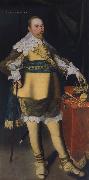
Swedish, born circa 1600-1664,was a portrait painter Elbfas was educated in Strasbourg in a tradition drawing back to Renaissance portraits. He established himself in Sweden from 1622 and from 1628 in Stockholm where he became a guild master. During the period 1634-1640 he worked as a court painter for Queen Maria Eleonora. His was frequently employed by the Swedish nobility and his influence on Swedish art was considerable until a new generation of artists were invited by Queen Christina during the 1640s.
|
|
|
|
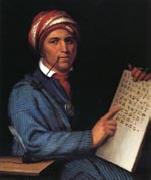 |
Inman Henry
|
|
American portrait, genre, and landscape painter, 1801-1846
The son of an English land agent who had emigrated to America in 1792, he studied under an itinerant drawing-master before moving to New York with his family in 1812. Two years later he obtained an apprenticeship with the city's leading portrait painter, John Wesley Jarvis, drawn to the artist not only for his skill but also for his collection of pictures, which at that time included Adolf Ulric Wertmuller's Danae and the Shower of Gold (1787; Stockholm, Nmus.). Inman worked closely with Jarvis, eventually accompanying him on his travels and serving more as a collaborator than an apprentice. Within this partnership Inman established a speciality in miniature painting. In 1823 he set up his own practice in New York and ceded miniature painting to his student and eventual partner Thomas Seir Cummings (1804-94).
|
|
|
|
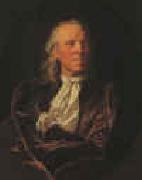 |
Hyacinthe Rigaud
|
|
1659-1743
French
Hyacinthe Rigaud Gallery
He was born Jacint Rigau i Ros [1] -- though in many encyclopaedias is "re-christened" with the name of H??acint Francesc Honrat Mathias Pere Martyr Andreu Joan Rigau -- in Perpignan, which became French (Treaty of the Pyrenees) a short time after his birth (November 7, 1659).
In 1682, he was awarded the Prix de Rome.
He was the most important portrait painter in the reign of King Louis XIV. His instinct for impressive poses and grand presentations precisely suited the tastes of the royal personages, ambassadors, clerics, courtiers, and financiers who sat for him.
Because Rigaud's paintings captured very exact likenesses along with the subject's costumes and background details, his paintings are considered precise records of contemporary fashions. Rigaud was a master of the Baroque style of art. Rigaud's best-known work is his 1701 painting of Louis XIV which today hangs in the Louvre in Paris, as well as the second copy also requested by Louis XIV which is now at Versailles.
In 1709 he was made a noble by his hometown of Perpignan. In 1727 he was made a knight of the Order of Saint Michael.
Hyacinthe Rigaud died in Paris, France on December 27, 1743.
|
|
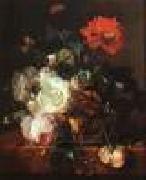 |
HUYSUM, Jan van
|
|
Dutch Painter, 1682-1749
Dutch painter of still life and landscapes. His father was Justus van Huysum (1659?C1716), a successful landscape and genre painter of Amsterdam. Although he painted landscapes in a classical style, Jan is best known for his flower and fruit still lifes in oil and in watercolor. These are distinguished for their brilliant light and shade effects, delicacy of coloring, and exquisite finish. They are to be found in most of the leading European museums
|
|
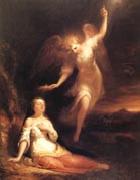 |
Huntington Daniel
|
|
American Hudson River School Painter.
b.1816 d.1906
was born in New York City, New York, the son of Benjamin Huntington, Jr. and Faith Trumbull Huntington; his paternal grandfather was Benjamin Huntington, delegate at the Second Continental Congress and First U.S. Representative from Connecticut. In 1835 he studied with SFB Morse, and produced "A Bar-Room Politician" and "A Toper Asleep." Subsequently he painted some landscapes on the Hudson river, and in 1839 went to Rome. On his return to America he painted portraits and began the illustration of The Pilgrim's Progress, but his eyesight failed, and in 1844 he went back to Rome. Returning to New York around 1846, he devoted his time chiefly to portrait-painting, although he has painted many genre, religious and historical subjects. He was president of the National Academy from 1862 to 1870, and again in 1877-1890.
|
|
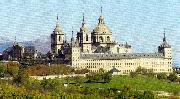 |
Huldrych Zwingli
|
|
1484-1531 fordomde alla kyrkliga bruk som inte hade sin grund i bibeln
|
|
|
|
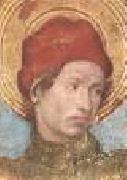 |
HUGUET, Jaume
|
|
Spanish Early Renaissance Painter, ca.1415-1492
Spanish painter. He is thought to have spent time in Saragossa in his youth (c. 1435-45), and he subsequently worked in Tarragona before establishing himself in Barcelona in 1448. He must, however, have had contact with painting from Barcelona before he moved there, because the centre panel of an early retable dedicated to the Virgin (Barcelona, Mus. A. Catalunya) from Vallmoll, near Tarragona, shows his awareness of the style of Bernat Martorell in the profiles of the two foreground angels, and of Llu?s Dalmau's Virgin of the Councillors (Barcelona, Mus. A. Catalunya) in the illusionistic painting of the Virgin's jewel-trimmed garments. In other early works, such as the Annunciation and Crucifixion from a small retable (Vic, Mus. Episc.),
|
|
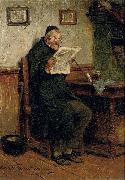 |
Hugo Wilhelm Kauffmann
|
|
(7 August 1844 - 30 December 1915) was a German painter, the son of Hermann Kauffmann.
Kauffmann was born in Hamburg. In 1861 he went to Frankfurt and worked there under Jakob Becker, Edward Jakob von Steinle and Johann Nepomuk Zwerger. From 1863-71 he lived in Kronberg in the Taunus. During this time he spent one winter in Hamburg and a five-month period in Desseldorf too; afterwards he spent 1½ years in Paris, until 1870 when the war drove him out. He lived until 1871 in Munich. He died in Prien at the Chiemsee in 1915.
|
|
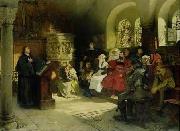 |
Hugo Vogel
|
|
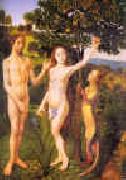
painted Martin Luther preaching at the Wartburg in 1882
|
|
 |
Hugo van der Goes
|
|
1440-1482
Flemish
Hugo van der Goes Galleries
Hugo became a member of the painters' guild of Ghent as a master in 1467. In 1468 he was involved in the decoration of the town of Bruges in celebration of the marriage between Charles the Bold and Margaret of York and he provided heraldic decorations for Charles's joyeuse entr??e to Ghent in 1469 and again in 1472. He was elected dean of the Ghent guild in 1473 or 1474.
In 1475, or some years later, Hugo entered Rooklooster, a monastery near Brussels belonging to the Windesheim Congregation, and professed there as a frater conversus. He continued to paint, and remained at Rooklooster until his death in 1482 or 1483. In 1480 he was called to the town of Leuven to evaluate the Justice Scenes left unfinished by the painter Dieric Bouts on his death in 1475. Shortly after this, Hugo, returning with other members of his monastery from a trip to Cologne, fell into a state of suicidal gloom, declaring himself to be damned. After returning to Rooklooster, Hugo recovered from his illness, and died there. His time at Rooklooster is recorded in the chronicle of his fellow monk, Gaspar Ofhuys. A report by a German physician, Hieronymus M??nzer, from 1495, according to which a painter from Ghent was driven to melancholy by the attempt to equal the Ghent Altarpiece, may refer to Hugo.
His most famous surviving work is the Portinari Triptych (Uffizi, Florence), an altarpiece commissioned for the church of San Egidio in the hospital of Santa Maria Nuova in Florence by Tommaso Portinari, the manager of the Bruges branch of the Medici Bank. The triptych arrived in Florence in 1483, apparently some years after its completion by van der Goes. The largest Netherlandish work that could be seen in Florence, it was greatly praised. Giorgio Vasari in his Vite of 1550 referred to it as by "Ugo d'Anversa" ("Hugo of Antwerp"). This the sole documentation for its authorship by Hugo; other works are attributed to him based on stylistic comparison with the altarpiece.
Hugo appears to have left a large number of drawings, and either from these or the paintings themselves followers made large numbers of copies of compositions that have not survived from his own hand. A drawing of Jacob and Rachel preserved at Christ Church, Oxford is thought to be a rare surviving autograph drawing.
|
|
 |
Hugo Simberg
|
|
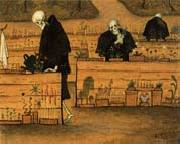
Hamina 1873-1917 Ahtari, Finnish painter and printmaker. He first studied at the Finnish Fine Arts Association in Helsinki. His natural inclination towards mysticism led him to seek the instruction of Akseli Gallen-Kallela, with whom he studied in Ruovesi intermittently between 1895 and 1897. Gallen-Kallela's influence, in particular his Symbolist synthesis of the National Romantic style, is evident in Simberg's early works, such as Frost and Autumn (both 1895; Helsinki, Athenaeum A. Mus.), which are highly personal expressions of the mysticism of nature.
|
|
|
|
 |
Hugo Muhlig
|
|
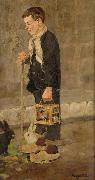
painted Knabe mit zwei Kaninchen und Vogelkafig in
|
|
 |
Hugo Loffler
|
|
1859-1935
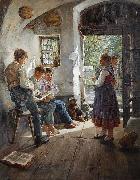
painted Preparing for the lesson in 1896
|
|
|
|
|
|
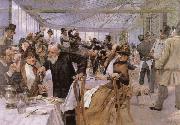 |
Hugo Birger
|
|
Swedish, 1854-1887
Swedish painter. He studied at the Konstakademi in Stockholm from 1871 to 1877. In 1877 he went to Paris and then spent the summer of 1878 at Barbizon with Carl Larsson, among others. There he painted several spontaneous plein-air paintings, such as Rue Gabrielle (1879; Goteborg, Kstmus.), in which the grey tones are contrasted realistically with exquisite colours. He also painted scenes of Parisian life, such as The Toilette (1880; two sketches in Stockholm, Nmus.), which aroused the interest of his contemporaries when it was exhibited at the Salon that year. Birger art was always conventional in style, allied to French salon painting. He was a master of technique and a brilliant subject painter, creating such scenes as In the Bower (c. 1880; Stockholm, Nmus.).
|
|
|
|
|
|
|
|
|
| Wholesale China Oil Painting Wholesale Oil Painting China Xiamen Portrait Reproduction on canvas Chinese Oil Painting Wholesale USA Oil Painting |
|
|
|
|
|