| |
|
Xiamen Oil Paintings, Wholesale Direct!
|
|
100% hand painted, 100% cotton canvas, 100% money back if not satisfaction. |
|
|
|
|
ART WORKS INDEX
A
B
C
D
E
F
G
H
I
J
K
L
M
N
O
P
Q
R
S
T
U
V
W
X
Y
Z
|
|
ARTISTS INDEX
A
B
C
D
E
F
G
H
I
J
K
L
M
N
O
P
Q
R
S
T
U
V
W
X
Y
Z
|
|
|
|
|
|
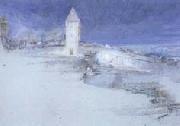 |
John Ruskin,HRWS
|
|
1819-1900
English academic and critic, who had an enormous influence not only on architectural style but on the ways in which standards of aesthetics were judged. He used an Evangelical and polemical tone in his writings that not only reached a mass audience but received the approval of the Ecclesiologists. Initially encouraged by J. C. Loudon, he contributed to some of Loudon's publications, but his key works date from the late 1840s and 1850s. The Gothic Revival was well established when Ruskin published The Seven Lamps of Architecture (1849), which was an immediate success, encapsulating the mood of the period rather than creating new ideas. He argued that architecture should be true, with no hidden structure, no veneers or finishes, and no carvings made by machines, and that Beauty in architecture was only possible if inspired by nature. As exemplars worthy of imitation (he argued that the styles known to Man were quite sufficient, and that no new style was necessary) he selected Pisan Romanesque, early Gothic of Western Italy, Venetian Gothic, and English early Second Pointed as his paradigms. In the choice of the last, the style of the late C13 and early C14, he was echoing A. W. N. Pugin's preferences as well as that of most ecclesiologically minded Gothic Revivalists such as G. G. Scott. The Stones of Venice (1851C3) helped to promote that phase of the Gothic Revival in which Continental (especially Venetian) Gothic predominated. Deane and Woodward's University Museum, Oxford (1854C60), is an example of Venetian or Ruskinian Gothic. In particular, structural polychromy, featuring colour in the material used, rather than applied, was popularized by Ruskin's writings.
|
|
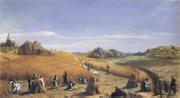 |
John Rogers Herbert
|
|
English historical painter and portraitist .
British, 1810-1890.
was an English painter who is most notable as a precursor of Pre-Raphaelitism. Herbert was born in Maldon, Essex. In 1825, he moved to London to study at the Royal Academy. His early works were influenced by the troubadour style of Richard Parkes Bonington. Subjects showed the influence of Byron and exotic episodes of Venetian history. Haydee (1834) depicted the heroine of Byron's poem Don Juan. Herbert's first major success was The Appointed Hour (1835), depicting a melodramatic scene in which a Venetian man lies murdered at the place appointed for a tryst with his lover. The work became a popular engraving. Herbert followed it with other dramatic subjects such as A Prisoner of Condottieri Freed (1836) and Desdemona asks for Cassio (1838). After he was chosen to paint a portrait of Princess Victoria, before she became queen, he became a favourite portrait painter of the aristocracy. Around this time, he came under the influence of the architect William Payne, a convert to Catholicism. In 1840, Herbert also converted to the Catholic Church. He then painted mainly religious subjects in a style influenced by the artists of the Nazarene movement. Herbert was elected to membership of the Royal Academy in 1846. Herbert's paintings The First Introduction of Christianity into Great Britain (1842) and Our Saviour Subject to his Parents in Nazareth (1847) were the inspiration for the two most important early works of William Holman Hunt and John Everett Millais, founders of Pre-Raphaelitism. The two paintings, Hunt's A Converted British Family Sheltering a Christian Missionary and Millais' Christ in the House of His Parents were exhibited at the RA in 1850 to great controversy.
|
|
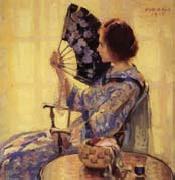 |
John Hubbard Rich
|
|
American,a versatile artist painting portraits, still lifes, figures and florals1878-1955
|
|
|
|
 |
John Hoppner
|
|
1758-1810
British
John Hoppner Galleries
John Hoppner (April 4?, 1758 - January 23, 1810), English portrait-painter, was born in Whitechapel.
His father was of German extraction, and his mother was one of the German attendants at the royal palace. Hoppner was consequently brought early under the notice and received the patronage of George III, whose regard for him gave rise to unfounded scandal. As a boy he was a chorister at the royal chapel, but showing strong inclination for art, he in 1775 entered as a student at the Royal Academy. In 1778 he took a silver medal for drawing from the life, and in 1782 the Academy's highest award, the gold medal for historical painting, his subject being King Lear.
He first exhibited at the Royal Academy In 1780. His earliest love was for landscape, but necessity obliged him to turn to the more lucrative business of portrait painting. At once successful, he had throughout life the most fashionable and wealthy sitters, and was the greatest rival of the growing attraction of Lawrence. Ideal subjects were very rarely at tempted by Hoppner, though a "Sleeping Venus," "Belisarius," "Jupiter and Io," a "Bacchante" and "Cupid and Psyche" are mentioned among his works. The prince of Wales visited him especially often, and many of his finest portraits are in the state apartments at St. James's Palace, the best perhaps being those of the prince, the duke and duchess of York, of Lord Rodney and of Lord Nelson, Among his other sitters were Sir Walter Scott, the Duke of Wellington, Frere and Sir George Beaumont.
Competent judges have deemed his most successful works to be his portraits of women and children. A Series of Portraits of Ladies was published by him in 1803, and a volume of translations of Eastern tales into English verse in 1805. The verse is of but mediocre quality. In his later years Hoppner suffered from a chronic disease of the liver. He was confessedly an imitator of Reynolds. When first painted, his works were much admired for the brilliancy and harmony of their colouring, but the injury due to destructive mediums and lapse of time which many of them suffered caused a great depreciation in his reputation. The appearance, however, of some of his pictures in good condition has shown that his fame as a brilliant colourist was well founded. His drawing is faulty, but his touch has qualities of breadth and freedom that give to his paintings a faint reflection of the charm of Reynolds. Hoppner was a man of great social power, and had the knowledge and accomplishments of a man of the world.
The best account of Hoppner's life and paintings is the exhaustive work by William McKay and W Roberts (1909
|
|
 |
John Hermann Carmiencke
|
|
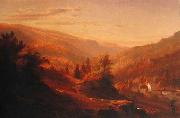
Johann Hermann Carmiencke or John Hermann Carmiencke (born at Hamburg in 1810; died at Brooklyn, New York on 15 June 1867) was a landscape painter and etcher.
|
|
|
|
 |
John Henry Twachtman
|
|
American Impressionist Painter, 1853-1902
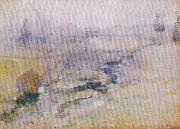
American painter and printmaker. He began as a painter of window-shades but developed one of the most personal and poetic visions in American landscape painting, portraying nature on canvases that were, in the words of Childe Hassam, 'strong, and at the same time delicate even to evasiveness'. His first artistic training was under Frank Duveneck, with whom he studied first in Cincinnati and then in Munich (1875-7). His absorption of the Munich style, characterized by bravura brushwork and dextrous manipulation of pigment, with the lights painted as directly as possible into warm,
|
|
|
|
|
|
 |
John Hayter
|
|
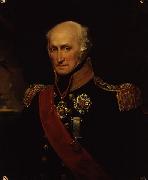
(1800-1895) was an English portrait painter. He was the second son of the miniaturist Charles Hayter and brother of Sir George Hayter, also a portaitist. He entered the Royal Academy schools in 1815, and began to exhibit at the Royal Academy in the same year. He also exhibited work at the British Institution and the Royal Society of British Artists. Hayter established himself during the 1820s, with portraits of notable figures such as the Duke of Wellington and the opera singer, Giuditta Pasta. His portrait drawings, in chalks or crayons, became particularly popular, a number of them being engraved for The Court Album, Portraits of the female aristocracy (1850-57).
|
|
 |
John Hamilton Mortimer
|
|
ARA (1740-1779) was a British Neoclassical figure and landscape painter and printmaker, known for romantic paintings set in Italy, works depicting conversations, and works drawn in the 1770s portraying war scenes, similar to those of Salvator Rosa.
Mortimer became President of the Society of Artists in 1774, five years before his death, at age 39.
John Hamilton Mortimer was born on 17 September 1740 at Eastbourne. Not much is known about his family, other than that his father was a customs officer, a dealer in flour and owner of several mills. By 1757, while he was still young, he was studying in London at the Duke of Richmond's Academy. During this time he became a friend of Joseph Wright, a fellow student at the Academy - a friendship which would endure throughout Mortimer's life. Mortimer is also known to have had some professional relationship with the artist Samuel Ireland, who was involved with etching Mortimer's work. At the St Martin's Lane Academy his fellow students included Thomas Jones and William Pars. In 1759 Mortimer won a first prize for a study after Michelangelo's Bacchus and a second prize for a life drawing.
He began to display his works on a regular basis from the early 1760s onwards. He became an active member of the Society of Artists and President of the Society in 1774.
|
|
 |
John Haberle
|
|
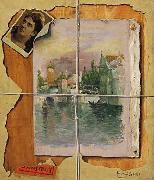
(1856-1933) was a 19th-century American painter in the trompe l'oeil (literally, "fool the eye") style. His still lifes of ordinary objects are painted in such a way that the painting can be mistaken for the objects themselves. He is considered one of the three major figuresetogether with William Harnett and John F. Petoepracticing this form of still life painting in the United States in the last quarter of the 19th century.
Haberle was born in New Haven, Connecticut; his parents were Swiss immigrants. At the age of 14 he left school to apprentice with an engraver. He also worked for many years as an exhibit preparator for the Peabody Museum of Natural History at Yale University. His career as a painter began in 1887.
His style is characterized by a meticulous rendering of two-dimensional objects. He is especially noted for his depictions of paper objects, including currency. Art historian Alfred Frankenstein has contrasted Haberle's work with that of his contemporaries:
Peto is moved by the pathos of used-up things. Haberle is wry and wacky, full of bravado, self-congratulating virtuosity, and sly flamboyance. He works largely within an old tradition, that of the trompe l'oeil still life in painted line ... It is poles away from Harnett's sumptuosity, careful balances, and well-modeled volumes, and is equally far from Peto's sensitivity in matters of tone and hue.
A Bachelor's Drawer (1890-94) is typical of his approach: various papers, including currency, postage stamps, photos, playing cards, tickets, and newspaper clippings, are shown affixed to an essentially planar surface. Other objectseeyeglasses, a comb, a pipe, matches, and so oneare shallow enough in volume so as not to spoil the illusion.
Like Harnett, he was warned by the Secret Service to cease and desist painting paper money, but he continued to do so throughout his years of greatest productivity; examples include The Changes of Time (1888) and Can You Break a Five? (c. 1885). He painted other subjects such as Slate (c. 1895), a bin of peanuts in Fresh Roasted (1887), The Clay Pipe (1889), and the huge Grandma's Hearthstone (1890), in the collection of the Detroit Institute of Arts.
By the turn of the century, problems with his eyes diminished Haberle's activity as an artist. Among his later works are paintings of flowers executed in a looser style, and in 1909 he painted his final trompe l'oeil, the large Night, in the collection of the New Britain Museum of American Art, New Britain, Connecticut. Haberle died in 1933.
|
|
|
|
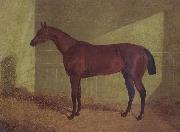 |
John Frederick Herring
|
|
British 1795-1865
was a painter, sign maker and coachman in Victorian England.John F. Herring, Sr. is the painter of the 1848 "Pharoah's Chariot Horses" (archaic spelling "Pharoah"). He amended his signature "SR" (senior) in 1836, with the growing fame of his teenage son John Frederick Herring, Jr.Herring, born in London in 1795, was the son of a London merchant of Dutch parentage, who had been born overseas in America. The first eighteen years of Herring's life were spent in London, England, where his greatest interests were drawing and horses.In the year 1814, at the age of 18, he moved to Doncaster in the north of England, arriving in time to witness the Duke of Hamilton's "William" win the St. Leger Stakes horserace. By 1815, Herring had married Ann Harris; his sons John Frederick Herring, Jr., Charles Herring, and Benjamin Herring were all to become artists, while his two daughters, Ann and Emma, both married painters. In Doncaster, England, Herring was employed as a painter of inn signs and coach insignia on the sides of coaches,and his later contact with a firm owned by a Mr. Wood led to Herring's subsequent employment as a night coach driver. Herring spent his spare time painting portraits of horses for inn parlors, and he became known as the "artist coachman" (at the time).Herring's talent was recognized by wealthy customers, and he began painting hunters and racehorses for the gentry. In 1830, John Frederick Herring, Senior left Doncaster for Newmarket, England, where he spent three years before moving to London, England. During this time, Herring might have received tuition from Abraham Cooper. In London, Herring experienced financial difficulties and was given financial assistance by W. T. Copeland, who commissioned many paintings, including some designs used for the Copeland Spode bone china. In 1840-1841, Herring visited Paris, painting several pictures, on the invitation of the Duc d'Orleans.
|
|
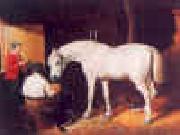 |
John F Herring
|
|
1795-1865
British
Herring, born in London in 1795, was the son of a London merchant of Dutch parentage, who had been born overseas in America. The first eighteen years of Herring life were spent in London, England, where his greatest interests were drawing and horses. In the year 1814, at the age of 18, he moved to Doncaster in the north of England, arriving in time to witness the Duke of Hamilton William win the St. Leger Stakes horserace. By 1815, Herring had married Ann Harris; his sons John Frederick Herring, Jr., Charles Herring, and Benjamin Herring were all to become artists, while his two daughters, Ann and Emma, both married painters.
In Doncaster, England, Herring was employed as a painter of inn signs and coach insignia on the sides of coaches, and his later contact with a firm owned by a Mr. Wood led to Herring subsequent employment as a night coach driver. Herring spent his spare time painting portraits of horses for inn parlors, and he became known as the artist coachman (at the time). Herring talent was recognized by wealthy customers, and he began painting hunters and racehorses for the gentry.
In 1830, John Frederick Herring, Senior left Doncaster for Newmarket, England, where he spent three years before moving to London, England. During this time, Herring might have received tuition from Abraham Cooper. In London, Herring experienced financial difficulties and was given financial assistance by W. T. Copeland, who commissioned many paintings, including some designs used for the Copeland Spode bone china. In 1840-1841, Herring visited Paris, painting several pictures, on the invitation of the Duc d Orleans (the Duke of Orleans), son of the French King Louis-Phillipe.
In 1845, Herring was appointed Animal Painter to HRH the Duchess of Kent, followed by a subsequent commission from the ruling Queen Victoria, who remained a patron for the rest of his life.
In 1853, Herring moved to rural Kent in the southeast of England and stopped painting horse portraits. He spent the last 12 years of his life at Meopham Park near Tonbridge, where he lived as a country squire. He then broadened his subject matter by painting agricultural scenes and narrative pictures, as well as his better known sporting works of hunting, racing and shooting.
A highly successful and prolific artist, Herring ranks along with Sir Edwin Landseer as one of the more eminent animal painters of mid-nineteenth (19th) century Europe. The paintings of Herring were very popular, and many were engraved, including his 33 winners of the St. Leger and his 21 winners of the Derby. Herring exhibited at the Royal Academy from 1818-1865, at the British Institution from 1830-1865, and at the Society of British Artists in 1836-1852, where Herring became Vice-President in 1842.
Herring created hundreds of paintings which were acknowledged during his lifetime.
|
|
|
|
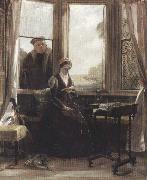 |
John callcott horsley,R.A.
|
|
1817-1903
English painter. A nephew of the landscape painter Augustus Wall Callcott, and later Isambard Kingdom Brunel's brother-in-law, he was born into the artistic establishment. He was educated at Henry Sass's Academy and at the Royal Academy. Although he executed two frescoes for the Houses of Parliament (The Spirit of Religion, 1847; London, House of Lords; Satan Wounded by Ithuriel's Lance, 1848; London, Pal. Westminster), his career began with portraiture. Success later came with literary subjects,
|
|
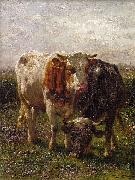 |
Johannes Hubertus Leonardus de Haas
|
|
(25 March 1832 - 4 August 1908) was a Dutch animal and landscape painter, and a peripheral figure of the Hague School.
Born at Hedel, De Haas spend his youth in Amsterdam where he got his first art education at evening-classes at the Koninklijke Academie. Consequently he moved to Haarlem where he was apprenticed to the artist Pieter Frederik van Os. During his stay in Haarlem he befriended Paul Gabriël and Hendrik Dirk Kruseman Van Elten who were also studying with Van Os.
In 1853, together with his two friends, De Haas decided to go to Oosterbeek. Here they came into contact with the influential landscape painter Johannes Warnardus Bilders and the group of painters which had gathered around him, many of whom would later be part of the Hague School. De Haas also met his future wife in Oosterbeek, Bilders' daughter, Caroline. In 1855 he received good reviews for his pictures that were exhibited in Paris from the noted art critic Jean Baptiste Gustave Planche.
In 1857 De Haas first went to Brussels, where he became friends with Willem Roelofs. De Haas frequently returned to the Netherlands and Oosterbeek for inspiration and Caroline. From 1860 his friend Gabriël also lived in Brussels, and De Haas often painted cattle in the landscapes of both Roelofs and Gabriel, fitting in perfectly with both their styles. In 1860 he won the gold medal at the exhibition of Utrecht.
From 1861 until 1869 De Haas is permanently settled in Brussels, painting mainly on the coasts of Flanders and Picardie in northern France. He married Caroline Bilders in 1862, and in 1864 they are briefly joined by her brother, the promising painter Gerard Bilders. In 1865 Caroline dies at the age of 24 of tuberculosis, leaving him with a young son. During his stay in Brussels De Haas is instrumental in passing on the style of the Barbizon school to the painters at Oosterbeek.
|
|
|
|
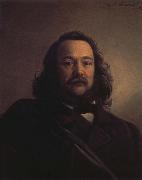 |
Johann Peter Hasenclever
|
|
1810 Remscheid-1853 Dusseldorf, German painter. His artistic talent was recognized in 1827, while he was at school in D?sseldorf. The same year he embarked on a course in architecture at the Akademie in D?sseldorf. In 1828 he turned to the study of history painting. After a difference of opinion over the theory of art with the Director of the Akademie, Wilhelm von Schadow, Hasenclever went home to Remscheid. There he taught himself portrait painting. An example of his work from this period is the portrait of Gertraude Scharff (1832-3; Remscheid, Dt. Werkzeugmus. & Heimatmus.). From 1832 to 1838 Hasenclever again studied at the Akademie in D?sseldorf in a painting class taught by Ferdinand Theodor Hildebrandt (1804-74). In portraits and humorous genre paintings Hasenclever found a field suited to his gifts. Pithy commentaries on the everyday life of the lower middle classes are present in all of Hasenclever's work. He was best known for subjects such as wine-tastings and cellar scenes, and he also made a series of Jobs pictures, humorous, ironic interpretations of popular life based on the poem 'Jobsiade', a grotesque and comic heroic epic written by Carl Arnold Kortum in 1784.
|
|
|
|
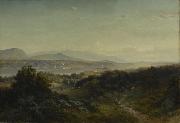 |
Johann Hermann Carmiencke
|
|
Johann Hermann Carmiencke, a landscape painter and etcher, was born at Hamburg in 1810. He went to Dresden in 1831 as a journeyman painter, and while there studied in Dahl's school. Thence he went to Copenhagen in 1834, where he studied in the Academy, and presently repairing to Leipsic, received instruction there from Sohonberg. Returning to Copenhagen in 1838, he proceeded to travel as an artist in Sweden, Bavaria, and the Tyrol, visiting Italy from 1845 to 1846. He was then appointed court painter to Christian VIII, for whom he executed many works. In consequence of the war, he went in 1851 to New York, where he was well received, and admitted into the Academy of Brooklyn. His works were mainly groups of mountain ranges, which were very effectively rendered, and possessed an excellent tone the execution being simple and true to nature. The 'Mountain Tarn' and the 'View on the Zillerthal' may be particularly noticed. There are thirty-five careful etchings of landscapes by him, some of which were published by the Art Association of Copenhagen in 1850 and 1851. He died at New York in 1867.
|
|
|
|
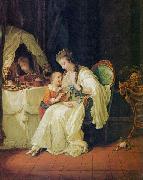 |
Johann Heinrich Wilhelm Tischbein
|
|
Johann Heinrich Wilhelm Tischbein, also known as Goethe-Tischbein (15 February 1751 - 26 February 1828) was a German painter. He was a descendant of the Tischbein family of painters, and a pupil of his uncle Johann Jacob Tischbein.
|
|
|
|
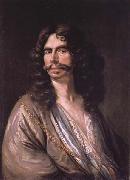 |
Johann Heinrich Roos
|
|
German Baroque Era Painter, 1631-1685
was a German Baroque era painter and etcher. His works are presented in various art museums worldwide.
|
|
|
|
|
|
|
|
|
|
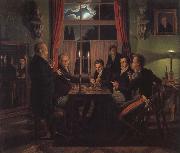 |
Johann Erdmann Hummel
|
|
1769 Kassel-1852 Berlin,German painter and writer. He studied from 1782 in the architecture class at the Akademie der Bildenden K?nste at Kassel and subsequently under the Kassel court painter, Wilhelm B?ttner. Hummel retained his connection with architecture, however, and this is manifested in his overpowering concern with structure and perspective. The Kassel court granted Hummel funds for travel and study in Italy and, in 1792, he went to Rome, where he joined a group of fellow Germans, including the painters Johann Christian Reinhart, Johann Martin von Rohden, Friedrich Bury and the architect Friedrich Weinbrenner. In 1796 Joseph Anton Koch joined the group. Hummel also attended the philosophical lectures given by Carl Ludwig Fernow (1763-1808) and became a friend of the archaeologist Aloys Hirt. In Rome,
|
|
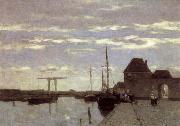 |
Johan Hendrik Weissenbruch
|
|
Dutch Painter, 1824-1903
Painter, cousin of Jan Weissenbruch. He referred to himself and signed his work as Jan Hendrik Weissenbruch. From 1840 he attended drawing lessons with the Norwegian painter Johannes Lew, and from 1846 he was taught by Bartholomeus J. van Hove at the Koninklijke Academie van Beeldende Kunsten in The Hague. His early paintings clearly show the influence of van Hove and Andreas Schelfhout, although it is uncertain whether he was actually taught by the latter. His father, an avid collector, owned works by both artists.
|
|
|
|
|
|
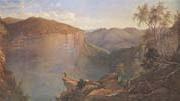 |
JH Carse
|
|
Australian Painter, ca.1819-1900
|
|
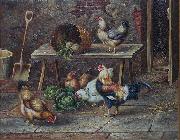 |
Jenny Hoppe
|
|
Jenny Hoppe (Dusseldorf, 1870 -Elsene, 1934) was een Duits-Belgische kunstschilderes.
|
|
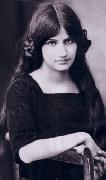 |
Jeanne Hebuterne
|
|
(April 6, 1898 C January 25, 1920) was a French artist, best known as the frequent subject and common-law wife of the artist Amedeo Modigliani.
Born in Paris to a Roman Catholic family, her father, Achille Casimir Hebuterne, worked at Le Bon Marche department store.
|
|
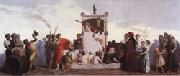 |
Jean-Louis Hamon
|
|
Plouha 1821 - Saint - Raphael, 1874.
French Academic Painter, 1821-1874.
Studied under Charles Gleyre.
French Academic Painter, 1821-1874. Studied under Charles Gleyre. French painter and designer. He was encouraged to practise drawing by the Brothers of the Christian Doctrine at Lannion. Through the intervention of Felicite-Robert de Lamennais (1782-1854), he was made drawing-master at a religious seminary at Ploermel, Brittany, although at this stage he had received no instruction and had never seen an oil painting. In 1840 he asked his conseil general for help and left for Paris the following year with a grant of 500 francs. He went to Delaroche's studio, where he made friends with Picou, Jean-Leon Gereme, Jean Aubert (1824-1906) and Jean Eugene Damery (1823-53). Charles Gleyre, who took over Delaroche's studio in 1843, encouraged and protected him during years of poverty.
|
|
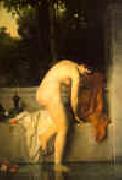 |
Jean-Jacques Henner
|
|
1829-1905
French
Jean Jacques Henner Galleries
French painter. He was born into a peasant family in the Sundgau and received his first artistic training at Altkirch with Charles Goutzwiller (1810-1900) and later in Strasbourg in the studio of Gabriel-Christophe Gu?rin (1790-1846). In 1846 he enrolled at the Ecole des Beaux-Arts in Paris as a pupil of Michel-Martin Drolling and, from 1851, of Francois-Edouard Picot. While a student he was particularly drawn to portraiture, and during his frequent visits to Alsace he made portraits of his family as well as of the notables of the region. He also painted scenes of Alsatian peasant life.
|
|
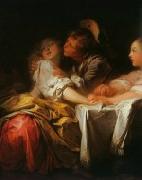 |
Jean-Honore Fragonard
|
|
French Rococo Era Painter, 1732-1806
was a French painter and printmaker whose late Rococo manner was distinguished by remarkable facility, exuberance, and hedonism. One of the most prolific artists active in the last decades of the Ancien Regime, Fragonard produced more than 550 paintings , of which only five are dated. Among his most popular works are genre paintings conveying an atmosphere of intimacy and veiled eroticism. He was born at Grasse, Alpes-Maritimes, the son of François Fragonard, a glover, and Françoise Petit. He was articled to a Paris notary when his father's circumstances became strained through unsuccessful speculations, but showed such talent and inclination for art that he was taken at the age of eighteen to François Boucher, who, recognizing the youth's rare gifts but disinclined to waste his time with one so inexperienced, sent him to Chardin's atelier. Fragonard studied for six months under the great luminist, then returned more fully equipped to Boucher, whose style he soon acquired so completely that the master entrusted him with the execution of replicas of his paintings. Though not yet a pupil of the Academy, Fragonard gained the Prix de Rome in 1752 with a painting of "Jeroboam Sacrificing to the Golden Calf", but before proceeding to Rome he continued to study for three years under Charles-Andre van Loo. In the year preceding his departure he painted the "Christ washing the Feet of the Apostles" now at Grasse cathedral. On September 17, 1756, he took up his abode at the French Academy in Rome, then presided over by Charles-Joseph Natoire. While at Rome, Fragonard contracted a friendship with a fellow painter, Hubert Robert. In 1760, they toured Italy together, executing numerous sketches of local scenery. It was in these romantic gardens, with their fountains, grottos, temples and terraces, that Fragonard conceived the dreams which he was subsequently to render in his art. He also learned to admire the masters of the Dutch and Flemish schools (Rubens, Hals, Rembrandt, Ruisdael), imitating their loose and vigorous brushstrokes. Added to this influence was the deep impression made upon his mind by the florid sumptuousness of Giovanni Battista Tiepolo, whose works he had an opportunity to study in Venice before he returned to Paris in 1761. In 1765 his "Coresus et Callirhoe" secured his admission to the Academy. It was made the subject of a pompous (though not wholly serious) eulogy by Diderot, and was bought by the king, who had it reproduced at the Gobelins factory. Hitherto Fragonard had hesitated between religious, classic and other subjects; but now the demand of the wealthy art patrons of Louis XV's pleasure-loving and licentious court turned him definitely towards those scenes of love and voluptuousness with which his name will ever be associated, and which are only made acceptable by the tender beauty of his color and the virtuosity of his facile brushwork;
|
|
|
|
|
|
 |
jean Huber
|
|
Swiss Painter (b. 1721, Geneve, d. 1786, Bellevue) ,
Geneva1721-1786
Geneva1721-1786,Silhouettist, painter, draughtsman and printmaker. His paternal ancestors were patrician Genevese merchant bankers. As a young man he soldiered at Kassel in Germany and in Italy, where he fought for Savoy in the War of the Austrian Succession (1740-48). In 1752 he was elected to Geneva's Council of Two Hundred and served his native city as a magistrate. He had no formal artistic training, but from his youth he clipped out of paper or cards freehand profiles of a kind that later came to be called silhouettes.
|
|
 |
Jean Honore Fragonard
|
|
1732-1806
French
Jean Honore Fragonard Locations
French painter. He studied with François Boucher in Paris c. 1749. He subsequently won a Prix de Rome, and while in Italy (1756 ?C 61) he traveled extensively and executed many sketches of the countryside, especially the gardens at the Villa d Este at Tivoli, and developed a great admiration for the work of Giovanni Battista Tiepolo. In 1765 his large historical painting Coresus Sacrifices Himself to Save Callirhoë was purchased for Louis XV and won Fragonard election to the French Royal Academy. He soon abandoned this style to concentrate on landscapes in the manner of Jacob van Ruisdael, portraits, and the decorative, erotic outdoor party scenes for which he became famous (e.g., The Swing, c. 1766). The gentle hedonism of such party scenes epitomized the Rococo style. Although the greater part of his active life was passed during the Neoclassical period, he continued to paint in a Rococo idiom until shortly before the French Revolution, when he lost his patrons and livelihood.
|
|
 |
Jean Hey
|
|
Flemish Northern Renaissance Painter, active 1480-1500
Until the late 20th century, the name of the painter of the Moulins Triptych was unknown, although art historians identified a number of other works that were evidently by the same hand. The first monograph on the Master of Moulins, written in 1961 by Madeleine Huillet d'Istria, argued that this artist did not actually exist, and that more than 12 different artists were responsible for the corpus of works traditionally ascribed to him. The Master's identity was established after an inscription was found on the reverse of a damaged painting, Christ with Crown of Thorns (1494) in the Royal Museums of Fine Arts of Belgium, Brussels, identifying the artist as Jean Hey, teutonicus and pictor egregius ("the famous painter"), and identifying the patron as Jean Cueillette, who was secretary to the King and an associate of the Bourbon family.Stylistic similarities link this painting to the works attributed to the Master of Moulins. The Master of Moulins appears to have been the court painter for the Bourbons, and from a surviving account for 1502-03, it is clear that the court painter's name was Jean; other candidates once considered plausible, such as Jean Perreal and Jean Prevost, have proven untenable in the light of subsequent research. The term "Teutonicus", or "German" included Flemings at this date.
|
|
 |
Jean Henri De Coene
|
|
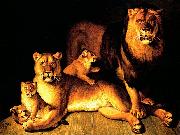
Jean Henri De Coene, a Belgian painter of genre and historical subjects, was born at Nederbrakel in 1798.
|
|
 |
Jean Baptiste Huet
|
|
(Paris, 15 October 1745-Paris, 27 January 1811) was a French painter, engraver and designer associated with pastoral and genre scenes of animals in the Rococo manner, influenced by François Boucher.
Born into a family of artistse his uncle was Christophe Huet, his father Nicolas Huetehe apprenticed with the animal painter Charles Dagomer, a member of the painters' guild, the Academie de Saint-Luc, Paris, who was working in the 1760s. Huet's interest in printmaking and his acquaintance with Gilles Demarteau, who later engraved many of his compositions, both date from this period. About 1764 Huet entered the studio of Jean-Baptiste Le Prince, where he further developed his printmaking skills, largely reproducing his own paintings, a method of publishing them with some profit.
In 1768 he was approved by the Academie Royale, and 29 July 1769 he was received (reçu) in the minor category (petite maniere) of painter of animals and was well received in the public reviews when he began to exhibit at the Paris Salon that same year, with a Dog Attacking Geese, now at the Louvre. He continued to exhibit annually until 1789, through his attempts at the grand manner of history painting, considered the noblest genre, were not met with approval.
|
|
|
|
|
|
|
|
|
|
|
| Wholesale China Oil Painting Wholesale Oil Painting China Xiamen Portrait Reproduction on canvas Chinese Oil Painting Wholesale USA Oil Painting |
|
|
|
|
|