| |
|
Xiamen Oil Paintings, Wholesale Direct!
|
|
100% hand painted, 100% cotton canvas, 100% money back if not satisfaction. |
|
|
|
|
ART WORKS INDEX
A
B
C
D
E
F
G
H
I
J
K
L
M
N
O
P
Q
R
S
T
U
V
W
X
Y
Z
|
|
ARTISTS INDEX
A
B
C
D
E
F
G
H
I
J
K
L
M
N
O
P
Q
R
S
T
U
V
W
X
Y
Z
|
|
|
|
 |
Jacques Blanchard
|
|
(1600 - 1638), also known as Jacques Blanchart, was a French baroque painter who was born in Paris. He was raised and taught by his uncle, the painter Nicolas Bollery (ca. 1560-1630). Jacques's brother and son, Jean-Baptiste Blanchard (after 1602-1665) and Gabriel Blanchard (1630-1704), respectively were also painters.
Jacques spent the years from 1624 to 1628 studying in Bologna and Venice. After briefly working in Turin at the court of the Charles Emmanuel I, Duke of Savoy (ca. 1628) he returned to France and set himself up in Paris in 1629. Jacques Blanchard is best known for his small religious and mythological paintings. He died in Paris in 1638. This painter should not be confused with the French sculptor of the same name who lived from 1634 to 1689.
Nothing seems to be known of his work before he left for Rome at the age of twenty-four. After two years he moved to Venice, where he remained for two more years. It was there that his style was formed. He then went to Turin, where he worked for the Dukes of Savoy, before returning to France 1628. It is from the brief but productive period after his return that all his dated works survive. They show him to stand quite apart from his contemporaries, not only in his painting style but also in his choice of sensual subject-matter, for example the Bacchanal at Nancy.
The chief influences were the sixteenth century painters, especially Titian and Tintoretto with their rich, warm colours, and Veronese, whose blond and silvery colour and limpid light he used most effectively in his small religious and mythological subjects. The several versions of Charity, depicted as a young woman with two or three children, are excellent examples of his tenderness of colour handling, and of a softness of sentiment nearer to the 18th than to the 17th century.
|
|
 |
Jacques Bellange
|
|
French Painter, ca.1575-1616,French painter, etcher and draughtsman. His known artistic activity dates only from 1602 to 1616 and he is now familiar chiefly for his etchings and drawings, all his decorative works and most of his paintings having perished. His highly idiosyncratic style was inspired by such Italian artists as Parmigianino, by the School of Fontainebleau and by northern artists including Albrecht Derer and Bartholomeus Spranger. His work would seem to express a private and nervous religious sensibility through a style of the greatest refinement.
|
|
 |
Jacopo Zanguidi Bertoia
|
|
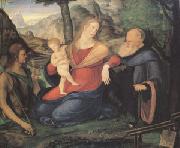
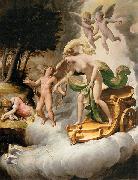
Jacopo Bertoia, also known as Giacomo Zanguidi or Jacopo Zanguidi or Bertoja, (1544 - ca. 1574), was an Italian painter of a late-Renaissance or Mannerist style that emerged in Parma towards the end of the 16th century.
He was strongly influenced by Parmigianino.
Born in Parma, he apparently studied in Bologna with Sabatini. His masterpiece is the Sala del Bacio, in the Palazzo del Giardino in Parma. He also helped decorate the Sala di Orfeo in the same palace. He was part of the team that decorated the walls of the Oratorio del Gonfalone (Entry into Jerusalem) in Rome. He was commissioned by Cardinal Alessandro Farnese in 1572-1573 to paint galleries (Sale del Giudizio, della Penitenza, dei Sogni, as well as the Anticamera degli Angeli) of the Villa Farnese in Caprarola, where he replaced the role of Taddeo Zuccari.
|
|
|
|
|
|
 |
Jacopo Bassano
|
|
Italian
c1510-1592
Jacopo Bassano Gallery
He was apprenticed to his father, with whom he collaborated on the Nativity (1528; Valstagna, Vicenza, parish church). In the first half of the 1530s Jacopo trained in Venice with Bonifazio de Pitati, whose influence, with echoes of Titian, is evident in the Flight into Egypt (1534; Bassano del Grappa, Mus. Civ.). He continued to work in the family shop until his fathers death in 1539. His paintings from those years were mainly altarpieces for local churches; many show signs of collaboration. He also worked on public commissions, such as the three canvases on biblical subjects (1535-6; Bassano del Grappa, Mus. Civ.) for the Palazzo Communale, Bassano del Grappa, in which the narrative schemes learnt from Bonifazio are combined with a new naturalism. From 1535 he concentrated on fresco painting, executing, for example, the interior and exterior decoration (1536-7) of S Lucia di Tezze, Vicenza, which demonstrates the maturity of his technique.
|
|
 |
Jacob de Backer
|
|
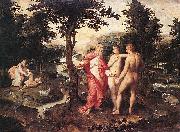
(c. 1555 - c. 1585) was a Flemish Mannerist painter and draughtsman active in Antwerp between about 1571 and 1585.
According to the RKD he was born in Antwerp in c.1540/45 and died there c.1591-1600.De Backer was abandoned by his father as a young boy. Carel van Mander reports that the artist studied with Antonio van Palermo and Hendrik van Steenwijk I, but that Palermo worked him so hard that the young de Backer died in the arms of his master's daughter at the age of thirty.
Although the artist painted in the high mannerist style of Giorgio Vasari, he never appeared to travel to Italy. A series of the "Seven Deadly Sins", however, was bought in Antwerp by Alessandro Farnese's secretary Cosimo Masi in 1594 and taken to Italy.These paintings are now in the Museo di Capodimonte in Naples. Other attributable works include a Last Judgment triptych by him or his studio for Christophe Plantin's tomb in the Antwerp Cathedral (c. 1589; illustrated right), and an Allegory of the Three Ages of Man in the Hermitage Museum, St. Petersburg.
He is not to be confused with the Dutch Golden Age painter Jacob Adriaensz Backer from
|
|
|
|
 |
j. beraud
|
|
1849-1935
1849 - Saint Petersburg, Russia - 1935 Paris)
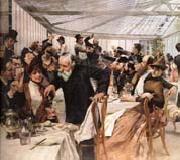
Scenes of daily life painted by Jean Beraud reveal interest in Naturalism. Such diverse themes as crowds observing the funeral of Victor Hugo (see Carnavalet, Paris) or studies of the interior of a Parisian Bank Apartment reflect aspects of French society during the Third Republic.
|
|
 |
J B Armand Guillaumin
|
|
1841-1927
Born Jean-Baptiste Armand Guillaumin in Paris, France, he worked at his uncle's lingerie shop while attending evening drawing lessons. He also worked for a French government railway before studying at the Academie Suisse in 1861. There, he met Paul C??zanne and Camille Pissarro with whom maintained lifelong friendships. While he never achieved the stature of these two, his influence on their work was significant. C??zanne attempted his first etching based on Guillaumin paintings of barges on the River Seine.
Guillaumin exhibited at the Salon des Refus??s in 1863 and later became a friend of Vincent van Gogh whose brother, Theo sold some of his works.
Noted for his intense colors, major museums around the world display Guillaumin's art. He is best remembered for his landscapes of Paris, the Creuse departement, and the area around Les Adrets-de-l'Esterel near the Mediterraneran coast in the Provence-Alpes-Cote d'Azur region of France.
Armand Guillaumin died in 1927 in Orly, Val-de-Marne just south of Paris.
|
|
 |
Ivan Bilibin
|
|
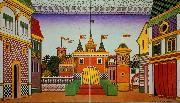
(Russian, 16 August [O.S. 4 August] 1876 - 7 February 1942) was a 20th-century illustrator and stage designer who took part in the Mir iskusstva and contributed to the Ballets Russes. Throughout his career, he was inspired by Slavic folklore.
Ivan Bilibin was born in a suburb of St. Petersburg. He studied in 1898 at Anton Ažbe Art School in Munich, then under Ilya Repin in St. Peterburg. In 1902-1904 Bilibin travelled in the Russian North, where he became fascinated with old wooden architecture and Russian folklore. He published his findings in the monograph Folk Arts of the Russian North in 1904. Another influence on his art was traditional Japanese prints.
Bilibin gained renown in 1899, when he released his illustrations of Russian fairy tales. During the Russian Revolution of 1905, he drew revolutionary cartoons. He was the designer for the 1909 premiere production of Nikolai Rimsky-Korsakov's The Golden Cockerel. The October Revolution, however, proved alien to him. After brief stints in Cairo and Alexandria, he settled in Paris in 1925. There he took to decorating private mansions and Orthodox churches. He still longed for his homeland and, after decorating the Soviet Embassy in 1936, he returned to Soviet Russia. He delivered lectures in the Soviet Academy of Arts until 1941. Bilibin died during the Siege of Leningrad.
|
|
|
|
 |
Isidoro Bianchi
|
|
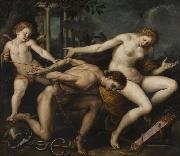
Isidoro Bianchi called da Campione (20 July 1581, Campione d'Italia, Lombardy - 5 December 1662) was an Italian painter of the Baroque period.
He was born in Campione d'Italia, Lombardy and was active c. 1626. He studied under Pietro Francesco Mazzuchelli. He excelled in fresco painting for the Basilica of Sant'Ambrogio at Milan and in different churches at Como. The Duke of Savoy chose him to finish a grand saloon at Rivoli, which had been left unfinished at the death of Mazzuchelli, who had commenced it. Bianchi was afterwards made painter to the Court, and was knighted in 1631.
|
|
|
|
 |
Hugo Birger
|
|
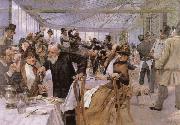
Swedish, 1854-1887
Swedish painter. He studied at the Konstakademi in Stockholm from 1871 to 1877. In 1877 he went to Paris and then spent the summer of 1878 at Barbizon with Carl Larsson, among others. There he painted several spontaneous plein-air paintings, such as Rue Gabrielle (1879; Goteborg, Kstmus.), in which the grey tones are contrasted realistically with exquisite colours. He also painted scenes of Parisian life, such as The Toilette (1880; two sketches in Stockholm, Nmus.), which aroused the interest of his contemporaries when it was exhibited at the Salon that year. Birger art was always conventional in style, allied to French salon painting. He was a master of technique and a brilliant subject painter, creating such scenes as In the Bower (c. 1880; Stockholm, Nmus.).
|
|
|
|
|
|
 |
Hippolyte Boulenger
|
|
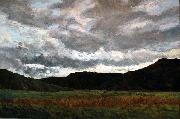
(1837 - 1874) was a Belgian landscape painter influenced by the French Barbizon school, considered to be "the Belgian Corot".
Hippolyte Boulenger was born to French parents in Tournai in 1837. He spent his youth in Tournai and lived in Paris between 1850 and 1853, where he studied drawing. In 1853, after he became an orphan, he went to Brussels to work at a design atelier. In the evening, he studied at the Academie Royale des Beaux-Arts with Joseph Quinaux, a landscape painter.
He met portrait painter Camille Van Camp in 1863, who became a mentor and mecenas. He showed his first painting in the Brussels Salon the same year. Boulenger went to Tervuren in 1864, and called round him a group of likeminded painters gathered there, the School van Tervuren, a Belgian version of the Barbizon school, of which he became the leading artist. At the time, his leading model was Jean-François Millet, although his later work was closer to that of Corot. By 1866, he was famous in Belgian art circles.
He married in 1868 and moved to Zaventem, but returned to Tervuren in 1870. These years were his best and most fruitful period, with e.g. the painting De oude Haagbeukdreef. Tervuren, which won him the Gold Medal of the 1872 Salon of Brussels. In this period, he travelled in Belgium and abroad, painting along the River Meuse. It was his suggestion that led to the creation of the Societe Libre des Beaux-Arts, an art circle of young Belgian artists, including Alfred Verwee, Felicien Rops, and Constantin Meunier, with honorary members from abroad like Corot and Millet, but also Honore Daumier, Gustave Courbet and Willem Maris.
By 1869, he began to suffer from epilepsy. Coupled with alcohol abuse, this led to an early death, in 1874 in a hotel in Brussels.
|
|
|
|
|
|
 |
Hildegard of Bingen
|
|
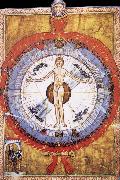
1098-1179,German composer, abbess and mystic. Her writings include much lyrical and dramatic poetry which has survived with monophonic music. The Symphonia armonie celestium revelationum contains musical settings of 77 poems arranged according to the liturgical calendar. The poetry is laden with imagery and the music, based on a few formulaic melodic patterns, is in some respects highly individual. Her morality play Ordo virtutum contains 82 melodies in a more syllabic style.
|
|
 |
Hieronymus Bosch
|
|
Netherlandish Northern Renaissance Painter, ca.1450-1516, Flemish painter. His surname was originally van Aeken; Bosch refers to 's Hertogenbosch, where he was born and worked. Little is known of his life and training, although it is clear that he belonged to a family of painters. His paintings, executed in brilliant colors and with an uncanny mastery of detail, are filled with strangely animated objects, bizarre plants and animals, and monstrous, amusing, or diabolical figures believed to have been suggested by folk legends, allegorical poems, moralizing religious literature, and aspects of late Gothic art. Such works as the Garden of Earthly Delights (Prado) appear to be intricate allegories; their symbolism, however, is obscure and has consistently defied unified interpretation. Bosch clearly had an interest in the grotesque, the diabolical, the exuberant, and the macabre. He also may have been the first European painter to depict scenes of everyday life, although often with a strong element of the bizarre. King Philip II of Spain collected some of his finest creations. The Temptation of St. Anthony (Lisbon) and The Last Judgment were recurring themes. Other examples of his art may be seen in the Escorial and in Brussels. Examples of the Adoration of the Magi are in the Metropolitan Museum and in the Philadelphia Museum, which also has the Mocking of Christ. Bosch, who deeply influenced the work of Peter Bruegel the Elder, was hailed in the 20th cent. as a forerunner of the surrealists, and his work continues to influence many contemporary artists.
|
|
 |
Herri met de Bles
|
|
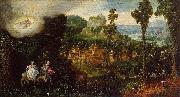
(also known as Herri de Dinant, Herry de Patinir, and Civetta) (c. 1510 - c. 1555 - 1560) was a Flemish Northern Renaissance and Mannerist landscape painter. He is also defined as a eeMosan landscape painter active during the second third of the 16thcentury (i.e., second generation of landscape painters).ee
Very little is positively known about the artist. He is believed to be a certain Herry de Patenir who joined Antwerp's Guild of St. Luke in 1535 as a painter and is also believed to be a court painter for the d'Este Dukes of Ferrara, where he ended his career known as "Il Civetta". He contributed, along with his possible-uncle Joachim Patinir, to a distinct style of Northern Renaissance landscape painting that combined small history or religious scenes into compositions defined by perspective and atmospheric effects. Also, along with a group of Antwerp-based followers of Hieronymus Bosch that included Jan Mandyn, Pieter Huys, and Jan Wellens de Cock, Met de Bles continued the tradition of fantastic imagery into northern Mannerism.
|
|
|
|
 |
Henry William Beechey
|
|
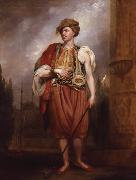
Sir Henry William Beechey (12 December 1753 - 28 January 1839), English portrait-painter, was born at Burford, the son of William Beechey (*1732) and Hannah Read (*c1732).
He was originally meant for a conveyancer, but a strong love for painting induced him to become a pupil at the Royal Academy in 1772. Some of his smaller portraits gained him considerable reputation; he began to be employed by the nobility, and in 1793 became associate of the Royal Academy. In the same year he was made portrait-painter to Queen Charlotte. His work has been described as relatively sober.
He painted the portraits of the members of the royal family, and of nearly all the most famous or fashionable persons of the time. What is considered his finest production is a review of cavalry, a large composition in the foreground of which he introduced portraits of George III, the Prince of Wales and the Duke of York, surrounded by a brilliant staff on horseback. Among his portraits were those of Lord Nelson, John Kemble, and Sarah Siddons.
George III and the Prince of Wales reviewing troops was painted in 1798, and obtained for the artist the honour of knighthood, and his election as RA (member of the Academy). This painting was destroyed in the 1992 Windsor Castle fire.
|
|
 |
Henry Richard S. Bunnett
|
|
1845 -1910
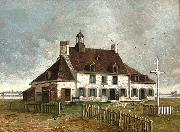
David Ross McCord (1844-1930) commissioned Henry Richard S. Bunnett (1845-1910) to paint over 200 oil paintings between 1885 and 1889. The works depicted buildings, views and places around Quebec that McCord felt were of historical importance.
|
|
|
|
|
|
 |
Henry Charles Bryant
|
|
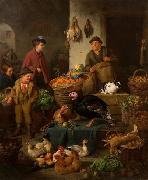
(1835 - 1915) was a popular painter of portraits and landscapes specialising in farmyard and market scenes which were noted for their great attention to detail. He worked mainly in London and exhibited frequently between 1860 and 1880 at the Royal Academy, the British Institution and the Royal Society of British Artists. His paintings are highly sought after today.He died at 49, Derby Road, Portsmouth in January, 1915(Obituary:- Hampshire Telegraph & Post, January 8, 1915).
|
|
|
|
 |
Henry Benbridge
|
|
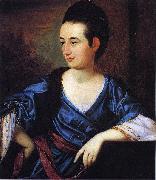
Henry Benbridge born October 1743 died February 1812), early American portrait painter, was born in Philadelphia, the only child of James and Mary (Clark) Benbridge. When he was seven years old, his mother, who had been left a widow, was married to Thomas Gordon, a wealthy Scot. The boy's artistic talent was encouraged. He made decorative designs for his stepfather's drawing-room which were much admired. When he was fourteen years old he may have watched John Wollaston paint Gordon's portrait. It has been plausibly argued that young Benbridge had instruction from Wollaston, since his earliest known portrait, that of his half-sister Rebecca Gordon, "seems to hark back to Wollaston." When he was 21, Benbridge was sent to Italy, where he studied with Pompeo Batoni and Anton Raphael Mengs. In 1769, on commission from James Boswell, biographer of Dr. Samuel Johnson, he made a portrait of Pasquale Paoli in Corsica which he took to London. It was exhibited (1769) at the Free Society of Artists, and from it three mezzotints were scraped and published with the artist's name signed "Bembridge." Like other young Americans he was encouraged by Benjamin West. He wrote, on December 7, 1769, to his stepfather: "Upon my arrival I waited upon Mr. West who received me with a sort of brotherly affection, as did my cousin, Mrs. West." Impelled, apparently, by a longing to rejoin his family, he left England in 1770, bearing from West the following note of recommendation to Francis Hopkinson: "By Mr. Benbridge you will receive these few lines. You will find him an Ingenous artist and an agreeable Companion. His merit in the art must procure him great incouragement and much esteem. I deare say it will give you great pleasure to have an ingenous artist resident amongst you."
Elizabeth Ann Timothy (Mrs. William Williamson), watercolor on ivory of 1775In Philadelphia Benbridge married a Miss Sage and was admitted on January 18, 1771, to membership in the American Philosophical Society, of which Benjamin Franklin was a founder. He painted the large portrait of the Gordon family, with six figures, one of his masterpieces. Suffering, however, from asthma, he sought a more congenial climate and moved to Charleston, South Carolina, where he succeeded Jeremiah Theus (d. May 18, 1774) as the popular portrait painter of South Carolina. There he made many likenesses of southern men and women, several of which have been popularly attributed to John Singleton Copley, an artist who never painted in the South and who left America in 1774. Around 1800 Benbridge settled in Norfolk, Virginia, whence he made frequent visits to his native city. At Norfolk he gave to Thomas Sully his first lessons in oil painting. He had previously instructed Thomas Coram of Charleston. Sully describes his master as "a portly man of good address - gentlemanly in his deportment." Benbridge's health is said by Hart to have declined in middle age. Dunlap's assertion that his last years were passed "in obscurity and poverty" has been disputed.
|
|
 |
Henry Bacon
|
|
1839-1922
Henry Bacon Gallery
Henry Bacon was born in Watseka, Illinois to father civil engineer Henry Bacon and mother Elizabeth Kelton Bacon, both of Massachusetts. Bacon was largely raised in Wilmington, N.C., where his father settled down and served as a government engineer in charge of the Cape Fear River improvements. At age 15, Henry Bacon was sent north to Boston's Chauncey Hall School. In 1884 he matriculated at the University of Illinois at Urbana-Champaign, but left within a year to launch an architectural career in the office of Chamberlin & Whidden in Boston as a draftsman. Bacon was soon hired into the office of famed McKim, Mead & White in New York City, the best-known American architectural firm of its time.
While at McKim, Mead & White (MMW), Bacon won, in 1889, the Rotch Traveling Scholarship for architectural students, which gave him two years of study and travel in Europe, learning and drawing details of Roman and Greek architecture as far afield as Turkey, where he met his future wife, Laura Florence Calvert, daughter of a British Consul. He traveled with another fellowship student, Albert Kahn who would become a leading industrial architect. Returning to the U.S. he spent a few more years with his mentor, McKim, working on projects like the Rhode Island State House in Providence, Rhode Island, and serving as McKim's personal representative in Chicago during the World's Fair in Chicago, where MMW was at work designing certain buildings for the World's Fair.
In 1897, Bacon left the office of McKim, Mead & White (MMW) to found, with a younger MMW architect James Brite, a new partnership Brite and Bacon Architects, where Brite was in charge of financial, administrative, and contracting aspects of the partnership, while Henry Bacon was in charge of the architectural design and construction. The partnership immediately won the competition for the Jersey City Public Library, the Hall of History for the American University at Washington, DC, and thereafter built a good number of public buildings and a small number of private residences. The partnership was selected to build two private residences in 1897, the "La Fetra Mansion" in Summit, New Jersey, and a three-story Georgian mansion "Laurel Hill" in Columbia, NC. The "La Fetra Mansion" was completed by the partnership sometime during 1899 to 1900, and published in the September 1901 issue of The Architecture, the pre-eminent architectural professional journal of its time. The LeFetra Mansion fully exhibits Bacon's Greek and Roman architectural predilections, his simple, austere, elegant lines, and his skill in dimensions and proportions that give rise to a feeling of the presence of divine spirituality, peaceful tranquility, and a sense of divine protection. While the La Fetra Mansion in Summit, NJ bears Bacon's signature style, the Georgian Mansion "Laurel Hill" was most probably designed by Brite.
|
|
|
|
 |
Henri De Braekeleer
|
|
Belgian Painter, 1840-1888
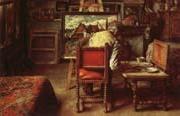
Belgian painter, was born at Antwerp. He was trained by his father, a genre painter, and his uncle, Baron Henri Leys, and devoted himself to scenes of everyday Antwerp life. The first pictures he exhibited, The Laundry (Van Cutsem collection, Brussels), and The Coppersmith's Workshop (Vleeshouwer collection, Antwerp), were shown. at the Antwerp exhibition in 1861. He received the gold medal at Brussels in 1872 for The Geographer and The Lesson (both in the Brussels gallery); the gold medal at Vienna in 1873 for The Painter's Studio and Grandmother's Birthday ; and the medal of honor at the Exposition Universelle at Amsterdam for The Pilot House. Among his more notable works are A Shoemaker (1862), A Tailor's Workroom (1863), A Gardener (1864, Antwerp gallery), Interior of a Church (1866), Interior, Flanders (1867), Woman Spinning (1869), Man Reading (1871), Theruedu Serment, Antwerp (1875), A Copperplate Printer, The Sailor's Return, The Man at the Window (Couteaux collection, Brussels), The Horn-blower (Couteaux collection), Man Retouching a Picture (Couteaux collection), The Potters (Marlier collection, Brussels), Staircase in the Hydraulic House at Antwerp (Marlier collection), and The Brewer's House at Antwerp (Marlier collection). The last, better known as A Man Sitting, is generally regarded as his masterpiece. As a lithographer and etcher, his work resembles that of Henri Leys.
|
|
|
|
|
|
 |
Hendrick van Balen the Elder
|
|
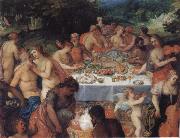
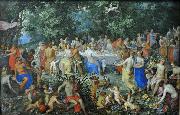
painted The Wedding of Thetis and Perseus with Apollo and the Concert of the Muses, or The Feast of the Gods in ca. 1618
|
|
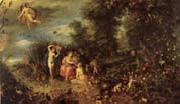 |
Hendrick van balen
|
|
Dutch Baroque Era Painter, ca.1575-1632
was a Flemish painter, who was born and died in Antwerp. Van Balen studied art while traveling in Italy. He was the teacher of Anthony Van Dyck and Frans Snyders and was also a contemporary of many of the other famous Flemish artists
|
|
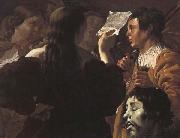 |
Hendrick the Brugghen
|
|
1588-1629
Dutch painter and draughtsman. He was, with Gerrit van Honthorst and Dirck van Baburen, one of the leading painters in the group of artists active in Utrecht in the 1620s who came to be known as the UTRECHT CARAVAGGISTI, since they adapted Caravaggio's subject-matter and style to suit the Dutch taste for religious and secular paintings. Ter Brugghen was an important innovator for later Dutch 17th-century genre painting; his recognition as an unorthodox,
|
|
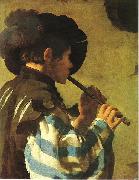 |
Hendrick ter Brugghen
|
|
(1588 - Nov 1, 1629) was a Dutch painter, and a leading member of the Dutch followers of Caravaggio ?? the so-called Dutch Caravaggisti.
Little is known of the early life of ter Brugghen; he could have been born in The Hague, but his family seems to have moved to the strongly Catholic Utrecht in the early 1590s. Here he started painting at the age of thirteen, studying with Abraham Bloemaert. From Bloemaert, a Mannerist history painter, he learned the basics of the art. Around 1604, however, ter Brugghen travelled to Italy to expand his skills, a rather unusual move for Dutch painters at the time. He was in Rome in 1604, and could therefore have been in direct contact with Caravaggio.
|
|
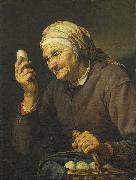 |
Hendrick Bloemaert
|
|
(1601 -- 1672), was a Dutch Golden Age painter.
Hendrick was the oldest son of Abraham Bloemaert. His brothers Cornelis and Adriaen were also painters. In 1626 he was registered in Rome, but by 1631 he was back in Utrecht, where he registered in the Utrecht Guild of St. Luke and married Margaretha van der Eem, the daughter of a lawyer.
|
|
 |
HELST, Bartholomeus van der
|
|
Dutch Baroque Era Painter, 1613-1670
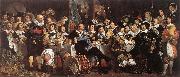
Dutch painter. He was the son of a Haarlem inn-keeper and presumably undertook part or all of his training in Amsterdam. His earliest works suggest that the painter Nicolaes Eliasz. Pickenoy was his master. Although van der Helst had probably already established himself as an independent master by the time he married Anna du Pire in Amsterdam in 1636, his earliest known work, a portrait of The Regents of the Walloon Orphanage, Amsterdam (Amsterdam, Maison Descartes), dates from 1637. Stylistically it is close to the work of Pickenoy. His portrait of a Protestant Minister of 1638 (Rotterdam, Boymans-van Beuningen) reveals the influence of Rembrandt. The young artist must have risen rapidly to fame in Amsterdam, for as early as 1639 he received the prestigious commission for a large painting for the Kloveniersdoelen (Arquebusiers' or Musketeers' Hall): The Civic Guard Company of Capt. Roelof Bicker and Lt Jan Michielsz. Blaeuw (Amsterdam, Rijksmus.), which formed part of the same series as Rembrandt's 'Night Watch' (Amsterdam, Rijksmus.). Van der Helst may not have completed this commission until 1642 or 1643. The ingenious arrangement of the figures in a broad composition shows the artist's special talent for composing large groups. Pickenoy's influence is less noticeable here than in the portrait of 1637; the self-assured poses of the individual figures were to become a characteristic feature of van der Helst's work. The successful execution of this portrait established van der Helst's reputation: from 1642, when he began to receive an increasing number of commissions for individual portraits, until 1670 he was the leading portrait painter of the ruling class in Amsterdam. From 1642 his technique in portrait painting gradually became more fluent and the rendering of costume materials more detailed. Some typical portraits of his earlier period are those of Andries Bicker (Amsterdam, Rijksmus.), his wife Catharina Gansneb Tengnagel (Dresden, Gem?ldegal. Alte Meister) and their son Gerard Bicker (Amsterdam, Rijksmus.), all of 1642, and the Portrait of a Young Girl (1645; London, N.G.). In 1648 van der Helst painted a second civic guard portrait, The Celebration of the Peace of M?nster at the Crossbowmen's Headquarters, Amsterdam (Amsterdam, Rijksmus.), a superbly composed and well painted portrait that, until the late 19th century, was considered one of the masterpieces of the Golden Age but later lost popularity because of its smooth and modish execution. It can nevertheless still be regarded as one of the most important group portraits of the 17th century.
|
|
|
|
 |
hector berlioz
|
|
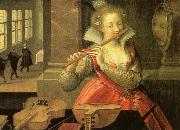
Period: Romantic (1820-1869)
Country: France
Born: December 11, 1803 in La Cocirc;te-St.-Andre, Isere, France
Died: March 08, 1869 in Paris, France
|
|
 |
Harriet Backer
|
|
Norwegian Painter, 1845-1932
Norwegian painter. In the 1860s and early 1870s she took lessons in drawing and painting in Christiania (now Oslo) and also travelled extensively in Europe with her sister Agathe, a composer and pianist. She copied works in major museums and took occasional art lessons; she later considered this experience to have been of fundamental importance to her artistic development. Little Red Riding Hood (1872; Oslo, N.G.) is impressive in technique, and the early portrait of her sister, Agathe Backer-Grendahl (1874; Holmestrand, Komm.), shows a refined colour scheme. At the age of nearly 30 Backer decided to train professionally as a painter and in 1874 went to Munich. She was never attached to a particular institution, but the influence of her friend the artist Eilif Peterssen was crucial to her development. In Munich she made a thorough study of perspective, which formed a secure basis for her later work.
|
|
 |
Hans Burgkmair
|
|
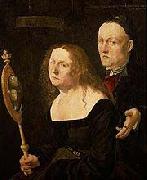
(1473 - 1531) was a German painter and printmaker in woodcut.
Burgkmair was born in Augsburg, the son of painter Thomas Burgkmair
and his son, Hans the Younger, became one too. From 1488 he was a pupil of Martin Schongauer in Colmar, who died during his two years there, before Burgkmair completed the normal period of training. He may have visited Italy at this time, and certainly did so in 1507, which greatly influenced his style. From 1491 he was working in Augsburg, where he became a master and opened his own workshop in 1498.
Hollstein ascribes 834 woodcuts to him, mostly for book illustrations, with slightly over a hundred being "single-leaf", that is prints not for books. The best of them show a talent for striking compositions, and a blend, not always fully successful, of Italian Renaissance forms and underlying German style. From about 1508 he spent much of his time working on the woodcut projects of Maximilian I until the Emperor's death in 1519. He was responsible for nearly half of the 135 prints in the Trumphs of Maximilian, which are large and full of character. He also did most of the illustrations for Weiss Kunig and much of Theurdank.
He was an important innovator of the chiaroscuro woodcut, and seems to have been the first to use a tone block, in a print of 1508.His Lovers Surprised by Death (1510) is the first chiaroscuro print to use three blocks.and also the first print that was designed to be printed only in colour, as the line block by itself would not make a satisfactory image. Other chiaroscuro prints from around this date by Baldung and Cranach had line blocks that could be and were printed by themselves.He produced one etching, Venus and Mercury (c1520),etched on a steel plate, but never tried engraving, despite his training with Schongauer.
|
|
 |
Hans Bollongier
|
|
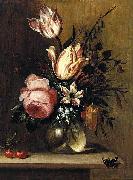
(1600-idem, 1645) was a Dutch Golden Age still life flower painter.
Bollongier was born in Haarlem. According to the RKD little is known of his early life. He became a member of the Haarlem Guild of St. Luke in 1623, and in 1675 his younger brother Horatio was named as his beneficiary. He was a specialist in bouquets of blooms. Paintings attributed to him that are not flower- or fruit still lifes are likely the work of his brother Horatio.He was an important influence on the later flower painters known as the monogrammist JF and Anthony Claesz II. He painted during a period of great productivity for Haarlem painters, during the decades after Karel van Mander published his Schilderboeck there. In Karel van Mander's book, there were a set of rules to follow to create good paintings and good drawings. Bollongier developed his own style and still observed all of these rules. His paintings were very popular, but his work was not regarded as such by contemporary Haarlem painters. As a genre, still life painting was considered inferior to historical allegories.
His work today is considered part of the proof that Tulip Mania took place, although there is reason to believe that this is also just part of early Haarlem tourist propaganda. Even as early as the 17th century, gentry from Amsterdam, Leiden, and places farther away enjoyed visiting the tulip fields of Haarlem in the Spring, and paintings of tulips were as popular as the bulbs.
|
|
 |
Hans Bol
|
|
(1534 - 1593), Flemish artist, received his early training from his two uncles who were also painters. He then was the apprentice to a Mechelen watercolorist and tempera painter at the age of fourteen. Because Boles watercolors became so widely reproduced, he began creating miniatures on parchment. The technique earned him many international clients and a good income. In addition, Bol also produced several oil paintings, illuminated manuscripts, drawings, and engravings. He preferred to create landscapes, mythological, allegorical and biblical scenes, and genre paintings.
Bol was a mannerist, which followed the High Renaissance.
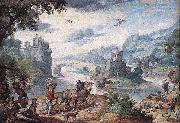
One of his most famous works of art is Landscape with the Fall of Icarus, made with watercolours on paper. It was inspired by Ovid's Metamorphoses, in which the ancient myth of Icarus is told. The painting is a marvelous example of the art of landscape. Subtle colour transitions, skilful perspective and effective contrasts between foreground and background, and human figures and the forces of nature, lend this miniature painting a cosmic dimension.
Bol chose the Icarus theme on several occasions. It was also subject of one of his paintings, which described in detail and highly praised by Karel van Mander in the 17th century. Although Bol was once an important and admired painter, we only know him through his small drawings and watercolours. Most of his paintings appear to have been lost. This miniature is all the more important, because it probably produces the painting referret to by Van Mander, which may have been his masterpiece. Consequently, Bol ought to be viewed not only as a superior miniature painter, but above all as an important artist who played a key role in the development of landscape art.
|
|
 |
Hans Baluschek
|
|
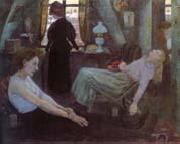
German, 1870-1935,German illustrator, painter, and writer, known for his graphic depictions of the proletarian milieu and hard life in big cities. Baluschek was also a renowned illustrator of fairy tales and produced superb illustrations for five books in the series Deutsche Marchenbucherei published by the Klemm Verlag between 1878 and 1923: Peterchens Mondfahrt (Little Peter's Flight to the Moon, 1915), Pips der Pilz. Ein Wald?\ und Weihnachtsmarchen (Pips the Mushroom: A Forest and Christmas Fairy Tale, 1920), Prinzessin Huschewind (Princess Hush Wind, 1922), and Ins Marchenland (Into Fairyland, 1922). He employed aquarelles and oils to form unusual and bizarre characters and also used ink to create the text.
|
|
 |
Hans Baldung Grien
|
|
German
1485-1545
Hans Baldung Grien Galleries
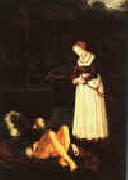
The earliest pictures assigned to him by some are altar-pieces with the monogram H. B. interlaced, and the date of 1496, in the monastery chapel of Lichtenthal near Baden-Baden. Another early work is a portrait of the emperor Maximilian, drawn in 1501 on a leaf of a sketch-book now in the print-room at Karlsruhe. "The Martyrdom of St Sebastian and the Epiphany" (Berlin Museum), fruits of his labour in 1507, were painted for the market-church of Halle in Saxony.
Baldung's prints, though D??reresque, are very individual in style, and often in subject. They show little direct Italian influence. His paintings are less important than his prints. He worked mainly in woodcut, although he made six engravings, one very fine. He joined in the fashion for chiaroscuro woodcuts, adding a tone block to a woodcut of 1510.[1] Most of his hundreds of woodcuts were commissioned for books, as was usual at the time; his "single-leaf" woodcuts (ie prints not for book illustration) are fewer than 100, though no two catalogues agree as to the exact number.
He was extremely interested in witches and made many images of them in different media, including several very beautiful drawings finished with bodycolour, which are more erotic than his treatments in other techniques.
Witch and Dragon. Drawing with bodycolour (b/w repro)Without absolute correctness as a draughtsman, his conception of human form is often very unpleasant, whilst a questionable taste is shown in ornament equally profuse and baroque. Nothing is more remarkable in his pictures than the pug-like shape of the faces, unless we except the coarseness of the extremities. No trace is apparent of any feeling for atmosphere or light and shade. Though Gr??n has been commonly called the Correggio of the north, his compositions are a curious medley of glaring and heterogeneous colours, in which pure black is contrasted with pale yellow, dirty grey, impure red and glowing green. Flesh is a mere glaze under which the features are indicated by lines. (1911)
His works are mainly interesting because of the wild and fantastic strength which some of them display. His Eve, the Serpent and Death (National Museum of Canada) shows his strengths well. We may pass lightly over the "Epiphany" of 1507, the "Crucifixion" of 1512, or the "Stoning of Stephen" of 1522, in the Berlin Museum. There is some force in the "Dance of Death" of 1517, in the museum of Basel, or the Madonna of 1530, in the Liechtenstein Gallery at Vienna. Gr??n's best effort is the altarpiece of Freiburg, where the Coronation of the Virgin, and the Twelve Apostles, the Annunciation, Visitation, Nativity and Flight into Egypt, and the Crucifixion, with portraits of donors, are executed with some of that fanciful power which Martin Schongauer bequeathed to the Swabian school.
As a portrait painter he is well known. He drew the likeness of Charles V, as well as that of Maximilian; and his bust of Margrave Philip in the Munich Gallery tells us that he was connected with the reigning family of Baden, as early as 1514. At a later period he had sittings from Margrave Christopher of Baden, Ottilia his wife, and all their children, and the picture containing these portraits is still in the grand-ducal gallery at Karlsruhe. Like D??rer and Cranach, Gr??n became a hearty supporter of the Reformation. He was present at the diet of Augsburg in 1518, and one of his woodcuts represents Luther under the protection of the Holy Ghost, which hovers over him in the shape of a dove.
|
|
|
|
|
|
|
|
|
| Wholesale China Oil Painting Wholesale Oil Painting China Xiamen Portrait Reproduction on canvas Chinese Oil Painting Wholesale USA Oil Painting |
|
|
|
|
|