| |
|
Xiamen Oil Paintings, Wholesale Direct!
|
|
100% hand painted, 100% cotton canvas, 100% money back if not satisfaction. |
|
|
|
|
ART WORKS INDEX
A
B
C
D
E
F
G
H
I
J
K
L
M
N
O
P
Q
R
S
T
U
V
W
X
Y
Z
|
|
ARTISTS INDEX
A
B
C
D
E
F
G
H
I
J
K
L
M
N
O
P
Q
R
S
T
U
V
W
X
Y
Z
|
|
|
|
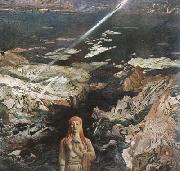 |
Leon Bakst
|
|
Russian Art Deco Designer and Illustrator, 1866-1924
|
|
 |
LEDESMA, Blas de
|
|
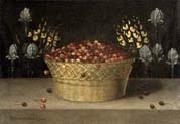
Spanish painter documented 1602-1614 in Granada,Spanish painter. He is known to have worked in Granada from 1602, and in 1614 he designed a stucco vault decoration for the Alhambra. Archival sources testify to his renown as a painter of decorative fresco grotesques (untraced) and still-lifes. His activity as a still-life painter remains debatable, partly because he has been confused with Blas de Prado and also because of Torres Marten's controversial attributions. Ledesma's only unanimously accepted autograph painting is Still-life with Cherries and Flowers (Atlanta, GA, High Mus. A.), signed in Granada. A highly decorative painting, it shows none of the sophistication of still-lifes by Juan Senchez Cot?n, in Granada from 1603. It is painted meticulously and drily. Depicting a severely drawn, rather flat basket on a narrow ledge flanked by flowers behind it, the rigorously symmetrical composition is relieved only by soft lighting and the studied disarray of some fallen cherries. Two other unsigned and poorly preserved still-lifes of analogous subject-matter have been attributed to Ledesma
|
|
|
|
 |
Lady Anne Barnard
|
|
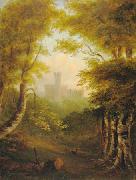
(12 December 1750-6 May 1825), nee Anne Lindsay, eldest daughter of James Lindsay, 5th Earl of Balcarres was born at Balcarres House, Fife, Scotland. She was author of the ballad Auld Robin Gray and an accomplished travel writer, artist and socialite of the period. Her five year residence in Cape Town, South Africa, although brief, had a significant impact on the cultural and social life of the time.
|
|
|
|
 |
Knud Bergslien
|
|
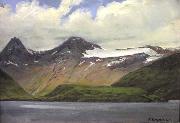
(May 15, 1827 - November 27, 1908) was a Norwegian painter, art teacher and master artist. In his art, he frequently portrayed the lives of the Norwegian people, their history and heroes of the past. Bergslien is most associated with his historical paintings, especially Skiing Birchlegs Crossing the Mountain with the Royal Child.
Knud Larsen Bergslien was born in Voss, in Hordaland, Norway. His parents were Lars Bergeson Bergslien and Kirsten Knutsdotter Gjelle. Knud Bergslien was the brother of sculptor Brynjulf Bergslien and uncle of painter and sculptor Nils Bergslien. Monuments honoring the three famous Bergslien artists now exist in Bergslien park located in Voss, Hordaland
|
|
|
|
|
|
|
|
 |
Karl Briullov
|
|
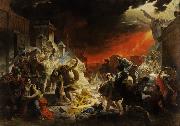
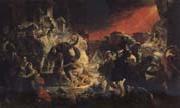
Russian Neoclassical/Romantic Painter, 1799-1852,was an internationally renowned Russian painter. He is regarded as a key figure in transition from the Russian neoclassicism to romanticism. Born of French parents in Saint Petersburg, Carlo Brulleau (as his name was spelled until 1822) felt drawn to Italy from his early years. Despite his education at the Imperial Academy of Arts (1809?C1821), Briullov never fully embraced the classical style taught by his mentors and promoted by his brother, Alexander Briullov. After distinguishing himself as a promising and imaginative student and finishing his education, he left Russia for Rome where he worked until 1835 as a portraitist and genre painter, though his fame as an artist came when he began doing historical painting. His best-known work, The Last Day of Pompeii (1830?C1833), is a vast composition compared by Pushkin and Gogol to the best works of Rubens and Van Dyck. It created a sensation in Italy and established Briullov as one of the finest European painters of his day. After completing this work, he triumphantly returned to the Russian capital, where he made many friends among the aristocracy and intellectual elite and obtained a high post in the Imperial Academy of Arts.
|
|
 |
Karl Bodmer
|
|
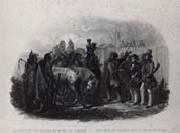
Swiss Painter, 1809-1893,Swiss painter and graphic artist, active in the USA and France. His earliest exposure to art probably came from his uncle, the landscape painter and engraver Johann Jakob Meyer (1787-1858). When he was 22, Bodmer moved to Paris, where he studied art under Sebastien Cornu. In Paris he met his future patron, Prince Maximilian of Wied-Neuwied, who was planning an ambitious scientific expedition to North America. Bodmer was engaged to accompany the expedition and to provide sketches of the American wilderness. After touring the East Coast, the party made their way westward via the Ohio and Mississippi rivers to St Louis, MO, and in 1833 travelled up the Missouri River into country scarcely inhabited by white men. On the journey north to Ft MacKenzie, WY, Bodmer recorded the landscape and the groups of Indians they encountered. Having wintered in Ft Clark, ND, they returned to New York and then Europe in 1834.
|
|
 |
Karl Blechen
|
|
German Romantic, 1798-1840
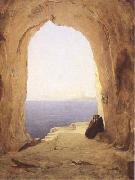
sometimes given as Karl Blechen, was a German painter, specializing in fantastic landscapes, sometimes with demons and grotesque figures. Born in Cottbus, he drew the attention of prominent architect Karl Friedrich Schinkel, who cast him as a decorative painter. Blechen however aimed for higher work and began producing landscape paintings. In 1827 he went to Italy
|
|
|
|
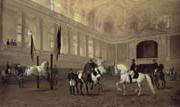 |
Julius von Blaas
|
|
1845-1923,was an Italian painter, the second son of Karl, born at Albano, Italy. He studied under his father, devoted himself principally to equestrian subjects, and went to Rome where he painted genre scenes from the Campagna. His "Race of Intoxicated Slavonic Peasants" (1869) is in the Imperial Museum of Vienna, as is "Antlassritt" (1899). Julius von Blaas was much employed by the Austrian court as a portrait painter and became professor in the Academy of Vienna.
|
|
|
|
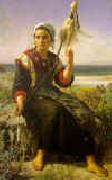 |
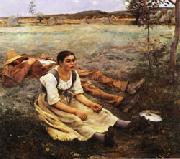
Jules Breton
|
|
1827-1906
French Jules Breton Locations
French painter and writer. After the death of his mother he was brought up in the village of Courrires by his father, grandmother and uncle. The last instilled in him respect for tradition and a commitment to the philosophical ideas of the 18th century. Breton father, as supervisor of the lands of the Duc de Duras, encouraged him to develop a deep knowledge of and affection for his native region and its heritage, which remained central to his art.
|
|
 |
Jules Bastien-Lepage
|
|
French Realist Painter, 1848-1884
French painter. Bastien-Lepage grew up on a farm. Although his earliest efforts in drawing were encouraged, his parents violently objected when he decided to become a professional artist. To mollify them he worked for a time as a postal clerk in Paris while studying at the Ecole des Beaux-Arts. In 1868 he left the civil service and was accepted into Alexandre Cabanel's atelier. During this apprenticeship, Bastien-Lepage won two prizes in drawing, and in 1870 he made his d?but at the Salon with a Portrait of a Young Man (untraced). In the Franco-Prussian War (1870-71) he joined a regiment of sharpshooters and was severely wounded in the chest. When he recovered he attempted unsuccessfully to find work as an illustrator.
|
|
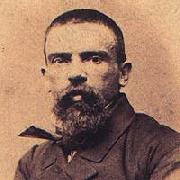 |
Juan Manuel Blanes
|
|
(June 8, 1830 - April 15, 1901) was a noted Uruguayan painter of the Realist school.
Blanes was born in Montevideo, Uruguay, in 1830. He was raised by his mother, with whom he relocated to the countryside in his early teens. Blanes took an interest in drawing at this point, and shortly afterwards, was hired as an illustrator for a Montevideo newsdaily, El Defensor de la Independencia Americana. Earning extra income with watercolors, he returned to his mother and, in 1854, established his first atelier.
He married Marea Linari, and in 1855, the couple settled in Salto, where he worked as a portrait painter. They relocated to Concepcien del Uruguay (across the Uruguay River, in Argentina) in 1857, and Blanes was commissioned by Argentine President Justo Jose de Urquiza to complete a number of portraits, allegories and landscapes to grace his nearby estancia, the Palacio San Jose. Returning to Montevideo in 1861, the talented painter obtained a scholarship from the Uruguayan government, and with it, traveled with his family to Florence, Italy, where he studied under Antonio Ciseri until 1864.
The experience became a valuable calling card for Blanes, who became of Uruguay's most sought-after portraiteurs. The 1871 outbreak of a yellow fever epidemic in Buenos Aires inspired his first renowned work, which he exhibited to acclaim in the recovering city. His 1872 portrait of the Argentine War of Independence hero, General Jose de San Marten (The Review in Rancagua), was also a success in Buenos Aires, and Blanes was invited to Chile to display the historic depiction.
|
|
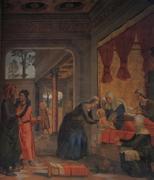 |
Juan de Borgona
|
|
Spanish Painter,
ca.1470-1534
was a High Renaissance painter who was born in the Duchy of Burgundy, probably just before it ceased to exist as an independent state, and was active in Spain from about 1495 to 1534. His earliest documented work was painted in 1495 for the cloister of the Cathedral of Toledo. Borgoña??s compositions are well balanced with finely drawn figures in elegant, tranquil poses. They are set either against open spaces leading on to craggy landscapes or against gold embroidered drapery. There were a number of foreign painters active in Spain in this period, including Juan de Flandes. Borgona??s students include Pedro de Cisneros the Elder (died 1546), Antonio de Comontes (ca. 1500-1519),
|
|
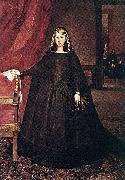 |
Juan Bautista del Mazo
|
|
Juan Bautista Martenez del Mazo (c.1612 - 10 February 1667) was a Spanish Baroque portrait and landscape painter, the most distinguished of the followers of Velezquez, whose style he imitated more closely than did any other artist. A fine painter himself, Mazo was a master of landscape, as proven by his most celebrated work View of Saragossa.
|
|
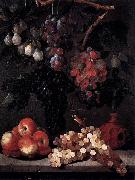 |
Juan Bautista de Espinosa
|
|
(1590-1641, Madrid) was a Spanish still life painter.
More paintings remain of him than biographical data and there is only one known painting remaining.
It is only known that he worked in Toledo and Madrid from 1612 to 1626 and, judging by his style, he was trained in Holland. De Espinosa's style is judged to be the transition from Flemish Baroque to Spanish Baroque.
Several mural paintings in Spanish churches are also attributed to him; one of these is in Alcaudete.
|
|
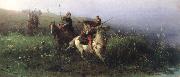 |
jozef brandt
|
|
Jozef Brandt (b. Szczebrzeszyn, 1841 - Radom, 1915) was a Polish painter, best known for his paintings of battles.
Brandt studied in Warsaw in the school of J.N. Leszczynski and at the Noblemen Institute. In 1858 he left for Paris to study at the Ecole centrale Paris but was persuaded by Juliusz Kossak to abandon engineering in favor of painting. At one point he studied as a painter under Franz Adam.
|
|
|
|
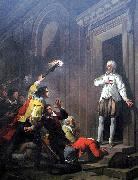 |
Joseph-Benoit Suvee
|
|
(3 January 1743 - 9 February 1807) was a Flemish painter strongly influenced by French neo-classicism.
He was born in Bruges. Initially a pupil of Matthias de Visch, he came to France aged 19 and became a pupil of Jean-Jacques Bachelier. In 1771, he won the Prix de Rome. In Rome from 1772 to 1778, he prolonged the usual duration allowed to pensionaries of the French Academy in Rome. He was named an academician on his return to Paris and he opened an art school for young women at the Louvre. He emulated and competed with Jacques-Louis David, earning his enduring hatred.
Named the French Academy in Rome's director in 1792, replacing François-Guillaume Menageot, he was imprisoned for a while in the Prison Saint-Lazare and only able to take up the post in 1801. After a brilliant career, and a six years' stay in Rome as the Academy's Director, he died there suddenly.
His works include Achilles depositing the body of Hector at the feet of the body of Patroclus, (1769, Louvre), and Cornelia, mother of the Gracchi, (1795, Louvre).
|
|
|
|
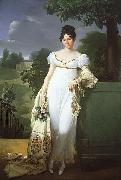 |
Joseph Blondel
|
|
Merry-Joseph Blondel (Paris, July 5, 1781 - Paris, June 12, 1853) was a French neo-classic painter.
After a first training in the Dilh et Guerhard porcelain factory, he later was a painting student of Jean-Baptiste Regnault. He won in 1803 Price of Rome with his painting Enee portant son pere Anchise. He lived in Villa Medicis, in Rome, Italy, from 1809 to 1812, and won a gold award for his painting Mort de Louis XII. He then started a career as an interior decorator (Fontainebleau Castel, Brongniart Palace, Louvre Museum, Senat).
|
|
|
|
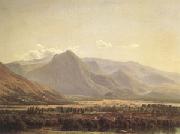 |
Joseph Bidauld
|
|
Carpentras(Vaucluse)1758-Montmorency (Val d'Oise)1846
French painter. He was apprenticed in Lyon for six years with his brother Jean-Pierre-Xavier Bidauld (1745-1813), a landscape and still-life painter. Subsequently, they left Lyon to travel together in Switzerland and Provence. In 1783 he moved to Paris, where he met Joseph Vernet (from whom he received valuable advice), Joseph-Siffred Duplessis and Jean-Honor? Fragonard. In 1785 he went to Rome with the assistance of Cardinal de Bernis and his patron, the dealer and perfumer Dulac. He stayed there for five years, travelling through Tuscany, Umbria and Campania and painting such works as Roman Landscape (1788; Basle, Kstmus.). Bidauld was closely involved with the circle of French Neo-classical painters in Rome in the 1780s. He was friendly with Louis Gauffier, Nicolas-Antoine Taunay and especially with Guillaume Lethiere, who became his brother-in-law and with whom he occasionally collaborated. On his return to Paris in 1790 he travelled extensively in France,
|
|
|
|
 |
Joseph Barney
|
|
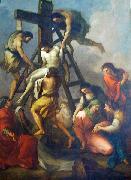
(1753 - 13 April 1832), was an English artist and engraver. He is usually described as a pupil of Antonio Zucchi and Angelica Kauffmann and as a fruit and flower painter to the Prince Regent. He was born in Wolverhampton.
Two of his large-scale paintings - altar pieces eThe Deposition from the Crosse (1781) and eThe Apparition of Our Lord to St Thomase (1784) have been preserved in Wolverhampton, and can be seen today at St Johnes church and at St Peter & St Paules Roman Catholic church. During Barneyes life-time, his artistic achievements were respected and praised. In 1798, Stebbing Shaw, mentioning eThe Deposition from the Crosse in his eHistory of Staffordshiree called Barney a enative geniuse of Wolverhampton. In the collection of Wolverhampton Art Gallery, there is a pen and ink drawing, eA Blind Musiciane, which gives some additional idea of quality and versatility of Barneyes works.
|
|
 |
Joseph Badger
|
|
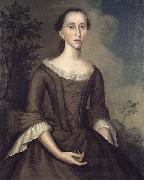
(ca.1707-1765) was a portrait artist in Boston, Massachusetts in the 18th-century. He painted some 80 portraits of merchants, businessmen, clergy, and other notables, and their wives and children.
Badger was born in Charlestown, Massachusetts, to tailor Stephen Badger and Mercy Kettell. In 1731 he married Katharine Felch; they moved to Boston around 1733. He was a member of the Brattle Street Church.
He "began his career as a house-painter and glazier, and ... throughout his life continued this work, besides painting signs, hatchments and other heraldic devices, in order to eke out a livelihood when orders for portraits slackened."
|
|
|
|
|
|
 |
Jorg Breu the Elder
|
|
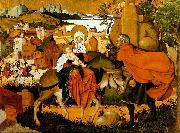
(c. 1475 -- 1537), of Augsburg, was a painter of the German Danube school. He was the son of a weaver.
He journeyed to Austria and created several multi-panel altarpieces there in 1500-02, such as the Melk Altar (1502). He returned to Augsburg in 1502 where he became a master. He travelled to Italy twice, in ca. 1508 and in 1514/15.
After his death in 1537, his son, Jörg Breu the Younger continued to lead his Augsburg workshop until his own death 10 years later.
|
|
 |
John wharlton bunney
|
|
1828-1882
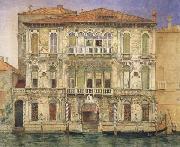
was an English topographical and landscape artist of the nineteenth century. His father was a merchant captain whom Bunney, as a boy, accompanied on several voyages around the world. Bunney demonstrated a strong talent for drawing and draftsmanship from an early age. The young Bunney became a follower of John Ruskin; he studied with Ruskin at the Working Men's College soon after its founding in 1854, and later worked as a clerk for Smith, Elder & Co., Ruskin's publisher. Bunney was able to give up his clerical job and make his living by his art and art teaching by 1859; Ruskin commissioned him to execute a series of drawings in Italy and Switzerland.Bunney married Elizabeth Fallon in 1863. The couple settled in Florence; they would have four children. Bunney worked for Ruskin's St. George's Company (later the Guild of St George) in northern Italy for the remainder of his life. In his career there, Bunney produced a noteworthy pictorial record of Italy in his era. Ruskin said that Bunney's work was "so faithful and careful as almost to enable the spectator to imagine himself on the spot." Bunney was a friend of many of the Pre-Raphaelites, especially William Holman Hunt. From 1870 on, Bunney lived and painted in Venice. In 1876 Ruskin commissioned Bunney to paint a picture that included the entire western facade of St. Mark's Basilica
|
|
|
|
|
|
|
|
|
|
|
|
|
|
 |
John George Brown
|
|
1831-1913
John George Brown Galleries
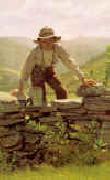
John George Brown (November 11, 1831 - February 8, 1913), American painter, was born in Durham, England, on 11 November 1831. He studied at Newcastle-on-Tyne, in the Edinburgh Academy, and after moving to New York City in 1853, he studied with Thomas Seir Cummings at the schools of the National Academy of Design, of which he became a member in 1863.New International Encyclopedia He was its vice-president, 1899-1904, and originated the idea of the removal of the Academy to a new site in 110th Street.
In 1866 he became one of the charter members of the Water-Color Society, of which he was president from 1887 to 1904. He generally confined himself to representations of street child life, bootblacks, newsboys, etc.; his Passing Show (Paris, Salon, 1877) and Street Boys at Play (Paris Exhibition, 1900) are good examples of his popular talent. Brown's art is best characterized as British genre paintings adapted to American subjects. Essentially literary, it is executed with precise detail, but is poor in color, and more popular with the general public than with connoisseurs.
|
|
|
|
|
|
|
|
|
|
 |
John Brett
|
|
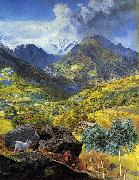
John Brett (1831-1902) was an artist associated with the Pre-Raphaelite movement (although is not considered to be a Pre-Raphaelite painter himself), mainly notable for his highly detailed landscapes. Brett was born near Reigate on 8 December 1831, the son of an army vet. In 1851 he began lessons in art with James Duffield Harding, a landscape painter. He also studied with Richard Redgrave. In 1853 he entered the Royal Academy schools, but was more interested in the ideas of John Ruskin and William Holman Hunt, whom he met through his friend the poet Coventry Patmore. Inspired by Hunt's ideal of scientific landscape painting Brett visited Switzerland, where he worked on topographical landscapes and came under the further influence of John William Inchbold.
|
|
|
|
|
|
|
|
|
|
|
|
|
|
|
| Wholesale China Oil Painting Wholesale Oil Painting China Xiamen Portrait Reproduction on canvas Chinese Oil Painting Wholesale USA Oil Painting |
|
|
|
|
|