| |
|
Xiamen Oil Paintings, Wholesale Direct!
|
|
100% hand painted, 100% cotton canvas, 100% money back if not satisfaction. |
|
|
|
|
ART WORKS INDEX
A
B
C
D
E
F
G
H
I
J
K
L
M
N
O
P
Q
R
S
T
U
V
W
X
Y
Z
|
|
ARTISTS INDEX
A
B
C
D
E
F
G
H
I
J
K
L
M
N
O
P
Q
R
S
T
U
V
W
X
Y
Z
|
|
|
|
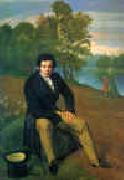 |
Orest Kiprensky
|
|
1782-1836
Russian
Orest Kiprensky Galleries
Orest was born in the village of Koporye near Saint Petersburg on 24 March [O.S. 13 March] 1782. He was an illegitimate son of a landowner Alexey Dyakonov, hence his name, derived from Kypris, one of the Greek names for the goddess of love. He was raised in the family of Adam Shvalber, a serf. Although Kiprensky was born a serf, he was released from the serfdom upon his birth and later his father helped him to enter a boarding school at the Imperial Academy of Arts in Saint Petersburg in 1788 (when Orest was only six years old).
He studied at the boarding school and the Academy itself until 1803. He lived at the Academy for three more years as a pensioner to fulfill requirements necessary to win the Major Gold medal. Winning the first prize for his work Prince Dmitri Donskoi after the Battle of Kulikovo (1805) enabled the young artist to go abroad to study art in Europe.
A year before his graduation, in 1804, he painted the portrait of Adam Shvalber, his foster father (1804), which was a great success. The portrait so impressed his contemporaries, that later members of the Naples Academy of Arts took it for the painting by some Old Master - Rubens or van Dyck. Kiprensky had to ask the members of the Imperial Academy of Arts for letters supporting his authorship.
Wikimedia Commons has media related to: Orest Kiprensky
After that, Kiprensky lived in Moscow (1809), Tver 1811, Saint Petersburg 1812, in 1816-1822 he lived in Rome and Napoli. In Italy he met a local girl Anne Maria Falcucci (Mariucci), to whom he became attached. He bought her from her dissolute family and employed as his ward. On leaving Italy, he sent her to a Roman Catholic convent.
In 1828, Kiprensky came back to Italy, as he got a letter from his friend Samuel Halberg, informing him that they had lost track of Mariucci. Kiprensky found Mariucci, who had been transferred to another convent. In 1836 he eventually married her. He had to convert into Roman Catholicism for this marriage to happen. He died by pneumonia in Rome later that year.
|
|
|
|
 |
Nils Kreuger
|
|
Swedish, 1858-1930,Swedish painter, draughtsman and illustrator. From 1874 he studied at the Konstakademi in Stockholm, where he soon became a friend of Richard Bergh and Karl Nordstrem, both of whom were later prominent exponents of the more advanced Swedish painting of the 1880s and 1890s. After being forced to interrupt his studies because of illness, Kreuger trained from 1878 at the art school of Edvard Perseus (1841-90) in Stockholm before he travelled to Paris, where he stayed for the most part until 1887. He made his d?but at the Paris Salon in 1882, and he also resided in the artists' colony in Grez-sur-Loing. During this period he painted such works as Old Country House (1887; Stockholm, Nmus.) with a free brushwork and sense of light that owed much to Jules Bastien-Lepage. In 1885 Kreuger was active in organizing the Opponenterna, a protest movement led by Ernst Josephson against the conservative establishment of the Konstakademi in Stockholm, and the following year he helped to found the Konstn?rsf?rbund (Artists' Union). Like the majority of the Konstnersferbund's members, Kreuger abandoned the French-inspired plein-air realism of the 1880s for symbolically coloured National Romanticism in the 1890s. For Kreuger this change took place between 1893 and 1896 in Varberg on the west coast of Sweden, where, together with Bergh and Nordstrem, he founded the Varberg Group. Drawing on Paul Gauguin's Synthetism, the group contributed to the formation of the National Romantic style of the 1890s in Sweden. Kreuger's encounter with van Gogh's drawings at an exhibition in Copenhagen in 1893 also played a decisive role in his development. He devised an intensely personal style in which the landscape was composed in large blocks that were then covered by a pattern of directional lines and dots in India ink (somewhat in the manner of van Gogh's late landscape drawings) to bring out the painting's colour values and create an effect of decoratively stylized forms: for example Spring in Halland (1894; Stockholm, Nmus.). Kreuger was also a prolific draughtsman and illustrator.
|
|
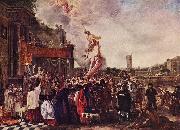 |
Nikolaus Knupfer
|
|
(1609 - 1655) was a Dutch Golden Age painter.
Knepfer was trained in Leipzig, where according to Houbraken he was apprenticed to Emanuel Nysen. He then moved to Magdeburg where he found work making brushes for artists. He stayed there until 1630, and then moved to Utrecht to work with Abraham Bloemaert. He lived with him for two years and then established his own studio in Utrecht, where in 1637 he became a visiting member of the Guild of St. Luke. He worked on the decorations of the castle Kronborg in Denemarken, and painted figures in the landscapes of Jan Both and Jan Baptist Weenix. Knepfer was a successful teacher, whose students were great painters after him, such as Jan Steen, Gabriel Metsu, Ary de Vois, and Pieter Crijnse Volmarijn.
|
|
|
|
|
|
|
|
|
|
|
|
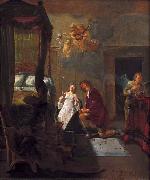 |
Nicolaes Knupfer
|
|
(1609 - 1655) was a Dutch Golden Age painter.
Knepfer was trained in Leipzig, where according to Houbraken he was apprenticed to Emanuel Nysen. He then moved to Magdeburg where he found work making brushes for artists. He stayed there until 1630, and then moved to Utrecht to work with Abraham Bloemaert. He lived with him for two years and then established his own studio in Utrecht, where in 1637 he became a visiting member of the Guild of St. Luke. He worked on the decorations of the castle Kronborg in Denemarken, and painted figures in the landscapes of Jan Both and Jan Baptist Weenix. Knepfer was a successful teacher, whose students were great painters after him, such as Jan Steen, Gabriel Metsu, Ary de Vois, and Pieter Crijnse Volmarijn.
|
|
 |
Nico Klopp
|
|
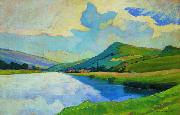
Den Nico Klopp war e letzebuergesche Moler. Hien ass den 18. September 1894 zu Bech-Maacher gebuer, an den 29. Dezember 1930 an der Stad Lëtzebuerg gestuerwen, wahrscheinlech un engem Gehirtumor, am Alter vun nëmme 36 Joer. Hie gëtt zu de postimpressionistesche Moler gerechent.
Säi LiewenDen Nico Klopp koum aus dem Wënzermilieu. Hien huet d'Handwierkerschoul an der Stad besicht. Seng Eltere si frei gestuerwen. No hirem Doud, huet hie sech fräi gefillt, fir vun 1915-1920 zu Dusseldorf a Weimar Konscht ze studeieren. Well hie vun der Konscht aleng net liewe konnt, war hien, vun 1923 un, Gemengereceveur zu Reimech.
Zäitweileg huet hien op Schoulen Zeechenunterrecht ginn, an huet nach en Täschegeld als Kannengerchersziichter verdengt. 1927 huet hie sech mat e puer anere Kënschtler, wei dem Joseph Kutter, dem Claus Cito, dem Auguste Tremont an anere vum Cercle Artistique getrennt, well him de Cercle ze reckstänneg war. Si goufe Sezessioniste genannt, well se 1927 e Salon de la Secession" organiseiert haten.
E puer vu senge Wierker sinn am Nationalmusee fir Geschicht a Konscht an der Stad ze gesinn.
Den Nico Klopp huet vill Biller vun der Musel gemoolt, bekannt si virun allem seng Biller vun der Muselbreck zu Reimech. Hien huet och Blummebiller gemoolt an dobäi hat hien eng Präferenz fir Tulpen. Ausserdeem war hien e Meeschter an Holz- a Linoschnëtter.
|
|
 |
Moritz Kellerhoven
|
|
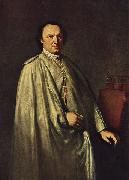
(1758-1830), sometimes referenced as Moritz Keller Hoven, was an Austrian painter and etcher.
Kellerhoven was born in Duchy of Berg, and spent some time studying art in Antwerp, Vienna, and Italy. He specialized in painting portraits, including many royal subjects. Kellerhoven died in Munich in 1830.
|
|
|
|
|
|
 |
Mina Kolokolnikov
|
|
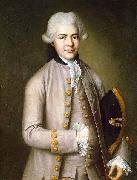
1708e-1775e) was a Russian painter and teacher.
Kolokolnikov was born in the village of Kravotyn in Tver gubernia. He was a serf of the Pafnutievo-Borovsky Monastery, and learnt the art of portrait painting from Ivan Nikitich Nikitin and Louis Caravaque; he also studied icon painting with Vasily Vasilevsky.
He is known to have assisted in the decoration of the palace at Tsarskoye Selo, and to have lived for a time in St. Petersburg, where one of his pupils was Trifon Anisimov. One of his portraits is in the Tver Regional Picture Gallery. He worked in the studio of Alexei Antropov; consequently, it is often difficult to tell Kolokolnikov's works from Antropov's, as both have very similar technique.
Kolokolnikov's brothers Ivan and Fedot were also painters.
|
|
 |
Miller, Kenneth Hayes
|
|
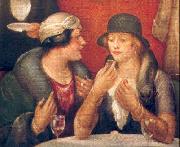
American Painter, 1876-1952
American painter and teacher. He studied with Kenyon Cox and William Merritt Chase before travelling to Europe in 1899. In the same year he also joined the staff of the New York School of Art. In 1911 he moved to the Art Students League, where he taught intermittently until 1951. As leader of the 14th Street school of urban genre painting, Miller was one of the most influential teachers of American artists since Robert Henri; his students included Isabel Bishop, Edward Hopper, George Bellows, Reginald Marsh and George Tooker (b 1920). His early work consists of romantic depictions of nude or semi-nude figures inhabiting dreamlike landscapes
|
|
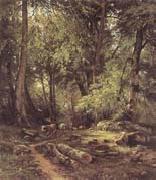 |
Mikhail Klodt
|
|
St. Petersburg,a descendant of an art dynasty1832-1902
|
|
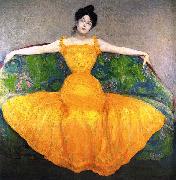 |
Max Kurzweil
|
|
Maximilian Franz Viktor Zdenko Marie Kurzweil (12 (13?) October 1867 Bisenz - 9 May 1916 Vienna) was an Austrian painter and printmaker. He moved near Vienna in 1879.
|
|
 |
Max Koch
|
|
(born July 17, 1854 - April 1, 1925) was a German-born Australian botanical collector.
Born in Berlin, Koch was apprenticed to a merchant's office, but, not liking the work, joined the crew of a Glasgow-based sailing ship at Bremerhaven. He left it at Port Augusta, South Australia in April 1878, taking work at a wheat farm. Later he moved to Mount Lyndhurst sheep station, where he remained for many years. Around 1896 he began serious botanical collecting.
Koch visited Germany around 1902-1903, then returned to Australia, and in 1904 moved to the extreme south-west of Western Australia, where he spent the next 17 years working in the timber industry. By that time he had a large family, and he supplemented his income by plant specimens, and, in his later years, seed. He died at Pemberton, Western Australia in 1925
|
|
 |
Max Klinger
|
|
German Symbolist Painter and Sculptor, 1857-1920
German painter, printmaker, sculptor and writer. He was one of the most versatile German artistic personalities of the turn of the 20th century and was especially celebrated for his cycles of prints, which were influential.
|
|
|
|
|
|
|
|
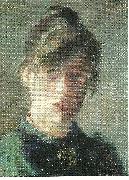 |
marie kroyer
|
|
(efter 1912 Alfven), född Triepcke 11 juni 1867 i Köpenhamn, död 25 maj 1940 i Stockholm, var en dansk konstnär, bosatt i Sverige från cirka 1905.
Marie Krøyer var 1889-1905 gift med konstnären Peder Severin Krøyer och hamnade i skuggan av hans konstnärskap. Själv kom hon att uppmärksammas som konstnär långt efter sin död. Hon levde ihop med den svenske tonsättaren Hugo Alfv??n från 1905 då de fick dottern Margita tillsammans; de gifte sig 1912 och skildes 1936 efter en lång rättsprocess. Paret var bosatta i Uppsala och Leksand. Marie hade också dottern Vibeke med Krøyer.
|
|
 |
MANDER, Karel van
|
|
b. 1548, Meulebeke, d. 1606, Amsterdam
Dutch painter, poet, and writer. Born of a noble family, after much wandering he settled in Haarlem in 1583 and founded a successful academy of painting with Hendrik Goltzius and Cornelis Cornelisz (1562 C 1638). He is best known for The Book of Painters (1604), which contains about 175 biographies of Dutch, Flemish, and German painters of the 15th C 16th centuries; it became for the northern countries what Giorgio Vasari's Lives of the Painters had been for Italy.
|
|
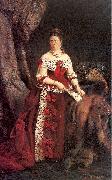 |
Makovsky, Konstantin
|
|
Russian, 1839-1915
He produced historical and social scenes, as well as being a portrait painter of some renown, although his significance lies more in the role he played as a founder-member of the WANDERERS art society in late 19th-century Russia. He studied first at the Moscow School of Painting and Sculpture (1851-8), which had been co-founded by his father Yegor Ivanovich Makovsky (1800-86), under Mikhail Ivanovich Skotti (1814-61) and Sergey Konstantinovich Zaryanko, then from 1858 to 1863 at the Petersburg Academy of Arts. In 1862 he was awarded a Minor Gold Medal, but the following year, together with 13 other students, Makovsky rebelled against the theme set for the Grand Gold Medal competition and left the Academy with the title of Artist of the Second Degree. In 1863 he joined the Petersburg Artel of artists, the forerunner of the Wanderers and the most potent symbol of the break with classical tradition. The reversal of official policy that this engendered led to his being made an academician in 1867, in 1869 a professor and in 1898 a full member of the Academy. As a member of the Wanderers, Makovsky was most notable for his new subject-matter, namely the common people. However, he split with the society in 1883 and by 1891 had become a member of the newly formed and more Salon-orientated St Petersburg Society of Artists, of which he was subsequently to be president. Makovsky often veered towards sentimentalism, giving his works a cloying pathos, as in his portrait of the Stasov Children (early 1870s) and Children Fleeing the Storm (1872),
|
|
|
|
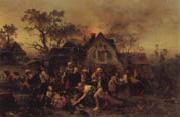 |
Ludwig Knaus
|
|
German Painter, 1829-1910
was a German genre painter of the younger Desseldorf school. He was born at Wiesbaden and studied from 1845 to 1852 under Sohn and Schadow in Desseldorf. His early works, like "The Gamblers," in the Desseldorf Gallery, are in the manner of that school, being dark and heavy in color. This deficiency was remedied by study at Paris, whither he went in 1852 and enrolled as a pupil of Couture. In 1853 his "Morning after the Kermess" received the second gold Medal of the Salon and made him a celebrated painter. Except for a year's study in Italy he remained in Paris until 1860.New International Encyclopedia His chief works of this period include "The Golden Wedding," "The Baptism," and "The Promenade," purchased for the Luxembourg. From 1861 to 1866 he practiced at Berlin, producing such works as "Boys Playing Cards," "Looking for a Bride" (Wiesbaden Museum), and "His Highness on His Travels." The next eight years of his life saw the production of much of his best work, including "The Children's Festival" (Nation Gallery, Berlin), "In Great Distress," and "The Village Prince." From 1874 to 1883 he was professor at the Academy of Berlin, continuing to reside in that city until his death. Among the most importand works of his last period were: "The Holy Family" and "The Road to Ruin," both painted in 1876 and now in the Metropolitan Museum of Art, New York; "Behind the Curtain" (1880), Dresden Gallery; "The Rag Baby" (1880) and "A Village Festival" (1881), both in the Vanderbilt collection, Metropolitan Museum, New York; and "A Duel." During his last period Knaus also painted a series of "Idyls," with nudes in a rather classical style, of which an important example is in the Wiesbaden Museum.
|
|
 |
ludvig karsten
|
|
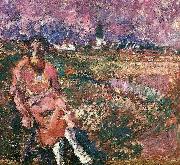
(Ludvig Peter Karsten), född 8 maj 1876 i Oslo, död 19 oktober 1926 i Paris, var en norsk målare. Han räknas som en av de viktigaste efterföljarna till Edvard Munch och räknades som en ledande impressionist.
|
|
|
|
|
|
 |
Lotz, Karoly
|
|
Hungarian Painter, 1833-1904
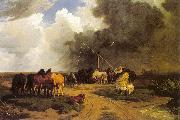
was a German-Hungarian painter. Karl Lotz was born in Bad Homburg vor der Höhe, Germany, the seventh and youngest surviving child of Wilhelm Christian Lotz and Antonia Höfflick. His father was a valet of Prince Gustav zu Hessen-Homburg at the time when the prince was representing Austria at the Congress of Vienna, which among other matters dealt with the House of Hessen-Homburg's rights of sovereignty over Hessen-Darmstadt. The sudden death of the young Baron von Sinclair, charge d'affaires, forced W. C. Lotz temporarily into the rôle. While in Hungary in 1815 he made the acquaintance of the 13-year-old Antonie Hoefflich, whom he married three years later. She gave birth to eight children, of whom Karl was the youngest. W. C. Lotz died in 1837 and Antonie moved the family to Pest (now that part of Budapest to the north of the River Danube). Karl attended the Piaristengymnasium, where, although Calvinist, he was awarded a scholarship for his exceptional academic performance. He began his artistic career as a pupil of the Hofkapellmeister Destouches, then in the academy of the Venetian master Jacopo Marastoni (1804-1860). Later he was a pupil of the historical painters Henrik Weber (1818-1866) in Budapest and Carl Rahl (1812-1865) in Vienna. Together with Rahl he worked on numerous commissions. Later he started on his own original works, first as a romantic landscape artist in scenes of the Alföld (the Hungarian lowland plain), and then as a creator of monumental murals and frescos in the style of the Venetian master Tiepolo. After various works in Budapest he became active in Vienna. He laid out plans for a grandiose palace, and completed murals commissioned by the Abbot of Tihany for his abbey church on the shore of Lake Balaton. He became known for his portraits and nudes, for which both his wife and his daughters (Katarina in particular) posed. Lotz found married bliss only at the age of 58, when he married the widow Jacoboy, the former wife of his brother Paul Johann Heinrich, who had died in 1828. From then on he signed his works Keroly Jacoboy-Lotz. In 1882 Lotz was appointed Professor at various art academies in Budapest, and in 1885 he became dean of a newly-established department for women painters.
|
|
 |
Lev Kamenev
|
|
Russian, 1833-1886
Russian political leader. A member of the Bolsheviks from 1903, he worked with Vladimir Ilich Lenin in Europe (1909 ?C 14), then returned to Russia, where he was arrested and sent to Siberia. After the Russian Revolution of 1917, he served as head of the Moscow soviet (1919 ?C 25). When Lenin became seriously ill in 1922, Kamenev joined Joseph Stalin and Grigory Y. Zinovyev to form the ruling triumvirate, attacking Leon Trotsky. In 1925 Stalin shifted his attack to Kamenev and Zinovyev, removng Kamenev as Moscow party head. In 1926 Kamenev was expelled from the party after conspiring with Zinovyev and Trotsky against Stalin.
|
|
|
|
 |
Leopold Graf Von Kalckreuth
|
|
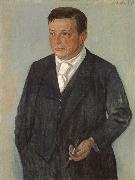
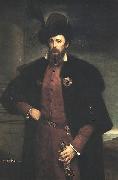
1855-1928,German painter and etcher. The son of the late Romantic landscape painter Eduard Stanislaus, Graf von Kalckreuth (1820-94), he studied from 1875 to 1878 under Ferdinand Schauss (1832-1916), Willem Linnig (1819-85) and Alexander Struys (1852-1941) at the Kunstschule in Weimar founded by his father. In 1879, after military service, he enrolled at the Akademie in Munich, where he attended Gyula Benczer's drawing classes and continued his study of painting under Karl Theodor von Piloty and Wilhelm von Diez (1839-1907). In 1883 he travelled to the Netherlands and then to Italy and France. In 1885 he accepted a teaching appointment at the Kunstschule in Weimar, but in 1890 he resigned and returned to Munich. During the next five years he worked at Heckricht in Silesia (now Jedrzychowice, Poland), perfecting his oil technique. In 1892 he was a founder-member of the Munich Secession. Kalckreuth's work from this period reflects the influence of several contemporaries; the portrait of the Artist's Wife of 1888 (Leipzig, Mus. Gesch.) recalls the portraits of Franz von Lenbach and Max Liebermann, while the visionary element brought to the genre scene Rainbow (1894-6; Munich, Neue Pin.) is close to the work of Fritz von Uhde.
|
|
 |
Leon Kaplinski
|
|
(1824-1873) was a Polish painter and political activist.
Born 1824 in Lisew not far from Warsaw, Leon was the son of a small landowner and an eminent freemason Jan Kaplieski. The Kaplieskis were a Frankist family; his grandfather Eliasz Adam Kaplieski was one of the last known Frankists. Leon Kaplieski studied law and philosophy in Warsaw and Wrocław (Breslau). He was engaged in revolutionary underground groups, fled from the part of Poland under Russian rule, was briefly held and interrogated by the Prussian police, and took part in the revolutionary movement in 1848. In the same year Kaplieski emigrated to Paris where he spent most of his remaining years. He took part in Polish emigre political activities, closely connected with the circle of Hotel Lambert and the Czartoryski family, accompanied the Count Witold Czartoryski during his trip to the Balkans and the Near East. Kaplieski also edited the periodical Ephemerides Polonaises. He was married to Helena Hryniewiecka. In 1871 he moved back to Poland, living mostly in Krakew, and died in 1873 in Milosław. He befriended several well-known Polish artists and writers, including Henryk Rodakowski, Jan Matejka, and Cyprian Kamil Norwid.
Kaplieski studied art in Poland and later in Paris. His first known works are copies of paintings by famous Italian artists; later he became known and appreciated for his patriotic historical paintings as Wernyhora (1855). His best works are portraits: of his mother Julia (1860), the writer Bohdan Zaleski (1857), Count Adam Jerzy Czartoryski (about 1860), and an autoportrait as a Templar (about 1872). Many of his paintings and other works have perished or been lost. Mainly influenced by classical Italian art and his contemporary Rodakowski, L.K. continued the tradition of academic painting and had no interest for the emerging modernist tendencies of the mid-nineteenth century. He won some recognition in France, participating in the Paris art salons. L.K. wrote some poems and a short novel Nad Wisłą (On Wisla).
|
|
 |
Leo von Klenze
|
|
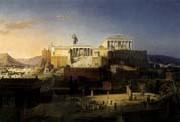
German Architect and Painter, 1784-1864,was a German neoclassicist architect, painter and writer. Court architect of Bavarian King Ludwig I, Leo von Klenze was one of the most prominent representatives of Greek revival style. Von Klenze studied architecture in Berlin and Paris. Between 1808 and 1813 he was a court architect of Jerome Bonaparte, King of Westphalia. Later he moved to Bavaria and in 1816 began to work as court architect of Ludwig I. The King's passion for Hellenism shaped the architectural style of von Klenze. He built many neoclassical buildings in Munich, including the Ruhmeshalle and Monopteros temple. On Konigsplatz he designed probably the best known modern Hellenistic architectural ensemble. Near Regensburg he built the Walhalla temple, named after Valhalla, the home of gods in Norse mythology. When Greece won its independence, Ludwig I's son Otto became the country's first king. Von Klenze was invited to Athens to submit plans of city reconstruction in the style of Ancient Greece. Russian Emperor Nicholas I commissioned von Klenze to design a building for the New Hermitage, a public museum that housed Greek, Roman, and Egyptian antiquities. Von Klenze also designed and arranged museum galleries in Munich, including the Glyptothek and Alte Pinakothek. Von Klenze was not only an architect, but also an accomplished painter and draughtsman. In many of his paintings ancient buildings were depicted. Those served as models for his own architectural projects. Klenze studied ancient architecture during his travels to Italy and Greece. He also participated in excavations of ancient buildings in Athens and submitted projects for the restoration of the Acropolis. Klenze collected works of important contemporary German painters. He sold his collection, including 58 landscapes and genre paintings, to King Ludwig I in 1841.
|
|
|
|
 |
Kuzma Sergeevich Petrov-Vodkin
|
|
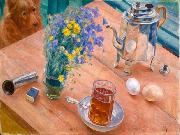
(1878, Khvalynsk, now Saratov OblasteFebruary 15, 1939, Leningrad) was an important Russian and Soviet painter and writer.
Kuzma Petrov-Vodkin was born in Khvalynsk (Saratov Oblast) into the family of a local shoemaker. His first exposure to art was in his early childhood, when he took some lessons from a couple of icon painters and a signmaker. Still, Petrov-Vodkin didn't quite see himself in art at that time; after graduating from middle school, he took a summer job at a small shipyard with plans to get into railroad college in Samara. After failing his exam, he turned to "Art Classes of Fedor Burov" in 1893.
In April 1895, Burov died and for some time Petrov-Vodkin took different painting jobs in the vicinity of Saratov. By chance, his mother's employer invited a well-known architect, R. Meltzer. Petrov-Vodkin was introduced to the guest and impressed him enough to get an invitation to study art at Saint Petersburg. The education was financed by a charitable subscription among local merchants. He also met at this time Borisov-Musatov, an important painter resident in Saratov, who encouraged Petrov-Vodkin to continue his studies.
Petrov-Vodkin stayed in Saint Petersburg from 1895 to 1897 studying at the Baron Stieglits School, before moving to the Moscow School of Painting, Sculpture and Architecture. There Petrov-Vodkin was a student of Valentin Serov, Isaak Levitan and especially Konstantin Korovin. In 1901 he travelled to Munich to take classes with Anton Ažbe.
He graduated in 1904.
|
|
 |
Kuzma Petrov-Vodkin
|
|
Russian Painter, 1878-1939
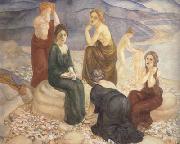
Russian painter. He began his studies in the drawing and painting classes of F. Burov (1843-95) in Samara (1893-5), and he attended Baron Stieglitz's school in St Petersburg from 1895 to 1897. He studied under Abram Arkhipov, Nikolay Kasatkin and Valentin Serov at the Moscow School of Painting, Sculpture and Architecture from 1897 to 1905 and at Anton Azb?'s school in Munich (1901). After working in various private studios in Paris between 1905 and 1908, he travelled to Constantinople (now Istanbul), Greece and Italy in 1905 and to Algiers in 1906. On his return to Russia, he held an exhibition in the editorial offices of the magazine Apollon in St Petersburg (1909). From 1911 to 1924 he exhibited with the WORLD OF ART group and from 1925 to 1928 with the FOUR ARTS SOCIETY OF ARTISTS. From the early 1910s Petrov-Vodkin's work was influential in the artistic life of St Petersburg. He attempted to reconcile classical and modern trends. His style was formed under a wide range of influences, often seemingly incompatible: 19th-century Russian painters such as Aleksey Venetsianov,
|
|
|
|
 |
Kurt Schwitters
|
|
German Dadaist Painter and Sculptor, 1887-1948
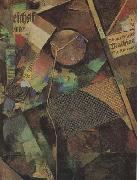
German painter, sculptor, designer and writer. He studied at the Kunstakademie in Dresden (1909-14) and served as a clerical officer and mechanical draughtsman during World War I. At first his painting was naturalistic and then Impressionistic, until he came into contact with Expressionist art, particularly the art associated with Der Sturm, in 1918. He painted mystical and apocalyptic landscapes, such as Mountain Graveyard (1912; New York, Guggenheim), and also wrote Expressionist poetry for Der Sturm magazine. He became associated with the DADA movement in Berlin after meeting Hans Arp, Raoul Hausmann, Hannah H?ch and Richard Huelsenbeck, and he began to make collages that he called Merzbilder. These were made from waste materials picked up in the streets and parks of Hannover, and in them he saw the creation of a fragile new beauty out of the ruins of German culture. Similarly he began to compose his poetry from snatches of overheard conversations and randomly derived phrases from newspapers and magazines. His mock-romantic poem An Anna Blume, published in Der Sturm in August 1919, was a popular success in Germany. From this time 'Merz' became the name of Schwitters's one-man movement and philosophy. The word derives from a fragment of the word Kommerz, used in an early assemblage (Merzbild, 1919; destr.; see Elderfield, no. 42), for which Schwitters subsequently gave a number of meanings, the most frequent being that of 'refuse' or 'rejects'. In 1919 he wrote: 'The word Merz denotes essentially the combination, for artistic purposes, of all conceivable materials, and, technically, the principle of the equal distribution of the individual materials .... A perambulator wheel, wire-netting, string and cotton wool are factors having equal rights with paint'; such materials were indeed incorporated in Schwitters's large assemblages and painted collages of this period, for example Construction for Noble Ladies (1919; Los Angeles, CA, Co. Mus. A.; see fig. 1; see also COLLAGE). Schwitters's essential aestheticism and formalism alienated him from the political wing of German Dada led by Huelsenbeck, and he was ridiculed as 'the Caspar David Friedrich of the Dadaist Revolution'. Although his work of this period is full of hints and allusions to contemporary political and cultural conditions, unlike the work of George Grosz or John Heartfield it was not polemical or bitterly satirical.
|
|
 |
KUPECKY, Jan
|
|
Bohemian Baroque Era Painter, 1667-1740
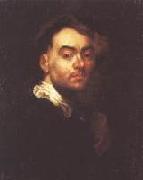
Bohemian painter. He was born into a weaver's family, who, as Moravian Brethren, were forced to emigrate from Bohemia to Pezinok, Slovakia. Having met the artist Benedikt Claus (1632/3-1707), he left home at 15 to join him in Vienna, and three years later accompanied him to Italy. He worked in Venice and other north Italian towns before settling in Rome, where he made a meagre living by copying portraits. Although he attempted genre and historical paintings, portraiture became his main work. His influences ranged from prominent Venetian painters such as Bernardo Strozzi, Johann Carl Loth and Giuseppe Ghislandi to Anthony van Dyck and Hyacinthe Rigaud.
|
|
|
|
 |
kulturen
|
|
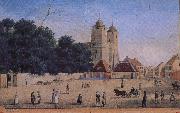
ivar johnssons byst av georg karlin, karv i uppsyn som originalet., bares upp au en tung granitplatta med orden forntid framtid. det var det motto karlin helt i nutidsanda satt for sitt museum samlingarna sklle lara om det forgangna inspirera till det kommande.
|
|
|
|
 |
Kuhn Walt
|
|
American cartoonist and painter,
1877-1949
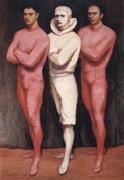
was an American painter and was an organizer of the modern art Armory Show of 1913, which was the first of its genre in America. Kuhn was born in Brooklyn, New York City. At 15, Kuhn sold his first drawings to a magazine and signed his name ??Walt.?? In 1893, he enrolled in art classes at the Brooklyn Polytechnic Institute. In 1899, Kuhn set out for California with only $60 in his pocket. Upon his arriving in San Francisco, he became an illustrator for WASP Magazine. In 1901, Walt left for Paris, where he briefly studied art at the Acad??mie Colarossi before leaving to the Royal Academy in Munich. Once in the capital of Bavaria, he studied under Heinrich von Zugel (1850-1941), a member of the Barbizon School. In 1903, he returned to New York and was employed as an illustrator for local journals. In 1905, he held his first exhibition at the Salmagundi Club, establishing himself as both a cartoonist and a serious painter. In this same year, he completed his first illustrations for LIFE magazine. When the New York School of Art moved to Fort Lee, NJ in the summer of 1908, Kuhn joined the faculty.
|
|
|
|
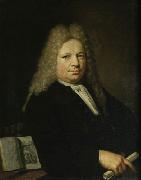 |
Krzysztof Lubieniecki
|
|
(1659-1729) was a Polish Baroque painter and engraver active in Amsterdam during the Dutch Golden Age.
Krzysztof was born in Szczecin. He and his brother Teodor Lubieniecki hailed from an Arian family. They learned to paint from Juriaan Stur in Hamburg. In 1667 they travelled to Amsterdam, where Krzysztof apprenticed with Adriaen Backer, and Teodor with Gerard de Lairesse. In 1682, Teodor moved to Hannover before eventually moving to Poland in 1706, where he died.
Krzysztof remained in Amsterdam, where he painted portraits and genre pieces. He also collaborated on prints for Jacobus Houbraken, Daniel Willink, and Johannes Brandt (son of Gerard Brandt). He died in Amsterdam.
|
|
|
|
|
|
|
|
|
|
|
| Wholesale China Oil Painting Wholesale Oil Painting China Xiamen Portrait Reproduction on canvas Chinese Oil Painting Wholesale USA Oil Painting |
|
|
|
|
|