| |
|
Xiamen Oil Paintings, Wholesale Direct!
|
|
100% hand painted, 100% cotton canvas, 100% money back if not satisfaction. |
|
|
|
|
ART WORKS INDEX
A
B
C
D
E
F
G
H
I
J
K
L
M
N
O
P
Q
R
S
T
U
V
W
X
Y
Z
|
|
ARTISTS INDEX
A
B
C
D
E
F
G
H
I
J
K
L
M
N
O
P
Q
R
S
T
U
V
W
X
Y
Z
|
|
|
|
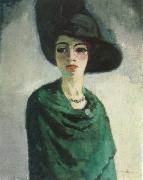 |
kees van dongen
|
|
kees van dongen,(1877 to 1968),French painter and printmaker of Dutch birth. He took evening classes in geometric drawing from 1892 to 1897 at the Akademie voor Beeldende Kunsten in Rotterdam. In 1895 he began working intermittently for the newspaper Rotterdamsche Nieuwsblad, for which he made, among other things, a series of bright watercolour drawings of Rotterdams red-light district and illustrations of Queen Wilhelminas coronation. Van Dongen first paintings used dark tones in imitation of Rembrandt, who remained the most important model for his work; his later book on Rembrandt was, in fact, a projection of his own life. By the mid-1890s he was using more vivid contrasts of black and white, for example in Spotted Chimera (1895; priv. col., see Chaumeil, pl. 1), his palette soon becoming brighter and his line more animated. In Le Muet Windmill (1896; priv. col., see Chaumeil, pl. 7), a red ochre monochrome painting, he successfully enlivened the colour by means of broad, energetic brushstrokes.
|
|
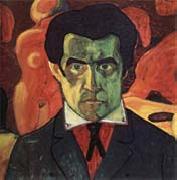 |
Kazimir Malevich
|
|
1878-1935
Russian painter, printmaker, decorative artist and writer of Ukranian birth. One of the pioneers of abstract art, Malevich was a central figure in a succession of avant-garde movements during the period of the Russian revolutions of 1905 and 1917 and immediately after. The style of severe geometric abstraction with which he is most closely associated, SUPREMATISM, was a leading force in the development of CONSTRUCTIVISM, the repercussions of which continued to be felt throughout the 20th century. His work was suppressed in Soviet Russia in the 1930s and remained little known during the following two decades. The reassessment of his reputation in the West from the mid-1950s was matched by the renewed influence of his work on the paintings of Ad Reinhardt and on developments
|
|
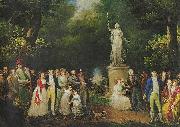 |
Kazimierz Wojniakowski
|
|
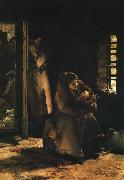
(1771-1812) was a Polish painter.
Wojniakowski was a pupil of Marcello Bacciarelli.
His work as a portraitist was influenced by that of the Polish painter Jezef Grassi, as in Wojniakowski's 1796 Portrait of Izabela Czartoryska, nee Fleming.
Other note-worthy portraits by Wojniakowski include his portrait of Tadeusz Kościuszko.
Wojniakowski also produced religious works and scenes of contemporary historic events (e.g., The Constitution of May 3, 1791, 1806).
Notable as well are Wojniakowski's drawings from journeys, e.g. in Lublin Province.
|
|
 |
Kazimierz Alchimowicz
|
|
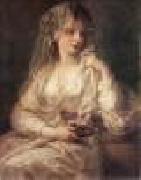
(1840 ?C 1916) was a Lithuanian-born Polish romantic painter.
Born in Dziembrow, Lithuania, Alchimowicz was banished to Siberia for six years for his participation in the January Uprising. After his return, he enrolled in a drawing class in Warsaw taught by Wojciech Gerson. The class had a great influence on his later artistic works. He later studied art in Munich, Germany and Paris, France. While staying in France, Alchimowicz was a craftsmen decorating porcelain and earthenware crafts. He settled permanently in Warsaw in 1880 to paint professionally. His artistic inspiration mainly came from patriotic topics and history.
|
|
 |
KAUFFMANN, Angelica
|
|
Swiss Neoclassical Painter, 1741-1807
Swiss-born Italian painter. She began studying art in Italy as a child, showing great precocity, and in 1766 her friend Joshua Reynolds took her to London. There she became known for her decorative work with architects such as Robert Adam. Her pastoral compositions incorporate delicate and graceful depictions of gods and goddesses; though her paintings are Rococo in tone and approach, her figures are Neoclassical (see Classicism and Neoclassicism). Her portraits of female sitters are among her finest works.
|
|
 |
Katsushika Hokusai
|
|
Japanese
1760-1849
Katsushika Hokusai Gallery
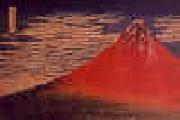
was a Japanese artist, ukiyo-e painter and printmaker of the Edo period. In his time, he was Japan's leading expert on Chinese painting.[2] Born in Edo (now Tokyo), Hokusai is best-known as author of the woodblock print series Thirty-six Views of Mount Fuji which includes the iconic and internationally recognized print, The Great Wave off Kanagawa, created during the 1820s. Hokusai created the "Thirty-Six Views" both as a response to a domestic travel boom and as part of a personal obsession with Mount Fuji.[3] It was this series, specifically The Great Wave print and Fuji in Clear Weather, that secured Hokusai??s fame both within Japan and overseas. As historian Richard Lane concludes, ??Indeed, if there is one work that made Hokusai's name, both in Japan and abroad, it must be this monumental print-series...?? While Hokusai's work prior to this series is certainly important, it was not until this series that he gained broad recognition and left a lasting impact on the art world. It was The Great Wave print that initially received, and continues to receive, acclaim and popularity in the Western world.
|
|
 |
kathe kollwitz
|
|
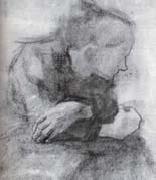
German Expressionist Printmaker and Sculptor, 1867-1945,was a German painter, printmaker, and sculptor whose work offered an eloquent and often searing account of the human condition in the first half of the 20th century. Her empathy for the less fortunate, expressed most famously through the graphic means of drawing, etching, lithography, and woodcut, embraced the victims of poverty, hunger, and war. Initially her work was grounded in Naturalism, and later took on Expressionistic qualities.
|
|
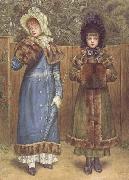 |
Kate Greenaway,RWS,RI
|
|
1846-1901
English painter, illustrator and writer. The daughter of a Fleet Street wood-engraver, John Greenaway (1818-90), she trained at Islington School of Art, Heatherleys Academy and the Slade School of Fine Art, all in London. In 1868 she did her first commercial work, producing Christmas and Valentine cards for Marcus Ward, Belfast.
|
|
|
|
|
|
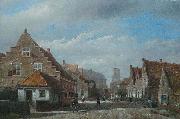 |
Kasparus Karsen
|
|
(April 2, 1810, Amsterdam - July 24, 1896, Biebrich near Wiesbaden, Germany) was a Dutch painter who specialised in townscapes.
He taught Cornelis Springer 1835-1837.
|
|
|
|
|
|
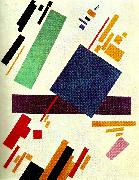 |
kasimir malevitj
|
|
Kazimir Severinovich Malevich (Russian: Polish: Kazimierz Malewicz, Ukrainian, German: Kasimir Malewitsch, Belarusian: (February 23, 1879, previously 1878: see below--May 15, 1935) was a Russian painter and art theoretician, born in Ukraine of ethnic Polish parents. He was a pioneer of geometric abstract art and the originator of the Avant-garde Suprematist movement.
|
|
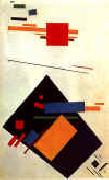 |
Kasimir Malevich
|
|
1878-1935
Kasimir Malevich Gallery
In 1904, after the death of his father, he moved to Moscow. He studied at the Moscow School of Painting, Sculpture and Architecture from 1904 to 1910 and in the studio of Fedor Rerberg in Moscow (1904?C1910). In 1911 he participated in the second exhibition of the group Soyuz Molodyozhi (Union of Youth) in St. Petersburg, together with Vladimir Tatlin and, in 1912, the group held its third exhibition, which included works by Aleksandra Ekster, Tatlin and others. In the same year he participated in an exhibition by the collective Donkey's Tail in Moscow. By that time his works were influenced by Natalia Goncharova and Mikhail Larionov, Russian avant-garde painters who were particularly interested in Russian folk art called lubok. In March 1913 a major exhibition of Aristarkh Lentulov's paintings opened in Moscow. The effect of this exhibition was comparable with that of Paul Cezanne in Paris in 1907, as all the main Russian avant-garde artists of the time (including Malevich) immediately absorbed the cubist principles and began using them in their works. Already in the same year the Cubo-Futurist opera Victory Over the Sun with Malevich's stage-set became a great success. In 1914 Malevich exhibited his works in the Salon des Independants in Paris together with Alexander Archipenko, Sonia Delaunay, Aleksandra Ekster and Vadim Meller, among others.
It remains one of the great mysteries of 20th century art, how, while leading a comfortable career, during which he just followed all the latest trends in art, in 1915 Malevich suddenly came up with the idea of Suprematism. The fact that Malevich throughout all his life was signing and re-signing his works using earlier dates makes this u-turn in his artistic career even more ambiguous. Be that as it may, in 1915 he published his manifesto From Cubism to Suprematism. In 1915-1916 he worked with other Suprematist artists in a peasant/artisan co-operative in Skoptsi and Verbovka village. In 1916-1917 he participated in exhibitions of the Jack of Diamonds group in Moscow together with Nathan Altman, David Burliuk and A. Ekster, among others. Famous examples of his Suprematist works include Black Square (1915) and White on White (1918).
In 1918 Malevich decorated a play Mystery Bouffe by Vladimir Mayakovskiy produced by Vsevolod Meyerhold.
Malevich also acknowledged that his fascination with aerial photography and aviation led him to abstractions inspired by or derived from aerial landscapes. Harvard doctoral candidate Julia Bekman Chadaga writes: ??In his later writings, Malevich defined the 'additional element' as the quality of any new visual environment bringing about a change in perception .... In a series of diagrams illustrating the ??environments' that influence various painterly styles, the Suprematist is associated with a series of aerial views rendering the familiar landscape into an abstraction..." (excerpted from Ms. Bekman Chadaga's paper delivered at Columbia University's 2000 symposium, "Art, Technology, and Modernity in Russia and Eastern Europe").
|
|
|
|
 |
Karoly Lotz
|
|
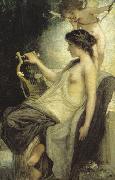
(16 December 1833 - 13 October 1904) was a German-Hungarian painter.
Karl Lotz was born in Bad Homburg vor der Höhe, Germany, the 7th and youngest surviving child of Wilhelm Christian Lotz and Antonia Höfflick (Höfflich). His father was a valet of Prince Gustav zu Hessen-Homburg at the time when the prince was representing Austria at the Congress of Vienna, which among other matters dealt with the House of Hessen-Homburg's rights of sovereignty over Hessen-Darmstadt. The sudden death of the young Baron von Sinclair, charge d'affaires, forced W. C. Lotz temporarily into the rôle. While in Hungary in 1815 he made the acquaintance of the 13-year-old Antonie Hoefflich, whom he married three years later. She gave birth to 8 children, of whom Karl was the youngest.
W. C. Lotz died in 1837 and Antonie moved the family to Pest (now one of the three constituent parts of Budapest; the one on the east bank of the River Danube). Karl attended the Piaristengymnasium, where, although Calvinist, he was awarded a scholarship for his exceptional academic performance. He began his artistic career as a pupil of the Hofkapellmeister Destouches, then in the academy of the Venetian master Jacopo Marastoni (1804-1860). Later he was a pupil of the historical painters Henrik Weber (1818-1866) in Budapest and Carl Rahl (1812-1865) in Vienna.
Together with Rahl he worked on numerous commissions. Later he started on his own original works, first as a romantic landscape artist in scenes of the Alföld (the Hungarian lowland plain), and then as a creator of monumental murals and frescos in the style of the Venetian master Tiepolo.
After various works in Budapest he became active in Vienna. He laid out plans for a grandiose palace, and completed murals commissioned by the Abbot of Tihany for his abbey church on the shore of Lake Balaton. He became known for his portraits and nudes, for which both his wife and his daughters (Katarina in particular) posed. Lotz found married bliss only at the age of 58, when he married the widow Jacoboy, the former wife of his brother Paul Johann Heinrich, who had died in 1828. From then on he signed his works Keroly Jacoboy-Lotz.
In 1882 Lotz was appointed Professor at various art academies in Budapest, and in 1885 he became dean of a newly-established department for women painters. He was an honorary member of the Academy of Pictorial Arts in Vienna.
Tomb of Keroly Lotz by Jenos Pesztor (Kerepesi cemetery in Budapest)Hist last important public commission was the "Apotheosis of the Habsburg Dynasty", a huge ceiling fresco in the Habsburg Room of the newly rebuilt Royal Palace, that he painted in 1903, one year before his death. Lotz was already seriously ill when he worked on the fresco. The "Apotheosis" followed the traditions of Baroque court painting and the work was praised by contemporary critics. The fresco survived the war unscathed, but it was destroyed in the 1950s.
He died in 1904 in Budapest. As a "Prince of Hungarian Artists" he was given a state funeral and interred inside a memorial. His pictures, drawings and sketches were donated to the State of Hungary and are now in the Szepműveszeti Mezeum. Several Hungarian cities have streets named after him, there are Hungarian stamps bearing his likeness, and there is a bust in the National Museum in Budapest.
|
|
 |
Karoly Ferenczy
|
|
1863-1917
Karoly Ferenczy Locations
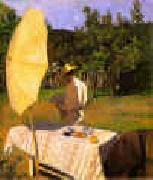
was a Hungarian Impressionist painter. He was one of the leading artists of the Nagybanya school of painting. He studied law and economics. He began to deal with painting at the Academie Julian in Paris. In 1889, he moved back to Hungary, to the town of Szentendre. Between 1893 and 1896 he lived in Munich with his family: There he joined the circle of Simon Hollosy: with whom he moved to Nagybanya in 1896 and became the leading painter of the artist colony. After 1906 he moved to Budapest and became the professor of the College of Fine Arts. His wife Olga Fialka and their children, the painter Valer Ferenczy (1885-1954), the tapestry weaver Noemi Ferenczy (1890-1957) and the sculptor Beni Ferenczy (1890- 1967) were famous representatives of Hungarian art.
|
|
|
|
 |
karl yens
|
|
1868-1945
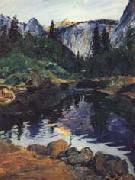
was a United States painter who specialised in coastal views. Born in Germany, he emigrated to the U.S. and settled in Laguna Beach, California. He was a founding member of the California Water Color Society.
|
|
 |
Karl von Piloty
|
|
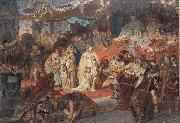
Karl Theodor von Piloty (1 October 1826 - 21 July 1886) was a German painter.
Von Piloty was born in Munich. His father, Ferdinand Piloty (d. 1844), enjoyed a great reputation as a lithographer. In 1840, Karl was admitted as a student of the Munich Academy, under the artists Karl Schorn and Julius Schnorr von Karolsfeld. After a journey to Belgium, France and England, he commenced work as a painter of genre pictures, and in 1853 produced a work, Die Amme (The Wet Nurse), which, on account of its originality of style, caused a considerable sensation in Germany at the time.
But he soon forsook this branch of painting in favour of historical subjects, and produced in 1854 for King Maximilian II The Accession of Maximilian I to the Catholic League in 1609. It was succeeded by Seni at the Dead Body of Wallenstein (1855), which gained for the young painter the membership of the Munich Academy, where he succeeded Schorn (his brother-in-law) as professor.
Among other well-known works by Piloty are the Battle of the White Mountain near Prague, Nero Dancing upon the Ruins of Rome (1861), Godfrey of Bouillon on a Pilgrimage to the Holy Land (1861), Galileo in Prison (1864) and The Death of Alexander the Great (unfinished), his last great work. He also executed a number of mural paintings for the royal palace in Munich.
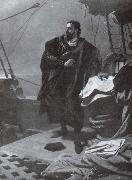
For Baron von Schach, he painted the famous Discovery of America. In 1874, he was appointed keeper of the Munich Academy, being afterwards ennobled by the king of Bavaria. Piloty was the foremost representative of the realistic school in Germany. He was a successful teacher, and among his more famous pupils were Hans Makart, Franz von Lenbach, Franz Defregger, Gabriel von Max, Georgios Jakobides and Eduard von Gretzner.
|
|
 |
Karl Theodor von Piloty
|
|
German, 1826-1886,German painter. He received his first training from his father, the lithographer Ferdinand Piloty (1786-1844). In 1838 Piloty entered the Munich Akademie der Bildenden Kenste and from 1840 became a pupil of Julius Schnorr von Carolsfeld. Piloty had to manage the family business after his father's death in 1844, but in 1846 he returned to the Akademie as a pupil of Karl Schorn (1801-50). His artistic development was influenced by the work of the Antwerp artist Louis Gallait (1810-87), the heightened colour and multi-figure compositions in whose history paintings especially impressed him. Besides his study of Old Masters, especially Veronese and Rubens, he was influenced by French history painters like Paul Delaroche and Horace Vernet. His history painting Seni by the Body of Wallenstein (1855; Munich, Neue Pin.) was an enormous success, allowing him to take a leading role in the art life of Munich. In 1860 he was ennobled.
|
|
|
|
|
|
 |
Karl Nordstrom
|
|
Swedish Painter, 1855-1923
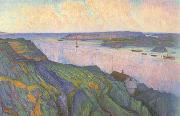
was a Swedish painter and one of the leading members of Konstnärsförbundet, which he chaired from 1896 until its dissolution in 1920. Born on Gotland, but growing up on Tjörn on the Swedish West Coast, Nordström studied at principskolan, the preparatory school of the Royal Academy of Arts in Stockholm and the private painting school of Edvard Perseus, but was never promoted to the "Antique school" of the Academy but had to continue on his own. Traveling to Paris in 1881, he was influenced by the impressionists. He spent a couple of years in Grez-sur-Loing, the site of an important colony of Scandinavian artists, practising his plein air painting in the strong French sunlight. In 1885, he joined the group of young artists protesting against the policies and leadership of the Academy, and he was ever since 1886 one of the leading members of Konstnärsförbundet, the formalization of the opposition group. He was its chairman from 1896 until its dissolution in 1920. In 1886, he married xylographer and photographer Tekla Lindeström in Paris. Later the same year, he settled on Tjörn, using what he had learnt in France about light and colours to depict the landscape where he had grown up. He spent the summer of 1889 in Visby. Around 1890, he moved from his earlier impressionism towards a more synthetist style. His influences came from Japanese art, which he had encountered in Paris, and from Gauguin, whose paintings he first saw in photographs he had received from Ivan Agueli. One of Nordström's old friends from the time at the Academy and in Perseus' school, Nils Kreuger, had lived in the city of Varberg since 1888. He convinced Nordström to move there in 1892, and they were joined by another of their old friends, Richard Bergh, in 1893.
|
|
 |
karl madsen
|
|
(1855-1938), Danish art historian, director of Statens Museum for Kunst
|
|
|
|
 |
Karl Kaspar Pitz
|
|
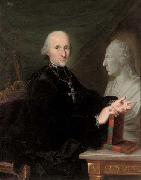
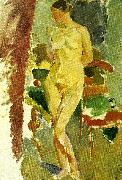
painted Portrait of a cleric a book in his right hand, by a marble bust in before 1795
|
|
|
|
|
|
 |
karl isakson
|
|
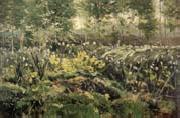
Karl Isakson, född 1878, död 1922, konstnär.
Karl Isakson växte upp i Stockholm, han och systern Ester uppfostrades av en religiös ensamstående mor, då fadern tidigt gått bort.
|
|
|
|
 |
Karl Hagemeister
|
|
German, 1848-1933,German painter. He studied from 1871 at the Kunstschule in Weimar under Friedrich Preller, who introduced him to the principles of classical landscape painting. In 1873 he began to develop a more modern approach when he met Carl Schuch at the Hintersee, near Berchtesgaden; he immediately became his pupil and later wrote Schuch's biography. Schuch introduced Hagemeister to the Leibl circle (see LEIBL, WILHELM). He travelled to the Netherlands and Belgium (1873-4), Italy (1876) and France (1884-5), often accompanying Schuch and, in the early journeys, Wilhelm Trebner. His approach to landscape changed from classical Naturalism to 'pure painting', a more formalist approach in which purely pictorial qualities were given priority over naturalistic representation, as in Lake Shore (c. 1900; Schweinfurt, Samml. Schefer). His brushwork became broader, his depiction of objects became increasingly summary, and his colours lighter and cooler. Absorbing the influence of Japanese art through the interpretations of the French Impressionists, and following trends in international Art Nouveau, Hagemeister developed an individual variant of Jugendstil. His pictures were composed in accordance with decorative rather than naturalistic principles and became primarily ornamental, as in White Poppy
|
|
 |
Karl friedrich schinkel
|
|
German Painter and Architect, 1781-1841
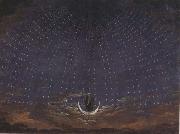
German architect and painter. As state architect of Prussia (from 1815), he executed many commissions for Frederick William III and other royal family members. He based his work on the revival of various historical styles. His mausoleum for Queen Louise (1810) and the brick and terra-cotta Werdersche Kirche, Berlin (1821 ?C 30), are among the earliest Gothic Revival designs in Europe. Other works include the Greek Revival Schauspielhaus (1818) and Altes Museum (1822 ?C 30), both in Berlin. In 1830 Schinkel became director of the Prussian Office of Public Works; his work as a city planner resulted in new boulevards and squares in Berlin.
|
|
|
|
 |
Karl Ferdinand Wimar
|
|
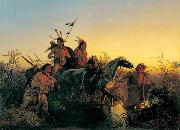
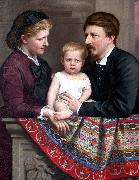
(also known as Charles Wimar and Carl Wimar) (1828-1862), was a German-American painter who concentrated on Native Americans in the West and the great herds of buffalo.
He is known for an early painting of a colonial incident: his The Abduction of Boone's Daughter by the Indians (1855-1856), a depiction of the 1776 capture near Boonesborough, Kentucky of Jemima Boone and two other girls by a Cherokee-Shawnee raiding party.
|
|
 |
Karl Ernst Papf
|
|
Karl Ernest Papf (Dresden, Germany, 1833 -Sao Paulo, 1910) was a German painter, and draftsman that moved to Brazil in 1867.
He studied in the Academy of Fine Arts of Dresden and in 1867, was hired for the profession of photographer by the firm of his compatriot Albert Henschel. He initially worked in Recife until 1872, then in Salvador until 1877 - always in service of the atelier Albert Henschel & Cia., as written in Almanak Laemmert. He moved to Rio de Janeiro in surch for a better environment for the development of his work.
|
|
|
|
|
|
 |
Karl Briullov
|
|
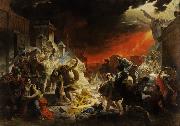
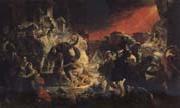
Russian Neoclassical/Romantic Painter, 1799-1852,was an internationally renowned Russian painter. He is regarded as a key figure in transition from the Russian neoclassicism to romanticism. Born of French parents in Saint Petersburg, Carlo Brulleau (as his name was spelled until 1822) felt drawn to Italy from his early years. Despite his education at the Imperial Academy of Arts (1809?C1821), Briullov never fully embraced the classical style taught by his mentors and promoted by his brother, Alexander Briullov. After distinguishing himself as a promising and imaginative student and finishing his education, he left Russia for Rome where he worked until 1835 as a portraitist and genre painter, though his fame as an artist came when he began doing historical painting. His best-known work, The Last Day of Pompeii (1830?C1833), is a vast composition compared by Pushkin and Gogol to the best works of Rubens and Van Dyck. It created a sensation in Italy and established Briullov as one of the finest European painters of his day. After completing this work, he triumphantly returned to the Russian capital, where he made many friends among the aristocracy and intellectual elite and obtained a high post in the Imperial Academy of Arts.
|
|
 |
Karl Bodmer
|
|
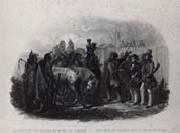
Swiss Painter, 1809-1893,Swiss painter and graphic artist, active in the USA and France. His earliest exposure to art probably came from his uncle, the landscape painter and engraver Johann Jakob Meyer (1787-1858). When he was 22, Bodmer moved to Paris, where he studied art under Sebastien Cornu. In Paris he met his future patron, Prince Maximilian of Wied-Neuwied, who was planning an ambitious scientific expedition to North America. Bodmer was engaged to accompany the expedition and to provide sketches of the American wilderness. After touring the East Coast, the party made their way westward via the Ohio and Mississippi rivers to St Louis, MO, and in 1833 travelled up the Missouri River into country scarcely inhabited by white men. On the journey north to Ft MacKenzie, WY, Bodmer recorded the landscape and the groups of Indians they encountered. Having wintered in Ft Clark, ND, they returned to New York and then Europe in 1834.
|
|
 |
Karl Blechen
|
|
German Romantic, 1798-1840
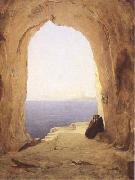
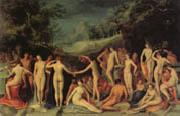
sometimes given as Karl Blechen, was a German painter, specializing in fantastic landscapes, sometimes with demons and grotesque figures. Born in Cottbus, he drew the attention of prominent architect Karl Friedrich Schinkel, who cast him as a decorative painter. Blechen however aimed for higher work and began producing landscape paintings. In 1827 he went to Italy
|
|
|
|
 |
Karel van Mander
|
|
Dutch Mannerist Writer and Painter, 1548-1606
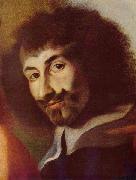
was a Flemish-born Dutch painter and poet, who is mainly remembered as a biographer of Netherlandish artists. As an artist he played an important role in Northern Mannerism in the Netherlands. He was born of a noble family at Meulebeke in modern West Flanders. He studied under Lucas de Heere at Ghent, and in 1568-1569 under Pieter Vlerick at Kortrijk. The next five years he devoted to the writing of religious plays for which he also painted the scenery. Then followed three years in Rome (1574-1577), where he is said to have been the first to discover the catacombs. On his return journey he passed through Vienna, where, together with the sculptor Hans Mont, he made the triumphal arch for the royal entry of the emperor Rudolph. In 1583 he settled in Haarlem where he lived and worked for 20 years on a commission by the city fathers to inventory "their" art collection; work that he later published in his "Schilder-boeck" (see below). While in Haarlem he continued to paint, concentrating his energy on his favorite genre: historical allegories. In 1603 he retired to the castle of Sevenbergen in Heemskerk to proofread his book that was published in 1604.
|
|
|
|
 |
Karel skreta
|
|
(1610, Prague - July 30, 1674, Prague) was a Czech Baroque painter.
Karel learnt painting perhaps from one of the masters at the royal courtyard. He studied in Saxony and in Italy. According to Houbraken he painted portraits and lived together with the respected watercolor painter Willem Bouwer in Rome. He became a member of the Bentvueghels with the nickname Slagzwaart or Slach-sweerd.According to the RKD he was the teacher of the Prague painter Johann Georg Heinsch (1640-1713).
Since 1638 he lived in Prague, where he worked on altarpieces for many churches, for example St. Thomas, St. Stephen or the Church of Our Lady in front of Týn.
|
|
 |
Karel Purkyne
|
|
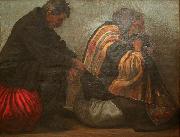
(1834-1868) was a Czech painter. He was one of the most prominent proponents of realism in Czech art in the second half of the 19th century. He was the son of the physiologist and anatomist Jan Evangelista Purkyne, and developed an interest in art while still young. Early influences included the Baroque painters Karel Škreta and Petr Brandl and the paintings of the Dutch Golden Age. He spent a year in Munich studying with Johann Baptist Berdelle before traveling to Paris, where he worked with Thomas Couture; there he copied paintings by Old Masters and encountered the work of contemporary French artists. He was particularly struck by the works of Gustave Courbet. Upon returning to Prague, Purkyne became known primarily as a portraitist, though a handful of works in other genres are known. He also made a name for himself as an organizer of artistic events and as an art critic.
|
|
 |
Karel Myslbek
|
|
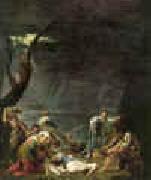
Karel Myslbek (1874-1915)Aliases: Frant. VovesProfessions: Figure painter; Painter.
|
|
 |
Karel Dujardin
|
|
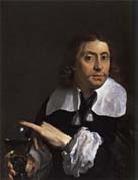
1621-1678
Dutch
Karel Dujardin Locations
Dujardin was born in Amsterdam in 1640. After training with Nicolaes Berchem, he went to Italy when young, and became a member of the Society of Painters at Rome, among whom, he was known as Barba di Becco. In Rome, his works met with general approbation.
According to some sources, on his way back to his native country, he contracted considerable debts at Lyon, to free himself from which, he married his old and rich landlady. He went with her to Amsterdam, where his pictures were valued very highly. He soon secretly left his home in that city, probably from dislike of his wife, and went back to Rome in 1675, where he was welcomed by his old friends and admirers, and lived at great expense. After a vist to Tangier he went to Venice, where he died in 1678.
Most of his paintings are cabinet paintings of Italianate landscapes and or with farm animals and peasants. His landscapes have spirit and harmony, his figures expression, and his colour the brilliancy which distinguishes his school. His paintings are rare and command a high price. He also published fifty-two etchings of simiar subjects, with great spirit and ease.
He painted a single, fine, portrait (probably a self-portrait), and a pair of Baroque religious paintings on the life of St Paul, probably commissioned, as they lie well outside his normal style. One of these, and the portrait, are in the National Gallery, London
|
|
 |
Karel du jardin
|
|
1626-78
Dutch painter, etcher and draughtsman. His father was Chaarles de Jardin (Gardyn; c. 1599-before 1650), a fat-renderer, and his mother was Catalyn Borchout (1588-before 1650). They had at least one other child, Herbert, who must have died by 1651
|
|
|
|
|
|
|
|
|
| Wholesale China Oil Painting Wholesale Oil Painting China Xiamen Portrait Reproduction on canvas Chinese Oil Painting Wholesale USA Oil Painting |
|
|
|
|
|