| |
|
Xiamen Oil Paintings, Wholesale Direct!
|
|
100% hand painted, 100% cotton canvas, 100% money back if not satisfaction. |
|
|
|
|
ART WORKS INDEX
A
B
C
D
E
F
G
H
I
J
K
L
M
N
O
P
Q
R
S
T
U
V
W
X
Y
Z
|
|
ARTISTS INDEX
A
B
C
D
E
F
G
H
I
J
K
L
M
N
O
P
Q
R
S
T
U
V
W
X
Y
Z
|
|
|
|
|
|
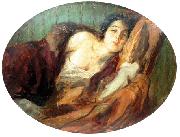 |
Nicolae Vermont
|
|
(October 10, 1866 - June 14, 1932) was a Romanian realist painter, graphic artist and muralist. He was noted for his wide range of subjects and his interest in social issues, and was an associate of the post-Impressionists Ştefan Luchian and Constantin Artachino, as well as a friend of the controversial art collector and political figure Alexandru Bogdan-Piteşti.
Born in Bacău, Vermont belonged to the Jewish community. Late in his life, Vermont abandoned Judaism and converted to the Romanian Orthodox Church.
He began his career in 1884, as a contributor to the journal Universul, while studying with Theodor Aman at the Academy of Fine Arts in Bucharest (graduated 1886). Vermont completed his training at the Munich Akademie der Bildenden Kenste (1893). He was able to attend the latter institution after being endorsed by the major Romanian artist Nicolae Grigorescu.
|
|
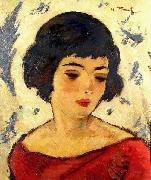 |
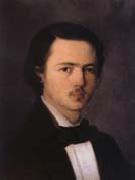
Nicolae Tonitza
|
|
(Romanian pronunciation: [nikoˈla.e toˈnit͡sa]; April 13, 1886 - February 27, 1940) was a Romanian painter, engraver, lithographer, journalist and art critic. Drawing inspiration from Post-impressionism and Expressionism, he had a major role in introducing modernist guidelines to local art.
Born in Bârlad, he left his home town in 1902 in order to attend the Iaşi National School of Fine Arts, where he had among his teachers Gheorghe Popovici and Emanoil Bardasare.The following year he visited Italy together with University of Bucharest students of archeology under the direction of Grigore Tocilescu.During that period, together with some of his fellow students, Tonitza painted the walls of Grozeşti church.
In 1908 he left for Munich, where he attended the Royal Academy of Fine Arts; he began publishing political cartoons in Furnica, and contributing art criticism articles to Arta Română. Tonitza spent the following three years in Paris, where he visited artists' studios, and studied famous paintings.Although the young artist's creation would initially conform to the prevalent style, his gift for colour and his personal touch would eventually lead him towards experiment.Throughout his life, he remained committed to the Munich School, hailing its innovative style over the supposedly "obscure imitators of Matisse".
|
|
 |
Nicolae Grigorescu
|
|
Romanian Painter, 1838-1907
From 1848 he trained in Bucharest with various church painters, producing icons and religious mural decorations. These works, which soon attracted attention, were influenced in style by the Viennese classicism widespread in the Romanian principalities in the early 19th century and by the Italian academicism established there after 1850 by Gheorghe Tattarescu. The earliest of his known paintings are in the church of SS Constantin and Elena at Baicoi, where his signature can be seen beside that of Nita Pereescu on the icon of St George (1853). He subsequently painted a series of icons (1854-5) at Caldarusani Monastery. In the later ensembles he was assisted by his older brother Georghe Grigorescu, who participated under his direction in the decoration of churches, such as those of the Zamfira (1856-8) and Agapia (1858-60) monasteries. In Nicolae's paintings at Agapia, classicism in Romanian art reached its highest point. The royal icons are distinguished for the elegance of the figures, both in their attitudes and in their drapery.
|
|
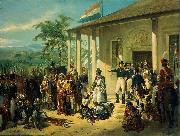 |
Nicolaas Pieneman
|
|
(1 January 1809, Amersfoort - 30 December 1860, Amsterdam) was a Dutch painter and lithographer. His father, Jan Willem Pieneman, was also a painter. Nicolaas Pieneman was a friend of William II of the Netherlands, whom he painted during his inauguration in 1840
|
|
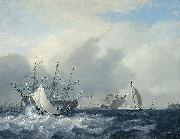 |
Nicolaas Baur
|
|
who was born at Harlingen in 1767, was the son of Hendricus Antonius Baur, a portrait painter (born 1736, died 1817). He painted landscapes and views of cities, and many houses in Holland are embellished by his works. He also painted moonlight and winter scenes; and was particularly successful in marine subjects. He is considered one of the best of the later Dutch marine painters. He died at Harlingen in 1820.
|
|
|
|
|
|
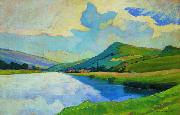 |
Nico Klopp
|
|
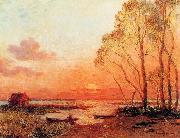
Den Nico Klopp war e letzebuergesche Moler. Hien ass den 18. September 1894 zu Bech-Maacher gebuer, an den 29. Dezember 1930 an der Stad Lëtzebuerg gestuerwen, wahrscheinlech un engem Gehirtumor, am Alter vun nëmme 36 Joer. Hie gëtt zu de postimpressionistesche Moler gerechent.
Säi LiewenDen Nico Klopp koum aus dem Wënzermilieu. Hien huet d'Handwierkerschoul an der Stad besicht. Seng Eltere si frei gestuerwen. No hirem Doud, huet hie sech fräi gefillt, fir vun 1915-1920 zu Dusseldorf a Weimar Konscht ze studeieren. Well hie vun der Konscht aleng net liewe konnt, war hien, vun 1923 un, Gemengereceveur zu Reimech.
Zäitweileg huet hien op Schoulen Zeechenunterrecht ginn, an huet nach en Täschegeld als Kannengerchersziichter verdengt. 1927 huet hie sech mat e puer anere Kënschtler, wei dem Joseph Kutter, dem Claus Cito, dem Auguste Tremont an anere vum Cercle Artistique getrennt, well him de Cercle ze reckstänneg war. Si goufe Sezessioniste genannt, well se 1927 e Salon de la Secession" organiseiert haten.
E puer vu senge Wierker sinn am Nationalmusee fir Geschicht a Konscht an der Stad ze gesinn.
Den Nico Klopp huet vill Biller vun der Musel gemoolt, bekannt si virun allem seng Biller vun der Muselbreck zu Reimech. Hien huet och Blummebiller gemoolt an dobäi hat hien eng Präferenz fir Tulpen. Ausserdeem war hien e Meeschter an Holz- a Linoschnëtter.
|
|
 |
Nicholas Roerich
|
|
(Russian: ,October 9, 1874 - December 13, 1947), was a Russian mystic, painter, philosopher, scientist, writer, traveler, and public figure. A prolific artist, he created thousands of paintings (many of them are exhibited in well-known museums of the world) and about 30 literary works. Roerich was an author and initiator of an international pact for the protection of artistic and academic institutions and historical sites (Roerich's Pact) and a founder of an international movement for the defence of culture. Roerich earned several nominations for the Nobel Prize.
|
|
 |
Nicholas Pocock
|
|
British Painter,
1741-1821
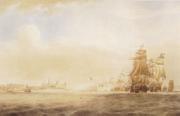
English painter. After an apprenticeship in the Bristol shipbuilding yards of Richard Champion, Pocock began a career at sea in the mid-1760s. He was a practised and gifted amateur watercolourist (his earliest signed and dated watercolour is from 1762), and when in command of the Lloyd, one of Champion's merchantmen, he began to keep detailed logbooks illustrated with wash drawings (four at London, N. Mar. Mus.). In 1780 he gave up his sea career, married and sent his first oil painting to the Royal Academy. The picture arrived too late for exhibition, but Sir Joshua Reynolds wrote back, noting 'It is much beyond what I expected from a first essay in oil colours'. Pocock exhibited annually at the Academy between 1782 and 1812 and enjoyed a steady supply of commissions for oil paintings and watercolours, mostly of marine subject-matter. He produced a series of watercolour views of Bristol (stylistically close to Edward Dayes) in the 1780s, many of which were engraved, and of Iceland in 1791.
|
|
 |
Nicholas Hilliard
|
|
1547-1619
British
Nicholas Hilliard Galleries
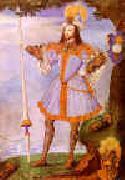
Nicholas Hilliard (c. 1547?CJanuary 7, 1619) was an English goldsmith and limner best known for his portrait miniatures of members of the courts of Elizabeth I and James I of England. He mostly painted small oval miniatures, but also some larger cabinet miniatures, up to about ten inches tall, and at least the two famous half-length panel portraits of Elizabeth. He enjoyed continuing success as an artist, and continuing financial troubles, for forty-five years, and his paintings still exemplify the visual image of Elizabethan England, very different from that of most of Europe in the late sixteenth century. Technically he was very conservative by European standards, but his paintings are superbly executed and have a freshness and charm that has ensured his continuing reputation as "the central artistic figure of the Elizabethan age, the only English painter whose work reflects, in its delicate microcosm, the world of Shakespeare's earlier plays.
|
|
|
|
 |
Nicholas Chevalier
|
|
Russia landscape artists and cartoonist .
1828-1902
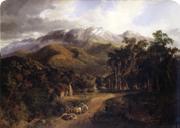
was an Australian artist. Chevalier was born in St Petersburg, Russia, the son of Louis Chevalier, who came from Vaud, Switzerland, and was overseer to the estates of the Prince de Wittgenstein in Russia. Nicholas' mother was Russian. Nicholas left Russia with his father in 1845, and studied painting and architecture in Lausanne, Switzerland and at Munich. In 1851 Chevalier moved to London and worked as an illustrator in lithography and water-colour. He also designed a fountain which was erected in the royal grounds at Osborne, and two of his paintings were hung at the Academy in 1852. Further study in painting followed at Rome. About the end of 1854 Chevalier sailed from London to Australia to join his father and brother, and in August 1855 obtained work as a cartoonist on the newly established Melbourne Punch. Later he did illustrative work for the Illustrated Australian News and also worked in chromo-lithography. In 1864, when the National Gallery of Victoria was founded, an exhibition of pictures by Victorian artists was held, the government underook to buy the best picture exhibited for £200. Chevalier's oil painting "The Buffalo Ranges" was selected, and was the first picture painted in Australia to be included in the Melbourne collection. In 1867 Chevalier visited New Zealand, travelling widely and doing much work there which was exhibited at Melbourne on his return. In 1869 he joined the H.M.S. Galatea as an artist with the Duke of Edinburgh, on the voyage to the East and back to London with stops in Tahiti, Hawaii, Japan, China, Ceylon (Sri Lanka) and India. The pictures painted during the voyage were exhibited at South Kensington. In January 1874 Chevalier was commissioned by Queen Victoria to travel to St Petersburg and paint a picture of the marriage of the Duke of Edinburgh. Chevalier made London his headquarters and was a constant exhibitor at the Academy from 1871 to 1887.
|
|
|
|
|
|
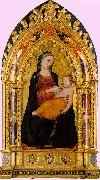 |
Niccolo di Pietro Gerini
|
|
Italian Painter, active ca.1368-1415
died in Florence in 1415, earned reputation of an important Italian painter. He represents giottesque school, in the tradition of the Andrea di Orcagna (1320-1368) and of Taddeo Gaddi. His father Pietro Geri is registered as a member of Lucas Guild in 1339. Niccolo worked mainly in Florence, although he also carried out commissions in Rome (Vatican), Pisa and Prato.
He was first recorded in 1368 as a member of the Arte dei Medici e Speziali in Florence but is identifiable with the Niccolo dipintore who collaborated with Jacopo di Cione on frescoes for the Guildhall of the Judges and Notaries in Florence in 1366. It is self-evident that he is the Niccolaio dipintore who worked with Jacopo di Cione on the altarpiece of the Coronation of the Virgin (presently in London, National Gallery) for St Pier Maggiore, Florence in 1370 and was paid 12 golden florins per disegnare la tavola dell altare in November of the same year. He designed the altarpiece and the elaborate throne canopy with his usual fine painting and detailed ornaments whilst Jacopo di Cione was depicting side saints. This altarpiece is amongst of very few largest commissioned in 14th century Florence. It was seemingly commissioned by Albizzi family.
He was collaborating with Jacopo di Cione on Coronation of the Virgin (Accademia, Florence) in 1372. Offner and Steinweg suggest that he was responsible for the design and fine painting and Jacopo for the execution of saints. It was commissioned by the mint of Florence Zecca Vecchia on the same year.
In 1383 Gerini again worked with Cione on a fresco of the Annunciation in the Palazzo dei Priori, Volterra. This fresco clearly shows the work of two very different artists: Niccolo di Pietro Gerini (design and very fine painting) and Jacopo di Cione (broadly painted saints and side decoration). In 1386 Niccolo frescoed the façade of the Bigallo, Florence. He also frescoed Sant Ambrogio church in Florence
Gerini performed the Crocefissione of St Felicita church in Florence.
His hand is clearly on sacrestia of the basilica of Saint Croce to Florence with Scenes of the life of Christ. Between 1391 and 1392 he worked in Prato where he frescoed Palazzo Datini, church of Saint Francisco with Lorenzo di Niccolo and Agnolo Gaddi.
He also frescoed capitolare of the church of Saint Francisco, Pisa.
Very typically for Gothic depiction Gerini figures have large chins, sloping foreheads, and sharp noses whilst their bodies are squat and frontally displaced.
Another important artist Lorenzo di Niccol?? di Martino was trained in Niccol?? di Pietro Gerini workshop and later collaborated with the master but was not his son as sometimes erroneously stated. Gerini though had a son Bindo di Niccolo di Pietro Gerini, born in 1363, who is registered as member of Lucas Guild since 1408.
Niccolo di Pietro Gerini works can be found in major art galleries of Rome, Vatican, Florence, London, Milan, New York, Los Angeles, Amsterdam, Berlin, Paris, St Petersburg, Boston, Cambridge, Budapest, Birmingham, Pegalo, Prato, Pisa, Altenburg, Avignon, Denver and several other museums.
|
|
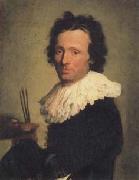 |
Niccolo Cassana
|
|
Italian , 1659 - 1714
was an Italian painter born in Venice and active during the late-Baroque. He trained with his father, Giovanni Francesco Cassana, a Genoese painter, who had been taught the art of painting by Bernardo Strozzi. He painted a "Conspiracy of Catiline" for the Gallery at Florence. Having painted portraits of the Florentine court, and also of some of the English nobility, Nicoletto was invited to England, and introduced to Queen Anne, who sat to him for her likeness, and conferred on him many marks of favour. He died in London in 1714
|
|
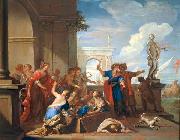 |
Niccolo Bambini
|
|
(1651-1736) was an Italian painter of the late-Renaissance and early-Baroque periods.
He was born in Venice, and first studied under Giulio Mazzoni at Venice; but afterwards went to Rome, where he became a pupil of Carlo Maratti. He painted for the church of San Stefano soon after his return from Rome. He died in Venice. He had two sons who were painters, Giovanni and Stefano.
|
|
|
|
|
|
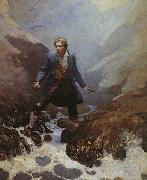 |
Newell Convers Wyeth
|
|
Newell Convers Wyeth (October 22, 1882 - October 19, 1945), known as N.C. Wyeth, was an American artist and illustrator. He was the pupil of artist Howard Pyle and became one of America's greatest illustrators. During his lifetime, Wyeth created over 3,000 paintings and illustrated 112 books, 25 of them for Scribner's, the Scribner Classics, which is the work for which he is best-known. The first of these, Treasure Island, was his masterpiece and the proceeds paid for his studio. Wyeth was a realist painter just as the camera and photography began to compete with his craft. Sometimes seen as melodramatic, his illustrations were designed to be understood quickly. Wyeth, who was both a painter and an illustrator, understood the difference, and said in 1908, "Painting and illustration cannot be mixedeone cannot merge from one into the other."
|
|
|
|
 |
NEUREUTHER, Eugen
|
|
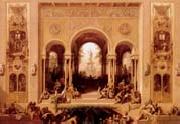
German painter b. 1806, Mnchen, d. 1882, Menchen,German lithographer, illustrator, decorative artist and painter. He was the son of the painter and printmaker Ludwig Neureuther (d 1832), and began his studies in Munich in 1823. His tutors included Peter von Cornelius, who enlisted him and several other young painters to help decorate the Glyptothek, and Wilhelm von Kobell. In 1830, fired with enthusiasm for the July Revolution in France, Neureuther went to Paris. He produced numerous studies from life (Munich, Staatl. Graph. Samml.), which are among his best works. From 1836-7 he was in Rome. From 1848 to 1856 he ran the Nymphenburg Porzellanmanufaktur, and for ten years from 1868 he taught decorative mural painting at the Munich Kunstgewerbeschule. Neureuther's principal importance lay in the field of book illustration. His reputation was established with the Vignettes for Goethe's Ballads and Romances (Randzeichnungen zu Goethes Balladen und Romanzen), published by J. G. Cotta in five booklets of 46 lithographic contour drawings in Munich, Stuttgart and Tebingen between 1829 and 1839. Goethe, to whom Cornelius had mentioned Neureuther, repeatedly spoke of these works in public, realizing their similarity to the prayer book of the Emperor Maximilian illustrated by Albrecht Derer, Lukas Cranach the elder, Hans Baldung, Albrecht Altdorfer and others. A new edition of this work, with lithographs by August Strixner (b 1820) had appeared in 1808. Neureuther later illustrated many other texts, but his approach became increasingly naturalistic and picturesque, and there was a notable decline in the artistic standard of the work.
|
|
|
|
|
|
|
|
 |
Nesterov, Mikhail
|
|
Russian, 1862-1942
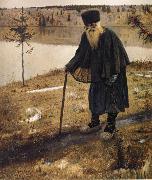
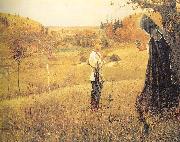
Russian painter. From 1877 to 1881 and again from 1884 to 1886 he studied at the Moscow School of Painting, Sculpture and Architecture under the Realist painters Vasily Perov and Illarion Pryanishnikov. Between 1881 and 1884 he worked under Pavel Chistyakov (1832-1919) at the Academy of Arts, St Petersburg. At the estate of Savva Mamontov at Abramtsevo he met the most influential painters of the period, then at the epicentre of the development of Russian Art Nouveau. Nesterov sought to combine this style with a deep Orthodox belief; however, in his desire to revive religious art he was influenced more by French Symbolism, particularly by Bastien-Lepage, than by old Russian icon painting. All of Nesterov's canvases are marked by a lyrical synthesis between the figures and their landscape surroundings, as in Hermit (1888-9; Moscow, Tret'yakov Gal.), which shows the stooped figure of an old man against a northern landscape of stunted trees and still water. The large oil painting Vision of Young Bartholomew (1889-90; Moscow, Tret'yakov Gal.) depicts the legend of the childhood of the Russian saint Sergey of Radonezh. A monk appears to the young Bartholomew (the future St Sergius) and prophesies a glorious future for him.
|
|
|
|
 |
Neroccio di Bartolomeo
|
|
1447 - 1500
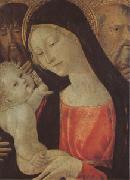
was an Italian painter and sculptor of the early-Renaissance or Quattrocento period in Siena. He was a student of Vecchietta, and then he shared a workshop with Francesco di Giorgio from 1468. He painted Scenes from the life of St Benedict, now in the Uffizi, probably in collaboration with di Giorgio, and a Madonna and Child between Saint Jerome and Saint Bernard, which is in the Pinacoteca of Siena. In 1472 he painted an Assumption for the abbey of Monte Oliveto Maggiore, and in 1475 he created a statue of Saint Catherine of Siena for the Sienese church dedicated to her. He separated from di Giorgio in 1475. In 1483, he designed the Hellespontine Sybil for the mosaic pavement of the Cathedral of Siena,
|
|
|
|
 |
NEER, Eglon van der
|
|
Dutch Baroque Era Painter, ca.1634-1703
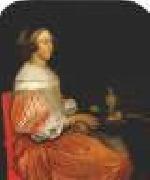
Son of Aert van der Neer. His birth date is based on Houbraken's statement that the artist was 70 years old when he died. He apparently studied first with his father and then with the genre and history painter Jacob van Loo. According to Houbraken, van der Neer was in France c. 1654, where he served as painter to the Counts of Dona, Dutch governors of the principality of Orange. He returned to Holland by 1659 and is recorded as a resident of Amsterdam at the time of his marriage to Maria van Wagensvelt in Rotterdam on 20 February 1659.
|
|
 |
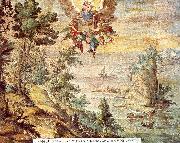
NEER, Aert van der
|
|
Dutch Baroque Era Painter, ca.1603-1677
Dutch landscape painter. Working mostly in Amsterdam, he excelled in painting unusual light effects, such as moonlight, sunsets, conflagrations, and glimmering light on snow and ice. His winter landscapes are among the best in Dutch art. He is well represented in many European galleries. The Metropolitan Museum has his Sunset, The Farrier, and Landscape. His son and pupil, Eglon Hendrik van der Neer, 1634C1703, was a genre, landscape, and portrait painter. He was court painter to the elector palatine in Desseldorf. He excelled in painting luxurious interiors, hunting scenes, and mythological or biblical subjects in Dutch settings.
|
|
|
|
|
|
 |
Nebbia, Cesare
|
|
Italian, 1536-1614
Italian painter and draughtsman. He was a pupil of GIROLAMO MUZIANO and much influenced by Federico Zuccaro, and Vasari cited him as a promising painter. Between 1562 and 1575 Nebbia was continuously employed in Orvieto, producing altarpieces and frescoes in the cathedral, for example the Marriage at Cana (1569), the Crucifixion (1574) and the Crowning with Thorns (1575; all Orvieto, Mus. Opera Duomo). In Rome, where from 1579 his name appeared in the register of the Accademia di S Luca, he executed an Ecce homo and another Crowning with Thorns (1576; oratory of the Gonfalone), a Noli me tangere (1579; S Maria degli Angeli), decorations in the Sforza Chapel, S Maria Maggiore (1582), Heraclius Taking the Cross (1582-4; Santissimo Crocifisso), the Martyrdom of St Lawrence (1589; S Susanna) and decorations in the Borghese Chapel, Trinit? dei Monti (c. 1590). Under Pope Sixtus V he was responsible, with Giovanni Guerra, for the decorations in the Sistine Library, and he also worked on the Scala Santa, in the Vatican Palace and in the Lateran Palace. In 1597 he was principal of the Accademia di S Luca. Two years later he received payment for the cartoons of St Matthew and St Mark for the mosaics in the cupola of St Peter's. The following year he painted the Dream of Constantine (S Giovanni in Laterano). In 1603-4 he decorated, with Zuccaro, the hall in the Collegio Borromeo, Pavia. He retired to Orvieto in 1609.
|
|
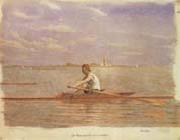 |
NC Wyeth
|
|
American Golden Age Illustrator, 1882-1945
1882-1945,was an American artist and illustrator. He was the star pupil of the artist Howard Pyle, and became one of America's greatest illustrators. During his lifetime, Wyeth created over 3,000 paintings and illustrated 112 books,25 of them for Scribner's, the work for which he is best known. Wyeth was a realist painter just as the camera and photography began to compete with his craft. Sometimes seen as melodramatic, his illustrations were designed to be understood quickly Wyeth who was both a painter and an illustrator, understood the difference, and said in 1908,
|
|
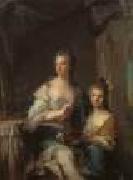 |
NATTIER, Jean-Marc
|
|
French Rococo Era Painter, 1685-1766
Brother of Jean-Baptiste Nattier. As well as being taught by his father, he trained with his godfather, Jean Jouvenet, and attended the drawing classes of the Acad?mie Royale, where in 1700 he won the Premier Prix de Dessin. From around 1703 he worked on La Galerie du Palais du Luxembourg. The experience of copying the work of Rubens does not, however, seem to have had a liberating effect on his draughtsmanship, which was described by the 18th-century collector Pierre-Jean Mariette as 'cold'. Nattier was commissioned to make further drawings for engravers in the early part of his career, including those after Hyacinthe Rigaud's famous state portrait of Louis XIV (1701; Paris, Louvre) in 1710, which indicates that he had established a reputation while he was still quite young. Although he was offered a place at the Acad?mie de France in Rome on the recommendation of Jouvenet, Nattier preferred to remain in Paris and further his career. In 1717 he nevertheless made a trip to Holland, where he painted portraits of Peter the Great and the Empress Catherine (St Petersburg, Hermitage).
|
|
 |
Natoire, Charles Joseph
|
|
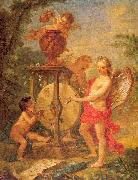
French, 1700-77
French painter, draughtsman and teacher, active also in Italy. An exact contemporary of Fran?ois Boucher, he was a painter of cabinet pictures, decorations and tapestry cartoons and one of the most adept practitioners of Rococo art in 18th-century France. The greater part of his career was spent in Paris, where he received important commissions from Louis XV as well as from private patrons. In 1751 he accepted the post of Director of the Acad?mie de France in Rome.
|
|
|
|
 |
Nathaniel Smibert
|
|
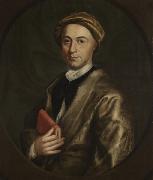
(January 20, 1734 - November 8, 1756), was an artist in Boston, Massachusetts, in the mid-18th century. Born in Boston in 1734, he trained as a painter with his father, the artist John Smybert, and produced several portraits, notably of Ezra Stiles, architect Peter Harrison, and Dorothy Wendell (in the Collection of Dr John L Hale, Boston).
|
|
|
|
 |
Nathaniel Hone
|
|
1718-1784
British
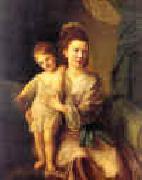
Nathaniel Hone (24 April 1718 ?C 14 August 1784) was an Irish-born portrait and miniature painter, and one of the founder members of the Royal Academy in 1768.
The son of a Dublin-based Dutch merchant, Hone moved to England as a young man and, after marrying in 1742, eventually settled in London, by which time he had acquired a reputation as a portrait-painter. While his paintings were popular, his reputation was particularly enhanced by his skill at producing miniatures and enamels. He interrupted his time in London by spending two years (1750-1752) studying in Italy.
As a portrait painter, several of his works are now held at the National Portrait Gallery in London. His sitters included magistrate Sir John Fielding and Methodist preacher John Wesley, and General Richard Wilford and Sir Levett Hanson in a double portrait.[2][3]
He courted controversy in 1775 when his satirical picture "The Conjurer" was seen to attack the fashion for Italian Renaissance art and to ridicule Sir Joshua Reynolds (it also included a nude caricature of fellow Academician Angelica Kauffmann, later painted out by Hone), and was rejected by the Royal Academy. To show his reputation was undamaged, Hone organised a one-man retrospective in London ?C the first such solo exhibition of an artist??s work.
His great-grand-nephew shared the same name and was also a notable Irish painter, known as Nathaniel Hone the Younger (1831-1917).
|
|
 |
Nathaniel Dance
|
|
English Painter, 1735-1811,Painter and politician, elder son of George Dance . He trained under Francis Hayman before travelling to Rome in 1754. As Nathaniel Dance he established himself as a portrait painter but was determined to succeed as a history painter. His picture the Death of Virginia (1759; untraced, but known from a sketch, London, Soane Mus.) is of documentary importance as the first dated Classical history painting by a British artist working in Rome. In 1762 Dance assisted Pompeo Girolamo Batoni, whose influence brightened his palette and introduced him to a grander clientele, including Edward Augustus, Duke of York (1739-67), who sat for both artists in 1764 (Dance's Edward Augustus, Duke of York, London, Buckingham Pal., Royal Col.). In the same year Dance painted a portrait of Angelica Kauffman (Burghley House, Cambs), with whom he was in love. He returned to London in 1765 and rapidly achieved fame as a portrait and history painter. His Timon of Athens (1767; London, Buckingham Pal., Royal Col.) was purchased by George III; but after the King appointed Benjamin West to be his history painter in 1772, Dance concentrated on portraits. He was among the 22 artists who successfully petitioned the King in 1768 to establish a Royal Academy, and he served for periods as a council member and visitor, until 1782. At the Academy's first exhibition (1769) Dance showed full-length portraits of George III and Queen Charlotte (Uppark, W. Sussex, NT); two years later he exhibited David Garrick as Richard III (Stratford-on-Avon, Town Hall). In the mid-1770s Dance became financially independent, and his output declined sharply, virtually ceasing after his marriage in 1783 to a wealthy widow. He resigned from the Academy in 1790 on his election as Member of Parliament for East Grinstead and subsequently only exhibited occasional landscapes as a 'gentleman'. In 1800 he was created a baronet and assumed the name of Dance-Holland; he died worth over
|
|
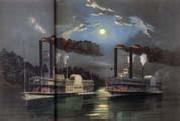 |
Nathaniel Currier
|
|
American lithographer and print publishers , 1813-1888
was an American lithographer, who headed the company Currier & Ives with James Ives. Currier was born in Roxbury, Massachusetts to Nathaniel and Hannah Currier. He attended public school until age fifteen, when he was apprenticed to the Boston printing firm of William and John Pendleton. The Pendletons were the first successful lithographers in the United States, lithography having only recently been invented in Europe, and Currier learned the process in their shop. He subsequently went to work for M. E. D. Brown in Philadelphia, in 1833. The following year, Currier moved to New York City, where he was to start a new business with John Pendleton. Pendleton backed out, and the new firm became Currier & Stodart, which lasted only one year. In addition to being a lithographer, he was also a volunteer fireman in the 1850s. In 1835, Currier started his own lithographic business as an eponymous sole proprietorship. He initially engaged in standard lithographic business of printing sheet music, letterheads, handbills, etc. However, he soon took his work in a new direction, creating pictures of current events. In late 1835, he issued a print illustrating a recent fire in New York. Ruins of the Merchant's Exchange N.Y. after the Destructive Conflagration of Decbr 16 & 17, 1835 was published by the New York Sun, just four days after the fire, and was an early example of illustrated news.
|
|
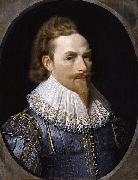 |
Nathaniel Bacon
|
|
(1585-1627) was a wealthy landowner from Culford, Suffolk, England.
self-portraitBacon was an exceptionally skillful amateur painter and gardener. Only a small group of 9 of his paintings survive. He was particularly known for his kitchen and market scenes, dominated by still-life depictions of large vegetables and fruit, often accompanied by a buxom maid, the most well known being "The Cookmaid with Still Life of Vegetables and Fruit" (Tate Gallery London). This predilection for cook or market scenes is much more common among Dutch and Flemish painters, see for example Joachim Beuckelaer (1533-1574), or from a later generation, Pieter Cornelisz van Rijck (1567-ca.1637), and Cornelis Jacobsz Delff.
Bacon is credited with the first known British landscape and also painted a self-portrait and a number of other portraits. He was created a Knight of the Bath in 1625, in honour of the Coronation of Charles I. He died at Culford Hall at the age of 42. He was buried there on 1 July 1627. His little daughter, Jane, aged three years, died that same October and is buried alongside her father. The entries of their burials follow each other in the Culford Parish Burial Register.
He was the son of Sir Nicholas Bacon, 1st Baronet.
|
|
|
|
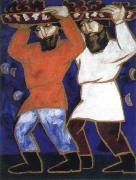 |
natalia goncharova
|
|
natalia goncharova(1881 to 1962),Russian painter, stage designer, printmaker and illustrator. She was a leading artist of the Russian avant-garde in the early 20th century but became a celebrity in the West through her work for SERGE DIAGHILEV and the BALLETS RUSSES. During the 1920s she played a significant role within the Ecole de Paris and continued to live and work in France until her death.
|
|
 |
Nasi
|
|
Italian, 19th century
Born in the town of Castel del Piano, near Grossetto, Giuseppe Nicola Nasini trained under Ciro Ferri at the Accademia Medicea in Rome in the early 1680??s. He also studied at the Accademia di San Luca, where he won several prizes, and later worked extensively in Rome. In 1689 he entered the service of the Grand Duke Cosimo III de?? Medici in Florence, for whom he painted a series of four large canvases on the theme of the Last Judgement for the Salone dei Novissimi of the Palazzo Pitti, executed between 1690 and 1694. Transferred at the end of the 18th century to a church in Siena, these are now lost. In the first quarter of the 18th century Nasini painted a number of works for churches in Rome, including an altarpiece of The Madonna and Child with Saints for the Chiesa dei Re Magi in 1707, and a Baptism of Christ for San Lorenzo in Lucina, completed in 1716. In 1718 Nasini was one of twelve leading painters working in Rome (including Benedetto Luti, Francesco Trevisani, Sebastiano Conca and Pier Leone Ghezzi) who were commissioned by Pope Clement XI to paint seated prophets in the oval niches of the nave of the basilica of San Giovanni in Laterano. One of Nasini??s last Roman works was a frescoed Glory of Saint Anthony for the church of SS. Apostoli, painted between 1721 and 1722. By the late 1720??s Nasini had risen to a position as the leading painter in Siena, where he headed a large and busy workshop. In such works as the decoration of the Oratorio del Crocifisso and the church of the Visitation he introduced the Baroque manner of Luca Giordano to his native city. His older brother Antonio was also a painter; the two collaborated on the decoration of the vault of the church of San Gaetano di Thiene in Siena, completed in 1734.
|
|
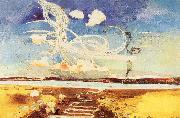 |
Nash, Paul
|
|
English, 1889-1946
Painter, printmaker, designer, writer and photographer. Although he briefly attended the Slade School, London, in 1910, he was essentially self-taught. His first one-man show was held in 1912 at the Carfax Gallery, London, where he showed a set of shadowy landscapes and imaginative drawings that look back to the Pre-Raphaelites and late 19th-century illustration. Between 1910 and 1914 he paid little attention to Post-Impressionism and the modern movements in London.
|
|
|
|
|
|
|
|
|
| Wholesale China Oil Painting Wholesale Oil Painting China Xiamen Portrait Reproduction on canvas Chinese Oil Painting Wholesale USA Oil Painting |
|
|
|
|
|