| |
|
Xiamen Oil Paintings, Wholesale Direct!
|
|
100% hand painted, 100% cotton canvas, 100% money back if not satisfaction. |
|
|
|
|
ART WORKS INDEX
A
B
C
D
E
F
G
H
I
J
K
L
M
N
O
P
Q
R
S
T
U
V
W
X
Y
Z
|
|
ARTISTS INDEX
A
B
C
D
E
F
G
H
I
J
K
L
M
N
O
P
Q
R
S
T
U
V
W
X
Y
Z
|
|
|
|
 |
RICCI, Sebastiano
|
|
Italian painter, Venetian school (b. 1659, Belluno, d. 1734, Venezia).Painter and draughtsman. He painted light and colourful religious, historical and mythological subjects with a fluid, painterly touch. His rediscovery of Paolo Veronese, whose settings and costumes he borrowed, was important to later Venetian painters. Sebastiano was an itinerant artist, celebrated throughout Europe.
|
|
 |
RICCI, Marco
|
|
Italian Painter, 1676-1730
Painter, printmaker and stage designer, nephew of (1) Sebastiano Ricci. He probably began his career in Venice in the late 1690s as his uncle's pupil, concentrating on history paintings (untraced). Having murdered a gondolier in a tavern brawl, he fled to Split in Dalmatia, where he remained for four years and was apprenticed to a landscape painter (Temanza, 1738). Once back in Venice (c. 1700) he put this training to use in painting theatrical scenery. Little is known about his early development, and it remains difficult to establish a chronology for his work. A group of restless, romantic landscapes (examples, Leeds, Temple Newsam House; Padua, Mus. Civ.), painted with lively, free strokes and formerly thought to represent his early period, have now been convincingly attributed (Moretti) to Antonio Marini (1668-1725). His earliest dated works, a tempera painting, View with Classical Ruins (1702; priv. col.), and a Landscape with Fishermen (1703; ex-Kupferstichkab., Berlin; untraced), are serene and classical, close in style to tempera paintings generally dated 1710-30. This suggests that Ricci's style did not develop much, and that strong classicizing tendencies,
|
|
 |
RIBALTA, Francisco
|
|
Spanish Baroque Era Painter, ca.1565-1628
He was the most distinguished artist working in Valencia in the early 17th century. His move towards naturalism at an early date was significant for the history of Spanish painting as well as being very influential. His documented mature works after about 1620 show a change of vision, and they are also of the highest quality. The religious paintings are depicted with more pronounced realism, and his deeply felt spiritual belief is expressed in a direct and very immediate way. In 1607 Ribalta supported other leading Valencian painters in a move to form the Colegio de Pintores (College of Painters) to safeguard the interests of the profession. The expulsion of the Moriscos in 1609 and the death in 1611 of the Patriarch Archbishop Juan de Ribera, Ribalta's most important patron, led to an economic crisis and spiritual void in Valencia that had an effect on his activity, since thereafter commissions came more rarely, and his work became more introspective. During 1616 and 1617 the idea of forming the Colegio de Pintores was revived, and Ribalta took an active role in the management and signed the petition to Philip III seeking support for the Colegio.
|
|
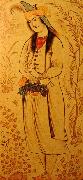 |
Reza Abbasi
|
|
(1565 - 1635) was the most renowned Persian miniaturist, painter and calligrapher of the Isfahan School, which flourished during the Safavid period under the patronage of Shah Abbas I.
He is considered to be one of the foremost Persian artists of all time. He received his training in the atelier of his father, Ali Asghar, and was received into the workshop of Shah Abbas I at a young age.
At the age of about 38 he received the honorific title of Abbasi from his patron, but soon left the Shah's employ, apparently seeking greater freedom to associate with simple people. In 1610 he returned to the court and continued in the employ of the Shah until his death.
His specialty was the Persian miniature, with a preference for naturalistic subjects often portrayed in an effeminate and impressionistic manner,a style which came to be popular during the late Safavid court.
|
|
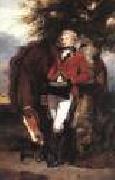 |
REYNOLDS, Sir Joshua
|
|
English Rococo Era Painter, 1723-1792
English painter, collector and writer. The foremost portrait painter in England in the 18th century, he transformed early Georgian portraiture by greatly enlarging its range. His poses, frequently based on the Old Masters or antique sculpture, were intended to invoke classical values and to enhance the dignity of his sitters. His rich colour, strong lighting and free handling of paint greatly influenced the generation of Thomas Lawrence and Henry Raeburn. His history and fancy pictures explored dramatic and emotional themes that became increasingly popular with both artists and collectors in the Romantic period. As first president of the Royal Academy in London, he did more than anyone to raise the status of art and artists in Britain. His Discourses on Art, delivered to the students and members of the Academy between 1769 and 1790,
|
|
|
|
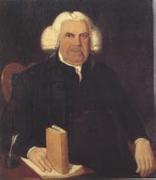 |
Reuben Moulthrop
|
|
American portrait, miniature, wax sculptor
b.1763-d.1814
American painter. As proprietor of a waxworks museum and travelling waxworks exhibition, he was interested in modelling in wax in his early years. While moving around his native state, he was exposed to several artistic influences, beginning with Winthrop Chandler. His earliest portraits seem to date from about 1788, when he completed Mr and Mrs Samuel Hathaway (1788; New Haven, CT, Colony Hist. Soc. Mus.). Its dark, heavy outlines, its flatness and almost geometric forms derive from Chandler. The quality of Moulthrop's paintings was extremely uneven; many of the best of the surviving body of about 50 works date from around 1800. The Rev. Thomas Robbins which depicts the sitter's direct gaze and contains more detail than the earlier portraits, shows the artist at his most accomplished. In the last years of his brief career he appears to have been influenced by William Jennys and John Durand,
|
|
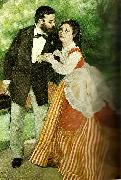 |
renoir
|
|
född 25 februari 1841 i Limoges, Haute-Vienne, Frankrike, död 3 december 1919 i Cagnes-sur-Mer
|
|
 |
RENI, Guido
|
|
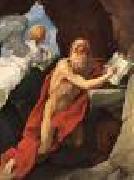
Italian Baroque Era Painter, 1575-1642
Italian painter, draughtsman and etcher. He was one of the greatest and most influential of the 17th-century Italian painters, whose sophisticated and complex art dominated the Bolognese school. A classicizing artist, deeply influenced by Greco-Roman art and by Raphael but also by the mannered elegance of Parmigianino's paintings, he sought an ideal beauty; his work was especially celebrated for its compositional and figural grace. In his religious art he was concerned with the expression of intense emotion, often charged with pathos; according to his biographer Malvasia, he boasted that he 'could paint heads with their eyes uplifted a hundred different ways' to give form to a state of ecstasy or divine inspiration.
|
|
 |
Rene-Antoine Houasse
|
|
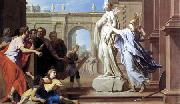
(c. 1645 - 1710) was a decorative French painter.
He was a pupil of Charles Le Brun, under whose direction he worked at the Manufacture des Gobelins, and with whom he worked on the decoration of the Château de Versailles. He was the director of the French Academy in Rome from 1699 to 1704. His son was Michel-Ange Houasse, a painter of genre scenes.
|
|
 |
Rene Schutzenberger
|
|
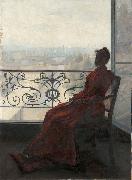
Rene Schutzenberger (Mulhouse July 29, 1860, Paris December 31, 1916), also known as Paul Rene Schutzenberger, was a French painter.
Born in an Alsatian family of famous brewers, his father Paul Schutzenberger (1829-1897) was a French chemist. The painter Louis-Frederic Schutzenberger (1825-1903) was his cousin.
He studied at the Academie Julian under Jean-Paul Laurens.
He started to exhibit at the Salon des artistes français since 1891, at the Salon des Independants since 1902 and at the Societe Nationale des Beaux-Arts since 1907. He got an honourable mention at the Salon of 1897 and at the Universal Exhibition of 1900.
He practices genre painting, portraits, nudes and landscapes. He treats subjects of the daily life and intimists subjects. His style is close to the Post-Impressionism movement. His drawings are influenced by the Nabis.
|
|
 |
Rene Herisson
|
|
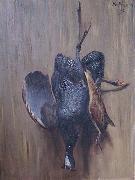
Rene Herisson (ne a Cognac (Charente) le 24 mai 1857 - decede le 4 janvier 1940) est un poete et peintre animalier francais
|
|
|
|
 |
Rembrandt van rijn
|
|
1606-1669
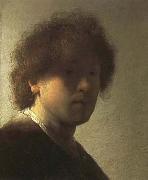
Dutch painter, draughtsman and etcher. From 1632 onwards he signed his works with only the forename Rembrandt; in documents, however, he continued to sign Rembrandt van Rijn (occasionally van Rhyn), initially with the addition of the patronymic 'Harmensz.'. This was no doubt in imitation of the great Italians such as Leonardo, Michelangelo, Raphael and Titian, on whom he modelled himself, sometimes literally. He certainly equalled them in fame, and not only in his own country. His name still symbolizes a whole period of art history rightfully known as 'Holland's Golden Age'. In 1970-71 a great exhibition in Paris was devoted to it under the eloquent title Le Si?cle de Rembrandt. A century before, a popular work of cultural history by C. Busken Huet referred to the Netherlands as 'the land of Rembrandt'. His fame is partly due to his multi-faceted talent. Frans Hals was perhaps at times a greater virtuoso with the brush but remained 'only' a portrait painter. Vermeer may have excelled Rembrandt in the art of illusion but was less prolific. Rembrandt was not only a gifted painter but also an inspired graphic artist: he has probably never been surpassed as an etcher, and he often seems inimitable as a draughtsman. His subjects reflect his manifold talent and interests. He painted, drew and etched portraits, landscapes, figures and animals, but, above all, scenes of biblical and secular history and mythology.
|
|
 |
Rembrandt Peale
|
|
1778-1860
Rembrandt Peale Galleries
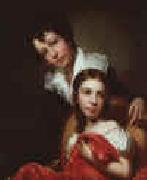
Rembrandt Peale (February 22, 1778 ?C October 3, 1860) was a 19th century American artist that received critical acclaim for his portraits of presidents George Washington and Thomas Jefferson. Although modern art critics would consider Peale??s artwork as French neoclassical, its dark and stylized characteristics are similar to 15th and 16th century paintings.
Rembrandt Peale was born the third of six surviving children (eleven had died) to his mother, Rachel Brewer, and father, Charles Willson Peale in Bucks County, Pennsylvania, on February 22, 1778. The father, Charles, also a notable artist, taught each child to paint scenery and portraiture, and Rembrandt was no exception. Charles tutored Rembrandt about the importance of having a strong mind from learning arts and sciences. At the age of eight, Rembrandt discovered drawing, and at thirteen, painted his first known self-portrait. Later on in his life, Rembrandt Peale "often showed this painting to young beginners, to encourage them to go from 'bad' to better..." like his steady progressions to become a successful portraitist.
A year after his mother??s death and remarriage of his father, Rembrandt Peale left the school of the arts, thereby applying his time to completing his first ever self-portrait at the age of 13. The canvas illustrates early mastery of a young aspiring artist, seeming very mature. The clothes, however give the notion that Peale over-exaggerated what a 13 year old would look like. This style demonstrates early forms of neoclassicism by the looks of Peale's angel-like hair, the way it waves and curls in such a fashion so as to depict an angel from a general Renaissance artist's works of art.
In July of 1787, Charles Willson Peale introduced his son Rembrandt to George Washington, where the young aspirant artist watched his father paint the remarkable figure of the country. In 1795, at the age of 17, Rembrandt painted an aging Washington, though the painter had depicted the politician as far more aged than the original facial characteristics. It did, nevertheless attain praise and Rembrandt had begun his debut.
At the age of 20, Rembrandt married 22-year-old Eleanor May Short (1776-1836) at St. Joseph's Catholic Church in Philadelphia. During their marriage, Rembrandt and Eleanor had nine children: Rosalba, Eleanor, Sarah Miriam, Michael Angelo, and Emma Clara among them.
In 1822, Peale moved to New York City where he embarked on an attempt to paint what he hoped would become the "standard likeness" of Washington. He studied portraits by other artists including John Trumbull, Gilbert Stuart and his own father, as well as his own 1795 picture which had never truly satisfied him. His resulting work Patriae Pater, completed in 1824, depicts Washington through an oval window, and is considered by many to be second only to Gilbert Stuart's iconic Athenaeum painting of the first president. Peale subsequently attempted to capitalize on the success of what quickly became known as his "Porthole" picture. Patriae Pater was purchased by Congress in 1832 and still hangs in the U.S. Capitol.
Later on, Peale made over 70 detailed replicas of the same "father of our country", the first President of the United States. Peale continued to paint other noted portraits, such as those of the third president Thomas Jefferson while he was in office (1805), and later on a portrait of Chief Justice John Marshall.
|
|
 |
REMBRANDT Harmenszoon van Rijn
|
|
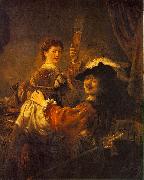
Born 1606, Died 1669.One of the great Dutch painters and printmakers of the 17th century, Rembrandt van Rijn is best known for his expressive use of light and shadow (also called chiaroscuro) in his many portraits. Raised in Leiden, he studied with Pieter Lastman (1583-1633) in Amsterdam, then returned to Leiden around 1625 and set up shop as a teacher and portrait artist. Sometime between 1630 and 1632 Rembrandt relocated to Amsterdam, where he spent the rest of his career. Though he had his detractors (some of whom considered him coarse and "low born"), Rembrandt was successful and famous during his lifetime, though he fell on financial hard times in his later years. He was a master printer and produced hundreds of group portraits and historical paintings, including The Anatomy Lesson of Dr. Tulp (1632), The Military Company of Captain Frans Banning Cocq (1642) and Aristotle with a Bust of Homer (1653). His portraits -- including a lifelong trail of intriguing and rather frank self-portraits -- reveal his interest in psychological study and continue to be admired as landmarks in Western art. The Military Company of Captain Frans Banning Cocq is also known as "The Night Watch" because it was thought the painting depicted a nighttime scene. When the painting was cleaned in the 1940s it became obvious that it depicted a daytime scene... He married Saskia van Ulenburgh (also Uylenburgh) in 1634.
|
|
 |
Rembrandt Harmensz Van Rijn
|
|
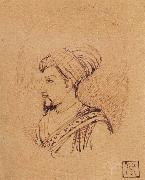
b. 1606 Leiden, The Netherlands, d. 1669 Amsterdam,Dutch painter, draughtsman and etcher. From 1632 onwards he signed his works with only the forename Rembrandt; in documents, however, he continued to sign Rembrandt van Rijn (occasionally van Rhyn), initially with the addition of the patronymic 'Harmensz.'. This was no doubt in imitation of the great Italians such as Leonardo, Michelangelo, Raphael and Titian, on whom he modelled himself, sometimes literally. He certainly equalled them in fame, and not only in his own country. His name still symbolizes a whole period of art history rightfully known as 'Holland's Golden Age'. In 1970-71 a great exhibition in Paris was devoted to it under the eloquent title Le Si?cle de Rembrandt. A century before, a popular work of cultural history by C. Busken Huet referred to the Netherlands as 'the land of Rembrandt'. His fame is partly due to his multi-faceted talent. Frans Hals was perhaps at times a greater virtuoso with the brush but remained 'only' a portrait painter. Vermeer may have excelled Rembrandt in the art of illusion but was less prolific. Rembrandt was not only a gifted painter but also an inspired graphic artist: he has probably never been surpassed as an etcher, and he often seems inimitable as a draughtsman. His subjects reflect his manifold talent and interests. He painted, drew and etched portraits, landscapes, figures and animals, but, above all, scenes of biblical and secular history and mythology.
|
|
 |
Reinier Nooms
|
|
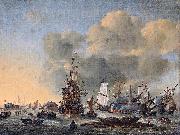
(c. 1623 - c. 1667), also known as Zeeman (Dutch for "sailor"), was a maritime painter known for his highly detailed paintings and etchings of ships.
Nooms was born and died in Amsterdam. He started painting and drawing in his later years, following a rough, drunken life as a sailor. It is not known how he acquired his skill as an artist. His knowledge of ships is evident from his work: ships and foreign locations are depicted with high accuracy and in great detail, and served as an example to other artists of how to depict ships.
A widely traveled artist, Nooms visited Paris, Venice and possibly Berlin, and also journeyed along the coast of North Africa.
A favourite subject of his paintings were the Dutch victories in the Anglo-Dutch Wars. For instance, he painted the Amalia, the flagship of admiral Maarten Tromp, before the Battle of the Downs in 1639. This painting now hangs in the National Maritime Museum in Greenwich, UK. His painting of the Battle of Leghorn in 1653 is in the collection of the Rijksmuseum in Amsterdam.
In the 1650s, Nooms made a series of etchings of ships and topographical views characterized by a high degree of detail and precision. These etchings served as an example to many artists. The 19th century French etcher Charles Meryon was highly influenced by Noom, whose etchings of Paris cityscapes inspired Meryon to his own series of Paris etchings. Meryon even dedicated some of this work to Nooms in poetic form.
|
|
 |
Reinhold Begas
|
|
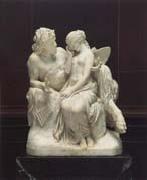
1831-1911 Berlin,was a German sculptor. Begas was born in Berlin to the painter Karl Begas. He received his early education (1846-1851) studying under Christian Daniel Rauch and Ludwig Wilhelm Wichmann. During a period of study in Italy, from 1856 to 1858, he was influenced by Arnold Bocklin and Franz Lenbach in the direction of a naturalistic style in sculpture. This tendency was marked in the group Borussia, executed for the facade of the exchange in Berlin, which first brought him into general notice. In 1861 Begas was appointed professor at the art school at Weimar, but retained the appointment only a few months. That he was chosen, after competition, to execute the statue of Schiller for the Gendarmenmarkt in Berlin, was a high tribute to the fame he had already acquired; and the result, one of the finest statues in the German metropolis, entirely justified his selection. Since the year 1870, Begas dominated the plastic art in the Kingdom of Prussia, but especially in Berlin. Among his chief works during this period are the colossal statue of Borussia for the Hall of Glory; the Neptune fountain in bronze on the Schlossplatz; the statue of Alexander von Humboldt, all in Berlin; the sarcophagus of Emperor Frederick III in the mausoleum of the Church of Peace at Potsdam
|
|
|
|
 |
Regis-Francois Gignoux
|
|
1816-1882
French/American
Regis-Francois Gignoux Gallery
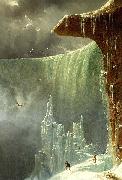
French painter who was active in the United States from 1840 to 1870. He was born in Lyon, France and studied at the École des Beaux-Arts under with the French painter Paul Delaroche (1797-1856). Gignoux arrived in the United States from France in 1840 and opened a studio in Brooklyn, New York. He was a member of the National Academy of Design, and was the first president of the Brooklyn Art Academy. George Inness (1825-1894) and John LaFarge (1835-1910) were both his students. Gignoux was the only member of the Hudson River School to specialize in snow scenes. He returned to France in 1870 and died in Paris in 1882.
The Brooklyn Museum, the Corcoran Gallery of Art (Washington, DC), the Georgia Museum of Art (University Of Georgia, Athens), the High Museum of Art (Atlanta, Georgia), the Honolulu Academy of Arts, the Hood Museum of Art (Dartmouth College, Hanover, New Hampshire), the Museum of Art at Brigham Young University (Provo, Utah), the Museum of Fine Arts, Boston, the Nelson-Atkins Museum of Art (Kansas City, Missouri), the New York Historical Society (New York City), the Parrish Art Museum (Southampton, New York), Smith College Museum of Art (Northampton, Massachusetts), the United States Capital Art Collection (Washington, D. C.), the Walters Art Museum (Baltimore, Maryland) and the Watson Gallery (Wheaton College, Norton, Massachusetts) are among the public collections holding work by R??gis François Gignoux.
|
|
 |
Regis Francois Gignoux
|
|
Regis François Gignoux (1816-1882) was a French painter who was active in the United States from 1840 to 1870. He was born in Lyon, France and studied at the École des Beaux-Arts under the French historical painter Hippolyte Delaroche, who inspired Gignoux to turn his talents toward landscape painting. Gignoux arrived in the United States from France in 1840 and eventually opened a studio in Brooklyn, New York. He was a member of the National Academy of Design, and was the first president of the Brooklyn Art Academy. George Inness, John LaFarge (1835-1910), and Charles Dormon Robinson were his students. By 1844, Gignoux had opened a studio in New York City and became one the first artists to join the famous Tenth Street Studio, where other members included Albert Bierstadt, Frederic Church, Jasper Francis Cropsey, and John Frederick Kensett. He returned to France in 1870 and died in Paris in 1882.
|
|
 |
Reginald Marsh
|
|
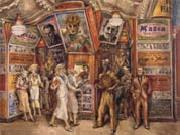
American Social Realist Painter, 1898-1954,American painter, printmaker and illustrator. He returned from France to the USA with his American parents, Fred Dana Marsh (1872-1961) and Alice Marsh, who were also artists, in 1900. In 1920 he graduated from Yale University, New Haven, CT, where he had been art editor and cartoonist for the Yale Record. He moved to New York and became staff artist for Vanity Fair and the New York Daily News. By 1923 he had begun painting scenes of street life in New York in oil and watercolour. His first one-man show was held at the Whitney Studio Club in 1924. In 1925 he joined the New Yorker, to which he contributed regularly until 1931.
|
|
|
|
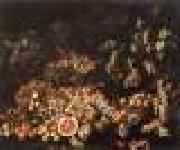 |
RECCO, Giuseppe
|
|
Italian Baroque Era Painter, 1634-1695
Son of Giacomo Recco. He was the most celebrated Neapolitan still-life painter of his day. He began in the tradition of his father and (probable) uncle Giovan Battista Recco, painting naturalistic arrangements of flowers, fish, game and kitchen scenes. There are many signed and dated works which chart the development of his style. The Bodeg?n with a Negro and Musical Instruments (1659; Madrid, Medibacoeli priv. col.), the Bodeg?n with Fish (1664; Paris, Moret priv. col.) and the Kitchen Interior (1675; Vienna, Ksthist. Mus.) are close to the art of Giovan Battista Recco. The fish and kitchen still-lifes are typically Neapolitan, yet Giuseppe's art is distinguished by the intensity with which he observes light and surface texture and by the clarity of the composition, based on a careful balance of horizontals and verticals. He moved toward a more Baroque and decorative style, and the unfinished Still-life with Fruit, Flowers and Birds (1672) and the Still-life with Fruit and Flowers
|
|
|
|
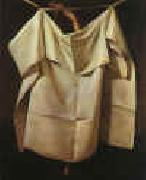 |
Raphaelle Peale
|
|
1774-1825
Peale was born in Philadelphia as the son and first child of Rachel and Charles Willson Peale, a famous portraitist.
Lived in Philadelphia, on a home at the corner of 3rd and Lombard.
Married Martha (Patty) McGlathery at the age of 20.
First first professional exhibition was in 1795 at the age of 21.
Artist. Born Raphaelle Peale in Annapolis, Maryland on February 17, 1774, the fifth child, though eldest surviving, of Charles Willson Peale and his first wife Rachel Brewer. As with all the Peale children, Raphael was trained by his father as an artist. Early in his career, the pair collaborated on portraits. On some commissions, Raphael painted miniatures while his brother, Rembrandt, painted full size portraits.
In 1792, he made a trip to South America in order to collect specimens for the Peale's Museum. In 1797, with his brother Rembrandt, he traveled to Charleston, South Carolina, where they attempted to establish another museum. The plan fell through, however, and Raphael returned to painting miniatures.
He married Martha McGlathery at about that same time, and with her had eight children. For about two years beginning in 1803, Raphael toured Virginia with the ??physiognotrace,' a profile making machine, with which he was briefly successful. In August 1808, he was hospitalized with delirium tremens, exacerbated by severe gout. By 1813, he was unable to walk without crutches. After the downturn in his health, in an era when most artists considered still life a subject worthy only of amateurs, he devoted himself almost exclusively to still life painting. It is for these works he is best known. Raphael Peale is today considered the founder of the American Still Life school. His work was on frequent exhibit at the Pennsylvania Academy of the Fine Arts between 1814 and 1818. After reportedly indulging in a night of heavy drinking, his health destroyed, Raphael died on March 3, 1825 at age 51 at his home in Philadelphia.
Peale's tightly grouped still lifes are often permeated with a delicate melancholy akin to that which characterized the life of the artist; he was an alcoholic who suffered the effects of arsenic and mercury poisoning caused by his work as a taxidermist in his father's museum. His spare, essential style may have been influenced by the Spanish still lifes he studied in Mexico and by the works of Juan Sanchez Cotan, exhibited at the Pennsylvania Academy in 1818.
|
|
|
|
|
|
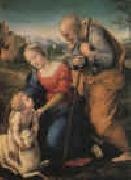 |
Raphael
|
|
Italian High Renaissance Painter, 1483-1520
Raphael Sanzio, usually known by his first name alone (in Italian Raffaello) (April 6 or March 28, 1483 ?C April 6, 1520), was an Italian painter and architect of the High Renaissance, celebrated for the perfection and grace of his paintings and drawings. Together with Michelangelo and Leonardo da Vinci, he forms the traditional trinity of great masters of that period.
Raphael was enormously productive, running an unusually large workshop, and, despite his early death at thirty-seven, a large body of his work remains, especially in the Vatican, whose frescoed Raphael Rooms were the central, and the largest, work of his career, although unfinished at his death. After his early years in Rome, much of his work was designed by him and executed largely by the workshop from his drawings, with considerable loss of quality. He was extremely influential in his lifetime, though outside Rome his work was mostly known from his collaborative printmaking. After his death, the influence of his great rival Michelangelo was more widespread until the 18th and 19th centuries, when Raphael's more serene and harmonious qualities were again regarded as the highest models.
His career falls naturally into three phases and three styles, first described by Giorgio Vasari: his early years in Umbria, then a period of about four years (from 1504-1508) absorbing the artistic traditions of Florence, followed by his last hectic and triumphant twelve years in Rome, working for two Popes and their close associates.
|
|
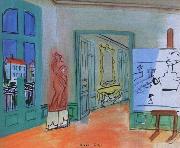 |
raoul dufy
|
|
raoul dufy(1877 to 1953) French painter, printmaker and decorative artist. From the age of 14 he was employed as a book-keeper, but at the same time he developed his innate gift for drawing at evening classes at the Ecole des Beaux-Arts in Le Havre,given by the Neo-classical painter Charles Lhuillier (1824-98). He discovered the work of Eug?ne Boudin, Poussin and Delacroix, whose Justice of Trajan (1840; Rouen, Mus. B.-A.) was 'a revelation and certainly one of the most violent impressions' of his life (Lassaigne, Eng. trans., p. 16). In 1900, with a grant from Le Havre, he joined his friend Othon Friesz in Paris and enrolled at the Ecole Nationale Sup-rieure des Beaux-Arts in the studio of L?on Bonnat. At the Mus?e du Louvre he studied the art of Claude Lorrain, to whom he painted several Homages between 1927 and 1947 (e.g. 1927; Nice, Mus. Mass-na). His encounter with works by van Gogh at the Galerie Bernheim-Jeune and with Impressionism at Durand-Ruel is reflected in such early works as Beach at St Adresse (1904; Paris, Pompidou).
|
|
 |
Ranney William Tylee
|
|
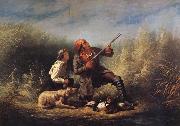
German-born American Painter, 1813-1857
American painter. He spent six formative years in the hill country of North Carolina. By 1834 he was working and studying drawing in New York, but two years later he went to Texas to join in the war for independence. Although he returned to New York a year later, it was not until 1846, with the outbreak of the Mexican War, that Ranney began to use his Western experience as the basis for his painting. With the encouragement of the American Art Union, he executed three types of Western subject: the Western trapper or hunter, pursuing a dangerous life on the prairies, as in Trapper's Last Shot (1850; untraced; engraved and lithographed by T. Dwight Booth); the pioneer family, heading across the plains with children, dogs and goods, as in Advice on the Prairie (1853; Malvern, PA, Claude J. Ranney priv. col.); and the dangers of emigration, for example Prairie Fire.
|
|
 |
RAMSAY, Allan
|
|
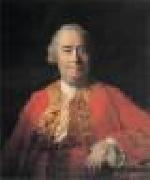
Scottish Rococo Era Painter, 1713-1784
Portrait painter, born in Edinburgh, son of the poet Allan Ramsay. He studied in Edinburgh, London, Rome, and Naples, settling in London in 1739 and quickly establishing himself as the leading portraitist of the capital. He was particularly successful in painting women. His career as a portrait painter ended in 1773
|
|
 |
Ramsay Richard Reinagle
|
|
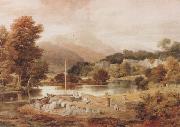
British Painter, 1775-1862
was an English portrait, landscape, and animal painter, and son of Philip Reinagle. Ramsay Richard Reinagle was a pupil of his father, whose style he followed, and he exhibited at the Royal Academy as early as 1788. He afterwards went to Italy, and was studying in Rome in 1796. Subsequently he visited Holland in order to study from the Dutch masters. After his return home he painted for a time at Robert Barker's panorama in Leicester Square, and then entered into partnership with Thomas Edward Barker, Robert's eldest son, who was not himself an artist, in order to erect a rival building in the Strand. They produced panoramas of Rome, the Bay of Naples, Florence, Gibraltar, Algeciras Bay, and Paris, but in 1816 disposed of their exhibition to Henry Aston Barker and John Burford. In 1805 Reinagle was elected an associate of the Society of Painters in Watercolours, and in 1806 a member. He became its treasurer in 1807, and was president from 1808 to 1812 Between 1806 and 1812 he sent to its exhibitions sixty-seven drawings, mostly Italian landscapes and scenery of the English lakes. During the same period he exhibited portraits and landscapes in oil at the Royal Academy, of which he became an associate in 1814, and an academician in 1823. He was a clever copyist of the old masters, and is said to have been much employed by a picture-dealer in restoring and 'improving ' their works.In 1848 he sent to the Royal Academy exhibition as his own work a small picture of 'Shipping a Breeze and Rainy Weather off Hurst Castle' painted by a young artist named J. W. Yarnold, which he had purchased at a broker's shop, and in which he had made some slight alterations. Attention was called to the imposition, and a full inquiry made by the academy resulted in his being called upon to resign his diploma as a royal academician. In 1850 he published in the 'Literary Gazzette' two letters in which he unsuccessfully endeavoured to exculpate himself.He continued to exhibit at the academy until 1857,
|
|
 |
Ramon marti alsina
|
|
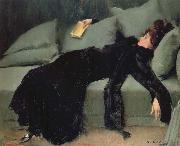
Spanish , 1826-1894
He studied in Paris in successive stages over which he came to know the work of Courbet, the French Realists and the Barbizon school. In the end he even adapted to Impressionism. He is considered the best representative of Spanish Realism..
|
|
 |
Ramon Casas i Carbo
|
|
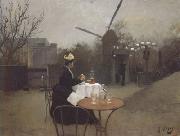
1866-1932,was a Catalan artist. Living through a turbulent time in the history of his native Barcelona, he was known as a portraitist, sketching and painting the intellectual, economic, and political elite of Barcelona, Paris, Madrid, and beyond; he was also known for his paintings of crowd scenes ranging from the audience at a bullfight to the assembly for an execution to rioters in the Barcelona streets.
|
|
 |
Ramon Casas
|
|
1866-1932
was a Catalan artist. Living through a turbulent time in the history of his native Barcelona, he was known as a portraitist, sketching and painting the intellectual, economic, and political elite of Barcelona, Paris, Madrid, and beyond; he was also known for his paintings of crowd scenes ranging from the audience at a bullfight to the assembly for an execution to rioters in the Barcelona streets. Also a graphic designer, his posters and postcards helped to define the Catalan art movement known as modernisme. Casas was born in Barcelona. His father had made a fortune in Matanzas, Cuba; his mother was from a well-off Catalan family. In 1877 he abandoned the regular course of schooling to study art in the studio of Joan Vicens. In 1881, still in his teens, he was a co-founder of the magazine L'Avenç; the 9 October 1881 issue included his sketch of the cloister of Sant Benet in Bages. That same month, accompanied by his cousin Miquel Carb i Carb, a medical student, he began his first stay in Paris, where he studied that winter at the Carolus Duran Academy and later at the Gervex Academy, and functioned as a Paris correspondent for L'Avenç. The next year he had a piece exhibited in Barcelona at the Sala Paris, and in 1883 in Paris the Salon des Champs Elysies exhibited his portrait of himself dressed as a flamenco dancer; the piece won him an invitation as a member of the salon of the Societe d'artistes françaises. The next few years he continued to paint and travel, spending most autumns and winters in Paris and the rest of the year in Spain, mostly in Barcelona but also in Madrid and Granada; his 1886 painting of the crowd at the Madrid bullfighting ring was to be the first of many highly detailed paintings of crowds. That year he survived tuberculosis, and convalesced for the winter in Barcelona.
|
|
 |
Ramon Bayeu
|
|
1746-1793
Spanish
Ramon Bayeu Gallery
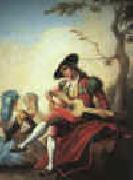
The biography of Jose del Castillo (Madrid, 14.10.1737-Madrid, 5.10.1793) shows that the artist, being in his youth one of the most appropriate painters for becoming a leader of the artistic movement of the Illustrious Absolutism, ends up performing secondary work, paintings for tapestry and some religious works of art, which was not the field where he could best display his talent. Jose del Castillo is a perfect example of how an unhappy destiny can influence on the professional life of a painter under the regime of that time. Surely the unhappy destiny, in point of fact, does not explain anything and we will have to find out the real reasons why one of the most promising careers in painting of the eighteenth century in Spain was crushed. Probably it was a combination of two unsuccessful elections, from our point of view, that excluded the figure of Jose del Castillo from the elite group of artists of that time.
|
|
 |
rameau
|
|
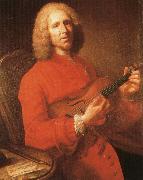
Period: Baroque (1600-1749)
Country: France
Born: September 25, 1683 in Dijon, France
Died: September 12, 1764 in Paris, France
Genres: Ballet, Chamber Music, Keyboard Music, Miscellaneous Music, Opera, Orchestral Music
|
|
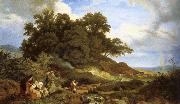 |
ralph vaughan willams
|
|
Period: Romantic (1820-1869)
Country: Germany
Born: February 03, 1809 in Hamburg, Germany
Died: November 04, 1847 in Leipzig, Germany
|
|
|
|
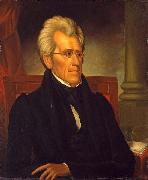 |
Ralph Eleaser Whiteside Earl
|
|
(1785-8 - Nashville, Tennessee, September 16, 1838), also known as Ralph E. W. Earl or Ralph Eleazer Whiteside Earl, was an American painter known as the "court painter" to President Andrew Jackson.
Earl was the son of portrait painter Ralph Earl and his second wife Ann Whiteside. He was born c. 1785-88, probably in New York City, and likely received his early training in portraiture from his father, whose naive style is reflected in the younger Earl's earliest works. He traveled to London in 1809, where he studied for a year with John Trumbull and was advised by Benjamin West, learning perspective, anatomy, and three-dimensional illusion. He remained in England until 1814, living with his maternal grandfather and uncle in Norwich and executing portrait commissions. He then traveled to Paris before returning to the United States in December 1815 with the intention of creating grand-scale history paintings on the European model.
As preparation for a planned project depicting the Battle of New Orleans, Earl met General Andrew Jackson and visited him at his Tennessee home, The Hermitage, in January 1817. Earl painted portraits of Jackson and his family, and married Mrs. Jackson's niece Jane Caffery on 19 May 1819. She died in childbirth in 1820.
|
|
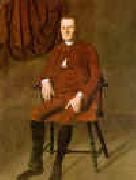 |
Ralph Earl
|
|
1751- 1801
Ralph Earl Galleries
Ralph Earl was born in either Shrewsbury or Leicester, Massachusetts. By 1774, he was working in New Haven, Connecticut as a portrait painter. In the autumn of 1774, Earl returned to Leicester, Massachusetts to marry his cousin, Sarah Gates. A few months later, their daughter was born; however, Earl left them both with Sarah's parents and returned to New Haven.
Like so many of the colonial craftsmen, Earl was self-taught, and for many years was an itinerant painter. In 1775, Earl visited Lexington and Concord, which were the sites of recent battles in the American Revolution. Together with engraver Amos Doolittle, he painted four of his most famous pictures, all battle scenes.
Although his father was a colonel in the Revolutionary army, Ralph Earl himself was a Loyalist. In 1778, he left behind his wife and daughter and escaped to England by disguising himself as the servant of British army captain John Money.
|
|
|
|
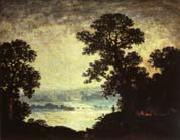 |
Ralph Blakelock
|
|
American Painter, 1847-1919
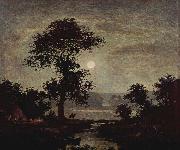
One of the most important visionary artists in late 19th-century America, he was self-taught as a painter. From 1867 he was exhibiting landscapes in the style of the Hudson River school at the National Academy of Design in New York. Rather than going abroad for advanced training, like most of his contemporaries, he spent the years 1869-72 in the western United States. Back in New York, Blakelock evolved his personal style during the 1870s and 1880s. Eschewing literal transcriptions of nature, he preferred to paint evocative moonlit landscapes such as Moonlight (Washington, DC, Corcoran Gal. A.).
|
|
 |
Ralph Barton
|
|
American Artist, 1891-1931
American Artist, 1891-1931,1921 Vanity Fair caricature; use cursor to identify figuresBarton's first caricature was of Thomas Hart Benton; his last, of Charlie Chaplin. In between he knew everyone and drew everyone in the social and culture scene of New York. Some of his most famous works were group drawings, and perhaps the most noted was a stage curtain created for a 1922 revue, depicting an "audience" of 139 faces looking back at the real theater-goers. "The effect was electrifying, and the applause was great," said another caricaturist of the era, Aline Fruhauf. He also directed a short film, Camille, described by an IMDB contributor as a "home movie version" of the Dumas novel with a cast of his many actor, artist, and other celebrity friends.This movie was made available as a bonus in a 2003 release of Chaplin's A Woman of Paris. At the height of his popularity, Barton enjoyed not only the acquaintance of the famous, but a solid and impressive income. All of this concealed a terribly unhappy life. He was beset by manic-depressive disorder, and each of his four marriages ended in divorce. A self-portrait, painted around 1925 and modeled on an el Greco.
|
|
 |
Ralph Albert Blakelock
|
|
(October 15, 1847 - August 9, 1919) was a romanticist painter from the United States.
Ralph Blakelock was born in New York City on October 15, 1847. In 1864, Blakelock entered the Free Academy of the City of New York (now known as the City College) with aspirations of becoming a physician. After his third term he opted to dismiss his formal education and left college. From 1869-71 he traveled west, extensively wandering far from known civilization and spending time among the American Indians. Largely self-taught as an artist, he began producing competent landscapes, depicting select views from his travels, as well as scenes of American Indian life. His works were exhibited in the National Academy of Design.
Moonlight, 1885, the Brooklyn MuseumIn 1877 Blakelock married Cora Rebecca Bailey; they had nine children. In art, Blakelock was a genius, yet, in business dealings and in monetary transactions he proved a failure. He found it difficult, if not crushing to maintain and support his wife and children. In desperation he found himself selling his paintings for extremely low prices, far beneath their known worth. In hopes of lifting his family from abject poverty, reportedly on the day his 9th child was born, Blakelock had offered a painting to a collector for $1000. The collector made a counter offer and after refusing the proposed sum Blakelock found himself in a bitter argument with his wife. After the domestic dispute, Blakelock returned to the patron and sold the painting for a much lesser sum. Defeated and frustrated, it is said he broke down and tore the cash into pieces. And so it was after such repeated failed business transactions that he began to suffer from extreme depression and eventually show symptoms of mental frailty. In 1899 he suffered a breakdown.
|
|
 |
Raja Ravi Varma
|
|
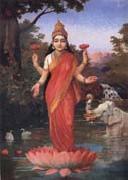
1848-1906, Indian painter. He was the most important and one of the earliest Indian artists of the 19th century to work in oil paints. The subjects of his paintings were often mythological, but they were produced in a European historicist style. He absorbed the influence of such French 19th-century academic painters as William-Adolphe Bouguereau and Gustave Boulanger and of Indian contemporary popular theatre, specializing in the type of mythological paintings that found favour with Indian rajas and British administrators. His successful exploitation (from 1894) of the lithographic reproduction of his paintings ensured, for the first time in India, that the work of an individual artist could reach a mass market.
|
|
 |
Raimundo Madrazo
|
|
(1841, Rome - 1920) was a Spanish realist painter.
He studied painting under his father, Federico de Madrazo, and at the School of the Beaux Arts in Madrid. After 1860 he lived mostly in Paris, where he studied under L??on Cogniet. His remarkable technical ability made him a highly successful portrait painter in a Salon style.
|
|
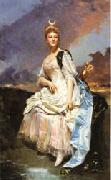 |
Raimundo de Madrazo y Garreta
|
|
Spanish realist Painter , 1841-1920
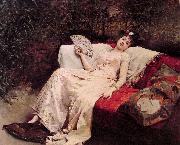
Son of Federico de Madrazo y K?ntz. Because of his ability and training with his father, Federico, in the Real Academia de S Fernando in Madrid and with L?on Cogniet in Paris, he seemed destined to continue the family tradition of academic painting. However, due to the influence of the Belgian Alfred Stevens, of his brother-in-law, Mariano Jos? Bernardo Fortuny y Marsal, and the Parisian environment, he exchanged dry historical painting (e.g. Arrival in Spain of the Body of the Apostle St James, 1858, and Ataulfo, 1860) for the preciousness of the tableautin, the small, intimate genre painting. He lived in Paris and New York and became so remote from Spanish artistic life that he and Fortuny y Marsal were the only Spanish artists not to participate in any national exhibition, and because of this the Spanish state never directly acquired their works. In 1882, with Giuseppe De Nittis, Stevens and the gallery owner Georges Petit, he co-founded the Exposition Internationale de Peinture, designed to promote foreign artists in Paris. Madrazo Garreta's most characteristic works are the female portrait and the witty and elegant genre painting, with soft, delicate tones and suggestive poses. The influence of the Rococo and of Japanese art is reflected in his painting, which expresses an exquisite aristocratic or bourgeois ideal, the illusion of a refined, sensual and superficial life. Consequently,
|
|
|
|
|
|
|
|
|
| Wholesale China Oil Painting Wholesale Oil Painting China Xiamen Portrait Reproduction on canvas Chinese Oil Painting Wholesale USA Oil Painting |
|
|
|
|
|