| |
|
Xiamen Oil Paintings, Wholesale Direct!
|
|
100% hand painted, 100% cotton canvas, 100% money back if not satisfaction. |
|
|
|
|
ART WORKS INDEX
A
B
C
D
E
F
G
H
I
J
K
L
M
N
O
P
Q
R
S
T
U
V
W
X
Y
Z
|
|
ARTISTS INDEX
A
B
C
D
E
F
G
H
I
J
K
L
M
N
O
P
Q
R
S
T
U
V
W
X
Y
Z
|
|
|
|
 |
Raimundo de Madrazo y Garreta
|
|
1841-1920
Spanish
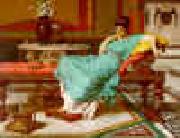
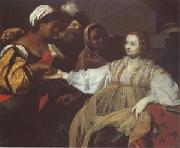
Son of Federico de Madrazo y Kentz. Because of his ability and training with his father, Federico, in the Real Academia de S Fernando in Madrid and with Leon Cogniet in Paris, he seemed destined to continue the family tradition of academic painting. However, due to the influence of the Belgian Alfred Stevens, of his brother-in-law, Mariano Jose Bernardo Fortuny y Marsal, and the Parisian environment, he exchanged dry historical painting for the preciousness of the tableautin, the small, intimate genre painting. He lived in Paris and New York and became so remote from Spanish artistic life that he and Fortuny y Marsal were the only Spanish artists not to participate in any national exhibition, and because of this the Spanish state never directly acquired their works. In 1882, with Giuseppe De Nittis, Stevens and the gallery owner Georges Petit, he co-founded the Exposition Internationale de Peinture, designed to promote foreign artists in Paris. Madrazo Garreta most characteristic works are the female portrait and the witty and elegant genre painting, with soft, delicate tones and suggestive poses. The influence of the Rococo and of Japanese art is reflected in his painting, which expresses an exquisite aristocratic or bourgeois ideal, the illusion of a refined, sensual and superficial life. Consequently, his works are also described as representing the Parisian seraglio. American collectors paid high prices for his paintings, for example Alexander Turney Stewart bought Lady with a Parrot; Carnival Festival (1878) was purchased by L. Wolfe; and Girls at the Window (1875) was bought by J. W. Vanderbilt, the last two now being in the Metropolitan Museum of Art, New York. His portraits were better received in Spain although because of collectors such as Ramen de Errazu (d 1909), the Museo del Prado has a good number of his paintings (e.g. After the Bath).
|
|
 |
ragnar sandberg
|
|
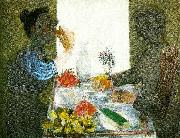
Ragnar Sandberg, född 16 februari 1902 i Sanne församling, Göteborgs och Bohus län, död 1972 i Stockholm, var en svensk konstnär.
Ragnar Sandberg var son till August och Johanna Sandberg (född Schagerholm). Familjen flyttade till Stenungsund och där de drev en diversehandel.
Sandberg studerade vid Valand för Tor Bjurström under 1920-talet. Han flyttade till Stockholm i slutet av 1940-talet och blev professor i teckning 1947 och sedermera i måleri vid Konstakademin. Sandberg ingår i den grupp av konstnärer som kallas "Göteborgskoloristerna".
Sandbergs första äktenskap ingicks med Elsa Sandberg (född Karlsson). I det äktenskapet föddes en dotter. Hans andra äktenskap ingicks med Birgit Broms Sandberg, och de har en dotter.
|
|
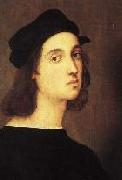 |
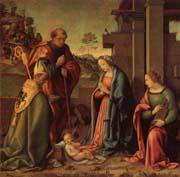
RAFFAELLO Sanzio
|
|
Italian High Renaissance Painter, 1483-1520
Italian painter and architect. As a member of Perugino's workshop, he established his mastery by 17 and began receiving important commissions. In 1504 he moved to Florence, where he executed many of his famous Madonnas; his unity of composition and suppression of inessentials is evident in The Madonna of the Goldfinch (c. 1506). Though influenced by Leonardo da Vinci's chiaroscuro and sfumato, his figure types were his own creation, with round, gentle faces that reveal human sentiments raised to a sublime serenity. In 1508 he was summoned to Rome to decorate a suite of papal chambers in the Vatican. The frescoes in the Stanza della Segnatura are probably his greatest work; the most famous, The School of Athens (1510 C 11), is a complex and magnificently ordered allegory of secular knowledge showing Greek philosophers in an architectural setting. The Madonnas he painted in Rome show him turning away from his earlier work's serenity to emphasize movement and grandeur, partly under Michelangelo's High Renaissance influence. The Sistine Madonna (1513) shows the richness of colour and new boldness of compositional invention typical of his Roman period. He became the most important portraitist in Rome, designed 10 large tapestries to hang in the Sistine Chapel, designed a church and a chapel, assumed the direction of work on St. Peter's Basilica at the death of Donato Bramante,
|
|
|
|
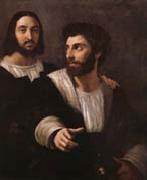 |
Raffaello
|
|
Italian painter , 1483-1520
was an Italian painter and architect of the High Renaissance, celebrated for the perfection and grace of his paintings and drawings. Together with Michelangelo and Leonardo da Vinci, he forms the traditional trinity of great masters of that period. Raphael was enormously productive, running an unusually large workshop, and, despite his early death at thirty-seven, a large body of his work remains, especially in the Vatican, whose frescoed Raphael Rooms were the central, and the largest, work of his career, although unfinished at his death. After his early years in Rome, much of his work was designed by him and executed largely by the workshop from his drawings, with considerable loss of quality. He was extremely influential in his lifetime, though outside Rome his work was mostly known from his collaborative printmaking. After his death, the influence of his great rival Michelangelo was more widespread until the 18th and 19th centuries, when Raphael's more serene and harmonious qualities were again regarded as the highest models.
|
|
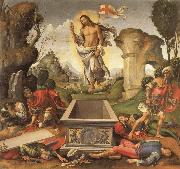 |
Raffaellino del garbo
|
|
Italian Early Renaissance Painter , ca.1466-1524
Italian painter and draughtsman. According to Vasari, he began as the most gifted assistant of Filippino Lippi and the most promising painter of the new generation but never fulfilled expectations, deteriorating into mediocrity and worse. Raffaellino's first known work is the frescoed vault of a small antechamber off Filippino Lippi's Carafa Chapel in S Maria sopra Minerva, Rome, uncovered during restoration in the 1960s. It was decorated with pagan themes, to Filippino's designs, apparently after the main chapel was completed in 1493. Filippino's influence is evident in the all'antica detail and animated figure style, to which Raffaellino brought a youthful freshness and charm. Vasari, in his account of the vault, likened it to an illuminator's work. It has been suggested that Raffaellino remained in Rome and worked with Bernardino Pinturicchio in the Borgia apartments in the Vatican, where some frescoes of 1495 show stylistic affinities with Raffaellino's work in S Maria sopra Minerva.
|
|
|
|
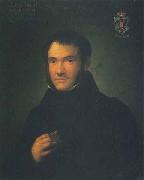 |
Rafal Hadziewicz
|
|
(13 October 1803 - 7 September 1883) was a Polish historical painter.
Born in Zamch, Hadziewicz attended art school from 1816 to 1822. In 1822 he studied at Warsaw University under Antoni Brodowski. After getting a scholarship he traveled to Dresden in 1829 and later to Paris, where he studied at a prominent French School of Painting. In 1831 he continued his studies in Rome. He stayed in Rome in 1833 for self-study of the masters. At this time he created many well-received sketches.
In 1834 he went to Krakew and painted icons for several Orthodox churches there. In 1839 he left for Moscow, where he served in the Department of Fine Art and Mathematics until 1844. In 1844 he moved back to Warsaw, where he served as a professor in the Warsaw School of Art. In 1871, near the end of his life, he was transferred to a university in Kielce, where he died.
Hadziewicz painted many religious paintings and portraits but was best known for historic compositions, which were often compared to art of the Italian Renaissance and European Baroque.
|
|
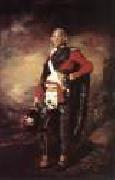 |
RAEBURN, Sir Henry
|
|
Scottish Romantic Painter, 1756-1823
Scottish painter. He is perhaps the best known of all Scottish painters, with a critical reputation rivalling that of Allan Ramsay. He was almost exclusively a portrait painter, and his work did much to define Scottish society in a period of immense vigour and intellectual distinction. The demand for his work was sufficient to sustain a career wholly in Scotland, although he occasionally regretted his lack of first-hand knowledge of portrait painting in London. His working life, which was largely confined to Edinburgh
|
|
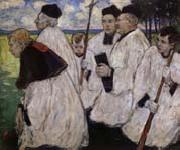 |
Rae Iso
|
|
Melbourn 1860-Brighton 1940
|
|
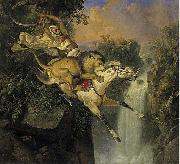 |
Raden Saleh
|
|
(1807 or 1811 - April 23, 1880) is one of the best known painters from Indonesia and a pioneer of modern Indonesian art.
He was considered to be the first modern artist from the Dutch East Indies (now Indonesia), and his paintings corresponded with nineteenth-century romanticism which was popular in Europe at the time. He also expressed his cultural roots and inventiveness in his work.
Raden Saleh, was born into a noble Javanese family. He was grandson of Sayyid Abdullah Bustaman from his mother's side. His father was Sayyid Husen bin Alwi bin Awal bin Yahya, an indonesian of arab descent.
|
|
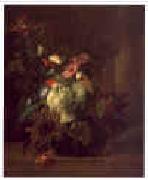 |
Rachel Ruysch
|
|
Dutch
1664-1750
Rachel Ruysch (June 3, 1664 ?? Amsterdam, August 12, 1750) was a Dutch artist who specialized in still-life paintings of flowers.
She was born in The Hague, but moved to Amsterdam when she was three. Her father Frederik Ruysch, a famous anatomist, and botanist, was appointed a professor there. He gathered a huge collection of rarities in his house. She assisted her father decorating the prepared specimen in a liquor balsamicum with flowers and lace. At fifteen Ruysch was apprenticed to Willem van Aelst, a prominent Delft painter, known for his flower paintings. In 1693, she married a portrait painter, Juriaen Pool (1666-1745), with whom she had ten children. Her sister Pieternel was married to Jan Munnicks, a young man who drew flowers in the Hortus Botanicus Amsterdam.
In 1701 Ruysch was inducted into the painters' guild in The Hague. Several years later Ruysch was invited to work for the court in D??sseldorf and serve as court painter to Johann Wilhelm, Elector Palatine. She remained working for him and his wife from 1708 until the prince's death in 1716. Also Jan Weenix and Adriaen van der Werff were invited to deliver paintings, after Eglon van der Neer died. In 1723 she won the lottery. Ruysch kept painting for her prominent clients.
Ruysch lived eighty-five years and her dated works establish that she painted from the time she was a young woman until she was an octogenarian. About a hundred paintings by her are known. The background of the paintings are usually dark. Ruysch was also noted for her paintings of detailed and realistic crystal vases.
|
|
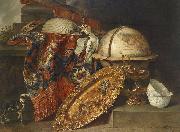 |
R. v. Bohnlich
|
|
R v Bohnlich (fl.c.1880)
19th Century Paintings and Watercolours
|
|
|
|
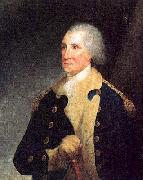 |
Pine, Robert Edge
|
|
American, 1720-88
English painter, active also in America. His father, John Pine (1691-1756), was a well-known engraver and printseller of whom William Hogarth painted a portrait (c. 1755; Fredericton, NB, Beaverbrook A.G.). Robert Edge Pine was initially considered to have the potential to rival Joshua Reynolds as a portrait painter, a promise derived from such works as the full-length portrait of George II (1759; Audley End, Essex), painted without a sitting being granted him by the King. In 1760 he won a premium at the Society of Arts, London, for a history painting, the Surrender of Calais to Edward III, also known as the Burghers of Calais (untraced), which was engraved in 1762 by Fran?ois Germain Aliamet (1734-88), and another in 1763 for Canute the Great Reproving his Courtiers for their Impious Flattery (untraced), also engraved by Aliamet. Pine was not invited to become a founder-member of the Royal Academy in 1768, probably because of his radical politics; that year he painted a portrait of the political agitator John Wilkes (London, Westminster Hall). In 1772 he left the Society of Arts following a quarrel over its choice of directors; he moved to Bath, where he joined his brother, Simon Pine (d Aug 1772), a painter of miniatures. Their sister was married to the landscape painter Alexander Cozens. While at Bath Pine painted his most ambitious family group,
|
|
|
|
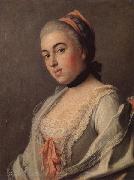 |
Pietro Antonio Rotari
|
|
Italian painter , (b. 1707, Verona, d. 1762, St. Petersburg)
Italian painter. His artistic career began as a youthful distraction, but his talent quickly became apparent, and he entered the studio of Antonio Balestra in Verona, remaining there until he was 18. He spent the years 1725-7 in Venice and then moved c. 1728 to Rome, where he stayed for four years as a student of Francesco Trevisani. Between 1731 and 1734 he studied with Francesco Solimena in Naples before returning to Verona, where he set up his own studio and school. His most notable early independent works are multi-figured altarpieces (e.g. the Four Martyrs, 1745; Verona, church of the Ospedale di S Giacomo), which emulate 17th-century Roman and Neapolitan works. However, he also studied the smaller, more intimate paintings of Roman Baroque artists, and these influenced his later works. He fell victim to the wanderlust that appears to have been endemic to 18th-century Venetian painters, and c. 1751 he travelled to Vienna, where he was able to study works by Jean-Etienne Liotard, whose clean pictorial smoothness impressed him. He later moved to Dresden
|
|
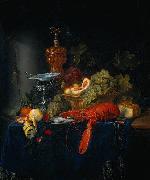 |
Pieter de Ring
|
|
(1615/1620 - 22 September 1660, Leiden) was a Dutch Golden Age painter of still lifes. became famous for his opulent, flashy still lifes or banquet pieces with fruit, a lobster, a goblet, shrimps, oysters, a rug and Chinese porcelain. His signature is often a painted ring or with the Latinised form of his name, P.Ab.Annulo.
De Ring was born either in Leiden, or in Ypres in Flanders, but there is no trace of his birth in the Leiden archives, and the Ypres Archives were destroyed in August 1914. Pieter de Ring started as a mason and painted still lifes in the evening. When the hall was filled with paintings he became a pupil of Jan Davidsz. de Heem, until 1635 living in Leiden. His father Daniel died in 1648; in 1657 his mother lived in Amsterdam. De Ring himself lived in a house at Hogewoerd.
There are no records in the Leiden Archive on his marriage or children. He appears not to have bought a house there nor wrote a will. What is known is that he became one of the founders a member and of the Guild of St. Luke in 1648, De Ring was buried in the Pieterskerk, Leiden on 22 September 1660 and taken to church from a house in the Nonnensteeg. If he had his studio there he probably had a view on the Leiden Academy building. If he lived on the east side of the alley he had a beautiful view on the Hortus Botanicus of Leiden, the work of Clusius.
|
|
|
|
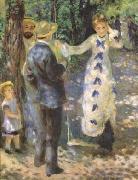 |
Pierre-Auguste Renoir
|
|
French Impressionist Painter, 1841-1919
French painter, printmaker and sculptor. He was one of the founders and leading exponents of IMPRESSIONISM from the late 1860s, producing some of the movement's most famous images of carefree leisure. He broke with his Impressionist colleagues to exhibit at the Salon from 1878, and from c. 1884 he adopted a more linear style indebted to the Old Masters.
His critical reputation has suffered from the many minor works he produced during his later years.
|
|
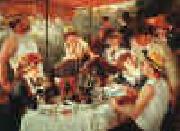 |
Pierre Renoir
|
|
French Impressionist Painter, 1841-1919
Pierre-Auguste Renoir (February 25, 1841?CDecember 3, 1919) was a French artist who was a leading painter in the development of the Impressionist style. As a celebrator of beauty, and especially feminine sensuality, it has been said that "Renoir is the final representative of a tradition which runs directly from Rubens to Watteau".
Renoir's paintings are notable for their vibrant light and saturated color, most often focusing on people in intimate and candid compositions. The female nude was one of his primary subjects. In characteristic Impressionist style, Renoir suggested the details of a scene through freely brushed touches of color, so that his figures softly fuse with one another and their surroundings.
His initial paintings show the influence of the colorism of Eugene Delacroix and the luminosity of Camille Corot. He also admired the realism of Gustave Courbet and Edouard Manet, and his early work resembles theirs in his use of black as a color. As well, Renoir admired Edgar Degas' sense of movement. Another painter Renoir greatly admired was the 18th century master François Boucher.
A fine example of Renoir's early work, and evidence of the influence of Courbet's realism, is Diana, 1867. Ostensibly a mythological subject, the painting is a naturalistic studio work, the figure carefully observed, solidly modeled, and superimposed upon a contrived landscape. If the work is still a 'student' piece, already Renoir's heightened personal response to female sensuality is present. The model was Lise Tr??hot, then the artist's mistress and inspiration for a number of paintings.
In the late 1860s, through the practice of painting light and water en plein air (in the open air), he and his friend Claude Monet discovered that the color of shadows is not brown or black, but the reflected color of the objects surrounding them. Several pairs of paintings exist in which Renoir and Monet, working side-by-side, depicted the same scenes (La Grenouill??re, 1869).
One of the best known Impressionist works is Renoir's 1876 Dance at Le Moulin de la Galette (Le Bal au Moulin de la Galette). The painting depicts an open-air scene, crowded with people, at a popular dance garden on the Butte Montmartre, close to where he lived.
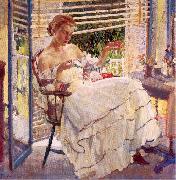
On the Terrace, oil on canvas, 1881, Art Institute of ChicagoThe works of his early maturity were typically Impressionist snapshots of real life, full of sparkling colour and light. By the mid 1880s, however, he had broken with the movement to apply a more disciplined, formal technique to portraits and figure paintings, particularly of women, such as The Bathers, which was created during 1884-87. It was a trip to Italy in 1881, when he saw works by Raphael and other Renaissance masters, that convinced him that he was on the wrong path, and for the next several years he painted in a more severe style, in an attempt to return to classicism. This is sometimes called his "Ingres period", as he concentrated on his drawing and emphasized the outlines of figures.
After 1890, however, he changed direction again, returning to the use of thinly brushed color which dissolved outlines as in his earlier work. From this period onward he concentrated especially on monumental nudes and domestic scenes, fine examples of which are Girls at the Piano, 1892, and Grandes Baigneuses, 1918-19. The latter painting is the most typical and successful of Renoir's late, abundantly fleshed nudes.
A prolific artist, he made several thousand paintings. The warm sensuality of Renoir's style made his paintings some of the most well-known and frequently-reproduced works in the history of art..
|
|
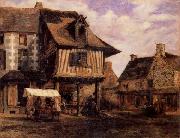 |
Pierre etienne theodore rousseau
|
|
Paris 1812-Barbizon 1867
French painter of the Barbizon school, was born in Paris, of a bourgeois family which included one or two artists.At first he received a business training, but soon displayed aptitude for painting. Although his father regretted the decision at first, he became reconciled to his son leaving business, and throughout the artist's career (for he survived his son) was a sympathizer with him in all his conflicts with the Paris Salon authorities. Theodore Rousseau shared the difficulties of the romantic painters of 1830 in securing for their pictures a place in the annual Paris exhibition. The whole influence of the classically trained artists was against them, and not until 1848 was Rousseau adequately presented to the public. He had exhibited one or two unimportant works in the Salon of 1831 and 1834, but in 1836 his great work "La descente des vaches" was rejected by the vote of the classic painters; and from then until after the revolution of 1848 he was persistently refused. He was not without champions in the press, and under the title of "le grand refus" he became known through the writings of Thor, the critic who afterwards resided in England and wrote under the name of Burger. During these years of artistic exile Rousseau produced some of his finest pictures: "The Chestnut Avenue", "The Marsh in the Landes" (now in the Louvre), "Hoar-Frost" (now in America); and in 1851, after the reorganization of the Salon in 1848, he exhibited his masterpiece, "The Edge of the Forest" (also in the Louvre), a picture similar in treatment to, but slightly varied in subject from, the composition called "A Glade in the Forest of Fontainebleau", in the Wallace Collection at Hertford House, London. Up to this period Rousseau had lived only occasionally at Barbizon, but in 1848 he took up his residence in the forest village, and spent most of his remaining days in the vicinity. He was now at the height of his artistic power, and was able to obtain fair sums for his pictures (but only about one-tenth of their value thirty years after his death), and his circle of admirers increased. He was still ignored by the authorities, for while Narcisse Virgilio Diaz was made Chevalier of the Legion of Honour in 1851, Rousseau was left undecorated at this time, but was nominated shortly afterwards. At the Exposition Universelle of 1853, where all Rousseau's rejected pictures of the previous twenty years were gathered together, his works were acknowledged to form one of the finest of the many splendid groups there exhibited. But during his lifetime Rousseau never really conquered French taste, and after an unsuccessful sale of his works by auction in 1861,
|
|
|
|
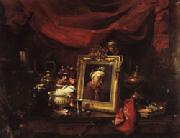 |
Philippe Rousseau
|
|
Paris 1816 - Acquigny 1887.
French Painter.
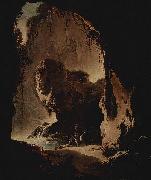
French Painter. French painter. He may have received his artistic training in the studios of Gros and Jean-Victor Bertin, since he credited them as his masters when he exhibited at the Salon. He began exhibiting in 1834 with a View of Normandy (untraced) and for the next six Salons he exhibited landscapes. In 1844 he began to show still-lifes. In 1845 he was awarded a third-class medal, and in 1847 his still-lifes were admired by Th?ophile Thor?, who was one of the earliest critics to recognize Rousseau's debt to Chardin. This influence became the subject for his 1867 Salon entry, Chardin and his Models (untraced, see McCoubrey, no. 15). The work is far grander and more cluttered in its conception than most still-lifes by Chardin and alludes to the master by faithfully reproducing some of his favourite objects within a traditional table-top format rather than by an analysis of his compositional devices.
|
|
 |
Philipp Peter Roos
|
|
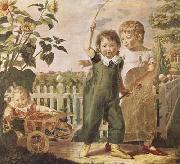
(later surnamed Rosa di Tivoli; 1651-1706), was a German Baroque painter.
He was born in Frankfurt am Main and learned to paint from his father, the landscape painter Johann Heinrich Roos.He was the brother of the painter Johann Melchior Roos, who briefly worked with him in Italy. As a young man, he painted in the style of his father. He was called to paint for Charles I, Landgrave of Hesse-Kassel, who liked him so much, he gave him a sum of money to travel to Rome with,which he did in 1677. He became a member of the Bentvueghels with the nickname "Mercury" and earned money making small paintings and sketches for tourists.
He fell in love with the daughter of Giacinto Brandi, whom he later married. They lived in a large house in Tivoli, near Rome, whence his surname. In Tivoli, they kept a menagerie of various animals so Roos could draw from live poses. This house was called the "Noah's Ark" by their friends. In his Italian style, he painted life-size figures and animals in a broad manner and a heavy brown tone.
|
|
 |
Philipp Otto Runge
|
|
German Romantic Painter, 1777-1810
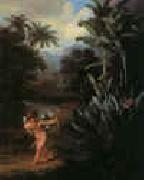
..German painter, draughtsman and theorist. He stands alongside Caspar David Friedrich as a leading figure in German Romantic painting even though his early death restricted his oeuvre to relatively few stages of development. The enduring prominence of philosophical and theoretical concerns suggests that further work would have contributed to the history of ideas as well as to that of art. Runge's greatest influence was on later, largely 20th-century artists and thinkers rather than on his immediate contemporaries. While 19th-century developments certainly bore out Runge's claim for a new, symbolic role for landscape,
|
|
 |
Philip Reinagle
|
|
1802-1835
British
Philip Reinagle Gallery
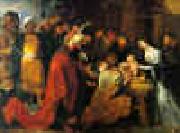
Philip Reinagle entered the schools of the Royal Academy in 1769, and afterwards became a pupil of Allan Ramsay (1713-1784), whom he assisted in the numerous portraits of George III and Queen Charlotte. He exhibited first at the Royal Academy in 1773, sending portraits almost exclusively until 1785, when the monotonous work of producing replicas of royal portraits appears to have given him a distaste for portraiture, and to have led him to abandon it for animal painting. He became very successful in his treatment of sporting dogs, especially spaniels, of birds, and of dead game. In 1787, however, he sent to the academy a 'View taken from Brackendale Hill, Norfolk,' and from that time his exhibited works were chiefly landscapes. He was elected an associate of the Royal Academy in 1787, but did not become an academician until 1812, when he presented as his diploma picture 'An Eagle and a Vulture disputing with a Hyaena'. He likewise exhibited frequently at the British Institution.
Reinagle was also an accomplished copyist of the Dutch masters, and his reproductions of the cattle-pieces and landscapes of Paul Potter, Ruysdael, Hobbema, Berchem, Wouwerman, Adnaan van de Velde, Karel Dujardin, and others have often been passed off as originals. He also made some of the drawings for Robert John Thornton's New Illustration of the Sexual System of Linnaeus, 1799-1807, and for his Philosophy of Botany, 1809-10 ; but his best drawings for book illustration were those of dogs for William Taplin's Sportsman's Cabinet, 1803, which were admirably engraved by John Scott.[1]
Reinagle died at 5 York Place, Chelsea, London, on 27 Nov. 1833, aged 84. A drawing by him, 'Fox-hunting the Death', is in the collection of the Victoria and Albert Museum. Reinagle's daughter Frances Arabella was married to John Levett-Yeats, grandson of the English merchant and planter Francis Levett. His son, Ramsey Richard Reingate, was also an artist, and followed his father's style.
|
|
 |
Peter Paul Rubens
|
|
Flemish Baroque Era Painter, 1577-1640
Peter Paul Rubens (June 28, 1577 ?C May 30, 1640) was a prolific seventeenth-century Flemish Baroque painter, and a proponent of an exuberant Baroque style that emphasized movement, color, and sensuality. He is well-known for his Counter-Reformation altarpieces, portraits, landscapes, and history paintings of mythological and allegorical subjects.
In addition to running a large studio in Antwerp which produced paintings popular with nobility and art collectors throughout Europe, Rubens was a classically-educated humanist scholar, art collector, and diplomat who was knighted by both Philip IV, king of Spain, and Charles I, king of England.
Rubens was a prolific artist. His commissioned works were mostly religious subjects, "history" paintings, which included mythological subjects, and hunt scenes. He painted portraits, especially of friends, and self-portraits, and in later life painted several landscapes. Rubens designed tapestries and prints, as well as his own house. He also oversaw the ephemeral decorations of the Joyous Entry into Antwerp by the Cardinal-Infante Ferdinand in 1635.
His drawings are mostly extremely forceful but not detailed; he also made great use of oil sketches as preparatory studies. He was one of the last major artists to make consistent use of wooden panels as a support medium, even for very large works, but he used canvas as well, especially when the work needed to be sent a long distance. For altarpieces he sometimes painted on slate to reduce reflection problems.
His fondness of painting full-figured women gave rise to the terms 'Rubensian' or 'Rubenesque' for plus-sized women. The term 'Rubensiaans' is also commonly used in Dutch to denote such women.
|
|
 |
Peter F Rothermel
|
|
1817-1895
Peter F Rothermel Gallery
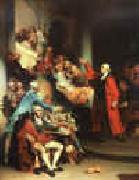
Rothermel was born in Nescopeck, Pennsylvania in 1817, although some date his birth earlier in 1813 or 1814. He studied under John R. Smith and Bass Otis before studying in various places in Europe. He specialized in portraits and dramatic historical paintings. He served as Vice President of the Artists' Fund Society in 1844 and as Director of the Pennsylvania Academy of Fine Arts from 1847 to 1855.
His most famous paintings include Patrick Henry before the Virginia House of Burgesses (1851) and a massive oil painting of the Battle of Gettysburg that hangs in the State Museum of Pennsylvania. This latter work was commissioned by Gettysburg lawyer David McConaughy. Another of his more popular historical works is Columbus Before the Queen, painted in 1844.
|
|
|
|
 |
Peeter Danckers de Rij
|
|
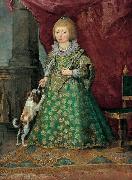
Pieter, Peeter, or Peter Danckerts de Rij, Dankers de Ry, or Peteris Dankersas (1605, Amsterdam - 9 August 1661, Rudnik) was a Dutch Golden Age painter.
He was the son of Cornelis Danckerts de Ry, member of a large family of printers, painters and engravers.
Adam Kazanowski - by Peeter Danckers de Rij.
Example of Dankerts-Sandrart collaboration in print of PC Hooft. This 1642 engraving was painted by Sandrart, etched by Reinier van Persijn, and printed by Danckerts. The poem in Latin at the bottom was written by Caspar Barlaeus.Cornelis is mentioned in Houbraken's Schouburg as being one of the many teachers of Joachim von Sandrart in 1640-41, though considering Sandrart's age and experience (he had just returned to the North from his Grand Tour to Italy), this was more of a collaboration. Since Filippo Baldinucci later wrote a biograhical sketch on Pietro Danckerse de Ry in his list of artists called the Notizie, it is possible that Danckerts visited Italy at some time. In any case Sandrart engraved some of Peter's paintings after this period. Peter was active until 1640 in Amsterdam, and then he moved to Warsaw, Danzig, and Vilnius in the Polish-Lithuanian Commonwealth. He was active in Poland as the court painter and architect of the Polish King Władysław IV Vasa. According to Houbraken a poem was written in his honor that applauds his work in Poland. He died as the result of a highway robbery in the Redininkai Forest near Vilnius, Lithuania.
|
|
 |
Peale, Raphaelle
|
|
American Painter, 1774-1825
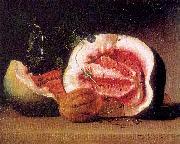
Painter, son of Charles Willson Peale. His mother was Rachel Brewer Peale. He studied painting with his father and assisted him in the museum. Raphaelle began to paint portraits professionally in 1794, but poor patronage in Philadelphia forced him to travel in the South and New England, taking silhouettes with the physiognotrace and painting portraits in oil and miniature. From about 1815 onwards, bouts of alcoholism and gout inhibited his progress. He turned to painting still-lifes, but these sold for small amounts.
|
|
|
|
 |
Paul Revere
|
|
American Sculptor and Engraver, 1735-1818
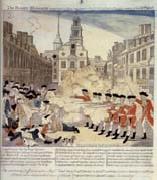
was an American silversmith and a patriot in the American Revolution. Because he was glorified after his death for his role as a messenger in the battles of Lexington and Concord, Revere's name and his "midnight ride" are well-known in the United States as a patriotic symbol. In his lifetime, Revere was a prosperous and prominent Boston craftsman, who helped organize an intelligence and alarm system to keep watch on the British military. Revere later served as an officer in one of the most disastrous campaigns of the American Revolutionary War, a role for which he was later exonerated. After the war, he was early to recognize the potential for large-scale manufacturing of metal.
|
|
 |
Paul Raud
|
|
(22 October 1865 in Kirikukela, Viru-Jaagupi Parish C 22 November 1930 in Tallinn) was an Estonian painter. The twin brother of painter Kristjan Raud, he studied in Desseldorf beginning in 1886, becoming influenced by the work of Eduard Gebhardt. After his return to Estonia, he painted mainly portrait commissions for some time, before traveling with his brother and Amandus Adamson to the islands of Muhu and Pakri in 1896. His works of this period are reminiscent of those of Max Liebermann. In 1899 he returned to work in Germany, taking on some of the stylistic trappings of Impressionism; this, coupled with time spent working with Ilya Repin, influenced his later style. Later in his career, most especially during and after World War I, he began to teach, from 1915 working as a drawing instructor at the Tallinn Institute of Commerce and from 1923 at the State School of Industrial Art in Tallinn.
|
|
 |
Paul Ranson
|
|
French Nabi Painter, 1864-1909
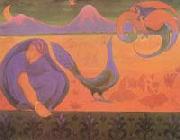
French painter and designer. The son of a successful local politician, Ranson was encouraged from the outset in his artistic ambitions. He studied at the Ecoles des Arts D?coratifs in Limoges and Paris but transferred in 1886 to the Acad?mie Julian. There he met Paul S?rusier and in 1888 became one of the original members of the group known as the NABIS. From 1890 onwards, Ranson and his wife France hosted Saturday afternoon meetings of the Nabis in their apartment in the Boulevard du Montparnasse, jokingly referred to as 'Le Temple'. Ranson acted as linchpin for the sometimes dispersed group. Noted for his enthusiasm and wit and for his keen interests in philosophy, theosophy and theatre, he brought an element of esoteric ritual to their activities. For example he introduced the secret Nabi language and the nicknames used familiarly within the group.
|
|
 |
Pandolfo Reschi
|
|
(b Gdansk, c. 1640; d Florence, 1696).
Polish painter, active in Italy
|
|
|
|
|
|
|
|
 |
Odilon Redon
|
|
French Symbolist Painter, 1840-1916
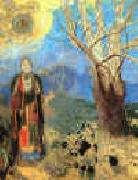
Bertrand-Jean Redon, better known as Odilon Redon (April 20, 1840 ?C July 6, 1916) was a Symbolist painter and printmaker, born in Bordeaux, Aquitaine, France. Odilon was a nickname derived from his mother, Odile.
Redon started drawing as a young child, and at the age of 10 he was awarded a drawing prize at school. At age 15, he began formal study in drawing but on the insistence of his father he switched to architecture. His failure to pass the entrance exams at Paris?? Ecole des Beaux-Arts ended any plans for a career as an architect, although he would later study there under Jean-L??on Gerôme.
Back home in his native Bordeaux, he took up sculpture, and Rodolphe Bresdin instructed him in etching and lithography. However, his artistic career was interrupted in 1870 when he joined the army to serve in the Franco-Prussian War.
At the end of the war, he moved to Paris, working almost exclusively in charcoal and lithography. It would not be until 1878 that his work gained any recognition with Guardian Spirit of the Waters, and he published his first album of lithographs, titled Dans le R??ve, in 1879. Still, Redon remained relatively unknown until the appearance in 1884 of a cult novel by Joris-Karl Huysmans titled, À rebours (Against Nature). The story featured a decadent aristocrat who collected Redon's drawings.
In the 1890s, he began to use pastel and oils, which dominated his works for the rest of his life. In 1899, he exhibited with the Nabis at Durand-Ruel's. In 1903 he was awarded the Legion of Honor. His popularity increased when a catalogue of etchings and lithographs was published by Andr?? Mellerio in 1913 and that same year, he was given the largest single representation at the New York Armory Show. In 1923 Mellerio published: Odilon Redon: Peintre Dessinateur et Graveur. An archive of Mellerio's papers is held by the Ryerson & Burnham Libraries at the Art Institute of Chicago.
In 2005 the Museum of Modern Art launched an exhibition entitled "Beyond The Visible", a comprehensive overview of Redon's work showcasing more than 100 paintings, drawings, prints and books from The Ian Woodner Family Collection. The exhibition ran from October 30, 2005 to January 23, 2006.
|
|
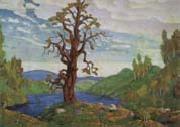 |
Nikolai Roerich
|
|
Russian, 1874-1947
Russian painter, stage designer and founder of cultural institutions. The son of a lawyer of Scandinavian descent, he graduated from the studio of the landscape painter Arkhip Kuindzhi at the Academy of Fine Arts (1897) and from the faculty of law at the University of St Petersburg (1898). He then studied in Paris with the history painter Fernand Cormon (1900). Roerich had wide interests and made an important contribution to Russian culture: he lectured at the Institute of Archaeology (1898); he became secretary of the Society for the Encouragement of the Arts (1901) and director of its school (1906); and he was the first chairman of the World of Art (Rus. Mir Iskusstva) Society (1910). The first volume of his collected cultural writings was published in Moscow in 1914. As a painter he exhibited with the Academy from 1897, WORLD OF ART from 1902, the Vienna Secession c. 1905 and the Salon d'Automne in Paris in 1906. From c. 1903 he was a leading member of the artists' colony at TALASHKINO, where he designed mosaics, friezes, murals and furniture. As a stage designer in Russia, he worked between 1907 and 1915 for such directors as Nikolay Yevreinov (1879-1953),
|
|
|
|
|
|
|
|
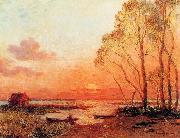 |
Nicholas Roerich
|
|
(Russian: ,October 9, 1874 - December 13, 1947), was a Russian mystic, painter, philosopher, scientist, writer, traveler, and public figure. A prolific artist, he created thousands of paintings (many of them are exhibited in well-known museums of the world) and about 30 literary works. Roerich was an author and initiator of an international pact for the protection of artistic and academic institutions and historical sites (Roerich's Pact) and a founder of an international movement for the defence of culture. Roerich earned several nominations for the Nobel Prize.
|
|
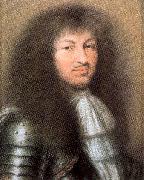 |
Nanteuil, Robert
|
|
French, 1623-1678
French engraver, draughtsman and pastellist. He was the son of Lancelot Nanteuil, a wool merchant, and submitted his thesis in philosophy, for which he engraved the headpiece, at the Jesuit College of Reims, in 1645. He went on to work in the studio of Nicolas Regnesson, whose sister he married in 1646, before moving to Paris in 1647. His early work mainly consisted of portrait drawings in black lead on parchment (e.g. Paris, Louvre), and he continued to draw throughout his career. He took 155 of his 221 portraits directly from life. His drawing style was influenced by Philippe de Champaigne, and he based his engraving technique on the work of Claude Mellan and Jean Morin.
|
|
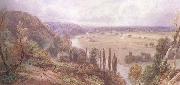 |
Myles Birket Foster,RWS
|
|
1825-1899
English painter, illustrator and collector. After a short and unsatisfactory period working in the family brewing business, he was able to convince his Quaker parents to allow him to pursue a career in art. He was apprenticed to a wood-engraver, Ebenezer Landells (1808-60), who recognized Foster's talent for drawing and set him to work designing blocks for engraving. Foster also provided designs for Punch and the Illustrated London News. In 1846 he set up on his own as an illustrator. The rustic vignettes of the seasons that he contributed to the Illustrated London News and its counterpart, the Illustrated London Almanack, established him as a charming interpreter of the English countryside and rural life and led to his employment illustrating similar themes in other publications. During the 1850s his designs were much in demand; he was called upon to illustrate volumes of the poetry of Longfellow, Sir Walter Scott and John Milton.
|
|
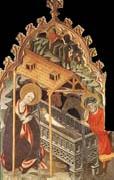 |
MUR, Ramon de
|
|
Catalan painter
active in first half of 14th century in Tarragona
|
|
|
|
|
|
|
|
|
|
|
| Wholesale China Oil Painting Wholesale Oil Painting China Xiamen Portrait Reproduction on canvas Chinese Oil Painting Wholesale USA Oil Painting |
|
|
|
|
|